1 John 2:21

Greek (Tischendorf 8th ed.) 1 John 2:21 appears in the Greek New Testament. The text above is from the Tischendorf 8th edition. Each word links to its Strong’s number and a concise gloss. Click any word for its full Thayer’s Greek Lexicon entry.
Download image
Cite this verse

1 John 2:21 (World English Bible). Public Domain. Lemma interlinear Bible study tool, https://lemma.gebible.app/v/1-john/2/21.

Show BibTeX & RIS
BibTeX
RIS
English Translation
I have not written to you because you don't know the truth, but because you know it, and because no lie is of the truth.
World English Bible · Public Domain
Download a study sheet

One document with this verse’s original text, its word-by-word gloss line, the meaning frame, cross-references with their text, attributed commentary, and full source and license credits — printable, and it pastes into notes with its structure intact.

This verse Autodidact and up

Study sheet (.html) Plain text (.txt)

A passage Seminary Student

Up to 50 verses in one chapter. A passage sheet keeps up to 6 commentary sources and 12 cross-references per verse, in the order this page ranks them, and says so on the sheet whenever that leaves anything out. Ask for a single verse and you get the Autodidact verse sheet above.

Everything on this page stays free to read, with no account — the sheet is a download of what is already on screen, not access to it.

Want to remove ads? Support Godless Engineer
Compare translations 3

The same verse in 3 English versions, stacked beneath the original-language interlinear above. Click any original word for its lexicon entry.

Each is an independent rendering of the whole verse — the interlinear is not word-aligned to these translations.

Highlighted words mark where these versions differ — a whole-verse word diff, not a word-by-word alignment.

  • World English Bible Public Domain
    I have not written to you because you don't know the truth, but because you know it, and because no lie is of the truth.
  • King James Version Public Domain
    I have not written unto you because ye know not the truth, but because ye know it, and that no lie is of the truth.
  • unfoldingWord Literal Text CC BY-SA 4.0
    I have not written to you because you do not know the truth, but because you do know it and that every lie is not from the truth.

unfoldingWord Literal Text — © unfoldingWord, licensed CC BY-SA 4.0. Word-aligned USFM3 via Door43 (git.door43.org/unfoldingWord/en_ult).

Versions to compare (up to 4)

3 of 4 selected

Show all 19 translations

Every available English version of this verse, each an independent rendering of the whole verse.

  • World English Bible Public Domain
    I have not written to you because you don't know the truth, but because you know it, and because no lie is of the truth.
  • Berean Standard Bible Public Domain
    I have not written to you because you lack knowledge of the truth, but because you have it, and because no lie comes from the truth.
  • Majority Standard Bible Public Domain
    I have not written to you because you lack knowledge of the truth, but because you have it, and because no lie comes from the truth.
  • King James Version Public Domain
    I have not written unto you because ye know not the truth, but because ye know it, and that no lie is of the truth.
  • American Standard Version (1901) Public Domain
    I have not written unto you because ye know not the truth, but because ye know it, and because no lie is of the truth.
  • Revised Version (1885) Public Domain
    I have not written unto you because ye know not the truth, but because ye know it, and because no lie is of the truth.
  • Geneva Bible (1599) Public Domain
    I haue not written vnto you, because ye knowe not the trueth: but because ye knowe it, and that no lie is of the trueth.
  • Douay-Rheims (1899) Public Domain
    I have not written to you as to them that know not the truth, but as to them that know it: and that no lie is of the truth.
  • Young's Literal Translation Public Domain
    I did not write to you because ye have not known the truth, but because ye have known it, and because no lie is of the truth.
  • Literal Standard Version CC BY-SA 4.0
    I did not write to you because you have not known the truth, but because you have known it, and because no lie is of the truth.
  • Unlocked Literal Bible CC BY-SA 4.0
    I did not write to you because you do not know the truth, but because you know it and because no lie is from the truth.
  • unfoldingWord Literal Text CC BY-SA 4.0
    I have not written to you because you do not know the truth, but because you do know it and that every lie is not from the truth.
  • Darby Bible Public Domain
    I have not written to you because ye do not know the truth, but because ye know it, and that no lie is of the truth.
  • World Messianic Bible Public Domain
    I have not written to you because you don’t know the truth, but because you know it, and because no lie is of the truth.
  • Webster's Bible Public Domain
    I have not written to you because ye know not the truth, but because ye know it, and that no lie is of the truth.
  • Free Bible Version CC BY-SA 4.0
    I'm not writing because you don't know the truth, but because you do know it, and because no lie comes from the truth.
  • Bible in Basic English Public Domain
    I have not sent you this letter because you have no knowledge of what is true, but because you have knowledge, and because that which is false has nothing in common with that which is true.
  • Text-Critical English NT CC BY 4.0
    I have not written to you because you do not know the truth, but because you know it, and because no lie is of the truth.
  • Tyndale New Testament (1534) Public Domain
    I wrote not vnto you as though ye knewe not the trueth: but as though ye knewe it and knowe also that no lye commeth of trueth.

Literal Standard Version (2020), Covenant Press — licensed CC BY-SA 4.0. Text via the HelloAO Bible API (eBible.org). Unlocked Literal Bible (unfoldingWord) — licensed CC BY-SA 4.0. Text via the HelloAO Bible API (eBible.org). unfoldingWord Literal Text — © unfoldingWord, licensed CC BY-SA 4.0. Word-aligned USFM3 via Door43 (git.door43.org/unfoldingWord/en_ult). Free Bible Version, Dr. Jonathan Gallagher — licensed CC BY-SA 4.0. Text via the HelloAO Bible API (eBible.org).

Word by word

More ways to search: Search by grammar → Find every occurrence → Compare this word →

Practice this passage: Drill this verse → Learn its vocabulary →

ψεῦδος
pseûdos
G5579
“lie”
Noun, Nominative, Singular, Neuter
Part of Speech
Noun
Case
Nominative
Number
Singular
Gender
Neuter
Full Thayer's Definition

Origin: from G5574

TDNT: 18:54,1

1. a lie 2. conscious and intentional falsehood 3. in a broad sense, whatever is not what it seems to be a. of perverse, impious, deceitful precepts
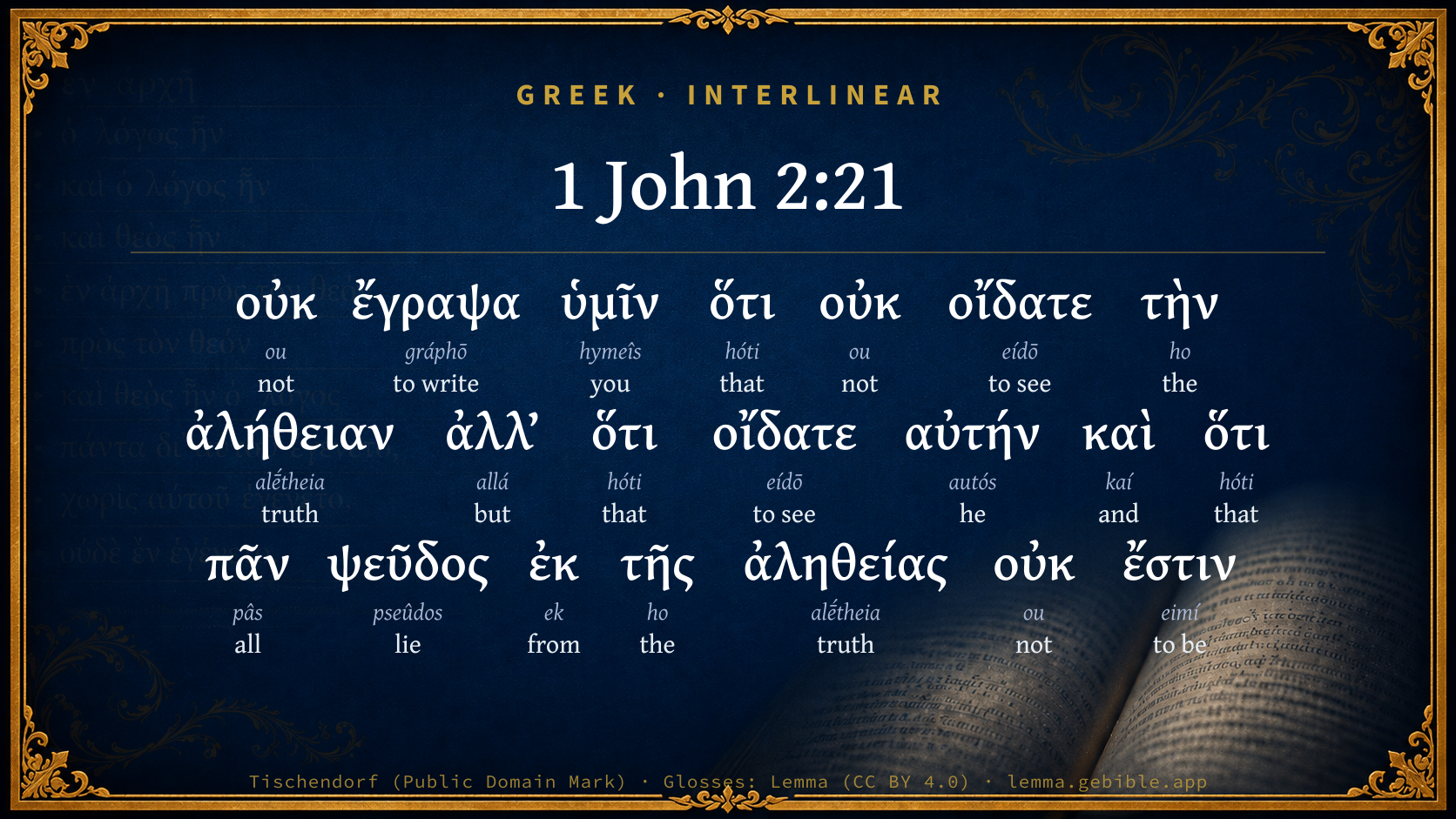
  1. οὐκ ou G3756 “not” Particle, Negative
  2. ἔγραψα gráphō G1125 “to write” Verb, Aorist, Active, Indicative, 1st person, Singular
  3. ὑμῖν hymeîs G5210 “you” Personal pronoun, 2nd person, Dative, Plural
  4. ὅτι hóti G3754 “that” Conjunction
  5. οὐκ ou G3756 “not” Particle, Negative
  6. οἴδατε eídō G1492 “to see” Verb, Perfect, Active, Indicative, 2nd person, Plural
  7. τὴν ho G3588 “the” Article, Accusative, Singular, Feminine
  8. ἀλήθειαν alḗtheia G225 “truth” Noun, Accusative, Singular, Feminine
  9. ἀλλ’ allá G235 “but” Conjunction
  10. ὅτι hóti G3754 “that” Conjunction
  11. οἴδατε eídō G1492 “to see” Verb, Perfect, Active, Indicative, 2nd person, Plural
  12. αὐτήν autós G846 “he” Personal pronoun, Accusative, Singular, Feminine
  13. καὶ kaí G2532 “and” Conjunction
  14. ὅτι hóti G3754 “that” Conjunction
  15. πᾶν pâs G3956 “all” Adjective, Nominative, Singular, Neuter
  16. ἐκ ek G1537 “from” Preposition
  17. τῆς ho G3588 “the” Article, Genitive, Singular, Feminine
  18. ἀληθείας alḗtheia G225 “truth” Noun, Genitive, Singular, Feminine
  19. οὐκ ou G3756 “not” Particle, Negative
  20. ἔστιν eimí G1510 “to be” Verb, Present, Active, Indicative, 3rd person, Singular

About this verse

These counts appear in no published source. They are computed here, from the morphology-tagged text and Lemma’s own curated glosses. What Lemma adds →

21
words
14
distinct lemmas
General Epistles
section

Notable vocabulary

The rarest word here is ψεῦδος lie G5579 — appearing just 10 times in the whole Greek New Testament.

Shared distinctive vocabulary

ψεῦδος lie G5579 occurs in 10 verses of the Greek New Testament. Also found in:

Repetition

Words recur within this verse:

  • οἴδατε to see G1492 ×2
  • ἀλήθειαν truth G225 ×2
  • οὐκ not G3756 ×3
  • ὅτι that G3754 ×3
  • τὴν the G3588 ×2

Cross-references

5

Topical passages linked to 1 John 2:21 in the Treasury of Scripture Knowledge — connected by theme and wording, ordered by reader-vote popularity; previews shown in the World English Bible.

  • 2 Peter 1:12 Therefore I will not be negligent to remind you of these things, though you know them, and are established in the present truth.
  • Jude 1:5 Now I desire to remind you, though you already know this, that the Lord, having saved a people out of the land of Egypt, afterward destroyed those who didn't believe.
  • Proverbs 1:5 That the wise man may hear, and increase in learning; That the man of understanding may attain to sound counsel:
  • Proverbs 9:8–9 Don't reprove a scoffer, lest he hate you. Reprove a wise man, and he will love you.
  • Romans 15:14–15 I myself am also persuaded about you, my brothers, that you yourselves are full of goodness, filled with all knowledge, able also to admonish others.

Cross-references courtesy of OpenBible.info (CC BY 4.0).

Commentary

Notes on 1 John 2:21 from classic Christian and Jewish commentators (each source and its license shown beneath its notes). The classic Christian expositions comment on the surrounding passage and are grouped to its opening verse, so a note may address several verses; the Jewish commentaries on the Tanakh (Rashi and others) are per-verse, so they appear only where the commentator wrote on this verse.

Lemma curates 59 commentaries, every one of them public domain or Creative Commons licensed, each selected and text-cleaned for this edition rather than reprinted as found. About our sources →

The Biblical Illustrator

Joseph S. Exell

1Jn_2:21-24

I have not written unto you because ye know not the truth, but because ye know it

Knowledge favourable to further teaching

I.

Why the apostle had written (1Jn_2:21). It does not follow that he would not have written to those who were either ignorant of the truth or opposed to it. To every sinner he would address the gospel of salvation, and entreat him to become a possessor of its benefits. Indeed, he did so in other writings. On the present occasion, however, he wrote to them that knew the truth. He had special reasons for writing to them particularly. No doubt one reason was the extreme jealousy of the apostle lest any of those who knew the truth should act inconsistently with it. In another epistle he discovers the spirit that animated him in this respect (2Jn_1:4) How it must have distressed him to have found some not walking in the truth. He therefore wrote to instruct, and warn, and encourage them that they might walk worthy of their high vocation. Nor can it be supposed this was not needed. In the most enlightened there is still much ignorance. In the most determined there is still irresolution. In the most devoted there is still deficiency. But his great reason appears to have been his hope of success in writing to such. He declared the truth to them, encouraged by the belief that there would be found in them a readiness of mind to receive it. In this assumption of the apostle there is a practical lesson of great value. We are taught that the acceptance or rejection of the truth is chiefly dependent on the disposition of the heart towards it. It is the perversity of the will that often blinds the understanding. Let that be rightly disposed, and we are apt to see clearly.

II. What, then, did he write? The reply is in the next two verses. It is observable that, in treating of truth and error, the whole subject of the apostle is concerning Jesus Christ. He assumes that if our views of Him are correct, so will be our apprehension of the whole circle of truth. He therefore goes largely into the subject. He presents the Saviour in various views of supreme importance, in which it is vital to true godliness that we shall perceive the truth and not fall into error.

1. The first is adverted to in the opening of 1Jn_2:22. Who is a liar but he that denieth that Jesus is the Christ? No doubt the general sentiment here is the rejection of the claims of Jesus Christ to be the Messiah promised in the scriptures of the Old Testament. This was the sin of the Jewish nation. He was the light, but they could not see it, because their eyes were blinded. This view, however, does not express the full doctrine of the apostle. To receive or reject Jesus as the Christ has respect to all His offices, and consequently to all the blessings which we may obtain or forfeit by embracing or refusing Him in them.

2. In the same verse the apostle gives another description, and says, He is antichrist that denies the Father and the Son. This cannot mean a denial of the existence of the Father and the Son as two distinct beings, the one dwelling in heaven, and the other upon the earth. The reference is manifestly to some union between them which some might be disposed or tempted to deny. It is that in which Christ is called Gods own Son, His only-begotten and well-beloved Son. In this relation the Son is the equal of the Father. Let us give Him the glory that is due by hearkening to His invitation, Look unto Me and be saved, all ye ends of the earth; for I am God, and beside Me there is no Saviour.

3. The apostle gives one other view of antichrist in 1Jn_2:23, Whosoever denieth the Son, etc. There are two deeply important sentiments in these words, which can only he noticed. The one is that no one can have just views of God unless He is known as He is revealed in the Son (Mat_11:27). The other sentiment is the result of the first. He only who knows God in His Son can have fellowship with Him.

III. This will more fully appear while we notice the object of the apostle in writing as he had done. It is expressed in the 24th verse. The three terms, abide, remain, continue, are the same in the original. The repetition is sufficient to show the extreme importance attached to the thought by the apostle. What, then, is it? It is suggested by a phrase which he uses again and again throughout the epistle, The truth is not in us. In order that the truth may have its due effect, it must be in us, not as a speculation in the head, but a mighty practical principle in the heart. It must he in us as food is in the man whom it nourishes. But it is not merely the truth, as a system, that must thus dwell in us. It is as the casket that contains the jewel; and that jewel is Christ. (James Morgan, D. D.)

The guileless spirit, amid antichristian denial of the Son, acknowledging the Son so as to have the Father also

I. How is a denial that Jesus is the Christ equivalent to a denial of the Son?

1. The official designation, Christ, or Messiah, or Anointed, marks not only a certain relation to the Jewish Scriptures, but also and still more a certain relation to God, whose Christ He is.

2. As the Son He stands in a distinct and definite relation to the Father. He must be owned in that relation if He is to be owned at all; otherwise He is to all intents and purposes denied.

II. How is it that to deny the Son is to deny the Father, so that whosoever denieth the Son the same hath not the Father; but he that acknowledgeth the Son hath the Father also?

1. In the exercise of His absolute sovereignty God is entitled to say upon what terms and in what way any of His creatures shalt have Him, that is, as theirs; have Him so as to have an interest in Him, and a bond of union with Him. He may set forth anyone He pleases, and say, If you deny Him you cannot have Me. In this case, however, He sets forth His Son, and therefore the appointment must be allowed to be in the highest degree reasonable and fair. The disowning of the Son cannot but be an offence to the Father; deeply wounding and grieving His heart.

2. But he that acknowledgeth the Son hath the Father also. He hath the Father; how surely, how fully, may partly appear, if we consider, not only what Jesus is to us, as our anointed Saviour, but also what He is to the Father as His beloved Son. All through His humiliation, how has He the Father? The Fathers love He has; His love of boundless complacency, approval, delight. He has the Fathers gracious presence with Him always. So He, as the Son, had the Father when He was as you are. So he would have you, acknowledging Him, to have the Father also. He shows you what it is to have the Father in the state in which you now are; amid the trials of earth, the enmity of the world, the very pains of hell. He shows you how even here you can have the Father as, in a work and warfare infinitely harder than yours, He had the Father; how you, in all your trial and tribulation, can rest in the consciousness of the Fathers favour; and rejoice in the doing of the Fathers will; and resign yourself contentedly to the Fathers disposal. (R. S. Candlish, D. D.)

Who is a liar but he that denieth that Jesus is the Christ?--

Deniers of Christ

1. Those who deny His eternal existence and Godhead, and the union of the Divine and human natures in His one person.

2. Those who deny the reality of His human nature.

3. Those who deny Him as Priest, and reject as irrational His expiatory sacrifice.

4. Those who deny Him as King and Judge, who scoff at His personal advent and reign on earth (2Pe_3:1-18), or who ridicule His solemn warnings as to the punishment of the wicked. (J. T. Demarest, D. D.)

Antichrist

We have here two subjects of thought.

I. The greatest Beings in the universe.

1. The Father. Who is He? The cause, the means, the end of all things in the universe but sin.

2. The Son. Who is the Son? His express Image, His Divine Equal, the one grand object of His love. Before these two Beings, all systems, all hierarchies, all potentates, kingdoms, principalities, are less than a spark to the sun, a drop to the ocean. Another subject of thought is--

II. The greatest crime in the universe. What is it?

1. Practical Anti-theism. Denieth the Father. Millions confess the Father, who practically deny Him.

2. Practical anti-Christism. Who is a liar but he that denieth that Jesus is the Christ? Practically, to deny Christ as the true Messiah, to live as if He never existed, is anti-theism in another form. This is the crime of crimes. Living as if no God the Father, no Christ the Son ever existed.

Conclusion.

1. Antichrist is confined to no one Church.

2. Antichrist embraces all sin. Every man that does not love the Father supremely, and accept the Son lovingly and loyally, is Antichrist. (D. Thomas, D. D.)

The Son and the Father

These Words strike at the root of a prevailing error. They warn us of the peril which we run by disparaging any of the central truths of the Christian Gospel--the loss which we incur if we surrender them. Deny that Christ is the eternal Son of God, and we lose hold of God Himself as our Father. Before looking at this startling sentence a little more closely, it is worth while to consider the fact that only where the Divine Sonship of the Lord Jesus Christ has been believed, have men thought of God with the joy and trust of children. We may dismiss the great pagan religions. But take the two great monotheistic religions--Judaism and Mohammedanism--and compare them with the Christian faith. Judaism, of course, knew nothing of the incarnation. There are certain elements in the Jewish faith which, as we see, prepared the life of the race for this consummate glory; but that God could ever actually become man could hardly, even in moments of clearest vision, have been made real to Jewish prophets or saints. And hence, wonderful and varied as is the religious life expressed in the Psalms and prophecies, it is not a religious life which has its roots in the belief that God is in any true and deep sense the Father of men. Take Mohammedanism; this great faith which still exerts authority over a hundred or a hundred and fifty millions of men, and which still appears to have the power to inspire that heroic courage which a thousand years ago made the Saracens masters of some of the fairest regions of Europe, Africa, and Asia--Mohammedanism denies the Incarnation, and therefore denies the eternal Sonship of Christ, and affirms the perfect simplicity of the Divine nature. As I have said, it is a great faith. It exalts the majesty of God; God is supreme; His will is irresistible; neither earth nor hell can stay His hand. The God of Mohammedanism is a God to fear; a God to obey; a God to live for; a God to die for; but He is not a Father; and the devout Mohammedan is a servant of God--a slave, not a child. And in the history of the Christian Church I find that wherever faith in the Divine Sonship of Christ declines, there soon declines with it, as a rule, the joy and exultation that come from the vision of the infinite love of God, and from the consciousness of our own kinship with Him. A flower severed from its root will retain its colour and its perfume for a time; but it must perish sooner or later. A real faith in the Divine Fatherhood may survive for a time after faith in the Divine Sonship of Christ has died; but sooner or later, whosoever denieth the San, discovers that in losing the Son he has lost the Father also. We may find fresh light on this subject if we look at the words which immediately precede the text--words which carry us back to speculations about the Lord Jesus Christ which have long vanished. Among the earliest forms of heresy was one which maintained that Jesus--Jesus, the son of Mary--was a man and nothing more; but that before His public ministry began, a great and mighty emanation from the Eternal descended upon Him. This emanation was called The Christ. It was in the power of the Divine Christ, according to this theory, that Jesus did all His wonderful works; and it was the illumination of the Divine Christ that enabled Him to speak all His wonderful words. The Christ took possession of Jesus when Jesus had reached manhood; but Jesus Himself, according to this doctrine, was not Divine. Who is the liar? asks John, but he that denieth that Jesus is the Christ?--that is who, being asked to confess it, refuses. John meant by a liar a man whose whole conception of God, and the world, and the human race was false; whose whole theory of life therefore rested on a false foundation, was rooted in falsehood. It was not merely the mans words that were untrue to his thought, but his thought was untrue to the fact, did not correspond to the reality of things. The falsehood was a grave one. It did not touch the mere details of the order of the world, but the fundamental relations of man and of the whole world to God. The heresy which denied that Jesus was the Christ was therefore fatal to all truth. The ancient Gnostic heresy has passed away, but the false conception of God and the world, which was the root of it, still survives. The distance between the Eternal and man seems so immense that it seems impossible that the Eternal Son of God ever became man, and that He remains man. In other words, human unbelief severs the human from the Divine. But when once we recognise in Christ the Divine glory, we see that God, instead of being remote from us, is near, that the great glories of the Divine nature are not onmipotence and omniscience, but righteousness, love, pity, grace. These glories we may share with the Eternal. In our own moral freedom we discover that which corresponds to the Divine sovereignty over nature; in our moral perfection that which may be the expression of the ethical life of God. We listen to Christ, we watch Him, we discover that He is God, and yet Son of God. He was eternally with the Father; He has come to share the conditions of our earthly life. This is a new discovery concerning God Himself, and not merely concerning our Lord Jesus Christ. It is a discovery that God has always been the Father; that the Eternal Son, sharing His life, sharing His glory, is eternally one with Him, and yet eternally separate from Him, and has eternally rejoiced in His love. This Eternal Son has shared our life that we may share His life, and might be really and truly sons of God. For this we were made, and only as this is achieved in us do we fulfil the thought and purpose of God. And now, dismissing these high discussions, and returning to the practical aspects of this subject, let me say something to those of you who, while you speak of the Divine Fatherhood, are very conscious, when you come to think of it, and to deal with yourselves fairly, that it gives you little peace, little courage, little joy, little power; that it is no great restraint on sin, no powerful support to righteousness; that it is a thing to argue about rather than to live upon. You do not exactly deny--but the Sonship of Christ, His eternal Sonship, is not real to you; the wonder and the glory of it do not possess and awe you. Is that the reason you have never entered fully into the consciousness of sonship? Try to dwell on the great fact that the Lord Jesus Christ, the eternal Word, the eternal Son of God, became flesh. Remember that through sixty Christian generations that truth, with the correlative truths, has been the substance of the very life of Christian people; that in the power of it they have trusted God, and have done the will of God. (R. W. Dale, D. D.)

Whosoever denieth the Son, the same hath not the Father--

The antagonism between truth and falsehood

I. All error is deadly.

1. It were a ludicrous absurdity to say that a wrong faith can save a man. Either, then, a right faith is necessary, or no faith at all is (Joh_3:15-16; Joh_6:40; Joh_11:25, etc.; Act_20:21; Rom_1:17; Rom_3:30; Gal_5:6; 2Th_2:13; Heb_11:6).

2. A wrong faith must necessarily produce a wrong practice. We may see this in the affairs of this world.

3. Tendencies do not always produce their full results. A wrong faith on some points has been in some degree compensated for by a right faith on others.

4. It is a matter of importance to believe the truth. All the misery and distress in the world is due to wrong beliefs.

5. How is a right faith to be attained? In answer to this we must

(a) dismiss the idea that any man, while in the flesh, can possibly attain to infallible certainty on all points whatsoever. For

(b) our condition here is progressive.

II. All error is based upon the denial that Jesus is the Christ.

1. Revelation is necessary. For otherwise we do not know

(1) whether there be a God,

(2) whether man is immortal or not,

(3) in what the foundation of morals consists.

2. The only revelation is that made by Jesus Christ.

3. The essential feature of revelation is that it was made by one Anointed, i.e., commissioned to declare Gods will. Thus we are forbidden, on any point on which Gods will is clearly declared, to question it.

4. How, then, do unbelievers in Christ lead moral and admirable lives? They can do so only so far as they believe what Christ tells them.

5. Continuance in the Son and in the Father the only possible means of salvation. The denial of this truth leads directly to the destruction of all moral principle whatever. The moral lives of unbelievers are due to their acceptance of the moral principles of their age. These moral principles are Christian principles. But Christian moral law without its Lawgiver is a superstructure without a foundation. Thus continuance in the Son and in the Father is the only means whereby

(1) error, the source of all evil, can be gradually dispelled, and

(2) truth, the source of all holiness and goodness, enabled to take full possession of the heart. (J. J. Lias, M. A.)

Our estimate of Christ the measure of Gods estimate of us

I have seen a perfect stranger heartily welcomed in an English home and treated with a deference, a tenderness, and a generous hospitality that did one good to witness, and I understood it all when informed that that stranger, though never seen before, had at one time shown kindness to a wandering, long-absent son in a certain town in the distant Australias. The parents governed their estimate of the stranger by this kindly treatment of their boy. And does not our Heavenly Father to some extent deal similarly with us? He views and estimates us according to our treatment of His beloved Son. If our estimate of Jesus is vague, or erroneous, or wilfully depreciatory, we suffer to that extent in the Divine estimation.

The Biblical Illustrator, edited by Joseph S. Exell (c. 1880s–1900s) — public domain. Text from a community e-Sword module.

Joseph Benson's Commentary

1Jn 2:21-23. I have not written unto you — In the manner I have done; because ye know not the truth — In which case I must have entered largely into the discussion of this matter; but, on the contrary, I have contented myself with these short intimations; because ye know it — Approve of and embrace it, and I am desirous to confirm you in the knowledge of it; and because no lie is of the truth — No false doctrine can proceed from, or agree with, that gospel which you have embraced; in other words, that all the doctrines of these antichrists are irreconcilable to it. Or perhaps the doctrine, contrary to that which was taught by the apostles, may be called a lie, because the teachers who propagated such doctrines knew them to be false, especially the doctrines which they propagated concerning the person and actions of Christ. They, therefore, in particular are called ο ψευστης, the liar, as in the next clause. Who is the liar — The false teacher foretold to come before the destruction of Jerusalem; but he that denieth that Jesus is the Christ — Who is guilty of that lying but he who denies the truth which is the sum of all Christianity? That Jesus is the Christ, that he is the Son of God, that he came in the flesh, is one undivided truth; and he that denies one part, in effect denies the whole. He is antichrist — He deservedly bears that name; that denieth the Father and the Son — Denies God to be the Father of Christ, by denying Christ to be his Son. Or who, in denying the Son, denies the Father also. He denies the Son directly, and by consequence denies the Father, who testified by a voice from heaven that Jesus was his Son, and by all the miracles which Christ wrought. Whosoever denieth the Son — Even the only-begotten and eternal Son of God, either in his person, his natures, offices, or merits. The same hath not the Father — Has no interest in him as his Father, since that is obtained only through Christ; and, consequently, he hath not communion with the Father. But he that truly and believingly acknowledgeth the Son, hath communion with the Father also — The last clause of this verse, in our English Bible, is printed in italic letters, to show that it is not in the common Greek copies. Beza, however, hath inserted it in his edition of the Greek Testament, on the authority of some ancient MSS., and of the Syriac and Vulgate versions. Mill also, on this verse, mentions a number of MSS. which have this clause. Estius reckoned it genuine, as did Doddridge, who says, “It is to be found in so many good MSS. that I cannot but believe it made a part of the original, by whatever accident it was omitted in some early copy, to which, as it seems, too much regard has been paid.”

Joseph Benson's Commentary on the Old and New Testaments (1811–1818) — public domain. Text from a community e-Sword module.

Bengel's Gnomon

Johann Albrecht Bengel

1Jn 2:21. Ἔγραψα, I have written) He did that at the end of 1Jn 2:13.—ὅτι, because) Thus 1Jn 2:13, note. The address is very confirmatory: Be assured that ye know: comp. 1Jn 2:3.—τὴν ἀλήθειαν) the truth, respecting the Son, and so respecting the Father: the verse cited above.—πᾶν ψεῦδος, every lie) The truth is altogether true, and nourishes no falsehood.

Bengel's Gnomon of the New Testament — English translation (T&T Clark, Edinburgh, 1860) — public domain. Text from a community e-Sword module.

Meyer's Critical & Exegetical Commentary

Heinrich August Wilhelm Meyer

1Jn_2:21. οὐκ ἔγραψα ὑμῖν] does not refer to the whole Epistle (Beza), but to that which is said of the antichrists; comp. 1Jn_2:26.[170]

ὅτι οὐκ οἴδατε τὴν ἀλήθειαν κ.τ.λ.] ὅτι = because (comp. 1Jn_2:12-14); the apostle does not want to teach the anointed Christians for the first time the truth which was revealed in Christ, but he is writing to them because they know it; a Lapide: non ut haec vos doceam, sed ut doctos confirmem.

καὶ ὅτι πᾶν ψεῦδος κ.τ.λ.] This ὅτι is not co-ordinate with the preceding one, but is dependent on οἴδατε. Luther, correctly according to the sense: but ye know it, and know that, etc.

πᾶν ψεῦδος, quite generally, though with special reference to the antichristian doctrine; ψεῦδος: not merely error, but lie (de Wette)the absolute antithesis of ἀλήθεια; Lange quite arbitrarily thinks that the abstract is here put for the concrete: that no false teacher can be a genuine Christian. It is incorrect to take πᾶν … οὐ as a Hebraism = οὐδέν; οὐ belongs rather to the predicate.

ἐκ τῆς ἀληθείας οὐκ ἔστι] ἐκ here also indicates the source, and does not express merely the connection (de Wette, Baumgarten-Crusius). Because the lie is not of the truth, so also it has no connection with it; Lorinus: ex vero non nisi verum sequitur, et verum vero consonat. Whence the lie, which is not ἐκ τῆς ἀληθείας, originates, Christ says in Joh_8:44 : The truth is from God, who is Himself the truth; the lie from the devil, who is not in the truth.

[170] Ebrard refers this ἔγραψα also arbitrarily to the Gospel of John.

Meyer — Critical and Exegetical Commentary on the New Testament — English translation by Peter Christie, edited by Frederick Crombie (T&T Clark, 1880) — public domain. Text from a community e-Sword module.

Expositor's Greek Testament

ed. W. Robertson Nicoll

1Jn 2:21 . ἔγραψα , “I wrote,” may refer to the Gospel, which is an exposition of the Incarnation, ἡ τοῦ Σωτῆρος ἡμῶν Ἰησοῦ Χριστοῦ ἔνσαρκος οἰκονομία ( cf. note on 1Jn 2:14 ); but more probably “aor. referring to the moment just past” (Jebb on Soph. O.T. 337). The aor. is appropriate. No sooner has he spoken of the antichrists than he hastens to reiterate his assurance of confidence in his readers. τὴν ἀλήθειαν , see note on 1Jn 1:8 . ἐκ , of parentage ( cf. 1Jn 3:8-10 ). His readers had only to be reminded of their experience ( οἴδατε ), and it would keep them from being led astray. An experience is an anchor to the soul in time of storm. “Tell me,” said the dying Cromwell to a minister, “is it possible to fall from grace?” “No, it is not possible.” “Then I am safe, for I know that I was once in grace” (Morley’s Oliver Cromwell , V. x.).

The Expositor's Greek Testament, edited by W. Robertson Nicoll (1897–1910) — public domain. Text from a community e-Sword module.

Geneva Bible (1599)

Geneva Bible translators

The taking away of an objection. He wrote not these things as to men which are ignorant of religion, but rather as to them which do well know the truth, yet so far forth that they are able to discern truth from falsehood.

Geneva Bible (1599) marginal notes — public domain. Text via Bolls.life.

Jamieson, Fausset & Brown

Robert Jamieson, A. R. Fausset & David Brown

but because ye know it, and that, &c.--Ye not only know what is the truth (concerning the Son and the Father, Jo1 2:13), but also are able to detect a lie as a thing opposed to the truth. For right (a straight line) is the index of itself and of what is crooked [ESTIUS]. The Greek is susceptible of ALFORD'S translation, "Because ye know it, and because no lie is of the truth" (literally, "every lie is excluded from being of the truth"). I therefore wrote (in this Epistle) to point out what the lie is, and who the liars are.

Jamieson, Fausset & Brown — Commentary Critical and Explanatory on the Whole Bible (1871) — public domain (CC PDM 1.0). Text via the HelloAO Bible API.

Adam Clarke's Commentary

Verse 21. I have not written, c.] It is not because ye are ignorant of these things that I write to you, but because you know them, and can by these judge of the doctrines of those false teachers, and clearly perceive that they are liars for they contradict the truth which ye have already received, and consequently their doctrine is a lie, and no lie can be of the truth, i.e. consistent with Christianity.

Adam Clarke's Commentary on the Bible (1810–1826) — public domain. Text from a community e-Sword/MySword module.

John Calvin's Commentaries

21 And that no lie is of the truth. He concedes to them a judgment, by which they could distinguish truth from falsehood; for it is not the dialectic proposition, that falsehood differs from truth, (such as are taught as general rules in the schools;) but what is said is applied to that which is practical and useful; as though he had said, that they did not only hold what was true, but were also so fortified against the impostures and fallacies of the ungodly, that they wisely took heed to themselves. Besides, he speaks not of this or of that kind of falsehood; but he says, that whatever deception Satan might contrive, or in whatever way he might attack them, they would be able readily to distinguish between light and darkness, because they had the Spirit as their guide.

John Calvin's Commentaries (1540-1563) — public domain. Text from the Calvin Translation Society English edition (1840s-50s) via the Christian Classics Ethereal Library (ccel.org). Calvin's coverage is partial (roughly two-thirds of the Bible); uncommented books and verses are honest gaps, never fabricated. The 19th-century editor's footnotes and remarks are omitted so the notes are faithfully Calvin's own voice.

The Cambridge Bible for Schools and Colleges

gen. ed. J. J. S. Perowne

21. I have not written] Literally, as in 1Jn_2:13-14; 1Jn_2:26, I wrote not, or, did not write: it is the aorist in the Greek. But (whatever may be true of 1Jn_2:13-14) what we have here is almost certainly the epistolary aorist, which may be represented in English either by the present or by the perfect. ‘I have written’ probably does not refer to the whole letter, but only to this section about the antichrists; this seems clear from 1Jn_2:26. ‘Do not think from my warning you against lying teachers that I suspect you of being ignorant of the truth: you who have been anointed with the Spirit of truth cannot be ignorant of the truth. I write as unto men who will appreciate what I say. I write, not to teach, but to confirm’. “S. John does not treat Christianity as a religion containing elements of truth, or even more truth than any religion which had preceded it. S. John presents Christianity to the soul as a religion which must be everything to it, if it is not really to be worse than nothing” (Liddon).

because ye know not the truth; but because ye know it, and that, &c.] There are no less than three ways of taking this, depending upon the meaning given to the thrice-repeated conjunction (ὅτι), which in each place may mean either ‘because’ or ‘that’. 1. As A.V.; because, … but because … and that. The A.V. follows the earlier Versions in putting ‘that’ in the last clause: so Wiclif, Tyndale, Cranmer, &c. 2. As R.V.; ‘because’ in each clause. 3. ‘That’ in each clause: ‘I have not written that ye know not the truth, but that ye know it, and that &c.’ This last is almost certainly wrong. As in 1Jn_2:13-14 the verb ‘write’ introduces the reason for writing and not the subject-matter or contents of the Epistle. And if the first conjunction is ‘because’, it is the simplest and most natural to take the second and third in the same way. The Apostle warns them against antichristian lies, not because they are ignorant, but (1) because they possess the truth, and (2) because every kind of lie is utterly alien to the truth they possess. “There is the modesty and the sound philosophy of an Apostle! Many of us think that we can put the truth into people, by screaming it into their ears. We do not suppose that they have any truth in them to which we can make appeal. S. John had no notion that he could be of use to his dear children at Ephesus unless there was a truth in them, a capacity of distinguishing truth from lies, a sense that one must be the eternal opposition of the other” (Maurice).

no lie is of the truth] Literally, every lie is not-of-the truth: the negative belongs to the predicate (comp. 1Jn_3:15). ‘Of the truth’ here is exactly analogous to ‘of the Father’ and ‘of the world’ in 1Jn_2:16 and to ‘of us’ in 1Jn_2:19. Every lie is in origin utterly removed from the truth: the truth springs from God; lying from the devil, ‘for he is a liar and the father thereof’ (Joh_8:44). See on 1Jn_2:16.

The Cambridge Bible for Schools and Colleges (gen. ed. J. J. S. Perowne; Cambridge University Press, 1878–1918) — public domain. Text from a community e-Sword module.

John Gill's Exposition

I have not written unto you,.... Either this epistle, or rather what particularly here regards those apostates from the truth, in order to shun them and not be deceived by them: the apostle here obviates an objection that he saw might be made upon what he last said, that they knew all things; and, if so, why then did he write the things he did, since they knew them before? to which he answers, that he did not write to them as to ignorant, but as to knowing persons:

because ye know not the truth, but because ye know it: the Father, who is the God of truth; Christ, who is truth itself; and the Spirit, who is the Spirit of truth; and the Gospel, which is the word of truth; and the Scriptures, which are the Scriptures of truth, and from whence truth is to be fetched, and by them to be confirmed and defended; and which, if they had not known, it would have been to no purpose for him to have written to them about the antichrists that were come into the world; and though they did know the truth, it was very proper to put them in remembrance of it, and to establish them in it, against these deceivers, which supposes former knowledge of it:

and that no lie is of the truth; either springs from it, or is according to it, but just the reverse. The apostle has respect to the errors and heresies of the above apostates, which were flagrant contradictions to the Gospel, and as distant from it as a lie is to truth; and of such lies, and of those liars, he speaks in the next verses. The Arabic version reads, "and that every liar is not of the truth".

John Gill's Exposition of the Whole Bible (1746–1763) — public domain (CC PDM 1.0). Text via the HelloAO Bible API.

Trapp's Complete Commentary

John Trapp

21 I have not written unto you because ye know not the truth, but because ye know it, and that no lie is of the truth.

Ver. 21. Because ye know not, &c.] Because ye are utterly ignorant; for God hath no blind children, but they all know him from the least to the greatest. Howbeit, the angels know not so much, but they would know more, Eph 3:10. Should not we?

John Trapp, A Commentary or Exposition upon All the Books of the Old and New Testament (1647–1656) — public domain. Text from a community e-Sword module.

Albert Barnes' Notes on the Bible

I have not written unto you because ye know not the truth - You are not to regard my writing to you in this earnest manner as any evidence that I do not suppose you to be acquainted with religion and its duties. Some, perhaps, might have been disposed to put this construction on what he had said, but he assures them that that was not the reason why he had thus addressed them. The very fact that they did understand the subject of religion, he says, was rather the reason why he wrote to them.

But because ye know it - This was the ground of his hope that his appeal would be effectual. If they had never known what religion was, if they were ignorant of its nature and its claims, he would have had much less hope of being able to guard them against error, and of securing their steady walk in the path of piety. We may always make a strong and confident appeal to those who really understand what the nature of religion is, and what are the evidences of its truth.

And that no lie is of the truth - No form of error, however plausible it may appear, however ingeniously it may be defended and however much it may seem to be favorable to human virtue and happiness, can be founded in truth. What the apostle says here has somewhat the aspect of a truism, but it contains a real truth of vital importance, and one which should have great influence in determining our minds in regard to any proposed opinion or doctrine. Error often appears plausible. It seems to be adapted to relieve the mind of many difficulties which perplex and embarrass it on the subject of religion. It seems to be adapted to promote religion. It seems to make those who embrace it happy, and for a time they apparently enjoy religion. But John says that however plausible all this may be, however much it may seem to prove that the doctrines thus embraced are of God, it is a great and vital maxim that no error can have its foundation in truth, and, of course, that it must be worthless. The grand question is, “what is truth;” and when that is determined, we can easily settle the inquiries which come up about the various doctrines that are abroad in the world. Mere plausible appearances, or temporary good results that may grow out of a doctrine, do not prove that it is based on truth; for whatever those results may be, it is impossible that any error, however plausible, should have its origin in the truth.

Albert Barnes' Notes on the Bible (1834–1885) — public domain. Text from a community e-Sword/MySword module.

Matthew Poole's English Annotations

He prudently intimates his confidence concerning them, together with the pleasure he himself took (as any one would) in communicating the sentiments of holy truth to prepared, receptive minds; implying also, that any part of false doctrine doth so ill match and square with the frame of Divine truth, that judicious Christians may discern they are not of a piece.

Matthew Poole's English Annotations on the Holy Bible (1683–1685) — public domain. Text from a community e-Sword/MySword module.

Whedon's Commentary on the Bible

Daniel D. Whedon

21. Not written—His epistle does not presuppose any doubt of their knowledge, but is an expression of his confidence in their adherence.

No lie—Like the denial of the reality of Christ’s person, and the claim to be pure while wallowing in sin. John had none of the modern delicacy that hesitates to call a lie a lie, any more than to call a murder a murder. Is of the system of apostolic truth. From his own knowledge (note 1Jn_1:1) our apostle knew that to deny our Lord’s flesh and body was a historic fiction, to which Christian truth was absolutely opposite.

Daniel D. Whedon (gen. ed.), Commentary on the Old and New Testaments (1874–1909) — public domain. Text from a community e-Sword module.

The Pulpit Commentary

The first oujk belongs to oti, not to e]graya: I wrote to you, not because ye know not, etc. It does not mean "I omitted to write to you because ye know not." Whatever meaning we give to the aorists in verses 13, 14 need not be retained here. There is here no abrupt change from present to aorist. Moreover, verse 26 limits this e]graya to the present section. What in verse 20 is spoken of as "all things" (assuming panta to be right) is here spoken of as "the truth." St. John writes to well-instructed Christians, to adults in the faith. It is precisely because they "know the truth" that he addresses them, especially to warn them against antichrists. We are in doubt whether kai oti, depends upon egraya ("and because")or upon oidate ("and that"). The former is better; it introduces a second reason for his writing. Some take oti, in all three places as "that" after e]graya: "I did not write to you and say that ye know not the truth, but that ye know it, and that no lie is of the truth." Every lie is fundamentally and ab origine ejk separate from the truth; and hence his readers will easily recognize lies and liars, for they know the truth.

The Pulpit Commentary (1880–1919), ed. H.D.M. Spence-Jones & Joseph S. Exell — public domain. Text from a community e-Sword module.

John Wesley's Explanatory Notes

I have written - Namely, 1 John ii, 13. To you because ye know the truth - That is, to confirm you in the knowledge ye have already. Ye know that no lie is of the truth - That all the doctrines of these antichrists are irreconcilable to it.

John Wesley, Explanatory Notes Upon the Whole Bible (1754–1765) — public domain. Text via the GEBible commentary corpus.

Kretzmann's Popular Commentary

Paul E. Kretzmann

Anti-Christian characteristics and the Christian’s attitude:

v. 21. I have not written unto you because ye know not the truth, but because ye know it, and that no lie is of the truth.

v. 22. Who is a liar but he that denieth that Jesus is the Christ? He is anti-Christ, that denieth the Father and the Son.

v. 23. Whosoever denieth the Son, the same hath not the Father; but he that acknowledgeth the Son hath the Father also.

v. 24. Let that, therefore, abide in you which ye have heard from the beginning. If that which ye have heard from the beginning shall remain in you, ye also shall continue in the Son and in the Father.

v. 25. And this is the promise that He hath promised us, even eternal life.

St. John here writes in almost an apologetic manner, both to avoid a misunderstanding and to urge the Christians forward in knowledge: Not have I written to you because you do not know the truth, but because you know it, and because no lie is connected with the truth. The complete and careful instruction which the apostle was here giving was not intended to convey to them any mistrust on his part, as though they had not yet come to the proper knowledge of the truth. They had learned what all Christians should know with regard to the divine and saving doctrines. He knew that the truth of God’s Word was the force which governed and controlled their lives. Truth has nothing in common with lying, with falsehood. Therefore all true Christians are well able to recognize, to detect, all teaching and living that is not in agreement with the truth. This knowledge they should utilize in keeping falsehood from gaining a foothold in their midst.

In one respect particularly the Christians must use all vigilance: Who is a liar if not the one who denies that Jesus is the Christ? This is the anti-Christ, that denies the Father and the Son. Even in those days certain false teachers very carefully distinguished between Jesus and the Christ, saying that Jesus was the son of Joseph and Mary, and that the Christ was a supernatural power which was given Him at His baptism, which, however, forsook Him again when He suffered and died. Similar doctrines are being held by false teachers in our days. St. John, therefore, firmly maintains that the human and the divine nature were united in the person of Jesus Christ, and calls every one, in an expression which certainly is not lacking in force and clearness, a liar, if he denies that Jesus of Nazareth is the Christ, the promised Messiah and Savior, the only-begotten Son of God, who was made man in the fullness of time. He that denies this truth thereby reveals his anti-Christian character, rejects all that God has revealed for our salvation, and denies all true knowledge of God. For he that denies the Son also denies the Father and can claim no fellowship with the Father.

This the apostle repeats with emphasis: Every one that denies the Son has also not the Father; he that confesses the Son has also the Father. To deny the Son as the Christ, as the Savior of the world, just as He revealed Himself in Scriptures, is to reject the Father as well, for the two persons are inseparably united; the Son is in the Father, and the Father is in the Son, Joh 14:10. On the other hand, every person that confesses Jesus as He is revealed to us in the Scriptures, as the eternal Son of the eternal Father, as Jesus the Christ, has the Father, has fellowship with the Father, is united with the Father through the bond of true faith.

It follows from this discussion, so far as all true Christians are involved: So far as you are concerned, what you have heard from the beginning, let it remain in you; if that remains in you which you heard from the beginning, you, on your part, will remain in the Son and in the Father. To make his appeal emphatic, the apostle places the pronoun ahead: You at least; at any rate, so far as you are concerned, cling firmly to that which you heard from the beginning, let that Gospel-truth remain in you which you were taught at the time of your conversion. At that time they had accepted the truth concerning the person and office of Christ. This certainty was to continue a power in their hearts and in their lives. And if the unadulterated Gospel, as they had heard it from the mouths of the apostles, would remain the one basis of their faith, then they, on their part, would be sure to remain in the true fellowship with the Son and with the Father. As the Father and the Son entered into our hearts by faith in the Word, so they will remain in us by that same faith. If we but continue in His Word, then our discipleship will remain certain, then He will abide in us, Joh 15:1-6.

Then, also, we have the further certainty: And this is the promise which He Himself promised to us, eternal life. This is a promise which Jesus made time and again in the days of His flesh, that those that believe on Him should have everlasting life, Joh 3:15-16; Joh 6:24; Joh 6:40-47. If we keep that faith in the Father and in the Son, as in those that worked our salvation for us and in us, then He, as a reward of mercy, will take us up to the eternal home, to the blessings of salvation, to the bliss of heaven. Even though we are not yet enjoying the delights of this life with God, we are nevertheless possessors of its glory and bliss, and we know that He is able to keep that which we have committed unto Him until that day, Php 1:6; 2Ti 1:12. What a powerful incentive to faithfulness!

Paul E. Kretzmann, Popular Commentary of the Bible (1921–1924) — public domain. Text from a community e-Sword module.

Burkitt's Expository Notes on the New Testament

William Burkitt

Observe here, 1. The character given of the gospel; it is the truth, the word of truth, the way of truth, confirmed by real miracles. It is divine truth, universal truth, effectual truth, and no lie; for Almighty God would never have set the seal of his omnipotency to a lie, and have confirmed it by signs and wonders, miracles and gifts of the Holy Ghost, had it been false.

Observe, 2. The character given of the heretics in St. John’s days, and in our days also, they denied that Jesus is the Christ, and therein deny the Father and the Son: For whosoever denieth the Son, the same hath not the Father; that is, he denieth the Father as well as the Son; for not having the Father, and denying the Father is the same thing, He is antichrist that denieth the Father and the Son 1Jn 2:22.

This is a text in which every Socinian may see himself an atheist; he that denies the divinity of the Son, denies the Deity of the Father for such is the nature of the Godhead, that one of these cannot be alone; the Father is not without the Son, nor can be; nor can the Son be without the Father; this coherence is inseparable and inviolable; therefore he that denies the eternal Son, denies the eternal Father; and if it be Atheism to deny the Divinity of the Father, it is no less to deny the Deity of the Son; for he that denieth the Son, denieth the Father also. There is such a connection between these two, the Father and the Son, they being co-essential and co-eternal, that if you deny the divinity of the one, you deny that of the other; therefore they are atheists that deny the divinity of Christ, as well as they that deny the being of God: For he that denieth the Son, denieth the Father also.

William Burkitt's Expository Notes on the New Testament (1700–1703) — public domain. Text from a community e-Sword module.

The People's New Testament

B. W. Johnson

21. I have not written, etc. John writes to them as those who know the truth, and know how to discern between the truth and lies.

B. W. Johnson's The People's New Testament with Notes (1889–1891) — public domain. Electronic text from the Christian Classics Ethereal Library (CCEL) ThML edition.

Cambridge Greek Testament for Schools and Colleges

21. οὐκ ἔγραψα. Whatever may be the explanation of the tense in 1Jn 2:14, here we probably have the epistolary aorist, which may be represented by either the present or the perfect in English. But some would refer this also to the Gospel; and the absence of ταῦτα renders this not impossible. More probably, however, as appears from 1Jn 2:26, ἔγραψα both here and there refers to this section about antichrists. ‘Do not think from my warning you against lying teachers that I suspect you of being ignorant of the truth: you who have been anointed with the Spirit of truth cannot be ignorant of the truth. I write as unto men who will appreciate what I say. I write, not to teach, but to confirm.’ “S. John does not treat Christianity as a religion containing elements of truth, or even more truth than any religion which had preceded it. S. John presents Christianity to the soul as a religion which must be everything to it, if it is not really to be worse than nothing” (Liddon).

ὅτι οὐκ οἴδατε τ. ἀλ., ἀλλʼ ὅτι οἴδ. αὐτήν, καὶ ὅτι. There are no less than three ways of taking this, depending upon the meaning given to the thrice repeated conjunction (ὅτι), which in each place may mean either ‘because’ or ‘that’. 1. As A.V.; because, … but because … and that. The A.V. follows the earlier Versions in putting ‘that’ in the last clause: so Tyndale, Cranmer, &c. 2. As R.V.; ‘because’ in each clause. 3. ‘That’ in each clause: ‘I have not written that ye know not the truth, but that ye know it, and that &c.’ This last is almost certainly wrong. As in 1Jn 2:13-14 the verb ‘write’ introduces the reason for writing and not the subject-matter or contents of the Epistle. And if the first conjunction is ‘because’, it is the simplest and most natural to take the second and third in the same way. The Apostle warns them against antichristian lies, not because they are ignorant, but (1) because they possess the truth, and (2) because every kind of lie is utterly alien to the truth they possess. “There is the modesty and the sound philosophy of an Apostle! Many of us think that we can put the truth into people, by screaming it into their ears. We do not suppose that they have any truth in them to which we can make appeal. S. John had no notion that he could be of use to his dear children at Ephesus unless there was a truth in them, a capacity of distinguishing truth from lies, a sense that one must be the eternal opposition of the other” (Maurice). Comp. ὑπομνῆσαι δὲ ὑμᾶς βούλομαι, εἰδότας ἅπαξ πάντα (Jud 1:5).

πᾶν ψεῦδος ἐκ τ. ἀλ. οὐκ ἔστιν. As in 1Jn 3:15, the negative belongs to the verb and not to the πᾶν; “all … not, not any, none’: No lie is of the truth. There is nothing Hebraistic in this form of expression, as in 1Jn 2:19: comp. Eph 5:5; Joh 3:16. Ἐκ expresses origin, as in 1Jn 2:16; 1Jn 2:19; ἐκ τοῦ πατρός, ἐκ τοῦ κόσμου, ἐξ ἡμῶν. Comp. τὸ βάπτισμα Ἰωάννου ἐξ οὐρανοῦ ἦν, ἢ ἐξ ἀνθρώπων; (Luk 20:5). Every lie is from its very source utterly removed from the truth. The truth springs from ὁ ἀψευδὴς Θεός (Tit 1:2); lying from the devil, ὅτι ψεύστης ἐστὶ καὶ ὁ πατὴρ αὐτοῦ (Joh 8:44): ἀλήθεια γὰρ ὀπαδὸς Θεοῦ (Philo Vita Mosis III): πάντῃ ἅρα ἀψευδὲς τὸ θεῖον (Plato Rep. II. 208 E).

Cambridge Greek Testament for Schools and Colleges (Cambridge University Press, 1896; 21 vols, various authors incl. Carr, Maclear, Plummer, Farrar, Lumby, Moule, M. R. James, Simcox) — public domain. Text from a community e-Sword module.

Alford’s Greek Testament

Henry Alford

21.] The Apostle puts them in mind, in an apologetic form, of the truth which they as Christians possessed, and the very possession of which, not the contrary, was his reason for thus writing to them. This reminiscence carries at the same time with it the force of an exhortation, as so many of the ideal statements on Christian perfection in our Epistle. What they have in the ideal depth of their Christian life, that they ought to have in living and working reality. And (hardly as Lücke, logically adversative to what preceded: so De Wette (aber), and many others. Huther ascribes this interpretation virtually to Düsterdieck, but wrongly: for the latter keeps καί in its simple copulative meaning, and only asserts that what adversative meaning there is consists in the sense, not in the outward expression. “John,” he says, “denotes only the passage to a new particular, without distinctly marking its adversative relation to the last”) ye (expressed, as emphatic: see above) have an anointing (χρῖσμα is properly the oil or ointment with which the anointing takes place, not the act itself of anointing. For this we have in English no word adequate to the necessity of the passage: “unguent” is the nearest approach, but is still inadequate. It is certain that in later Greek there arose a considerable confusion between verbal nouns in -μα and their cognates in -σις. Thus in Exo_29, the ἔλαιον τοῦ χρίσματος, ver. 7, becomes the ἔλαιον τῆς χρίσεως, in ver. 21. On the meaning, see below) from the Holy One (viz. from Christ, the δίκαιος of our ver. 1, the ἁγνός of ch. 3:3, the ἅγιος of Act 3:14, and ἅγιος τοῦ θεοῦ of Joh 6:69: cf. also Rev 3:18, where the Laodicean church is counselled to buy of Christ κολλύριον ἐγχρῖσαι τοὺς ὀφθαλμούς σου, ἵνα βλέπῃς. This is agreed to by almost all Commentators: even Socinus says that the Apostle “de Deo simul et Christo loqui, non secus ac si ambo una tantum persona essent:” and Schlichting concedes that the words may be understood of Christ), and know all things (the full and perfect knowledge of Christian truth is the ideal completion of those who have this anointing. This of course must not be understood as actually predicated of these readers: but the expression explains itself as referring to all things needful for right action in the matter under consideration: q. d. πάντα ταῦτα. So most Commentators. “Quod autem omnia dicit novisse, non universaliter capi, sed ad præsentis loci circumstantiam restringi debet,” Calv. See note on Joh 16:13: cf. also 1Co 1:5, 1Co 1:8:1; Eph 1:18; Col 2:2. Some understand, all things necessary to Christian life and godliness: so Œc., Wolf, Bengel, Neander: “quæ ut homines a Spiritu Sancto uncti doctique tum ad salutem, tum ad cavendos illos seductorum et antichristorum errores scire debetis,” Wolf. The alternative reading πάντες would mean “ye all know it:” a sense which hardly seems to be applicable.

But now the question recurs, What is this χρῖσμα, and what leads the Apostle to use this peculiar expression here? The reply to the latter question is probably, as Bengel, “Alludit appellatio chrismatis ad antichristi nomen, ex opposito.” The Apostle sets his readers, as χριστούς, anointed of God, over against the ἀντίχριστοι. Then as to the nature of the χρῖσμα, we can hardly fail to be right in interpreting it of the Holy Ghost. For “Christ received the Holy Ghost without measure (Joh 3:34): on Him the Holy Ghost abode (ib. 1:33): God ἔχρισεν αὐτὸν πνεύματι ἁγίῳ (Act 10:38). Christ baptizeth with the Holy Ghost (Joh 1:33): He sends the Holy Ghost, who takes of His and shews it to believers (Joh 15:26, Joh 16:14, Act 2:33). And seeing that the Son hath all which the Father hath, the Father is said to send forth the Spirit of His Son into the hearts of His children (Gal 4:6: cf. Eph 3:16, Php 1:19, 2Co 3:17 ff.), and this, at the prayer, in the name, through the mediation, of the Son (Joh 14:16, Joh 16:7 f.): the Father anoints believers by giving them His Spirit (2Co 1:21 f.), as He has anointed the Son with the Holy Ghost. And hence the Spirit, which we have received, is the token that we are in the Father (ch. 3:24), and in the Son (2:27), that we are children of God (Rom 8:14 ff., Gal 4:6). The Holy Ghost teaches the faithful the truth and keeps them in it: that truth, in the knowledge of which they have eternal life, having thereby the Father and the Son.” Düsterdieck, p. 354 f. This anointing, by virtue of which they are Christ’s and the Father’s, and without which a man is none of Christ’s (Rom 8:14, Rom 8:9), in respect of which they are χριστοί, the ἀντίχριστοι attack in its very root, and would rob them of, thereby severing them from the Son and from the Father: from light and truth and life. And this very χρῖσμα is the means and weapon whereby they must be detected and resisted).

21.] I did not write to you (see on ἔγραψα above, vv. 13, 14. It may refer either to what has immediately preceded, or to the whole Epistle: here probably to the immediately preceding) because ye know not the truth, but because ye know it, and because no lie is of the truth (i. e. coupling the fact of your knowledge of the truth with the fact that no lie is of the truth, I wrote to supply the link between these two, to point out to you the lie and the liar, that you might at once act on that your knowledge of the truth, and not listen to them that deceive you. Thus we keep ὅτι and καὶ ὅτι correlative. So Justiniani, Schlichting, and Neander: but almost all the expositors take the second ὅτι as dependent on οἴδατε, “because ye know the truth, and (also know) that no lie, &c.” So Aug., Bede, Erasmus, Grot., Calvin, Luther, Estius, Corn.-a-lap., Socinus, Episcopius, Wolf, Whitby, Hammond, Lücke, Baumg.-Crus., De Wette, Sander, Düsterd., Huther, and many others. But this surely does violence to the construction: ὅτι οἴδατε αὐτήν, καὶ ὅτι … οὐκ ἔστιν. ὅτι twice repeated, and each time with an indicative verb, surely must be kept to one and the same meaning in both clauses. Nor does the sense gain any thing, as Düsterd. maintains. For their knowing the truth and their knowing that no lie is of the truth, the one a cognition of God and His Son, the other a mere apprehension of a truism, are no logical correlatives, nor can be concurrent reasons for the Apostle’s writing: whereas the two facts, the one, their knowing the truth, the other, that no lie belongs to that truth, are concurrent reasons for the Apostle’s writing: viz. that he may set plainly before them what the lie is, that they may at once discern their entire alienation from it. And this accordingly he proceeds to do in the next verse. As regards the construction of πᾶν ψεῦδος.… οὐκ ἔστιν, it is not, as so many of the Commentators, a Hebraism, but merely that common one of attaching the negative to the predicate, instead of to the subject. πᾶν ψεῦδος (every lie) ἐκ τῆς ἀληθείας οὐκ ἔστιν (is excluded from being of the truth)).

Henry Alford, The Greek Testament (1849–1861) — public domain. Text from a community e-Sword module.

International Critical Commentary

21. The writer’s appeal to his readers to use their power of discernment is based on their knowledge, not on their need of instruction. But for such knowledge it would be useless to make the appeal.

ἔγραψα] refers, as usual, to what has been already written, and especially to what immediately precedes.

καὶ ὅτι πᾶν ψεῦδος κ.τ.λ.] This clause may be either subordinate to the preceding one, depending on the verb οἴδατε, or co-ordinate with it; (1) if ὅτι is demonstrative the meaning will be, “Because you know the truth, and know that no lie is of the truth, and therefore must reject the lie the moment its true character is made manifest”; (2) if the ὅτι is causal, the sentence must mean, “I have written what I have written because you have knowledge, and because no lie has its source in the truth. Those who know the truth are in a position to detect at once the true character of that which is opposed to it.” In the first case, they need teaching that the thing is a lie, and they will at once reject it. In the second, their knowledge of the truth enables them to detect at once the character of its opposite. The latter gives the fullest sense, and that which is most in harmony with the context. If he can but awaken their knowledge, his task is done. They possess the means, if they will only use them. The whole object of the Epistle is to “stir up the gift that is in them.”

πᾶν … οὐκ ἔστιν] For the construction, see the notes on ver. 19. And for ἐκ, cf. vv. 16, 19 and Luk 20:5.

οτι 20] om. Ib δ368 (266).

και] om. boh-ed.

παν] om. C.

(3) 22-25. Content and meaning of the false teaching

, 22 ff.. Falsehood finds its consummation in the one lie, which denies that Jesus of Nazareth is the Christ, i.e. not merely the Jewish Messiah, but also the Christ according to the wider conception of His office which finds its expression in the Fourth Gospel and in this Epistle. Such a denial is the very work of Antichrist, who, setting himself up for Christ, destroys the work of the true Christ. The denial of the Son carries with it the denial of the Father also. The false teachers, whether Jews who claim to worship the same God as the Christians after a true fashion, or “Gnostics” who claim a superior and exclusive knowledge of the Father of all, forfeit their claim by rejecting the revelation of Himself which He has given in His Son Jesus Christ. The confession of the Son, in word and in life, affords the only true access to the Father.

International Critical Commentary — older volumes (1896–1929), various authors — public domain. Text from a community e-Sword module.

Vincent's Word Studies in the New Testament

Marvin R. Vincent

I have not written [ουκ εγραψα] . Or, I wrote not. See on ver. 13.

Marvin R. Vincent, Word Studies in the New Testament (1887–1900) — public domain. Text from a community e-Sword/MySword module.

Lesson kit

Teaching starters — assembled from the data on this page, not authored interpretation. Every prompt links to the verse data it draws on. Edit before teaching.

1 John, in the General Epistles, opens this verse with 21 words (14 distinct Greek lemmas). Its most distinctive word is pseûdos (“lie”). A historical commentator’s framing appears above. Read the whole chapter for the surrounding context.

Discussion questions

  1. What does “lie” (pseûdos) contribute to the verse as a whole?
  2. How does John 8:44, which shares the word «lie», read alongside this verse?
  3. What does the repetition of “to see” (2× in this one verse) do in this verse?
  4. These translations render this verse differently; the difference is in the English rendering, not the original. What questions does that raise?
  5. Compare how The Biblical Illustrator and Joseph Benson's Commentary read this verse. Where do they agree or differ?

Things to notice

  • These translations choose different wording for 3 words in this verse.
  • “to see” occurs 2× in this single verse.
  • 14 distinct Greek lemmas span 21 words in this verse.

Reading settings

Reading text

Shown beneath each verse's original-language words.

Old Testament
Old Testament edition

Read the OT as the Masoretic Hebrew (MT) or the Greek Septuagint (LXX).

English shown for the Greek Septuagint (in the Hebrew ↔ Greek comparison).

Comparing translations? Open the Compare panel on any verse page to stack up to four side by side.