Philippians 1:14

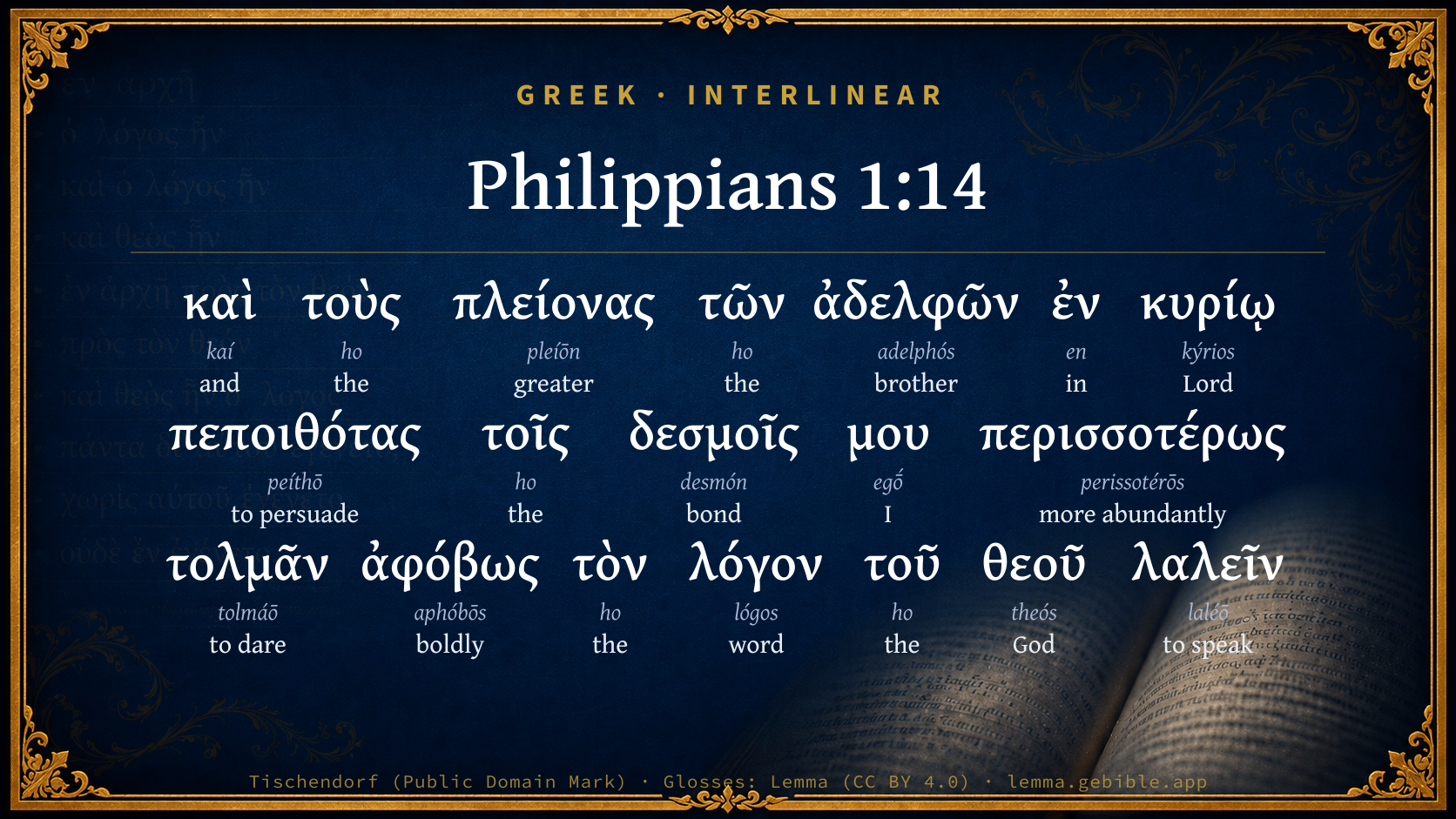
Greek (Tischendorf 8th ed.) Philippians 1:14 appears in the Greek New Testament. The text above is from the Tischendorf 8th edition. Each word links to its Strong’s number and a concise gloss. Click any word for its full Thayer’s Greek Lexicon entry.
Download image
Cite this verse

Philippians 1:14 (World English Bible). Public Domain. Lemma interlinear Bible study tool, https://lemma.gebible.app/v/philippians/1/14.

Show BibTeX & RIS
BibTeX
RIS
English Translation
and that most of the brothers in the Lord, being confident through my bonds, are more abundantly bold to speak the word of God without fear.
World English Bible · Public Domain
Download a study sheet

One document with this verse’s original text, its word-by-word gloss line, the meaning frame, cross-references with their text, attributed commentary, and full source and license credits — printable, and it pastes into notes with its structure intact.

This verse Autodidact and up

Study sheet (.html) Plain text (.txt)

A passage Seminary Student

Up to 50 verses in one chapter. A passage sheet keeps up to 6 commentary sources and 12 cross-references per verse, in the order this page ranks them, and says so on the sheet whenever that leaves anything out. Ask for a single verse and you get the Autodidact verse sheet above.

Everything on this page stays free to read, with no account — the sheet is a download of what is already on screen, not access to it.

Want to remove ads? Support Godless Engineer
Compare translations 3

The same verse in 3 English versions, stacked beneath the original-language interlinear above. Click any original word for its lexicon entry.

Each is an independent rendering of the whole verse — the interlinear is not word-aligned to these translations.

Highlighted words mark where these versions differ — a whole-verse word diff, not a word-by-word alignment.

  • World English Bible Public Domain
    and that most of the brothers in the Lord, being confident through my bonds, are more abundantly bold to speak the word of God without fear.
  • King James Version Public Domain
    And many of the brethren in the Lord, waxing confident by my bonds, are much more bold to speak the word without fear.
  • unfoldingWord Literal Text CC BY-SA 4.0
    And most of the brothers have become confident in the Lord by my chains to dare more fearlessly to speak the word.

unfoldingWord Literal Text — © unfoldingWord, licensed CC BY-SA 4.0. Word-aligned USFM3 via Door43 (git.door43.org/unfoldingWord/en_ult).

Versions to compare (up to 4)

3 of 4 selected

Show all 19 translations

Every available English version of this verse, each an independent rendering of the whole verse.

  • World English Bible Public Domain
    and that most of the brothers in the Lord, being confident through my bonds, are more abundantly bold to speak the word of God without fear.
  • Berean Standard Bible Public Domain
    And most of the brothers, confident in the Lord by my chains, now dare more greatly to speak the word without fear.
  • Majority Standard Bible Public Domain
    And most of the brothers, confident in the Lord by my chains, now dare more greatly to speak the word without fear.
  • King James Version Public Domain
    And many of the brethren in the Lord, waxing confident by my bonds, are much more bold to speak the word without fear.
  • American Standard Version (1901) Public Domain
    and that most of the brethren in the Lord, being confident through my bonds, are more abundantly bold to speak the word of God without fear.
  • Revised Version (1885) Public Domain
    and that most of the brethren in the Lord, being confident through my bonds, are more abundantly bold to speak the word of God without fear.
  • Geneva Bible (1599) Public Domain
    In so much that many of the brethren in the Lord are boldened through my bandes, and dare more frankely speake the word.
  • Douay-Rheims (1899) Public Domain
    And many of the brethren in the Lord, growing confident by my bands, are much more bold to speak the word of God without fear.
  • Young's Literal Translation Public Domain
    and the greater part of the brethren in the Lord, having confidence by my bonds, are more abundantly bold -- fearlessly to speak the word.
  • Literal Standard Version CC BY-SA 4.0
    and the greater part of the brothers in the LORD, having confidence by my bonds, are more abundantly bold to fearlessly speak the word.
  • Unlocked Literal Bible CC BY-SA 4.0
    Most of the brothers have far more confidence in the Lord because of my chains, and they have courage to fearlessly speak the word.
  • unfoldingWord Literal Text CC BY-SA 4.0
    And most of the brothers have become confident in the Lord by my chains to dare more fearlessly to speak the word.
  • Darby Bible Public Domain
    and that the most of the brethren, trusting in [the] Lord through my bonds, dare more abundantly to speak the word of God fearlessly.
  • World Messianic Bible Public Domain
    and that most of the brothers in the Lord, being confident through my bonds, are more abundantly bold to speak the word of God without fear.
  • Webster's Bible Public Domain
    And many of the brethren in the Lord, becoming confident by my bonds, are much more bold to speak the word without fear.
  • Free Bible Version CC BY-SA 4.0
    and because of my chains most of the Christians here have been encouraged to speak God's word boldly and fearlessly!
  • Bible in Basic English Public Domain
    And most of the brothers in the Lord, taking heart because of my chains, are all the stronger to give the word of God without fear.
  • Text-Critical English NT CC BY 4.0
    And the greater part of the brothers in the Lord have gained confidence through my imprisonment and are far more bold to speak the word without fear.
  • Tyndale New Testament (1534) Public Domain
    In so moche that many of the brethren in the lorde are boldned thorow my bodes and dare more largely speake the worde with out feare.

Literal Standard Version (2020), Covenant Press — licensed CC BY-SA 4.0. Text via the HelloAO Bible API (eBible.org). Unlocked Literal Bible (unfoldingWord) — licensed CC BY-SA 4.0. Text via the HelloAO Bible API (eBible.org). unfoldingWord Literal Text — © unfoldingWord, licensed CC BY-SA 4.0. Word-aligned USFM3 via Door43 (git.door43.org/unfoldingWord/en_ult). Free Bible Version, Dr. Jonathan Gallagher — licensed CC BY-SA 4.0. Text via the HelloAO Bible API (eBible.org).

Word by word

More ways to search: Search by grammar → Find every occurrence → Compare this word →

Practice this passage: Drill this verse → Learn its vocabulary →

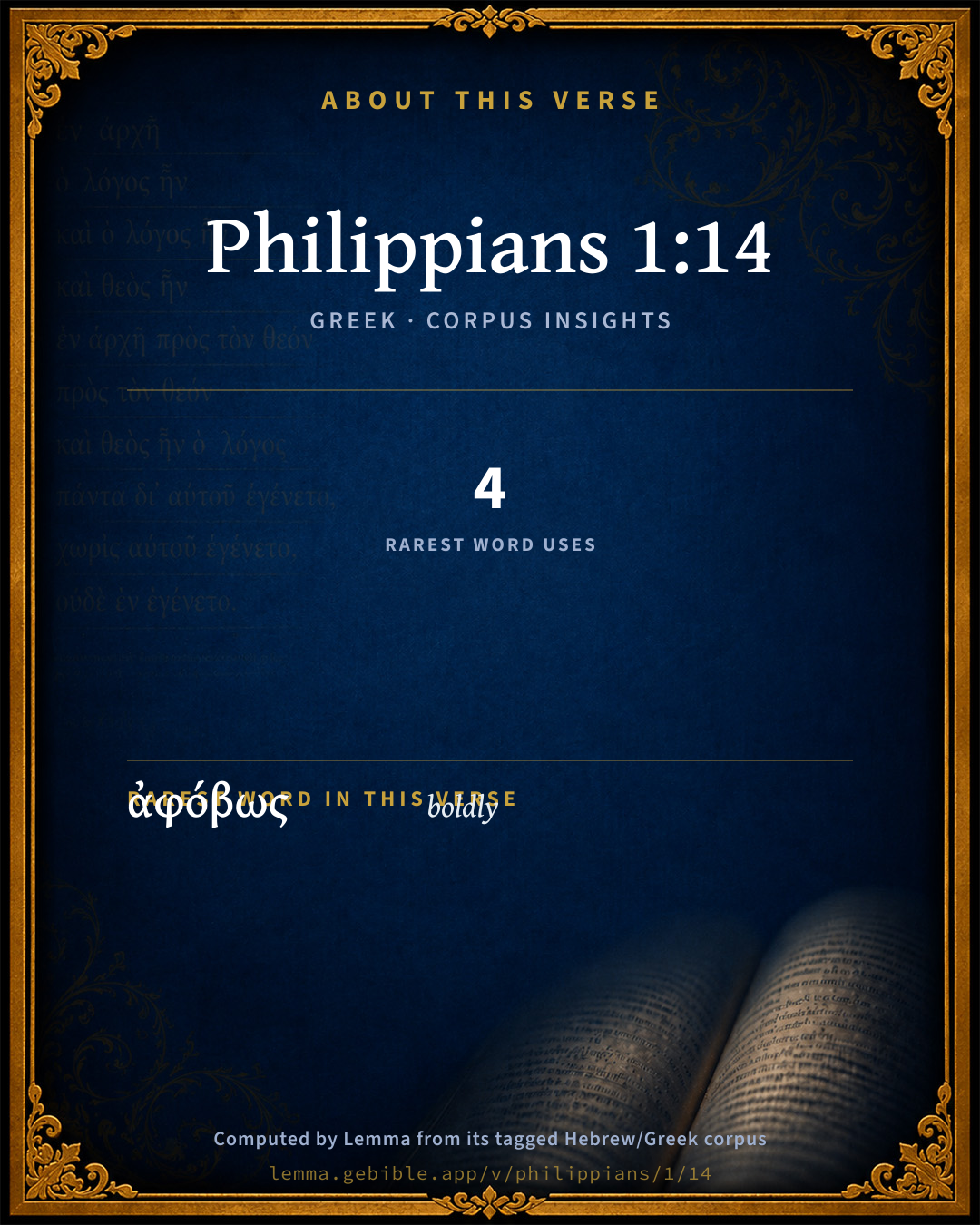
ἀφόβως
aphóbōs
G870
“boldly”
Adverb
Part of Speech
Adverb
Full Thayer's Definition

Origin: from a compound of G1 (as a negative particle) and G5401

TDNT: None

1. without fear, boldly
  1. καὶ kaí G2532 “and” Conjunction
  2. τοὺς ho G3588 “the” Article, Accusative, Plural, Masculine
  3. πλείονας pleíōn G4119 “greater” Adjective, Accusative, Plural, Masculine, Comparative
  4. τῶν ho G3588 “the” Article, Genitive, Plural, Masculine
  5. ἀδελφῶν adelphós G80 “brother” Noun, Genitive, Plural, Masculine
  6. ἐν en G1722 “in” Preposition
  7. κυρίῳ kýrios G2962 “Lord” Noun, Dative, Singular, Masculine
  8. πεποιθότας peíthō G3982 “to persuade” Verb, Perfect, Active, Participle, Accusative, Plural, Masculine
  9. τοῖς ho G3588 “the” Article, Dative, Plural, Masculine
  10. δεσμοῖς desmón G1199 “bond” Noun, Dative, Plural, Masculine
  11. μου egṓ G1473 “I” Personal pronoun, 1st person, Genitive, Singular
  12. περισσοτέρως perissotérōs G4056 “more abundantly” Adverb, Comparative
  13. τολμᾶν tolmáō G5111 “to dare” Verb, Present, Active, Infinitive
  14. τὸν ho G3588 “the” Article, Accusative, Singular, Masculine
  15. λόγον lógos G3056 “word” Noun, Accusative, Singular, Masculine
  16. τοῦ ho G3588 “the” Article, Genitive, Singular, Masculine
  17. θεοῦ theós G2316 “God” Noun, Genitive, Singular, Masculine
  18. λαλεῖν laléō G2980 “to speak” Verb, Present, Active, Infinitive

About this verse

These counts appear in no published source. They are computed here, from the morphology-tagged text and Lemma’s own curated glosses. What Lemma adds →

19
words
15
distinct lemmas
Pauline Epistles
section

Notable vocabulary

The rarest word here is ἀφόβως boldly G870 — appearing just 4 times in the whole Greek New Testament.

Shared distinctive vocabulary

ἀφόβως boldly G870 occurs in 4 verses of the Greek New Testament. Also found in:

Repetition

A word recurs within this verse:

  • τοὺς the G3588 ×5

Cross-references

11

Topical passages linked to Philippians 1:14 in the Treasury of Scripture Knowledge — connected by theme and wording, ordered by reader-vote popularity; previews shown in the World English Bible.

  • Ephesians 6:19–20 on my behalf, that utterance may be given to me in opening my mouth, to make known with boldness the mystery of the Gospel,
  • 1 Thessalonians 2:2 but having suffered before and been shamefully treated, as you know, at Philippi, we grew bold in our God to tell you the Gospel of God in much conflict.
  • Luke 1:74 To grant to us that we, being delivered out of the hand of our enemies, should serve him without fear,
  • Philippians 1:7 It is even right for me to think this way on behalf of all of you, because I have you in my heart, because, both in my bonds and in the defense and confirmation of the Gospel, you all are partakers with me of grace.
  • Colossians 4:4 that I may reveal it as I ought to speak.
  • Colossians 4:7 All my affairs will be made known to you by Tychicus, the beloved brother, faithful servant, and fellow bondservant in the Lord.
  • Luke 12:5–7 But I will warn you whom you should fear. Fear him, who after he has killed, has power to cast into Gehenna. Yes, I tell you, fear him.
  • Acts 4:23–31 Being let go, they came to their own company, and reported all that the chief priests and the elders had said to them.
  • 2 Corinthians 1:3–7 Blessed be the God and Father of our Lord Jesus Christ, the Father of mercies and God of all comfort;
  • Ephesians 3:13 Therefore I ask that you may not lose heart at my troubles for you, which are your glory.
  • Philippians 4:1 Therefore, my brothers, beloved and longed for, my joy and crown, so stand firm in the Lord, my beloved.

Cross-references courtesy of OpenBible.info (CC BY 4.0).

Where the printed editions differ

1 variant

Places in this verse where the major printed Greek editions disagree on the wording in a way that affects the translation — a comparison of editions, not a manuscript-by-manuscript collation. The editions are the modern critical texts (Nestlé-Aland 28/27, SBL, Westcott-Hort, Tregelles, Tyndale House) and the traditional texts behind the KJV (the Textus Receptus and the Byzantine/Majority text). It is not a claim about which reading is original.

  1. Extra text
    τοῦ θεοῦ

    “of the God”

    In WHTreg Not in NA28NA27TynSBLTRByz

    τοῦ θεοῦ (tou theou) 'of the God' is only in a few manuscripts (WH+Treg)

Textual data: Translators Amalgamated Greek New Testament (STEPBible TAGNT) · CC BY 4.0.

Commentary

Notes on Philippians 1:14 from classic Christian and Jewish commentators (each source and its license shown beneath its notes). The classic Christian expositions comment on the surrounding passage and are grouped to its opening verse, so a note may address several verses; the Jewish commentaries on the Tanakh (Rashi and others) are per-verse, so they appear only where the commentator wrote on this verse.

Lemma curates 59 commentaries, every one of them public domain or Creative Commons licensed, each selected and text-cleaned for this edition rather than reprinted as found. About our sources →

Tyndale Open Study Notes

Tyndale Open Resources

1:14 As a result of Paul’s courage and boldness, the believers (literally the brothers in the Lord; see study note on 1:12) had become more daring and less fearful in proclaiming God’s message. Paul’s boldness was contagious.

Tyndale Open Study Notes — © Tyndale Open Resources, licensed CC BY-SA 4.0. Text via the HelloAO Bible API.

Bengel's Gnomon

Johann Albrecht Bengel

Php 1:14. Τῶν ἀδελφῶν, of the brethren) who had formerly been afraid.—ἐν Κυρίῳ, in the Lord) construed with are bold.—τοῖς δεσμοῖς μου, by my bonds) They saw Paul both constant and safe in his confession of Christ.—ἀφόβως, without fear) no one terrifying them. Fear often is no longer felt by [flies from] those who make an attempt.

Bengel's Gnomon of the New Testament — English translation (T&T Clark, Edinburgh, 1860) — public domain. Text from a community e-Sword module.

Meyer's Critical & Exegetical Commentary

Heinrich August Wilhelm Meyer

Php_1:14. τοὺς πλείονας] the majority, 1Co_10:5; 1Co_15:6, et al. It is not to be more precisely specified or limited.

ἐν κυρίῳ] belongs not to ἀδελφῶν (Luther, Castalio, Grotius, Cornelius a Lapide, Heinrichs, van Hengel, de Wette, Ewald, Weiss, and others)in which case it would not indeed have needed a connecting article (Col_1:2; Col_4:7), yet would have been entirely superfluousbut to πεποιθότας, along with which, however, it is not to be rendered: relying upon the Lord with respect to my bonds (Rheinwald, Flatt, Rilliet, comp. Schneckenburger, p. 301). It means rather: in the Lord trusting my bonds, so that ἐν κυρίῳ is the specific modal definition of πεποιθ. τοῖς δ. μ., which trust is based and depends on Christ. Comp. Php_2:24; Gal_5:10; Rom_14:14; 2Th_3:4. On the dative, comp. 2Co_10:7; Phm_1:21, and the ordinary usage in the classics; in the New Testament mostly with ἐπί or ἐν. Ἐν κυρίῳ is placed first as the correlative of the ἐν Χριστ., Php_1:13. As the apostles bonds had become generally known as in Christ, so also in Christ (who will not abandon the work of His prisoner that had thus become so manifest) may be found the just ground of the confidence which encourages the brethren, Pauls fellow-Christians in Rome, ἀφόβως τ. λ. λαλεῖν. They trust the bonds of the apostle, inasmuch as these bonds exhibit to them not only an encouraging example of patience (Grotius), but also (comp. Php_3:8; Col_1:24 f.; 2Ti_2:8 f.; Mat_5:11 f., and many other passages) a practical guarantee, highly honourable to Christ and His gospel, of the complete truth and justice, power and glory of the word,[64] for the sake of which Paul is in bonds; thereby, instead of losing their courage, they are only made all the bolder in virtue of the elevating influence of moral sympathy with this situation of the apostle in bonds. Weiss explains as if the passage ran τῇ φανερώσει τῶν δεσμῶν μου (which would tend to the recommendation of the gospel); while Hofmann thinks that, to guard themselves against the danger of being criminally prosecuted on account of their preaching, they relied on the apostles imprisonment, in so far as the latter had now shown itself, in the judicial process that had at length been commenced, to be solely on account of Christ, and not for anything culpable. The essential elements, forsooth, are thus introduced in consequence of the way in which Hofmann has construed for himself the situation (see on Php_1:13).

περισσοτ.] i.e. in a higher degree than they had formerly ventured upon, before I lay here in bonds. Their ἀφοβία in preaching had increased. This, however, is explained by Hofmann, in accordance with the above hypothesis, by the fact that the political guiltlessness of preaching Christ had now been established,thus referring, in fact, the increase of their fearless boldness to a sense of legal security. But the reason of the increased ἀφοβία lay deeper, in the sphere of the moral idea, which manifested itself in the apostles bonds, and in accordance with which they trusted those bonds in the Lord, seeing them borne for the Lords sake. They animated the brethren to boldness through that holy confidence, rooted in Christ, with which they imbued them.

τὸν λόγου λαλεῖν] i.e. to let the gospel become known, to preach, Act_11:19, and frequently. On ἀφόβως, comp. Act_4:31.

[64] Oecumenius well says: εἰ γὰρ μὴ θεῖον ἧν, φησὶ, τὸ κήρυγμα, οὐκ ἂν ὁ Παῦλος ἠνείχετο ὑπὲρ αὐτοῦ δεδέσθαι Comp. ver. 16.

Meyer — Critical and Exegetical Commentary on the New Testament — English translation by Peter Christie, edited by Frederick Crombie (T&T Clark, 1880) — public domain. Text from a community e-Sword module.

Expositor's Greek Testament

ed. W. Robertson Nicoll

Phi 1:14 . τοὺς πλείονας . Vaughan holds that “from the universal practice of deciding matters by the vote of a majority the term comes to mean the main body , the society as a whole ,” but this scarcely seems needful. τῶν ἀδ . ἐν Κ . These words surely make up one phrase (so Alf [21] , Weizs., Ws [22] , etc., as against Lft [23] , Lips [24] , Myr [25] , etc.). Cf. Col 1:2 . It is difficult to see where the tautology, which is said to be involved in this interpretation, comes in. Probably it is an almost technical combination. Dsm [26] ( BS [27] , p. 82) notes from Papyri a precisely similar technical use of ἀδελφός in the language of the Serapeum at Memphis. πεποιθ . τ . δεσμ . μου . “Having confidence in my bonds,” i.e. , being encouraged by the favourable light in which his imprisonment was beginning to be regarded when seen in its true character. [This tells in favour of (4) in Phi 1:13 .] Cf. Phm 1:21 , πεποιθὼς τῇ ὑπακοῇ σου . λαλεῖν . Hpt [28] believes that λαλ . is used here expressly instead of λέγειν as emphasising the physiological process rather than the word spoken. In the later language these refinements were apt to be overlooked. Still it is interesting to find that in LXX דָבַר is almost invariably transl. by λαλεῖν and אָמַר by λέγειν .

[21] Alford’s Greek Testament .

[22] Weiss.

[23] Lightfoot.

[24]ips. Lipsius.

[25] Meyer.

[26] Deissmann ( BS. = Bibelstudien, NBS. = Neue Bibelstudien ).

[27] Bibelstudien

[28] Haupt.

The Expositor's Greek Testament, edited by W. Robertson Nicoll (1897–1910) — public domain. Text from a community e-Sword module.

Cambridge Greek Testament for Schools and Colleges

14. τοὺς πλείονας. “The majority.” There were exceptions, a minority. He has in mind what comes out below, the difference between friendly and unfriendly sections among the Roman Christians. Act 28:15, and the Epistle to the Romans as a whole, assure us that the friendly were the majority. On the whole we gather from this passage (Php 1:14-18) that a new energy was moving the whole Roman mission, but that the motives in it varied; the majority of the converts were stimulated by the Apostle’s willing sufferings, a minority by opposition to his influence.

τῶν ἀδελφῶν ἐν κυρίῳ. So connect the words (with A.V. and R.V.), not τῶν ἀδελφῶν, ἐν κ. πεποιθότας κτλ. (with Ellicott and Lightfoot). Such authorities notwithstanding, the construction they decline is an easy one in the Greek of the N. T. In classical Greek no doubt we should have τῶν ἐν κυρίῳ ἀδελφῶν or τῶν ἀ. τῶν ἐν κ. But the law of N. T. usage is certainly looser in such “attributives”; see e.g. 1Co 10:18 (τὸν Ἰσραὴλ κατὰ σάρκα); Col 1:8 (τὴν … ἀγάπην ἐν πνεύματι). True, Gal 5:10 (πέποιθα εἰς ὑμᾶς ἐν κυρίῳ) has been compared, to justify the rendering here, “Having in the Lord confidence in my bonds”; but the difference here is that ἐν κυρίῳ, if made to begin a clause, would take an emphasis which seems to be uncalled for. (See generally Winer, N. T. Grammar, III. § xx. Winer explains as Ellicott, &c.)—The precise phrase ἀδελφὸς ἐν κυρίῳ is not found elsewhere; but it is self-evidently possible; and see 1Co 4:15 for a (practical) instance of πατὴρ ἐν Χριστῷ.

πεποιθότας τοῖς δεσμοῖς μου. Πεποιθέναι, with the dative of the person or thing trusted, is common in Greek poetry, and occasional in Hellenistic prose. In N. T. the only parallels are 2Co 10:7; Phm 1:2. “Confiding in my bonds” is a singular expression; but the paradox is surely intentional. On St Paul as imprisoned they leaned, as men always tend to lean on a leadership proved to be strong by self-sacrifice. So led, they began working with a new assurance of their cause, and of their hope.

περισσοτέρως τολμᾶν. “More abundantly venture”; they are more lavish of effort and venture. On the bearing of such a statement on the date of the Epistle, see Introduction, ch. ii—Περισσός and its cognates are favourite words in the warm style of St Paul.

ἀφόβως. They saw the fearless Apostle teaching Christ ἀκωλύτως (Act 28:31); why should they not venture?

τὸν λόγον τοῦ θεοῦ. The revealed account of the glory and work of the Christ of God; the Gospel. It is observable that he regards the work of “speaking the word” as the work not only of ordained messengers but of all Christians.—On the reading see critical note.

Cambridge Greek Testament for Schools and Colleges (Cambridge University Press, 1896; 21 vols, various authors incl. Carr, Maclear, Plummer, Farrar, Lumby, Moule, M. R. James, Simcox) — public domain. Text from a community e-Sword module.

International Critical Commentary

14. καὶ τοὺς πλείονας τῶν ἀδελφῶν ἐν κυρίῳ πεποιθότας τοῖς δεσμοῖς μου: ‘And the majority of the brethren having confidence in the Lord by reason of my bonds.’

τοὺς πλείονας: Not as A.V. ‘many,’ but ‘the greater number.’ (Comp. 1Co 10:5.)

Differences as to the connection of the words. 1. ἐν κυρίῳ: (a) with ἀδελφῶν, ‘brethren in the Lord’ (Alf., Kl., Dw., Weiss, De W., Weizs. [Trans.]); (b) with πεποιθότας τοῖς δεσμοῖς, ‘relying on my bonds in the Lord.’ According to this, ἐν κυρίῳ is the modal definition of πεπ. τ. δεσμ. The ground of confidence is τοῖς δεσμ., not ἐν κυρ., which marks the nature and sphere of the confidence (so Mey., Lightf., Ellic., Lips., Ead.). 2. πεποιθότας: (a) with τοῖς δεσμοῖς, as that in which confidence is reposed (Mey., Kl., Ead., Lightf., Alf., Lips.); (b) with ἐν κυρίῳ, as the ground of confidence (Beet, Hack.).

As to 1 (a), ἀδελφοὶ ἐν κυρίῳ does not occur elsewhere. None of the passages cited by Kl. and others, such as 1Co 4:17; Col 4:7; Phm 1:16, are in point, since in none of them does the preposition depend directly on ἀδελφὸς. Moreover, the addition of ἐν κ. would seem superfluous. 1 (b) is grammatically defensible. (See Gal 5:10; 2Th 3:4.) But the sense is forced, if it can be called sense. What is meant by ‘having confidence in,’ or ‘trusting in my bonds’? 2 (b) is a legitimate construction. (See Jer 31:7, LXX, Eng. Bib. 48:7; Php 2:24; and the analogous constructions, Php 3:3, Php 3:4.) It is true that in such cases πεποιθ. usually precedes; but the change of position is for the sake of emphasis, as Php 3:3. Ἐν κυρίῳ is the ground of πεποιθ., and τοῖς δεσμ. is instrumental. The sense is thus simple and consistent. By Paul’s bonds the brethren have had their confidence in the Lord strengthened. He has already said that his bonds have become manifest in Christ. The testimony borne by his imprisonment has been distinctly that of Christ’s prisoner, and has therefore encouraged confidence in Christ.

περισσοτέρως τολμᾷν ἀφόβως τὸν λόγον τοῦ θεοῦ λαλεῖν: ‘are more abundantly bold to speak the word of God without fear.’ For περισσοτέρως, comp. 2Co 1:12, 2Co 1:2:4; Gal 1:14. It belongs with τολμᾷν, not with ἀφόβως.

Τολμᾷν is to carry into action the feeling of resolute confidence expressed by θαρσεῖν. (See 2Co 10:2, and W. St. ad loc.)

τὸν λόγον τοῦ θεοῦ: The message of God; the gospel. Very frequent in N.T. Once in the sense of ‘the declared purpose of God’ (Rom 9:6). Not elsewhere in Paul with λαλεῖν. For the phrase τὸν λόγ. λαλ. or τὸν λόγ. θε. λαλ., see Act 4:31, Act 13:46, Act 14:25.

Paul’s boldness and patience in his captivity have stirred up the courage and zeal of the Roman Christians, and probably have awakened shame in some recreant disciples. Chrys. remarks that their courage had not failed before, but had grown by the apostle’s bonds.

International Critical Commentary — older volumes (1896–1929), various authors — public domain. Text from a community e-Sword module.

Geneva Bible (1599)

Geneva Bible translators

The Gospel is called the Word, to set forth the excellence of it.

Geneva Bible (1599) marginal notes — public domain. Text via Bolls.life.

Jamieson, Fausset & Brown

Robert Jamieson, A. R. Fausset & David Brown

Translate as Greek, "And that (Phi 1:13) most of the brethren in the Lord," &c. "In the Lord," distinguishes them from "brethren after the flesh," Jewish fellow countrymen. ELLICOTT translates, "Trusting in the Lord."

by my bonds--encouraged by my patience in bearing my bonds.

much more bold--Translate as Greek, "are more abundantly bold."

Jamieson, Fausset & Brown — Commentary Critical and Explanatory on the Whole Bible (1871) — public domain (CC PDM 1.0). Text via the HelloAO Bible API.

Adam Clarke's Commentary

Verse 14. Waxing confident] Finding the effect produced by the public defence which the apostle made, they were greatly encouraged, and the more boldly and openly proclaimed the doctrine of Christ crucified.

The word] The doctrine of Christ; several excellent MSS. and versions add, some θεου, others κυριου, the word of God, or the word of the Lord. This is a respectable reading, and is probably genuine.

Adam Clarke's Commentary on the Bible (1810–1826) — public domain. Text from a community e-Sword/MySword module.

John Calvin's Commentaries

14 Many of the brethren. By this instance we are taught that the tortures of the saints, endured by them in behalf of the gospel, are a ground of confidence to us. It were indeed a dreadful spectacle, and such as might tend rather to dishearten us, did we see nothing but the cruelty and rage of the persecutors. When, however, we see at the same time the hand of the Lord, which makes his people unconquerable, under the infirmity of the Cross, and causes them to triumph, relying upon this, we ought to venture farther than we had been accustomed, having now a pledge of our victory in the persons of our brethren. The knowledge of this ought to overcome our fears, that we may speak boldly in the midst of dangers.

John Calvin's Commentaries (1540-1563) — public domain. Text from the Calvin Translation Society English edition (1840s-50s) via the Christian Classics Ethereal Library (ccel.org). Calvin's coverage is partial (roughly two-thirds of the Bible); uncommented books and verses are honest gaps, never fabricated. The 19th-century editor's footnotes and remarks are omitted so the notes are faithfully Calvin's own voice.

Ellicott's Commentary for English Readers

(14) And many (properly, the greater number) of the brethren in the Lord.—The words “in the Lord” should be connected with “trusting,” as in Php_2:24; Gal_5:10; 2Th_3:4. As connected with the word “brethren,” they are unmeaning; whereas St. Paul constantly uses them (especially in these Epistles), generally with a verb or verbal adjective, and always to convey some distinct idea. That the words “in my bonds” follow constitutes no difficulty. “In the Lord” expresses the ground of confidence; “in my bonds” simply the occasion and circumstances.

Waxing confident by my bonds.—There is a two-fold sense here, corresponding to the two-fold division of preachers made below. Those who preached Christ “of contention” trusted in St. Paul’s captivity as giving them scope; those who preached “of good will” found in it a striking example of evil overruled to good, and so gained from it fresh encouragement.

A Bible Commentary for English Readers, edited by Charles John Ellicott (1878–1897) — public domain. Text from a community e-Sword module.

The Cambridge Bible for Schools and Colleges

gen. ed. J. J. S. Perowne

14. many] Better, most. It is noticeable that the Apostle should imply that there were exceptions. Possibly, he refers here to what comes out more clearly below, the difference between friendly and unfriendly sections among the Roman Christians. We can scarcely doubt (in view of Romans 16 and Acts 28) that the friendly were the majority. If so, St Paul may here practically say that a majority of the brethren were energized into fresh efforts, by his imprisonment, while a minority, also stirred into new activity, were acting on less worthy motives. In view of the context, this seems more likely than that he should merely imply by this phrase that the revival of activity was not universal.

In any case, this verse implies that a spirit of languor and timidity had recently infected the believing community at Rome.

the brethren in the Lord] So also R.V. Bps Ellicott and Lightfoot connect the words here otherwise; “the brethren, having in the Lord confidence, &c.” Grammatically, either is possible. But to us the “rhythm of the sentence,” a sort of evidence not easy to define and explain, but a real item for decision, seems to plead for the connexion in the text. It is true that the precise phrase “brethren in the Lord” is not found elsewhere. But a near parallel is Rom_16:13, “Rufus, the chosen one in the Lord”; for there too the words “in the Lord” are in a certain sense superfluous. See too Rom_16:8; Rom_16:10.

waxing confident] More strictly and simply (for the Greek participle is practically, though not in form, a present), being confident, confiding.—The idea is that of a sense of rest and reassurance after misgivings.

by my bonds] More closely, perhaps, in my bonds. The “confidence was, in a sense, reposed “in,” or on, Paul’s chains, his captivity, just so far as that captivity vividly reminded the Roman believers of the sacredness and goodness of the cause, and of the Person, for whose sake the Apostle unflinchingly incurred it and willingly bore it. The heart is the best interpreter of such words.

For the construction in the Greek, cp. Phm_1:21, the only exact N.T. parallel. It is found, but rarely, in the LXX.

are much more bold] Lit., and better, more abundantly venture. They “venture” more often, more habitually, than of late.—On the bearing of such statements on the date of the Epistle see Introduction, p. 16.

to speak the word] “The word of the cross” (1Co_1:18); “of truth” (Eph_1:13); “of life” (below, Php_2:16); “of Christ” (Col_3:16); “of the Lord” (1Th_1:8; 1Th_4:15); &c.—It is the revealed and delivered account of what Christ is, has wrought, &c.—It is observable that St Paul regards such “speaking” as the work, not only of the class of ordained Christians, but of Christians in general. See further on Php_2:16.

The Cambridge Bible for Schools and Colleges (gen. ed. J. J. S. Perowne; Cambridge University Press, 1878–1918) — public domain. Text from a community e-Sword module.

John Gill's Exposition

And many of the brethren in the Lord,.... This is another instance of the usefulness of the apostle's sufferings, and another proof of their being for the furtherance of the Gospel; they were not only the means of the conversion of many that were without, but were very encouraging and strengthening to them that were within the church, and to many that were in the ministry; who are called "brethren", some real, others nominal; being partakers of the grace of God, at least in profession, or otherwise they would not have been fit to have been ministers of the word, nor members of a Gospel church, which was necessary to their being regularly sent forth; and whom the apostle calls and owns as brethren in the ministry, being sent forth by Christ, at least some of them, and having the same commission to preach the Gospel as he had; though they had not equal gifts and qualifications with him: he styles them brethren "in the Lord", to distinguish them from the Jews at Rome, who were his brethren according to the flesh; and to express their spiritual character and relation, and point out the work of the Lord, in which they were jointly concerned with him: now though not all the brethren, yet many of them were greatly affected with, and influenced by the apostle's patient and cheerfully suffering for Christ; insomuch that, as he says,

waxing confident by my bonds, are much more bold to speak the word without fear; or as some read it, "waxing confident in the Lord"; connecting the phrase, "in the Lord", with this word, and so make the ground and object of their confidence the Lord; whose presence, power, grace, and Spirit, emboldened them the more by the apostle's bonds to preach the Gospel with courage and intrepidity; the Lord being on their side, and their helper, they feared not what men could do unto them; or else being animated by the apostle's patience and firmness of mind in suffering, and by the use they saw his bonds were of for the spread of the Gospel, they took heart and courage to "speak the word"; the word "of God", as the Vulgate Latin, Syriac, and Ethiopic versions read; and so the Alexandrian, Claromontane, and two of Stephens's copies: meaning either the essential word, the Lord Jesus Christ, who was the subject of their ministry; or the written word, the writings of Moses and the prophets, the books of the Old Testament, according to which they spoke; or the Gospel, called often the word, and sometimes with an addition, the word of truth, the word of faith, the word of reconciliation, the word of righteousness, the word of life, and the word of our salvation, from the several subjects of it: this they spake boldly and freely, as it ought to be spoken, and "without fear", not without fear and reverence of God, whose word it is; nor of themselves and their own weakness and inabilities, which cause much fear and trembling; but without the fear of man, which brings a snare; they had no regard to the threats and menaces, the reproaches and persecutions of men; none of these things moved them; they feared God and not man, and so went on boldly, preaching the Gospel; which is related with pleasure, as a fruit and effect of the apostle's sufferings, and which he doubted not would be very delightful to the Philippians to hear of.

John Gill's Exposition of the Whole Bible (1746–1763) — public domain (CC PDM 1.0). Text via the HelloAO Bible API.

Trapp's Complete Commentary

John Trapp

14 And many of the brethren in the Lord, waxing confident by my bonds, are much more bold to speak the word without fear.

Ver. 14. Are much more bold] This is the fruit of the saints’ sufferings. Ecclesia totum mundum sanguine et oratione convertit, saith Luther. As the lily is increased by its own juice that flows from it, so is the Church by its sufferings. This caused Julian to spare some Christians whom he could have wished out of the world. I thank our Lord God (said Bp Ridley, in a letter of his to Bradford) that since I heard of our dear brother Rogers’ departing, and stout confessing of Christ and his truth even unto death, my heart, blessed be God, rejoiced of it; neither ever since that time I have felt any lumpish heaviness, as I grant I have felt sometimes before. So Bradford in a letter to Cranmer, Latimer, and Ridley, prisoners at Oxford: Our dear brother Rogers hath broken the ice valiantly. As this day I think hearty Hooper, trusty Taylor, and sincere Saunders end their course and receive their crown. The next am I, which hourly look for the porter to open me the gates after them to enter into the desired rest. God forgive me mine unthankfulaess for this exceeding great mercy.

John Trapp, A Commentary or Exposition upon All the Books of the Old and New Testament (1647–1656) — public domain. Text from a community e-Sword module.

Albert Barnes' Notes on the Bible

And many of the brethren - Many Christians. It is evident from this, that there were already “many” in Rome who professed Christianity.

In the Lord - In the Lord Jesus; that is, united to him and to each other by a professed attachment to him. This is a common phrase to, designate Christians.

Waxing confident by my bonds - Becoming increasingly bold and zealous in consequence of my being confined. This might have been either:

(1)That from the very fact that so distinguished a champion of the truth had been imprisoned, they were excited to do all they could in the cause of the gospel. Or,

(2)They were aroused by the fact that the cause of his imprisonment had become generally understood, and that there was a strong current of popular favor setting toward Christianity in consequence of it. Or,

(3)They had had contact with Paul in his own “hired house,” and had been incited and encouraged by him to put forth great efforts in the cause. Or,

(4)It would seem that some had been emboldened to promulgate their views, and set themselves up as preachers, who would have been restrained if Paul had been at liberty.

They were disposed to form parties, and to secure followers, and rejoiced in an opportunity to increase their own popularity, and were not unwilling thus to diminish the popularity and lessen the influence of so great a man as Paul. Had he been at liberty, they would have had no prospect of success; see Phi 1:16. To this may be added a suggestion by Theodoret. “Many of the brethren have increased boldness - θάρσος tharsos - on account of my bonds. For seeing me bear such hard things with pleasure, they announce that the gospel (which sustains me) is divine.” The same sentiment occurs in Oecumen, and Theophylact; see Bloomfield. In Paul himself they had an illustration of the power of religion, and being convinced of its truth, they went and proclaimed it abroad.

To speak the word without fear - That is, they see that I remain safely (compare Act 28:30), and that there is no danger of persecution, and, stimulated by my sufferings and patience, they go and make the gospel known.

Albert Barnes' Notes on the Bible (1834–1885) — public domain. Text from a community e-Sword/MySword module.

Haydock's Catholic Bible Commentary

And many of, &c. encouraged by the intrepidity and perseverance of the apostle. (Calmet) --- Knowing that sufferings undergone for the cause of Jesus Christ were most honourable, and the portion truly enviable of all the saints, as by sufferings they were known to be his disciples, and by sufferings they were to purchase that eternal weighty of glory prepared for all that suffer patiently and joyfully for God’s sake.

George Leo Haydock (1774–1849), Haydock's Catholic Family Bible and Commentary, 1859 edition — public domain. Excludes Psalms (Douay-Rheims chapter numbering differs from Protestant) and Deuterocanonical books (Catholic canon only).

Whedon's Commentary on the Bible

Daniel D. Whedon

14. Waxing confident—A second result was the increased boldness of Christians in preaching.

Many—Rather, the greater part. Naturally, the peril of their great leader would inspire hesitancy and wariness in his friends, but his brave endurance of his situation, his persistent discourse concerning Christ to all comers, and his heroic readiness to die for him, kindled anew their courage and zeal, and multiplied their labours.

Daniel D. Whedon (gen. ed.), Commentary on the Old and New Testaments (1874–1909) — public domain. Text from a community e-Sword module.

The Pulpit Commentary

And many of the brethren in the Lord; rather, and that most. Most of the brethren took courage; there were exceptions. Waxing confident by my bonds. The words, "in the Lord," are perhaps better taken with being "confident." Their confidence rests upon St. Paul"s bonds, but it is in the Lord. St. Paul"s example gives them courage, because they know that he is suffering for the love of Christ, and is supported in his sufferings by the grace of Christ. Are much more bold to speak the word without fear; better, more abundantly, as R.V. The best manuscripts read here, "the Word of God."

The Pulpit Commentary (1880–1919), ed. H.D.M. Spence-Jones & Joseph S. Exell — public domain. Text from a community e-Sword module.

John Wesley's Explanatory Notes

And many - Who were before afraid. Trusting in the Lord through my bonds - When they observed my constancy, and safety not withstanding, are more bold.

John Wesley, Explanatory Notes Upon the Whole Bible (1754–1765) — public domain. Text via the GEBible commentary corpus.

The People's New Testament

B. W. Johnson

14. Many of the brethren. Taking courage from his boldness, though in bonds, the brethren were engaged in preaching the gospel with greater zeal than ever before. See 4:22, for some of the results of this preaching.

B. W. Johnson's The People's New Testament with Notes (1889–1891) — public domain. Electronic text from the Christian Classics Ethereal Library (CCEL) ThML edition.

Alford’s Greek Testament

Henry Alford

14.] and (so that) most of (not ‘many of,’ as E. V., al.) the brethren in the Lord (this is the most natural connexion: see on πέποιθα, -ώς, standing first in the sentence, above, ver. 5. And so De W., al. Meyer, Ellic., Winer, § 20. 2, al., take ἐν κυρ. with πεποιθότας, as the element in which their confidence was exercised, as ἐν χριστῷ, ver. 13. To this sense there is no objection: but the other arrangement still seems to me, in spite of Ellic.’s note, more natural. No article is required before ἐν: see reff.) encouraged by (having confidence in) my bonds (εἰ γὰρ μὴ θεῖον ἦν, φησί, τὸ κήρυγμα, οὐκ ἂν ὁ Παῦλος ἠνείχετο ὑπὲρ αὐτοῦ δεδέσθαι, Œc.) are venturing more abundantly (than before) to speak the word of God (it would certainly seem here, from the variations, as if the shorter reading were the original text) fearlessly.

Henry Alford, The Greek Testament (1849–1861) — public domain. Text from a community e-Sword module.

Vincent's Word Studies in the New Testament

Marvin R. Vincent

Many [τους πλειονας] . Rev., correctly, the most. Lit., the more. Implying that there were a few who held back.

Brethren in the Lord. In the Lord should be rather connected with being confident. The expression brethren in the Lord does not occur in the New Testament; while to have confidence in one in the Lord is found Gal 5:10; 2Th 3:4; compare ch. 2 24. In the Lord is thus emphatic. It may be correlative with in Christ, ver. 13; but this is not certain. 175 In the Lord trusting my bonds, signifies that the bonds awaken confidence as being the practical testimony to the power of the Gospel for which Paul is imprisoned, and therefore an encouragement to their faith.

Are much more bold [περισσοτερως τολμαν] . Rev., more abundantly bold, thus holding more closely to the literal meaning of the adverb. For are bold, see on 2Co 10:2. The boldness required to profess Christ within the precincts of the palace is illustrated by the graffito or wall - scribble discovered in 1857 among the ruins on the Palatine. It is a caricature of Christ on the cross, with an ass's head, while on the left appears a christian youth in an attitude of adoration. Underneath are scrawled the words Alexamenos worships God. 176 To speak [λαλειν] . The verb denotes the fact rather than the substance of speaking. See on Mt 28:18. They have broken silence.

Marvin R. Vincent, Word Studies in the New Testament (1887–1900) — public domain. Text from a community e-Sword/MySword module.

Lesson kit

Teaching starters — assembled from the data on this page, not authored interpretation. Every prompt links to the verse data it draws on. Edit before teaching.

Philippians, in the Pauline Epistles, opens this verse with 19 words (15 distinct Greek lemmas). Its most distinctive word is aphóbōs (“boldly”). A historical commentator’s framing appears above. Read the whole chapter for the surrounding context.

Discussion questions

  1. What does “boldly” (aphóbōs) contribute to the verse as a whole?
  2. How does Luke 1:74, which shares the word «boldly», read alongside this verse?
  3. What does the repetition of “the” (5× in this one verse) do in this verse?
  4. These translations render this verse differently; the difference is in the English rendering, not the original. What questions does that raise?
  5. Compare how Tyndale Open Study Notes and Bengel's Gnomon read this verse. Where do they agree or differ?

Things to notice

Reading settings

Reading text

Shown beneath each verse's original-language words.

Old Testament
Old Testament edition

Read the OT as the Masoretic Hebrew (MT) or the Greek Septuagint (LXX).

English shown for the Greek Septuagint (in the Hebrew ↔ Greek comparison).

Comparing translations? Open the Compare panel on any verse page to stack up to four side by side.