
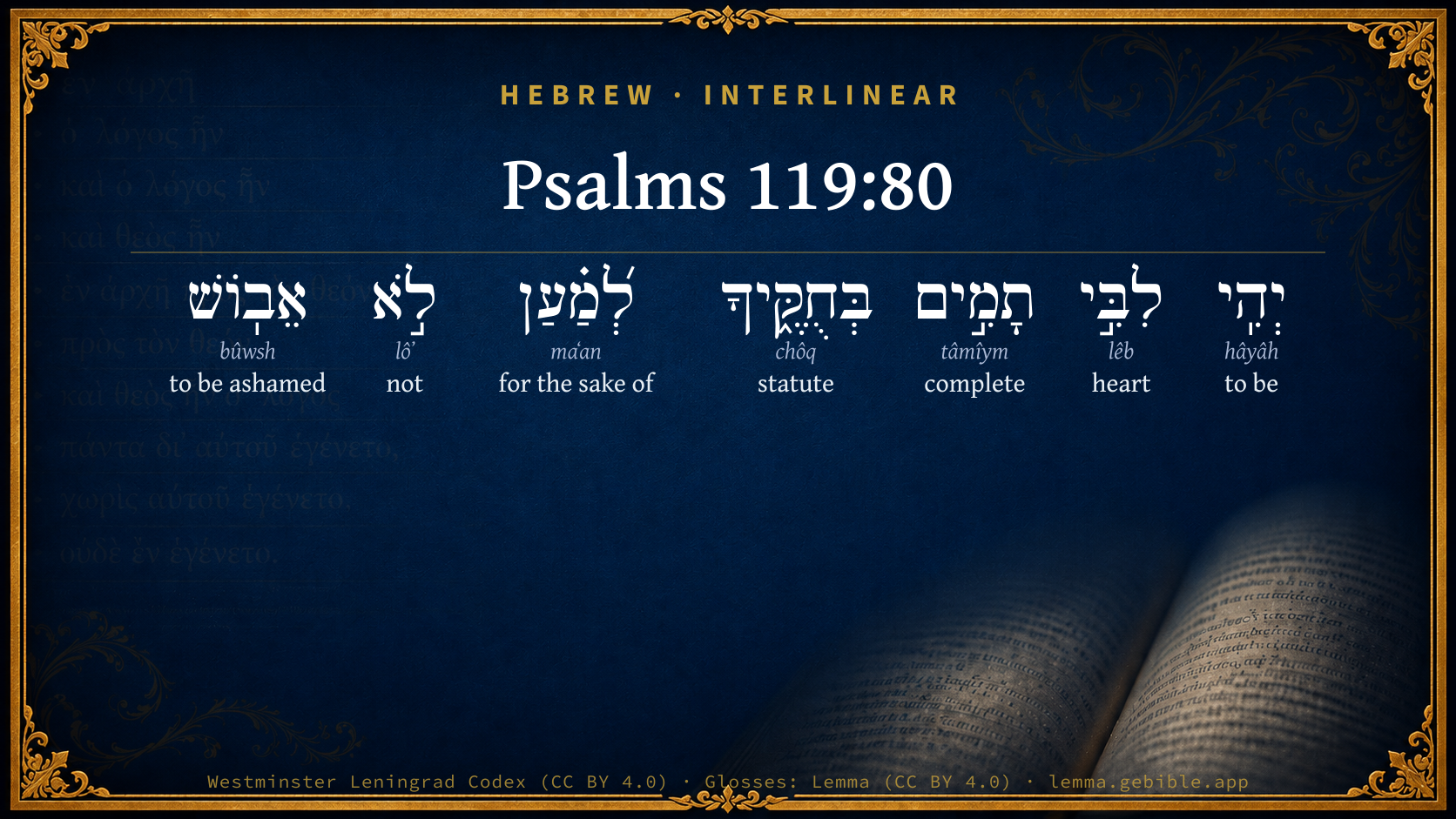
Psalms 119:80

Hebrew (Westminster Leningrad Codex) Psalms 119:80 appears in the Hebrew Old Testament. The text above is from the Westminster Leningrad Codex. Each word links to its Strong’s number, a concise gloss, and parsing drawn from the Open Scriptures Hebrew Bible morphology. Click any word for its full Brown-Driver-Briggs (BDB) entry.
Download image
Cite this verse

Psalms 119:80 (World English Bible). Public Domain. Lemma interlinear Bible study tool, https://lemma.gebible.app/v/psalms/119/80.

Show BibTeX & RIS
BibTeX
RIS
English Translation
Let my heart be blameless toward your decrees, That I may not be disappointed.
World English Bible · Public Domain
Download a study sheet

One document with this verse’s original text, its word-by-word gloss line, the meaning frame, cross-references with their text, attributed commentary, and full source and license credits — printable, and it pastes into notes with its structure intact.

This verse Autodidact and up

Study sheet (.html) Plain text (.txt)

A passage Seminary Student

Up to 50 verses in one chapter. A passage sheet keeps up to 6 commentary sources and 12 cross-references per verse, in the order this page ranks them, and says so on the sheet whenever that leaves anything out. Ask for a single verse and you get the Autodidact verse sheet above.

Everything on this page stays free to read, with no account — the sheet is a download of what is already on screen, not access to it.

Want to remove ads? Support Godless Engineer
Compare translations 3

The same verse in 3 English versions, stacked beneath the original-language interlinear above. Click any original word for its lexicon entry.

Each is an independent rendering of the whole verse — the interlinear is not word-aligned to these translations.

Highlighted words mark where these versions differ — a whole-verse word diff, not a word-by-word alignment.

  • World English Bible Public Domain
    Let my heart be blameless toward your decrees, That I may not be disappointed.
  • King James Version Public Domain
    Let my heart be sound in thy statutes; that I be not ashamed.
  • unfoldingWord Literal Text CC BY-SA 4.0
    May my heart be blameless in your statutes, so that I may not have shame. KAPH

unfoldingWord Literal Text — © unfoldingWord, licensed CC BY-SA 4.0. Word-aligned USFM3 via Door43 (git.door43.org/unfoldingWord/en_ult).

Versions to compare (up to 4)

3 of 4 selected

Show all 17 translations

Every available English version of this verse, each an independent rendering of the whole verse.

  • World English Bible Public Domain
    Let my heart be blameless toward your decrees, That I may not be disappointed.
  • Berean Standard Bible Public Domain
    May my heart be blameless in Your statutes, that I may not be put to shame.
  • Majority Standard Bible Public Domain
    May my heart be blameless in Your statutes, that I may not be put to shame.
  • King James Version Public Domain
    Let my heart be sound in thy statutes; that I be not ashamed.
  • American Standard Version (1901) Public Domain
    Let my heart be perfect in thy statutes, That I be not put to shame.
  • Revised Version (1885) Public Domain
    Let my heart be perfect in thy statutes; that I be not ashamed.
  • Geneva Bible (1599) Public Domain
    Let mine heart bee vpright in thy statutes, that I be not ashamed.
  • Young's Literal Translation Public Domain
    My heart is perfect in Thy statutes, So that I am not ashamed.
  • Literal Standard Version CC BY-SA 4.0
    My heart is perfect in Your statutes, || So that I am not ashamed.
  • Unlocked Literal Bible CC BY-SA 4.0
    May my heart be blameless with respect to your statutes so that I may not be put to shame.
  • unfoldingWord Literal Text CC BY-SA 4.0
    May my heart be blameless in your statutes, so that I may not have shame. KAPH
  • Darby Bible Public Domain
    Let my heart be perfect in thy statutes, that I be not ashamed.
  • World Messianic Bible Public Domain
    Let my heart be blameless toward your decrees, that I may not be disappointed. KAPF
  • Webster's Bible Public Domain
    Let my heart be sound in thy statutes; that I may not be ashamed.
  • Free Bible Version CC BY-SA 4.0
    May I be innocent in the way I keep your rules so that I won't be ashamed. Kaph
  • Bible in Basic English Public Domain
    Let all my heart be given to your orders, so that I may not be put to shame.
  • JPS Tanakh (1917) Public Domain
    Let my heart be undivided in Thy statutes, in order that I may not be put to shame.

Literal Standard Version (2020), Covenant Press — licensed CC BY-SA 4.0. Text via the HelloAO Bible API (eBible.org). Unlocked Literal Bible (unfoldingWord) — licensed CC BY-SA 4.0. Text via the HelloAO Bible API (eBible.org). unfoldingWord Literal Text — © unfoldingWord, licensed CC BY-SA 4.0. Word-aligned USFM3 via Door43 (git.door43.org/unfoldingWord/en_ult). Free Bible Version, Dr. Jonathan Gallagher — licensed CC BY-SA 4.0. Text via the HelloAO Bible API (eBible.org).

Word by word

More ways to search: Search by grammar → Find every occurrence → Compare this word →

Practice this passage: Drill this verse → Learn its vocabulary →

About this verse

These counts appear in no published source. They are computed here, from the morphology-tagged text and Lemma’s own curated glosses. What Lemma adds →

7
words
7
distinct lemmas
Wisdom
section

Grammatical profile

  • 2 verbs
  • 2 nouns
  • 1 adjective
  • 1 preposition
  • 1 particle

Verb forms

  • יְהִֽי Qal · Jussive
  • אֵבֽוֹשׁ Qal · Imperfect

Hebrew & Septuagint length

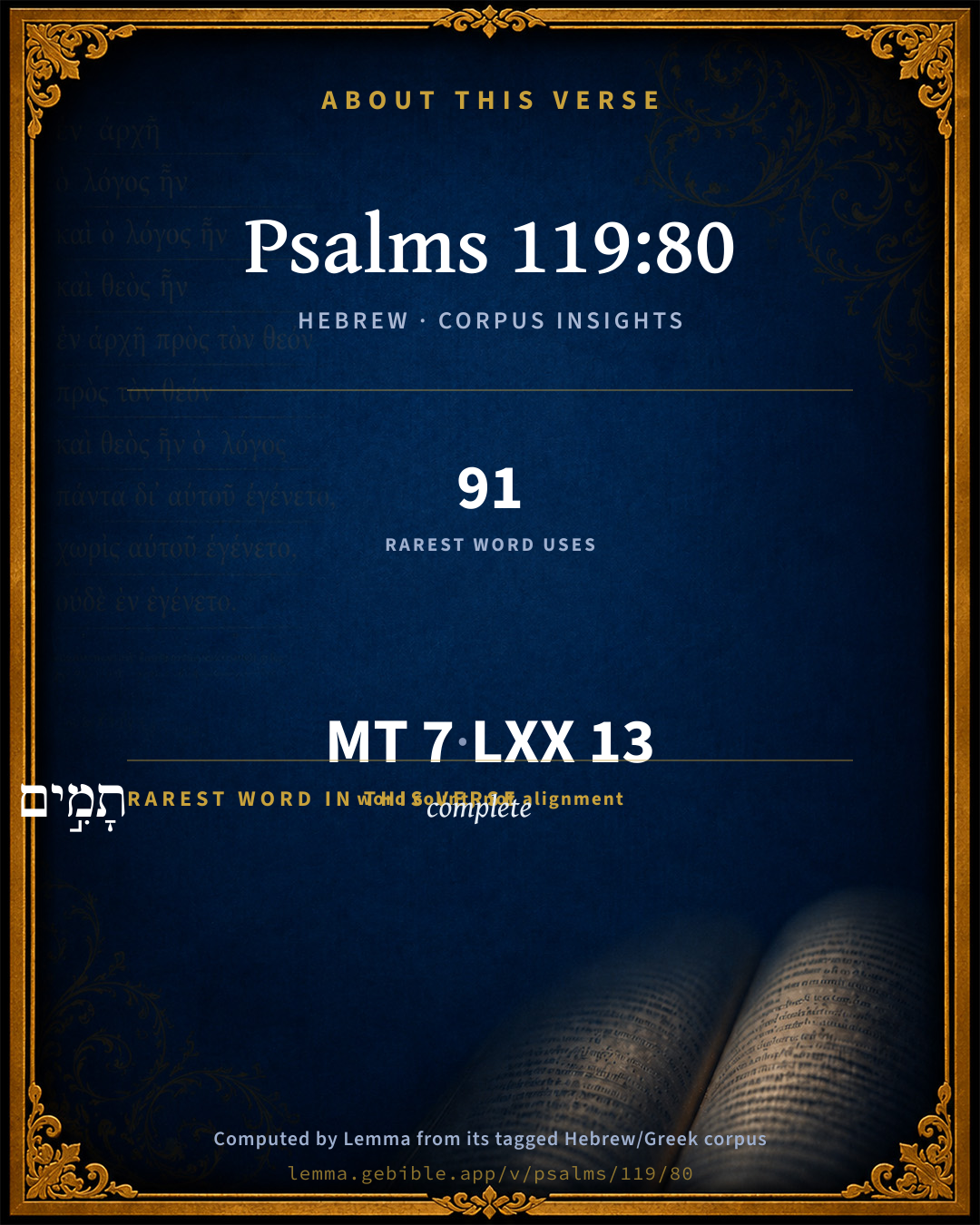
In English translation the verse runs 14 words from the Hebrew and 14 from the Septuagint (LXX English) — the same length.

A rough comparison of the two English renderings, which tokenize alike — not a word-level alignment.

Word counts can differ between the Hebrew and the Greek without any difference in meaning — e.g. the Hebrew direct-object marker אֵת has no separate Greek word, and Greek often adds the article ὁ.

In the original languages it is 7 Hebrew tokens and 13 Greek tokens — but the two are counted differently (Hebrew bundles its prefixes and suffixes into one token; the Greek is in lemma form), so that isn’t a like-for-like length.

Cross-references

14

Topical passages linked to Psalms 119:80 in the Treasury of Scripture Knowledge — connected by theme and wording, ordered by reader-vote popularity; previews shown in the World English Bible.

  • Deuteronomy 26:16 This day Yahweh your God commands you to do these statutes and ordinances: you shall therefore keep and do them with all your heart, and with all your soul.
  • 1 John 2:28 Now, little children, remain in him, that when he appears, we may have boldness, and not be ashamed before him at his coming.
  • 2 Chronicles 12:14 He did that which was evil, because he didn't set his heart to seek Yahweh.
  • Psalms 119:6 Then I wouldn't be disappointed, When I consider all of your commandments.
  • John 1:47 Jesus saw Nathanael coming to him, and said about him, "Behold, an Israelite indeed, in whom is no deceit!"
  • 2 Corinthians 1:12 For our boasting is this: the testimony of our conscience, that in holiness and sincerity of God, not in fleshly wisdom but in the grace of God we behaved ourselves in the world, and more abundantly toward you.
  • Psalms 32:2 Blessed is the man to whom Yahweh doesn't impute iniquity, In whose spirit there is no deceit.
  • Proverbs 4:23 Keep your heart with all diligence, For out of it is the wellspring of life.
  • 2 Chronicles 15:17 But the high places were not taken away out of Israel: nevertheless the heart of Asa was perfect all his days.
  • 2 Chronicles 25:2 He did that which was right in the eyes of Yahweh, but not with a perfect heart.
  • 2 Chronicles 31:20–21 Thus did Hezekiah throughout all Judah; and he worked that which was good and right and faithful before Yahweh his God.
  • Psalms 25:2–3 My God, I have trusted in you, Don't let me be shamed. Don't let my enemies triumph over me.
  • Psalms 25:21 Let integrity and uprightness preserve me, For I wait for you.
  • Ezekiel 11:9 I will bring you forth out of the midst of it, and deliver you into the hands of strangers, and will execute judgments among you.

Cross-references courtesy of OpenBible.info (CC BY 4.0).

Hebrew and Greek witnesses Masoretic Hebrew ↔ Greek Septuagint

The same verse in the two great witnesses to the Old Testament, shown verse-for-verse.

You’re reading Greek Psalm 118 (Hebrew Psalm 119). The Septuagint counts the superscription, so verse numbers can differ from the Hebrew — chapter-level alignment, not verse-by-verse. Numbering follows Rahlfs.

These are two independent witnesses, not word-aligned to each other, and the Septuagint is shown in lemma (dictionary) form.

Hebrew Psalms 119:80 Masoretic · Westminster Leningrad Codex

יְהִֽי לִבִּ֣י תָמִ֣ים בְּחֻקֶּ֑יךָ לְ֝מַ֗עַן לֹ֣א אֵבֽוֹשׁ

Let my heart be blameless toward your decrees, That I may not be disappointed.

World English Bible · Public Domain

Greek LXX Greek Psalm 118:80 Septuagint · lemma form

γίγνομαι ὁ καρδία ἐγώ ἄμωμος ἐν ὁ δικαίωμα σύ ὅπως ἄν μή αἰσχύνω

Let my heart be blameless in your ordinances, that I may not be ashamed.

LXX2012 (modern English Septuagint) · Public Domain

On this verse, Albert Barnes' Notes on the Bible discusses the Septuagint’s reading. Read the note in Commentary ↓

Hebrew: Westminster Leningrad Codex (CC BY 4.0). Greek: Septuagint (public domain); English from LXX2012 (modern English Septuagint) (Public Domain). How the Septuagint differs from the Hebrew →

Commentary

Notes on Psalms 119:80 from classic Christian and Jewish commentators (each source and its license shown beneath its notes). The classic Christian expositions comment on the surrounding passage and are grouped to its opening verse, so a note may address several verses; the Jewish commentaries on the Tanakh (Rashi and others) are per-verse, so they appear only where the commentator wrote on this verse.

Lemma curates 59 commentaries, every one of them public domain or Creative Commons licensed, each selected and text-cleaned for this edition rather than reprinted as found. About our sources →

Trapp's Complete Commentary

John Trapp

Psa 119:80 Let my heart be sound in thy statutes; that I be not ashamed.

Ver. 80. Let my heart be sound] For the main, though I have many failings. Pray we against hypocrisy.

That I be not ashamed] As all dissemblers once shall be.

John Trapp, A Commentary or Exposition upon All the Books of the Old and New Testament (1647–1656) — public domain. Text from a community e-Sword module.

The Biblical Illustrator

Joseph S. Exell

Psa_119:80

Let my heart be sound in Thy statutes.

A sound heart

A heathen prayed for a sound mind in a sound body. A sound body is, of all earthly blessings, the most priceless. But a sound heart is a far greater blessing. A sound heart, like the AEolian harp, can catch music from the tempest, or, like the bee, gather honey from weeds and briers.

I. A sound heart throbs is unison with the moral laws of the universe. Those laws are the laws of benevolence and truth.

II. A sound heart is a united heart,. It has no fissures, no rents, no distractions, it is one whole.

III. A sound heart is a strong heart. It does not sink under trial, or quail under danger. O happy heart, says Quarles, where piety affecteth, where humility subjecteth, where repentance correcteth, where obedience dissecteth, where perseverance perfecteth, where power protecteth, where devotion projecteth, where charity connecteth. (Homilist.)

Right-heartedness

Some follow religion merely for safety from penalty, some merely for its excitement, and others for gain; but the psalmist desires to be right just because it is right, and does not make ashamed.

I. The prayer. Let my heart be sound.

1. It is a definite prayer. Holiness means wholeness--sound in faith, in charity, in patience.

2. It is a personal prayer. Let my heart.

II. The occasion for this prayer.

1. After the excitements of conversion.

2. In a time of temptation.

3. When engaged in self-examination.

4. In times of persecution.

5. In times of work and witnessing for the Saviour.

6. In affliction.

III. A strong reason for this prayer. That I be not ashamed.

1. That I be not ashamed of the profession I have made.

2. That I be not ashamed before men, in the ship, in the shop, at the polling booth; that I may live respected and die lamented.

3. That I may not be ashamed before God at His coming, but joyfully hear, Well done, good and faithful servant, etc. (D. Brotchie.)

The Biblical Illustrator, edited by Joseph S. Exell (c. 1880s–1900s) — public domain. Text from a community e-Sword module.

Joseph Benson's Commentary

Psa 119:80. Let my heart be sound in thy statutes — Hebrew, perfect, or entire; that I may love and obey them sincerely, constantly, and universally. That I be not ashamed — Namely, for my sins, which are the only just causes of shame, and for the disappointment of my hopes following upon them. “This is a prayer necessary for all men to use at all times, but more particularly in seasons of persecution and temptation.” When there are solidity and steadfastness in grace and virtue, as opposed to the mere form of godliness, or the fair show of the hypocrite; “when internal holiness accompanies and actuates that which is external; when the word is thoroughly rooted, and faith,” working by love, “hath acquired the sovereignty over our desires, then our hearts are sound in God’s statutes, and there is hope that, in the day of trial, we shall not give our brethren cause to be ashamed of us, nor be ourselves ashamed before God.” — Horne.

Joseph Benson's Commentary on the Old and New Testaments (1811–1818) — public domain. Text from a community e-Sword module.

J. A. Alexander on Psalms

Joseph Addison Alexander

80. (Psa 119:80) Let my heart be perfect in thy statutes, to the end that I may not be ashamed. In thy statutes, in the knowledge and the practice of them, or as it is expressed in Psa 19:11), in keeping them. Shamed, put to shame by the frustration of my highest hopes. See above, on Psa 119:6. Two of the verses in this stanza begin with the same Hebrew word.

Joseph Addison Alexander, The Psalms Translated and Explained (1850) — public domain. Text from a community e-Sword module.

Matthew Henry's Commentary

Here is, 1. David's prayer for sincerity, that his heart might be brought to God's statutes, and that it might be sound in them, not rotten and deceitful, that he might not rest in the form of godliness, but be acquainted with the subject to the power of it, - that he might be hearty and constant in religion, and that his soul might be in health. 2. His dread of the consequences of hypocrisy: That I be not ashamed. Shame is the portion of hypocrites, either here, if it be repented of, or hereafter, if it be not: "Let my heart be sound, that I fall not into scandalous sin, that I fall not quite off from the ways of God, and so shame myself. Let my heart be sound, that I may come boldly to the throne of grace, and may lift up my face without spot at the great day."

Matthew Henry's Commentary on the Whole Bible (1708–1710) — public domain (CC PDM 1.0). Text via the HelloAO Bible API.

Adam Clarke's Commentary

Verse 80. Let my heart be sound in thy statutes] Let it be perfect - all given up to thee, and all possessed by thee.

ANALYSIS OF LETTER YOD. - Tenth Division

I. In the first place the psalmist prays for understanding, comfort, and mercy; and uses this argument, I am thy creature: "Thy hands have fashioned me."

II. He prays for understanding: Give me heavenly light and influence.

III. He prays for this that he may learn God's commandments. This was his end.

1. He endeavours to persuade God to this by the benefit that others would receive from seeing his conversion: "They - that fear thee will be glad," c.

2. He acknowledges that, if he was at any time deserted, it was because he was unfaithful, and that it was in very faithfulness that God had corrected him therefore God's judgments were right.

3. He prays that God's merciful kindness may be extended to him. But this prayer he would not presume to have offered, had he not been authorized and encouraged by God's word: "According to thy word." When God gives a promise, he binds himself to fulfil it.

4. He desires to be treated as a child in the heavenly family; and therefore prays for God's fatherly mercies - his bowels of compassion.

5. And he prays for them for this end, "that he may live." And here also he adds a reason why he should be heard: "Thy law is my delight."

6. He puts up another petition for his enemies, if they will take timely warning: "Let the proud be ashamed;" let them see their unprincipled conduct and blush that they have been persecuting and calumniating innocent people.

7. He next expresses his own resolution: "I will meditate on thy statutes." Howsoever they deal with me, I will cleave unto my God.

8. He prays that he may be acknowledged by the godly: "Let them that fear thee turn unto me." God's Church is a communion of saints, and to them has God so distributed his graces that one stands in need of another. Where one doubts, the light of another may solve his difficulty. One grieves; another may comfort him. One is tempted; another may uphold and restore him. This company the psalmist would have joined to him for these ends.

9. He prays that he may be sound in the faith, for without this he could not be steady in his obedience. Though an orthodox creed does not constitute true religion, yet it is the basis of it, and it is a great blessing to have it; and soundness of mind is a strong help to the retention of a sound creed.

Finally, he shows the end for which he desires this blessing, that "he may not be ashamed." That he may continue sincere and upright, have dominion over all sin, give no place to secret iniquities, and that he may never be put to the blush before God or man. Reader, beg of God to enable thee to lay these things profitably to heart.

Adam Clarke's Commentary on the Bible (1810–1826) — public domain. Text from a community e-Sword/MySword module.

John Calvin's Commentaries

80. Let my heart be sound in thy statutes Having, a little before, desired to be endued with a sound understanding, he now prays, in a similar manner, for sincere affection of heart. The understanding and affections, as is well known, are the two principal faculties of the human soul, both of which he clearly shows to be depraved and perverse, when he requests that his understanding may be illuminated, and, at the same time, that his heart may be framed to the obedience of the law. This plainly refutes all that the Papists babble about free will. The prophet not only here prays that God would help him, because his will was weak; but he testifies, without qualification, that uprightness of heart is. the gift of the Holy Spirit. We are, moreover, taught by these words, in what the true keeping of the law consists. A great part of mankind, after having carelessly framed their life according to the Divine law, by outward obedience, think that they want nothing. But the Holy Spirit here declares that no service is acceptable to God, except that which proceeds from integrity of heart. As to the word, תמים, thamim, rendered sound, we have elsewhere said, that a sound heart is set in opposition to a double or deceitful heart. It is as if the prophet had said, that those who are without dissimulation, and who offer to God a pure heart, yield themselves truly to Him. When it is added, that I may not be put to shame, it is intimated, that such shall be the undoubted issue as to all the proud, who, disdaining the grace of God, lean upon their own strength; and as to all hypocrites, who, for a time, parade themselves in gay colors. The amount, then, is, that unless God govern us by his Spirit, and keep us in the performance of our duty, so that our hearts may be sound in his statutes, although our shame may be hidden for a time, yea, although all men should praise us, and hold us in admiration, yet we cannot avoid falling, at length, into dishonor and ignominy.

John Calvin's Commentaries (1540-1563) — public domain. Text from the Calvin Translation Society English edition (1840s-50s) via the Christian Classics Ethereal Library (ccel.org). Calvin's coverage is partial (roughly two-thirds of the Bible); uncommented books and verses are honest gaps, never fabricated. The 19th-century editor's footnotes and remarks are omitted so the notes are faithfully Calvin's own voice.

The Cambridge Bible for Schools and Colleges

gen. ed. J. J. S. Perowne

80. sound] Perfect, cp. Psa_119:1.

The Cambridge Bible for Schools and Colleges (gen. ed. J. J. S. Perowne; Cambridge University Press, 1878–1918) — public domain. Text from a community e-Sword module.

John Gill's Exposition

How many are the days of thy servant?.... If this is to be understood of the days of his life, they were very few, as the days of every man be; and if of his days of joy and comfort, peace and prosperity, they were fewer still; but if of days of adversity and affliction, which seems to be the sense, they were many indeed;

when wilt thou execute judgment on them that persecute me? good men have their persecutors; there is a judgment that will be executed on them, if not here, yet hereafter; it is a righteous thing with God to do it; it is often deferred when the saints, through zeal for the glory of God, and the honour of his justice, as well as for their own deliverance and comfort, are at times somewhat impatient for it, and earnestly solicit it, as the psalmist here; see Rev 6:9.

John Gill's Exposition of the Whole Bible (1746–1763) — public domain (CC PDM 1.0). Text via the HelloAO Bible API.

Albert Barnes' Notes on the Bible

Let my heart be sound ... - Hebrew, “Be perfect.” See the notes at Job 1:1. The Septuagint here is “immaculate,” ἄμωμος amōmos. So the Latin Vulgate. It is the expression of a desire that the heart might be pure; that there might be no improper attachment for other objects; that there might be no defect of love to God.

That I be not ashamed - See the notes at Psa 119:6. A man has no occasion to be ashamed of a pure heart; and that which can alone keep us from being ultimately ashamed is sincerity, uprightness, and purity in the service of God.

Albert Barnes' Notes on the Bible (1834–1885) — public domain. Text from a community e-Sword/MySword module.

Matthew Poole's English Annotations

Sound, Heb. perfect, or entire, that I may love and obey them sincerely, constantly, and universally.

That I be not ashamed, to wit, for my sins, which are the only just causes of shame, and for the disappointment of my hopes following upon them.

Matthew Poole's English Annotations on the Holy Bible (1683–1685) — public domain. Text from a community e-Sword/MySword module.

The Treasury of David

Charles H. Spurgeon

Ver. 80. Let my heart be sound in thy statutes; that I be not ashamed. This is even more important than to be held in esteem by good men. This is the root of the matter. If the heart be sound in obedience to God, all is well, or will be well. If right at heart we are right in the main. If we be not sound before God, our name for piety is an empty sound. Mere profession will fail, and undeserved esteem will disappear like a bubble when it bursts; only sincerity and truth will endure in the evil day. He who is right at heart has no reason for shame, and he never shall have any; hypocrites ought to be ashamed now, and they shall one day be put to shame without end; their hearts are rotten, and their names shall rot. This eightieth verse is a variation of the prayer of the seventy-third verse; there be sought sound understanding, here he goes deeper, and begs for a sound heart. Those who have learned their own frailty by sad experience, are led to dive beneath the surface, and cry to the Lord for truth in the inward parts. In closing the consideration of these eight verses, let us join with the writer in the prayer, "Let my heart be sound in thy statutes."

Ver. 80. Let my heart be sound. What is a sound heart? It notes reality and solidity in grace. The Septuagint hath it, Let my heart be without spot and blemish. It implies the reality of grace, opposed to the bare form of godliness, or the fair shows of hypocrites, and the sudden and vanishing motions of temporaries.

If you would have me unfold what this sound heart is, there is required these four things:

1. An enlightened understanding; that is, the directive part of the soul; and it is sound when it is kept free from the leaven and contagion of error: "A man of understanding walketh uprightly, " Pr 15:21. A sound mind is a good help to a sound heart.

2. There is required an awakened conscience, that warns of our duty, and riseth up in dislike of sin upon all occasions: "When thou goest, it shall lead thee; when thou sleepest, it shall keep thee; and when thou awakest, it shall talk with thee" (Pr 6:22): to have a constant monitor in our bosoms to put us in mind of God, when our reins preach to us in the night season (Ps 16:7): there is a secret spy in our bosoms that observes all that we do, and think, and speak; a domestic chaplain, that is always preaching to us. His heart is his Bible.

3. There is required a rightly disposed will, or a steadfast purpose to walk with God in all conditions, and to do what is good and acceptable in his sight: "He exhorted them all that with purpose of heart they would cleave unto the Lord, "Ac 6:23. Many have light inclinations, or wavering resolutions; but their hearts are not fixedly, habitually bent to please God; therein chiefly lieth this sound heart, that it doth inseparably cleave to God in all things.

4. There is required that the affections be purged and quickened: these are the vigorous motions of the will, and therefore this must be heedfully regarded; purged they must be from that carnality and fleshliness that cleaveth to them. This is called in Scripture the circumcision of the heart (De 30:6). Condensed from Manton.

Ver. 80. Let my heart be sound. "A sound mind in a sound body, " was the prayer of a heathen, and his desire was according to the extent of his knowledge; but a heart sound in God's statutes, sound to the very core, with no speck, nor spot, nor wrinkle, nor any such thing, and like the king's daughter, "all glorious within." this is what the Psalmist prays for, this is what every child of God aims at, and prays for too, "Even as He is pure." Barton Bouchier.

Ver. 80. Let my heart be sound.

True hearted, wholehearted, faithful and loyal,

King of our lives, by thy grace will we be!

Under thy standard, exalted and royal,

Strong in thy strength, we will battle for thee!

True hearted, wholehearted! Fullest allegiance

Yielding henceforth to our glorious King;

Valiant endeavour and loving obedience

Freely and joyously now would we bring.

True hearted, Saviour, thou knowest our story;

Weak are the hearts that we lay at thy feet,

Sinful and treacherous! yet for thy glory,

Heal them, and cleanse them from sin and deceit.

Wholehearted! Saviour, beloved and glorious,

Take thy great power, and reign thou alone,

Over our wills and affections victorious,

Freely surrendered, and wholly thine own.

Half hearted! false hearted! Heed we the warning!

Only the whole can be perfectly true;

Bring the whole offering, all timid thought scorning,

True hearted only if wholehearted too.

Half hearted! Saviour, shall aught be withholden,

Giving thee part who has given us all?

Blessings outpouring, and promises golden

Pledging, with never reserve or recall.

Half hearted! Master, shall any who know thee

Grudge thee their lives, who hast laid down thine own?

Nay; we would offer the hearts that we owe thee,

Live for thy love and thy glory alone.

Sisters, dear sisters, the call is resounding,

Will ye not echo the silver refrain,

Mighty and sweet, and in gladness abounding,

"True hearted, wholehearted!" ringing again?

Jesus is with us, his rest is before us,

Brightly his standard is waving above.

Brothers, dear brothers, in gathering chorus,

Peal out the watchword of courage and love!

Peal out the watchword, and silence it never,

Song of our spirits, rejoicing and free!

"True hearted, wholehearted, now and for ever,

King of our lives, by thy grace we will be!" Frances Ridley Havergal (1836-1879) in "Loyal Responses."

Ver. 80. Let my heart be sound, etc. This is a plain difference between a sound heart and a false heart; in the receiving of Christ the sound heart receives him as a favourite receives a prince, he gives up all to him, and lets him have the command of all. A mere innkeeper entertains him that comes next to him; he will take any man's money, and will give welcome to any man; if it be the worst man that comes he cares not, for he loves gain above all things. Not so the good heart; he welcomes Christ alone, and resigns up all to Christ. Whatsoever is pleasing to Christ he will do it, and whatsoever comes from Christ he will welcome. Thomas Hooker (1586-1647) in "The Soules Implantation."

Ver. 80. Be sound. Heb. Be perfect; as the word from the same root is rendered in Job 1:1. Dr. R. Young gives as the meaning of the word as used by the Psalmist, whole, complete, plain.

Ver. 80. Sound in thy statutes, etc. Though an orthodox creed does not constitute true religion, yet it is the basis of it and it is a great blessing to have it. Nicolson, quoted by W. S. Plumer.

Ver. 80. If you would be faithful to Christ, be sincere in your profession of him, make David's prayer and desire to be yours: "Let my heart be sound in thy statutes; that I be not ashamed." Religion which is begun in hypocrisy will certainly end in apostasy, and this always carries with it reproach and ignominy. William Spurstowe (1666)

Ver. 80. Ashamed. We may be ashamed either before God or men, ourselves or others.

1. Before God: either in our addresses to him at the throne of grace, or when summoned to appear at the last day before the tribunal of his justice.

(a) If you understand it of our approach to him, we cannot come into his presence with confidence if we have not a sound heart. "If our heart condemn us not, then have we confidence toward God": 1Jo 3:21. We lose that holy familiarity and cheerfulness, when we are unbosoming ourselves to our heavenly Father, when our hearts are not sound.

(b) When we are summoned to appear before the tribunal of his justice. Many, now, with a bold impudence, will obtrude themselves upon the worship of God, because they see him not, and have not a due sense of his majesty; but the time will come, when the most impudent and outbraving sinners will be astonished, even then when the secrets of all hearts shall be laid open and made manifest, and hidden things brought to light (1Co 4:5); and every one is to receive his judgment from God according to what he hath done, either good or evil.

2. Before men man may be ashamed, and so before ourselves and others.

(1) Ourselves. It was a saying of Pythagoras, Reverence thyself; be not ashamed of thyself. God hath a spy and deputy within us, and taketh notice of our conformity and unconformity to his will, and, after sin committed, lashes the soul with the sense of its own guilt and folly, as the body is lashed with stripes: "What fruit had ye then in those things whereof ye are now ashamed?" Ro 6:21.

(2) Before others. And so our shame may be occasioned by our scandals, or our punishments; it is hard to say which is intended here. Condensed from Manton.

Ver. 80.

1. David's prayer for sincerity that his heart might be brought to God's statutes, and that it might be sound in them, not rotten or deceitful.

2. His dread of the consequences of hypocrisy: "that I be not ashamed." Shame is the portion of hypocrites, here or hereafter. M. Henry.

Ver. 80.

1. The heart in religion.

2. The necessity of its being sound in it.

3. The result of such sound heartedness.

Psalms 119:81*

This portion of the gigantic psalm sees the Psalmist in extremis. His enemies have brought him to the lowest condition of anguish and depression; yet he is faithful to the law and trustful in his God. This octave is the midnight of the psalm, and very dark and black it is. Stars, however, shine out, and the last verse gives promise of the dawn. The strain will after this become more cheerful; but meanwhile it should minister comfort to us to see so eminent a servant of God so hardly used by the ungodly: evidently in our own persecutions, no strange thing has happened unto us.

Charles H. Spurgeon's The Treasury of David (1869–1885) — public domain. Psalms only. Text from a community e-Sword/MySword module.

The Pulpit Commentary

Let my heart be sound in thy statutes; or, "perfect in thy statutes in the knowledge and in the practice of them. That I be not ashamed (see ver. 31)

What is a perfect heart?

It is necessary to see that the term "perfect" varies its connotation according to the substantive word with which it stands connected. We speak of a perfect animal, and mean completely and healthily organized, according to the standard of that particular animal. We speak of a perfect machine, and mean one that entirely and efficiently accomplishes everything that it is required to do. We speak of perfect conduct, and mean that which in every detail conforms to the rule. We speak of a perfect statue, and mean one that in all points realizes and satisfies our ideal. Then what do we mean by a perfect heart using that term as meaning the will inspired by the emotions? Both the will and the emotions are such fluctuating things that it may not be possible to create an ideal, or to find a standard, by which every heart must be judged. Even here we cannot say of the Lord Jesus that he has presented an absolute standard. He has with his particular environment found a model expression for the highest principles; but righteousness for each man must be the expression of the principles of right in his own particular environment, and with his own particular disposition. A perfect heart cannot mean a will always biased to decision by particular considerations; and getting the bias by a particular condition of the feelings. Perfection when applied to the heart must mean genuineness, sincerity. But it means this made even more distinct and precise. It means unity, absolute agreement; the whole being brought in and bound together in one purpose. And if taken in its fullest suggestiveness, it farther means an instructed heart, not one carried into conduct by any accident, but borne to it by a deliberate choice, based on competent knowledge. Perfect-hearted may be apprehended as whole-hearted, true-hearted, and as opposed to half-hearted. R.T.

The Pulpit Commentary (1880–1919), ed. H.D.M. Spence-Jones & Joseph S. Exell — public domain. Text from a community e-Sword module.

John Wesley's Explanatory Notes

Sound - That I may love and obey them sincerely, constantly, and universally.

John Wesley, Explanatory Notes Upon the Whole Bible (1754–1765) — public domain. Text via the GEBible commentary corpus.

Lesson kit

Teaching starters — assembled from the data on this page, not authored interpretation. Every prompt links to the verse data it draws on. Edit before teaching.

Psalms, in the Wisdom, opens this verse with 7 words (7 distinct Hebrew lemmas). Its most distinctive word is tâmîym (“complete”). A historical commentator’s framing appears above. Read the whole chapter for the surrounding context.

Discussion questions

  1. What does “complete” (tâmîym) contribute to the verse as a whole?
  2. How does Deuteronomy 26:16, which shares this passage’s theme, read alongside this verse?
  3. The translations on this page render this verse differently — a whole-verse word diff, not a word-by-word alignment. What might account for the different wordings?
  4. «יְהִֽי» is a Qal Jussive verb. How does that grammatical form shape the action described?
  5. Compare how Trapp's Complete Commentary and The Biblical Illustrator read this verse. Where do they agree or differ?

Things to notice

Reading settings

Reading text

Shown beneath each verse's original-language words.

Old Testament
Old Testament edition

Read the OT as the Masoretic Hebrew (MT) or the Greek Septuagint (LXX).

English shown for the Greek Septuagint (in the Hebrew ↔ Greek comparison).

Comparing translations? Open the Compare panel on any verse page to stack up to four side by side.