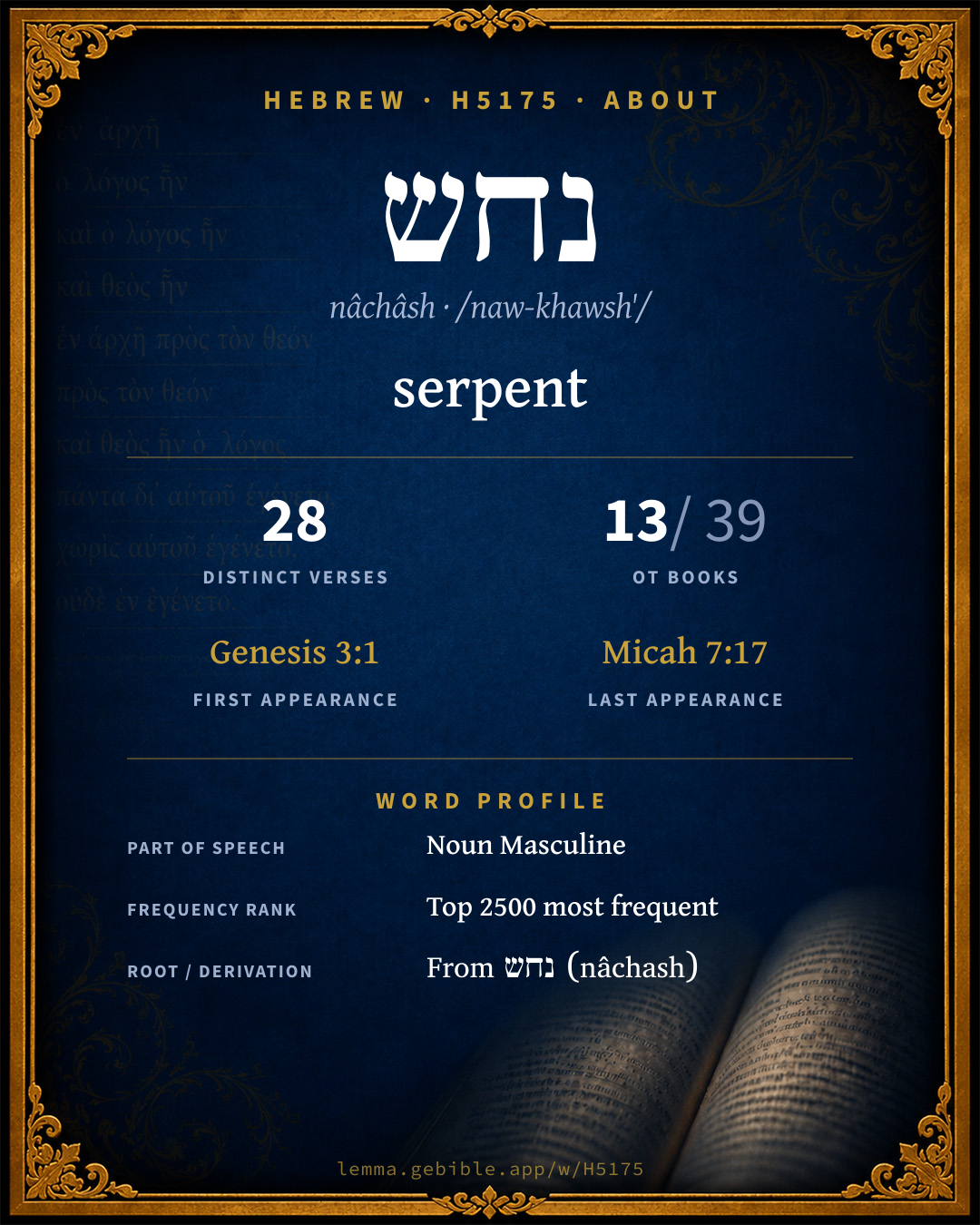
נָחָשׁ
serpent
‘serpent’ is one of 4 main senses fuller range ↓
Full lexicon entry — Brown-Driver-Briggs (BDB)
From Brown-Driver-Briggs (BDB)
Where this word appears
See every Absolute-state word in the Hebrew Bible →
Grammar key — what these labels mean
Part of speech
- Noun
- A naming word — a person, place, thing, or idea.
Noun type
- Common
- A common noun — a general class of person, place, or thing (“king,” “city,” “water”), not a specific name.
State
- Absolute
- The independent form of a noun, not bound to a following word.
- Construct
- A noun bound to a following noun in a possessive / “of” relationship (the construct chain).
Gender
- Masculine
- Grammatically masculine.
Number
- Singular
- One.
- Plural
- More than one (in Hebrew, generally three or more).
Grammatical forms
- Noun, Common, Masculine, Singular, Absolute 26 times (84%)
- Noun, Common, Masculine, Singular, Construct 3 times (10%)
- Noun, Common, Masculine, Plural, Absolute 2 times (6%)
Parsed forms decoded from the imported morphology (morphhb / Westminster Leningrad Codex — WLC text public domain, morphhb tagging CC BY 4.0), counted across 31 parsed occurrences — not distinct verses.
Every verse where H5175 appears — 28 distinct verses across 13 books. Click any verse to open its interlinear word-by-word view. Verse text shown in the World English Bible for context — . Each verse’s Hebrew form is shown with its reference; the English is not keyword-highlighted, since the data carries no word-level English alignment. Use “Compare translations” on any verse to read it across multiple English versions. This concordance covers the Hebrew Bible; Septuagint (Greek Old Testament) occurrences are not indexed here.
Genesis 6 verses
- Genesis 3:1 וְ/הַ/נָּחָשׁ֙ conj + ptcl def.art + n c ms Now the serpent was more subtle than any animal of the field which Yahweh God had made. He said to the woman, "Yes, has God said, 'You shall not eat of any tree of the garden?'"
- Genesis 3:2 הַ/נָּחָ֑שׁ ptcl def.art + n c ms The woman said to the serpent, "Of the fruit of the trees of the garden we may eat,
- Genesis 3:4 הַ/נָּחָ֖שׁ ptcl def.art + n c ms The serpent said to the woman, "You won't surely die,
- Genesis 3:13 הַ/נָּחָ֥שׁ ptcl def.art + n c ms Yahweh God said to the woman, "What is this you have done?" The woman said, "The serpent deceived me, and I ate."
- Genesis 3:14 הַ/נָּחָשׁ֮ ptcl def.art + n c ms Yahweh God said to the serpent, "Because you have done this, cursed are you above all cattle, and above every animal of the field. On your belly shall you go, and you shall eat dust all the days of your life.
- Genesis 49:17 נָחָ֣שׁ n c ms Dan will be a serpent in the way, An adder in the path, That bites the horse's heels, So that his rider falls backward.
Exodus 2 verses
- Exodus 4:3 לְ/נָחָ֑שׁ prep + n c ms He said, "Throw it on the ground." He threw it on the ground, and it became a snake; and Moses ran away from it.
- Exodus 7:15 לְ/נָחָ֖שׁ prep + n c ms Go to Pharaoh in the morning. Behold, he goes out to the water; and you shall stand by the river's bank to meet him; and the rod which was turned to a serpent you shall take in your hand.
Numbers 3 verses
- Numbers 21:6 הַ/נְּחָשִׁ֣ים ptcl def.art + n c mp Yahweh sent fiery serpents among the people, and they bit the people; and much people of Israel died.
- Numbers 21:7 הַ/נָּחָ֑שׁ ptcl def.art + n c ms The people came to Moses, and said, We have sinned, because we have spoken against Yahweh, and against you; pray to Yahweh, that he take away the serpents from us. Moses prayed for the people.
- Numbers 21:9 נְחַ֣שׁ הַ/נָּחָשׁ֙ נְחַ֥שׁ n c ms cs ptcl def.art + n c ms n c ms cs Moses made a serpent of brass, and set it on the standard: and it happened, that if a serpent had bitten any man, when he looked to the serpent of brass, he lived.
Deuteronomy 1 verse
2 Kings 1 verse
Job 1 verse
Psalms 2 verses
Proverbs 2 verses
Ecclesiastes 2 verses
Isaiah 3 verses
- Isaiah 14:29 נָחָשׁ֙ n c ms Don't rejoice, O Philistia, all of you, because the rod that struck you is broken; for out of the serpent's root shall come forth an adder, and his fruit shall be a fiery flying serpent.
- Isaiah 27:1 נָחָ֣שׁ נָחָ֖שׁ n c ms n c ms In that day Yahweh with his hard and great and strong sword will punish leviathan the swift serpent, and leviathan the crooked serpent; and he will kill the monster that is in the sea.
- Isaiah 65:25 וְ/נָחָ֖שׁ conj + n c ms The wolf and the lamb shall feed together, and the lion shall eat straw like the ox; and dust shall be the serpent's food. They shall not hurt nor destroy in all my holy mountain, says Yahweh.
Jeremiah 2 verses
- Jeremiah 8:17 נְחָשִׁים֙ n c mp For, behold, I will send serpents, adders, among you, which will not be charmed; and they shall bite you, says Yahweh.
- Jeremiah 46:22 כַּ/נָּחָ֣שׁ prep det + n c ms The sound of it shall go like the serpent; for they shall march with an army, and come against her with axes, as wood cutters.
Amos 2 verses
- Amos 5:19 הַ/נָּחָֽשׁ ptcl def.art + n c ms As if a man fled from a lion, And a bear met him; Or he went into the house and leaned his hand on the wall, And a snake bit him.
- Amos 9:3 הַ/נָּחָ֖שׁ ptcl def.art + n c ms Though they hide themselves in the top of Carmel, I will search and take them out there; and though they be hid from my sight in the bottom of the sea, there I will command the serpent, and it will bite them.
Micah 1 verse
About this entry
At a glance — auto-summarized from this page’s data, not written by a person. Every figure links to its source below. This summary describes the numbers; it doesn’t interpret them.
The Hebrew noun נחש centers on the idea of “serpent.” Older and newer Bibles part ways — “serpent” in the King James Version, “snake” (Berean Standard Bible) in modern versions. See the renderings breakdown. It turns up in 28 verses across 13 books, a moderately common footprint. Its earliest occurrence is Genesis 3:1. The lexicon spreads it across several senses; see its full sense range. Dig into 28-verse concordance and the renderings breakdown below.
Gloss history
Strong's 1890 vs modern scholarship
About this word
Strong's H5175 catalogs a Hebrew word from the Hebrew Old Testament.
These counts are not copied from any lexicon or concordance. They are computed here, from the morphology-tagged Hebrew Old Testament. What Lemma adds →
- 28
- distinct verses
- The word appears in 28 distinct verses.
- 13 / 39
- OT books
- The word appears in 13 of 39 Old Testament books.
- #1,120
- by frequency
- Top 2500 most frequent Hebrew words (rank 1,120 of 8,640 Hebrew words by occurrence).
View all 28 occurrences in the concordance →
By section of the Old Testament
By traditional corpus
Conventional, traditional groupings — biblical authorship is debated, so this is a traditional corpus grouping, not an authorship claim. Each share is this word’s portion of its verses in that division of the Hebrew canon. Each figure is a share of the word’s 28 distinct verses.
- Torah (Pentateuch) 12 verses · 43%
- Prophets (Nevi'im) 9 verses · 32%
- Writings (Ketuvim) 7 verses · 25%
How translations render this word
Counts come from each version’s own published word-to-Strong’s tagging or interlinear alignment — an approximate guide to how each version renders this word, not a word-level alignment the data otherwise carries. Because each total is that version’s own tagged count, the per-version totals vary from one another and need not match the appearance or distinct-verse counts above. These counts may also differ from a printed concordance because Lemma counts each distinctly tagged rendering and does not collapse phrase taggings into a single head-word total. This is a fixed set of word-tagged versions (KJV, ASV, BSB, ULT) and does not change with the reading translation you choose elsewhere. Each version’s license is shown beside its name below (and on Sources).
BDB lists this Strong’s number as 2 distinct words (homographs). Each count above pools all of them and is not split by sense — see the Senses section below. A low-frequency rendering may belong to a different one of those words, not the primary meaning.
- King James Version†: Serpent 16×, Like a serpent 4×, Serpents 4×
- American Standard Version†: Serpent 18×, Like a serpent 3×, Serpents 3×
- Berean Standard Bible†: Snake 12×, Serpent 10×, Snakes 5×
- unfoldingWord Literal Text†: Serpent 17×, Snake 7×, The 3×
King James Version Public Domain
Renders H5175 across 31† tagged occurrences — most commonly:
Plus 7 renderings that appear only once — usually multi-word phrases or single function words the recovered tagging swept in, not distinct renderings.
American Standard Version Public Domain
Renders H5175 across 31† tagged occurrences — most commonly:
Plus 7 renderings that appear only once — usually multi-word phrases or single function words the recovered tagging swept in, not distinct renderings.
Berean Standard Bible Public Domain
Renders H5175 across 30† tagged occurrences — most commonly:
Plus 1 rendering that appears only once — usually multi-word phrases or single function words the recovered tagging swept in, not distinct renderings. Not rendered by a distinct English word in 1 further occurrence.
unfoldingWord Literal Text CC BY-SA 4.0
Renders H5175 across 32† tagged occurrences — most commonly:
Plus 5 renderings that appear only once — usually multi-word phrases or single function words the recovered tagging swept in, not distinct renderings.
10 senses and sub-senses in the full BDB
What do BDB’s symbols mean?
BDB uses these scholarly abbreviations:
| Symbol | Meaning |
|---|---|
| 𝔊 | the Septuagint (the ancient Greek translation, LXX) |
| 𝔙 | the Vulgate (the Latin translation) |
| 𝔖 | the Syriac version (the Peshitta) |
| 𝔗 | the Targum (the Aramaic translation) |
| ψ | the Psalms |
| √ | root (the underlying root or stem) |
| ‖ | parallel passage (a synonymous or contrasted parallel) |
| † | the dagger: every passage where the word occurs is cited |
The 10 senses and sub-senses the full Brown-Driver-Briggs lexicon distinguishes for this word, in lexicon order (not ranked by frequency), with BDB’s own verbatim wording and sub-sense lettering. Shown in Hebrew script with BDB’s own scholarly abbreviations. The condensed entry is in the Lexicon Entry tab. See also the Forms in the corpus table below.
נחש I
- 1. serpent:
- a. as biting, Am 5:19 Ec 10:8, in spite of charm (לַחַשׁ) v 11 [cf. Ecclus 12:13], Je 8:17 (+ צִפְעֹנִים; fig. of enemies); so הַנְּחָשִׁים הַשְּׂרָפִים Nu 21:6 (deadly; JE; cf. JacobArab. Dicht. iv. 10 ff.), and sg. v 9, also (coll.) v 7 cf. נ׳ שָׂרָף Dt 8:15 (+ עַקְרָב); נ׳ fig. of oppressor, מִשֹּׁרֶשׁ נָחָשׁ יֵצֵא צֶפַע וּפִרְיוֹ שָׂרָף מְעוֹפֵף Is 14:29; fig. of Dan Gn 49:17 (poem in J; ‖ שְׁפִיפֹן); חֲמַת נ׳ ψ 58:5 (sim. of perniciousness of ungodly), cf. נ׳ 140:4; sim. of effect of wine Pr 23:32 (‖ צִפִעֹנִי). e.g. Amos 5:19
- b. rod becomes נ׳ Ex 4:3 (J), cf. 7:15 (E); דֶּרֶךְ נ׳ עֲלֵי צוּר Pr 30:19. e.g. Exodus 4:3
- c. נ׳ (appar.) as hissing Je 46:22 (in sim., cf. Gie); as eating dust Is 65:25 cf. Mi 7:17 (in sim.; v. also Gn 3:14). e.g. Jeremiah 46:22
- d. as crafty tempter Gn 3:1, 2, 4, 13, 14. e.g. Genesis 3:1
- 2. נ׳ (הַ)נְּחשֶׁת, bronze image of serpent Nu 21:9(×2) 2 K 18:4 (cf. נְחֻשְׁתָּן). e.g. Numbers 21:9
- 3. mythol. נ׳ בָּרִחַ Jb 26:13 fleeing serpent, of eclipse-dragon (cf. לִוְיָתָן 3:6); also לִוְיָתָן נ׳ בָּרִחַ … לִוְיָתָן נ׳ עֲקַלָּתוֹן Is 27:1 (symbol. of world-powers); נ׳ of sea-monster Am 9:3.—נ׳ c. vb. נָשַׁךְ bite Nu 21:6 + 8 times. On supernat. character of serpents in Arabic belief v. NöZeitschr. für Völkerpsychol. i (1860), 412–416 RSKinship 197; Sem i. 421 f., 2d ed. 442 WeSkizzen iii. 147; Arab. Heid. 2, 152 f. JacobArab. Dicht. iv. 5. e.g. Job 26:13
נחש II
- 1. king of Ammon 1 S 11:1(×2), 2; 12:12 2 S 10:2 1 Ch 19:1, 2; perhaps also 2 S 17:27; 𝔊 Ναας. e.g. 1 Samuel 11:1
- 2. father of Abigail and Zeruiah 2 S 17:25, si vera l.; 𝔊 Ναας, but 𝔊L Ιεσσαι (cf. 1 Ch 2:16); WeGesch. 2, 57 Anm. 1 Löhr defend נחשׁ; dub. WeSm HPS. e.g. 2 Samuel 17:25
- 3. giving name to a city עִיר נ׳ 1 Ch 4:12, 𝔊 πόλεως Ναας; 𝔊L Ηρναας. e.g. 1 Chronicles 4:12
Senses from the full Brown-Driver-Briggs lexicon (Brown, Driver, Briggs; Oxford 1906 — public domain), digitized via Sefaria, supplemented by the OpenScriptures HebrewLexicon (CC BY 4.0). Full attribution on Sources.
Word origin
n.m. Gn 3:1 serpent (NH id.; Arabic حَنَشٌ serpent, viper (Lane406 anything hunted) is cp. by LagM i. 230; BN 50, 188 BAES 48, but improb.; Arabic نَحِسَ v. sub [נָחַשׁ] infr.; on formation cf. LagBN 50);—abs. נ׳ Am 5:19 +; cstr. נְחָשׁ Nu 21:9 + 2 times; pl. נְחָשִׁים Nu 21:6 Je 8:17;—
— Brown-Driver-Briggs (Oxford 1906, public domain), digitized via Sefaria, supplemented by the OpenScriptures HebrewLexicon (CC BY 4.0). See Sources.
Derived from נחש (nâchash) (H5172) — to divine.
Jastrow Dictionary
A second Hebrew/Aramaic lexicon for comparison, covering Aramaic and post-biblical (Talmudic, Targumic, Midrashic) usage that the biblical-Hebrew BDB does not. Matched by lemma rather than by Strong’s number, so a lemma may carry more than one Jastrow headword (shown separately below), and the entries cover usage well beyond the Bible.
נָחַשׁ
- to whisper.
- to divine, to make action dependent on an omen, to augur. Tosef. Sabb. VII (VIII), 13 איזהו מְנַחֵשׁ וכ׳ a diviner (under the law, Lev. XIX, 26) is he who says, ‘my staff fell out of my hand’ (it portends evil) &c.; Snh. 65ᵇ. Ib. 66ᵃ כגון אלו המְנַחֲשִׁים בחולדה וכ׳ like those who divine (evil or luck) from a weasel, birds &c. Y. Sabb. VI, end, 8ᵈ כל המנחש סופו לבוא עליו if one believes in omens, what he fears will finally befall him (with ref. to לא נחש Num. XXIII, 23, changed into לו נחש); Ned. 32ᵃ כל המנחש לו נחש for him who believes in omens, the omen exists (will be realized). Ib. כל אדם שאינו מנ׳ he who rejects divination. Mekh. B’shall. s. 2 שמא יְנַחֲשׁוּ ויחזרו וכ׳ lest they consider it a bad omen and go back. Ib. וזקני מדין נִחֲשׁוּ וכ׳ and the Midianite elders considered (Balaam’s death) a bad omen and went home; a. fr.—Sifra Vayikra, Par. 9, ch. XIII (ref. to Lev. XVIII, 3) [read:] שלא תְנַחֵשׁ thou must not augur (v. however, נָקַר II). e.g. Leviticus 19:26
נְחַשׁ I
- , Pa. נַחֵישׁ, נָ׳ same. Targ. II Kings XXI, 6. Ib. XVII, 17 (ed. Wil. ונְחִישׁוּ Pe.); a. fr.—Ḥull. 95ᵇ דנָחֵישׁ because he had made his movements dependent on an omen. Yeb. 120ᵇ כיס … מְנַחֲשֵׁי אינשי וכ׳ as to purse and bag people are superstitious and do not lend them; a. e.
נְחַשׁ II
- , Af. אַנְחֵשׁ, הַנְחֵשׁ (denom. of נְחָשׁ) to use copper and plate it with silver, to plate. Pesik. Ekhah, p. 122ᵇ הַנְחֵשׁ ליה make it plated for him (in place of solid silver); Yalk. Is. 258 אכחיש, read: אַנְ׳.
נַחַשׁ
- divination from omen, superstition. Num. R. s. 20 בעל נ׳ a believer in omens. Ned. 32ᵃ, v. נָחַשׁ. Y. Sabb. VI, 8ᶜ bot. אע"פ שאין נ׳ יש סימן although you must not make them an omen, they are a sign (presage); Ḥull. 95ᵇ. Ib. כל נ׳ שאינו … אינו נ׳ an omen which is not proposed in the manner of Eliezer … (Gen. XXIV, 13, sq.) or of Jonathan (I Sam. XIV, 9, sq.) is not considered a divination (in the sense of Lev. XIX, 26); a. fr.—Pl. נְחָשִׁים. Tanḥ. Balak 4 בעל נ׳, v. supra. e.g. Genesis 24:13
נָחָשׁ
- 1. [the hissing,] serpent. Gen. R. s. 22 נ׳ הקדמוני the original serpent (the seducer of Eve). Gen. R. s. 20 נ׳ זה רשע בעל תשובות that serpent is wicked and skilled in arguments. Bekh. 8ᵃ נ׳ לשבע שנים וכ׳ a serpent’s pregnancy lasts seven years, and for that wicked animal I find no parallel (in the vegetable kingdom). Gen. R. s. 54 הנ׳ של בית the domestic serpent (harmless); a. fr.—Pl. נְחָשִׁים. Gen. R. s. 84 נ׳ ועקרבים snakes and scorpions; a. fr.
- 2. a pungent (poisonous) fluid in the leaves or in the stems of onions kept for a long time in the ground. Erub. 29ᵇ
- 3. a disease of the eye, v. חִלָּזוֹן. Bekh. VI, 2 חלזון נ׳ וכ׳, expl. ib. 38ᵇ as identical with חלזון; Tosef. ib. IV, 2; Sifra Emor ch. II, Par. 3.
נַחַשׁ ²
- Targ. Y. II, Num. XXIII, 23.— Snh. 19ᵃ נ׳ קא רמי להו (by saying to his comforters, ‘be comforted’) does he not cast an evil omen on them (that they would suffer bereavement)? Gen. R. s. 87, v. הָן; a. e.—Pl. נַחְשִׁין, נַחְשַׁיָּא, נְחָ׳. Targ. Num. l. c. (O. ed. Berl. נַחַשַׁ׳). Targ. O. ib. XXIV, 1. Targ. Y. Lev. XIX, 26; a. fr.
נְחָשׁ
- m. ch. = h. נְחוֹשֶׁת. Targ. Jer. XV, 20. Targ. Num. XXI, 9; a. fr.—Y. Kidd. I, 58ᵈ נ׳ יקיר נ׳ זליל copper rises and falls (silver being the standard), v. יֵקִּירָא. Esth. R. to I, 22 (ר׳ עזריה) מה דהדין קיתונא דנ׳ וכ׳ what purpose this copper vessels serves, an earthen vessel may serve as well; Lev. R. s. 12 (not נחשת); a. e.
A Dictionary of the Targumim, the Talmud Babli and Yerushalmi, and the Midrashic Literature (Marcus Jastrow; London, Luzac, 1903) — Public Domain. Digitized via Sefaria. Digitized via Sefaria. Full attribution on Sources.
Forms in the corpus
The 27 distinct written forms H5175 takes in the Hebrew Bible, most frequent first — each parse links to that state’s occurrences in the concordance. Hebrew forms include their vowel points and cantillation, so a single lemma takes many written forms.
Same root — word family
Other BDB entries built from the same root as H5175, grouped by Strong’s listed origin. These share a root / origin per the lexicon — not necessarily a shared meaning. Each links to that word’s own entry.
Derives from
Shares the same root
Proper names from this root
People and places named from this root — a name, not an additional meaning of the word.
Compare all same-root words → Showing 4 of 6 — not the complete family. 2 of the same-root words are proper names (people or places). They share a root, not necessarily a meaning.
Septuagint verse parallels
This word appears in 27 verses that also exist in the Greek Old Testament (Septuagint), out of the 28 Hebrew verses it occurs in. You can read those verses in Greek by switching the Old Testament edition to the Septuagint.
Read these verses in the Septuagint
- Genesis 3:1
- Exodus 4:3
- Numbers 21:6
- Deuteronomy 8:15
- 2 Kings 18:4
- Job 26:13
- Psalms 58:4
- Proverbs 23:32
- Ecclesiastes 10:8
- Isaiah 14:29
- Jeremiah 8:17
- Amos 5:19
This is a verse-level parallel only — the same verses exist in both the Hebrew and Greek Old Testaments. No word-level Hebrew↔Greek correspondence is claimed: the data carries no such alignment, so no Greek word is shown as this Hebrew word’s translation. Coverage is not total — the Septuagint omits the deuterocanon and renumbers the Psalms, so some Hebrew verses have no direct Greek parallel.