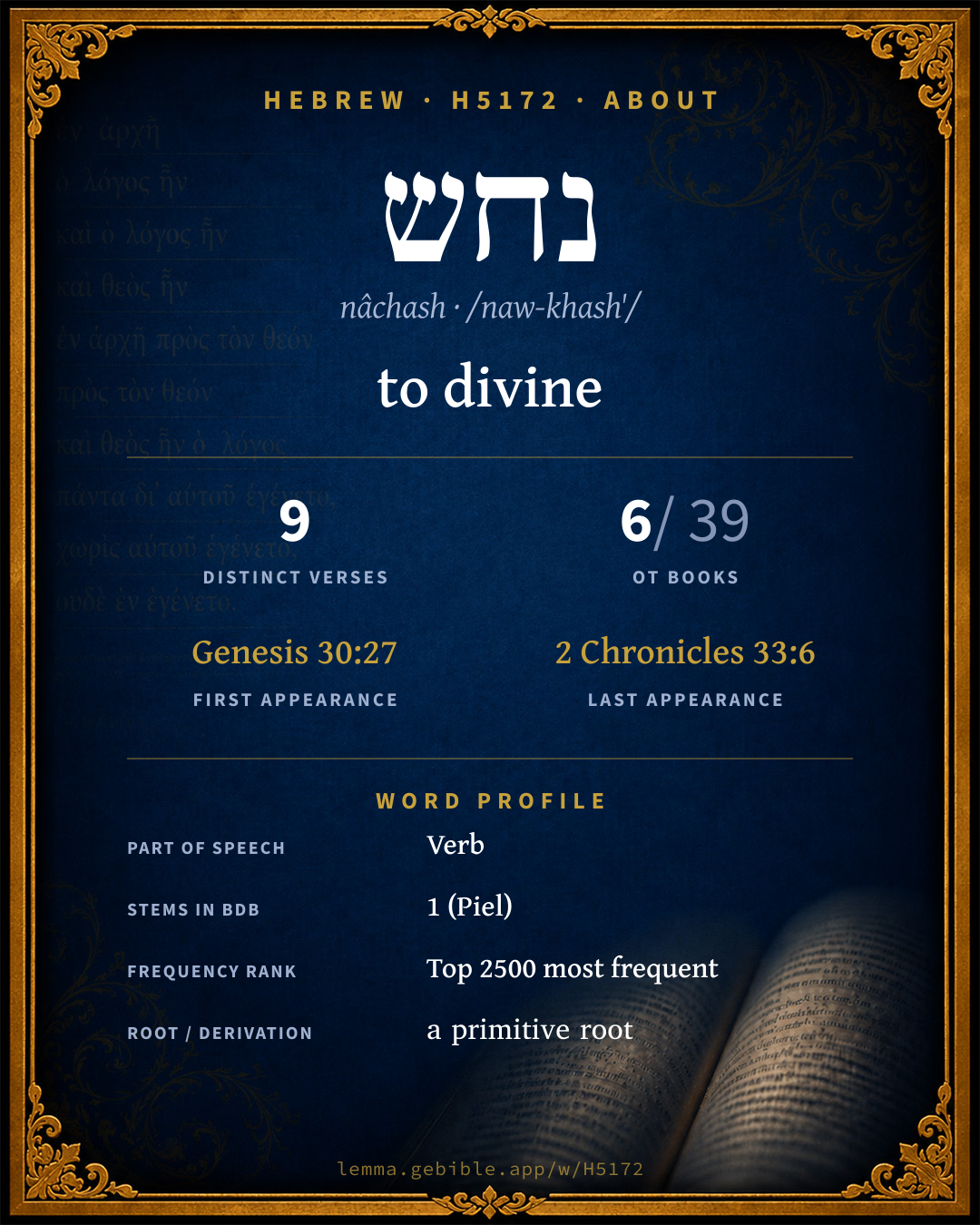
נָחַשׁ
to divine
‘to divine’ is one of 3 main senses fuller range ↓
Full lexicon entry — Brown-Driver-Briggs (BDB)
From Brown-Driver-Briggs (BDB)
Where this word appears
Grammar key — what these labels mean
Part of speech
- Verb
- An action or state-of-being word.
Stem
- Piel
- An intensive or resultative active stem. Here: ‘practise divination’
Form
- Infinitive Absolute
- An unbound verbal noun, often intensifying or standing in for a finite verb.
- Imperfect
- An incomplete, ongoing, or future action (“he will / would write”).
- Perfect
- A completed action or state — Hebrew marks aspect (completeness) more than strict tense (“he wrote”).
- Sequential Perfect
- A perfect with prefixed waw continuing a preceding imperfect or command (waw-consecutive perfect).
- Participle Active
- A verbal adjective expressing ongoing or characteristic action (“writing / one who writes”).
- Sequential Imperfect
- An imperfect with prefixed waw — the standard past-narrative form (waw-consecutive imperfect).
State
- Absolute
- The independent form of a noun, not bound to a following word.
Person
- 3rd Person
- The one spoken about (“he / she / it / they”).
- 2nd Person
- The one addressed (“you”).
- 1st Person
- The speaker (“I / we”).
Gender
- Masculine
- Grammatically masculine.
- Common
- Either gender — not distinguished for this form.
Number
- Singular
- One.
- Plural
- More than one (in Hebrew, generally three or more).
Grammatical forms 9 distinct
- Verb, Piel, Infinitive Absolute 2 times (18%)
- Verb, Piel, Imperfect, 3rd Person, Masculine, Singular 2 times (18%)
- Verb, Piel, Perfect, 3rd Person, Masculine, Singular 1 time (9%)
- Verb, Piel, Sequential Perfect, 3rd Person, Masculine, Singular 1 time (9%)
- Verb, Piel, Participle Active, Masculine, Singular, Absolute 1 time (9%)
- Verb, Piel, Sequential Imperfect, 3rd Person, Masculine, Plural 1 time (9%)
- Verb, Piel, Imperfect, 2nd Person, Masculine, Plural 1 time (9%)
- Verb, Piel, Imperfect, 3rd Person, Masculine, Plural 1 time (9%)
+1 more form (1 occurrence)
Parsed forms decoded from the imported morphology (morphhb / Westminster Leningrad Codex — WLC text public domain, morphhb tagging CC BY 4.0), counted across 11 parsed occurrences — not distinct verses.
Every verse where H5172 appears — 9 distinct verses across 6 books. Click any verse to open its interlinear word-by-word view. Verse text shown in the World English Bible for context — . Each verse’s Hebrew form is shown with its reference; the English is not keyword-highlighted, since the data carries no word-level English alignment. Use “Compare translations” on any verse to read it across multiple English versions. This concordance covers the Hebrew Bible; Septuagint (Greek Old Testament) occurrences are not indexed here.
Genesis 3 verses
- Genesis 30:27 נִחַ֕שְׁתִּי Piel pf 1cs Laban said to him, "If now I have found favor in your eyes, stay here, for I have divined that Yahweh has blessed me for your sake."
- Genesis 44:5 נַחֵ֥שׁ יְנַחֵ֖שׁ Piel inf.abs Piel impf 3ms Isn't this that from which my lord drinks, and by which he indeed divines? You have done evil in so doing.'"
- Genesis 44:15 נַחֵ֧שׁ יְנַחֵ֛שׁ Piel inf.abs Piel impf 3ms Joseph said to them, "What deed is this that you have done? Don't you know that such a man as I can indeed divine?"
Leviticus 1 verse
Deuteronomy 1 verse
1 Kings 1 verse
2 Kings 2 verses
- 2 Kings 17:17 וַ/יְנַחֵ֑שׁוּ conj + Piel wimpf 3mp They caused their sons and their daughters to pass through the fire, and used divination and enchantments, and sold themselves to do that which was evil in the sight of Yahweh, to provoke him to anger.
- 2 Kings 21:6 וְ/נִחֵ֔שׁ conj + Piel wpf 3ms He made his son to pass through the fire, and practiced sorcery, and used enchantments, and dealt with those who had familiar spirits, and with wizards: he worked much evil in the sight of Yahweh, to provoke him to anger.
2 Chronicles 1 verse
About this entry
At a glance — auto-summarized from this page’s data, not written by a person. Every figure links to its source below. This summary describes the numbers; it doesn’t interpret them.
The Hebrew verb נחש centers on the idea of “to divine.” Debuting at Genesis 30:27, it then recurs through the corpus. Spanning 9 verses in 6 books, it ranks among the uncommon words of the Hebrew Bible. Genesis dominates its distribution — 3 of 9 verses. The lexicon spreads it across several senses; see its full sense range. For the data behind this summary, explore the sense tree and the renderings breakdown below.
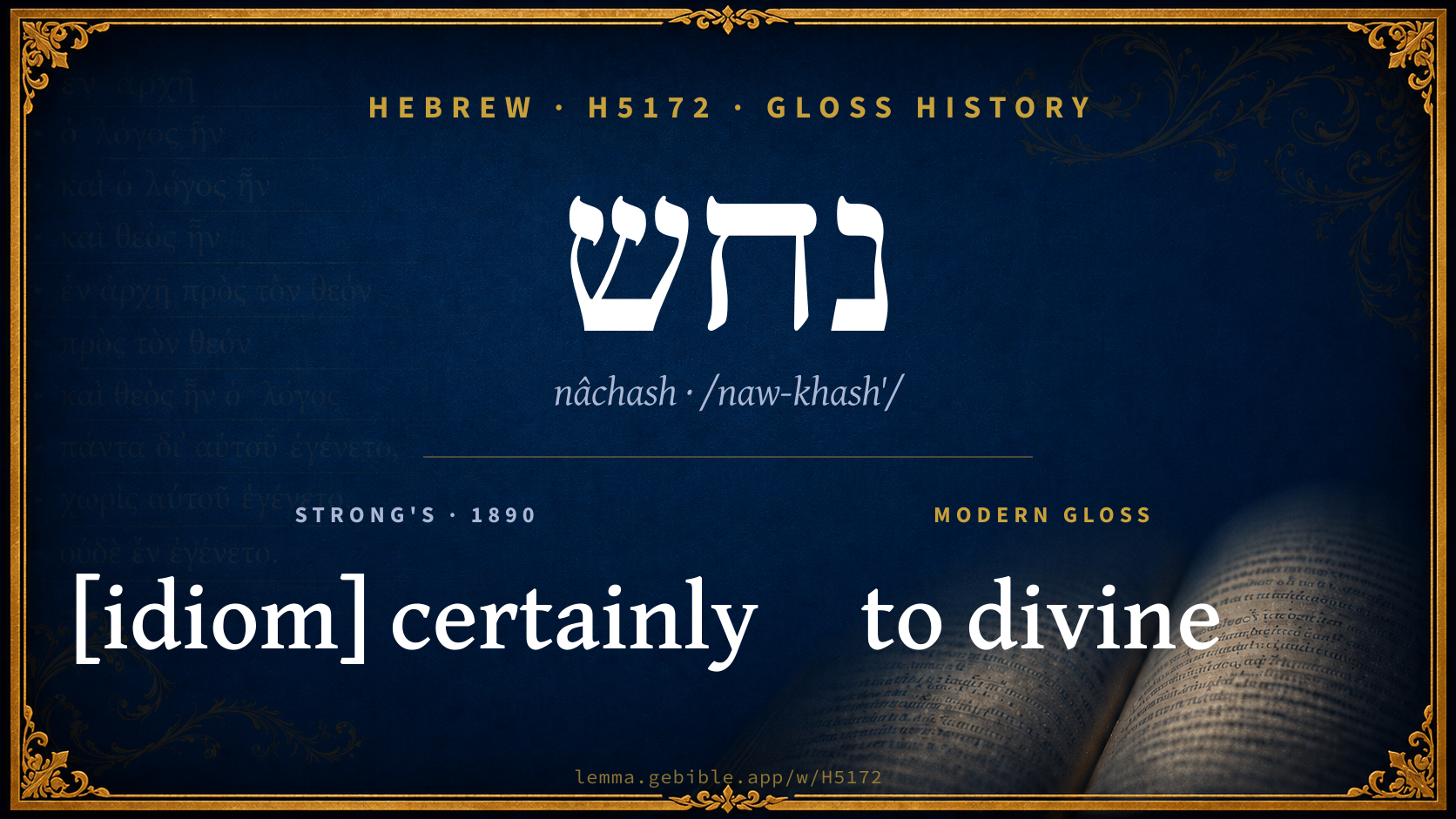
Gloss history
Strong's 1890 vs modern scholarship
About this word
Strong's H5172 catalogs a Hebrew word from the Hebrew Old Testament.
These counts are not copied from any lexicon or concordance. They are computed here, from the morphology-tagged Hebrew Old Testament. What Lemma adds →
- 9
- distinct verses
- The word appears in 9 distinct verses.
- 6 / 39
- OT books
- The word appears in 6 of 39 Old Testament books.
- #2,210
- by frequency
- Top 2500 most frequent Hebrew words (rank 2,210 of 8,640 Hebrew words by occurrence).
View all 9 occurrences in the concordance →
By section of the Old Testament
By traditional corpus
Conventional, traditional groupings — biblical authorship is debated, so this is a traditional corpus grouping, not an authorship claim. Each share is this word’s portion of its verses in that division of the Hebrew canon. Each figure is a share of the word’s 9 distinct verses.
- Torah (Pentateuch) 5 verses · 56%
- Prophets (Nevi'im) 3 verses · 33%
- Writings (Ketuvim) 1 verse · 11%
How translations render this word
Counts come from each version’s own published word-to-Strong’s tagging or interlinear alignment — an approximate guide to how each version renders this word, not a word-level alignment the data otherwise carries. Because each total is that version’s own tagged count, the per-version totals vary from one another and need not match the appearance or distinct-verse counts above. These counts may also differ from a printed concordance because Lemma counts each distinctly tagged rendering and does not collapse phrase taggings into a single head-word total. This is a fixed set of word-tagged versions (KJV, ASV, BSB, ULT) and does not change with the reading translation you choose elsewhere. Each version’s license is shown beside its name below (and on Sources).
- King James Version: Used enchantments 2×
- American Standard Version: Used enchantments 2×
- Berean Standard Bible: Divination 2×
- unfoldingWord Literal Text: Divines 2×, Indeed 2×
King James Version Public Domain
Renders H5172 across 11 tagged occurrences — most commonly:
Plus 9 renderings that appear only once — usually multi-word phrases or single function words the recovered tagging swept in, not distinct renderings.
American Standard Version Public Domain
Renders H5172 across 11 tagged occurrences — most commonly:
Plus 9 renderings that appear only once — usually multi-word phrases or single function words the recovered tagging swept in, not distinct renderings.
Berean Standard Bible Public Domain
Renders H5172 across 9 tagged occurrences — most commonly:
Plus 7 renderings that appear only once — usually multi-word phrases or single function words the recovered tagging swept in, not distinct renderings. Not rendered by a distinct English word in 2 further occurrences.
unfoldingWord Literal Text CC BY-SA 4.0
Renders H5172 across 13 tagged occurrences — most commonly:
Plus 9 renderings that appear only once — usually multi-word phrases or single function words the recovered tagging swept in, not distinct renderings.
Senses in the full BDB
What do BDB’s symbols mean?
BDB uses these scholarly abbreviations:
| Symbol | Meaning |
|---|---|
| 𝔊 | the Septuagint (the ancient Greek translation, LXX) |
| 𝔙 | the Vulgate (the Latin translation) |
| 𝔖 | the Syriac version (the Peshitta) |
| 𝔗 | the Targum (the Aramaic translation) |
| ψ | the Psalms |
| √ | root (the underlying root or stem) |
| ‖ | parallel passage (a synonymous or contrasted parallel) |
| † | the dagger: every passage where the word occurs is cited |
The 3 senses and sub-senses the full Brown-Driver-Briggs lexicon distinguishes for this word, in lexicon order (not ranked by frequency), with BDB’s own verbatim wording and sub-sense lettering. Shown in Hebrew script with BDB’s own scholarly abbreviations. The condensed entry is in the Lexicon Entry tab. See also the Forms in the corpus table below.
Piel
- practise divination, divine, observe signs (denom. from נָחָשׁ according to NöZeitschr. f. Völkerpsychol. i (1860), 413 BauSem. Rel., i. 287 LagBN 188 GerberVerb. Denom. 29; otherwise WeSkizzen iii. 147 MeChrest. Targ. s.v. BAES 48 (agst. him v. Sta Th Lz, April 28, 1894, 235); chief difficulty is that Aramaic, which has נַהֵשׁ, has no נָחָשׁ, cf. RSJPh. xiv. 115;—NH Qal Pt. נוֹחֵשׁ, and Pi.; Aramaic Pa. נַחֵשׁ, ܢܰܚܶܫ all = divine, learn by omens; perhaps cp. also Arabic نَحِسَ be unlucky Lane275 cf. Mel.c.);—Pf. 3 ms. וְנִחֵשׁ 2 K 21:6 2 Ch 33:6; 1 s. נִחַ֫שְׁתִּי Gn 30:27; Impf. יְנַחֵשׁ Gn 44:5, 15; 3 mpl. יְנַחֲשׁוּ 1 K 20:33, וַיְנַחֵ֑שׁוּ 2 K 17:17; 2 mpl. תְּנַתֲשׁוּ Lv 19:26; Inf. abs. נַחֵשׁ 1 K 20:33; Pt. מְנַחֵשׁ Dt 18:10 (cf. especially RSJPh. xiv. 113 ff.);— e.g. 2 Kings 21:6
- 1. practise divination Gn 44:5 (J; by means of cup, i.e. by hydromancy), with implied power to learn secret things v 15; condemned by proph. writer 2 K 21:6 = 2 Ch 33:6 (+ עוֹנֵן וְעָשָׂה אוֹב וְיִדְּעֹנִים), 2 K 17:17 (‖ וַיִּקְסְמוּ קְסָמִים), forbidden in D and H: Dt 18:10 (+ קֹסֵם קְסָמִים מְעוֹנֵן וּמְכַשֵּׁף), Lv 19:26 (H; ‖ תְּעוֹנֵנ֑וּ). e.g. Genesis 44:5
- 2. observe the signs or omens Gn 30:27 (J); so prob. יְנַחֲשׁוּ 1 K 20:33 now the men were observing the signs. e.g. Genesis 30:27
Senses from the full Brown-Driver-Briggs lexicon (Brown, Driver, Briggs; Oxford 1906 — public domain), digitized via Sefaria, supplemented by the OpenScriptures HebrewLexicon (CC BY 4.0). Full attribution on Sources.
Word origin
Origin: a primitive root
Jastrow Dictionary
A second Hebrew/Aramaic lexicon for comparison, covering Aramaic and post-biblical (Talmudic, Targumic, Midrashic) usage that the biblical-Hebrew BDB does not. Matched by lemma rather than by Strong’s number, so a lemma may carry more than one Jastrow headword (shown separately below), and the entries cover usage well beyond the Bible.
נָחַשׁ
- to whisper.
- to divine, to make action dependent on an omen, to augur. Tosef. Sabb. VII (VIII), 13 איזהו מְנַחֵשׁ וכ׳ a diviner (under the law, Lev. XIX, 26) is he who says, ‘my staff fell out of my hand’ (it portends evil) &c.; Snh. 65ᵇ. Ib. 66ᵃ כגון אלו המְנַחֲשִׁים בחולדה וכ׳ like those who divine (evil or luck) from a weasel, birds &c. Y. Sabb. VI, end, 8ᵈ כל המנחש סופו לבוא עליו if one believes in omens, what he fears will finally befall him (with ref. to לא נחש Num. XXIII, 23, changed into לו נחש); Ned. 32ᵃ כל המנחש לו נחש for him who believes in omens, the omen exists (will be realized). Ib. כל אדם שאינו מנ׳ he who rejects divination. Mekh. B’shall. s. 2 שמא יְנַחֲשׁוּ ויחזרו וכ׳ lest they consider it a bad omen and go back. Ib. וזקני מדין נִחֲשׁוּ וכ׳ and the Midianite elders considered (Balaam’s death) a bad omen and went home; a. fr.—Sifra Vayikra, Par. 9, ch. XIII (ref. to Lev. XVIII, 3) [read:] שלא תְנַחֵשׁ thou must not augur (v. however, נָקַר II). e.g. Leviticus 19:26
נְחַשׁ I
- , Pa. נַחֵישׁ, נָ׳ same. Targ. II Kings XXI, 6. Ib. XVII, 17 (ed. Wil. ונְחִישׁוּ Pe.); a. fr.—Ḥull. 95ᵇ דנָחֵישׁ because he had made his movements dependent on an omen. Yeb. 120ᵇ כיס … מְנַחֲשֵׁי אינשי וכ׳ as to purse and bag people are superstitious and do not lend them; a. e.
נְחַשׁ II
- , Af. אַנְחֵשׁ, הַנְחֵשׁ (denom. of נְחָשׁ) to use copper and plate it with silver, to plate. Pesik. Ekhah, p. 122ᵇ הַנְחֵשׁ ליה make it plated for him (in place of solid silver); Yalk. Is. 258 אכחיש, read: אַנְ׳.
נַחַשׁ
- divination from omen, superstition. Num. R. s. 20 בעל נ׳ a believer in omens. Ned. 32ᵃ, v. נָחַשׁ. Y. Sabb. VI, 8ᶜ bot. אע"פ שאין נ׳ יש סימן although you must not make them an omen, they are a sign (presage); Ḥull. 95ᵇ. Ib. כל נ׳ שאינו … אינו נ׳ an omen which is not proposed in the manner of Eliezer … (Gen. XXIV, 13, sq.) or of Jonathan (I Sam. XIV, 9, sq.) is not considered a divination (in the sense of Lev. XIX, 26); a. fr.—Pl. נְחָשִׁים. Tanḥ. Balak 4 בעל נ׳, v. supra. e.g. Genesis 24:13
נָחָשׁ
- 1. [the hissing,] serpent. Gen. R. s. 22 נ׳ הקדמוני the original serpent (the seducer of Eve). Gen. R. s. 20 נ׳ זה רשע בעל תשובות that serpent is wicked and skilled in arguments. Bekh. 8ᵃ נ׳ לשבע שנים וכ׳ a serpent’s pregnancy lasts seven years, and for that wicked animal I find no parallel (in the vegetable kingdom). Gen. R. s. 54 הנ׳ של בית the domestic serpent (harmless); a. fr.—Pl. נְחָשִׁים. Gen. R. s. 84 נ׳ ועקרבים snakes and scorpions; a. fr.
- 2. a pungent (poisonous) fluid in the leaves or in the stems of onions kept for a long time in the ground. Erub. 29ᵇ
- 3. a disease of the eye, v. חִלָּזוֹן. Bekh. VI, 2 חלזון נ׳ וכ׳, expl. ib. 38ᵇ as identical with חלזון; Tosef. ib. IV, 2; Sifra Emor ch. II, Par. 3.
נַחַשׁ ²
- Targ. Y. II, Num. XXIII, 23.— Snh. 19ᵃ נ׳ קא רמי להו (by saying to his comforters, ‘be comforted’) does he not cast an evil omen on them (that they would suffer bereavement)? Gen. R. s. 87, v. הָן; a. e.—Pl. נַחְשִׁין, נַחְשַׁיָּא, נְחָ׳. Targ. Num. l. c. (O. ed. Berl. נַחַשַׁ׳). Targ. O. ib. XXIV, 1. Targ. Y. Lev. XIX, 26; a. fr.
נְחָשׁ
- m. ch. = h. נְחוֹשֶׁת. Targ. Jer. XV, 20. Targ. Num. XXI, 9; a. fr.—Y. Kidd. I, 58ᵈ נ׳ יקיר נ׳ זליל copper rises and falls (silver being the standard), v. יֵקִּירָא. Esth. R. to I, 22 (ר׳ עזריה) מה דהדין קיתונא דנ׳ וכ׳ what purpose this copper vessels serves, an earthen vessel may serve as well; Lev. R. s. 12 (not נחשת); a. e.
A Dictionary of the Targumim, the Talmud Babli and Yerushalmi, and the Midrashic Literature (Marcus Jastrow; London, Luzac, 1903) — Public Domain. Digitized via Sefaria. Digitized via Sefaria. Full attribution on Sources.
Forms in the corpus
The 11 distinct written forms H5172 takes in the Hebrew Bible, most frequent first — each parse links to that stem’s occurrences in the concordance. Hebrew forms include their vowel points and cantillation, so a single lemma takes many written forms.
| Form | Parsing | Example | Uses |
|---|---|---|---|
| וְ/נִחֵ֔שׁ | Verb, Piel, Sequential Perfect, 3rd Person, Masculine, Singular | 2 Kings 21:6 | 1 |
| וְ/נִחֵשׁ֙ | Verb, Piel, Perfect, 3rd Person, Masculine, Singular | 2 Chronicles 33:6 | 1 |
| וַ/יְנַחֵ֑שׁוּ | Verb, Piel, Sequential Imperfect, 3rd Person, Masculine, Plural | 2 Kings 17:17 | 1 |
| וּ/מְנַחֵ֖שׁ | Verb, Piel, Participle Active, Masculine, Singular, Absolute | Deuteronomy 18:10 | 1 |
| יְנַחֲשׁ֨וּ | Verb, Piel, Imperfect, 3rd Person, Masculine, Plural | 1 Kings 20:33 | 1 |
| יְנַחֵ֖שׁ | Verb, Piel, Imperfect, 3rd Person, Masculine, Singular | Genesis 44:5 | 1 |
| יְנַחֵ֛שׁ | Verb, Piel, Imperfect, 3rd Person, Masculine, Singular | Genesis 44:15 | 1 |
| נִחַ֕שְׁתִּי | Verb, Piel, Perfect, 1st Person, Common, Singular | Genesis 30:27 | 1 |
| נַחֵ֥שׁ | Verb, Piel, Infinitive Absolute | Genesis 44:5 | 1 |
| נַחֵ֧שׁ | Verb, Piel, Infinitive Absolute | Genesis 44:15 | 1 |
| תְנַחֲשׁ֖וּ | Verb, Piel, Imperfect, 2nd Person, Masculine, Plural | Leviticus 19:26 | 1 |
Same root — word family
Other BDB entries built from the same root as H5172, grouped by Strong’s listed origin. These share a root / origin per the lexicon — not necessarily a shared meaning. Each links to that word’s own entry.
Derived from this word
Proper names from this root
People and places named from this root — a name, not an additional meaning of the word.
Compare all same-root words → Showing 4 of 5 — not the complete family. 1 of the same-root words is a proper name (a person or place). They share a root, not necessarily a meaning.
Septuagint verse parallels
This word appears in 8 verses that also exist in the Greek Old Testament (Septuagint), out of the 9 Hebrew verses it occurs in. You can read those verses in Greek by switching the Old Testament edition to the Septuagint.
Read these verses in the Septuagint
This is a verse-level parallel only — the same verses exist in both the Hebrew and Greek Old Testaments. No word-level Hebrew↔Greek correspondence is claimed: the data carries no such alignment, so no Greek word is shown as this Hebrew word’s translation. Coverage is not total — the Septuagint omits the deuterocanon and renumbers the Psalms, so some Hebrew verses have no direct Greek parallel.