
Lamentations 3:5

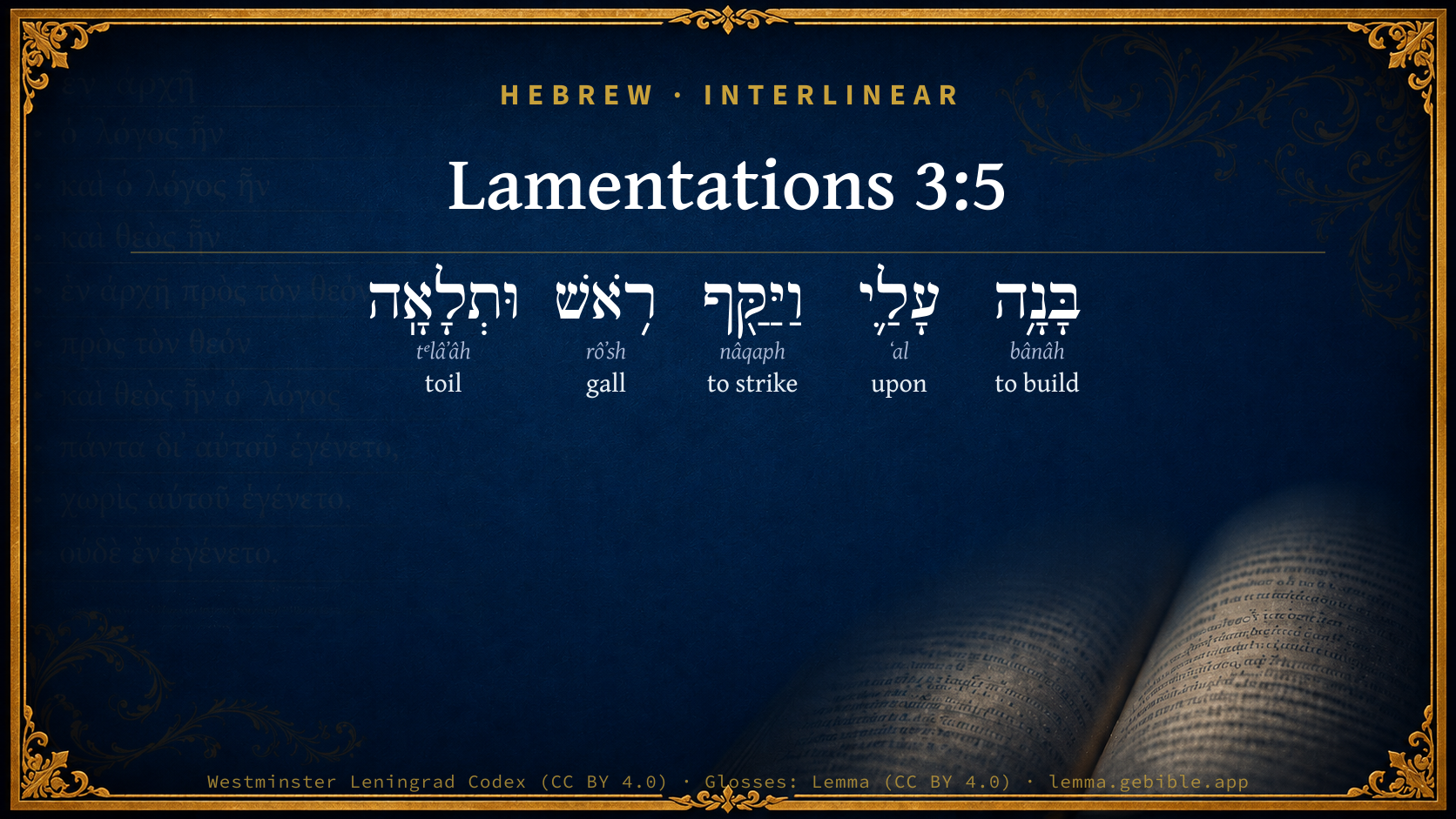
Hebrew (Westminster Leningrad Codex) Lamentations 3:5 appears in the Hebrew Old Testament. The text above is from the Westminster Leningrad Codex. Each word links to its Strong’s number, a concise gloss, and parsing drawn from the Open Scriptures Hebrew Bible morphology. Click any word for its full Brown-Driver-Briggs (BDB) entry.
Download image
Cite this verse

Lamentations 3:5 (World English Bible). Public Domain. Lemma interlinear Bible study tool, https://lemma.gebible.app/v/lamentations/3/5.

Show BibTeX & RIS
BibTeX
RIS
English Translation
He has built against me, and compassed me with gall and travail.
World English Bible · Public Domain
Download a study sheet

One document with this verse’s original text, its word-by-word gloss line, the meaning frame, cross-references with their text, attributed commentary, and full source and license credits — printable, and it pastes into notes with its structure intact.

This verse Autodidact and up

Study sheet (.html) Plain text (.txt)

A passage Seminary Student

Up to 50 verses in one chapter. A passage sheet keeps up to 6 commentary sources and 12 cross-references per verse, in the order this page ranks them, and says so on the sheet whenever that leaves anything out. Ask for a single verse and you get the Autodidact verse sheet above.

Everything on this page stays free to read, with no account — the sheet is a download of what is already on screen, not access to it.

Want to remove ads? Support Godless Engineer
Compare translations 3

The same verse in 3 English versions, stacked beneath the original-language interlinear above. Click any original word for its lexicon entry.

Each is an independent rendering of the whole verse — the interlinear is not word-aligned to these translations.

Highlighted words mark where these versions differ — a whole-verse word diff, not a word-by-word alignment.

  • World English Bible Public Domain
    He has built against me, and compassed me with gall and travail.
  • King James Version Public Domain
    He hath builded against me, and compassed me with gall and travail.
  • unfoldingWord Literal Text CC BY-SA 4.0
    He built against me and surrounded poison and hardship.

unfoldingWord Literal Text — © unfoldingWord, licensed CC BY-SA 4.0. Word-aligned USFM3 via Door43 (git.door43.org/unfoldingWord/en_ult).

Versions to compare (up to 4)

3 of 4 selected

Show all 18 translations

Every available English version of this verse, each an independent rendering of the whole verse.

  • World English Bible Public Domain
    He has built against me, and compassed me with gall and travail.
  • Berean Standard Bible Public Domain
    He has besieged me and surrounded me with bitterness and hardship.
  • Majority Standard Bible Public Domain
    He has besieged me and surrounded me with bitterness and hardship.
  • King James Version Public Domain
    He hath builded against me, and compassed me with gall and travail.
  • American Standard Version (1901) Public Domain
    He hath builded against me, and compassed me with gall and travail.
  • Revised Version (1885) Public Domain
    He hath builded against me, and compassed me with gall and travail.
  • Geneva Bible (1599) Public Domain
    He hath builded against me, and compassed me with gall, and labour.
  • Douay-Rheims (1899) Public Domain
    Beth. He hath built round about me, and he hath compassed me with gall and labour.
  • Young's Literal Translation Public Domain
    He hath built up against me, And setteth round poverty and weariness.
  • Literal Standard Version CC BY-SA 4.0
    He has built up against me, || And sets around poverty and weariness.
  • Unlocked Literal Bible CC BY-SA 4.0
    He built up siege works against me, and surrounded me with bitterness and hardship.
  • unfoldingWord Literal Text CC BY-SA 4.0
    He built against me and surrounded poison and hardship.
  • Darby Bible Public Domain
    He hath built against me, and encompassed [me] with gall and toil.
  • World Messianic Bible Public Domain
    He has built against me, and surrounded me with bitterness and hardship.
  • Webster's Bible Public Domain
    He hath built against me, and compassed me with gall and labor.
  • Free Bible Version CC BY-SA 4.0
    He has besieged me, surrounding me with bitterness and misery.
  • Bible in Basic English Public Domain
    He has put up a wall against me, shutting me in with bitter sorrow.
  • JPS Tanakh (1917) Public Domain
    He hath builded against me, and compassed me with gall and travail.

Literal Standard Version (2020), Covenant Press — licensed CC BY-SA 4.0. Text via the HelloAO Bible API (eBible.org). Unlocked Literal Bible (unfoldingWord) — licensed CC BY-SA 4.0. Text via the HelloAO Bible API (eBible.org). unfoldingWord Literal Text — © unfoldingWord, licensed CC BY-SA 4.0. Word-aligned USFM3 via Door43 (git.door43.org/unfoldingWord/en_ult). Free Bible Version, Dr. Jonathan Gallagher — licensed CC BY-SA 4.0. Text via the HelloAO Bible API (eBible.org).

Word by word

More ways to search: Search by grammar → Find every occurrence → Compare this word →

Practice this passage: Drill this verse → Learn its vocabulary →

About this verse

These counts appear in no published source. They are computed here, from the morphology-tagged text and Lemma’s own curated glosses. What Lemma adds →

5
words
5
distinct lemmas
Prophets
section

Notable vocabulary

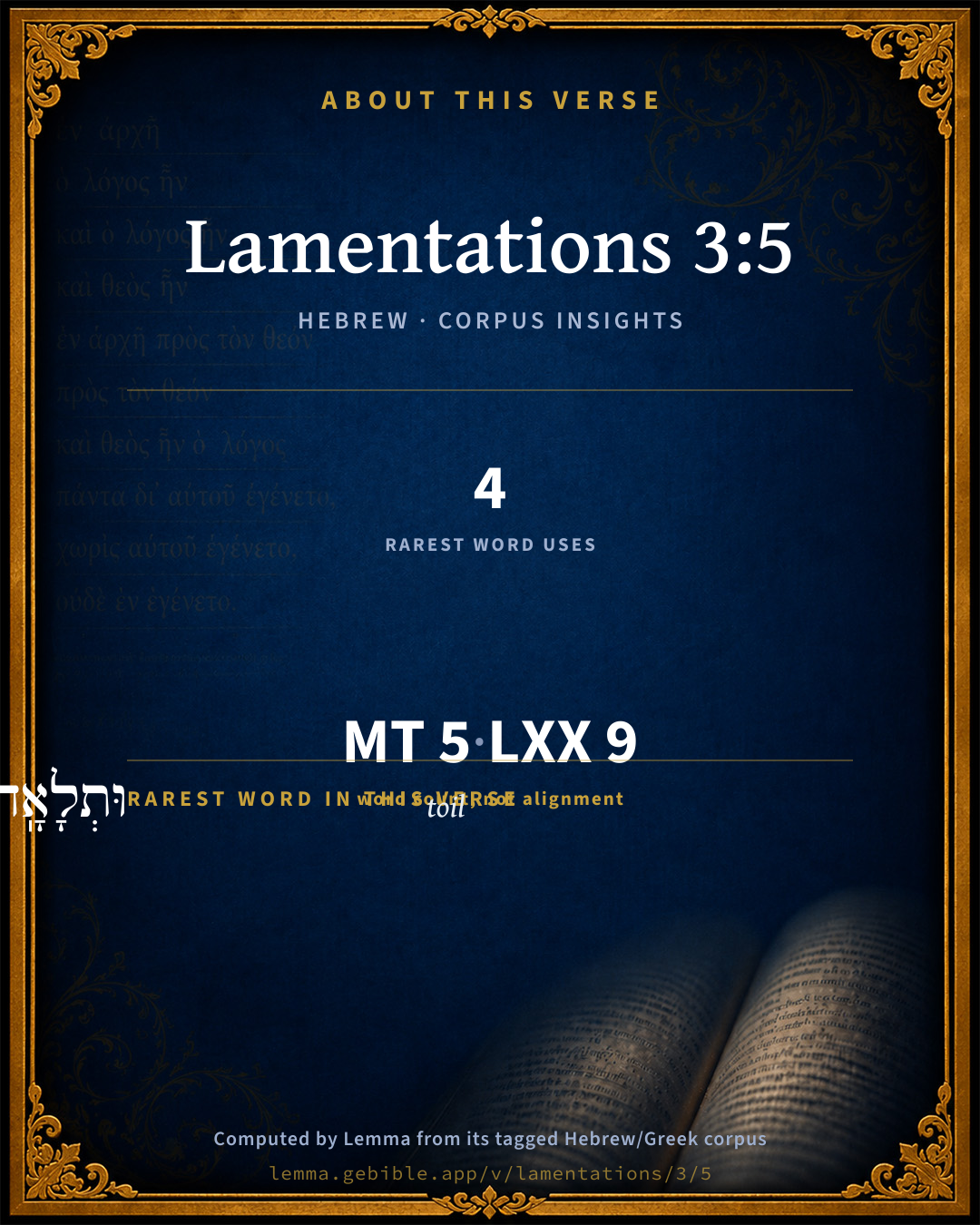
The rarest word here is וּתְלָאָֽה toil H8513 — appearing just 4 times in the whole Hebrew Bible.

Shared distinctive vocabulary

וּתְלָאָֽה toil H8513 occurs in 4 verses of the Hebrew Bible. Also found in:

Grammatical profile

  • 2 verbs
  • 2 nouns
  • 1 preposition

Verb forms

  • בָּנָ֥ה Qal · Perfect
  • וַיַּקַּ֖ף Hiphil · Sequential Imperfect

Hebrew & Septuagint length

In English translation the verse runs 12 words from the Hebrew and 15 from the Septuagint (LXX English) — closely comparable.

A rough comparison of the two English renderings, which tokenize alike — not a word-level alignment.

Word counts can differ between the Hebrew and the Greek without any difference in meaning — e.g. the Hebrew direct-object marker אֵת has no separate Greek word, and Greek often adds the article ὁ.

In the original languages it is 5 Hebrew tokens and 9 Greek tokens — but the two are counted differently (Hebrew bundles its prefixes and suffixes into one token; the Greek is in lemma form), so that isn’t a like-for-like length.

Cross-references

7

Topical passages linked to Lamentations 3:5 in the Treasury of Scripture Knowledge — connected by theme and wording, ordered by reader-vote popularity; previews shown in the World English Bible.

  • Lamentations 3:19 Remember my affliction and my misery, the wormwood and the gall.
  • Jeremiah 23:15 Therefore thus says Yahweh of Hosts concerning the prophets: Behold, I will feed them with wormwood, and make them drink the water of gall; for from the prophets of Jerusalem is ungodliness gone forth into all the land.
  • Job 19:8 He has walled up my way so that I can't pass, And has set darkness in my paths.
  • Psalms 69:21 They also gave me gall for my food. In my thirst, they gave me vinegar to drink.
  • Jeremiah 8:14 Why do we sit still? assemble yourselves, and let us enter into the fortified cities, and let us be silent there; for Yahweh our God has put us to silence, and given us water of gall to drink, because we have sinned against Yahweh.
  • Jeremiah 9:15 therefore thus says Yahweh of Hosts, the God of Israel, Behold, I will feed them, even this people, with wormwood, and give them water of gall to drink.
  • Lamentations 3:7–9 He has walled me about, that I can't go forth; he has made my chain heavy.

Cross-references courtesy of OpenBible.info (CC BY 4.0).

Hebrew and Greek witnesses Masoretic Hebrew ↔ Greek Septuagint

The same verse in the two great witnesses to the Old Testament, shown verse-for-verse.

These are two independent witnesses, not word-aligned to each other, and the Septuagint is shown in lemma (dictionary) form.

Hebrew Lamentations 3:5 Masoretic · Westminster Leningrad Codex

בָּנָ֥ה עָלַ֛י וַיַּקַּ֖ף רֹ֥אשׁ וּתְלָאָֽה

He has built against me, and compassed me with gall and travail.

World English Bible · Public Domain

Greek LXX Lamentations 3:5 Septuagint · lemma form

ἀναοἰκοδομέω κατά ἐγώ καί κυκλόω κεφαλή ἐγώ καί μοχθέω

BETH. He has built against me, and compassed my head, and brought travail upon me.

LXX2012 (modern English Septuagint) · Public Domain

On this verse, Haydock's Catholic Bible Commentary discusses the Septuagint’s reading. Read the note in Commentary ↓

Hebrew: Westminster Leningrad Codex (CC BY 4.0). Greek: Septuagint (public domain); English from LXX2012 (modern English Septuagint) (Public Domain). How the Septuagint differs from the Hebrew →

Commentary

Notes on Lamentations 3:5 from classic Christian and Jewish commentators (each source and its license shown beneath its notes). The classic Christian expositions comment on the surrounding passage and are grouped to its opening verse, so a note may address several verses; the Jewish commentaries on the Tanakh (Rashi and others) are per-verse, so they appear only where the commentator wrote on this verse.

Lemma curates 59 commentaries, every one of them public domain or Creative Commons licensed, each selected and text-cleaned for this edition rather than reprinted as found. About our sources →

Trapp's Complete Commentary

John Trapp

Lam 3:5 He hath builded against me, and compassed [me] with gall and travail.

Ver. 5. He hath builded against me.] Bulwarks and batteries.

And compassed me with gall and travel.] Or, With venom and vexation. See Jer 8:14. In these and the like hyperbolic expressions we must note that words are too weak to utter the greatness of the saints’ grief, when they lie under the sense of God’s wrath and heavy displeasure.

John Trapp, A Commentary or Exposition upon All the Books of the Old and New Testament (1647–1656) — public domain. Text from a community e-Sword module.

Geneva Bible (1599)

Geneva Bible translators

He speaketh this, as one that felt God’s heavy judgment, which he greatly feared, and therefore setteth them out with this diversity of words.

Geneva Bible (1599) marginal notes — public domain. Text via Bolls.life.

Jamieson, Fausset & Brown

Robert Jamieson, A. R. Fausset & David Brown

builded--mounds, as against a besieged city, so as to allow none to escape (so Lam 3:7, Lam 3:9).

Jamieson, Fausset & Brown — Commentary Critical and Explanatory on the Whole Bible (1871) — public domain (CC PDM 1.0). Text via the HelloAO Bible API.

Adam Clarke's Commentary

Verse 5. He hath builded against me] Perhaps there is a reference here to the mounds and ramparts raised by the Chaldeans in order to take the city.

Adam Clarke's Commentary on the Bible (1810–1826) — public domain. Text from a community e-Sword/MySword module.

John Calvin's Commentaries

The words, as translated, may seem harsh, yet they have no common beauty in Hebrew. The Prophet says he was blocked up and straitened as it were by walls; and as we shall see, he repeats this comparison three times; in other words, indeed, but for the same purpose.

God, he says, hath built against me, as, when we wish to besiege any one, we build mounds, so that there may be no escape. This, then, is the sort of building of which the Prophet now speaks: God, he says, holds me confined all around, so that there is no way of escape open to me.

He then gives a clearer explanation, that he was surrounded by gall or poison and trouble. He mentions poison first, and then, without a figure, he shews what that poison was, even that he was afflicted with many troubles. He afterwards adds, —

John Calvin's Commentaries (1540-1563) — public domain. Text from the Calvin Translation Society English edition (1840s-50s) via the Christian Classics Ethereal Library (ccel.org). Calvin's coverage is partial (roughly two-thirds of the Bible); uncommented books and verses are honest gaps, never fabricated. The 19th-century editor's footnotes and remarks are omitted so the notes are faithfully Calvin's own voice.

Ellicott's Commentary for English Readers

(5) He hath builded.—The attack of sorrow is presented under the figure of a siege. In the next clause the figure is dropped. “Gall” stands, as in Jer_8:14, for bitterest sorrow. “Travel” is the old English form of “travail,” the two forms, originally identical, being now used with different meanings.

A Bible Commentary for English Readers, edited by Charles John Ellicott (1878–1897) — public domain. Text from a community e-Sword module.

The Cambridge Bible for Schools and Colleges

gen. ed. J. J. S. Perowne

5. He hath builded against me, and compassed] Here as in Lam_3:3 we have to deal with the idiom by which two verbs are used where we should in English have a verb and adverb. Translate therefore He hath builded against me round about.

gall] See on Jer_8:14. The combination with “travail” suggests some corruption in the text. Löhr adopts for his translation (though with some hesitation) bitterness and wormwood.

travail] weariness, hardship. From 1611 to the American edition of 1867 all editions of the Authorized Version had travel both here and in the case of Num_20:14. It was probably in comparatively recent times that the two modes of spelling came to be definitely appropriated to distinct meanings of the word.

The Cambridge Bible for Schools and Colleges (gen. ed. J. J. S. Perowne; Cambridge University Press, 1878–1918) — public domain. Text from a community e-Sword module.

John Gill's Exposition

He hath builded against me,.... Fortresses, as the Targum adds; as when forts and batteries were raised by the Chaldeans against the city of Jerusalem, in which the prophet was:

and compassed me with gall and travail; or "weariness" (e); the same with gall and wormwood, Lam 3:19; as Jarchi observes. The sense is, he was surrounded with sorrow, affliction, and misery, which were as disagreeable as gall; or like poison that drank up his spirits, and made him weary of his life. Thus our Lord was exceeding sorrowful, even unto death; encompassed with sorrows, Mat 26:38. The Targum is,

"he hath surrounded the city, and rooted up the heads of the people, and caused them to fail.''

(e) "et fatigatione", Montanus, Vatablus, Castalio.

John Gill's Exposition of the Whole Bible (1746–1763) — public domain (CC PDM 1.0). Text via the HelloAO Bible API.

Albert Barnes' Notes on the Bible

He hath builded ... - The metaphor is taken from the operations in a siege.

Gall and travail - Or “travail;” i. e. bitterness and weariness (through toil).

Albert Barnes' Notes on the Bible (1834–1885) — public domain. Text from a community e-Sword/MySword module.

Haydock's Catholic Bible Commentary

Gall. Septuagint, "head." Chaldean, "he hath seized the chief," Job xvi. 13. He speaks in the name of the besieged, who had been threatened with this punishment, ver. 19., and chap. viii. 14. (Calmet) --- And labour. Nabuzardan ransacked the city worse than his master, (Worthington) if the latter was at all present. (Haydock)

George Leo Haydock (1774–1849), Haydock's Catholic Family Bible and Commentary, 1859 edition — public domain. Excludes Psalms (Douay-Rheims chapter numbering differs from Protestant) and Deuterocanonical books (Catholic canon only).

Matthew Poole's English Annotations

He hath not builded with me, increasing my prosperity, and protecting my houses, but he hath builded forts, and batteries, and castles, (military buildings,) to batter down my walls and houses, Isa 29:2,3. And compassed me with gall and travel; or with poison, venom, and misery, as some translate it; and it seems more proper than gall and travel, which have no cognation one with another. We are not well acquainted with the ancient dialect of other countries: the sense is obvious, God had surrounded them with misery and calamities.

Matthew Poole's English Annotations on the Holy Bible (1683–1685) — public domain. Text from a community e-Sword/MySword module.

Whedon's Commentary on the Bible

Daniel D. Whedon

5. Hath builded against me — As besiegers enclose a city.

Gall and travail — A most extraordinary combination surely, but not unlike Jeremiah. “Gall” is the name of a bitter plant which has come to be synonymous with keen suffering, and so it seems to be used here co-ordinate with “travail.”

Daniel D. Whedon (gen. ed.), Commentary on the Old and New Testaments (1874–1909) — public domain. Text from a community e-Sword module.

The Pulpit Commentary

He hath builded against me, and compassed me. A figure from the siege of a town. Gall. For the true meaning of the word, see on Jer_8:14. We need not trouble ourselves about it here, for the word is evidently used as a kind of "ideograph" for bitterness. Travel; literally, weariness.

The Pulpit Commentary (1880–1919), ed. H.D.M. Spence-Jones & Joseph S. Exell — public domain. Text from a community e-Sword module.

John Wesley's Explanatory Notes

Builded - He hath built forts and batteries against my walls and houses.

John Wesley, Explanatory Notes Upon the Whole Bible (1754–1765) — public domain. Text via the GEBible commentary corpus.

unfoldingWord translationNotes

Door43 World Missions Community

He built up siege works against me

Siege works are ramps that an army builds around a city to enable them to climb over the city walls and invade the city.

He built up siege works against me

Possible meanings are 1) the author speaks of God causing bad things to happen to him as if he were a city and God was an enemy that built up siege works against him. AT: "God attacked me like an enemy army that sets up siege works around a city" or 2) the author speaks of God causing the enemy army to attack Jerusalem as if God were the enemy. AT: "God caused the enemy army to build up siege works against me" (See: Metaphor)

surrounded me with bitterness and hardship

This represents God causing him to experience much bitterness and hardship. AT: "caused me to experience much bitterness and hardship" or "caused me to suffer and have many problems" (See: Metaphor)

bitterness

Here "bitterness" represents suffering. (See: Metaphor)

He made me live in dark places, like those who died long ago

Here "dark places" is a metaphor for suffering. The author compares the intensity of his suffering to the intensity of the darkness that those who died long ago experience. AT: "The suffering that he causes me is intense like the darkness of the grave" or "He makes me suffer terribly, as if I were in the darkness of those who died long ago" (See: Metaphor and Simile)

He built a wall around me and I cannot escape. He made my chains heavy

This represents the continuing suffering. Like a person who cannot escape from prison, the author cannot make his suffering stop. AT: "My suffering continues. It is as though he has built a wall around me and put heavy chains on me, and I cannot escape" (See: Metaphor)

he shut out my prayer

The author speaks about God refusing to listen to his prayers as though God was shutting his ears so that the author's prayers could not go into them. AT: "he refuses to hear my prayer" (See: Idiom)

translationWords

siege

darkness

die

pray

unfoldingWord translationNotes — © Distant Shores Media and the Door43 World Missions Community, licensed CC BY-SA 4.0. Source: git.door43.org/Door43/en_tn.

Rashi

Rabbi Shlomo Yitzchaki (Rashi)

and encompassed He encompassed me.

gall Heb. רֹאשּׁ, like (Deut. 29: “gall (רֹאשּׁ) and wormwood.” The Midrash Aggadah (Lam. Rabhah), states: רֹאשּׁ refers to Nebuchadnezzar in the exile of Jehoiachin. travail Nebuzaradan, who completed the blow in the days of Zedekiah, and he wearied me.

Rashi on the Tanakh — English translations: “The Judaica Press complete Tanach with Rashi, translated by A. J. Rosenberg” (CC BY 4.0); “Pentateuch with Rashi's commentary by M. Rosenbaum and A.M. Silbermann, 1929-1934” (public domain); “The Metsudah Tanach series, Lakewood, N.J” (CC BY 4.0); and “The Book of Joshua, Metsudah Publications, 1997” (CC BY 4.0). Text via Sefaria.

Lesson kit

Teaching starters — assembled from the data on this page, not authored interpretation. Every prompt links to the verse data it draws on. Edit before teaching.

Lamentations, in the Prophets, opens this verse with 5 words (5 distinct Hebrew lemmas). Its most distinctive word is tᵉlâʼâh (“toil”). A historical commentator’s framing appears above. Read the whole chapter for the surrounding context.

Discussion questions

  1. The word tᵉlâʼâh carries the sense “toil.” How does it shape the verse?
  2. How does Exodus 18:8, which shares the word «toil», read alongside this verse?
  3. These translations render this verse differently. What is at stake in choosing one wording over another?
  4. «בָּנָ֥ה» is a Qal Perfect verb. How does that grammatical form shape the action described?
  5. Compare how Trapp's Complete Commentary and Geneva Bible (1599) read this verse. Where do they agree or differ?

Things to notice

Reading settings

Reading text

Shown beneath each verse's original-language words.

Old Testament
Old Testament edition

Read the OT as the Masoretic Hebrew (MT) or the Greek Septuagint (LXX).

English shown for the Greek Septuagint (in the Hebrew ↔ Greek comparison).

Comparing translations? Open the Compare panel on any verse page to stack up to four side by side.