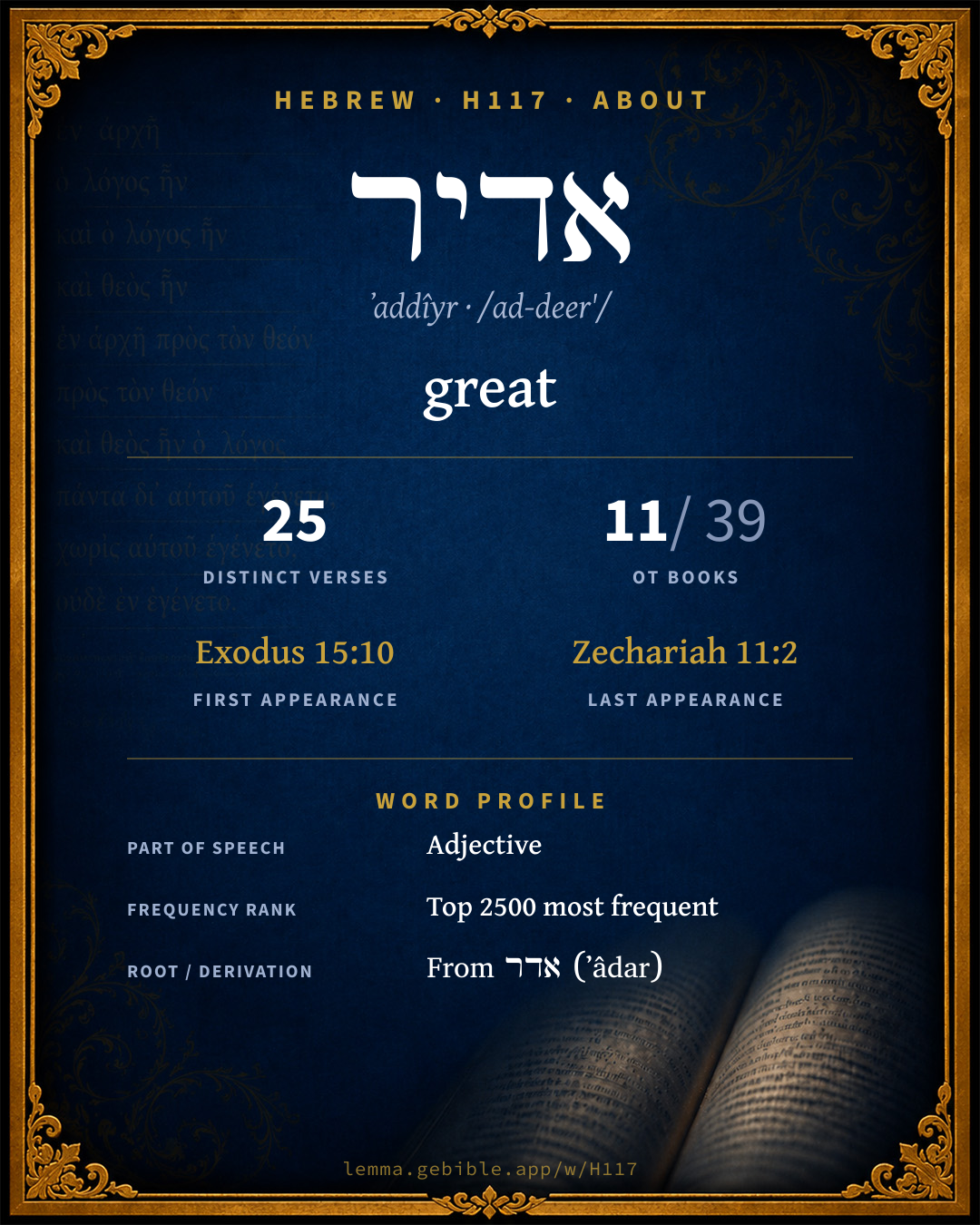
אַדִּיר
great
‘great’ is one of 2 main senses fuller range ↓
Full lexicon entry — Brown-Driver-Briggs (BDB)
From Brown-Driver-Briggs (BDB)
Where this word appears
See every Absolute-state word in the Hebrew Bible →
Grammar key — what these labels mean
Part of speech
- Adjective
- A word that describes or qualifies a noun.
State
- Absolute
- The independent form of a noun, not bound to a following word.
- Construct
- A noun bound to a following noun in a possessive / “of” relationship (the construct chain).
Gender
- Masculine
- Grammatically masculine.
Number
- Singular
- One.
- Plural
- More than one (in Hebrew, generally three or more).
Grammatical forms
- Adjective, Adjective, Masculine, Plural, Absolute 9 times (33%)
- Adjective, Adjective, Masculine, Plural, Construct 9 times (33%)
- Adjective, Adjective, Masculine, Singular, Absolute 8 times (30%)
- Adjective, Adjective, Masculine, Singular, Construct 1 time (4%)
Parsed forms decoded from the imported morphology (morphhb / Westminster Leningrad Codex — WLC text public domain, morphhb tagging CC BY 4.0), counted across 27 parsed occurrences — not distinct verses.
Every verse where H117 appears — 25 distinct verses across 11 books. Click any verse to open its interlinear word-by-word view. Verse text shown in the World English Bible for context — . Each verse’s Hebrew form is shown with its reference; the English is not keyword-highlighted, since the data carries no word-level English alignment. Use “Compare translations” on any verse to read it across multiple English versions. This concordance covers the Hebrew Bible; Septuagint (Greek Old Testament) occurrences are not indexed here.
Exodus 1 verse
Judges 2 verses
1 Samuel 1 verse
2 Chronicles 1 verse
Nehemiah 2 verses
- Nehemiah 3:5 וְ/אַדִּֽירֵי/הֶם֙ conj + Adjective Adjective mp cs + sfx pers 3mp Next to them the Tekoites repaired; but their nobles didn't put their necks to the work of their lord.
- Nehemiah 10:29 אַדִּירֵי/הֶם֒ adj Adjective mp cs + sfx pers 3mp They joined with their brothers, their nobles, and entered into a curse, and into an oath, to walk in God's law, which was given by Moses the servant of God, and to observe and do all the commandments of Yahweh our Lord, and his ordinances and his statutes;
Psalms 6 verses
- Psalms 8:1 אַדִּ֣יר adj Adjective ms Yahweh, our Lord, how majestic is your name in all the earth, Who has set your glory above the heavens!
- Psalms 8:9 אַדִּ֥יר adj Adjective ms Yahweh, our Lord, How majestic is your name in all the earth!
- Psalms 16:3 וְ֝/אַדִּירֵ֗י conj + Adjective Adjective mp cs As for the saints who are in the earth, They are the excellent ones in whom is all my delight.
- Psalms 76:4 אַדִּ֗יר adj Adjective ms Glorious are you, and excellent, More than mountains of game.
- Psalms 93:4 אַדִּירִ֣ים אַדִּ֖יר adj Adjective mp adj Adjective ms Above the voices of many waters, The mighty breakers of the sea, Yahweh on high is mighty.
- Psalms 136:18 אַדִּירִ֑ים adj Adjective mp And killed mighty kings; For his loving kindness endures forever:
Isaiah 2 verses
- Isaiah 10:34 בְּ/אַדִּ֥יר prep + Adjective Adjective ms He will cut down the thickets of the forest with iron, and Lebanon shall fall by a mighty one.
- Isaiah 33:21 אַדִּ֤יר אַדִּ֖יר adj Adjective ms adj Adjective ms But there Yahweh will be with us in majesty, a place of broad rivers and streams, in which shall go no galley with oars, neither shall gallant ship pass thereby.
Jeremiah 5 verses
- Jeremiah 14:3 וְ/אַדִּ֣רֵי/הֶ֔ם conj + Adjective Adjective mp cs + sfx pers 3mp Their nobles send their little ones to the waters: they come to the cisterns, and find no water; they return with their vessels empty; they are disappointed and confounded, and cover their heads.
- Jeremiah 25:34 אַדִּירֵ֣י adj Adjective mp cs Wail, you shepherds, and cry; and wallow [in ashes], you principal of the flock; for the days of your slaughter and of your dispersions are fully come, and you shall fall like a goodly vessel.
- Jeremiah 25:35 מֵ/אַדִּירֵ֥י prep + Adjective Adjective mp cs The shepherds shall have no way to flee, nor the principal of the flock to escape.
- Jeremiah 25:36 אַדִּירֵ֣י adj Adjective mp cs A voice of the cry of the shepherds, and the wailing of the principal of the flock! for Yahweh lays waste their pasture.
- Jeremiah 30:21 אַדִּיר֜/וֹ adj Adjective ms cs + sfx pers 3ms Their prince shall be of themselves, and their ruler shall proceed from the midst of them; and I will cause him to draw near, and he shall approach to me: for who is he who has had boldness to approach to me? says Yahweh.
Ezekiel 2 verses
- Ezekiel 17:23 אַדִּ֑יר adj Adjective ms in the mountain of the height of Israel will I plant it; and it shall bring forth boughs, and bear fruit, and be a goodly cedar: and under it shall dwell all birds of every wing; in the shade of the branches of it shall they dwell.
- Ezekiel 32:18 אַדִּרִ֛ם adj Adjective mp Son of man, wail for the multitude of Egypt, and cast them down, even her, and the daughters of the famous nations, to the lower parts of the earth, with those who go down into the pit.
Nahum 2 verses
- Nahum 2:5 אַדִּירָ֔י/ו adj Adjective mp cs + sfx pers 3ms He summons his picked troops. They stumble on their way. They dash to its wall, and the protective shield is put in place.
- Nahum 3:18 אַדִּירֶ֑י/ךָ adj Adjective mp cs + sfx pers 2ms Your shepherds slumber, king of Assyria. Your nobles lie down. Your people are scattered on the mountains, and there is no one to gather them.
Zechariah 1 verse
About this entry
At a glance — auto-summarized from this page’s data, not written by a person. Every figure links to its source below. This summary describes the numbers; it doesn’t interpret them.
The Hebrew adjective אדיר centers on the idea of “great.” Where the King James Version says “nobles,” newer translations reach for “majestic” (Berean Standard Bible); the renderings breakdown has the detail. It appears 25 verses across 11 books of the Hebrew Bible, among its uncommon vocabulary. Debuting at Exodus 15:10, it then recurs through the corpus. The lexicon spreads it across several senses; see its full sense range. For the data behind this summary, explore the sense tree and the renderings breakdown below.
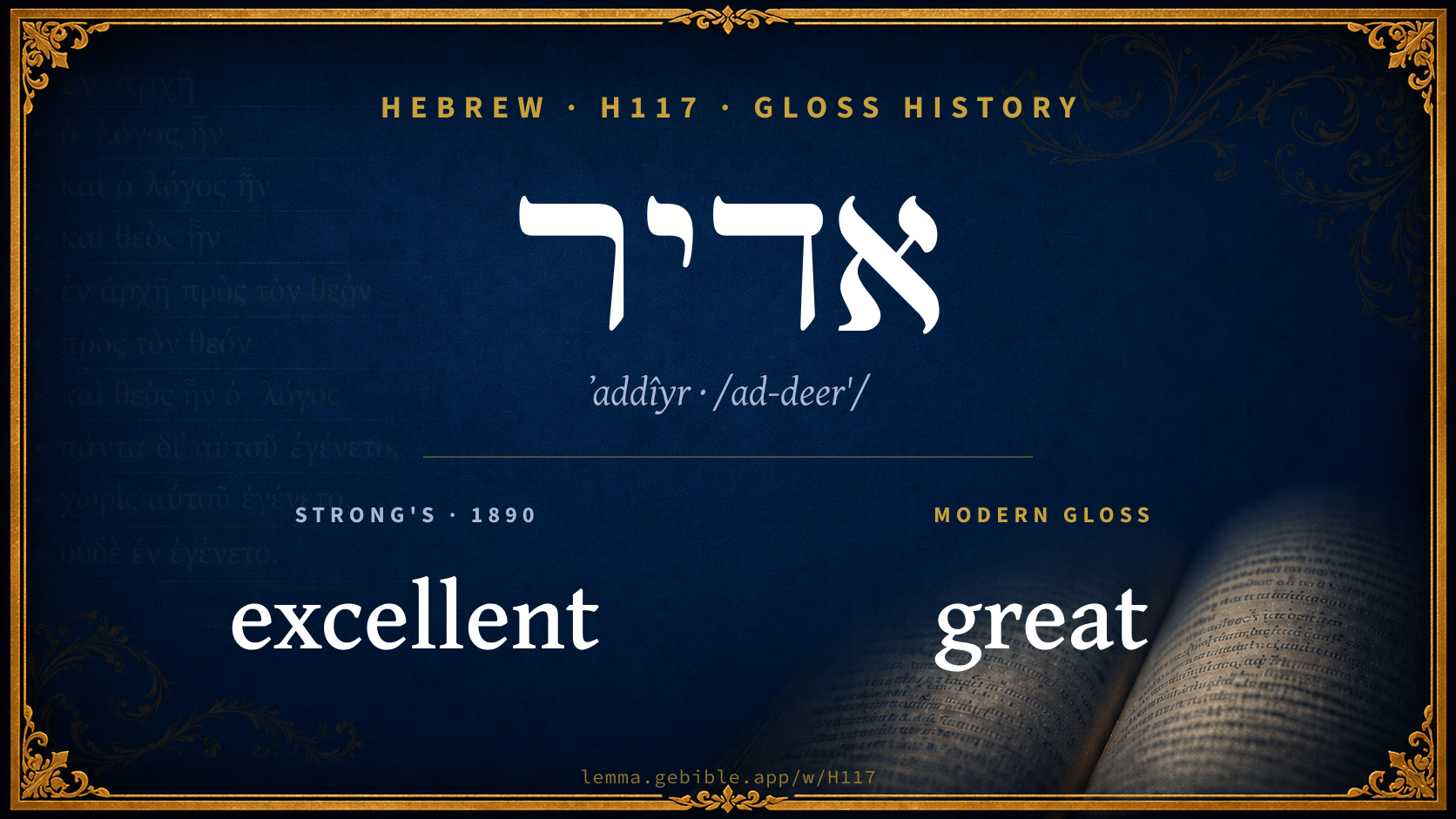
Gloss history
Strong's 1890 vs modern scholarship
About this word
Strong's H117 catalogs a Hebrew word from the Hebrew Old Testament.
These counts are not copied from any lexicon or concordance. They are computed here, from the morphology-tagged Hebrew Old Testament. What Lemma adds →
- 25
- distinct verses
- The word appears in 25 distinct verses.
- 11 / 39
- OT books
- The word appears in 11 of 39 Old Testament books.
- #1,226
- by frequency
- Top 2500 most frequent Hebrew words (rank 1,226 of 8,640 Hebrew words by occurrence).
View all 25 occurrences in the concordance →
By section of the Old Testament
By traditional corpus
Conventional, traditional groupings — biblical authorship is debated, so this is a traditional corpus grouping, not an authorship claim. Each share is this word’s portion of its verses in that division of the Hebrew canon. Each figure is a share of the word’s 25 distinct verses.
- Prophets (Nevi'im) 15 verses · 60%
- Writings (Ketuvim) 9 verses · 36%
- Torah (Pentateuch) 1 verse · 4%
How translations render this word
Counts come from each version’s own published word-to-Strong’s tagging or interlinear alignment — an approximate guide to how each version renders this word, not a word-level alignment the data otherwise carries. Because each total is that version’s own tagged count, the per-version totals vary from one another and need not match the appearance or distinct-verse counts above. These counts may also differ from a printed concordance because Lemma counts each distinctly tagged rendering and does not collapse phrase taggings into a single head-word total. This is a fixed set of word-tagged versions (KJV, ASV, BSB, ULT) and does not change with the reading translation you choose elsewhere. Each version’s license is shown beside its name below (and on Sources).
- King James Version: Nobles 6×, Mighty 3×, Excellent 2×
- American Standard Version: Nobles 7×, Mighty 3×, How excellent 2×
- Berean Standard Bible: Majestic 5×, Mighty 5×, Nobles 5×
- unfoldingWord Literal Text: Majestic 5×, Nobles 5×, Mighty 4×
King James Version Public Domain
Renders H117 across 27 tagged occurrences — most commonly:
Plus 10 renderings that appear only once — usually multi-word phrases or single function words the recovered tagging swept in, not distinct renderings.
American Standard Version Public Domain
Renders H117 across 27 tagged occurrences — most commonly:
Plus 13 renderings that appear only once — usually multi-word phrases or single function words the recovered tagging swept in, not distinct renderings.
Berean Standard Bible Public Domain
Renders H117 across 27 tagged occurrences — most commonly:
Plus 10 renderings that appear only once — usually multi-word phrases or single function words the recovered tagging swept in, not distinct renderings.
unfoldingWord Literal Text CC BY-SA 4.0
Renders H117 across 27 tagged occurrences — most commonly:
Plus 9 renderings that appear only once — usually multi-word phrases or single function words the recovered tagging swept in, not distinct renderings.
Senses in the full BDB
What do BDB’s symbols mean?
BDB uses these scholarly abbreviations:
| Symbol | Meaning |
|---|---|
| 𝔊 | the Septuagint (the ancient Greek translation, LXX) |
| 𝔙 | the Vulgate (the Latin translation) |
| 𝔖 | the Syriac version (the Peshitta) |
| 𝔗 | the Targum (the Aramaic translation) |
| ψ | the Psalms |
| √ | root (the underlying root or stem) |
| ‖ | parallel passage (a synonymous or contrasted parallel) |
| † | the dagger: every passage where the word occurs is cited |
The 2 senses and sub-senses the full Brown-Driver-Briggs lexicon distinguishes for this word, in lexicon order (not ranked by frequency), with BDB’s own verbatim wording and sub-sense lettering. Shown in Hebrew script with BDB’s own scholarly abbreviations. The condensed entry is in the Lexicon Entry tab. See also the Forms in the corpus table below.
- 1. majestic (wide, lofty) of waters of sea Ex 15:10 ψ 93:4; a ship Is 33:21; a tree Ez 17:23; a vine Ez 17:8 (גֶּפֶן אַדֶּרֶת, so Fü; or א׳ n. abstr. v. sub אַדֶּרֶת infr.); also fig. of kings ψ 136:18; nations Ez 32:18; gods 1 S 4:8; of י׳ ψ 93:4; 76:5; of name of י׳ ψ 8:2, 10. e.g. Exodus 15:10
- 2. subst. majestic one, of nobles, chieftains, etc., Ju 5:13, 25 Na 2:6, 3:18 Je 14:3; 25:34 (אַדִּירֵי הַצֹּאן fig. so) 35, 36; 30:21 Zc 11:2 2 Ch 23:20 Ne 3:5; 10:30; of י׳ Is 10:34; 33:21; of servants of י׳ ψ 16:3 (= priests? cf. 1 Ch 24:5 & v. Che). e.g. Judges 5:13
Senses from the full Brown-Driver-Briggs lexicon (Brown, Driver, Briggs; Oxford 1906 — public domain), digitized via Sefaria, supplemented by the OpenScriptures HebrewLexicon (CC BY 4.0). Full attribution on Sources.
Word origin
adj. majestic—א׳ ψ 8:2 +; f. אַדֶּ֫רֶת Ez 17:8? (v. infr.) etc.—
— Brown-Driver-Briggs (Oxford 1906, public domain), digitized via Sefaria, supplemented by the OpenScriptures HebrewLexicon (CC BY 4.0). See Sources.
Derived from אדר (ʼâdar) (H142) — to be great.
Jastrow Dictionary
A second Hebrew/Aramaic lexicon for comparison, covering Aramaic and post-biblical (Talmudic, Targumic, Midrashic) usage that the biblical-Hebrew BDB does not. Matched by lemma rather than by Strong’s number, so a lemma may carry more than one Jastrow headword (shown separately below), and the entries cover usage well beyond the Bible.
אַדִּיר
- ; distinguished, glorious, mighty.—Pl. אַדִּירִים. Men. 53ᵃ
אַדִּיר ²
- Targ. O. Ex. XV, 6; a. fr.
A Dictionary of the Targumim, the Talmud Babli and Yerushalmi, and the Midrashic Literature (Marcus Jastrow; London, Luzac, 1903) — Public Domain. Digitized via Sefaria. Digitized via Sefaria. Full attribution on Sources.
Forms in the corpus
The 25 distinct written forms H117 takes in the Hebrew Bible, most frequent first — each parse links to that state’s occurrences in the concordance. Hebrew forms include their vowel points and cantillation, so a single lemma takes many written forms.
Same root — word family
Other BDB entries built from the same root as H117, grouped by Strong’s listed origin. These share a root / origin per the lexicon — not necessarily a shared meaning. Each links to that word’s own entry.
Derives from
Shares the same root
Derived from this word
Proper names from this root
People and places named from this root — a name, not an additional meaning of the word.
Compare all same-root words → Showing 4 of 8 — not the complete family. 3 of the same-root words are proper names (people or places). They share a root, not necessarily a meaning.
Septuagint verse parallels
This word appears in 19 verses that also exist in the Greek Old Testament (Septuagint), out of the 25 Hebrew verses it occurs in. You can read those verses in Greek by switching the Old Testament edition to the Septuagint.
Read these verses in the Septuagint
- Exodus 15:10
- Judges 5:13
- 1 Samuel 4:8
- 2 Chronicles 23:20
- Psalms 8:1
- Isaiah 10:34
- Jeremiah 14:3
- Ezekiel 17:23
- Nahum 2:5
- Zechariah 11:2
This is a verse-level parallel only — the same verses exist in both the Hebrew and Greek Old Testaments. No word-level Hebrew↔Greek correspondence is claimed: the data carries no such alignment, so no Greek word is shown as this Hebrew word’s translation. Coverage is not total — the Septuagint omits the deuterocanon and renumbers the Psalms, so some Hebrew verses have no direct Greek parallel.