

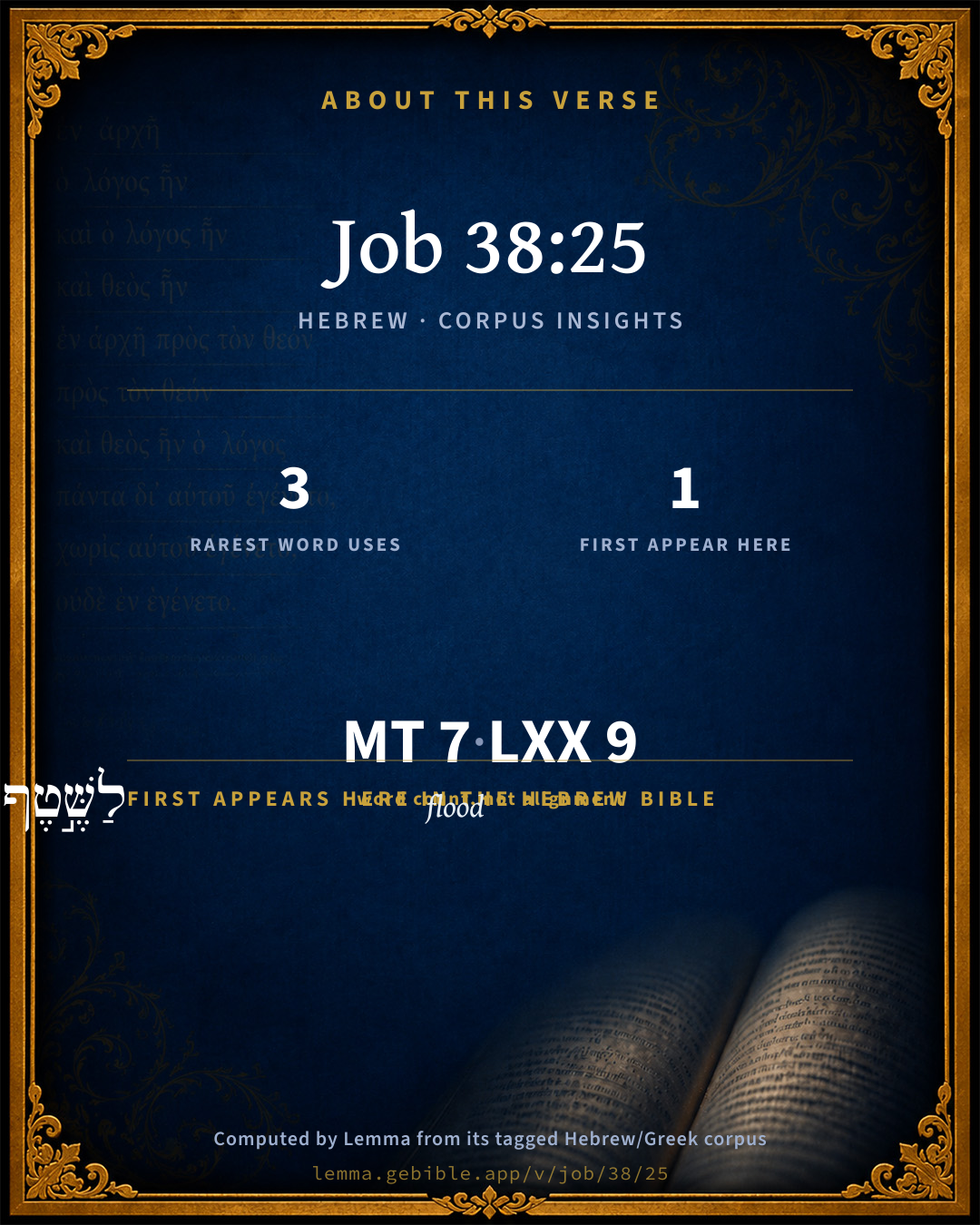
Job 38:25

Hebrew (Westminster Leningrad Codex) Job 38:25 appears in the Hebrew Old Testament. The text above is from the Westminster Leningrad Codex. Each word links to its Strong’s number, a concise gloss, and parsing drawn from the Open Scriptures Hebrew Bible morphology. Click any word for its full Brown-Driver-Briggs (BDB) entry.
Download image
Cite this verse

Job 38:25 (World English Bible). Public Domain. Lemma interlinear Bible study tool, https://lemma.gebible.app/v/job/38/25.

Show BibTeX & RIS
BibTeX
RIS
English Translation
Who has cut a channel for the flood water, Or the path for the thunderstorm;
World English Bible · Public Domain
Highlights
  • 1 first appearance in the Hebrew Bible
Full analysis ↓
Download a study sheet

One document with this verse’s original text, its word-by-word gloss line, the meaning frame, cross-references with their text, attributed commentary, and full source and license credits — printable, and it pastes into notes with its structure intact.

This verse Autodidact and up

Study sheet (.html) Plain text (.txt)

A passage Seminary Student

Up to 50 verses in one chapter. A passage sheet keeps up to 6 commentary sources and 12 cross-references per verse, in the order this page ranks them, and says so on the sheet whenever that leaves anything out. Ask for a single verse and you get the Autodidact verse sheet above.

Everything on this page stays free to read, with no account — the sheet is a download of what is already on screen, not access to it.

Want to remove ads? Support Godless Engineer
Compare translations 3

The same verse in 3 English versions, stacked beneath the original-language interlinear above. Click any original word for its lexicon entry.

Each is an independent rendering of the whole verse — the interlinear is not word-aligned to these translations.

Highlighted words mark where these versions differ — a whole-verse word diff, not a word-by-word alignment.

  • World English Bible Public Domain
    Who has cut a channel for the flood water, Or the path for the thunderstorm;
  • King James Version Public Domain
    Who hath divided a watercourse for the overflowing of waters, or a way for the lightning of thunder;
  • unfoldingWord Literal Text CC BY-SA 4.0
    Who cut a channel for the downpour, or a way for the lightning of the thunder,

unfoldingWord Literal Text — © unfoldingWord, licensed CC BY-SA 4.0. Word-aligned USFM3 via Door43 (git.door43.org/unfoldingWord/en_ult).

Versions to compare (up to 4)

3 of 4 selected

Show all 18 translations

Every available English version of this verse, each an independent rendering of the whole verse.

  • World English Bible Public Domain
    Who has cut a channel for the flood water, Or the path for the thunderstorm;
  • Berean Standard Bible Public Domain
    Who cuts a channel for the flood or clears a path for the thunderbolt,
  • Majority Standard Bible Public Domain
    Who cuts a channel for the flood or clears a path for the thunderbolt,
  • King James Version Public Domain
    Who hath divided a watercourse for the overflowing of waters, or a way for the lightning of thunder;
  • American Standard Version (1901) Public Domain
    Who hath cleft a channel for the waterflood, Or the way for the lightning of the thunder;
  • Revised Version (1885) Public Domain
    Who hath cleft a channel for the waterflood, or a way for the lightning of the thunder;
  • Geneva Bible (1599) Public Domain
    Who hath deuided the spowtes for the raine? or the way for the lightning of ye thunders,
  • Douay-Rheims (1899) Public Domain
    Who gave a course to violent showers, or a way for noisy thunder:
  • Young's Literal Translation Public Domain
    Who hath divided for the flood a conduit? And a way for the lightning of the voices?
  • Literal Standard Version CC BY-SA 4.0
    Who has divided a conduit for the flood? And a way for the lightning of the voices?
  • Unlocked Literal Bible CC BY-SA 4.0
    Who has created the channels for the floods of rain, or who has made a path for the thunder,
  • unfoldingWord Literal Text CC BY-SA 4.0
    Who cut a channel for the downpour, or a way for the lightning of the thunder,
  • Darby Bible Public Domain
    Who hath divided a channel for the rain-flood, and a way for the thunder's flash;
  • World Messianic Bible Public Domain
    Who has cut a channel for the flood water, or the path for the thunderstorm,
  • Webster's Bible Public Domain
    Who hath divided a watercourse for the overflowing of waters, or a way for the lightning of thunder;
  • Free Bible Version CC BY-SA 4.0
    Who cuts a channel for the rain to flow? Who creates a path for the thunderbolt?
  • Bible in Basic English Public Domain
    By whom has the way been cut for the flowing of the rain, and the flaming of the thunder;
  • JPS Tanakh (1917) Public Domain
    Who hath cleft a channel for the waterflood, or a way for the lightning of the thunder;

Literal Standard Version (2020), Covenant Press — licensed CC BY-SA 4.0. Text via the HelloAO Bible API (eBible.org). Unlocked Literal Bible (unfoldingWord) — licensed CC BY-SA 4.0. Text via the HelloAO Bible API (eBible.org). unfoldingWord Literal Text — © unfoldingWord, licensed CC BY-SA 4.0. Word-aligned USFM3 via Door43 (git.door43.org/unfoldingWord/en_ult). Free Bible Version, Dr. Jonathan Gallagher — licensed CC BY-SA 4.0. Text via the HelloAO Bible API (eBible.org).

Word by word

More ways to search: Search by grammar → Find every occurrence → Compare this word →

Practice this passage: Drill this verse → Learn its vocabulary →

About this verse

These counts appear in no published source. They are computed here, from the morphology-tagged text and Lemma’s own curated glosses. What Lemma adds →

7
words
7
distinct lemmas
Wisdom
section

Notable vocabulary

The rarest word here is לַחֲזִ֥יז lightning H2385 — appearing just 3 times in the whole Hebrew Bible.

First appearance in Scripture

This word makes its first canonical appearance in the Hebrew Bible here:

  • לַשֶּׁ֣טֶף flood H7858

Shared distinctive vocabulary

לַחֲזִ֥יז lightning H2385 occurs in 3 verses of the Hebrew Bible. Also found in:

Grammatical profile

  • 1 verb
  • 5 nouns
  • 1 particle

Verb forms

  • פִלַּ֣ג Piel · Perfect

Hebrew & Septuagint length

In English translation the verse runs 15 words from the Hebrew and 15 from the Septuagint (LXX English) — the same length.

A rough comparison of the two English renderings, which tokenize alike — not a word-level alignment.

Word counts can differ between the Hebrew and the Greek without any difference in meaning — e.g. the Hebrew direct-object marker אֵת has no separate Greek word, and Greek often adds the article ὁ.

In the original languages it is 7 Hebrew tokens and 9 Greek tokens — but the two are counted differently (Hebrew bundles its prefixes and suffixes into one token; the Greek is in lemma form), so that isn’t a like-for-like length.

Cross-references

4

Topical passages linked to Job 38:25 in the Treasury of Scripture Knowledge — connected by theme and wording, ordered by reader-vote popularity; previews shown in the World English Bible.

  • Job 28:26 When he made a decree for the rain, And a way for the lightning of the thunder;
  • Psalms 29:3–10 Yahweh's voice is on the waters. The God of glory thunders, even Yahweh on many waters.
  • Job 36:27–28 For he draws up the drops of water, Which distill in rain from his vapor,
  • Job 37:3–6 He sends it forth under the whole sky, And his lightning to the ends of the earth.

Cross-references courtesy of OpenBible.info (CC BY 4.0).

Hebrew and Greek witnesses Masoretic Hebrew ↔ Greek Septuagint

The same verse in the two great witnesses to the Old Testament, shown verse-for-verse.

These are two independent witnesses, not word-aligned to each other, and the Septuagint is shown in lemma (dictionary) form.

Hebrew Job 38:25 Masoretic · Westminster Leningrad Codex

מִֽי פִלַּ֣ג לַשֶּׁ֣טֶף תְּעָלָ֑ה וְ֝דֶ֗רֶךְ לַחֲזִ֥יז קֹלֽוֹת

Who has cut a channel for the flood water, Or the path for the thunderstorm;

World English Bible · Public Domain

Greek LXX Job 38:25 Septuagint · lemma form

τίς δέ ἑτοιμάζω ὑετός λάβρος ῥύσις ὁδός δέ κυδοιμέω

And who prepared a course for the violent rain, and a way for the thunders;

LXX2012 (modern English Septuagint) · Public Domain

Hebrew: Westminster Leningrad Codex (CC BY 4.0). Greek: Septuagint (public domain); English from LXX2012 (modern English Septuagint) (Public Domain). How the Septuagint differs from the Hebrew →

Commentary

Notes on Job 38:25 from classic Christian and Jewish commentators (each source and its license shown beneath its notes). The classic Christian expositions comment on the surrounding passage and are grouped to its opening verse, so a note may address several verses; the Jewish commentaries on the Tanakh (Rashi and others) are per-verse, so they appear only where the commentator wrote on this verse.

Lemma curates 59 commentaries, every one of them public domain or Creative Commons licensed, each selected and text-cleaned for this edition rather than reprinted as found. About our sources →

Matthew Henry's Commentary

Hitherto God had put such questions to Job as were proper to convince him of his ignorance and short-sightedness. Now he comes, in the same manner, to show his impotency and weakness. As it is but little that he knows, and therefore he ought not to arraign the divine counsels, so it is but little that he can do, and therefore he ought not to oppose the proceedings of Providence. Let him consider what great things God does, and try whether he can do the like, or whether he thinks himself an equal match for him.

I. God has thunder, and lightning, and rain, and frost, at command, but Job has not, and therefore let him not dare to compare himself with God, or to contend with him. Nothing is more uncertain than what weather it shall be, nor more out of our reach to appoint; it shall be what weather pleases God, not what pleases us, unless, as becomes us, whatever pleases God pleases us. Concerning this observe here,

1. How great God is.

(1.) He has a sovereign dominion over the waters, has appointed them their course, even then when they seem to overflow and to be from under his check, Job 38:25. He has divided a water-course, directs the rain where to fall, even when the shower is most violent, with as much certainty as if it were conveyed by canals or conduit-pipes. Thus the hearts of kings are said to be in God's hand; and as the rains, those rivers of God, he turns them whithersoever he will. Every drop goes as it is directed. God has sworn that the waters of Noah shall no more return to cover the earth; and we see that he is able to make good what he has promised, for he has the rain in a water-course.

(2.) He has dominion over the lightning and the thunder, which go not at random, but in the way that he directs them. They are mentioned here because he prepares the lightnings for the rain, Psa 135:7. Let not those that fear God be afraid of the lightning or the thunder, for they are not blind bullets, but go the way that God himself, who means no hurt to them, directs.

(3.) In directing the course of the rain he does not neglect the wilderness, the desert land (Job 38:26, Job 38:27), where no man is. [1.] Where there is no man to be employed in taking care of the productions. God's providence reaches further than man's industry. If he had not more kindness for many of the inferior creatures than man has, it would go ill with them. God can make the earth fruitful without any art or pains of ours, Gen 2:5, Gen 2:6. When there was not a man to till the ground, yet there went up a mist and watered it. But we cannot make it fruitful without God; it is he that gives the increase. [2.] Where there is no man to be provided for nor to take the benefit of the fruits that are produced. Though God does with very peculiar favour visit and regard man, yet he does not overlook the inferior creatures, but causes the bud of the tender herb to spring forth for food for all flesh, as well as for the service of man. Even the wild asses shall have their thirst quenched, Psa 104:11. God has enough for all, and wonderfully provides even for those creatures that man neither has service from nor makes provision for.

(4.) He is, in a sense, the Father of the rain, Job 38:28. It has no other father. He produces it by his power; he governs and directs it, and makes what use he pleases of it. Even the small drops of the dew he distils upon the earth, as the God of nature; and, as the God of grace, he rains righteousness upon us and is himself as the dew unto Israel. See Hos 14:5, Hos 14:6; Mic 5:7.

(5.) The ice and the frost, by which the waters are congealed and the earth incrustrated, are produced by his providence, Job 38:29, Job 38:30. These are very common things, which lessens the strangeness of them. But, considering what a vast change is made by them in a very little time, how the waters are hid as with a stone, as with a grave-stone, laid upon them (so thick, so strong, is the ice that covers them), and the face even of the deep is sometimes frozen, we may well ask, "Out of whose womb came the ice? What created power could produce such a wonderful work?" No power but that of the Creator himself. Frost and snow come from him, and therefore should lead our thoughts and meditations to him who does such great things, past finding out. And we shall the more easily bear the inconveniences of winter-weather if we learn to make this good use of it.

2. How weak man is. Can he do such things as these? Could Job? No, v. 34, 35. (1.) He cannot command one shower of rain for the relief of himself or his friends: "Canst thou lift up thy voice to the clouds, those bottles of heaven, that abundance of waters may cover thee, to water thy fields when they are dry and parched?" If we lift up our voice to God, to pray for rain, we may have it (Zac 10:1); but if we lift up our voice to the clouds, to demand it, they will soon tell us they are not at our beck, and we shall go without it, Jer 14:22. The heavens will not her the earth unless God hear them, Hos 2:21. See what poor, indigent, depending creatures we are; we cannot do without rain, nor can we have it when we will. (2.) He cannot commission one flash of lightning, if he had a mind to make use of it for the terror of his enemies (Job 38:35): "Canst thou send lightnings, that they may go on thy errand, and do the execution thou desirest? Will they come at thy call, and say unto thee, Here we are?" No, the ministers of God's wrath will not be ministers of ours. Why should they, since the wrath of man works not the righteousness of God? See Luk 9:55.

II. God has the stars of heaven under his command and cognizance, but we have them not under ours. Our meditations are now to rise higher, far above the clouds, to the glorious lights above. God mentions particularly, not the planets, which move in lower orbs, but the fixed stars, which are much higher. It is supposed that they have an influence upon this earth, notwithstanding their vast distance, not upon the minds of men or the events of providence (men's fate is not determined by their stars), but upon the ordinary course of nature; they are set for signs and seasons, for days and years, Gen 1:14. And if the stars have such a dominion over this earth (Job 38:33), though they have their place in the heavens and are but mere matter, much more has he who is their Maker and ours, and who is an Eternal Mind. Now see how weak we are. 1. We cannot alter the influences of the stars (Job 38:31), not theirs that are instrumental to produce the pleasures of the spring: Canst thou loose the bands of Orion? - that magnificent constellation which makes so great a figure (none greater), and dispenses rough and unpleasing influences, which we cannot control nor repel. Both summer and winter will have their course. God can change them when he pleases, can make the spring cold, and so bind the sweet influences of Pleiades, and the winter warm, and so loose the bands of Orion; but we cannot. 2. It is not in our power to order the motions of the stars, nor are we entrusted with the guidance of them. God, who calls the stars by their names (Psa 147:4), calls them forth in their respective seasons, appointing them the time of their rising and setting. But this is not our province; we cannot bring forth Mazzaroth - the stars in the southern signs, nor guide Arcturus - those in the northern, Job 38:32. God can bring forth the stars to battle (as he did when in their courses they fought against Sisera) and guide them in the attacks they are ordered to make; but man cannot do so. 3. We are not only unconcerned in the government of the stars (the government they are under, and the government they are entrusted with, for they both rule and are ruled), but utterly unacquainted with it; we know not the ordinances of heaven, Job 38:33. So far are we from being able to change them that we can give no account of them; they are a secret to us. Shall we then pretend to know God's counsels, and the reasons of them? If it were left to us to set the dominion of the stars upon the earth, we should soon be at a loss. Shall we then teach God how to govern the world?

III. God is the author and giver, the father and fountain, of all wisdom and understanding, Job 38:36. The souls of men are nobler and more excellent beings than the stars of heaven themselves, and shine more brightly. The powers and faculties of reason with which man is endued, and the wonderful performances of thought, bring him into some alliance to the blessed angels; and whence comes this light, but from the Father of lights? Who else has put wisdom into the inner parts of man, and given understanding to the heart? 1. The rational soul itself, and its capacities, come from him as the God of nature; for he forms the spirit of man within him. We did not make our own souls, nor can we describe how they act, nor how they are united to our bodies. He only that made them knows them, and knows how to manage them. He fashioneth men's hearts alike in some things, and yet unlike in others. 2. True wisdom, with its furniture and improvement, comes from him as the God of grace and the Father of every good and perfect gift. Shall we pretend to be wiser than God, when we have all our wisdom from him? Nay, shall we pretend to be wise above our sphere, and beyond the limits which he that gave us our understanding sets to it? He designed we should with it serve God and do our duty, but never intended we should with it set up for directors of the stars or the lightning.

IV. God has the clouds under his cognizance and government, but so have not we, Job 38:37. Can any man, with all his wisdom, undertake to number the clouds, or (as it may be read) to declare and describe the nature of them? Though they are near us, in our own atmosphere, yet we know little more of them than of the stars which are at so great a distance. And when the clouds have poured down rain in abundance, so that the dust grows into solid mire and the clods cleave fast together (Job 38:38), who can stay the bottles of heaven? Who can stop them, that it may not always rain? The power and goodness of God are herein to be acknowledged, that he gives the earth rain enough, but does not surfeit it, softens it, but does not drown it, makes it fit for the plough, but not unfit for the seed. As we cannot command a shower of rain, so we cannot command a fair day, without God; so necessary, so constant, is our dependence upon him.

V. God provides food for the inferior creatures, and it is by his providence, not by any care or pains of ours, that they are fed. The following chapter is wholly taken up with the instances of God's power and goodness about animals, and therefore some transfer to it the last three verses of this chapter, which speak of the provision made, 1. For the lions, Job 38:39, Job 38:40. "Thou dost not pretend that the clouds and stars have any dependence upon thee, for they are above thee; but on the earth thou thinkest thyself paramount; let us try that then: Wilt thou hunt the prey for the lion? Thou valuest thyself upon thy possessions of cattle which thou wast once owner of, the oxen, and asses, and camels, that were fed at thy crib; but wilt thou undertake the maintenance of the lions, and the young lions, when they couch in their dens, waiting for a prey? No, needest not do it, they can shift for themselves without thee: thou canst not do it, for thou hast not wherewithal to satisfy them: thou darest not do it; shouldst thou come to feed them, they would seize upon thee. But I do it." See the all-sufficiency of the divine providence: it has wherewithal to satisfy the desire of every living thing, even the most ravenous. See the bounty of the divine Providence, that, wherever it has given life, it will give livelihood, even to those creatures that are not only not serviceable, but dangerous, to man. And see its sovereignty, that it suffers some creatures to be killed for the support of other creatures. The harmless sheep are torn to pieces, to fill the appetite of the young lions, who yet sometimes are made to lack and suffer hunger, to punish them for their cruelty, while those that fear God want no good thing. 2. For the young ravens, Job 38:41. As ravenous beasts, so ravenous birds, are fed by the divine Providence. Who but God provides for the raven his food? Man does not; he takes care only of those creatures that are, or may be, useful to him. But God has a regard to all the works of his hands, even the meanest and least valuable. The ravens' young ones are in a special manner necessitous, and God supplies them, Psa 147:9. God's feeding the fowls, especially these fowls (Mat 6:26), is an encouragement to us to trust him for our daily bread. See here, (1.) What distress the young ravens are often in: They wander for lack of meat. The old ones, they say, neglect them, and do not provide for them as other birds do for their young: and indeed those that are ravenous to others are commonly barbarous to their own, and unnatural. (2.) What they are supposed to do in that distress: They cry, for they are noisy clamorous creatures, and this is interpreted as crying to God. It being the cry of nature, it is looked upon as directed to the God of nature. The putting of so favourable a construction as this upon the cries of the young ravens may encourage us in our prayers, though we can but cry, Abba, Father. (3.) What God does for them. Some way or other he provides for them, so that they grow up, and come to maturity. And he that takes this care of the young ravens certainly will not be wanting to his people or theirs. This, being but one instance of many of the divine compassion, may give us occasion to think how much good our God does, every day, beyond what we are aware of.

Matthew Henry's Commentary on the Whole Bible (1708–1710) — public domain (CC PDM 1.0). Text via the HelloAO Bible API.

Trapp's Complete Commentary

John Trapp

Job 38:25 Who hath divided a watercourse for the overflowing of waters, or a way for the lightning of thunder;

Ver. 25. Who hath divided (or derived) a watercourse for the overflowing of waters] That is, the waterclouds, for the pouring out of rain, velut per canales et tubulos, as by pipes and conveyances, wheresoever God pleaseth, men being amazed at those miracles of nature; is it not the Lord alone? He it is who divideth the deluge of waters; as it were, draining them into certain furrows which would otherwise fall down from heaven all at once, and make great spoil here below.

Or a way for the lightning of thunder] Nimbo sonoro, saith Tremellius. See Job 28:6. {See Trapp on "Job 28:6"}

John Trapp, A Commentary or Exposition upon All the Books of the Old and New Testament (1647–1656) — public domain. Text from a community e-Sword module.

The Biblical Illustrator

Joseph S. Exell

Job_38:25-27

To cause it to rain on the earth.

Rain and grace-a comparison

We shall work out a parallel between grace and rain.

I. God alone giveth rain and the same is true of grace. We say of rain and of grace,--God is the sole author of it. He devised and prepared the channel by which it comes to earth. He hath divided a watercourse for the overflowing of waters. The Lord makes a way for grace to reach His people. He directs each drop, and gives each blade of grass its own drop of dew,--to every believer his portion of grace. He moderates the force, so that it does not beat down or drown the tender herb. Grace comes in its own gentle way. Conviction, enlightenment, etc., are sent in due measure. He holds it in His power. Absolutely at His own will does God bestow either rain for the earth, or grace for the soul.

II. Rain falls irrespective of men and so does grace. Grace waits not mans observation. As the rain falls where no man is, so grace courts not publicity. Nor his cooperation. It tarrieth not for man, nor waiteth for the sons of men (Mic_5:7). Nor his prayers. Grass calls not for rain, yet it comes. I am found of them that sought Me not (Isa_65:1). Nor his merits. Rain falls on the waste ground.

III. Rain falls where we might least have expected it. It falls where there is no trace of former showers, even upon the desolate wilderness; so does grace enter hearts which had hitherto been unblest, where great need was the only plea which rose to heaven (Isa_35:7). It falls where there seems nothing to repay the boon. Many hearts are naturally as barren as the desert (Isa_35:6). It falls where the need seems insatiable; to satisfy the desolate. Some cases seem to demand an ocean of grace; but the Lord meets the need; and His grace falls where the joy and glory are all directed to God by grateful hearts. Twice we are told that the rain falls where no man is. When conversion is wrought of the Lord, no man is seen: the Lord alone is exalted.

IV. This rain is most valued by life.

1. The rain gives joy to seeds and plants in which there is life. Budding life knows of it; the tenderest herb rejoices in it; so is it with those who begin to repent, who feebly believe, and thus are just alive.

2. The rain causes development. Grace also perfects grace. Buds of hope grow into strong faith. Buds of feeling expand into love. Buds of desire rise to resolve. Buds of confession come to open avowal. Buds of usefulness swell into fruit.

3. The rain causes health and vigour of life. Is it not so with grace?

4. The rain creates the flower with its colour and perfume, and God is pleased. The full outgrowth of renewed nature cometh of grace, and the Lord is well pleased therewith. Application--Let us acknowledge the sovereignty of God as to grace. Let us cry to Him for grace. Let us expect Him to send it though we may feel sadly barren, and quite out of the way of the usual means of grace. (C. H. Spurgeon.)

Wherein there is so man.--

Fertility of uninhabited part of the earth

A distinguished naturalist, who is a Fellow of the Royal Society, describes how such a mistaken idea was corrected in his experience. Once he was pushing his way through a dense and tangled thicket in a lone and lofty region of Jamaica. Suddenly he came upon the most magnificent terrestrial orchid, in full bloom, which he had ever seen. It was a noble plant, crowned with the pyramidal spike of lily-like flowers, whose expanding petals seemed to his ravished gaze the very perfection of beauty. Then he began to reflect how long that exquisite plant had been growing in a wild, unvisited spot, every season filling the air around with its glory, and yet it could never have met a human gaze before. To what purpose is this waste? he asks himself. But ere long the true reply entered his mind. Speak not of waste! Can man alone admire beauty? Can man alone exult in it? Surely the eye of the Lord rests with delight on the perfect work of His hands, on the apt expression of His own sublime thought!

The Biblical Illustrator, edited by Joseph S. Exell (c. 1880s–1900s) — public domain. Text from a community e-Sword module.

Joseph Benson's Commentary

Job 38:25. Who hath divided a water-course, &c. — For the showers of rain, which come down orderly and gradually, as if they were conveyed in pipes or channels; which, without the care of God’s providence, would fall confusedly, and overwhelm the earth. Or a way for the lightning — For lightning and thunder? — Who opened a passage for them out of the cloud in which they were imprisoned? And these are joined with the rain, because they are commonly accompanied with great showers of rain.

Joseph Benson's Commentary on the Old and New Testaments (1811–1818) — public domain. Text from a community e-Sword module.

Whedon's Commentary on the Bible

Daniel D. Whedon

δ. Who formed the heavenly conduits, through which the water torrents flow? and who providentially guides the thunderbolt, so that untenanted wastes and the thirsty wilderness are blessed? Job_38:25-27.

25. Overflowing of waters — The rain falls in such immense masses that the sky seems to overflow. Some one’s mind directs, as through aqueducts, these outpourings (literally, “the water gush” of the sky) which inundate specific regions, and even those unoccupied by man.

A way for the lightning of thunder — The Hebrew is verbatim the same as in Job_28:26, on which see note. Thunder is now generally regarded as the result of the sudden re-entrance of the air into a void space, as in the experiment of a bladder tied over an open-mouthed receiver, and burst by the pressure of the external air. This vacuum is supposed to be generated by the lightning in its passage through the air. Electricity communicates a powerful repulsive force to the particles of air along the path of its discharge, producing thus a momentary void, into which immediately afterward the surrounding air rushes with a violence proportioned to the intensity of the electricity. LOOMIS’ Meteorology, p. 168. Dr. Clarke (Com., in loc.) gives a dissertation on the connexion between thunder and rain.

Daniel D. Whedon (gen. ed.), Commentary on the Old and New Testaments (1874–1909) — public domain. Text from a community e-Sword module.

Jamieson, Fausset & Brown

Robert Jamieson, A. R. Fausset & David Brown

waters--Rain falls, not in a mass on one spot, but in countless separate canals in the air marked out for them.

way for the lightning-- (Job 28:26).

Jamieson, Fausset & Brown — Commentary Critical and Explanatory on the Whole Bible (1871) — public domain (CC PDM 1.0). Text via the HelloAO Bible API.

Adam Clarke's Commentary

Verse 25. Divided a water-course] The original תעלה tealah, from עלה alah, to ascend, may signify rather a cloud, or clouds in general, where the waters are stored up. I cannot see how the overflowings or torrents of water can be said to ascend any other way than by evaporation; and it is by this Divine contrivance that the earth is not only irrigated, but even dried; and by this means too much moisture is not permitted to lie upon the ground, which would not only be injurious to vegetation, but even destroy it. But query, may not a waterspout be intended?

A way for the lightning of thunder] "A path for the bolt of thunder." God is represented as directing the course even of the lightning; he launches the bolt, and makes the path in which it is to run. To grasp, manage, and dart the thunderbolt or lightning, was a work which heathenism gave to Jupiter, its supreme god. None of the inferior deities were capable of this. But who can thunder with a voice like the Almighty? He is THE THUNDERER.

Adam Clarke's Commentary on the Bible (1810–1826) — public domain. Text from a community e-Sword/MySword module.

Ellicott's Commentary for English Readers

(25) Who hath divided a watercourse.—Rather, cleft a channel for the water-flood.

A Bible Commentary for English Readers, edited by Charles John Ellicott (1878–1897) — public domain. Text from a community e-Sword module.

The Cambridge Bible for Schools and Colleges

gen. ed. J. J. S. Perowne

25. for the overflowing of waters] Rather, for the rain-flood. The second clause indicates that by the “watercourse” is meant the conduit (Isa_7:3) or channel cut through the arch of the heavens, down which the rain-flood pours to the earth. In like manner the lightning follows a track or path prepared for it through the heavens.

The Cambridge Bible for Schools and Colleges (gen. ed. J. J. S. Perowne; Cambridge University Press, 1878–1918) — public domain. Text from a community e-Sword module.

John Gill's Exposition

To cause it to rain on the earth, where no man is; on the wilderness, wherein there is no man. Which is uninhabited by men, being so dry and barren; where there is no man to cultivate and water it, as gardens are; and where is no man to receive any advantage by the rain that comes upon it; and yet the Lord sends it for the use of animals that dwell there; which shows his care and providence with respect even to the wild beasts of the earth. This may be an emblem of the rain of the Gospel upon the Gentile world, comparable to a wilderness; see Isa 35:1.

.

Job 38:27

job 38:27

job 38:27

job 38:27To satisfy the desolate and waste ground,.... Which is exceeding desolate, and therefore two such words are used to express it; which is so dry and thirsty that it is one of the four things that say not it is enough, Pro 30:16; and yet God can and does give it rain to its full satisfaction, Psa 104:13; so the Lord satisfies souls, comparable to dry and thirsty ground, by his word and ordinances, with the goodness and fatness of his house; see Psa 63:1;

and to cause the bud of the tender herb to spring forth? grass for the cattle, and herb for the service of men, Psa 104:14; of like use is the word in a spiritual sense for the budding and increase of the graces of the Spirit in the Lord's people; see Deu 32:2.

John Gill's Exposition of the Whole Bible (1746–1763) — public domain (CC PDM 1.0). Text via the HelloAO Bible API.

Albert Barnes' Notes on the Bible

Who hath divided a water-course for the overflowing of waters - That is, for the waters that flow down from the clouds. The idea seems to be this, that the waters of heaven, instead of pouring down in floods, or all coming down together, seemed to flow in certain canals formed for them; as if they had been cut out through the clouds for that purpose. The causes of rain, the manner in which water was suspended in the clouds, and the reasons why the rain did not come down altogether in floods, early attracted attention, and gave occasion to investigation. The subject is more than once referred to in this book; see the notes at Job 26:8.

Or a way for the lightning of thunder - For the thunder-flash. The idea is this: a path seems to be opened in the dark cloud for the passage of the flash of lightning. How such a path was made, by what agency or by what laws, was the question proposed for inquiry. The lightning seemed at once to burst through the dark cloud where there was no opening and no sign of a path before, and pursue its zig-zag journey as if all obstructions were removed, and it passed over a beaten path. The question is, who could have traced out this path for the thunder-flash to go in? Who could do it but the Almighty? And still, with all the light that science has cast on the subject, we may repeat the question.

Albert Barnes' Notes on the Bible (1834–1885) — public domain. Text from a community e-Sword/MySword module.

Haydock's Catholic Bible Commentary

Noisy. Hebrew, "for lightning, which accompanies thunder?" By these questions, respecting things which to man are impossible, and many inexplicable, God humbles (Calmet) the pride of the human heart. (Haydock)

George Leo Haydock (1774–1849), Haydock's Catholic Family Bible and Commentary, 1859 edition — public domain. Excludes Psalms (Douay-Rheims chapter numbering differs from Protestant) and Deuterocanonical books (Catholic canon only).

Matthew Poole's English Annotations

For the overflowing of waters; for the showers of rain which come down out of the clouds, orderly, moderately, and gradually, as if they were conveyed in pipes or channels; which, without the care of God’s providence, would fall confusedly, and all together; and, instead of refreshing, would overwhelm the earth.

For the lightning of thunder, i.e. for that lightning which, breaking out of the cloud with violence, causeth thunder. Or, for lightning and thunder. Who opened a passage for them out of the cloud in which they were imprisoned? And these are here joined with the rain, because they are commonly accompanied with great showers of rain; which is here noted as a wonderful work of God, that fire and water should come out of the same cloud.

Matthew Poole's English Annotations on the Holy Bible (1683–1685) — public domain. Text from a community e-Sword/MySword module.

The Pulpit Commentary

Who hath divided a water-course for the overflowing of waters? rather, as in the Revised Version, Who hath cleft a channel for the water-flood? i.e. Who has furrowed and seamed the ground (in Western Asia) with deep gullies, or "water-courses," for the rapid carrying off of the violent rains to which those regions are subject? The wadi"s of Syria and Arabia seem to be alluded to. They too are God"s work, not Job"s. Or a way for the lightning of thunder? The "way" for the passage of the electric current is not marked out beforehand, like the way for the escape of the superfluous waters; but it is equally determined on and arranged previously by God, who has laid down the laws which it is bound to follow.

The Pulpit Commentary (1880–1919), ed. H.D.M. Spence-Jones & Joseph S. Exell — public domain. Text from a community e-Sword module.

John Wesley's Explanatory Notes

Overflowing - For the showers of rain which come down orderly, and gradually, as if they were conveyed in pipes or channels; which, without the care of God's providence, would fall confusedly, and overwhelm the earth. Lightning - For lightning and thunder? Who opened a passage for them out of the cloud in which they were imprisoned? And these are joined with the rain, because they are commonly accompanied with great showers of rain.

John Wesley, Explanatory Notes Upon the Whole Bible (1754–1765) — public domain. Text via the GEBible commentary corpus.

unfoldingWord translationNotes

Door43 World Missions Community

Connecting Statement:

Yahweh continues to challenge Job.

General Information:

Yahweh questions Job to emphasize that he causes it to rain and thunder and Job does not. (See: Rhetorical Question)

Who has created the channels for the floods of rain, or who has made ... sprout with grass?

This can be translated as a statement. AT: "Only I have created the channels for the floods of rain, and only I have made ... grass sprout up." (See: Rhetorical Question)

the floods of rain

"the torrents of rain"

a path for the thunder

"a way for the rumble of thunder to be heard."

on lands where no person exists, and on the wilderness, in which there is no one

These two phrases have nearly the same meaning. (See: Parallelism)

where no person exists

"where there are no people"

to satisfy

The implied information is that it is the rain that meets the needs of the land to grow grass. AT: "so that the rain can satisfy the needs of" (See: Assumed Knowledge and Implicit Information)

devastated and desolate

"ruined and wasted." These two words have nearly the same meaning and emphasize the ruined and empty nature of these regions. (See: Hendiadys)

with grass

"the new grass" or "the fresh grass." This is grass that is just starting to grow.

make the ground sprout with

"make the ground support new grass"

translationWords

create

flood

desert

barren

unfoldingWord translationNotes — © Distant Shores Media and the Door43 World Missions Community, licensed CC BY-SA 4.0. Source: git.door43.org/Door43/en_tn.

Rashi

Rabbi Shlomo Yitzchaki (Rashi)

Who has separated a place for the hair Heb. לטשף. In Arabia, a hair is called שִׁיטְפָא. To every hair on the head I have given תְעָלָה, a separate shaft from which to draw sap. If two would draw from the same shaft, a person’s eyesight would fail. These have not been changed by Me, how then should I change אִיוֹב, Job, for אוֹיֵב, enemy? And this is the meaning of מן הסערה, from the hair. Another explanation: לַשֶטֶף a streaming raindrop. I set apart for each drop a hole in the clouds, for if they were to come down [together] from one opening, they would soften the earth and turn it into a mire.

and a way for the cloud of the thunderclaps who parted? Every thunderclap has its own path, and if two of them would go along one path, the creatures would not be able to bear the sound.

Rashi on the Tanakh — English translations: “The Judaica Press complete Tanach with Rashi, translated by A. J. Rosenberg” (CC BY 4.0); “Pentateuch with Rashi's commentary by M. Rosenbaum and A.M. Silbermann, 1929-1934” (public domain); “The Metsudah Tanach series, Lakewood, N.J” (CC BY 4.0); and “The Book of Joshua, Metsudah Publications, 1997” (CC BY 4.0). Text via Sefaria.

Lesson kit

Teaching starters — assembled from the data on this page, not authored interpretation. Every prompt links to the verse data it draws on. Edit before teaching.

Job, in the Wisdom, opens this verse with 7 words (7 distinct Hebrew lemmas). Its most distinctive word is chăzîyz (“lightning”). A historical commentator’s framing appears above. Read the whole chapter for the surrounding context.

Discussion questions

  1. The word chăzîyz carries the sense “lightning.” How does it shape the verse?
  2. This is the first place “flood” appears in Scripture (first appears here). What does its debut here establish?
  3. How does Job 28:26, which shares the word «lightning», read alongside this verse?
  4. The translations on this page render this verse differently — a whole-verse word diff, not a word-by-word alignment. What might account for the different wordings?
  5. «פִלַּ֣ג» is a Piel Perfect verb. How does that grammatical form shape the action described?
  6. Compare how Matthew Henry's Commentary and Trapp's Complete Commentary read this verse. Where do they agree or differ?

Things to notice

Reading settings

Reading text

Shown beneath each verse's original-language words.

Old Testament
Old Testament edition

Read the OT as the Masoretic Hebrew (MT) or the Greek Septuagint (LXX).

English shown for the Greek Septuagint (in the Hebrew ↔ Greek comparison).

Comparing translations? Open the Compare panel on any verse page to stack up to four side by side.