
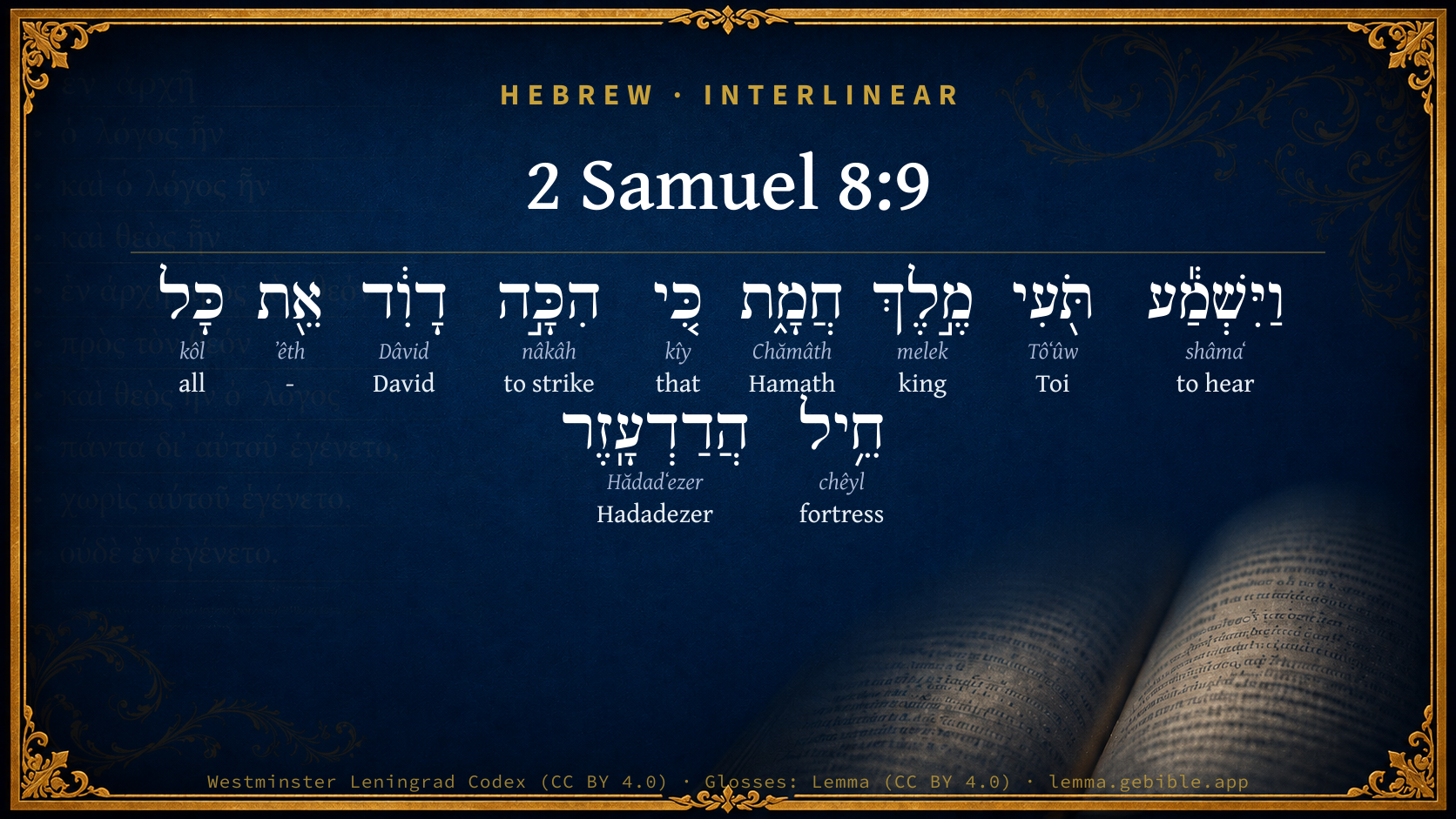
2 Samuel 8:9

Hebrew (Westminster Leningrad Codex) 2 Samuel 8:9 appears in the Hebrew Old Testament. The text above is from the Westminster Leningrad Codex. Each word links to its Strong’s number, a concise gloss, and parsing drawn from the Open Scriptures Hebrew Bible morphology. Click any word for its full Brown-Driver-Briggs (BDB) entry.
Download image
Cite this verse

2 Samuel 8:9 (World English Bible). Public Domain. Lemma interlinear Bible study tool, https://lemma.gebible.app/v/2-samuel/8/9.

Show BibTeX & RIS
BibTeX
RIS
English Translation
When Toi king of Hamath heard that David had struck all the host of Hadadezer,
World English Bible · Public Domain
Highlights
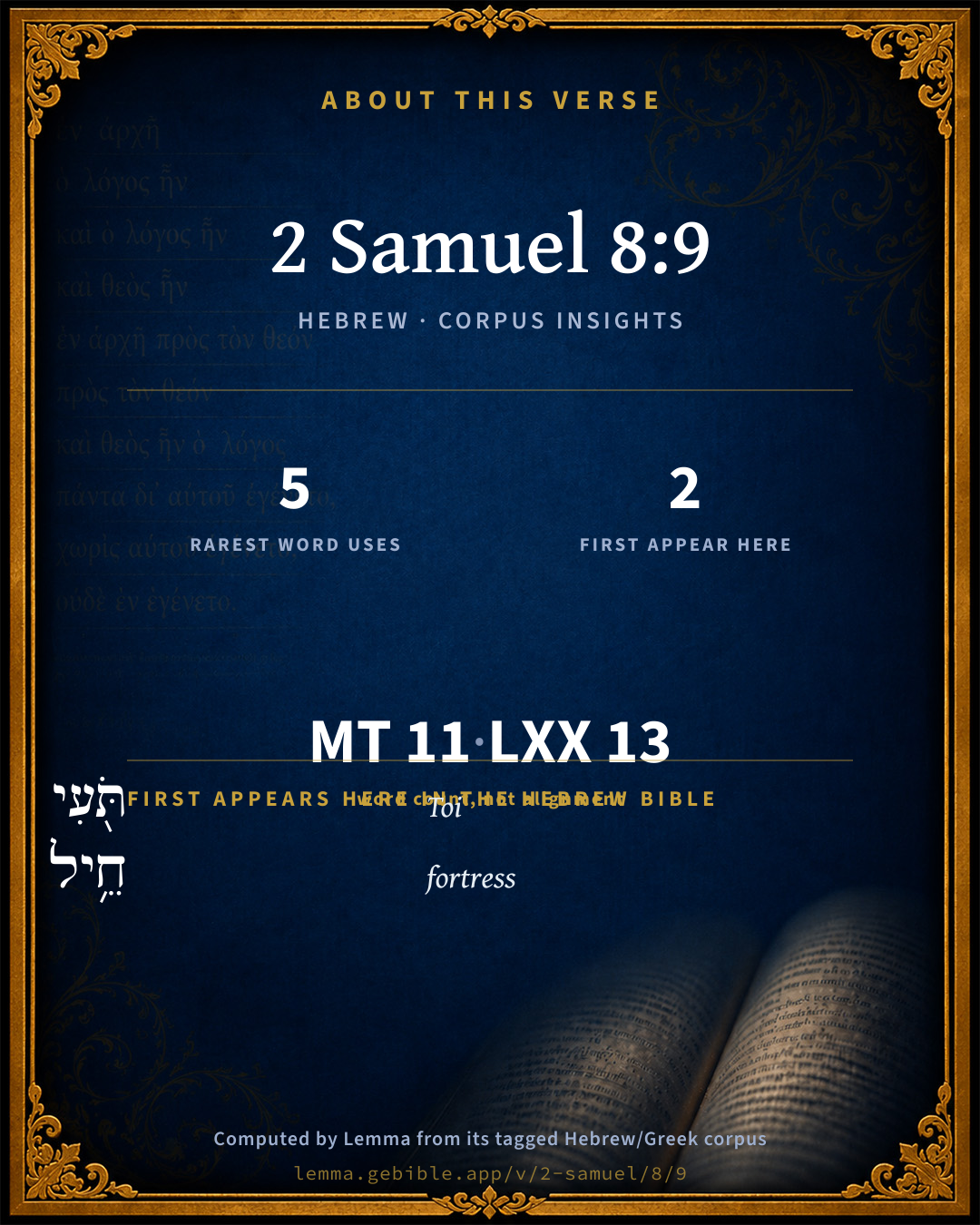
  • 2 first appearances in the Hebrew Bible
Full analysis ↓
Download a study sheet

One document with this verse’s original text, its word-by-word gloss line, the meaning frame, cross-references with their text, attributed commentary, and full source and license credits — printable, and it pastes into notes with its structure intact.

This verse Autodidact and up

Study sheet (.html) Plain text (.txt)

A passage Seminary Student

Up to 50 verses in one chapter. A passage sheet keeps up to 6 commentary sources and 12 cross-references per verse, in the order this page ranks them, and says so on the sheet whenever that leaves anything out. Ask for a single verse and you get the Autodidact verse sheet above.

Everything on this page stays free to read, with no account — the sheet is a download of what is already on screen, not access to it.

Want to remove ads? Support Godless Engineer
Compare translations 3

The same verse in 3 English versions, stacked beneath the original-language interlinear above. Click any original word for its lexicon entry.

Each is an independent rendering of the whole verse — the interlinear is not word-aligned to these translations.

Highlighted words mark where these versions differ — a whole-verse word diff, not a word-by-word alignment.

  • World English Bible Public Domain
    When Toi king of Hamath heard that David had struck all the host of Hadadezer,
  • King James Version Public Domain
    When Toi king of Hamath heard that David had smitten all the host of Hadadezer,
  • unfoldingWord Literal Text CC BY-SA 4.0
    And Toi, the king of Hamath, heard that David had struck all of the army of Hadadezer.

unfoldingWord Literal Text — © unfoldingWord, licensed CC BY-SA 4.0. Word-aligned USFM3 via Door43 (git.door43.org/unfoldingWord/en_ult).

Versions to compare (up to 4)

3 of 4 selected

Show all 18 translations

Every available English version of this verse, each an independent rendering of the whole verse.

  • World English Bible Public Domain
    When Toi king of Hamath heard that David had struck all the host of Hadadezer,
  • Berean Standard Bible Public Domain
    When King Toi of Hamath heard that David had defeated the entire army of Hadadezer,
  • Majority Standard Bible Public Domain
    When King Toi of Hamath heard that David had defeated the entire army of Hadadezer,
  • King James Version Public Domain
    When Toi king of Hamath heard that David had smitten all the host of Hadadezer,
  • American Standard Version (1901) Public Domain
    And when Toi king of Hamath heard that David had smitten all the host of Hadadezer,
  • Revised Version (1885) Public Domain
    And when Toi king of Hamath heard that David had smitten all the host of Hadadezer,
  • Geneva Bible (1599) Public Domain
    Then Toi king of Hamath heard howe Dauid had smitten all the hoste of Hadadezer,
  • Douay-Rheims (1899) Public Domain
    And Thou the king of Emath heard that David had defeated all the forces of Adarezer.
  • Young's Literal Translation Public Domain
    And Toi king of Hamath heareth that David hath smitten all the force of Hadadezer,
  • Literal Standard Version CC BY-SA 4.0
    And Toi king of Hamath hears that David has struck all the force of Hadadezer,
  • Unlocked Literal Bible CC BY-SA 4.0
    When Tou, king of Hamath, heard that David had defeated all the army of Hadadezer,
  • unfoldingWord Literal Text CC BY-SA 4.0
    And Toi, the king of Hamath, heard that David had struck all of the army of Hadadezer.
  • Darby Bible Public Domain
    And Toi king of Hamath heard that David had smitten all the forces of Hadadezer;
  • World Messianic Bible Public Domain
    When Toi king of Hamath heard that David had struck all the army of Hadadezer,
  • Webster's Bible Public Domain
    When Toi king of Hamath heard that David had smitten all the host of Hadadezer,
  • Free Bible Version CC BY-SA 4.0
    When Tou, king of Hamath, learned that David had destroyed the entire army of Hadadezer, king of Zobah,
  • Bible in Basic English Public Domain
    And when Tou, king of Hamath, had news that David had overcome all the army of Hadadezer,
  • JPS Tanakh (1917) Public Domain
    And when Toi king of Hamath heard that David had smitten all the host of Hadadezer,

Literal Standard Version (2020), Covenant Press — licensed CC BY-SA 4.0. Text via the HelloAO Bible API (eBible.org). Unlocked Literal Bible (unfoldingWord) — licensed CC BY-SA 4.0. Text via the HelloAO Bible API (eBible.org). unfoldingWord Literal Text — © unfoldingWord, licensed CC BY-SA 4.0. Word-aligned USFM3 via Door43 (git.door43.org/unfoldingWord/en_ult). Free Bible Version, Dr. Jonathan Gallagher — licensed CC BY-SA 4.0. Text via the HelloAO Bible API (eBible.org).

Word by word

More ways to search: Search by grammar → Find every occurrence → Compare this word →

Practice this passage: Drill this verse → Learn its vocabulary →

About this verse

These counts appear in no published source. They are computed here, from the morphology-tagged text and Lemma’s own curated glosses. What Lemma adds →

11
words
11
distinct lemmas
Historical
section

Notable vocabulary

The rarest word here is תֹּ֖עִי Toi H8583 — appearing just 5 times in the whole Hebrew Bible.

First appearance in Scripture

These words make their first canonical appearance in the Hebrew Bible here:

  • תֹּ֖עִי Toi H8583
  • חֵ֥יל fortress H2426

Shared distinctive vocabulary

תֹּ֖עִי Toi H8583 occurs in 4 verses of the Hebrew Bible. Also found in:

Grammatical profile

  • 2 verbs
  • 7 nouns
  • 1 conjunction
  • 1 particle

Verb forms

  • וַיִּשְׁמַ֕ע Qal · Sequential Imperfect
  • הִכָּ֣ה Hiphil · Perfect

Hebrew & Septuagint length

In English translation the verse runs 15 words from the Hebrew and 16 from the Septuagint (LXX English) — closely comparable.

A rough comparison of the two English renderings, which tokenize alike — not a word-level alignment.

Word counts can differ between the Hebrew and the Greek without any difference in meaning — e.g. the Hebrew direct-object marker אֵת has no separate Greek word, and Greek often adds the article ὁ.

In the original languages it is 11 Hebrew tokens and 13 Greek tokens — but the two are counted differently (Hebrew bundles its prefixes and suffixes into one token; the Greek is in lemma form), so that isn’t a like-for-like length.

Cross-references

4

Topical passages linked to 2 Samuel 8:9 in the Treasury of Scripture Knowledge — connected by theme and wording, ordered by reader-vote popularity; previews shown in the World English Bible.

  • 1 Kings 8:65 So Solomon held the feast at that time, and all Israel with him, a great assembly, from the entrance of Hamath to the brook of Egypt, before Yahweh our God, seven days and seven days, even fourteen days.
  • 2 Chronicles 8:4 He built Tadmor in the wilderness, and all the store-cities, which he built in Hamath.
  • 1 Chronicles 18:9 When Tou king of Hamath heard that David had struck all the host of Hadarezer king of Zobah,
  • Amos 6:2 Go to Calneh, and see; And from there go to Hamath the great; Then go down to Gath of the Philistines. Are they better than these kingdoms? Or is their border greater than your border?

Cross-references courtesy of OpenBible.info (CC BY 4.0).

Hebrew and Greek witnesses Masoretic Hebrew ↔ Greek Septuagint

The same verse in the two great witnesses to the Old Testament, shown verse-for-verse.

These are two independent witnesses, not word-aligned to each other, and the Septuagint is shown in lemma (dictionary) form.

Hebrew 2 Samuel 8:9 Masoretic · Westminster Leningrad Codex

וַיִּשְׁמַ֕ע תֹּ֖עִי מֶ֣לֶךְ חֲמָ֑ת כִּ֚י הִכָּ֣ה דָוִ֔ד אֵ֖ת כָּל חֵ֥יל הֲדַדְעָֽזֶר

When Toi king of Hamath heard that David had struck all the host of Hadadezer,

World English Bible · Public Domain

Greek LXX 2 Samuel 8:9 Septuagint · lemma form

καί ἀκούω θοου ὁ βασιλεύς ημαθ ὅτι πατάσσω δαυίδ πᾶς ὁ δύναμις αδρααζαρ

And You the king of Hemath heard that David had struck all the host of Adraazar.

LXX2012 (modern English Septuagint) · Public Domain

On this verse, Ellicott's Commentary for English Readers discusses the Septuagint’s reading. Read the note in Commentary ↓

Hebrew: Westminster Leningrad Codex (CC BY 4.0). Greek: Septuagint (public domain); English from LXX2012 (modern English Septuagint) (Public Domain). How the Septuagint differs from the Hebrew →

Targum (Aramaic paraphrase)

1

The Targum is the ancient Jewish Aramaic paraphrase of the Hebrew Scriptures — an interpretive translation, not the Hebrew text itself. Onkelos (literal) and Pseudo-Jonathan (expansive) render the Torah, and Jonathan the Prophets. Coverage is partial: where no permissively-licensed English translation exists for a verse, only the Aramaic is shown. This is verse-level text, not a word-by-word alignment to the Hebrew.

  1. Targum Jonathan Prophets (Joshua–Malachi)
    וּשְׁמַע תּוֹעִי מַלְכָּא דַחֲמָת אֲרֵי מְחָא דָוִד יַת כָּל מַשִׁרְיַת הֲדַדְעֶזֶר:

    (no public-domain English translation for this verse)

    Targum Jonathan — Aramaic: “Mikraot Gedolot” (public domain). English: “Sefaria Community Translation” (CC0 1.0 (public-domain dedication)); “London "Chaldee Paraphrase," 1871” (public domain). Text via Sefaria.

Commentary

Notes on 2 Samuel 8:9 from classic Christian and Jewish commentators (each source and its license shown beneath its notes). The classic Christian expositions comment on the surrounding passage and are grouped to its opening verse, so a note may address several verses; the Jewish commentaries on the Tanakh (Rashi and others) are per-verse, so they appear only where the commentator wrote on this verse.

Lemma curates 59 commentaries, every one of them public domain or Creative Commons licensed, each selected and text-cleaned for this edition rather than reprinted as found. About our sources →

Matthew Henry's Commentary

Here is, 1. The court made to David by the king of Hamath, who, it seems was at this time at war with the king of Zobah. He hearing of David's success against his enemy, sent his own son ambassador to him (Sa2 8:9, Sa2 8:10), to congratulate him on his victory, to return him thanks for the favour he had done him in breaking the power of one he was in fear of, and to beg his friendship. Thus he not only secured but strengthened himself. And David lost nothing by taking this little prince under his protection, any more than the old Romans did by the like policy; for the wealth he had from the countries he conquered by way of spoil he had from this by way of present or gratuity: Vessels of silver and gold. Better get by composition than by compulsion. 2. The offering David made to God of the spoils of the nations and all the rich things that were brought him. He dedicated all to the Lord, Sa2 8:11, Sa2 8:12. This crowned all his victories, and made them far to out-shine Alexander's or Caesar's, that they sought their own glory, but he aimed at the glory of God. All the precious things he was master of were dedicated things, that is, they were designed for the building of the temple; and a good omen it was of kindness to the Gentiles in the fulness of time, and of the making of God's house a house of prayer for all people, that the temple was built of the spoils and presents of Gentile nations, in allusion to which we find the kings of the earth bringing their glory and honour into the new Jerusalem, Rev 21:24. Their gods of gold David burnt (Sa2 5:21), but their vessels of gold he dedicated. Thus in the conquest of a soul, by the grace of the Son of David, what stands in opposition to God must be destroyed, every lust mortified and crucified, but what may glorify him must be dedicated and the property of it altered. Even the merchandise and the hire must be holiness to the Lord (Isa 23:18), the gain consecrated to the Lord of the whole earth (Mic 4:13), and then it is truly our own and that most comfortably. 3. The reputation he got, in a particular manner, by his victory over the Syrians and their allies the Edomites, who acted in conjunction with them, as appears by comparing the title of the 60th Psalm, which was penned on this occasion, with Sa2 8:13. He got himself a name for all that conduct and courage which are the praise of a great and distinguished general. Something extraordinary, it is likely, there was in that action, which turned very much to his honour, yet he is careful to transfer the honour to God, as appears by the psalm he penned on this occasion, Sa2 8:12. It is through God that we do valiantly. 4. His success against the Edomites. They all became David's servants, Sa2 8:14. Now, and not till now, Isaac's blessing was accomplished, by which Jacob was made Esau's Lord (Gen 27:37-40) and the Edomites continued long tributary to the kings of Judah, as the Moabites were to the kings of Israel, till, in Joram's time, they revolted (Ch2 21:8) as Isaac had there foretold that Esau should, in process of time, break the yoke from off his neck. Thus David by his conquests, (1.) Secured peace to his son, that he might have time to build the temple. And, (2.) Procured wealth for his son, that he might have wherewith to build it. God employs his servants variously, some in one employment, others in another, some in the spiritual battles, others in the spiritual buildings; and one prepares work for the other, that God may have the glory of all. All David's victories were typical of the success of the gospel against the kingdom of Satan, in which the Son of David rode forth, conquering and to conquer, and he shall reign till he has brought down all opposing rule, principality, and power: and he has, as David had (Sa2 8:2), a line to kill and a line to save; for the same gospel is to some a savour of life unto life, to others a savour of death unto death.

Matthew Henry's Commentary on the Whole Bible (1708–1710) — public domain (CC PDM 1.0). Text via the HelloAO Bible API.

Trapp's Complete Commentary

John Trapp

2Sa 8:9 When Toi king of Hamath heard that David had smitten all the host of Hadadezer,

Ver. 9. When Toi king of Hamath.] Called afterwards Antiochia, as the Chaldee Paraphrast hath it, of King Antiochus; as Methegammah or Gath, {2Sa 8:1} was called Diocaesarea.

John Trapp, A Commentary or Exposition upon All the Books of the Old and New Testament (1647–1656) — public domain. Text from a community e-Sword module.

Joseph Benson's Commentary

2Sa 8:9-11. King of Hamath — This city was also in Syria, and lay north of Judea. To salute him, and bless him — To congratulate him on his good success in the war with Hadadezer, and to wish him continued prosperity. Joram brought with him vessels, &c. — As a present to King David, whose friendship he sought by this embassy. Which David did dedicate to the Lord — These words seem to import, that he was so far from multiplying silver and gold for himself, (which Moses forbade, Deu 17:16,) that he put all his spoil, or the greatest part of it, into God’s treasury, for the building of the temple, which he designed, and his son was to accomplish, chap. 2Sa 7:13. A rare instance of his piety and gratitude to God, by whose aid he conquered; too seldom imitated by kings!

Joseph Benson's Commentary on the Old and New Testaments (1811–1818) — public domain. Text from a community e-Sword module.

Tyndale Open Study Notes

Tyndale Open Resources

8:9 Hamath was northwest of Hadadezer’s Zobah.

Tyndale Open Study Notes — © Tyndale Open Resources, licensed CC BY-SA 4.0. Text via the HelloAO Bible API.

Geneva Bible (1599)

Geneva Bible translators

Or, Antiochia.

Geneva Bible (1599) marginal notes — public domain. Text via Bolls.life.

Jamieson, Fausset & Brown

Robert Jamieson, A. R. Fausset & David Brown

Toi king of Hamath--Cœle-Syria; northwards, it extended to the city Hamath on the Orontes, which was the capital of the country. The Syrian prince, being delivered from the dread of a dangerous neighbor, sent his son with valuable presents to David to congratulate him on his victories, and solicit his alliance and protection.

Jamieson, Fausset & Brown — Commentary Critical and Explanatory on the Whole Bible (1871) — public domain (CC PDM 1.0). Text via the HelloAO Bible API.

Adam Clarke's Commentary

Verse 9. Toi king of Hamath] Hamath is supposed to be the famous city of Emesa, situated on the Orontes, in Syria. This was contiguous to Hadadezer; and led him to wage war with Toi, that he might get possession of his territories. For a comparison of the 10th verse, see 1Ch 18:9.

Adam Clarke's Commentary on the Bible (1810–1826) — public domain. Text from a community e-Sword/MySword module.

Ellicott's Commentary for English Readers

(9) Toi king of Hamath.—The Vatican LXX. has the name, in accordance with Chron., Tau. Hamath, the capital of the kingdom of the same name, was situated on the Orontes. According to 1Ch_18:3. David’s victory was on the borders of this kingdom. It was tributary to Solomon (1Ki_4:24, 2Ch_8:3-4), subsequently became independent, and was recovered by Jeroboam II. (2Ki_14:28), and was finally captured by Assyria (2Ki_19:13). It is described as “the great” by Amos (6:2), and a considerable town still occupies its site.

A Bible Commentary for English Readers, edited by Charles John Ellicott (1878–1897) — public domain. Text from a community e-Sword module.

The Cambridge Bible for Schools and Colleges

gen. ed. J. J. S. Perowne

9–12. Congratulatory embassy from Toi king of Hamath

9. Toi] The Sept. agrees with Chr. in reading his name Toü.

Hamath] A kingdom north of Zobah, with a capital of the same name situated on the Orontes. Hamath was one of the kingdoms which were tributary to Solomon, who built cities there (1Ki_4:24; 2Ch_8:4). After his death it regained its independence until Jeroboam II. recovered it (2Ki_14:28). A century later it is reckoned among the conquests of Assyria (2Ki_19:13). The epithet “great,” applied to the city by Amos (ch. 2Sa_6:2), attests its importance. A considerable town, retaining the name of Hamah, still occupies the site.

The Cambridge Bible for Schools and Colleges (gen. ed. J. J. S. Perowne; Cambridge University Press, 1878–1918) — public domain. Text from a community e-Sword module.

John Gill's Exposition

When Toi king of Hamath,.... Which was another small kingdom in Syria, perhaps lately erected to defend themselves against Hadadezer, and this the first king of it, at least the first we hear of; his name is Tou in Ch1 18:9; where in the Targum he is called king of Antioch. Hamath lay to the north of the land of Canaan; See Gill on Num 34:8, it is said (t) to be three days' journey from Tripoli, and that it stands in the midway to Aleppo, on a very goodly plain, replenished with corn and cotton wool, but very much in ruins, and falls more and more to decay: at this day (says my author, who travelled in those parts in the beginning of the seventeenth century) there is scarce one half of the wall standing, which hath been very fair and strong. The king of this place

heard that David had smitten all the host of Hadadezer; the news of which soon reached him, he being in the neighbourhood.

(t) Cartwright's Preacher's Travels, p. 6.

John Gill's Exposition of the Whole Bible (1746–1763) — public domain (CC PDM 1.0). Text via the HelloAO Bible API.

Albert Barnes' Notes on the Bible

Hamath - This appears as an independent kingdom so late as the time of Senacherib Isa 37:13. But in the time of Nebuchadnezzar, both Hamath and Arpad appear to have been incorporated in the kingdom of Damascus Jer 49:23.

Albert Barnes' Notes on the Bible (1834–1885) — public domain. Text from a community e-Sword/MySword module.

Haydock's Catholic Bible Commentary

Emath, or Emesa. Its king, Thou, being alarmed at the ambition of his neighbour Adarezer, (Calmet) was pleased with the victories of a prince from whom he thought he had less to fear, as the lived at a greater distance. (Haydock)

George Leo Haydock (1774–1849), Haydock's Catholic Family Bible and Commentary, 1859 edition — public domain. Excludes Psalms (Douay-Rheims chapter numbering differs from Protestant) and Deuterocanonical books (Catholic canon only).

Matthew Poole's English Annotations

Hamath; another eminent city of Syria.

Matthew Poole's English Annotations on the Holy Bible (1683–1685) — public domain. Text from a community e-Sword/MySword module.

Whedon's Commentary on the Bible

Daniel D. Whedon

9. Hamath — A very ancient city of Syria situated on the Orontes river, about sixty miles southeast of Antioch. See on Num_13:21, and Jos_13:5. Its king was glad to have David for an ally.

Daniel D. Whedon (gen. ed.), Commentary on the Old and New Testaments (1874–1909) — public domain. Text from a community e-Sword module.

The Pulpit Commentary

Toi, called in Chronicles Tou, King of Hamath. This was a famous city upon the river Orontes, afterwards called by the Greeks Epiphania, and was situated upon the northernmost boundary of Palestine. Its interest in the present day lies in its having been the capital of the Hittites a race whose very existence was doubted a few years ago, in spite of the testimony of Holy Scripture; but whose marvellous empire has been lately proved to be historical by Egyptian records on the one side, and cuneiform inscriptions on the other. Unfortunately, inscriptions which they have themselves left behind have not yet found any one capable of deciphering them. In the twelfth century B.C. they were the paramount power from the Euphrates to the Lebanon. For many centuries they contended with the Pharaohs for the possession of Egypt, and while Rameses II had to make an inglorious peace with the Kheta, as they are called, and marry the king"s daughter, Rameses III won a great victory over them, and saved Egypt from thraldom. In the cuneiform inscriptions we find the record of a struggle between Assyria and the Hittites, lasting for four hundred years, during which Shalmaneser made thirty campaigns against them, but they were not finally conquered until B.C. 717, during the reign of Sargon. Fuller details will be found in Dr. Wright"s "Empire of the Hittites," published by Messrs. Nisbet.

The Pulpit Commentary (1880–1919), ed. H.D.M. Spence-Jones & Joseph S. Exell — public domain. Text from a community e-Sword module.

Keil & Delitzsch

C. F. Keil & F. Delitzsch

After the defeat of the king of Zobah and his allies, Toi king of Hamath sought for David's friendship, sending his son to salute him, and conveying to him at the same time a considerable present of vessels of silver, gold, and brass. The name Toi is written Tou in the Chronicles, according to a different mode of interpretation; and the name of the son is given as Hadoram in the Chronicles, instead of Joram as in the text before us. The former is evidently the true reading, and Joram an error of the pen, as the Israelitish name Joram is not one that we should expect to find among Aramaeans; whilst Hadoram occurs in Ch1 1:21 in the midst of Arabic names, and it cannot be shown that the Hadoram or Adoram mentioned in Ch2 10:18 and Kg1 12:18 was a man of Israelitish descent. The primary object of the mission was to salute David ("to ask him of peace;" cf. Gen 43:27, etc.), and to congratulate him upon his victory ("to bless him because he had fought," etc.); for Toi had had wars with Hadadezer. "A man of wars" signifies a man who wages wars (cf. Ch1 28:3; Isa 42:13). According to Ch1 18:3, the territory of the king of Hamath bordered upon that of Hadadezer, and the latter had probably tried to make king Toi submit to him. The secret object of the salutation, however, was no doubt to secure the friendship of this new and powerful neighbour.

Keil & Delitzsch — Biblical Commentary on the Old Testament (1861–1891) — public domain (CC PDM 1.0). Text via the HelloAO Bible API. (Old Testament only.)

Kretzmann's Popular Commentary

Paul E. Kretzmann

David’s Prestige Recognized

v. 9. When Toi, king of Hamath, a district of Syria on the Orontes River, heard that David had smitten all the host of Hadadezer,

v. 10. then Toi sent Joram, his son (also known as Hadoram), unto King David, to salute him, with the usual greetings of peace, and to bless him, because he had fought against Hadadezer and smitten him; for Hadadezer had wars with Toi, he had been waging continual war with Toi with the purpose of subduing his land. David’s victory had freed him from a dangerous enemy, and therefore Toi wisely sought an alliance with the powerful victor. And Joram brought with him vessels of silver and vessels of gold and vessels of brass, gifts almost like those of a tributary king,

v. 11. which also, like the metal brought as booty from the Syrian war, King David did dedicate unto the Lord, placing them into the treasury of the Tabernacle, with the silver and gold that he had dedicated of all nations which he subdued, including the Ammonites, the Amalekites, and the Edomites;

v. 12. of Syria, and of Moab, and of the children of Ammon, and of the Philistines, and of Amalek, and of the spoil of Hadadezer, son of Rehob, king of Zobah.

v. 13. And David gat him a name, he gained renown, his fame spread far and wide, when he returned from smiting of the Syrians in the Valley of Salt, being eighteen thousand men, namely, of the Edomites. It seems that the children of Edom took the opportunity offered by David’s absence in the Syrian country to make an attack on Southern Canaan. They had advanced to the Southern end of the Dead Sea when the army of David, just back from the Syrian war, fell upon them with such disastrous results.

v. 14. And he put garrisons in Edom; through out all Edom put he garrisons, the character of the country demanding such a complete garrisoning, and all they of Edom became David’s servants, tributary vassals. And the lord preserved David whithersoever he went; it was due to God’s protection, to his blessing, that David was so successful in his campaign.

v. 15. And David reigned over all Israel, the reunited nation. And David, taking advantage of the peaceful conditions following the conquest of the various nations, executed judgment and justice unto all his people; he built up his influence among his own people by a wise and just rule, ordering and administering the affairs of the nation with great care.

v. 16. And Joab, the son of Zeruiah, was over the host, had supreme command of the army; and Jehoshaphat, the son of Ahilud, was recorder, chronicler and preserver of the most important happenings in the kingdom;

v. 17. and Zadok, the son of Ahitub, of the line of Eleazar, Aaron’s son, and Ahimelech, the son of Abiathar, of the line of Eli, were the priests, that is, the high priests, one probably officiating at the Tabernacle on the heights of Gibeon, 1Ch 16:39, the other in the tent at Jerusalem; and Seraiah was the scribe, secretary of state;

v. 18. and Benaiah, the son of Jehoiada, was over both the Cherethites and the Pelethites, the king’s body-guard, who not only carried out the royal orders, but also executed the royal death sentences, being executioners and runners; and David’s sons were chief rulers, serving as confidential counselors. Like David, all believers labor and battle during their whole life for the honor of the Lord, serve Him with body and soul, and willingly sacrifice of the blessing which the Lord has given them.

Paul E. Kretzmann, Popular Commentary of the Bible (1921–1924) — public domain. Text from a community e-Sword module.

unfoldingWord translationNotes

Door43 World Missions Community

Tou ... Hadoram

These are the names of men. (See: How to Translate Names)

Hamath

This is the name of a place. (See: How to Translate Names)

David had defeated

Here "David" represents his army. AT: "David's army had defeated" (See: Synecdoche)

translationWords

Hamath

send

bless

silver

unfoldingWord translationNotes — © Distant Shores Media and the Door43 World Missions Community, licensed CC BY-SA 4.0. Source: git.door43.org/Door43/en_tn.

Lesson kit

Teaching starters — assembled from the data on this page, not authored interpretation. Every prompt links to the verse data it draws on. Edit before teaching.

2 Samuel, in the Historical, opens this verse with 11 words (11 distinct Hebrew lemmas). Its most distinctive word is Tôʻûw (“Toi”). A historical commentator’s framing appears above. Read the whole chapter for the surrounding context.

Discussion questions

  1. What does “Toi” (Tôʻûw) contribute to the verse as a whole?
  2. 2 words here appear for the first time in Scripture. What is being introduced at this debut?
  3. 2 Samuel 8:10 shares the word «Toi» with this verse. How do the two illuminate each other?
  4. The translations on this page render this verse differently — a whole-verse word diff, not a word-by-word alignment. What might account for the different wordings?
  5. The verb «וַיִּשְׁמַ֕ע» is Qal Sequential Imperfect. How does its form color the action?
  6. Reading how Matthew Henry's Commentary and Trapp's Complete Commentary read this verse, where do the two commentators agree and where do they part?

Things to notice

Reading settings

Reading text

Shown beneath each verse's original-language words.

Old Testament
Old Testament edition

Read the OT as the Masoretic Hebrew (MT) or the Greek Septuagint (LXX).

English shown for the Greek Septuagint (in the Hebrew ↔ Greek comparison).

Comparing translations? Open the Compare panel on any verse page to stack up to four side by side.