
Psalms 104:7

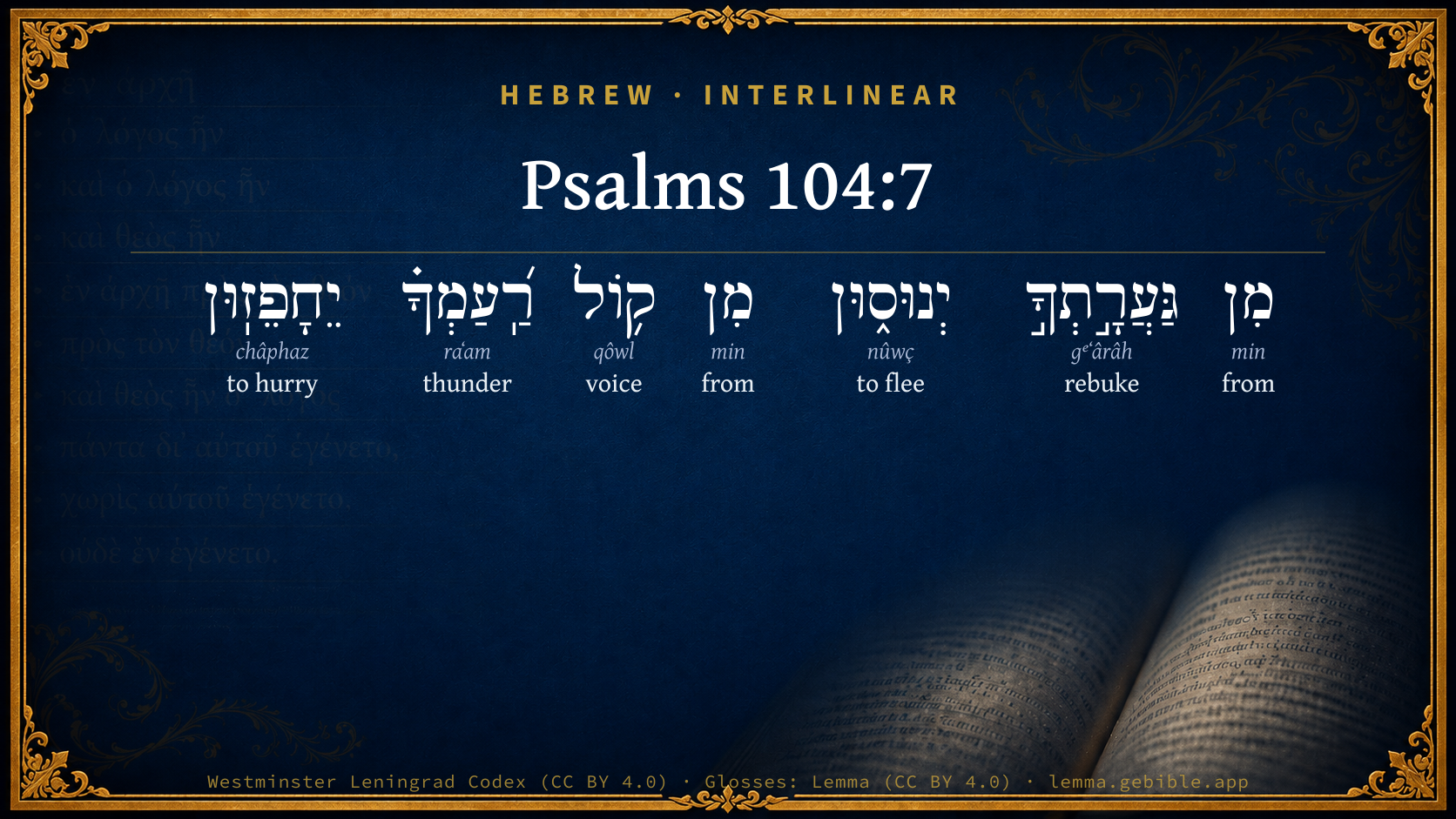
Hebrew (Westminster Leningrad Codex) Psalms 104:7 appears in the Hebrew Old Testament. The text above is from the Westminster Leningrad Codex. Each word links to its Strong’s number, a concise gloss, and parsing drawn from the Open Scriptures Hebrew Bible morphology. Click any word for its full Brown-Driver-Briggs (BDB) entry.
Download image
Cite this verse

Psalms 104:7 (World English Bible). Public Domain. Lemma interlinear Bible study tool, https://lemma.gebible.app/v/psalms/104/7.

Show BibTeX & RIS
BibTeX
RIS
English Translation
At your rebuke they fled. At the voice of your thunder they hurried away.
World English Bible · Public Domain
Download a study sheet

One document with this verse’s original text, its word-by-word gloss line, the meaning frame, cross-references with their text, attributed commentary, and full source and license credits — printable, and it pastes into notes with its structure intact.

This verse Autodidact and up

Study sheet (.html) Plain text (.txt)

A passage Seminary Student

Up to 50 verses in one chapter. A passage sheet keeps up to 6 commentary sources and 12 cross-references per verse, in the order this page ranks them, and says so on the sheet whenever that leaves anything out. Ask for a single verse and you get the Autodidact verse sheet above.

Everything on this page stays free to read, with no account — the sheet is a download of what is already on screen, not access to it.

Want to remove ads? Support Godless Engineer
Compare translations 3

The same verse in 3 English versions, stacked beneath the original-language interlinear above. Click any original word for its lexicon entry.

Each is an independent rendering of the whole verse — the interlinear is not word-aligned to these translations.

Highlighted words mark where these versions differ — a whole-verse word diff, not a word-by-word alignment.

  • World English Bible Public Domain
    At your rebuke they fled. At the voice of your thunder they hurried away.
  • King James Version Public Domain
    At thy rebuke they fled; at the voice of thy thunder they hasted away.
  • unfoldingWord Literal Text CC BY-SA 4.0
    From your rebuke they fled; from your voice of thunder they hurried away.

unfoldingWord Literal Text — © unfoldingWord, licensed CC BY-SA 4.0. Word-aligned USFM3 via Door43 (git.door43.org/unfoldingWord/en_ult).

Versions to compare (up to 4)

3 of 4 selected

Show all 18 translations

Every available English version of this verse, each an independent rendering of the whole verse.

  • World English Bible Public Domain
    At your rebuke they fled. At the voice of your thunder they hurried away.
  • Berean Standard Bible Public Domain
    At Your rebuke the waters fled; at the sound of Your thunder they hurried away—
  • Majority Standard Bible Public Domain
    At Your rebuke the waters fled; at the sound of Your thunder they hurried away—
  • King James Version Public Domain
    At thy rebuke they fled; at the voice of thy thunder they hasted away.
  • American Standard Version (1901) Public Domain
    At thy rebuke they fled; At the voice of thy thunder they hasted away
  • Revised Version (1885) Public Domain
    At thy rebuke they fled; at the voice of thy thunder they hasted away;
  • Geneva Bible (1599) Public Domain
    But at thy rebuke they flee: at the voyce of thy thunder they haste away.
  • Douay-Rheims (1899) Public Domain
    At thy rebuke they shall flee: at the voice of thy thunder they shall fear.
  • Young's Literal Translation Public Domain
    From Thy rebuke they flee, From the voice of Thy thunder haste away.
  • Literal Standard Version CC BY-SA 4.0
    They flee from Your rebuke, || They hurry away from the voice of Your thunder.
  • Unlocked Literal Bible CC BY-SA 4.0
    Your rebuke made the waters recede; at the sound of your thunderous voice they fled.
  • unfoldingWord Literal Text CC BY-SA 4.0
    From your rebuke they fled; from your voice of thunder they hurried away.
  • Darby Bible Public Domain
    At thy rebuke they fled, at the voice of thy thunder they hasted away; --
  • World Messianic Bible Public Domain
    At your rebuke they fled. At the voice of your thunder they hurried away.
  • Webster's Bible Public Domain
    At thy rebuke they fled; at the voice of thy thunder they hasted away.
  • Free Bible Version CC BY-SA 4.0
    but at your command the waters fled; at the sound of your thunder they rushed away.
  • Bible in Basic English Public Domain
    At the voice of your word they went in flight; at the sound of your thunder they went away in fear;
  • JPS Tanakh (1917) Public Domain
    At Thy rebuke they fled, at the voice of Thy thunder they hasted away —

Literal Standard Version (2020), Covenant Press — licensed CC BY-SA 4.0. Text via the HelloAO Bible API (eBible.org). Unlocked Literal Bible (unfoldingWord) — licensed CC BY-SA 4.0. Text via the HelloAO Bible API (eBible.org). unfoldingWord Literal Text — © unfoldingWord, licensed CC BY-SA 4.0. Word-aligned USFM3 via Door43 (git.door43.org/unfoldingWord/en_ult). Free Bible Version, Dr. Jonathan Gallagher — licensed CC BY-SA 4.0. Text via the HelloAO Bible API (eBible.org).

Word by word

More ways to search: Search by grammar → Find every occurrence → Compare this word →

Practice this passage: Drill this verse → Learn its vocabulary →

About this verse

These counts appear in no published source. They are computed here, from the morphology-tagged text and Lemma’s own curated glosses. What Lemma adds →

7
words
6
distinct lemmas
Wisdom
section

Notable vocabulary

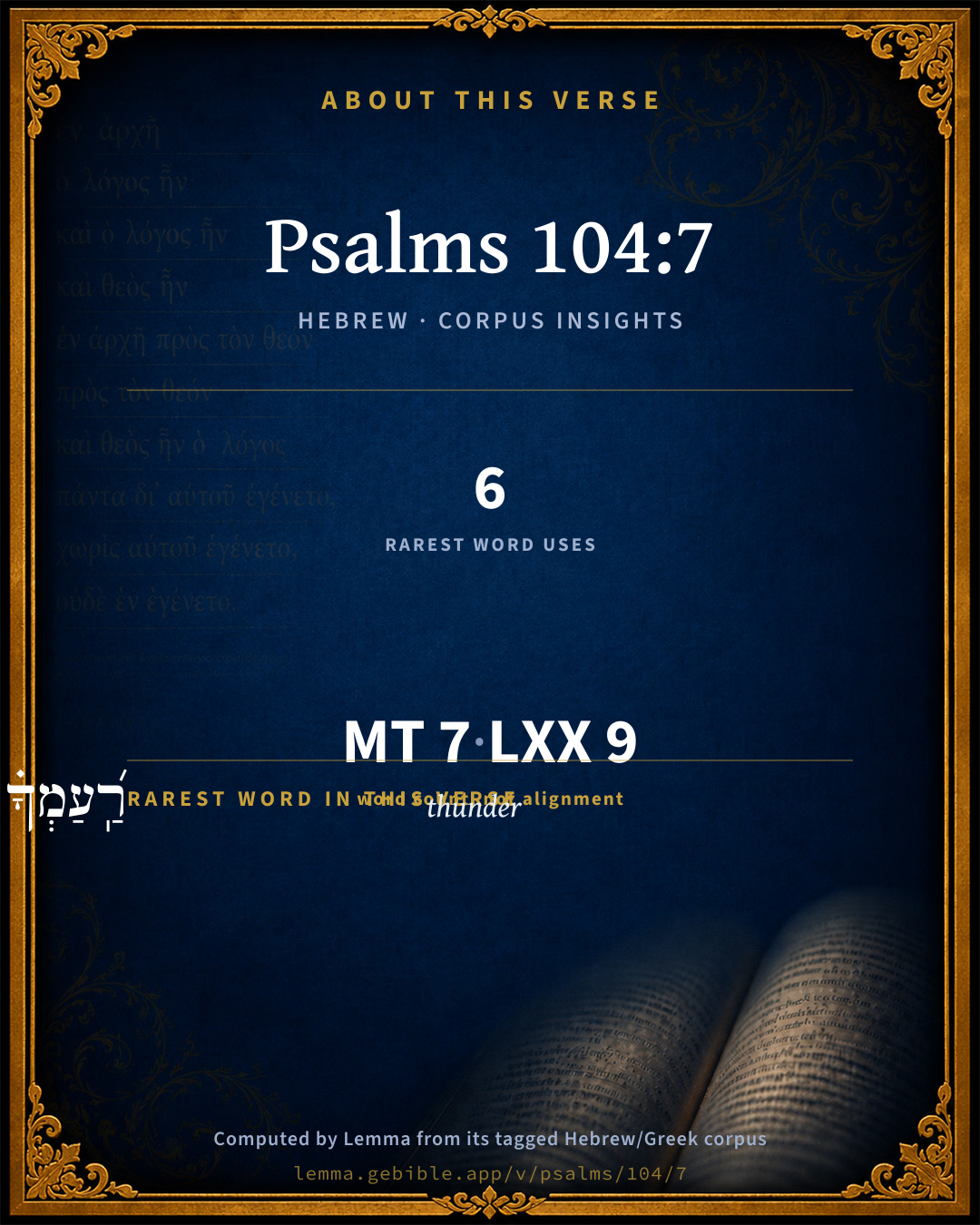
The rarest word here is רַֽ֝עַמְךָ֗ thunder H7482 — appearing just 6 times in the whole Hebrew Bible.

Shared distinctive vocabulary

רַֽ֝עַמְךָ֗ thunder H7482 occurs in 6 verses of the Hebrew Bible. Also found in:

Grammatical profile

  • 2 verbs
  • 3 nouns
  • 2 prepositions

Verb forms

  • יְנוּס֑וּן Qal · Imperfect
  • יֵחָפֵזֽוּן Niphal · Imperfect

Repetition

A word recurs within this verse — often emphatic in Hebrew:

Hebrew & Septuagint length

In English translation the verse runs 14 words from the Hebrew and 16 from the Septuagint (LXX English) — closely comparable.

A rough comparison of the two English renderings, which tokenize alike — not a word-level alignment.

Word counts can differ between the Hebrew and the Greek without any difference in meaning — e.g. the Hebrew direct-object marker אֵת has no separate Greek word, and Greek often adds the article ὁ.

In the original languages it is 7 Hebrew tokens and 9 Greek tokens — but the two are counted differently (Hebrew bundles its prefixes and suffixes into one token; the Greek is in lemma form), so that isn’t a like-for-like length.

Cross-references

7

Topical passages linked to Psalms 104:7 in the Treasury of Scripture Knowledge — connected by theme and wording, ordered by reader-vote popularity; previews shown in the World English Bible.

  • Psalms 18:15 Then the channels of waters appeared, The foundations of the world were laid bare at your rebuke, Yahweh, At the blast of the breath of your nostrils.
  • Genesis 8:1 God remembered Noah, all the animals, and all the cattle that were with him in the ark; and God made a wind to pass over the earth. The waters subsided.
  • Mark 4:39 He awoke, and rebuked the wind, and said to the sea, "Peace! Be still!" The wind ceased, and there was a great calm.
  • Psalms 106:9 He rebuked the Red Sea also, and it was dried up; So he led them through the depths, as through a desert.
  • Psalms 114:3–7 The sea saw it, and fled. The Jordan was driven back.
  • Proverbs 8:28 When he established the clouds above, When the springs of the deep became strong,
  • Psalms 77:18 The voice of your thunder was in the whirlwind. The lightnings lit up the world. The earth trembled and shook.

Cross-references courtesy of OpenBible.info (CC BY 4.0).

Hebrew and Greek witnesses Masoretic Hebrew ↔ Greek Septuagint

The same verse in the two great witnesses to the Old Testament, shown verse-for-verse.

You’re reading Greek Psalm 103 (Hebrew Psalm 104). The Septuagint counts the superscription, so verse numbers can differ from the Hebrew — chapter-level alignment, not verse-by-verse. Numbering follows Rahlfs.

These are two independent witnesses, not word-aligned to each other, and the Septuagint is shown in lemma (dictionary) form.

Hebrew Psalms 104:7 Masoretic · Westminster Leningrad Codex

מִן גַּעֲרָ֣תְךָ֣ יְנוּס֑וּן מִן ק֥וֹל רַֽ֝עַמְךָ֗ יֵחָפֵזֽוּן

At your rebuke they fled. At the voice of your thunder they hurried away.

World English Bible · Public Domain

Greek LXX Greek Psalm 103:7 Septuagint · lemma form

ἀπό ἐπιτίμησις σύ φεύγω ἀπό φωνή βροντή σύ δειλιάω

At your rebuke they shall flee; at the voice of your thunder they shall be alarmed.

LXX2012 (modern English Septuagint) · Public Domain

Hebrew: Westminster Leningrad Codex (CC BY 4.0). Greek: Septuagint (public domain); English from LXX2012 (modern English Septuagint) (Public Domain). How the Septuagint differs from the Hebrew →

Commentary

Notes on Psalms 104:7 from classic Christian and Jewish commentators (each source and its license shown beneath its notes). The classic Christian expositions comment on the surrounding passage and are grouped to its opening verse, so a note may address several verses; the Jewish commentaries on the Tanakh (Rashi and others) are per-verse, so they appear only where the commentator wrote on this verse.

Lemma curates 59 commentaries, every one of them public domain or Creative Commons licensed, each selected and text-cleaned for this edition rather than reprinted as found. About our sources →

Trapp's Complete Commentary

John Trapp

Psa 104:7 At thy rebuke they fled; at the voice of thy thunder they hasted away.

Ver. 7. At thy rebuke they fled] At thy word of command and angry countenance, overawing that raging and ranging creature: so Christ rebuked the winds and waves.

They hasted away] They ran away headlong, as for life.

John Trapp, A Commentary or Exposition upon All the Books of the Old and New Testament (1647–1656) — public domain. Text from a community e-Sword module.

J. A. Alexander on Psalms

Joseph Addison Alexander

7. (Psa 104:7) At thy rebuke they flee, at the voice of thy thunder they hasten away. The same power that produced the deluge put an end to it. The verbs agree with waters in ver. 6 (Psa 104:6). The divine command that they should cease or disappear is poetically spoken of as a rebuke. See above, on Psa 18:15; Psa 76:6, and compare Isa 1:2. The Hebrew particle means from, denoting both the time and cause of the effect described. The last verb is a passive meaning strictly to be panic-struck, or to flee in consequence of being panic-struck. See above, on Psa 31:22; Psa 48:5. The voice of thy thunder may be literally understood to mean the sound of thunder, or according to a well-known Hebrew idiom, thy voice of thunder, or thy thundering voice.

Joseph Addison Alexander, The Psalms Translated and Explained (1850) — public domain. Text from a community e-Sword module.

Tyndale Open Study Notes

Tyndale Open Resources

104:7 The Lord created dry ground on day three of creation (Gen 1:9-13).

Tyndale Open Study Notes — © Tyndale Open Resources, licensed CC BY-SA 4.0. Text via the HelloAO Bible API.

Adam Clarke's Commentary

Verse 7. At thy rebuke they fled] When God separated the waters which were above the firmament from those below, and caused the dry land to appear. He commanded the separation to take place; and the waters, as if instinct with life, hastened to obey.

At the voice of thy thunder] It is very likely God employed the electric fluid as an agent in this separation.

Adam Clarke's Commentary on the Bible (1810–1826) — public domain. Text from a community e-Sword/MySword module.

The Cambridge Bible for Schools and Colleges

gen. ed. J. J. S. Perowne

7. At thy rebuke they flee,

At the voice of thy thunder they haste away,

7, 8. The graphic imperfects are continued, picturing the process of the separation of land and water.

The Cambridge Bible for Schools and Colleges (gen. ed. J. J. S. Perowne; Cambridge University Press, 1878–1918) — public domain. Text from a community e-Sword module.

John Gill's Exposition

At thy rebuke they fled,.... The depths of water that covered the earth fled, went off apace, when Christ, the essential Word, gave the word of command that they should; saying, "Let the waters under the heaven be gathered together unto one place, and let the dry land appear, and it was so", Gen 1:9 and this being called a "rebuke", suggests as if there was something amiss, irregular and disorderly, and to be amended; as if these waters were not in their proper place.

At the voice of thy thunder they hasted away; ran off with great precipitancy; just as a servant, when his master puts on a stern countenance, and speaks to him in a thundering, menacing manner, hastes away from him to do his will and work. This is an instance of the mighty power of Christ; and by the same power he removed the waters of the deluge; when they covered the earth, and the tops of the highest hills; and rebuked the Red sea, and it became dry land; and drove back the waters of Jordan for the Israelites to pass through; and who also rebuked the sea of Galilee when his disciples were in distress: and with equal ease can he and does he remove the depth of sin and darkness from his people at conversion; rebukes Satan, and delivers out of his temptations, when he comes in like a flood; and rebukes the waters of affliction when they threaten to overwhelm; who are his servants, and come when he bids them come, and go when he bids them go.

John Gill's Exposition of the Whole Bible (1746–1763) — public domain (CC PDM 1.0). Text via the HelloAO Bible API.

Albert Barnes' Notes on the Bible

At thy rebuke they fled - At thy command; or when thou didst speak to them. The Hebrew word also implies the notion of “rebuke,” or “reproof,” as if there were some displeasure or dissatisfaction. Pro 13:1; Pro 17:10; Ecc 7:5; Isa 30:17; Psa 76:6. It is “as if” God had been displeased that the waters prevented the appearing or the rising of the dry land, and had commanded them to “hasten” to their beds and channels, and no longer to cover the earth. The allusion is to Gen 1:9, and there is nowhere to be found a more sublime expression than this. Even the command, “And God said, Let there be light; and there was light,” so much commended by Longinus as an instance of sublimity, does not surpass this in grandeur.

At the voice of thy thunder they hasted away - They fled in dismay. The Hebrew word - חפז châphaz - contains the idea of haste, trepidation, consternation, alarm, “as if” they were frightened; Psa 31:22. God spake in tones of thunder, and they fled. It is impossible to conceive anything more sublime than this.

Albert Barnes' Notes on the Bible (1834–1885) — public domain. Text from a community e-Sword/MySword module.

Matthew Poole's English Annotations

At thy rebuke; upon thy severe command, Gen 1:9; which he calls a rebuke, to imply that there was something in that state of things which might seem to need reproof and correction, even that confusion of earth and water together, which therefore God amended in his second day’s work.

They fled; they immediately went to the place which God had allotted to them. Of thy thunder; of thy sovereign command, which as they could not but hear, so they durst not disobey. He ascribes sense and reason to inanimate creatures by a figure called prosopopaeia.

Matthew Poole's English Annotations on the Holy Bible (1683–1685) — public domain. Text from a community e-Sword/MySword module.

The Treasury of David

Charles H. Spurgeon

Ver. 7. At thy rebuke they fled; at the voice of thy thunder they hasted away. When the waters and vapours covered all, the Lord had but to speak and they disappeared at once. As though they had been intelligent agents the waves hurried to their appointed deeps and left the land to itself; then the mountains lifted their heads, the high lands rose from the main, and at length continents and islands, slopes and plains were left to form the habitable earth. The voice of the Lord effected this great marvel. Is not his word equal to every emergency? potent enough to work the greatest miracle? By that same word shall the waterfloods of trouble be restrained, and the raging billows of sin be rebuked: the day cometh when at the thunder of Jehovah's voice all the proud waters of evil shall utterly haste away. "O Lord, my God, thou art very great."

Ver. 7. At thy rebuke they fled. The famous description of Virgil comes to mind, who introduces Neptune as sternly rebuking the winds for daring without his consent to embroil earth and heaven, and raise such huge mountain-waves: then swifter than the word is spoken, he calms the swollen seas, scatters the gathered clouds, and brings back the sun. Lorinus.

Ver. 7. At the voice of thy that rider they hasted away, ran off with great precipitance: just as a servant, when his master puts on a stern countenance, and speaks to him in a thundering, menacing manner, hastens away from him to do his will and work. This is an instance of the mighty power of Christ; and by the same power he removed the waters of the deluge, when they covered the earth, and the tops of the highest hills; and rebuked the Red Sea, and it became dry land; and drove back the waters of Jordan for the Israelites to pass through; and who also rebuked the Sea of Galilee when his disciples were in distress; and with equal ease can be and does he remove the depth of sin and darkness from his people at conversion; rebukes Satan, and delivers out of his temptations, when he comes in like a flood; and commands off the waters of affliction when they threaten to overwhelm; who are his servants, and come when he bids them come, and go when he bids them go. John Gill.

Ver. 7. At the voice of thy thunder. It is very likely God employed the electric fluid as an agent in this separation. Ingram Cobbin.

Ver. 7. They hasted away.

God said,

Be gathered now, ye waters under heaven

Into one place and let dry land appear.

Immediately the mountains huge appear

Emergent, and their broad bare backs upheave

Into the clouds; their tops ascend the sky:

So high as heaved the tumid hills, so low

Down sunk a hollow bottom broad and deep,

Capacious bed of waters: Thither they

Hasted with glad precipitance, uprolled

As drops on dust conglobing from the dry:

Part rise in crystal wall, or ridge direct,

For haste: such flight the great command impressed

On the swift floods: As armies at the call

Of trumpet (for of armies thou hast heard)

Troop to their standard; so the watery throng,

Wave rolling after wave, where way they found,

If steep, with torrent rapture, if through plain,

Soft ebbing; nor withstood them rock or hill;

But they, or under ground, or circuit wide

With serpent error wandering, found their way,

And on the washy ooze deep channels wore;

Easy, ere God had bid the ground be dry,

All but within those banks, where rivers now

Stream, and perpetual draw their tumid train,

The dry land, Earth; and the great receptacle

Of congregated waters, he called Seas:

And saw that it was good. John Milton.

Ver. 7. The power of the divine word in nature shows its power in other spheres.

Psalms 104:8*

Charles H. Spurgeon's The Treasury of David (1869–1885) — public domain. Psalms only. Text from a community e-Sword/MySword module.

Whedon's Commentary on the Bible

Daniel D. Whedon

7. At thy rebuke they fled—There is a harshness in the words “rebuke,” voice of thy thunder, and in the terror implied in the terms “fled,” hasted away, as if they deemed that God was displeased at them, because, says Hengstenberg, “God is the enemy of disorder, and because the waters stood in an attitude of hostility to the realization of his purpose to manifest his glory on the earth.” This also favours the hypothesis that the condition of the earth’s surface was that of disorder and desolation, by reason of the undue prevalence of the waters of the ocean, which now give way to the present order of things. See the original fiat, Gen_1:9, and Compare Psa_106:9; Nah_1:4; Psa_18:15; Isa_50:2

Daniel D. Whedon (gen. ed.), Commentary on the Old and New Testaments (1874–1909) — public domain. Text from a community e-Sword module.

The Pulpit Commentary

At thy rebuke they fled. It required only a few words from God (Gen_1:9) for the whole surface of the earth to be changed. The waters "fled they shifted their place removed from some portions of the earth"s surface, and "gathered themselves together" into others, allowing the dry land to appear. Elevations and depressions of the land must have at the same time occurred. At the voice of thy thunder they hasted away. (comp. Job_40:9, "Hast thou an arm like God, or canst thou thunder with a voice like his? The voice of God, especially when he speaks in "rebuke," is as thunder.

The Pulpit Commentary (1880–1919), ed. H.D.M. Spence-Jones & Joseph S. Exell — public domain. Text from a community e-Sword module.

John Wesley's Explanatory Notes

Rebuke - Upon thy command, Gen. i, 9. Fled - They immediately went to the place which God had allotted them.

John Wesley, Explanatory Notes Upon the Whole Bible (1754–1765) — public domain. Text via the GEBible commentary corpus.

Rashi

Rabbi Shlomo Yitzchaki (Rashi)

From Your rebuke they fled When You said (Gen. 1:9): “Let the waters gather.” And from that voice they hastened away and gathered in the place that You founded for them.

Rashi on the Tanakh — English translations: “The Judaica Press complete Tanach with Rashi, translated by A. J. Rosenberg” (CC BY 4.0); “Pentateuch with Rashi's commentary by M. Rosenbaum and A.M. Silbermann, 1929-1934” (public domain); “The Metsudah Tanach series, Lakewood, N.J” (CC BY 4.0); and “The Book of Joshua, Metsudah Publications, 1997” (CC BY 4.0). Text via Sefaria.

Lesson kit

Teaching starters — assembled from the data on this page, not authored interpretation. Every prompt links to the verse data it draws on. Edit before teaching.

Psalms, in the Wisdom, opens this verse with 7 words (6 distinct Hebrew lemmas). Its most distinctive word is raʻam (“thunder”). A historical commentator’s framing appears above. Read the whole chapter for the surrounding context.

Discussion questions

  1. What does “thunder” (raʻam) contribute to the verse as a whole?
  2. Job 26:14 shares the word «thunder» with this verse. How do the two illuminate each other?
  3. “from” occurs 2× in this one verse. What is the effect of the repetition?
  4. These translations render this verse differently; the difference is in the English rendering, not the original. What questions does that raise?
  5. The verb «יְנוּס֑וּן» is Qal Imperfect. How does its form color the action?
  6. Reading how Trapp's Complete Commentary and J. A. Alexander on Psalms read this verse, where do the two commentators agree and where do they part?

Things to notice

Reading settings

Reading text

Shown beneath each verse's original-language words.

Old Testament
Old Testament edition

Read the OT as the Masoretic Hebrew (MT) or the Greek Septuagint (LXX).

English shown for the Greek Septuagint (in the Hebrew ↔ Greek comparison).

Comparing translations? Open the Compare panel on any verse page to stack up to four side by side.