Ezra 6:2

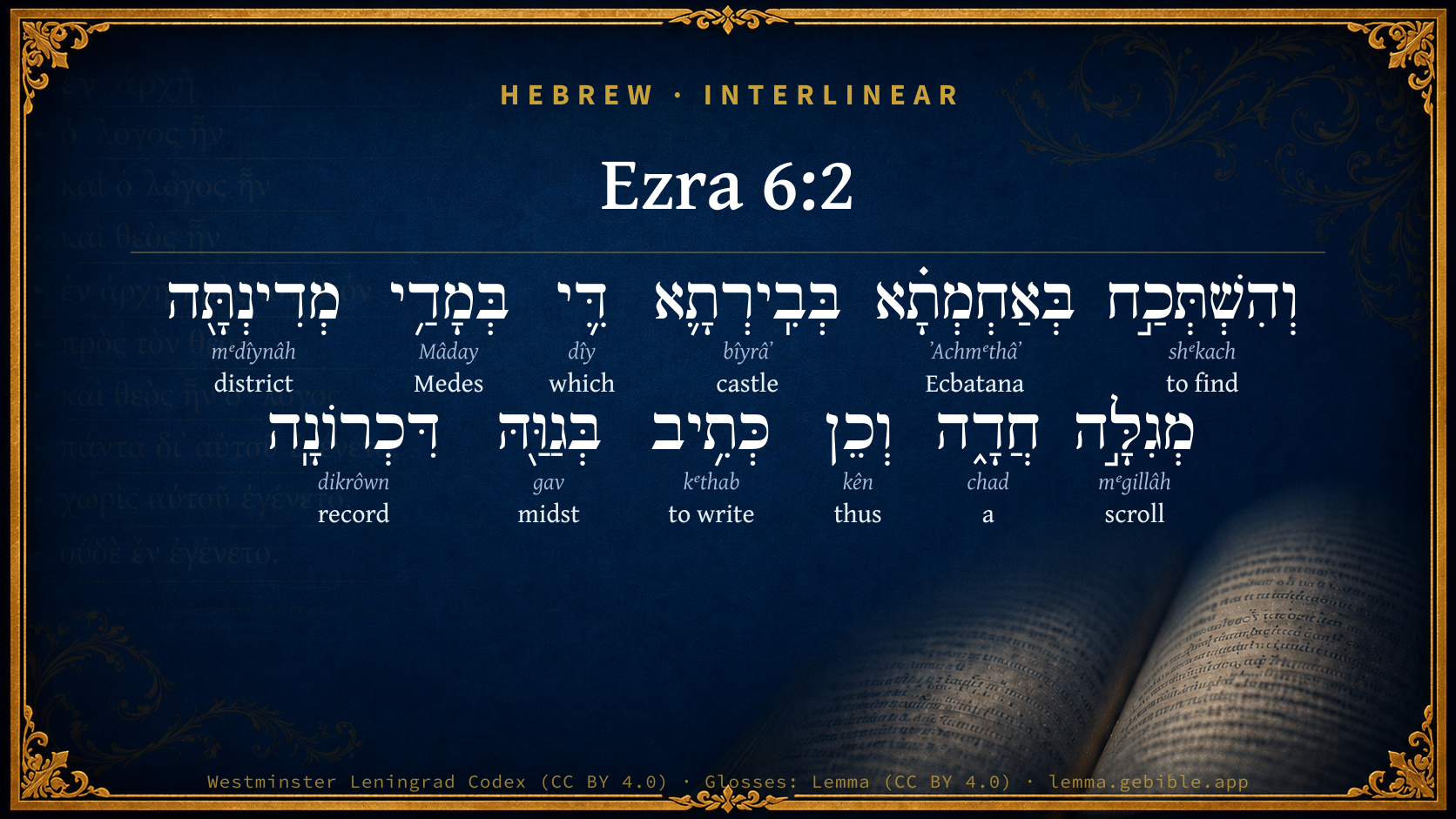
Hebrew (Westminster Leningrad Codex) Ezra 6:2 appears in the Hebrew Old Testament. The text above is from the Westminster Leningrad Codex. Each word links to its Strong’s number, a concise gloss, and parsing drawn from the Open Scriptures Hebrew Bible morphology. Click any word for its full Brown-Driver-Briggs (BDB) entry.
Download image
Cite this verse

Ezra 6:2 (World English Bible). Public Domain. Lemma interlinear Bible study tool, https://lemma.gebible.app/v/ezra/6/2.

Show BibTeX & RIS
BibTeX
RIS
English Translation
There was found at Achmetha, in the palace that is in the province of Media, a scroll, and therein was thus written for a record:
World English Bible · Public Domain
Highlights
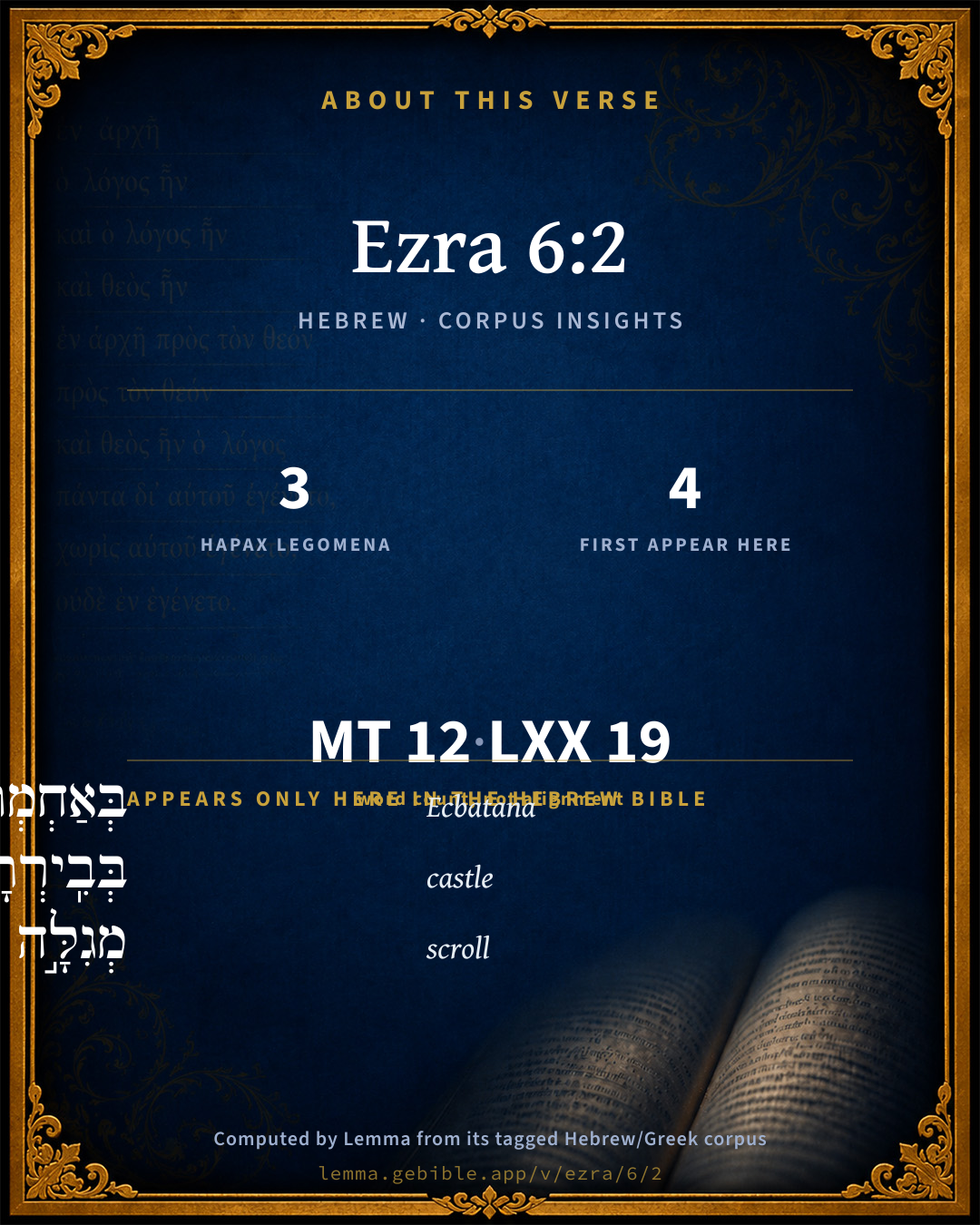
  • 3 hapax legomena — only here in the Hebrew Bible
  • 4 first appearances in the Hebrew Bible
Full analysis ↓
Download a study sheet

One document with this verse’s original text, its word-by-word gloss line, the meaning frame, cross-references with their text, attributed commentary, and full source and license credits — printable, and it pastes into notes with its structure intact.

This verse Autodidact and up

Study sheet (.html) Plain text (.txt)

A passage Seminary Student

Up to 50 verses in one chapter. A passage sheet keeps up to 6 commentary sources and 12 cross-references per verse, in the order this page ranks them, and says so on the sheet whenever that leaves anything out. Ask for a single verse and you get the Autodidact verse sheet above.

Everything on this page stays free to read, with no account — the sheet is a download of what is already on screen, not access to it.

Want to remove ads? Support Godless Engineer
Compare translations 3

The same verse in 3 English versions, stacked beneath the original-language interlinear above. Click any original word for its lexicon entry.

Each is an independent rendering of the whole verse — the interlinear is not word-aligned to these translations.

Highlighted words mark where these versions differ — a whole-verse word diff, not a word-by-word alignment.

  • World English Bible Public Domain
    There was found at Achmetha, in the palace that is in the province of Media, a scroll, and therein was thus written for a record:
  • King James Version Public Domain
    And there was found at Achmetha, in the palace that is in the province of the Medes, a roll, and therein was a record thus written:
  • unfoldingWord Literal Text CC BY-SA 4.0
    And one scroll was found in the fortress at Ecbatana that is in the province of Media, and the record was written within it thusly:

unfoldingWord Literal Text — © unfoldingWord, licensed CC BY-SA 4.0. Word-aligned USFM3 via Door43 (git.door43.org/unfoldingWord/en_ult).

Versions to compare (up to 4)

3 of 4 selected

Show all 18 translations

Every available English version of this verse, each an independent rendering of the whole verse.

  • World English Bible Public Domain
    There was found at Achmetha, in the palace that is in the province of Media, a scroll, and therein was thus written for a record:
  • Berean Standard Bible Public Domain
    And a scroll was found in the fortress of Ecbatana, in the province of Media, with the following written on it: Memorandum:
  • Majority Standard Bible Public Domain
    And a scroll was found in the fortress of Ecbatana, in the province of Media, with the following written on it: Memorandum:
  • King James Version Public Domain
    And there was found at Achmetha, in the palace that is in the province of the Medes, a roll, and therein was a record thus written:
  • American Standard Version (1901) Public Domain
    And there was found at Achmetha, in the palace that is in the province of Media, a roll, and therein was thus written for a record:
  • Revised Version (1885) Public Domain
    And there was found at Achmetha, in the palace that is in the province of Media, a roll, and therein was thus written for a record.
  • Geneva Bible (1599) Public Domain
    And there was founde in a coffer (in the palace that was in the prouince of the Medes) a volume, and therein was it thus written, as a memoriall,
  • Douay-Rheims (1899) Public Domain
    And there was found in Ecbatana, which is a castle in the province of Media, a book in which this record was written.
  • Young's Literal Translation Public Domain
    and there hath been found at Achmetha, in a palace that `is' in the province of Media, a roll, and a record thus written within it `is':
  • Literal Standard Version CC BY-SA 4.0
    and there has been found at Achmetha, in a palace that [is] in the province of Media, a scroll, and a record thus written within it [is]:
  • Unlocked Literal Bible CC BY-SA 4.0
    In the fortified city of Ecbatana in Media a scroll was found; this was its record:
  • unfoldingWord Literal Text CC BY-SA 4.0
    And one scroll was found in the fortress at Ecbatana that is in the province of Media, and the record was written within it thusly:
  • Darby Bible Public Domain
    And there was found at Achmetha in the fortress that is in the province of Media a roll, and therein was a record thus written:
  • World Messianic Bible Public Domain
    A scroll was found at Achmetha, in the palace that is in the province of Media, and in it this was written for a record:
  • Webster's Bible Public Domain
    And there was found at Achmetha, in the palace that is in the province of the Medes, a roll, and in it was a record thus written:
  • Free Bible Version CC BY-SA 4.0
    But it was actually in the fortress of Ecbatana, in the province of Media, that a scroll was found, recording the following:
  • Bible in Basic English Public Domain
    And at Achmetha, in the great house of the king in the land of Media, they came across a roll, in which this statement was put on record:
  • JPS Tanakh (1917) Public Domain
    And there was found at Ahmetha, in the palace that is in the province of Media, a roll, and therein was thus written: 'A record.

Literal Standard Version (2020), Covenant Press — licensed CC BY-SA 4.0. Text via the HelloAO Bible API (eBible.org). Unlocked Literal Bible (unfoldingWord) — licensed CC BY-SA 4.0. Text via the HelloAO Bible API (eBible.org). unfoldingWord Literal Text — © unfoldingWord, licensed CC BY-SA 4.0. Word-aligned USFM3 via Door43 (git.door43.org/unfoldingWord/en_ult). Free Bible Version, Dr. Jonathan Gallagher — licensed CC BY-SA 4.0. Text via the HelloAO Bible API (eBible.org).

Word by word

More ways to search: Search by grammar → Find every occurrence → Compare this word →

Practice this passage: Drill this verse → Learn its vocabulary →

בְּאַחְמְתָ֗א
ʼAchmᵉthâʼ
H307
“in/at · Ecbatana”
Adjective, R + Noun, Proper
Part of Speech
Adjective + Noun
Type
Proper
Full BDB Definition

Origin: of Persian derivation

TWOT: None

Achmetha = "Ecbatana" - capital of Media, captured by Cyrus in 550 BC and then summer residence of Persian kings
  1. וְהִשְׁתְּכַ֣ח shᵉkach H7912 “and · to find” Adjective, C + Verb, Hothpaal, Perfect, 3rd Person, Masculine, Singular
  2. בְּבִֽירְתָ֛א bîyrâʼ H1001 “in/at · castle · the” Adjective, R + Noun, Common, Feminine, Singular, Determined + Particle, Definite Article
  3. דִּ֛י dîy H1768 “which” Adjective, T
  4. בְּמָדַ֥י Mâday H4076 “in/at · Medes” Adjective, R + Noun, Proper
  5. מְדִינְתָּ֖ה mᵉdîynâh H4083 “district · the” Adjective, N, Common + Particle, Definite Article
  6. מְגִלָּ֣ה mᵉgillâh H4040 “scroll” Adjective, N, Common
  7. חֲדָ֑ה chad H2298 “a” Adjective, A, Common
  8. וְכֵן kên H3652 “and · thus” Adjective, C + Adverb
  9. כְּתִ֥יב kᵉthab H3790 “to write” Adjective, V, Plural
  10. בְּגַוַּ֖הּ gav H1459 “in/at · midst · her” Adjective, R + Noun, Common, Masculine, Singular, Construct + Suffix, Personal, 3rd Person, Feminine, Singular
  11. דִּכְרוֹנָֽה dikrôwn H1799 “record · the” Adjective, N, Common + Particle, Definite Article

About this verse

These counts appear in no published source. They are computed here, from the morphology-tagged text and Lemma’s own curated glosses. What Lemma adds →

12
words
12
distinct lemmas
Historical
section

Notable vocabulary

3 hapax legomena — words that appear only here in the entire Hebrew Bible:

  • בְּאַחְמְתָ֗א Ecbatana H307
  • בְּבִֽירְתָ֛א castle H1001
  • מְגִלָּ֣ה scroll H4040

First appearance in Scripture

These words make their first canonical appearance in the Hebrew Bible here:

  • בְּאַחְמְתָ֗א Ecbatana H307
  • בְּבִֽירְתָ֛א castle H1001
  • בְּמָדַ֥י Medes H4076
  • מְגִלָּ֣ה scroll H4040

Shared distinctive vocabulary

דִּכְרוֹנָֽה record H1799 occurs in 2 verses of the Hebrew Bible. Also found in:

Grammatical profile

  • 1 verb
  • 3 nouns
  • 4 adjectives
  • 1 adverb
  • 3 particles

Verb forms

  • וְהִשְׁתְּכַ֣ח Hothpaal · Perfect

Hebrew & Septuagint length

In English translation the verse runs 25 words from the Hebrew and 20 from the Septuagint (LXX English) — closely comparable.

A rough comparison of the two English renderings, which tokenize alike — not a word-level alignment.

Word counts can differ between the Hebrew and the Greek without any difference in meaning — e.g. the Hebrew direct-object marker אֵת has no separate Greek word, and Greek often adds the article ὁ.

In the original languages it is 12 Hebrew tokens and 19 Greek tokens — but the two are counted differently (Hebrew bundles its prefixes and suffixes into one token; the Greek is in lemma form), so that isn’t a like-for-like length.

Cross-references

1

Topical passages linked to Ezra 6:2 in the Treasury of Scripture Knowledge — connected by theme and wording, ordered by reader-vote popularity; previews shown in the World English Bible.

  • 2 Kings 17:6 In the ninth year of Hoshea the king of Assyria took Samaria, and carried Israel away to Assyria, and placed them in Halah, and on the Habor, the river of Gozan, and in the cities of the Medes.

Cross-references courtesy of OpenBible.info (CC BY 4.0).

Hebrew and Greek witnesses Masoretic Hebrew ↔ Greek Septuagint

The same verse in the two great witnesses to the Old Testament, shown verse-for-verse.

These are two independent witnesses, not word-aligned to each other, and the Septuagint is shown in lemma (dictionary) form.

Hebrew Ezra 6:2 Masoretic · Westminster Leningrad Codex

וְהִשְׁתְּכַ֣ח בְּאַחְמְתָ֗א בְּבִֽירְתָ֛א דִּ֛י בְּמָדַ֥י מְדִינְתָּ֖ה מְגִלָּ֣ה חֲדָ֑ה וְכֵן כְּתִ֥יב בְּגַוַּ֖הּ דִּכְרוֹנָֽה

There was found at Achmetha, in the palace that is in the province of Media, a scroll, and therein was thus written for a record:

World English Bible · Public Domain

Greek LXX Ezra 6:2 Septuagint · lemma form

καί εὑρίσκω ἐν πόλις ἐν ὁ βάρις ὁ μηδία πόλις κεφαλίς εἷς καί οὗτος εἰμί γράφω ἐν αὐτός ὑπόμνημα

And there was found in the city, in the palace, a volume, and this was the record written in it.

LXX2012 (modern English Septuagint) · Public Domain

In the Septuagint this is one book — Esdras B (2 Esdras): Ezra is chapters 1–10, Nehemiah 11–23.

On this verse, Haydock's Catholic Bible Commentary discusses the Septuagint’s reading. Read the note in Commentary ↓

Hebrew: Westminster Leningrad Codex (CC BY 4.0). Greek: Septuagint (public domain); English from LXX2012 (modern English Septuagint) (Public Domain). How the Septuagint differs from the Hebrew →

Commentary

Notes on Ezra 6:2 from classic Christian and Jewish commentators (each source and its license shown beneath its notes). The classic Christian expositions comment on the surrounding passage and are grouped to its opening verse, so a note may address several verses; the Jewish commentaries on the Tanakh (Rashi and others) are per-verse, so they appear only where the commentator wrote on this verse.

Lemma curates 59 commentaries, every one of them public domain or Creative Commons licensed, each selected and text-cleaned for this edition rather than reprinted as found. About our sources →

Trapp's Complete Commentary

John Trapp

Ezr 6:2 And there was found at Achmetha, in the palace that [is] in the province of the Medes, a roll, and therein [was] a record thus written:

Ver. 2. And there was found at Achmetha] Or Ecbatana. This was occasioned by the malice of the Jews’ adversaries, and proved a great furtherance to the finishing of the temple. Sic canes lingunt ulcera Lazari. So dogs licked the sores of Lazarus. All things work together for good to them that love God, Rom 8:28. Venenum aliquando pro remedio fuit, At length a poison will be for a medicine. saith Seneca.

John Trapp, A Commentary or Exposition upon All the Books of the Old and New Testament (1647–1656) — public domain. Text from a community e-Sword module.

Tyndale Open Study Notes

Tyndale Open Resources

6:2 The fortress at Ecbatana, the king’s summer home, was located about 300 miles northeast of Babylon. This suggests that Cyrus wrote the scroll in the summer of 538 BC. • Media was a mountainous area north of Persia and east of Assyria. This area is now inhabited by the Kurds (descendants of the Medes). • Texts introduced by the term Memorandum tended to be summaries that listed the main facts of an event for the royal archives (cp. 1:9-10).

Tyndale Open Study Notes — © Tyndale Open Resources, licensed CC BY-SA 4.0. Text via the HelloAO Bible API.

Geneva Bible (1599)

Geneva Bible translators

Wherein were the acts of the kings of the Medes and Persians.

Geneva Bible (1599) marginal notes — public domain. Text via Bolls.life.

Jamieson, Fausset & Brown

Robert Jamieson, A. R. Fausset & David Brown

Achmetha--long supposed to be the capital of Greater Media (the Ecbatana of classical, the Hamadan of modern times), [is] at the foot of the Elwund range of hills, where, for its coolness and salubrity, Cyrus and his successors on the Persian throne established their summer residence. There was another city, however, of this name, the Ecbatana of Atropatene, and the most ancient capital of northern Media, and recently identified by COLONEL RAWLINSON in the remarkable ruins of Takht-i-Soleiman. Yet as everything tends to show the attachment of Cyrus to his native city, the Atropatenian Ecbatana, rather than to the stronger capital of Greater Media, COLONEL RAWLINSON is inclined to think that he deposited there, in his fortress, the famous decree relating to the Jews, along with the other records and treasures of his empire [Nineveh and Persepolis].

Jamieson, Fausset & Brown — Commentary Critical and Explanatory on the Whole Bible (1871) — public domain (CC PDM 1.0). Text via the HelloAO Bible API.

Adam Clarke's Commentary

Verse 2. At Achmetha] Ecbatana in India, whither it is probable all the records of Cyrus had been carried. This was a sort of summer residence for the kings of Persia.

Adam Clarke's Commentary on the Bible (1810–1826) — public domain. Text from a community e-Sword/MySword module.

Ellicott's Commentary for English Readers

(2) At Achmetha.—That is, Ecbatana, the Median capital of Cyrus. It is probable that the original roll of parchment had been destroyed at Babylon by Smerdis, but a copy of it was found here, probably in a Chaldean transcript.

A Bible Commentary for English Readers, edited by Charles John Ellicott (1878–1897) — public domain. Text from a community e-Sword module.

The Cambridge Bible for Schools and Colleges

gen. ed. J. J. S. Perowne

2. And there was found at Achmetha] R.V. margin, That is, Ecbatana. The precious document was not found at Babylon. It has been suggested that valuable records were hastily transferred from Babylon to Ecbatana during the short and disturbed reign of Pseudo-Smerdis, who would wish to destroy the edicts of his predecessors. But whatever the cause may have been, notice of its removal had been duly recorded, and the enquiry at Babylon led to search and identification at Ecbatana.

Achmetha] This is the Aramaic transliteration of the Median capital known to us as ‘Ecbatana’ (Gr. ἐκβάτανα and ἀγβάτανα) of which the Persian pronunciation was something like ‘Hangmatâna’. It was the summer residence of the Persian kings. According to Herodotus it was built by king Deioces (708–655 b.c.) and surrounded with seven walls. Alexander the Great resided there in the autumn of 324. After his death, the city fell into insignificance until under the Parthian monarchy it once more became a royal residence. Under the Mohammedans the name became altered to Hamadan. An unhistorical description of the place is given in Jdt_1:1 ff.

in the palace] The royal palace, which was probably also the citadel (bîrah, Greek βάρις) and the treasury. The Aramaic word is the same as the Hebrew rendered ‘palace’ (marg. or ‘castle’) in Neh_1:1; Est_1:2 &c.; Dan_8:2 in reference to ‘Shushan’, and in 1Ch_29:1; 1Ch_29:19 in reference to ‘the Temple of Solomon’; ‘castle’, Neh_2:8; Neh_7:2 in reference to fortifications of Temple.

in the province of the Medes] R.V. of Media. Literally ‘in the province of Madai’ (see Gen_10:2). Media stretched north and south between the Caspian sea and the country of Elam, being bounded by Mt Zagros on the W. and by Parthia on the E. During the earlier period, of which we have an historical account in the Inscriptions, Media seems to have been a tributary province of the Assyrian Empire. She shook off the yoke probably in the reign of Assurbanipal (666–624); and the Median king Cyaxares joined with the Babylonian king Nabopolassar in the overthrow of Nineveh. Cyrus by his defeat of Astyages (550 b.c.) gained possession of Media, which he united with the Persian kingdom.

was a record thus written] R.V. was thus written for a record. More literally accurate: the roll was to serve as the official memorandum.

The Cambridge Bible for Schools and Colleges (gen. ed. J. J. S. Perowne; Cambridge University Press, 1878–1918) — public domain. Text from a community e-Sword module.

John Gill's Exposition

And there was found at Achmetha,.... Which Jarchi and Aben Ezra take to be the name of a vessel in which letters and writings were put for safety; but it was no doubt the name of a place; the Vulgate Latin version has it Ecbatana; and so Josephus (s); which was the name of a city in Media, where the kings of that country had their residence in the summer time (t); for it has its name from heat (u); the Persian kings dwelt at Shushan in the winter, and at Ecbatana in the summer (w); hence they are compared by Aelian (x) to cranes, birds of passage, because of their going to and from the above places:

in the palace that is in the province of the Medes, here was found

a roll; which was the decree of Cyrus, which perhaps he took with him when he went thither:

and therein was a record thus written; as follows.

(s) Antiqu. l. 11. c. 4. sect. 6. (t) Curtius, l. 5. c. 8. Vid. Alex. ab Alex. Genial. Dier. l. 3. c. 6. (u) Hiller. Onomastic. Sacr. p. 618. (w) Athen. Deipnosophist, l. 12. c. 1. (x) De Animal. l. 3. c. 13.

John Gill's Exposition of the Whole Bible (1746–1763) — public domain (CC PDM 1.0). Text via the HelloAO Bible API.

Albert Barnes' Notes on the Bible

“Achmetha” is the “Ecbatana,” or “Agbatana,” of the Greeks, the Persian name for which, as we find in the Behistun Inscription, was HaGMaTANa.

We must suppose that, when Babylon had been searched in vain, the other cities which possessed record-offices were visited, and the decree looked for in them. Ecbatana was the capital of Cyrus.

Albert Barnes' Notes on the Bible (1834–1885) — public domain. Text from a community e-Sword/MySword module.

Haydock's Catholic Bible Commentary

Ecbatana. Chaldean achmetha, signifies "a jug, or chest." (Calmet) --- "They found in the chest of the palace, under the inscription of Media." (Munster) (Pagnin) --- "And a roll was found (some add, in Amatha) in the city, in a chest, (or tower; Greek: Barei) and this memorial was written in it." (Septuagint) Protestants style the place, "Achmetha." (Haydock) --- Arabic, "Athana." Syriac, "Ahmathane." The memoirs of Cyrus had probably been conveyed to Ecbatana, which was built by Dejoces, the first king of the Medes, and greatly enlarged by his successor, Phraortes. (Calmet) --- Province. Media now only formed a province of the empire. (Tirinus)

George Leo Haydock (1774–1849), Haydock's Catholic Family Bible and Commentary, 1859 edition — public domain. Excludes Psalms (Douay-Rheims chapter numbering differs from Protestant) and Deuterocanonical books (Catholic canon only).

Matthew Poole's English Annotations

Here the king’s answer may seem to begin, and this following account he sends to them, and after that lays down his commands.

Achmetha; the royal city of the Medes and Persians.

Matthew Poole's English Annotations on the Holy Bible (1683–1685) — public domain. Text from a community e-Sword/MySword module.

Whedon's Commentary on the Bible

Daniel D. Whedon

2. Achmetha — The Chaldee form of the Persian Hagmatana or Hagmatan, and the Ecbatana of the classical writers. Its site is usually identified with the modern Hamadan. Herodotus (i, 98) describes it as a great city, whose walls were built circle within circle, each wall out-topping the one beyond it by the height of its battlements. This was done by means of the conical hill on which the city was built. The circular walls were seven in number, and the royal palace and treasury were within the innermost wall. It was originally the capital of the Medes, and hence its location here noticed as in the province of the Medes, but it was subsequently made the summer residence of the Persian kings. Hither it would seem the royal records had been transferred for greater security. The Behistun inscription shows that Babylon revolted at the beginning of Darius’s reign, but was soon reconquered, and that may have been the occasion of this transfer of the archives, and among them this celebrated roll containing Cyrus’s decree for the restoration of the exiles, and the rebuilding of their temple. Perhaps, however, the record in question had never been deposited at Babylon, but placed originally among the archives kept at Achmetha.

Daniel D. Whedon (gen. ed.), Commentary on the Old and New Testaments (1874–1909) — public domain. Text from a community e-Sword module.

The Pulpit Commentary

There was found at Achmetha. Not "in a coffer," as our translators suggest in the margin, and as Aben Ezra and Jarchi interpret; but "at Ecbatana," which is expressed letter for letter by the word used in the original, except that the final n is dropped. Compare for this omission the passage of Harran into Carrhae, and of Shu-shan into Susa. In the palace that is in the province of the Medes. The palace of Ecbatana was very famous. Herodotus says that it was built by Deioces, the first Median king, occupied the centre of the town, and was defended by seven circles of walls, one inside the other (1:98). Polybius states that the building covered an area 1420 yards in circumference, and consisted of a number of halls and cloistered courts, supported by wooden pillars, of cypress or of cedar, both of which were coated with a plating of gold or silver, and supported roofs sloped at an angle, consisting of silver plates instead of the customary tiling (5:27, 10). This grannd building was the residence of the old Median monarchs, and also of Cyrus and Cambyses. Darius built himself still more magnificent residences at Susa and Persepolis; but both he and the later Achaemenian monarchs continued to use the Median palace as a summer residence, and it maintained its celebrity till the close of the empire (see Arrian, "Exp. Alex.," 3:19). A roll. According to Ctesias ("Died. Sic.," 2:32), the Persians employed parchment or vellum for the material of their records, not baked clay, like the Assyrians and Babylonians, or paper, like the Egyptians. Parchment would be a suitable material for rolls, and no doubt was anciently used chiefly in that shape. Therein was a record thus written. The decree would no doubt be written, primarily, in the Persian language and the Persian cuneiform character; but it may have been accompanied by a Chaldaean transcript, of which Ezra may have obtained a copy. Public documents were commonly set forth by the Persians in more than one language (see "Herod.," 4:87; and comp. the "Inscriptions," passim, which are almost universally either bilingual or trilingual).

The Pulpit Commentary (1880–1919), ed. H.D.M. Spence-Jones & Joseph S. Exell — public domain. Text from a community e-Sword module.

John Wesley's Explanatory Notes

Achmetha - The royal city of the Medes and Persians.

John Wesley, Explanatory Notes Upon the Whole Bible (1754–1765) — public domain. Text via the GEBible commentary corpus.

Rashi

Rabbi Shlomo Yitzchaki (Rashi)

And there was found in a pouch And a text of one scroll was found there in an אַחְמְתָא. So did the interpreters interpret, that it is a receptacle made for letters, written sheets and books, and they established it from the root of (Gen. 21:14): “a skin of water (וְחֵמַת מַיִם),” and the “aleph” in the word is not a radical, like the rest of the Aramaic language.

in the citadel in that citadel that was in the province of Media.

and so was written and so was written therein its memorandum.

Rashi on the Tanakh — English translations: “The Judaica Press complete Tanach with Rashi, translated by A. J. Rosenberg” (CC BY 4.0); “Pentateuch with Rashi's commentary by M. Rosenbaum and A.M. Silbermann, 1929-1934” (public domain); “The Metsudah Tanach series, Lakewood, N.J” (CC BY 4.0); and “The Book of Joshua, Metsudah Publications, 1997” (CC BY 4.0). Text via Sefaria.

Lesson kit

Teaching starters — assembled from the data on this page, not authored interpretation. Every prompt links to the verse data it draws on. Edit before teaching.

Ezra, in the Historical, opens this verse with 12 words (12 distinct Hebrew lemmas). Its most distinctive word is ʼAchmᵉthâʼ (“Ecbatana”). A historical commentator’s framing appears above. Read the whole chapter for the surrounding context.

Discussion questions

  1. How does “Ecbatana” (ʼAchmᵉthâʼ) shape what this verse is saying?
  2. This verse holds 3 words here found nowhere else in the Hebrew Bible. What might the rare words draw attention to?
  3. 4 words here appear for the first time in Scripture. What is being introduced at this debut?
  4. Ezra 4:15 shares the word «record» with this verse. How do the two illuminate each other?
  5. These translations render this verse differently; the difference is in the English rendering, not the original. What questions does that raise?
  6. The verb «וְהִשְׁתְּכַ֣ח» is Hothpaal Perfect. How does its form color the action?
  7. Reading how Trapp's Complete Commentary and Tyndale Open Study Notes read this verse, where do the two commentators agree and where do they part?

Things to notice

Reading settings

Reading text

Shown beneath each verse's original-language words.

Old Testament
Old Testament edition

Read the OT as the Masoretic Hebrew (MT) or the Greek Septuagint (LXX).

English shown for the Greek Septuagint (in the Hebrew ↔ Greek comparison).

Comparing translations? Open the Compare panel on any verse page to stack up to four side by side.