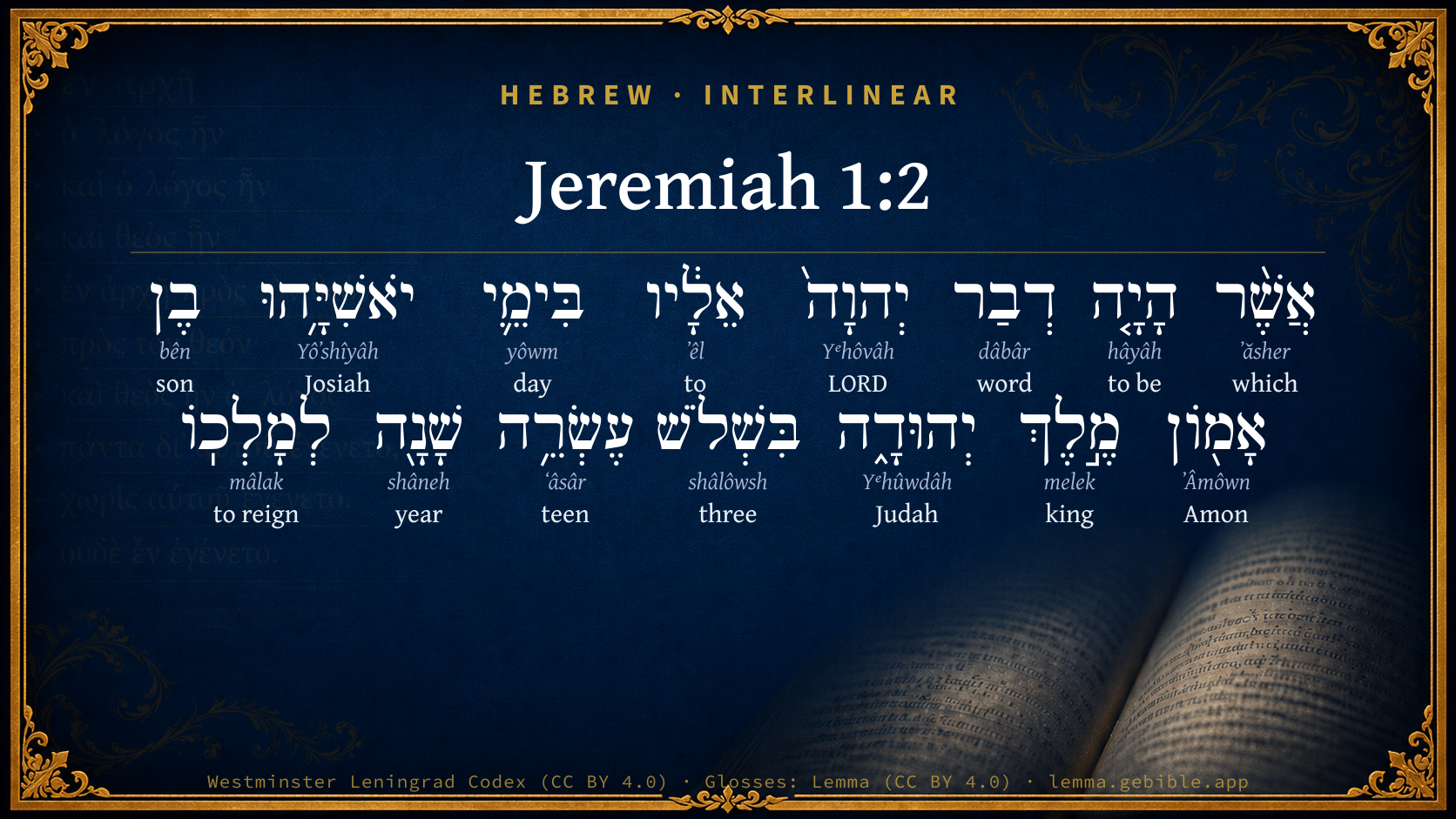
Jeremiah 1:2

Hebrew (Westminster Leningrad Codex) Jeremiah 1:2 appears in the Hebrew Old Testament. The text above is from the Westminster Leningrad Codex. Each word links to its Strong’s number, a concise gloss, and parsing drawn from the Open Scriptures Hebrew Bible morphology. Click any word for its full Brown-Driver-Briggs (BDB) entry.
Download image
Cite this verse

Jeremiah 1:2 (World English Bible). Public Domain. Lemma interlinear Bible study tool, https://lemma.gebible.app/v/jeremiah/1/2.

Show BibTeX & RIS
BibTeX
RIS
English Translation
to whom the word of Yahweh came in the days of Josiah the son of Amon, king of Judah, in the thirteenth year of his reign.
World English Bible · Public Domain
Download a study sheet

One document with this verse’s original text, its word-by-word gloss line, the meaning frame, cross-references with their text, attributed commentary, and full source and license credits — printable, and it pastes into notes with its structure intact.

This verse Autodidact and up

Study sheet (.html) Plain text (.txt)

A passage Seminary Student

Up to 50 verses in one chapter. A passage sheet keeps up to 6 commentary sources and 12 cross-references per verse, in the order this page ranks them, and says so on the sheet whenever that leaves anything out. Ask for a single verse and you get the Autodidact verse sheet above.

Everything on this page stays free to read, with no account — the sheet is a download of what is already on screen, not access to it.

Want to remove ads? Support Godless Engineer
Compare translations 3

The same verse in 3 English versions, stacked beneath the original-language interlinear above. Click any original word for its lexicon entry.

Each is an independent rendering of the whole verse — the interlinear is not word-aligned to these translations.

Highlighted words mark where these versions differ — a whole-verse word diff, not a word-by-word alignment.

  • World English Bible Public Domain
    to whom the word of Yahweh came in the days of Josiah the son of Amon, king of Judah, in the thirteenth year of his reign.
  • King James Version Public Domain
    To whom the word of the LORD came in the days of Josiah the son of Amon king of Judah, in the thirteenth year of his reign.
  • unfoldingWord Literal Text CC BY-SA 4.0
    which was the word of Yahweh to him in the days of Josiah son of Amon, king of Judah, in the thirteenth year of his reign.

unfoldingWord Literal Text — © unfoldingWord, licensed CC BY-SA 4.0. Word-aligned USFM3 via Door43 (git.door43.org/unfoldingWord/en_ult).

Versions to compare (up to 4)

3 of 4 selected

Show all 18 translations

Every available English version of this verse, each an independent rendering of the whole verse.

  • World English Bible Public Domain
    to whom the word of Yahweh came in the days of Josiah the son of Amon, king of Judah, in the thirteenth year of his reign.
  • Berean Standard Bible Public Domain
    The word of the LORD came to Jeremiah in the thirteenth year of the reign of Josiah son of Amon king of Judah,
  • Majority Standard Bible Public Domain
    The word of the LORD came to Jeremiah in the thirteenth year of the reign of Josiah son of Amon king of Judah,
  • King James Version Public Domain
    To whom the word of the LORD came in the days of Josiah the son of Amon king of Judah, in the thirteenth year of his reign.
  • American Standard Version (1901) Public Domain
    to whom the word of Jehovah came in the days of Josiah the son of Amon, king of Judah, in the thirteenth year of his reign.
  • Revised Version (1885) Public Domain
    to whom the word of the LORD came in the days of Josiah the son of Amon, king of Judah, in the thirteenth year of his reign.
  • Geneva Bible (1599) Public Domain
    To whom the worde of the Lord came in the dayes of Iosiah the sonne of Amon King of Iudah in the thirteenth yeere of his reigne:
  • Douay-Rheims (1899) Public Domain
    The word of the Lord which came to him in the days of Josias the son of Amon king of Juda, in the thirteenth year of his reign.
  • Young's Literal Translation Public Domain
    unto whom the word of Jehovah hath been in the days of Josiah son of Amon, king of Judah, in the thirteenth year of his reign,
  • Literal Standard Version CC BY-SA 4.0
    to whom the word of YHWH has been in the days of Josiah son of Amon, king of Judah, in the thirteenth year of his reign,
  • Unlocked Literal Bible CC BY-SA 4.0
    The word of Yahweh came to him in the days of Josiah son of Amon, king of Judah, in the thirteenth year of his reign.
  • unfoldingWord Literal Text CC BY-SA 4.0
    which was the word of Yahweh to him in the days of Josiah son of Amon, king of Judah, in the thirteenth year of his reign.
  • Darby Bible Public Domain
    to whom the word of Jehovah came in the days of Josiah the son of Amon, king of Judah, in the thirteenth year of his reign;
  • World Messianic Bible Public Domain
    The LORD’s word came to him in the days of Josiah the son of Amon, king of Judah, in the thirteenth year of his reign.
  • Webster's Bible Public Domain
    To whom the word of the LORD came in the days of Josiah the son of Amon king of Judah, in the thirteenth year of his reign.
  • Free Bible Version CC BY-SA 4.0
    The Lord's message came to Jeremiah beginning in the thirteenth year of the reign of Josiah, son of Amon, king of Judah,
  • Bible in Basic English Public Domain
    To whom the word of the Lord came in the days of Josiah, the son of Amon, king of Judah, in the thirteenth year of his rule.
  • JPS Tanakh (1917) Public Domain
    to whom the word of the LORD came in the days of Josiah the son of Amon, king of Judah, in the thirteenth year of his reign.

Literal Standard Version (2020), Covenant Press — licensed CC BY-SA 4.0. Text via the HelloAO Bible API (eBible.org). Unlocked Literal Bible (unfoldingWord) — licensed CC BY-SA 4.0. Text via the HelloAO Bible API (eBible.org). unfoldingWord Literal Text — © unfoldingWord, licensed CC BY-SA 4.0. Word-aligned USFM3 via Door43 (git.door43.org/unfoldingWord/en_ult). Free Bible Version, Dr. Jonathan Gallagher — licensed CC BY-SA 4.0. Text via the HelloAO Bible API (eBible.org).

Word by word

More ways to search: Search by grammar → Find every occurrence → Compare this word →

Practice this passage: Drill this verse → Learn its vocabulary →

אָמ֖וֹן
ʼÂmôwn
H526
“Amon”
Noun, Proper
Part of Speech
Noun
Type
Proper
Full BDB Definition

Origin: the same as H525

TWOT: None

Amon = "skilled workman" or " master workman" - a king of Judah, son of Manasseh - a governor of Samaria - a descendant of a servant of Solomon
  1. אֲשֶׁ֨ר ʼăsher H834 “which” Particle, Relative
  2. הָיָ֤ה hâyâh H1961 “to be” Verb, Qal, Perfect, 3rd Person, Masculine, Singular
  3. דְבַר dâbâr H1697 “word of” Noun, Common, Masculine, Singular, Construct
  4. יְהוָה֙ Yᵉhôvâh H3068 “LORD” Noun, Proper
  5. אֵלָ֔יו ʼêl H413 “to · him” Preposition + Suffix, Personal, 3rd Person, Masculine, Singular
  6. בִּימֵ֛י yôwm H3117 “in/at · days of” Preposition + Noun, Common, Masculine, Plural, Construct
  7. יֹאשִׁיָּ֥הוּ Yôʼshîyâh H2977 “Josiah” Noun, Proper
  8. בֶן bên H1121 “son of” Noun, Common, Masculine, Singular, Construct
  9. מֶ֣לֶךְ melek H4428 “king of” Noun, Common, Masculine, Singular, Construct
  10. יְהוּדָ֑ה Yᵉhûwdâh H3063 “Judah” Noun, Proper
  11. בִּשְׁלֹשׁ shâlôwsh H7969 “in/at · three” Preposition + Adjective, Cardinal number, Feminine, Singular, Absolute
  12. עֶשְׂרֵ֥ה ʻâsâr H6240 “teen” Adjective, Cardinal number, Feminine, Singular, Absolute
  13. שָׁנָ֖ה shâneh H8141 “year” Noun, Common, Feminine, Singular, Absolute
  14. לְמָלְכֽוֹ mâlak H4427 “to reign · him” Preposition + Verb, Qal, Infinitive Construct + Suffix, Personal, 3rd Person, Masculine, Singular

About this verse

These counts appear in no published source. They are computed here, from the morphology-tagged text and Lemma’s own curated glosses. What Lemma adds →

15
words
15
distinct lemmas
Prophets
section

Notable vocabulary

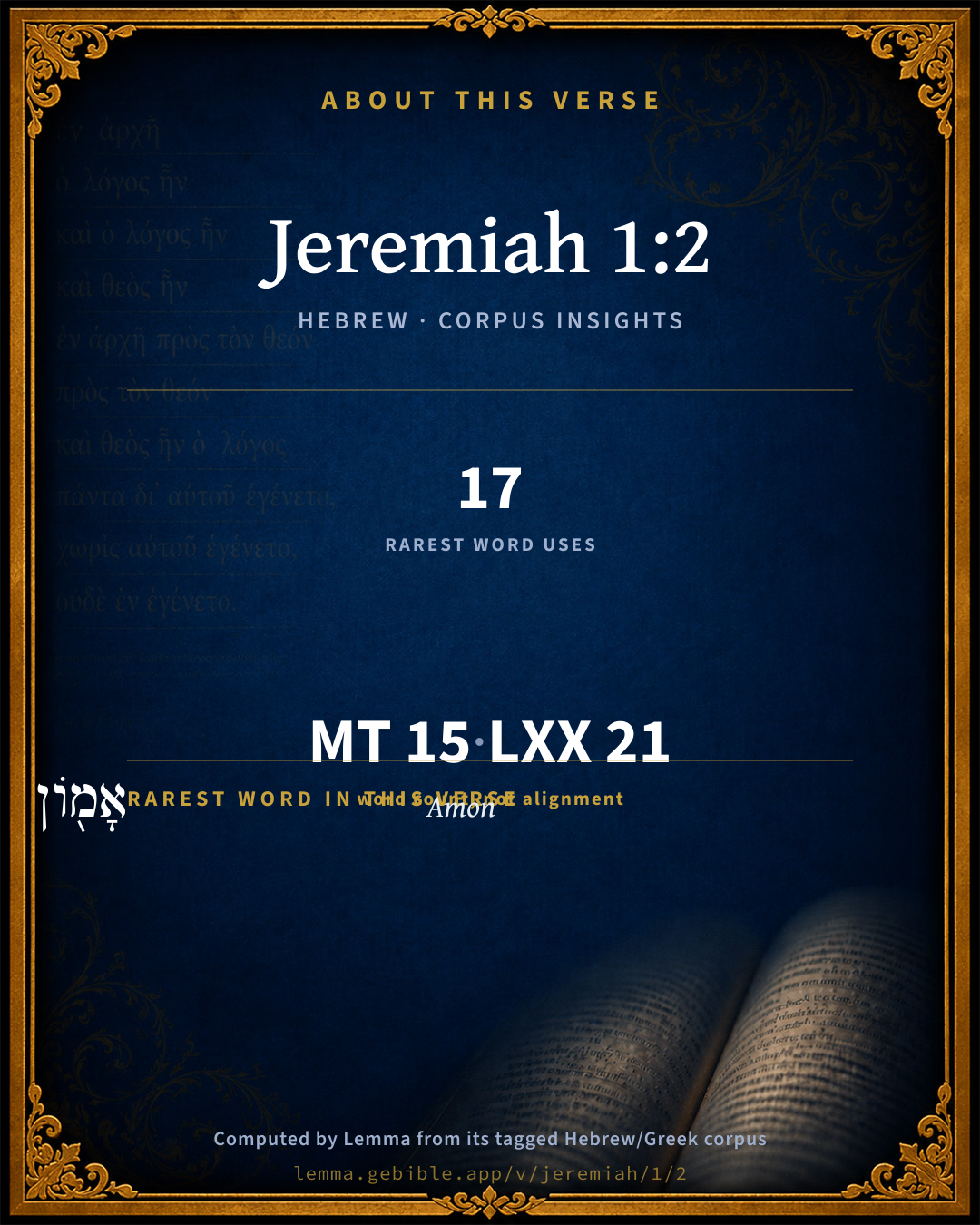
The rarest word here is אָמ֖וֹן Amon H526 — appearing just 17 times in the whole Hebrew Bible.

Shared distinctive vocabulary

אָמ֖וֹן Amon H526 occurs in 17 verses of the Hebrew Bible. Also found in:

Grammatical profile

  • 2 verbs
  • 9 nouns
  • 2 adjectives
  • 1 preposition
  • 1 particle

Verb forms

  • הָיָ֤ה Qal · Perfect
  • לְמָלְכֽוֹ Qal · Infinitive Construct

Hebrew & Septuagint length

In the original languages it is 15 Hebrew tokens and 21 Greek tokens — but the two are counted differently (Hebrew bundles its prefixes and suffixes into one token; the Greek is in lemma form), so that isn’t a like-for-like length.

Cross-references

10

Topical passages linked to Jeremiah 1:2 in the Treasury of Scripture Knowledge — connected by theme and wording, ordered by reader-vote popularity; previews shown in the World English Bible.

  • 1 Kings 13:20 It happened, as they sat at the table, that the word of Yahweh came to the prophet who brought him back;
  • Jeremiah 1:4 Now the word of Yahweh came to me, saying,
  • Jeremiah 1:11 Moreover the word of Yahweh came to me, saying, Jeremiah, what see you? I said, I see a rod of an almond tree.
  • Hosea 1:1 The word of Yahweh that came to Hosea the son of Beeri, in the days of Uzziah, Jotham, Ahaz, and Hezekiah, kings of Judah, and in the days of Jeroboam the son of Joash, king of Israel.
  • Jonah 1:1 Now the word of Yahweh came to Jonah the son of Amittai, saying,
  • Micah 1:1 The word of Yahweh that came to Micah the Morashtite in the days of Jotham, Ahaz, and Hezekiah, kings of Judah, which he saw concerning Samaria and Jerusalem.
  • 2 Kings 21:24–22:20 But the people of the land killed all those who had conspired against king Amon; and the people of the land made Josiah his son king in his place.
  • 2 Chronicles 34:1–33 Josiah was eight years old when he began to reign; and he reigned thirty-one years in Jerusalem.
  • Jeremiah 25:3 From the thirteenth year of Josiah the son of Amon, king of Judah, even to this day, these twenty-three years, the word of Yahweh has come to me, and I have spoken to you, rising up early and speaking; but you have not listened.
  • Jeremiah 36:2 Take a scroll of a book, and write therein all the words that I have spoken to you against Israel, and against Judah, and against all the nations, from the day I spoke to you, from the days of Josiah, even to this day.

Cross-references courtesy of OpenBible.info (CC BY 4.0).

Hebrew and Greek witnesses Masoretic Hebrew ↔ Greek Septuagint

The same verse in the two great witnesses to the Old Testament, shown verse-for-verse.

These are two independent witnesses, not word-aligned to each other, and the Septuagint is shown in lemma (dictionary) form.

Hebrew Jeremiah 1:2 Masoretic · Westminster Leningrad Codex

אֲשֶׁ֨ר הָיָ֤ה דְבַר יְהוָה֙ אֵלָ֔יו בִּימֵ֛י יֹאשִׁיָּ֥הוּ בֶן אָמ֖וֹן מֶ֣לֶךְ יְהוּדָ֑ה בִּשְׁלֹשׁ עֶשְׂרֵ֥ה שָׁנָ֖ה לְמָלְכֽוֹ

to whom the word of Yahweh came in the days of Josiah the son of Amon, king of Judah, in the thirteenth year of his reign.

World English Bible · Public Domain

Greek LXX Structure differs

In the Septuagint, Jeremiah is about an eighth shorter than the Hebrew and arranges its material differently — the Oracles Against the Nations (Hebrew chapters 46–51) appear in the middle of the Greek book, after 25:13. Because the chapter and verse boundaries do not line up, a verse-for-verse comparison with the Hebrew is not shown.

A verse-for-verse comparison isn’t shown here because the chapters and verses don’t line up. Switch to the LXX edition with the MT / LXX toggle above to read the Greek directly.

On this verse, John Gill's Exposition discusses the Septuagint’s reading. Read the note in Commentary ↓

Hebrew: Westminster Leningrad Codex (CC BY 4.0). Greek: Septuagint (public domain); English from a public-domain English Septuagint. How the Septuagint differs from the Hebrew →

Targum (Aramaic paraphrase)

1

The Targum is the ancient Jewish Aramaic paraphrase of the Hebrew Scriptures — an interpretive translation, not the Hebrew text itself. Onkelos (literal) and Pseudo-Jonathan (expansive) render the Torah, and Jonathan the Prophets. Coverage is partial: where no permissively-licensed English translation exists for a verse, only the Aramaic is shown. This is verse-level text, not a word-by-word alignment to the Hebrew.

  1. Targum Jonathan Prophets (Joshua–Malachi)
    דַהֲוָה פִּתְגָם נְבוּאָה מִן קֳדָם יְיָ עִמֵיהּ בְּיוֹמֵי יֹאשִׁיָה בַר אָמוֹן מֶלֶךְ שִׁבְטָא דְבֵית יְהוּדָה בִּתְלַת עַסְרֵי שְׁנִין לְמִמְלְכֵיהּ:

    (no public-domain English translation for this verse)

    Targum Jonathan — Aramaic: “Mikraot Gedolot” (public domain). English: “Sefaria Community Translation” (CC0 1.0 (public-domain dedication)); “London "Chaldee Paraphrase," 1871” (public domain). Text via Sefaria.

Commentary

Notes on Jeremiah 1:2 from classic Christian and Jewish commentators (each source and its license shown beneath its notes). The classic Christian expositions comment on the surrounding passage and are grouped to its opening verse, so a note may address several verses; the Jewish commentaries on the Tanakh (Rashi and others) are per-verse, so they appear only where the commentator wrote on this verse.

Lemma curates 59 commentaries, every one of them public domain or Creative Commons licensed, each selected and text-cleaned for this edition rather than reprinted as found. About our sources →

Trapp's Complete Commentary

John Trapp

Jer 1:2 To whom the word of the LORD came in the days of Josiah the son of Amon king of Judah, in the thirteenth year of his reign.

Ver. 2. Unto whom the word of the Lord came in the days of Josiah.] Woe be to the world because of the word! The Lord keepeth count what preachers he sendeth, what pains they take, and how long, to how little purpose they preach unto a people. He saith that it was "The word of the Lord," for authority sake, and that none might despise his youth, since he was sent by the "Ancient of days."

In the thirteenth year of his reign.] Eighteen years then he prophesied under good Josiah, who was to blame, doubtless, in not sending to advise with this or some other prophet before he went forth against Pharaohnecho; sometimes both grace and wit are asleep in the holiest and wariest breasts.

John Trapp, A Commentary or Exposition upon All the Books of the Old and New Testament (1647–1656) — public domain. Text from a community e-Sword module.

Tyndale Open Study Notes

Tyndale Open Resources

1:2-3 Jehoahaz and Jehoiachin are both missing from this list of kings. Neither of them reigned for longer than three months.

Tyndale Open Study Notes — © Tyndale Open Resources, licensed CC BY-SA 4.0. Text via the HelloAO Bible API.

Geneva Bible (1599)

Geneva Bible translators

This is spoken to confirm his vocation and office, forasmuch as he did not presume of himself to preach and prophesy, but was called thereunto by God.

Geneva Bible (1599) marginal notes — public domain. Text via Bolls.life.

Jamieson, Fausset & Brown

Robert Jamieson, A. R. Fausset & David Brown

Jehoiakim . . . Josiah . . . Zedekiah--Jehoahaz and Jehoiachin are omitted for they reigned only three months each. The first and last of the kings under whom each prophet prophesied are often thus specified in the general title. See on these kings, and Jeremiah's life, my Introduction.

thirteenth . . . of his reign-- (Jer 25:3).

fifth month-- (Kg2 25:8).

Jamieson, Fausset & Brown — Commentary Critical and Explanatory on the Whole Bible (1871) — public domain (CC PDM 1.0). Text via the HelloAO Bible API.

John Calvin's Commentaries

He begins in the second verse to speak of his calling. It would have, indeed, been to little purpose, had he said that he came forth and brought a message; but he explains, in the second verse, that he brought nothing but what had been delivered to him by God, as though he had said, that he faithfully declared what God had commanded him. For we know that the whole authority belongs entirely to God, with regard to the doctrine of religion, and that it is not in the power of men to blend this or that, and to make the faithful subject to themselves. As God, then, is the only true teacher of the Church, whosoever demands to be heard, must prove that he is God’s minister. This is, then, what Jeremiah is now carefully doing, for he says that the word of Jehovah was given to him.

He had before said, the words of Jeremiah, the son of Hilkiah; but any one of the people might have objected and said, “Why dost thou intrude thyself, as though any one is to be heard? for God claims this right to himself alone.” Hence Jeremiah, by way of correction, subjoins, that the words were his, but that he was not the author of them, but the minister only. He says, then, that he only executed what God had commanded, for he had been the disciple of God himself, before he undertook the office of a teacher.

John Calvin's Commentaries (1540-1563) — public domain. Text from the Calvin Translation Society English edition (1840s-50s) via the Christian Classics Ethereal Library (ccel.org). Calvin's coverage is partial (roughly two-thirds of the Bible); uncommented books and verses are honest gaps, never fabricated. The 19th-century editor's footnotes and remarks are omitted so the notes are faithfully Calvin's own voice.

Ellicott's Commentary for English Readers

(2) In the thirteenth year of his reign.—If we take the data of 2 Kings 22, Josiah was at that time in his twentieth or twenty-first year, having grown up under the training of Hilkiah. His active work of reformation began five years later. The images of Baal and Asherah (the groves) were thrown down, and the high places desecrated. The near coincidence of the commencement of Jeremiah’s work as prophet with that of the king must not be forgotten. As Josiah reigned for thirty-one years, we have to place eighteen years of the prophet’s ministry as under his rule.

A Bible Commentary for English Readers, edited by Charles John Ellicott (1878–1897) — public domain. Text from a community e-Sword module.

The Cambridge Bible for Schools and Colleges

gen. ed. J. J. S. Perowne

2. in the days of, etc.] See introductory note.

in the thirteenth year of his reign] c. b.c. 626. The period included in these two verses is one of 40 years, viz. the latter part of Josiah’s reign = 18 years; that of Jehoahaz = 3 months; that of Jehoiakim = 11 years; that of Jehoiachin = 3 months; that of Zedekiah = 11 years. The omission of the names of Jehoahaz and Jehoiachin is probably due to the shortness of their reigns.

The Cambridge Bible for Schools and Colleges (gen. ed. J. J. S. Perowne; Cambridge University Press, 1878–1918) — public domain. Text from a community e-Sword module.

John Gill's Exposition

To whom the word of the Lord came in the days of Josiah,.... This was the beginning of the prophecy of Jeremiah, so that he prophesied long after Isaiah, Hosea, Amos, and Micah; for this king was

the son of Amon king of Judah, which Amon was the son of Manasseh; the Septuagint and Arabic versions wrongly call him Amos; and Jeremiah began to prophesy

in the thirteenth year of his reign: in the twenty first of Josiah's age, for he began to reign when he was eight years old, and he reigned eighteen years after, for he reigned in all thirty one years; and it was five years after this that the book of the law was found by Hilkiah the high priest, Kg2 22:3.

John Gill's Exposition of the Whole Bible (1746–1763) — public domain (CC PDM 1.0). Text via the HelloAO Bible API.

Albert Barnes' Notes on the Bible

Came - literally, was (and in Jer 1:4); the phrase implies that Jeremiah possessed God’s word from that time onward, not fitfully as coming and going, but constantly.

The thirteenth year of his reign - According to the ordinary reckoning, this would be 629 b.c., but if the Ptolemaic canon be right in putting the capture of Jerusalem at 586 b.c., it would be two years later, namely 627 b.c. However, according to the Assyrian chronology, it would be 608 b.c. It was the year after that in which Josiah began his reforms.

Albert Barnes' Notes on the Bible (1834–1885) — public domain. Text from a community e-Sword/MySword module.

Matthew Poole's English Annotations

The word of the Lord; either that commission from God that did authorize him to his prophetical work, as it may probably be taken, Joh 10:35, was actually given unto him, Jer 1:10; or, command of God, as it is used, 1Ki 12:24; or rather, the materials of which his prophecies were to consist, for the space of forty-one years successively, in Judea, viz. from the thirteenth year of Josiah to the eleventh year of Zedekiah, besides the time that he prophesied in Egypt. See Jer 43; Jer 44, as Isa 2:1.

In the days of Josiah, i.e. during his reign and reformed state of religion.

Amon; who corrupted again that religion by those idolatries that his father Manasseh had in the latter part of his reign so well reformed by rooting of them out, 2Ch 33:21-23. In the thirteenth year; by which it appears that Jeremiah prophesied the last eighteen years of Josiah’s reign; for he reigned thirty-one years, 2Ki 22:1.

Matthew Poole's English Annotations on the Holy Bible (1683–1685) — public domain. Text from a community e-Sword/MySword module.

Whedon's Commentary on the Bible

Daniel D. Whedon

2, 3. To whom the word of the Lord came — To whom the spirit of prophecy was imparted.

In the days of Josiah — The sixteenth king of Judah after the separation from it of the kingdom of Israel.

Thirteenth year of his reign — From “the thirteenth year” of Josiah to the eleventh year of Zedekiah was about forty years; namely, eighteen remaining of Josiah’s reign, eleven of Jehoiakim’s and eleven of Zedekiah’s. The closing years of Jeremiah’s life, spent amid the ruins of his own land and in Egypt, are not here included. Josiah, the great reformer, stands out in his line of kings “faithful among the faithless.” Five years after the commencement of Jeremiah’s official career he led the people in a formal renewal of their covenant with Jehovah, and celebrated the occasion by a passover feast perhaps more remarkable and imposing than any other ever celebrated at Jerusalem. Eight years later, when Pharaoh-Necho was on his way to the memorable battle of Carchemish, Josiah went out against him, and being mortally wounded at Megiddo, (2Ki_23:29-30; 2Ch_35:22-24,) died before reaching Jerusalem. For him Jeremiah made public lamentation, “and all the singing men and the singing women spake of Josiah in their lamentations to this day.” 2Ch_35:24-25. Jehoiakim was made king by Pharaoh-Necho, who had deposed his younger brother after a three months’ reign, and carried him in fetters to Riblah. As the Egyptian king was at this time making his expedition against Babylon, he charged his vassal Jehoiakim with the work of collecting a tribute of about $200,000, which he levied on the Jewish people. But Pharaoh met his Waterloo at Carchemish, and the king of Babylon seized upon Palestine as the natural fruit of his victory. He besieged and captured Jerusalem, made the king prisoner, and carried away to Babylon many of the principal inhabitants and some of the sacred vessels of the temple. Among these prisoners were Daniel and his three friends. Jehoiakim, having been subsequently reinstated, remained tributary to the king of Babylon for three years, and then, against the advice and warnings of Jeremiah, rebelled. The Babylonish king being at that time occupied with an Asiatic expedition, sent against the Jews an army composed from several of his allied and tributary peoples, Syrians, Moabites, and Ammonites, who cruelly harassed the country. The misery of the land was extreme. Jehoiakim finally came to a violent and ignominious death, and the greatest dishonour was done to his body, for it was dragged away “beyond the gates of Jerusalem,” and buried “with the burial of an ass.” The times of Jehoiakim were characterized by gross and general corruption. The sacred places became altars of lust. The holy city and even the very temple were filled with abomination. See Ezekiel 8. The character of this most corrupt and foolish of all the kings of Judah is concentrated into two inspired phrases, “his abomination which he did,” (2Ch_36:8,) and “he filled Jerusalem with innocent blood.” 2Ki_24:4. As in the time of Josiah the zeal and faith of the prophet were stimulated and developed, so in that of Jehoiakim he must have been burdened and alarmed by the general and outbreaking wickedness of the people. Jehoiachin, who succeeded his father Jehoiakim, having, after a brief reign of three months, been carried away to Babylon with ten thousand other captives Zedekiah, his uncle, was made king, 599 B.C. He was a fitting successor of Jehoiakim, showing the same characteristics of weakness and wickedness. “He humbled not himself before Jeremiah the prophet… from the mouth of the Lord.” 2Ch_36:12. The cup of Judah’s wickedness was now full, and God’s judgments came swiftly and terribly. Jerusalem was taken and pillaged; the temple burned; the sacred vessels, what remained of them, were taken away; the glory of Jerusalem, as a political capital, finally extinguished, and the captivity fully inaugurated.

Daniel D. Whedon (gen. ed.), Commentary on the Old and New Testaments (1874–1909) — public domain. Text from a community e-Sword module.

John Wesley's Explanatory Notes

The word - That commission from God that authorized him to his prophetic work, for the space of forty-one years successively in Judea, viz. from the 13th year of Josiah to the 11th year of Zedekiah, besides the time that he prophesied in Egypt. In the days - During his reign. Thirteenth - By which it appears that Jeremiah prophesied the last eighteen years of Josiah's reign; for he reigned thirty-one years, 2 Kings xxii, 1.

John Wesley, Explanatory Notes Upon the Whole Bible (1754–1765) — public domain. Text via the GEBible commentary corpus.

Rashi

Rabbi Shlomo Yitzchaki (Rashi)

To whom the word of the Lord came Upon whom the Shechinah commenced to rest at that time.

Rashi on the Tanakh — English translations: “The Judaica Press complete Tanach with Rashi, translated by A. J. Rosenberg” (CC BY 4.0); “Pentateuch with Rashi's commentary by M. Rosenbaum and A.M. Silbermann, 1929-1934” (public domain); “The Metsudah Tanach series, Lakewood, N.J” (CC BY 4.0); and “The Book of Joshua, Metsudah Publications, 1997” (CC BY 4.0). Text via Sefaria.

Lesson kit

Teaching starters — assembled from the data on this page, not authored interpretation. Every prompt links to the verse data it draws on. Edit before teaching.

Jeremiah, in the Prophets, opens this verse with 15 words (15 distinct Hebrew lemmas). Its most distinctive word is ʼÂmôwn (“Amon”). A historical commentator’s framing appears above. Read the whole chapter for the surrounding context.

Discussion questions

  1. How does “Amon” (ʼÂmôwn) shape what this verse is saying?
  2. 1 Kings 22:26 shares the word «Amon» with this verse. How do the two illuminate each other?
  3. The translations on this page render this verse differently — a whole-verse word diff, not a word-by-word alignment. What might account for the different wordings?
  4. The verb «הָיָ֤ה» is Qal Perfect. How does its form color the action?
  5. Reading how Trapp's Complete Commentary and Tyndale Open Study Notes read this verse, where do the two commentators agree and where do they part?

Things to notice

Reading settings

Reading text

Shown beneath each verse's original-language words.

Old Testament
Old Testament edition

Read the OT as the Masoretic Hebrew (MT) or the Greek Septuagint (LXX).

English shown for the Greek Septuagint (in the Hebrew ↔ Greek comparison).

Comparing translations? Open the Compare panel on any verse page to stack up to four side by side.