
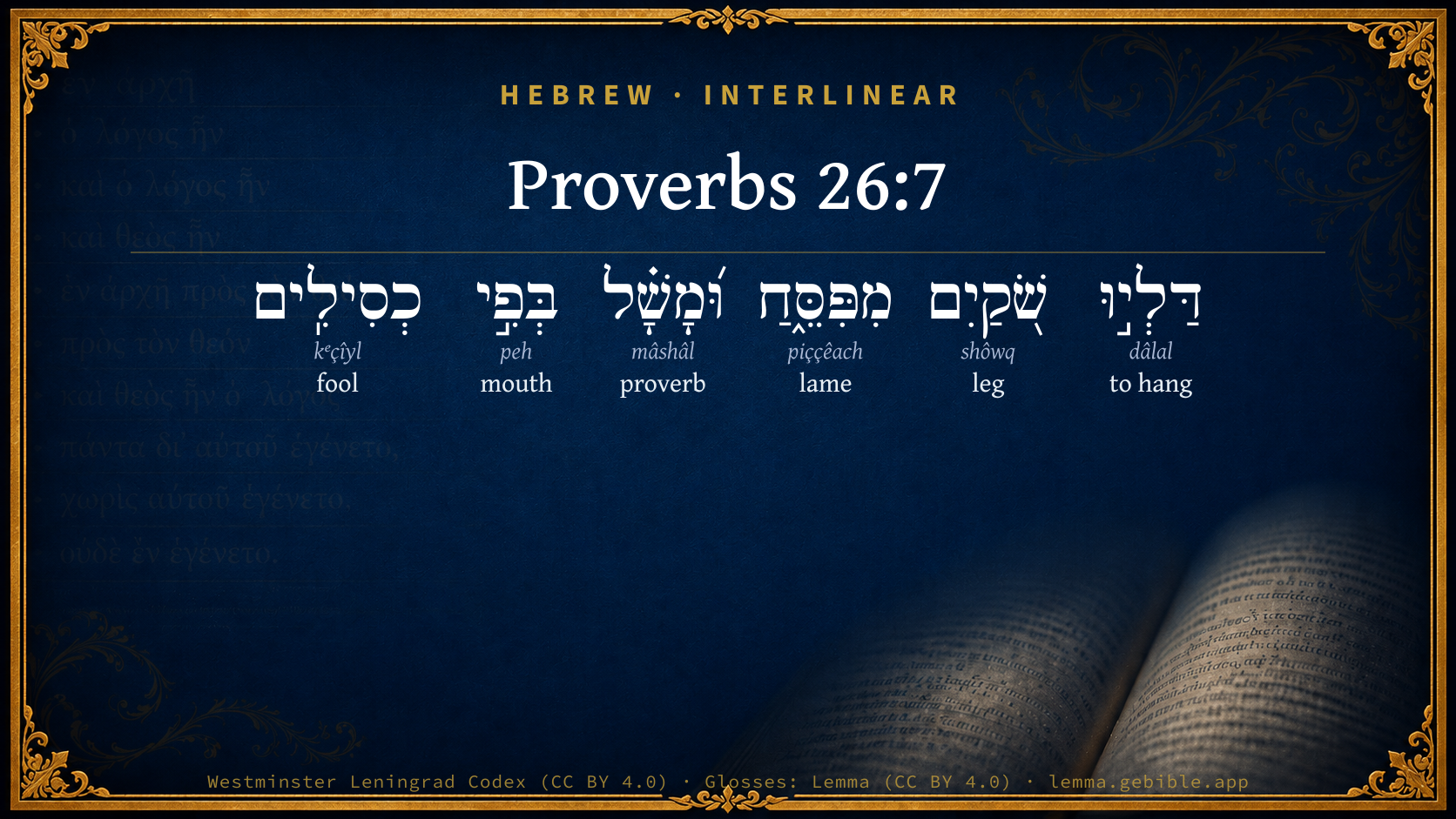
Proverbs 26:7

Hebrew (Westminster Leningrad Codex) Proverbs 26:7 appears in the Hebrew Old Testament. The text above is from the Westminster Leningrad Codex. Each word links to its Strong’s number, a concise gloss, and parsing drawn from the Open Scriptures Hebrew Bible morphology. Click any word for its full Brown-Driver-Briggs (BDB) entry.
Download image
Cite this verse

Proverbs 26:7 (World English Bible). Public Domain. Lemma interlinear Bible study tool, https://lemma.gebible.app/v/proverbs/26/7.

Show BibTeX & RIS
BibTeX
RIS
English Translation
Like the legs of the lame that hang loose: So is a parable in the mouth of fools.
World English Bible · Public Domain
Download a study sheet

One document with this verse’s original text, its word-by-word gloss line, the meaning frame, cross-references with their text, attributed commentary, and full source and license credits — printable, and it pastes into notes with its structure intact.

This verse Autodidact and up

Study sheet (.html) Plain text (.txt)

A passage Seminary Student

Up to 50 verses in one chapter. A passage sheet keeps up to 6 commentary sources and 12 cross-references per verse, in the order this page ranks them, and says so on the sheet whenever that leaves anything out. Ask for a single verse and you get the Autodidact verse sheet above.

Everything on this page stays free to read, with no account — the sheet is a download of what is already on screen, not access to it.

Want to remove ads? Support Godless Engineer
Compare translations 3

The same verse in 3 English versions, stacked beneath the original-language interlinear above. Click any original word for its lexicon entry.

Each is an independent rendering of the whole verse — the interlinear is not word-aligned to these translations.

Highlighted words mark where these versions differ — a whole-verse word diff, not a word-by-word alignment.

  • World English Bible Public Domain
    Like the legs of the lame that hang loose: So is a parable in the mouth of fools.
  • King James Version Public Domain
    The legs of the lame are not equal: so is a parable in the mouth of fools.
  • unfoldingWord Literal Text CC BY-SA 4.0
    Legs dangle from a lame one, and a proverb in the mouth of stupid ones.

unfoldingWord Literal Text — © unfoldingWord, licensed CC BY-SA 4.0. Word-aligned USFM3 via Door43 (git.door43.org/unfoldingWord/en_ult).

Versions to compare (up to 4)

3 of 4 selected

Show all 18 translations

Every available English version of this verse, each an independent rendering of the whole verse.

  • World English Bible Public Domain
    Like the legs of the lame that hang loose: So is a parable in the mouth of fools.
  • Berean Standard Bible Public Domain
    Like lame legs hanging limp is a proverb in the mouth of a fool.
  • Majority Standard Bible Public Domain
    Like lame legs hanging limp is a proverb in the mouth of a fool.
  • King James Version Public Domain
    The legs of the lame are not equal: so is a parable in the mouth of fools.
  • American Standard Version (1901) Public Domain
    The legs of the lame hang loose: So is a parable in the mouth of fools.
  • Revised Version (1885) Public Domain
    The legs of the lame hang loose: so is a parable in the mouth of fools.
  • Geneva Bible (1599) Public Domain
    As they that lift vp the legs of the lame, so is a parable in a fooles mouth.
  • Douay-Rheims (1899) Public Domain
    As a lame man hath fair legs in vain: so a parable is unseemly in the mouth of fools.
  • Young's Literal Translation Public Domain
    Weak have been the two legs of the lame, And a parable in the mouth of fools.
  • Literal Standard Version CC BY-SA 4.0
    The two legs of the lame have been weak, || And an allegory in the mouth of fools.
  • Unlocked Literal Bible CC BY-SA 4.0
    Like the legs of a paralytic which hang down is a proverb in the mouth of fools.
  • unfoldingWord Literal Text CC BY-SA 4.0
    Legs dangle from a lame one, and a proverb in the mouth of stupid ones.
  • Darby Bible Public Domain
    The legs of the lame hang loose; so is a proverb in the mouth of fools.
  • World Messianic Bible Public Domain
    Like the legs of the lame that hang loose, so is a parable in the mouth of fools.
  • Webster's Bible Public Domain
    The legs of the lame are not equal: so is a parable in the mouth of fools.
  • Free Bible Version CC BY-SA 4.0
    A proverb spoken by someone stupid is as useless as a lame person's legs.
  • Bible in Basic English Public Domain
    The legs of one who has no power of walking are hanging loose; so is a wise saying in the mouth of the foolish.
  • JPS Tanakh (1917) Public Domain
    The legs hang limp from the lame; so is a parable in the mouth of fools.

Literal Standard Version (2020), Covenant Press — licensed CC BY-SA 4.0. Text via the HelloAO Bible API (eBible.org). Unlocked Literal Bible (unfoldingWord) — licensed CC BY-SA 4.0. Text via the HelloAO Bible API (eBible.org). unfoldingWord Literal Text — © unfoldingWord, licensed CC BY-SA 4.0. Word-aligned USFM3 via Door43 (git.door43.org/unfoldingWord/en_ult). Free Bible Version, Dr. Jonathan Gallagher — licensed CC BY-SA 4.0. Text via the HelloAO Bible API (eBible.org).

Word by word

More ways to search: Search by grammar → Find every occurrence → Compare this word →

Practice this passage: Drill this verse → Learn its vocabulary →

About this verse

These counts appear in no published source. They are computed here, from the morphology-tagged text and Lemma’s own curated glosses. What Lemma adds →

6
words
6
distinct lemmas
Wisdom
section

Notable vocabulary

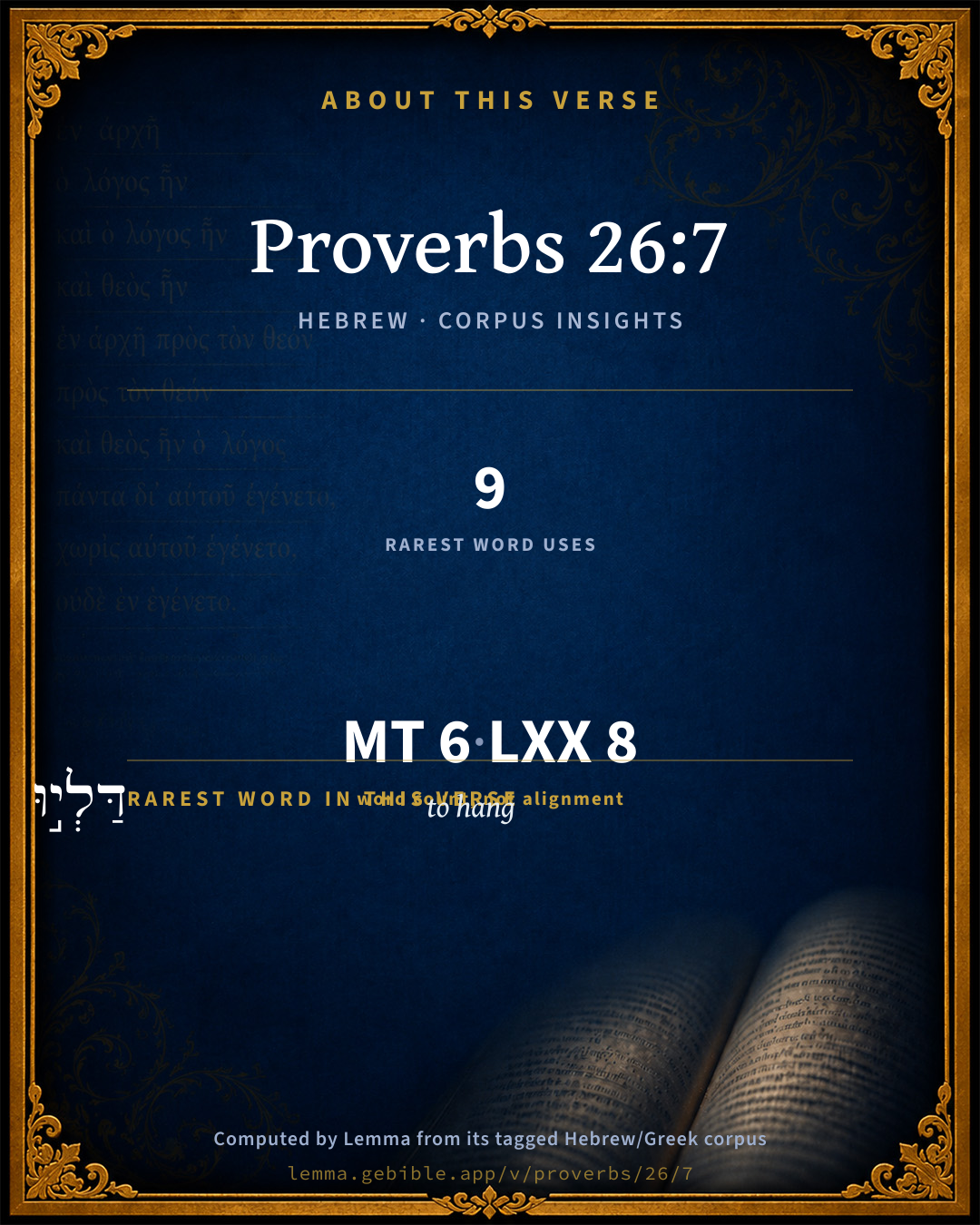
The rarest word here is דַּלְי֣וּ to hang H1809 — appearing just 9 times in the whole Hebrew Bible.

Shared distinctive vocabulary

דַּלְי֣וּ to hang H1809 occurs in 9 verses of the Hebrew Bible. Also found in:

Grammatical profile

  • 1 verb
  • 3 nouns
  • 2 adjectives

Verb forms

  • דַּלְי֣וּ Qal · Perfect

Hebrew & Septuagint length

In English translation the verse runs 18 words from the Hebrew and 16 from the Septuagint (LXX English) — closely comparable.

A rough comparison of the two English renderings, which tokenize alike — not a word-level alignment.

Word counts can differ between the Hebrew and the Greek without any difference in meaning — e.g. the Hebrew direct-object marker אֵת has no separate Greek word, and Greek often adds the article ὁ.

In the original languages it is 6 Hebrew tokens and 8 Greek tokens — but the two are counted differently (Hebrew bundles its prefixes and suffixes into one token; the Greek is in lemma form), so that isn’t a like-for-like length.

Cross-references

6

Topical passages linked to Proverbs 26:7 in the Treasury of Scripture Knowledge — connected by theme and wording, ordered by reader-vote popularity; previews shown in the World English Bible.

  • Proverbs 26:9 Like a thornbush that goes into the hand of a drunkard, So is a parable in the mouth of fools.
  • Psalms 64:8 Their own tongues shall ruin them. All who see them will shake their heads.
  • Proverbs 17:7 Arrogant speech isn't fitting for a fool, Much less do lying lips fit a prince.
  • Psalms 50:16–21 But to the wicked God says, "What right do you have to declare my statutes, That you have taken my covenant on your lips,
  • Matthew 7:4–5 Or how will you tell your brother, 'Let me remove the speck from your eye;' and behold, the beam is in your own eye?
  • Luke 4:23 He said to them, "Doubtless you will tell me this parable, 'Physician, heal yourself! Whatever we have heard done at Capernaum, do also here in your hometown.'"

Cross-references courtesy of OpenBible.info (CC BY 4.0).

Hebrew and Greek witnesses Masoretic Hebrew ↔ Greek Septuagint

The same verse in the two great witnesses to the Old Testament, shown verse-for-verse.

These are two independent witnesses, not word-aligned to each other, and the Septuagint is shown in lemma (dictionary) form.

Hebrew Proverbs 26:7 Masoretic · Westminster Leningrad Codex

דַּלְי֣וּ שֹׁ֭קַיִם מִפִּסֵּ֑חַ וּ֝מָשָׁ֗ל בְּפִ֣י כְסִילִֽים

Like the legs of the lame that hang loose: So is a parable in the mouth of fools.

World English Bible · Public Domain

Greek LXX Proverbs 26:7 Septuagint · lemma form

ἀποαἱρέω πορεία σκέλος καί παροιμία ἐκ στόμα ἄφρων

As well take away the motion of the legs, as transgression from the mouth of fools.

LXX2012 (modern English Septuagint) · Public Domain

On this verse, The Pulpit Commentary discusses the Septuagint’s reading. Read the note in Commentary ↓

Hebrew: Westminster Leningrad Codex (CC BY 4.0). Greek: Septuagint (public domain); English from LXX2012 (modern English Septuagint) (Public Domain). How the Septuagint differs from the Hebrew →

Commentary

Notes on Proverbs 26:7 from classic Christian and Jewish commentators (each source and its license shown beneath its notes). The classic Christian expositions comment on the surrounding passage and are grouped to its opening verse, so a note may address several verses; the Jewish commentaries on the Tanakh (Rashi and others) are per-verse, so they appear only where the commentator wrote on this verse.

Lemma curates 59 commentaries, every one of them public domain or Creative Commons licensed, each selected and text-cleaned for this edition rather than reprinted as found. About our sources →

Trapp's Complete Commentary

John Trapp

Pro 26:7 The legs of the lame are not equal: so [is] a parable in the mouth of fools.

Ver. 7. The legs of the lame are not equal.] Locum habet proverbium cum is qui male vivit, bene loquitur, saith an interpreter. {a} This proverb hits such as speak well, but live otherwise. Uniformity and ubiquity of obedience are sure signs of sincerity; but as [an] unequal pulse argues a distempered body, so doth uneven walking show a diseased soul. A wise man’s life is all of one colour, like itself; and godliness runs through it, as the woof runs through the warp. But if all the parts of the line of thy life be not straight before God, it is a crooked life. If thy tongue speak by the talent, but thine hands scarce work by the ounce, thou shalt pass for a Pharisee. {Mat 23:3} They spake like angels, lived like devils; had heaven commonly at their tongue ends, but the earth continually at their finger ends. Odi homines ignava opera, philosopha sententia, said the heathen; that is, I hate such hypocrites as have mouths full of holiness, hearts full of hollowness. A certain stranger coming on embassy to the senate of Rome, and colouring his hoary hair and pale cheeks with vermilion hue, a grave senator espying the deceit, stood up and said, ‘What sincerity are we to expect at this man’s hand, whose locks, and looks, and lips do lie?’

{a} Rodulph. Bain.

John Trapp, A Commentary or Exposition upon All the Books of the Old and New Testament (1647–1656) — public domain. Text from a community e-Sword module.

Joseph Benson's Commentary

Pro 26:7. The legs of the lame are not equal — Hebrew, דליו, are lifted up, namely, in going, which is done with great inequality and uncomeliness; so is a parable in the mouth of fools — No less absurd and indecent are wise and pious speeches from a foolish and ungodly man, whose actions grossly contradict them, whereby he makes them contemptible, and himself ridiculous.

Joseph Benson's Commentary on the Old and New Testaments (1811–1818) — public domain. Text from a community e-Sword module.

Tyndale Open Study Notes

Tyndale Open Resources

26:7 A fool might know a proverb but not be able to use it correctly. Cp. 26:9.

Tyndale Open Study Notes — © Tyndale Open Resources, licensed CC BY-SA 4.0. Text via the HelloAO Bible API.

Jamieson, Fausset & Brown

Robert Jamieson, A. R. Fausset & David Brown

legs . . . equal--or, "take away the legs," or "the legs . . . are weak." In any case the idea is that they are the occasion of an awkwardness, such as the fool shows in using a parable or proverb (see Introduction; Pro 17:7).

Jamieson, Fausset & Brown — Commentary Critical and Explanatory on the Whole Bible (1871) — public domain (CC PDM 1.0). Text via the HelloAO Bible API.

Ellicott's Commentary for English Readers

(7) The legs of the lame are not equal.—Better, perhaps. The legs hang down from a lame man, and so is a parable (useless) in the mouth of fools; they can make no more use of it for the guidance of themselves or others, than can a lame man use his legs. (Comp. Luk_8:10.)

A Bible Commentary for English Readers, edited by Charles John Ellicott (1878–1897) — public domain. Text from a community e-Sword module.

The Cambridge Bible for Schools and Colleges

gen. ed. J. J. S. Perowne

7. are not equal] Rather, hang loose, R.V. The strongest members of the body and the weightiest aphorisms of wisdom are alike useless appendages to one who lacks the power to turn them to account.

The Cambridge Bible for Schools and Colleges (gen. ed. J. J. S. Perowne; Cambridge University Press, 1878–1918) — public domain. Text from a community e-Sword module.

John Gill's Exposition

The legs of the lame are not equal,.... Or as "the lifting up the legs by one that is lame" (m), to dance to a pipe or violin, is very unseemly, and does but the more expose his infirmity, and can give no pleasure to others, but causes derision and contempt;

so is a parable in the mouth of fools; an apophthegm, or sententious expression of his own, which he delivers out as a wise saying, but is lame and halts; it is not consistent with itself, but like the legs of a lame man, one higher than the other: or one of the proverbs of this book, or rather any passage of Scripture, in the mouth of a wicked man; or any religious discourse of his is very unsuitable, since his life and conversation do not agree with it; it is as disagreeable to hear such a man talk of religious affairs as it is to see a lame man dance; or whose legs imitate buckets at a well, where one goes up and another down, as Gussetius (n) interprets the word.

(m) "elevatio crurum a claudo facta", Gejerus, Michaelis. (n) "Femora claudi imitantur situlas", Gussetius, p. 188. "situlas agunt crura ex claudio", Schultens; "instar binarum sitularum in puteo alternatium adscendentium ac descendentium", Gejerus.

John Gill's Exposition of the Whole Bible (1746–1763) — public domain (CC PDM 1.0). Text via the HelloAO Bible API.

Albert Barnes' Notes on the Bible

Or, Take away the legs of the lame man, and the parable that is in the mouth of fools: both are alike useless to their possessors. Other meanings are:

(1) “The legs of the lame man are feeble, so is parable in the mouth of fools.”

(2) “the lifting up of the legs of a lame man, i. e., his attempts at dancing, are as the parable in the mouth of fools.”

Albert Barnes' Notes on the Bible (1834–1885) — public domain. Text from a community e-Sword/MySword module.

Haydock's Catholic Bible Commentary

Fair. Hebrew, "unequal legs," or "lifted up," so, &c. (Haydock)

George Leo Haydock (1774–1849), Haydock's Catholic Family Bible and Commentary, 1859 edition — public domain. Excludes Psalms (Douay-Rheims chapter numbering differs from Protestant) and Deuterocanonical books (Catholic canon only).

Matthew Poole's English Annotations

The legs of the lame are not equal, Heb. As (which note of similitude is plainly understood from the particle so in the following clause) the legs of the lame are lifted up, to wit, in going, or rather in dancing, which is done with great inequality and uncomeliness.

So is a parable in the mouth of fools; no less absurd and indecent are wise and pious speeches from a foolish and ungodly man, whose actions grossly contradict them, whereby he makes them contemptible, and himself ridiculous.

Matthew Poole's English Annotations on the Holy Bible (1683–1685) — public domain. Text from a community e-Sword/MySword module.

Whedon's Commentary on the Bible

Daniel D. Whedon

7. Legs… not equal — The root of דליו, (dalyu,) translated not equal, is uncertain. Hence we have the following: 1. As the legs of the lame are weak, so a proverb, etc. 2. Take away the legs of a lame man, and so take away a proverb, etc. 3. The legs hang down from the lame, etc. 4. The legs drag after the lame, etc. Each of these is favoured by different authorities. Forms from the supposed root are sometimes rendered in our Version in the sense of exalted, lifted up, etc. (See margin; also Psa_30:1.) Hence Patrick says: “As the word dalyu signifies something of elevation or lifting up, I have explained it of dancing,” which explanation, as it is curious, we give: “A wise saying as ill becomes a fool as dancing doth a cripple; for as his lameness never so much appears as when he would seem nimble, the other’s folly is never so ridiculous as when he would seem wise.” A good sense, whether it is that of the proverb or not.

Parable — משׁל, (mashal,) the same word is rendered proverb in this book. See on Pro_1:1.

Daniel D. Whedon (gen. ed.), Commentary on the Old and New Testaments (1874–1909) — public domain. Text from a community e-Sword module.

The Pulpit Commentary

The legs of a lame man are not equal. The first word of this verse, WylD, has occasioned some difficulty. It is considered as an imperative from hld, "draw off," "take away." Thus the Septuagint, afelou ; Venetian, eparate . But the verb seems never to have this meaning; nor, if it had, would the sense be very satisfactory, for. as Delitzsch points out, lame legs are better than none, and there is a great difference between the perfectly crippled or paralytic who has to be carried, and the lame man (jSepi) who can limp or get along on crutches., And when we explain the proverb in this sense (as Plumptre), "Take away the legs of the lame man and the parable from the mouth of fools," for both alike ere useless to their possessors, and their loss would not be felt we must recognize that the conclusion is not true. No one would think of amputating s man"s legs simply because he was lame, and such a one"s legs cannot be considered absolutely useless. Others regard the word as third plural kal, "the legs hang loose;" though the form is not sufficiently accounted for. All explanations of the word as a verbal form have such difficulties, that some take it as a noun, meaning "dancing," which is Luther"s interpretation, "as dancing to a cripple, so it becometh a fool to talk of wisdom." But the word could never sightly anything but "limping," and could not express the elegant motion of dancing. The Authorized Version considers the Hebrew to mean, "are lifted up," i.e. are unequal, one being longer or stronger than the other; but this loses the force of the comparison. There seems to be no better interpretation than that mentioned above," The legs of the lame hang loose," i.e. are unserviceable, however sound in appearance. St. Jerome has expressed this, though in a strange fashion, "As it is vain for a lame man to have seemly legs." So is a parable in the mouth of a fool. "Parable" (mashal), sententious saying, the enunciation of which, as well as the recital of stories, was always a great feature in Eastern companies, and afforded a test of a man"s ability. A fool fails in the exhibition; he misses the point of the wise saying which he produces; it falls lame from his mouth, affords no instruction to others, and makes no way with its hearers. Siracides gives another reason for the incongruity, "A parable shall be rejected when it cometh out of a fool"s mouth; for he will not speak it in its season" (Ecc 20:20). Septuagint, "Take away the motion of legs, and transgression (paranomian , ? paroimian , Lag.) from the mouth of fools."

The Pulpit Commentary (1880–1919), ed. H.D.M. Spence-Jones & Joseph S. Exell — public domain. Text from a community e-Sword module.

John Wesley's Explanatory Notes

The legs - Hebrew. the legs of the lame are lifted up, in going, or in dancing, which is done with great inequality and uncomeliness. So - No less incident are wise and pious speeches from a foolish and ungodly man.

John Wesley, Explanatory Notes Upon the Whole Bible (1754–1765) — public domain. Text via the GEBible commentary corpus.

Keil & Delitzsch

C. F. Keil & F. Delitzsch

7 The hanging down of the legs of a lame man;

And a proverb in a fool's mouth.

With reference to the obscure דּליוּ, the following views have been maintained: - (1) The form as punctuated appears directly as an imperative. Thus the lxx translate, the original text of which is here: ἀφελοῦ πορείαν κυλλῶν (conj. Lagarde's) καὶ παροιμίαν ἐκ στόματος ἀφρόνων, which the Syr. (with its imitator, the Targ.) has rendered positively: "If thou canst give the power of (sound) going to the lame, then wilt thou also receive (prudent) words from the mouth of a fool." Since Kimchi, דּליוּ has been regarded by many as the softening of the Imp. Piel דּדּוּ, according to which the Venet. translates: ἐπάρατε κνήμας χωλοῦ; and Bertheau and Zckler explain: always take away his legs from the lame, since they are in reality useless to him, just as a proverb in the mouth of the fool is useless - something that without loss might be never there." But why did not the poet write הרימוּ, or הסירוּ, or קחוּ, or the like? דּלּי, to carry away, to dispense with, is Syriac (Targ. Jer. I, under Deu 32:50), but not Hebrew. And how meaningless is this expression! A lame man would withstand a surgeon (as he would a murderer) who would amputate his legs; for lame legs are certainly better than none, especially since there is a great distinction between a lame man (פּדּח, from פּסח, luxare; cf. (Arab.) fasaḥ, laxare, vid., Schultens) who halts or goes on crutches (Sa2 3:29), and one who is maimed (paralytic), who needs to be carried. It comes to this, that by this rendering of 7a one must, as a consequence, with the lxx, regard וּמשׁל [and a proverb] as object. accus. parallel to שׁקים [legs]; but "to draw a proverb from one's mouth" is, after Pro 20:5, something quite different from to tear a proverb away from him, besides which, one cannot see how it is to be caught. Rather one would prefer: attollite crura claudi (ut incedat, et nihil promovebitis); but the מן of מפּסּח does not accord with this, and 7b does not connect itself with it. But the explanation: "take away the legs from a lame man who has none, at least none to use, and a proverb in the mouth of fools, when there is none," is shattered against the "leg-taking-away," which can only be used perhaps of frogs' legs. (2) Symmachus translates: ἐξέλιπον κνῆμαι ἀπὸ χωλοῦ; and Chajg explains דּליוּ as 3 pret. Kal, to which Kimchi adds the remark, that he appears to have found דּליוּ, which indeed is noted by Norzi and J. H. Michaelis as a variant. But the Masoretic reading is דּליוּ, and this, after Gesenius and Bttcher (who in this, without any reason, sees an Ephraimitic form of uttering the word), is a softened variation from דּדּוּ. Only it is a pity that this softening, while it is supported by alius = ἄλλος, folium = φύλλον, faillir = fallere, and the like, has yet not a single Hebrew or Semitic example in its favour. (3) Therefore Ewald finds, "all things considered," that it is best to read דּליוּ, "the legs are too loose for the lame man to use them." But, with Dietrich, we cannot concur in this, nor in the more appropriate translation: "the legs of the lame hang down loose," to say nothing of the clearly impossible: "high are the legs of the lame (one higher than the other)," and that because this form גּליוּ for גּליוּ also occurs without pause, Psa 57:2; Psa 73:2; Psa 122:6; Isa 21:12; but although thus, as at Psa 36:9; Psa 68:32, at the beginning of a clause, yet always only in connection, never at the beginning of an address. (4) It has also been attempted to interpret דּליוּ as abstr., e.g., Euchel: "he learns from a cripple to dance, who seeks to learn proverbs from the mouth of a fool." דּליוּ שׁקים must mean the lifting up of the legs = springing and dancing. Accordingly Luther translates:

"As dancing to a cripple,

So does it become a fool to speak of wisdom."

The thought is agreeable, and according to fact; but these words to not mean dancing, but much rather, as the Arabic shows (vid., Schultens at Pro 20:5, and on the passage before us), a limping, waddling walk, like that of ducks, after the manner of a well-bucket dangling to and fro. And דּליוּ, after the form מלכוּ, would be an unheard-of Aramaism. For forms such as שׂחוּ, swimming, and שׁלוּ, security, Psa 30:7, on which C. B. Michaelis and others rest, cannot be compared, since they are modified from sachw, ṣalw, while in דּליוּ the ending must be, and besides the Aramaic דּליוּ must in st. constr. be דּליוּוּת. Since none of these explanations are grammatically satisfactory, and besides דּליוּ = דּללוּ = דּדּוּ gives a parallel member which is heterogeneous and not conformable to the nature of an emblematical proverb, we read דּלּוּי after the forms צפּוּי, שׁקּוּי (cf. חבּוּק, Pro 6:10; Pro 24:33), and this signifies loose, hanging down, from דּלה, to hang at length and loosely down, or transitively: to hang, particularly of the hanging down at length of the bucket-rope, and of the bucket itself, to draw water from the well. The מן is similar to that of Job 28:4, only that here the connecting of the hanging down, and of that from which it hangs down, is clear. Were we to express the purely nominally expressed emblematical proverb in the form of a comparative one, it would thus stand as Fleischer translates it: ut laxa et flaccida dependent (torpent) crura a claudo, sic sententia in ore stultorum (sc. torpet h. e. inutilis est). The fool can as little make use of an intelligent proverb, or moral maxim (dictum sententiosum), as a lame man can of his feet; the word, which in itself is full of thought, and excellent, becomes halting, lame, and loose in his mouth (Schultens: deformiter claudicat); it has, as spoken and applied by him, neither hand nor foot. Strangely, yet without missing the point, Jerome: quomodo pulcras frustra habet claudus tibias, sic indecens est in ore stultorum parabola. The lame man possibly has limbs that appear sound; but when he seeks to walk, they fail to do him service - so a bon-mot comes forth awkwardly when the fool seeks to make use of it. Hitzig's conjecture: as leaping of the legs on the part of a lame man..., Bttcher has already shown sufficient reasons for rejecting; leaping on the part of any one, for the leaping of any one, were a court style familiar to no poet.

Keil & Delitzsch — Biblical Commentary on the Old Testament (1861–1891) — public domain (CC PDM 1.0). Text via the HelloAO Bible API. (Old Testament only.)

unfoldingWord translationNotes

Door43 World Missions Community

Like the legs ... is a proverb in the mouth of fools

The phrases can be reordered. AT: "A proverb in the mouth of fools is like the legs of a paralytic which hang down" or "A proverb in the mouth of fools is as useless as the legs of a paralytic which hang down" (See: Simile)

a paralytic

a person who is unable to move or feel all or part of his body

in the mouth of fools

Here "mouth" is a metonym for speaking. AT: "in the speech of fools" or "that fools say" (See: Metonymy)

tying a stone in a sling

In order to throw a stone very far, people put it into a sling and swing the sling so that the stone will fly from it very quickly. The result of tying a stone in a sling can be stated clearly. AT: "tying a stone in a sling so that it cannot be thrown" (See: Assumed Knowledge and Implicit Information)

giving honor to a fool

"honoring a fool"

translationWords

proverb

stone

honor

unfoldingWord translationNotes — © Distant Shores Media and the Door43 World Missions Community, licensed CC BY-SA 4.0. Source: git.door43.org/Door43/en_tn.

Rashi

Rabbi Shlomo Yitzchaki (Rashi)

thighs seem raised to a lame man Heb. דליו, as in (Isa. 38:14): “My eyes were lifted (דלו).” Every man’s thighs appear to the lame to be higher than he. This phrase is a parable in the mouth of the fool, who says it in reference to the study of wisdom, “How can we come to study wisdom? It is hidden and raised up higher than I am. The parable states, ‘Thighs seem raised to a lame man.’”

Rashi on the Tanakh — English translations: “The Judaica Press complete Tanach with Rashi, translated by A. J. Rosenberg” (CC BY 4.0); “Pentateuch with Rashi's commentary by M. Rosenbaum and A.M. Silbermann, 1929-1934” (public domain); “The Metsudah Tanach series, Lakewood, N.J” (CC BY 4.0); and “The Book of Joshua, Metsudah Publications, 1997” (CC BY 4.0). Text via Sefaria.

Lesson kit

Teaching starters — assembled from the data on this page, not authored interpretation. Every prompt links to the verse data it draws on. Edit before teaching.

Proverbs, in the Wisdom, opens this verse with 6 words (6 distinct Hebrew lemmas). Its most distinctive word is dâlal (“to hang”). A historical commentator’s framing appears above. Read the whole chapter for the surrounding context.

Discussion questions

  1. How does “to hang” (dâlal) shape what this verse is saying?
  2. Judges 6:6 shares the word «to hang» with this verse. How do the two illuminate each other?
  3. The translations on this page render this verse differently — a whole-verse word diff, not a word-by-word alignment. What might account for the different wordings?
  4. The verb «דַּלְי֣וּ» is Qal Perfect. How does its form color the action?
  5. Reading how Trapp's Complete Commentary and Joseph Benson's Commentary read this verse, where do the two commentators agree and where do they part?

Things to notice

Reading settings

Reading text

Shown beneath each verse's original-language words.

Old Testament
Old Testament edition

Read the OT as the Masoretic Hebrew (MT) or the Greek Septuagint (LXX).

English shown for the Greek Septuagint (in the Hebrew ↔ Greek comparison).

Comparing translations? Open the Compare panel on any verse page to stack up to four side by side.