
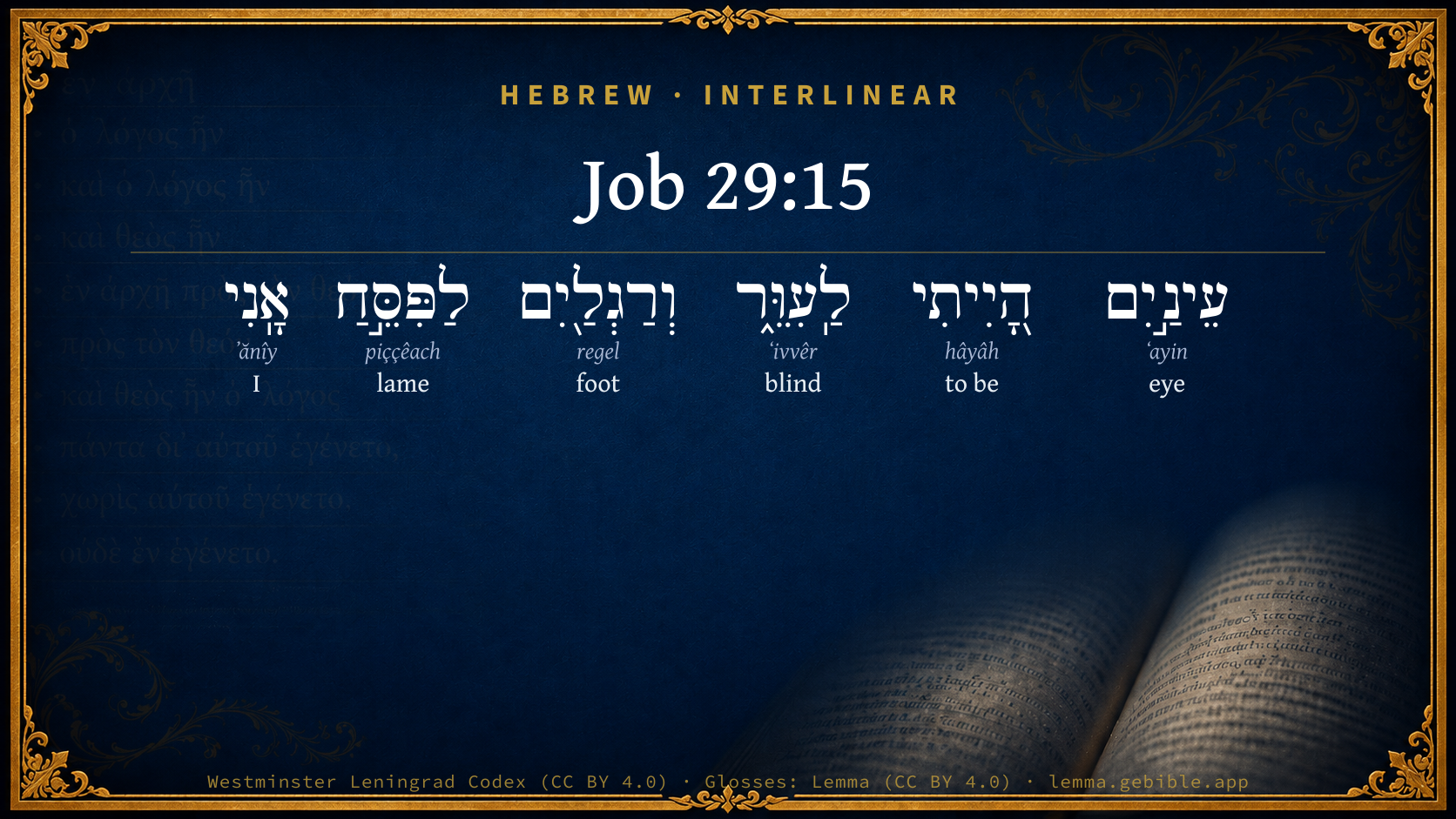
Job 29:15

Hebrew (Westminster Leningrad Codex) Job 29:15 appears in the Hebrew Old Testament. The text above is from the Westminster Leningrad Codex. Each word links to its Strong’s number, a concise gloss, and parsing drawn from the Open Scriptures Hebrew Bible morphology. Click any word for its full Brown-Driver-Briggs (BDB) entry.
Download image
Cite this verse

Job 29:15 (World English Bible). Public Domain. Lemma interlinear Bible study tool, https://lemma.gebible.app/v/job/29/15.

Show BibTeX & RIS
BibTeX
RIS
English Translation
I was eyes to the blind, And feet to the lame.
World English Bible · Public Domain
Download a study sheet

One document with this verse’s original text, its word-by-word gloss line, the meaning frame, cross-references with their text, attributed commentary, and full source and license credits — printable, and it pastes into notes with its structure intact.

This verse Autodidact and up

Study sheet (.html) Plain text (.txt)

A passage Seminary Student

Up to 50 verses in one chapter. A passage sheet keeps up to 6 commentary sources and 12 cross-references per verse, in the order this page ranks them, and says so on the sheet whenever that leaves anything out. Ask for a single verse and you get the Autodidact verse sheet above.

Everything on this page stays free to read, with no account — the sheet is a download of what is already on screen, not access to it.

Want to remove ads? Support Godless Engineer
Compare translations 3

The same verse in 3 English versions, stacked beneath the original-language interlinear above. Click any original word for its lexicon entry.

Each is an independent rendering of the whole verse — the interlinear is not word-aligned to these translations.

Highlighted words mark where these versions differ — a whole-verse word diff, not a word-by-word alignment.

  • World English Bible Public Domain
    I was eyes to the blind, And feet to the lame.
  • King James Version Public Domain
    I was eyes to the blind, and feet was I to the lame.
  • unfoldingWord Literal Text CC BY-SA 4.0
    I was eyes to the blind, and I feet to the lame.

unfoldingWord Literal Text — © unfoldingWord, licensed CC BY-SA 4.0. Word-aligned USFM3 via Door43 (git.door43.org/unfoldingWord/en_ult).

Versions to compare (up to 4)

3 of 4 selected

Show all 18 translations

Every available English version of this verse, each an independent rendering of the whole verse.

  • World English Bible Public Domain
    I was eyes to the blind, And feet to the lame.
  • Berean Standard Bible Public Domain
    I served as eyes to the blind and as feet to the lame.
  • Majority Standard Bible Public Domain
    I served as eyes to the blind and as feet to the lame.
  • King James Version Public Domain
    I was eyes to the blind, and feet was I to the lame.
  • American Standard Version (1901) Public Domain
    I was eyes to the blind, And feet was I to the lame.
  • Revised Version (1885) Public Domain
    I was eyes to the blind, and feet was I to the lame.
  • Geneva Bible (1599) Public Domain
    I was the eyes to the blinde, and I was the feete to the lame.
  • Douay-Rheims (1899) Public Domain
    I was an eye to the blind, and a foot to the lame.
  • Young's Literal Translation Public Domain
    Eyes I have been to the blind, And feet to the lame `am' I.
  • Literal Standard Version CC BY-SA 4.0
    I have been eyes to the blind, || And I [am] feet to the lame.
  • Unlocked Literal Bible CC BY-SA 4.0
    I was eyes to blind people; I was feet to lame people.
  • unfoldingWord Literal Text CC BY-SA 4.0
    I was eyes to the blind, and I feet to the lame.
  • Darby Bible Public Domain
    I was eyes to the blind, and feet was I to the lame;
  • World Messianic Bible Public Domain
    I was eyes to the blind, and feet to the lame.
  • Webster's Bible Public Domain
    I was eyes to the blind, and feet was I to the lame.
  • Free Bible Version CC BY-SA 4.0
    I was like eyes for the blind and feet for the lame.
  • Bible in Basic English Public Domain
    I was eyes to the blind, and feet to him who had no power of walking.
  • JPS Tanakh (1917) Public Domain
    I was eyes to the blind, and feet was I to the lame.

Literal Standard Version (2020), Covenant Press — licensed CC BY-SA 4.0. Text via the HelloAO Bible API (eBible.org). Unlocked Literal Bible (unfoldingWord) — licensed CC BY-SA 4.0. Text via the HelloAO Bible API (eBible.org). unfoldingWord Literal Text — © unfoldingWord, licensed CC BY-SA 4.0. Word-aligned USFM3 via Door43 (git.door43.org/unfoldingWord/en_ult). Free Bible Version, Dr. Jonathan Gallagher — licensed CC BY-SA 4.0. Text via the HelloAO Bible API (eBible.org).

Word by word

More ways to search: Search by grammar → Find every occurrence → Compare this word →

Practice this passage: Drill this verse → Learn its vocabulary →

About this verse

These counts appear in no published source. They are computed here, from the morphology-tagged text and Lemma’s own curated glosses. What Lemma adds →

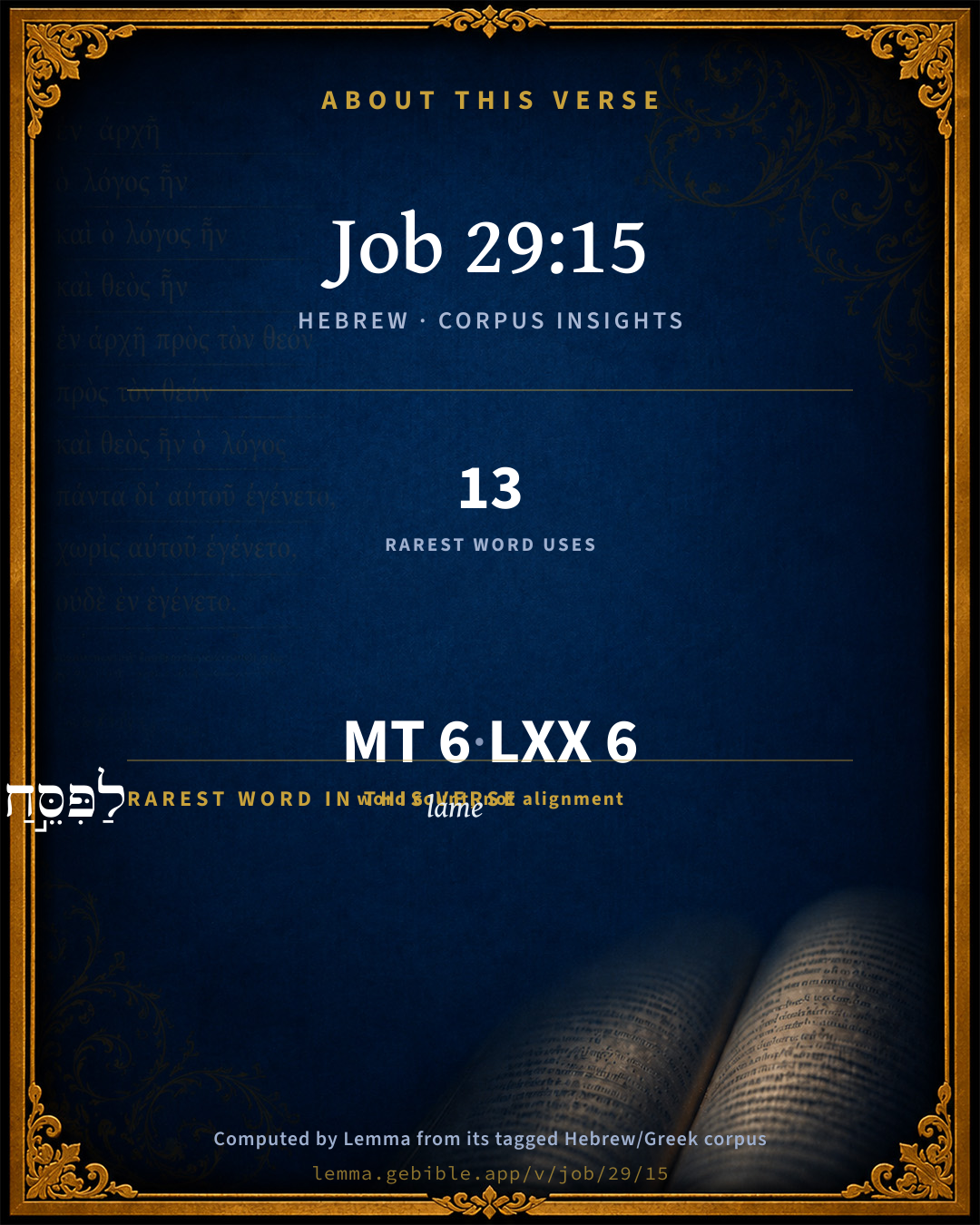
6
words
6
distinct lemmas
Wisdom
section

Notable vocabulary

The rarest word here is לַפִּסֵּ֣חַ lame H6455 — appearing just 13 times in the whole Hebrew Bible.

Shared distinctive vocabulary

לַפִּסֵּ֣חַ lame H6455 occurs in 12 verses of the Hebrew Bible. Also found in:

Grammatical profile

  • 1 verb
  • 2 nouns
  • 2 adjectives
  • 1 pronoun

Verb forms

  • הָ֭יִיתִי Qal · Perfect

Hebrew & Septuagint length

In English translation the verse runs 11 words from the Hebrew and 13 from the Septuagint (LXX English) — closely comparable.

A rough comparison of the two English renderings, which tokenize alike — not a word-level alignment.

Word counts can differ between the Hebrew and the Greek without any difference in meaning — e.g. the Hebrew direct-object marker אֵת has no separate Greek word, and Greek often adds the article ὁ.

In the original languages it is 6 Hebrew tokens and 6 Greek tokens — but the two are counted differently (Hebrew bundles its prefixes and suffixes into one token; the Greek is in lemma form), so that isn’t a like-for-like length.

Cross-references

3

Topical passages linked to Job 29:15 in the Treasury of Scripture Knowledge — connected by theme and wording, ordered by reader-vote popularity; previews shown in the World English Bible.

  • Numbers 10:31 He said, Don't leave us, please; because you know how we are to encamp in the wilderness, and you shall be to us instead of eyes.
  • Matthew 11:5 the blind receive their sight, the lame walk, the lepers are cleansed, the deaf hear, the dead are raised up, and the poor have good news preached to them.
  • 1 Corinthians 12:12–31 For as the body is one, and has many members, and all the members of the body, being many, are one body; so also is Christ.

Cross-references courtesy of OpenBible.info (CC BY 4.0).

Hebrew and Greek witnesses Masoretic Hebrew ↔ Greek Septuagint

The same verse in the two great witnesses to the Old Testament, shown verse-for-verse.

These are two independent witnesses, not word-aligned to each other, and the Septuagint is shown in lemma (dictionary) form.

Hebrew Job 29:15 Masoretic · Westminster Leningrad Codex

עֵינַ֣יִם הָ֭יִיתִי לַֽעִוֵּ֑ר וְרַגְלַ֖יִם לַפִּסֵּ֣חַ אָֽנִי

I was eyes to the blind, And feet to the lame.

World English Bible · Public Domain

Greek LXX Job 29:15 Septuagint · lemma form

ὀφθαλμός εἰμί τυφλός πούς δέ χωλός

I was the eye of the blind, and the foot of the lame.

LXX2012 (modern English Septuagint) · Public Domain

Hebrew: Westminster Leningrad Codex (CC BY 4.0). Greek: Septuagint (public domain); English from LXX2012 (modern English Septuagint) (Public Domain). How the Septuagint differs from the Hebrew →

Commentary

Notes on Job 29:15 from classic Christian and Jewish commentators (each source and its license shown beneath its notes). The classic Christian expositions comment on the surrounding passage and are grouped to its opening verse, so a note may address several verses; the Jewish commentaries on the Tanakh (Rashi and others) are per-verse, so they appear only where the commentator wrote on this verse.

Lemma curates 59 commentaries, every one of them public domain or Creative Commons licensed, each selected and text-cleaned for this edition rather than reprinted as found. About our sources →

Trapp's Complete Commentary

John Trapp

Job 29:15 I was eyes to the blind, and feet [was] I to the lame.

Ver. 15. I was eyes to the blind] Here he saith the same in effect as before, Job 29:12-13, only he setteth it forth Pulcherrimis allegoriis per synathroismum velut conglobatis, by a heap of most elegant allegories (Mercer). He meaneth here, I gave advice to the simple, and support to the weak and impotent. But how many great men are there, qui etiam videntes, circumveniunt et fallunt, who put out the eyes of men, as Korah falsely accused Moses, Num 16:14. And cut off their legs (as that tyrant in the story served his guests that were too long for his bed) by disabling or discouraging them to follow their just causes, so that they are ready to say, with Themistocles, that if two ways were showed him, whereof the one led to hell and the other to those corrupt courses of justice, he would seriously choose the former rather than the latter (Plut.).

John Trapp, A Commentary or Exposition upon All the Books of the Old and New Testament (1647–1656) — public domain. Text from a community e-Sword module.

The Biblical Illustrator

Joseph S. Exell

Job_29:15

I was eyes to the blind.

Self-multiplication

Are not my eyes my own? No, nothing is your own; and until you get that truth driven into your very soul you cannot be a Christian. May not a man do what he will with his own? Yes, when he gets it. Your hand is not your own, so what about the little thing that is in it? The greater includes the less. Not a hair upon your head is your own, not a breath in your body is your own; the blood of Christ bought you every whir and every fibre, or He bought none of you. If a man has vision he holds that vision for the sake of him who has none. That is the New Testament law of property. Every man who has need of your help you can make part of yourself, and by a transmigration of souls, which has nothing to do with the old fables of metempsychosis, you can take other men into you, put yourselves into other men, and live the public life, the life philanthropic, without many people knowing much about it. Does he give nothing who is eyes to the blind, who reads the small print for those whose eyes are dim? They say, we can make out these large letters, but what is all this small writing? Is it nothing to read the Bible to a person whose eyes are failing and who cannot any longer see the sweet revelation of God in dim type? Is it nothing to sit for an hour beside some poor solitary soul on a Sunday evening and read to that soul words from heaven? Does he who does this do nothing because his name does not appear in this list or in that? The difficulty which all men have to contend with is that they cannot get away from their own little narrow conceptions of what things are. If you do not do exactly as I do and when I do it, then the enemy suggests to me that you are doing nothing, whereas you may be doing ten thousand times more than it ever entered into my imagination to conceive it possible for a man to do. Thus--There are some persons who cannot get away from the idea that unless a ministry be associated with thousands upon thousands of conversions it is doing nothing. Blessed be God, they are not judges, they are only critics. Does he do nothing who stimulates the whole humanity that is in a man? Does he do nothing who makes the coward say, God help me to be brave, and when the enemy comes in again I will stand up against him with full-toned strength? Do not attempt to write another mans subscription list for him. Every man shall give account of himself to God. Enough! God is love. There are others who cannot get away from the idea that unless you have endless organisations, a whole tumult of mechanisms, you are doing nothing. Does the blind man play no part in all this wondrous drama of love? Why, the blind man should never forget who it was that led him across the thoroughfare. Even a blind man is not exempted from gratitude; even the man who has been helped ought to remember the man who assisted him; even God sits that He may receive our tributes of thankfulness,--need of them He has none, but He knows it is good for us to cleanse our selfishness by allowing to be poured through it our streams of gratitude. Have you recognised all the men who were eyes to you? I fear not. Who was eyes to you in business, when you were a young man, and could see very little? Who was that strong man with the piercing eyes that saw miles beyond the line where your vision failed, and who said to you, Thus and thus lie the horizon of destiny and the sphere of commercial possibility? You profited by that mans eyes and that mans guidance: what have you done for him? Are you aware that some of his children are in difficulties? Do you know that his widow would be almost happy if she had but one pound a week more than she has? Do you know that that man, then so good and strong, has not a gravestone to mark where his bones lie? You might put up one and write upon it, He helped me, he was eyes to me; but for that man whose body lies here I should have died in the nighttime without ever having seen the light; and that Bible passage men might read, and reading might begin to feel, and feeling might begin to pray, and praying might begin to help other young men. Who was it that counselled you when you were in difficulty? But what money value attaches to good counsel? Who cares to pay for ideas? Pay for bricks and stones, iron pillars and gaslight and painted glass, but never, saith the miser, pay for soul, mind, blood, the fury of high inspiration. Many men do not see the blind, or they would help them. Shall I tell you why many men do not see the blind? The answer is, because they do not look for them; and it is amazing how much you can miss if you never look for it. There are souls that are telling this lie to themselves, namely, Now, if only I had the opportunity I could do a good deal, but people that need this sort of help never seem to come in my way: no doubt there are many deserving cases in the world if one only knew them. How dare you go to rest in darkness after telling that falsehood? Out upon such hypocrisy! This I am prepared to say, that some of us have larger opportunities of seeing than other men have. That is of necessity true: but the other men ought to say to those who have the larger outlook, Spend this money for me; I would give it with my own hand if I knew the eases, but you have larger opportunities of seeing them: spend two hundred pounds a year for me. Think of a man having his ten thousand, fifteen, twenty thousand a year, and never making any man who has large vision of society his treasurer or his trustee. Let us remember that there is other blindness than that of the body. Here is the larger field, here is scope for genius and sympathy and prayerfulness and love. I was eyes to the blind--the ignorant; I taught them their letters, I gave them the key of knowledge, I showed them how to read a little for themselves, and then I gave them a book or two; and now they are reading and mentally growing; they are thinking deeply upon practical questions, and are themselves teaching other people to read. I was eyes to the blind--to those who were labouring in the darkness of superstition, thinking of omens, and being frightened by suggestions of spectral presences; not the great spirituality which fills the universe with the Holy Ghost, but afraid of witch and demon and imp and fairy: for them I purged the air, I made them feel that the air was a great wind of health from heaven, meant to rejuvenate men, to make men young and cheerful, glad with a solemn merriment; and now they ate telling other people that God is light, God is love, and that they who fear the God and Father of our Lord Jesus Christ have nothing else to fear, for they stand in the light of love. (Joseph Parker, D. D.)

Eyes to the blind

I. The peculiarly dependent condition of the blind.

1. As to spiritual things, the blind are peculiarly dependent. In spiritual things all men are dependent. Sometimes blindness is sent in judgment. How many are the books which the blind do not possess. From how many objects of sight the Scripture draws lessons of faith. These must be more difficult to the blind than to others.

2. As to temporal things. So few professions and trades the blind can follow.

II. The duty and mode of becoming eyes to the blind. It is our duty to study the mind of God towards the blind, and to pray, and to endeavour with His help, to be like-minded, according to our opportunity. As to mode, this will apply to individuals. All should maintain the sincerest sympathy, all should be ready to give their practical help; but different individuals may help in different ways. (John Hambleton, M. A.)

Jobs social goodness

Job was evidently a common friend and benefactor, a lover of mankind, one that cheerfully employed his time, his labour, and his substance in promoting the welfare and happiness of others.

I. Job was eyes to the blind. This is commonly understood of intellectual blindness, of those whose minds are darkened. Being eyes to them must consequently mean the enlightening those dark minds by the beams of knowledge and instruction. This figurative sense of the words need not exclude the literal one. The loss of eyesight is so touching a calamity, so irksome and comfortless a state, as to raise compassion in some breasts not apt to be much affected by other objects. The rational powers of a man, which is the inward eyesight, may be blinded by sin, by ignorance, or by distraction.

II. Job was feet to the lame. Soundness of body, and a hale constitution, with all the limbs entire, and capable of exerting their respective functions, is all the inheritance the great number of mankind is born into. Hard indeed is their lot, and very severe the dispensation under which they are fallen, who have neither bread to eat, nor hands wherewith to work for it; who are sorely maimed and crippled in their limbs, racked with tormenting pains, or wasted with lingering diseases. For such, special hospitals are provided.

III. Job was a father to the poor. He had too enlarged and generous a soul to let his bounty flow merely in the channel of his family. He is in this a very noble pattern for imitation. (Andrew Snape, D. D.)

Happy memories of past usefulness

The most beautiful invention of the poet Dante is not his picture of Beatrice, nor of Francesca, but his description of the river Eunoe, in whose waters having been immersed, one recalls at once all the good actions and thoughts of his past life. Long before the time of Dante, the poets of the heathen world had sung about a stream called Lethe, in which if one plunged he forgot the sorrows of the past. The one was the outgrowth of heathen, the other of Christian thought. The heathen could hope for nothing better than oblivion. Complete forgetfulness was all the sinful heart dared hope for. But Christianity not only points with hope to the future, but sanctifies the past. It fills mens lives with kindly deeds and blessed memories, never to be forgotten. And in the eternal future, Gods children with memory quickened will praise Him for the past. (D. Swing.)

The Biblical Illustrator, edited by Joseph S. Exell (c. 1880s–1900s) — public domain. Text from a community e-Sword module.

Joseph Benson's Commentary

Job 29:15-16. I was eyes to the blind — That is, instead of eyes, to instruct, direct, and assist such, as through ignorance or weakness were apt to mistake, and to be seduced or cheated by the craft and artifices of evil- minded men. And feet was I to the lame — That is, ready to help him who was unable to help himself. I was a father to the poor — For the poor I had such a tender affection, that I was as careful of their interest as if I had been their father, and was as ready to relieve them, and supply their wants, as if they had been my children. And the cause which I knew not I searched out — I was their advocate, as well as their judge, and never ceased considering their cause, when there was any obscurity in it, till I thoroughly understood it, that I might set it in a true light, cleared of all false colours, and do them justice. In all causes, especially in those which concerned the poor, I diligently inquired into the matters of fact, patiently and impartially heard both sides, laid all circumstances together, that might discover the truth and the merits of every cause; and then, and not till then, gave judgment upon it.

Joseph Benson's Commentary on the Old and New Testaments (1811–1818) — public domain. Text from a community e-Sword module.

Jamieson, Fausset & Brown

Robert Jamieson, A. R. Fausset & David Brown

Literally, "the blind" (Deu 27:18); "lame" (Sa2 9:13); figuratively, also the spiritual support which the more enlightened gives to those less so (Job 4:3; Heb 12:13; Num 10:31).

Jamieson, Fausset & Brown — Commentary Critical and Explanatory on the Whole Bible (1871) — public domain (CC PDM 1.0). Text via the HelloAO Bible API.

Adam Clarke's Commentary

Verse 15. I was eyes to the blind, and feet was I to the lame.] Alluding probably to the difficulty of travelling in the Arabian deserts. I was eyes to the blind - those who did not know the way, I furnished with guides. I was feet to the lame-those who were worn out, and incapable of walking, I set forward on my camels, &c.

Adam Clarke's Commentary on the Bible (1810–1826) — public domain. Text from a community e-Sword/MySword module.

The Cambridge Bible for Schools and Colleges

gen. ed. J. J. S. Perowne

15. The blind he enabled to see that which of themselves they could not perceive; the lame he enabled to attain to that which of themselves they were unable to reach.

The Cambridge Bible for Schools and Colleges (gen. ed. J. J. S. Perowne; Cambridge University Press, 1878–1918) — public domain. Text from a community e-Sword module.

John Gill's Exposition

I was eyes to the blind,.... Either in a literal sense: there was a law in Israel against putting a stumbling block before the blind, and a curse pronounced on those that caused them to wander out of the way; which implied that they ought to remove all impediments out of their way, and should lead, guide, and direct them in the right way; and this Job might do, if not in his own person, yet by his servants, and so was as eyes unto them, and especially by taking care of and providing for persons in such circumstances: or rather in a civil sense; such who were in perplexity and distress, oppressed by their neighbours, but did not know how to get justice done them, what steps to take, or methods to pursue, to obtain their right or secure it; these Job instructed with his good advice and counsel, and put them into a way of proceeding whereby they could be extricated out of their difficulties, and peaceably enjoy their own, see Num 10:31, and it might be true of him in a spiritual sense; that he was eyes to his blind Heathen neighbours among whom he dwelt; who were ignorant of God, and of the living Redeemer, and of the way of life and salvation by him, and of their miserable and lost estate, and of their need of a Saviour; not being acquainted with the nature of sin, and the sad consequences of it, and with the way of atonement for it, nor with the mind and will of God, and the worship of him; all which he might be a means of enlightening their minds with: Eliphaz owns he instructed many, Job 4:3; thus ministers of the Gospel are eyes to the blind; for though they cannot give eyes, or spiritual sight to men, which is only from the Lord, yet they may be instruments of opening blind eyes, and of turning men from darkness to light, as the word preached by them is a means of "enlightening the eyes", Act 26:18; whereby men come to see their lost estate, and the way of salvation by Christ:

and feet was I to the lame; either in a literal sense, as David was to Mephibosheth, when he sent for and maintained him at his own table, so that he had no occasion to seek for his bread elsewhere, Sa2 9:13; and Job might make a provision in some way or another for such sort of persons: or rather in a civil sense, such who were engaged in law suits, and had justice on their side, but for want of friends or money, or both, could not carry them on; these Job supported and supplied, and carried them through their suits, and got their cause for them.

John Gill's Exposition of the Whole Bible (1746–1763) — public domain (CC PDM 1.0). Text via the HelloAO Bible API.

Albert Barnes' Notes on the Bible

I was eyes to the blind - An exceedingly beautiful expression, whose meaning is obvious. He became their counsellor and guide.

And feet was I to the lame - I assisted them, and became their benefactor. I did for them, in providing a support, what they would have done for themselves if they had been in sound health.

Albert Barnes' Notes on the Bible (1834–1885) — public domain. Text from a community e-Sword/MySword module.

Matthew Poole's English Annotations

Eyes, i.e. instead of eyes, to instruct, and direct, and assist.

To the blind; either,

1. Corporally. Or rather,

2. Spiritually; such as through ignorance or weakness were apt to mistake, and to be seduced or cheated by the craft and artifices of evil-minded men. These I cautioned, and advised, and led into the right way.

Feet was I to the lame, i.e. ready to help him who was unable to help himself.

Matthew Poole's English Annotations on the Holy Bible (1683–1685) — public domain. Text from a community e-Sword/MySword module.

The Pulpit Commentary

I was eyes to the blind, and feet was I to the lame. The Persian kings had officials, whom they called their "eyes" and their "ears observers who were to inform them of all that went on in the provinces ("Ancient Monarchies," vol. 3. p. 213). Job acted as "eyes" to the blind of his time, giving them the information which their infirmity hindered them from obtaining. He was also feet to the lame, taking messages for them, going on their errands, and the like. He was kind and helpful to his fellowmen, not only in great, but also in little matters.

The Pulpit Commentary (1880–1919), ed. H.D.M. Spence-Jones & Joseph S. Exell — public domain. Text from a community e-Sword module.

Keil & Delitzsch

C. F. Keil & F. Delitzsch

15 I was eyes to the blind,

And feet was I to the lame.

16 I was a father to the needy,

And the cause of the unknown I found out,

17 And broke the teeth of the wicked,

And I cast the spoil forth out of his teeth.

The less it is Job's purpose here to vindicate himself before the friends, the more forcible is the refutation which the accusations of the most hard-hearted uncharitableness raised against him by them, especially by Eliphaz, Job 22, find everywhere here. His charity relieved the bodily and spiritual wants of others - eyes to the blind (לעוּר with Pathach), feet to the lame. A father was he to the needy, which is expressed by a beautiful play of words, as if it were: the carer for the care-full ones; or what perhaps corresponds to the primary significations of אב and אביון:

(Note: There is an old Arabic defective verb, bayya, which signifies "to seek an asylum for one's self," e.g., anâ baj, I come as one seeking protection, a suppliant, in the usual language synon. of Arab. dachala, and thereby indicating its relationship to the Hebr. בּוא, perhaps the root of בּית (בּתּים), the ת of which would then not be a radical letter, but, as according to Ges. Thes. in זית, used only in the forming of the word, and the original meaning would be "a refuge." Traced to a secondary verb, אבה (properly to take up the fugitive, qabila-l-bı̂ja) springing from this primitive verb, אב would originally signify a guardian, protector; and from the fact of this name denoting, according to the form פּעל, properly in general the protecting power, the ideal femin. in אבות (Arab. abawât' and the Arabic dual abawain (properly both guardians), which embraces father and mother, would be explained and justified. Thus the rare phenomenon that the same אבה signifies in Hebr. "to be willing," and in Arab. "to refuse," would be solved. The notion of taking up the fugitive would have passed over in the Hebrew, taken according to its positive side, into the notion of being willing, i.e., of receiving and accepting (אבּל, qabila, e.g., Kg1 20:8, לא תעבה = la taqbal); in the Arabic, however, taken according to its negative side, as refusing the fugitive to his pursuer, into that of not being willing; and the usage of the language favours this: abâhu ‛aleihi, he protected him against (Arab. 'lâ) the other (refused him to the other); Arab. abı̂yun = ma'bin, protected, inaccessible to him who longs for it; Arab. ibyat, the protection, i.e., the retention of the milk in the udder. Hence אביון, from the Hebrew signif. of the verb, signifies one who desires anything, or a needy person, but originally (inasmuch as אבה is connected with Arab. byy) one who needs protection; from the Arabic signif. of Arab. 'abâ, one who restrains himself because he is obliged, one to whom what he wants is denied. To the Arab. ibja (defence, being hindered) corresponds in form the Hebr. אבה, according to which אניות אבה, Job 9:26, may be understood of ships, which, with all sails set and in all haste, seek the sheltering harbour before the approaching storm. We leave this suggestion for further research to sift and prove. More on Job 34:36. - Wetzst.)

the protector of those needing (seeking) protection. The unknown he did not regard as those who were nothing to him, but went unselfishly and impartially into the ground of their cause. לא־ידעתּי is an attributive clause, as Job 18:21; Isa 55:5; Isa 41:3, and freq., with a personal obj. (eorum) quos non noveram, for the translation causam quam nesciebam (Jer.) gives a tame, almost meaningless, thought. With reference to the suff. in אחקרהוּ, on the form ehu used seldom by Waw consec. (Job 12:4), and by the imper. (Job 40:11), chiefly with a solemn calm tone of speech, vid., Ew. 250, c. Further: He spared not to render wrong-doers harmless, and snatched from them what they had taken from others. The cohortative form of the fut. consec., ואשׁבּרה, has been discussed already on Job 1:15; Job 19:20. The form מתלּעות is a transposition of מלתּעות, to render it more convenient for pronunciation, for the Arab. ṭl‛, efferre se, whence a secondary form, Arab. tl‛, although used of the appearing of the teeth, furnishes no such appropriate primary signification as the Arab. lḏg, pungere, mordere, whence a secondary form, Arab. ltg; the Aethiopic maltâht, jawbone (maxilla), also favours מלתעה as the primary form. He shattered the grinders of the roguish, and by moral indignation against the robber he cast out of his teeth what he had stolen.

Keil & Delitzsch — Biblical Commentary on the Old Testament (1861–1891) — public domain (CC PDM 1.0). Text via the HelloAO Bible API. (Old Testament only.)

Lesson kit

Teaching starters — assembled from the data on this page, not authored interpretation. Every prompt links to the verse data it draws on. Edit before teaching.

Job, in the Wisdom, opens this verse with 6 words (6 distinct Hebrew lemmas). Its most distinctive word is piççêach (“lame”). A historical commentator’s framing appears above. Read the whole chapter for the surrounding context.

Discussion questions

  1. How does “lame” (piççêach) shape what this verse is saying?
  2. Leviticus 21:18 shares the word «lame» with this verse. How do the two illuminate each other?
  3. The verb «הָ֭יִיתִי» is Qal Perfect. How does its form color the action?
  4. Reading how Trapp's Complete Commentary and The Biblical Illustrator read this verse, where do the two commentators agree and where do they part?

Things to notice

Reading settings

Reading text

Shown beneath each verse's original-language words.

Old Testament
Old Testament edition

Read the OT as the Masoretic Hebrew (MT) or the Greek Septuagint (LXX).

English shown for the Greek Septuagint (in the Hebrew ↔ Greek comparison).

Comparing translations? Open the Compare panel on any verse page to stack up to four side by side.