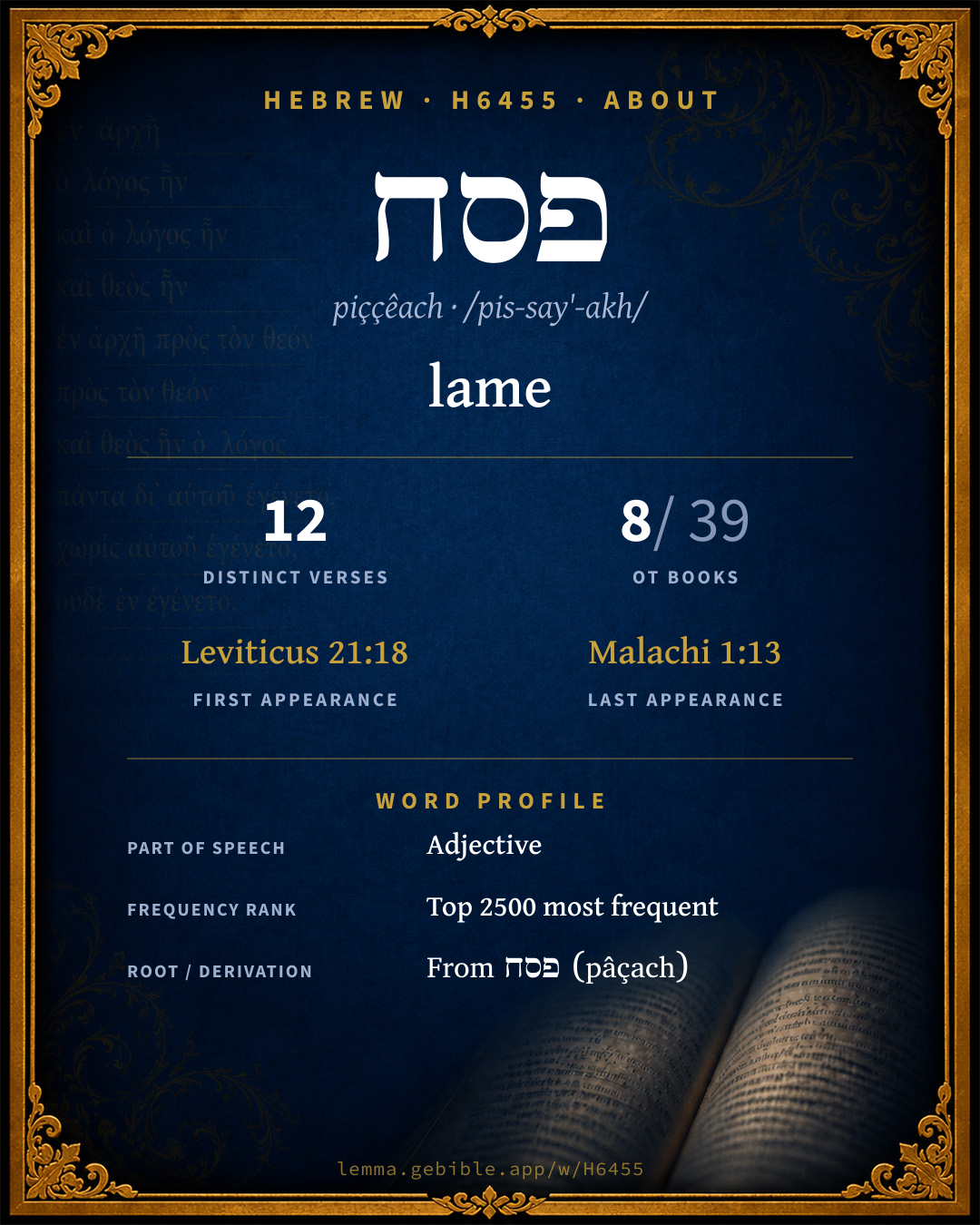
פִּסֵּחַ
lame
Full lexicon entry — Brown-Driver-Briggs (BDB)
From Brown-Driver-Briggs (BDB)
Where this word appears
Grammar key — what these labels mean
Part of speech
- Adjective
- A word that describes or qualifies a noun.
State
- Absolute
- The independent form of a noun, not bound to a following word.
Gender
- Masculine
- Grammatically masculine.
Number
- Singular
- One.
- Plural
- More than one (in Hebrew, generally three or more).
Grammatical forms
- Adjective, Adjective, Masculine, Singular, Absolute 11 times (85%)
- Adjective, Adjective, Masculine, Plural, Absolute 2 times (15%)
Parsed forms decoded from the imported morphology (morphhb / Westminster Leningrad Codex — WLC text public domain, morphhb tagging CC BY 4.0), counted across 13 parsed occurrences — not distinct verses.
Every verse where H6455 appears — 12 distinct verses across 8 books. Click any verse to open its interlinear word-by-word view. Verse text shown in the World English Bible for context — . Each verse’s Hebrew form is shown with its reference; the English is not keyword-highlighted, since the data carries no word-level English alignment. Use “Compare translations” on any verse to read it across multiple English versions. This concordance covers the Hebrew Bible; Septuagint (Greek Old Testament) occurrences are not indexed here.
Leviticus 1 verse
Deuteronomy 1 verse
2 Samuel 3 verses
- 2 Samuel 5:8 הַ/פִּסְחִים֙ וּ/פִסֵּ֔חַ ptcl def.art + Adjective Adjective mp conj + Adjective Adjective ms David said on that day, Whoever strikes the Jebusites, let him get up to the watercourse, and [strike] the lame and the blind, who are hated of David's soul. Therefore they say, There are the blind and the lame; he can't come into the house.
- 2 Samuel 9:13 פִסֵּ֖חַ adj Adjective ms So Mephibosheth lived in Jerusalem; for he ate continually at the king's table. He was lame in both his feet.
- 2 Samuel 19:26 פִסֵּ֖חַ adj Adjective ms He answered, My lord, O king, my servant deceived me: for your servant said, I will saddle me a donkey, that I may ride thereon, and go with the king; because your servant is lame.
Job 1 verse
Proverbs 1 verse
Isaiah 2 verses
- Isaiah 33:23 פִּסְחִ֖ים adj Adjective mp Your rigging is untied; they could not strengthen the foot of their mast, they could not spread the sail: then was the prey of a great spoil divided; the lame took the prey.
- Isaiah 35:6 פִּסֵּ֔חַ adj Adjective ms Then shall the lame man leap as a hart, and the tongue of the mute shall sing; for in the wilderness shall waters break out, and streams in the desert.
Jeremiah 1 verse
Malachi 2 verses
- Malachi 1:8 פִּסֵּ֥חַ adj Adjective ms When you offer the blind for sacrifice, isn't that evil? And when you offer the lame and sick, isn't that evil? Present it now to your governor! Will he be pleased with you? Or will he accept your person?" says Yahweh of Hosts.
- Malachi 1:13 הַ/פִּסֵּ֨חַ֙ ptcl def.art + Adjective Adjective ms You say also, 'Behold, what a weariness it is!' and you have sniffed at it," says Yahweh of Hosts; "and you have brought that which was taken by violence, the lame, and the sick; thus you bring the offering. Should I accept this at your hand?" says Yahweh.
About this entry
At a glance — auto-summarized from this page’s data, not written by a person. Every figure links to its source below. This summary describes the numbers; it doesn’t interpret them.
“lame” is the headline sense of the Hebrew adjective פסח (piççêach). Scripture first uses it in Leviticus 21:18. It appears 12 verses across 8 books of the Hebrew Bible, among its uncommon vocabulary. More than a quarter of its appearances fall in 2 Samuel. It shares a root with פסח, פסח and פסח. The sections below give every sense, occurrence, and version rendering.
Gloss history
Strong's 1890 vs modern scholarship
About this word
Strong's H6455 catalogs a Hebrew word from the Hebrew Old Testament.
These counts are not copied from any lexicon or concordance. They are computed here, from the morphology-tagged Hebrew Old Testament. What Lemma adds →
- 12
- distinct verses
- The word appears in 12 distinct verses.
- 8 / 39
- OT books
- The word appears in 8 of 39 Old Testament books.
- #2,001
- by frequency
- Top 2500 most frequent Hebrew words (rank 2,001 of 8,640 Hebrew words by occurrence).
View all 12 occurrences in the concordance →
By section of the Old Testament
By traditional corpus
Conventional, traditional groupings — biblical authorship is debated, so this is a traditional corpus grouping, not an authorship claim. Each share is this word’s portion of its verses in that division of the Hebrew canon. Each figure is a share of the word’s 12 distinct verses.
- Prophets (Nevi'im) 8 verses · 67%
- Torah (Pentateuch) 2 verses · 17%
- Writings (Ketuvim) 2 verses · 17%
How translations render this word
Counts come from each version’s own published word-to-Strong’s tagging or interlinear alignment — an approximate guide to how each version renders this word, not a word-level alignment the data otherwise carries. Because each total is that version’s own tagged count, the per-version totals vary from one another and need not match the appearance or distinct-verse counts above. These counts may also differ from a printed concordance because Lemma counts each distinctly tagged rendering and does not collapse phrase taggings into a single head-word total. This is a fixed set of word-tagged versions (KJV, ASV, BSB, ULT) and does not change with the reading translation you choose elsewhere. Each version’s license is shown beside its name below (and on Sources).
- King James Version: Lame 8×
- American Standard Version: Lame 7×
- Berean Standard Bible: Lame 10×
- unfoldingWord Literal Text: Lame 9×
King James Version Public Domain
Renders H6455 across 14 tagged occurrences — most commonly:
Plus 6 renderings that appear only once — usually multi-word phrases or single function words the recovered tagging swept in, not distinct renderings.
American Standard Version Public Domain
Renders H6455 across 14 tagged occurrences — most commonly:
Plus 7 renderings that appear only once — usually multi-word phrases or single function words the recovered tagging swept in, not distinct renderings.
Berean Standard Bible Public Domain
Renders H6455 across 14 tagged occurrences — most commonly:
Plus 4 renderings that appear only once — usually multi-word phrases or single function words the recovered tagging swept in, not distinct renderings.
unfoldingWord Literal Text CC BY-SA 4.0
Renders H6455 across 12 tagged occurrences — most commonly:
Plus 3 renderings that appear only once — usually multi-word phrases or single function words the recovered tagging swept in, not distinct renderings.
Senses in BDB
The 1 sense BDB distinguishes for this word, in lexicon order (not ranked by frequency or importance). The full entry — with sub-senses — is in the Lexicon Entry tab.
- lame
Word origin
adj. lame;—abs. פ׳ 2 S 9:13 +; pl. פִּסְחִים 5:6 +;—as attrib. Lv 21:18 (+ עִוֵּר); pred. 2 S 19:27, פ׳ שְׁתֵּי רַגְלָיו 9:13 lame as to both his feet; cf. also (of animal) Dt 15:21 (+ עִוֵּר); as subst. 2 S 5:6, 8;(×2) Je 31:8; Mal 1:8, 13; Jb 29:15 (all + עִוֵּר), also Is 33:23; 35:6; Pr 26:7.
— Brown-Driver-Briggs (Oxford 1906, public domain), digitized via Sefaria, supplemented by the OpenScriptures HebrewLexicon (CC BY 4.0). See Sources.
Derived from פסח (pâçach) (H6452) — to skip.
Jastrow Dictionary
A second Hebrew/Aramaic lexicon for comparison, covering Aramaic and post-biblical (Talmudic, Targumic, Midrashic) usage that the biblical-Hebrew BDB does not. Matched by lemma rather than by Strong’s number, so a lemma may carry more than one Jastrow headword (shown separately below), and the entries cover usage well beyond the Bible.
פָּסַח
- (b. h.) to leap over; to spare. Ex. R. s. 15 שאני פוֹסֵחַ עליכם ומגין וכ׳ I (the Lord) will pass over and protect you. Pes. X, 5 פֶּסַח על שום שפ׳ המקום וכ׳ the Passover lamb is symbolical of the fact that the Lord passed over the houses &c.
- (denom. of פִּסֵּחַ) to become lame. Y. Ber. I, 3ᶜ bot. ונ׳ ונתרפא and became lame, but was cured; Gen. R. s. 39; a. e.
פסח
- , Targ. Is. XXXIII, 12 מפסחין, v. פְּסַךְ
פִּסֵּחַ
- preced. art.) limping, lame. Sifra Emor ch. II, Par. 3 פ׳ בין חגר וכ׳ ‘lame’ (Lev. XXI, 18), whether lame on both feet or on one. Sifré Deut. 126; a. e.—Pl. פִּסְּחִים, פִּי׳. Pirké d’R. El. ch. XXXVI (ref. to II Sam. V, 6) העורים והפ׳ אלו הצלמים ‘the blind and the lame’ means the idols; Yalk. Gen. 82 (with ref. to Ps. CXV, 5-7). e.g. Leviticus 21:18
פֶּסַח
- preced. wds.) Passover festival; (sub. זבח) Passover sacrifice, Passover meal. Pes. V, 1 (58ᵃ) חל ערב פ׳ וכ׳ (Mish. ed. ערבי פסחים; Y. ed. ערב פסחים) if the eve of Passover occurred on a Friday. Ib. 2 הפ׳ ששחטו וכ׳ if they slaughtered a Passover lamb not as such. Ib. IX, 9 חבורה שאבדה פִסְחָהּ a party that lost its dedicated Passover lamb. Ib. 5, a. fr. פ׳ מצרים, פ׳ דורות, v. דּוֹר. Ib. 3, a. fr. פ׳ ראשון the first Passover, i.e. that celebrated on the fifteenth of Nisan; פ׳ שני the second (vicarious) Passover, on the eve of the fifteenth of Iyar (Num. IX, 10 sq.); a. v. fr.—Pl. פְּסָחִים. Ib. 10 שתי … שנתערבו פִּסְחֵיהֶן two parties whose Passover sacrifices were mixed up. Ib. X, 6 ונאכל שם … ומן הפ׳ וכ׳ that there we may partake of the offerings and the Passover sacrifices &c.; a. fr.—ערבי (ערב) פ׳, v. supra. Ib. 1; a. fr.—P’saḥim, name of a treatise, of the Order of Moëd, of the Mishnah, Tosefta, Talmud Babli and Y’rushalmi. e.g. Numbers 9:10
A Dictionary of the Targumim, the Talmud Babli and Yerushalmi, and the Midrashic Literature (Marcus Jastrow; London, Luzac, 1903) — Public Domain. Digitized via Sefaria. Digitized via Sefaria. Full attribution on Sources.
Forms in the corpus
The 11 distinct written forms H6455 takes in the Hebrew Bible, most frequent first — each parse links to that state’s occurrences in the concordance. Hebrew forms include their vowel points and cantillation, so a single lemma takes many written forms.
| Form | Parsing | Example | Uses |
|---|---|---|---|
| וּ/פִסֵּ֔חַ | Adjective, Adjective, Masculine, Singular, Absolute | 2 Samuel 5:8 | 2 |
| פִסֵּ֖חַ | Adjective, Adjective, Masculine, Singular, Absolute | 2 Samuel 9:13 | 2 |
| הַ/פִּסְחִים֙ | Adjective, Adjective, Masculine, Plural, Absolute | 2 Samuel 5:8 | 1 |
| הַ/פִּסֵּ֨חַ֙ | Adjective, Adjective, Masculine, Singular, Absolute | Malachi 1:13 | 1 |
| לַ/פִּסֵּ֣חַ | Adjective, Adjective, Masculine, Singular, Absolute | Job 29:15 | 1 |
| מִ/פִּסֵּ֑חַ | Adjective, Adjective, Masculine, Singular, Absolute | Proverbs 26:7 | 1 |
| פִסֵּ֔חַ | Adjective, Adjective, Masculine, Singular, Absolute | Leviticus 21:18 | 1 |
| פִּסְחִ֖ים | Adjective, Adjective, Masculine, Plural, Absolute | Isaiah 33:23 | 1 |
| פִּסֵּ֔חַ | Adjective, Adjective, Masculine, Singular, Absolute | Isaiah 35:6 | 1 |
| פִּסֵּ֥חַ | Adjective, Adjective, Masculine, Singular, Absolute | Malachi 1:8 | 1 |
| פִּסֵּ֨חַ֙ | Adjective, Adjective, Masculine, Singular, Absolute | Deuteronomy 15:21 | 1 |
Same root — word family
Other BDB entries built from the same root as H6455, grouped by Strong’s listed origin. These share a root / origin per the lexicon — not necessarily a shared meaning. Each links to that word’s own entry.
Derives from
Proper names from this root
People and places named from this root — a name, not an additional meaning of the word.
Compare all same-root words → Showing 4 of 5 — not the complete family. 3 of the same-root words are proper names (people or places). They share a root, not necessarily a meaning.
Septuagint verse parallels
This word appears in 12 verses that also exist in the Greek Old Testament (Septuagint), out of the 12 Hebrew verses it occurs in. You can read those verses in Greek by switching the Old Testament edition to the Septuagint.
Read these verses in the Septuagint
- Leviticus 21:18
- Deuteronomy 15:21
- 2 Samuel 5:8
- Job 29:15
- Proverbs 26:7
- Isaiah 33:23
- Jeremiah 31:8
- Malachi 1:8
This is a verse-level parallel only — the same verses exist in both the Hebrew and Greek Old Testaments. No word-level Hebrew↔Greek correspondence is claimed: the data carries no such alignment, so no Greek word is shown as this Hebrew word’s translation. Coverage is not total — the Septuagint omits the deuterocanon and renumbers the Psalms, so some Hebrew verses have no direct Greek parallel.