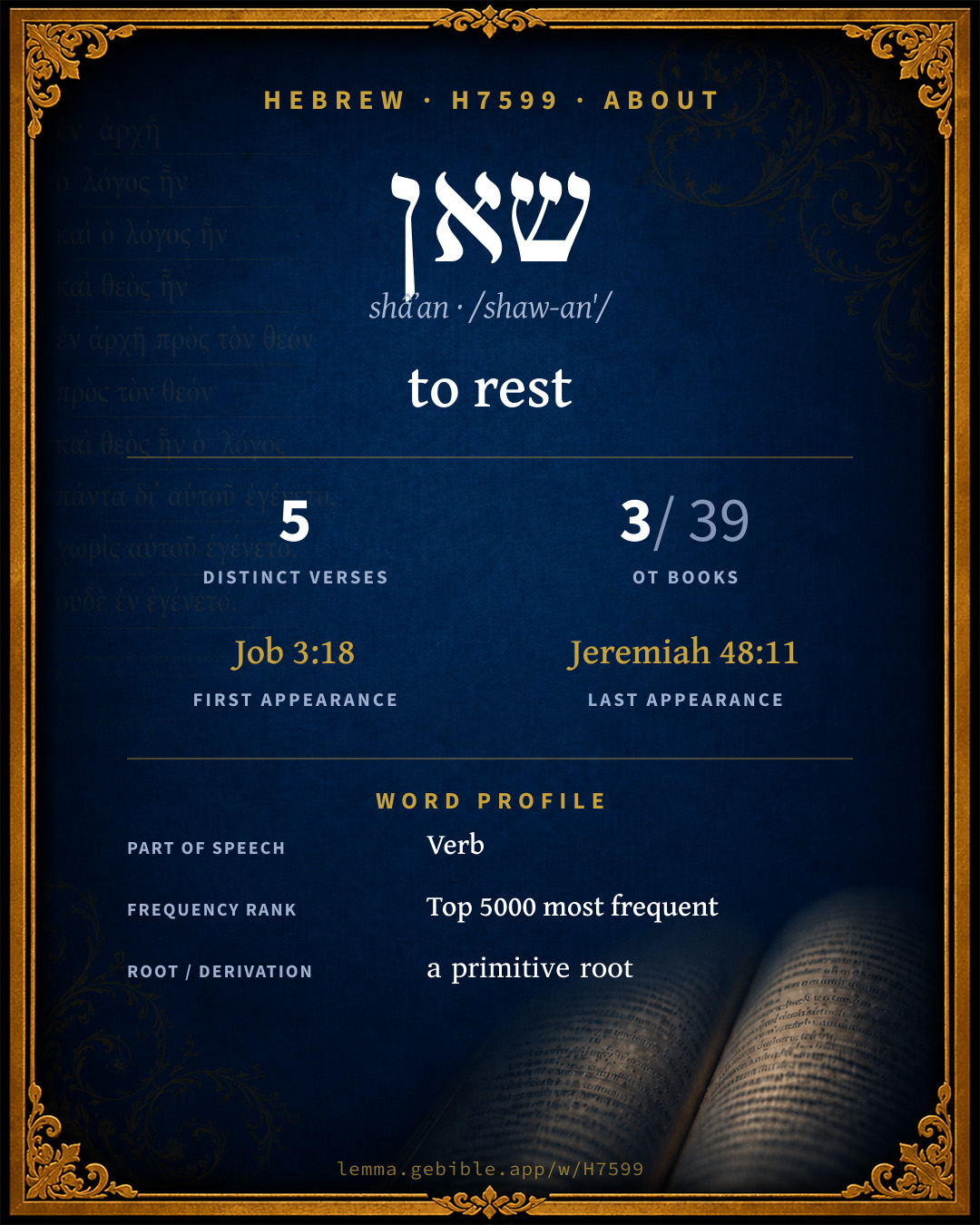
שָׁאַן
to rest
Full lexicon entry — Brown-Driver-Briggs (BDB)
From Brown-Driver-Briggs (BDB)
Where this word appears
Grammar key — what these labels mean
Part of speech
- Verb
- An action or state-of-being word.
Form
- Sequential Perfect
- A perfect with prefixed waw continuing a preceding imperfect or command (waw-consecutive perfect).
- Perfect
- A completed action or state — Hebrew marks aspect (completeness) more than strict tense (“he wrote”).
Person
- 3rd Person
- The one spoken about (“he / she / it / they”).
Gender
- Masculine
- Grammatically masculine.
- Common
- Either gender — not distinguished for this form.
Number
- Singular
- One.
- Plural
- More than one (in Hebrew, generally three or more).
Grammatical forms
- Verb, Palel, Sequential Perfect, 3rd Person, Masculine, Singular 2 times (40%)
- Verb, Palel, Perfect, 3rd Person, Masculine, Singular 2 times (40%)
- Verb, Palel, Perfect, 3rd Person, Common, Plural 1 time (20%)
Parsed forms decoded from the imported morphology (morphhb / Westminster Leningrad Codex — WLC text public domain, morphhb tagging CC BY 4.0), counted across 5 parsed occurrences — not distinct verses.
Every verse where H7599 appears — 5 distinct verses across 3 books. Click any verse to open its interlinear word-by-word view. Verse text shown in the World English Bible for context — . Each verse’s Hebrew form is shown with its reference; the English is not keyword-highlighted, since the data carries no word-level English alignment. Use “Compare translations” on any verse to read it across multiple English versions. This concordance covers the Hebrew Bible; Septuagint (Greek Old Testament) occurrences are not indexed here.
Job 1 verse
Proverbs 1 verse
Jeremiah 3 verses
- Jeremiah 30:10 וְ/שַׁאֲנַ֖ן conj + Palel wpf 3ms Therefore don't you be afraid, O Jacob my servant, says Yahweh; neither be dismayed, Israel: for, behold, I will save you from afar, and your seed from the land of their captivity; and Jacob shall return, and shall be quiet and at ease, and none shall make him afraid.
- Jeremiah 46:27 וְ/שַׁאֲנַ֖ן conj + Palel pf 3ms But don't be afraid you, Jacob my servant, neither be dismayed, Israel: for, behold, I will save you from afar, and your seed from the land of their captivity; and Jacob shall return, and shall be quiet and at ease, and none shall make him afraid.
- Jeremiah 48:11 שַׁאֲנַ֨ן Palel pf 3ms Moab has been at ease from his youth, and he has settled on his lees, and has not been emptied from vessel to vessel, neither has he gone into captivity: therefore his taste remains in him, and his scent is not changed.
About this entry
At a glance — auto-summarized from this page’s data, not written by a person. Every figure links to its source below. This summary describes the numbers; it doesn’t interpret them.
שאן (shâʼan) is a Hebrew verb most often rendered “to rest.” A scarce word — 5 verses in all of the Hebrew Bible. Jeremiah dominates its distribution — 3 of 5 verses. It first appears in Job 3:18. Sharing its root, it stands alongside שאנן. The sections below give every sense, occurrence, and version rendering.
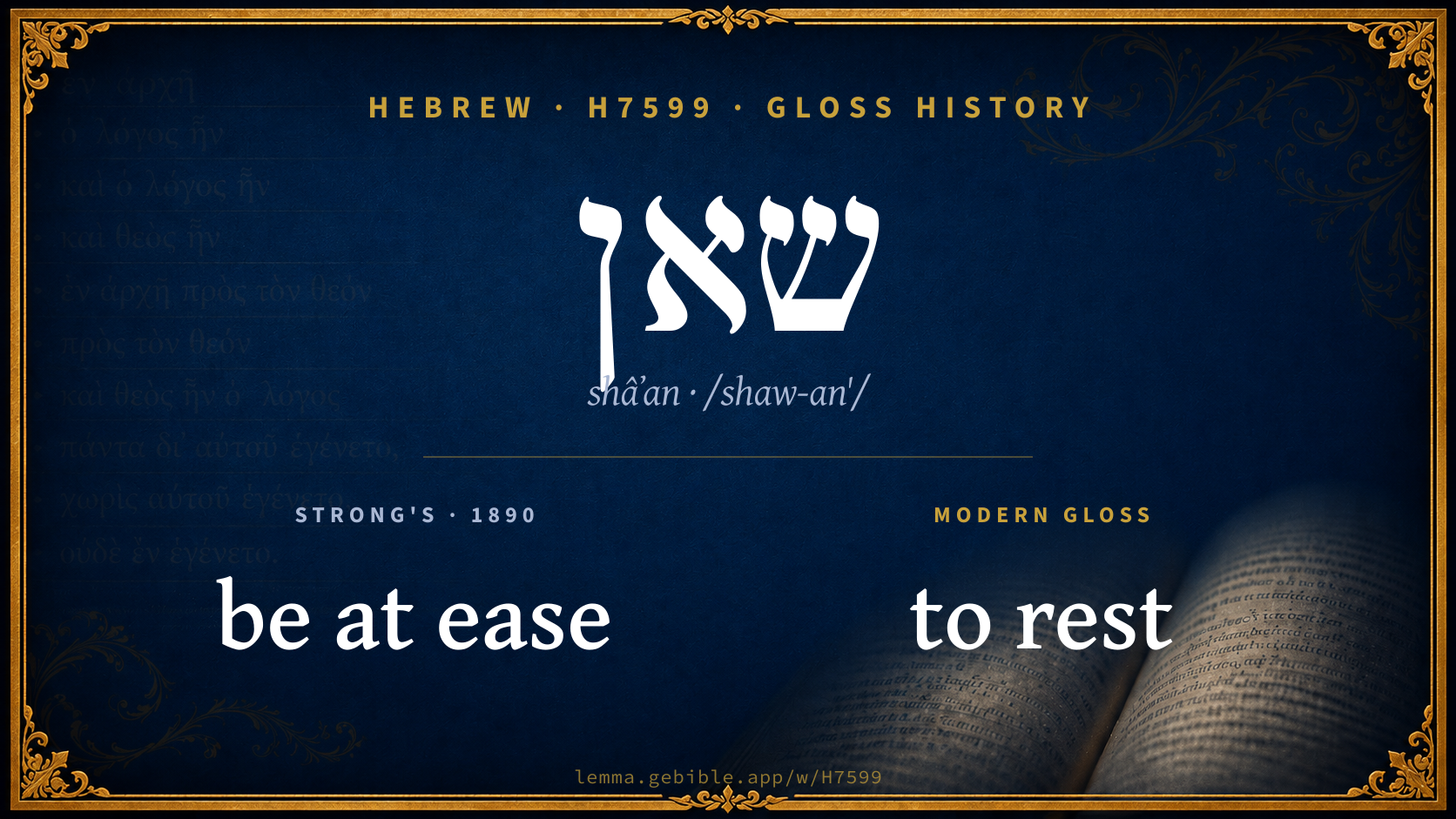
Gloss history
Strong's 1890 vs modern scholarship
About this word
Strong's H7599 catalogs a Hebrew word from the Hebrew Old Testament.
These counts are not copied from any lexicon or concordance. They are computed here, from the morphology-tagged Hebrew Old Testament. What Lemma adds →
- 5
- distinct verses
- The word appears in 5 distinct verses.
- 3 / 39
- OT books
- The word appears in 3 of 39 Old Testament books.
- #3,337
- by frequency
- Top 5000 most frequent Hebrew words (rank 3,337 of 8,640 Hebrew words by occurrence).
View all 5 occurrences in the concordance →
By section of the Old Testament
By traditional corpus
Conventional, traditional groupings — biblical authorship is debated, so this is a traditional corpus grouping, not an authorship claim. Each share is this word’s portion of its verses in that division of the Hebrew canon. Each figure is a share of the word’s 5 distinct verses.
- Prophets (Nevi'im) 3 verses · 60%
- Writings (Ketuvim) 2 verses · 40%
How translations render this word
Counts come from each version’s own published word-to-Strong’s tagging or interlinear alignment — an approximate guide to how each version renders this word, not a word-level alignment the data otherwise carries. Because each total is that version’s own tagged count, the per-version totals vary from one another and need not match the appearance or distinct-verse counts above. These counts may also differ from a printed concordance because Lemma counts each distinctly tagged rendering and does not collapse phrase taggings into a single head-word total. This is a fixed set of word-tagged versions (KJV, ASV, BSB, ULT) and does not change with the reading translation you choose elsewhere. Each version’s license is shown beside its name below (and on Sources).
- King James Version: Be quiet 1×, Ease 1×, Hath been at ease 1×
- American Standard Version: Ease 2×
- Berean Standard Bible: Ease 3×
- unfoldingWord Literal Text: Relax 1×, Will be at ease 1×
King James Version Public Domain
Renders H7599 across 5 tagged occurrences — most commonly:
American Standard Version Public Domain
Renders H7599 across 5 tagged occurrences — most commonly:
Plus 3 renderings that appear only once — usually multi-word phrases or single function words the recovered tagging swept in, not distinct renderings.
Berean Standard Bible Public Domain
Renders H7599 across 5 tagged occurrences — most commonly:
Plus 2 renderings that appear only once — usually multi-word phrases or single function words the recovered tagging swept in, not distinct renderings.
unfoldingWord Literal Text CC BY-SA 4.0
Renders H7599 across 2 tagged occurrences — most commonly:
Senses in BDB
The 1 sense BDB distinguishes for this word, in lexicon order (not ranked by frequency or importance). The full entry — with sub-senses — is in the Lexicon Entry tab.
- (Pilel) to be at ease, be at peace, rest, rest securely, be quiet
Word origin
vb. Paʿl. (Ges§ 55d) be at ease or at peace, rest securely (Syriac ܫܰܝܶܢ pacify, ܫܰܝܢܳܐ, Ethiopic ስንእ; peace);—Pf. 3 ms. שַׁאֲנַן Je 48:11, וְשׁ׳ consec. 30:10 +; 3 pl. שַׁאֲנָ֑נוּ Jb 3:18;—be at ease, secure, undisturbed by ill fortune: וְשָׁקַט וְשׁ׳ וְאֵין מַחֲרִיד Je 30:10 = 46:27; 48:11 (of Moab); שׁ׳ מִפַּחַד רָעָה Pr 1:33; of rest from trouble, etc., in grave Jb 3:18.
— Brown-Driver-Briggs (Oxford 1906, public domain), digitized via Sefaria, supplemented by the OpenScriptures HebrewLexicon (CC BY 4.0). See Sources.
Origin: a primitive root
Jastrow Dictionary
A second Hebrew/Aramaic lexicon for comparison, covering Aramaic and post-biblical (Talmudic, Targumic, Midrashic) usage that the biblical-Hebrew BDB does not. Matched by lemma rather than by Strong’s number, so a lemma may carry more than one Jastrow headword (shown separately below), and the entries cover usage well beyond the Bible.
אִין II
- 1. if, whether. Targ. Ps. VII, 4; a. e. [Apocopated: אִי q. v.]—אין תימר (h. אם תאמר) if thou wilt say (argue). Y. Macc. II, 31ᵈ bot.; a. fr.—אין כיני (h. אם כן היא) if this is (be) the case. Y. Naz. VI, 54ᵈ bot.—Lam. R. introd. end אן את יתיב וכ׳ if thou remainest here, or &c. Koh. R. to X, 5 אן אתת ענתה וכ׳ if the (my dying) time comes first, what of it? and if &c.
- 2. adv. of interrogation, introducing the alternative, or. Targ. Job VI, 6; a. e.
אֶן
- if, v. אִין.
אָן
- (b. h.) where? לְאָן whither. Ab. III, 1.
אָן ²
- ; (interrog.) where? Targ. Gen. IV, 9; a. e.—Y. Yoma VIII, 44ᵈ bot. אן מן הדה (read … מן אן) wherefrom this? i.e. where is your authority? Y. Yeb. XII, 12ᵈ bot. ההן סבא לְאָן ליך of what use is this old man to thee?; a. e.—(relat.) where, wherever. Lev. R. s. 27 beg. א׳ את יהיב וכ׳ (Yalk. Ps. 727 הן) wherever thou givest, thou givest abundantly.
שאן
- , Targ. I Sam. XIX, 24 Ar., v. בִּרְשָׁן
שְׁאָן
- (b. h.) pr. n. pl. Bethshean (Scythopolis), in Galilee. Ḥull. 6ᵇ והתיר רבי את ב׳ ש׳ כולה Rabbi permitted the entire territory of Bethshean (permitted its fruits to be eaten without tithes, it being considered foreign territory). Y. Kidd. II, 62ᶜ bot. כלי פשתן … מב׳ ש׳ the finer linen garments that come from B.; Y. Keth. VII, 31ᶜ בית שָׁן; Koh. R. to I, 18. Gen. R. s. 98 תהום ב׳ ש׳ וכ׳ the district of B. is named Kinnereth; a. fr.—V. בֵּישַׁן.
A Dictionary of the Targumim, the Talmud Babli and Yerushalmi, and the Midrashic Literature (Marcus Jastrow; London, Luzac, 1903) — Public Domain. Digitized via Sefaria. Digitized via Sefaria. Full attribution on Sources.
Forms in the corpus
The 4 distinct written forms H7599 takes in the Hebrew Bible, most frequent first — each parse links to that stem’s occurrences in the concordance. Hebrew forms include their vowel points and cantillation, so a single lemma takes many written forms.
| Form | Parsing | Example | Uses |
|---|---|---|---|
| וְ/שַׁאֲנַ֖ן | Verb, Palel, Perfect, 3rd Person, Masculine, Singular | Jeremiah 46:27 | 2 |
| וְ֝/שַׁאֲנַ֗ן | Verb, Palel, Sequential Perfect, 3rd Person, Masculine, Singular | Proverbs 1:33 | 1 |
| שַׁאֲנַ֨ן | Verb, Palel, Perfect, 3rd Person, Masculine, Singular | Jeremiah 48:11 | 1 |
| שַׁאֲנָ֑נוּ | Verb, Palel, Perfect, 3rd Person, Common, Plural | Job 3:18 | 1 |
Same root — word family
Other BDB entries built from the same root as H7599, grouped by Strong’s listed origin. These share a root / origin per the lexicon — not necessarily a shared meaning. Each links to that word’s own entry.
Derived from this word
Compare all same-root words → They share a root, not necessarily a meaning.
Septuagint verse parallels
This word appears in 4 verses that also exist in the Greek Old Testament (Septuagint), out of the 5 Hebrew verses it occurs in. You can read those verses in Greek by switching the Old Testament edition to the Septuagint.
Read these verses in the Septuagint
This is a verse-level parallel only — the same verses exist in both the Hebrew and Greek Old Testaments. No word-level Hebrew↔Greek correspondence is claimed: the data carries no such alignment, so no Greek word is shown as this Hebrew word’s translation. Coverage is not total — the Septuagint omits the deuterocanon and renumbers the Psalms, so some Hebrew verses have no direct Greek parallel.