Exodus 39:28

Hebrew (Westminster Leningrad Codex) Exodus 39:28 appears in the Hebrew Old Testament. The text above is from the Westminster Leningrad Codex. Each word links to its Strong’s number, a concise gloss, and parsing drawn from the Open Scriptures Hebrew Bible morphology. Click any word for its full Brown-Driver-Briggs (BDB) entry.
Download image
Cite this verse

Exodus 39:28 (World English Bible). Public Domain. Lemma interlinear Bible study tool, https://lemma.gebible.app/v/exodus/39/28.

Show BibTeX & RIS
BibTeX
RIS
English Translation
and the turban of fine linen, and the linen headbands of fine linen, and the linen breeches of fine twined linen,
World English Bible · Public Domain
Highlights
  • 1 first appearance in the Hebrew Bible
Full analysis ↓
Download a study sheet

One document with this verse’s original text, its word-by-word gloss line, the meaning frame, cross-references with their text, attributed commentary, and full source and license credits — printable, and it pastes into notes with its structure intact.

This verse Autodidact and up

Study sheet (.html) Plain text (.txt)

A passage Seminary Student

Up to 50 verses in one chapter. A passage sheet keeps up to 6 commentary sources and 12 cross-references per verse, in the order this page ranks them, and says so on the sheet whenever that leaves anything out. Ask for a single verse and you get the Autodidact verse sheet above.

Everything on this page stays free to read, with no account — the sheet is a download of what is already on screen, not access to it.

Want to remove ads? Support Godless Engineer
Compare translations 3

The same verse in 3 English versions, stacked beneath the original-language interlinear above. Click any original word for its lexicon entry.

Each is an independent rendering of the whole verse — the interlinear is not word-aligned to these translations.

Highlighted words mark where these versions differ — a whole-verse word diff, not a word-by-word alignment.

  • World English Bible Public Domain
    and the turban of fine linen, and the linen headbands of fine linen, and the linen breeches of fine twined linen,
  • King James Version Public Domain
    And a mitre of fine linen, and goodly bonnets of fine linen, and linen breeches of fine twined linen,
  • unfoldingWord Literal Text CC BY-SA 4.0
    and the fine linen turban and the fine linen ornate headbands and the linen undergarments of fine twisted linen

unfoldingWord Literal Text — © unfoldingWord, licensed CC BY-SA 4.0. Word-aligned USFM3 via Door43 (git.door43.org/unfoldingWord/en_ult).

Versions to compare (up to 4)

3 of 4 selected

Show all 18 translations

Every available English version of this verse, each an independent rendering of the whole verse.

  • World English Bible Public Domain
    and the turban of fine linen, and the linen headbands of fine linen, and the linen breeches of fine twined linen,
  • Berean Standard Bible Public Domain
    as well as the turban of fine linen, the ornate headbands and undergarments of finely spun linen,
  • Majority Standard Bible Public Domain
    as well as the turban of fine linen, the ornate headbands and undergarments of finely spun linen,
  • King James Version Public Domain
    And a mitre of fine linen, and goodly bonnets of fine linen, and linen breeches of fine twined linen,
  • American Standard Version (1901) Public Domain
    and the mitre of fine linen, and the goodly head-tires of fine linen, and the linen breeches of fine twined linen,
  • Revised Version (1885) Public Domain
    and the mitre of fine linen, and the goodly headtires of fine linen, and the linen breeches of fine twined linen,
  • Geneva Bible (1599) Public Domain
    And the miter of fine linen, and goodly bonnets of fine linen, and linen breeches of fine twined linen,
  • Douay-Rheims (1899) Public Domain
    And a girdle of fine twisted linen, violet, purple, and scarlet twice dyed, of embroidery work, as the Lord had commanded Moses.
  • Young's Literal Translation Public Domain
    and the mitre of linen, and the beautiful bonnets of linen, and the linen trousers, of twined linen,
  • Literal Standard Version CC BY-SA 4.0
    and the turban of linen, and the beautiful caps of linen, and the linen trousers, of twined linen,
  • Unlocked Literal Bible CC BY-SA 4.0
    They made the turban of fine linen, the ornate headbands of fine linen, the linen undergarments of fine linen,
  • unfoldingWord Literal Text CC BY-SA 4.0
    and the fine linen turban and the fine linen ornate headbands and the linen undergarments of fine twisted linen
  • Darby Bible Public Domain
    and the turban of byssus; and the ornamental caps, of byssus; and the linen trousers, of twined byssus;
  • World Messianic Bible Public Domain
    the turban of fine linen, the linen headbands of fine linen, the linen trousers of fine twined linen,
  • Webster's Bible Public Domain
    And a miter of fine linen, and goodly bonnets of fine linen, and linen breeches of fine twined linen,
  • Free Bible Version CC BY-SA 4.0
    They also made turbans, headdresses, and headbands of fine linen, and finely-woven linen undershorts,
  • Bible in Basic English Public Domain
    And the twisted head-dress for Aaron, and beautiful head-dresses of linen, and linen trousers,
  • JPS Tanakh (1917) Public Domain
    and the mitre of fine linen, and the goodly head-tires of fine linen, and the linen breeches of fine twined linen,

Literal Standard Version (2020), Covenant Press — licensed CC BY-SA 4.0. Text via the HelloAO Bible API (eBible.org). Unlocked Literal Bible (unfoldingWord) — licensed CC BY-SA 4.0. Text via the HelloAO Bible API (eBible.org). unfoldingWord Literal Text — © unfoldingWord, licensed CC BY-SA 4.0. Word-aligned USFM3 via Door43 (git.door43.org/unfoldingWord/en_ult). Free Bible Version, Dr. Jonathan Gallagher — licensed CC BY-SA 4.0. Text via the HelloAO Bible API (eBible.org).

Word by word

More ways to search: Search by grammar → Find every occurrence → Compare this word →

Practice this passage: Drill this verse → Learn its vocabulary →

הַמִּגְבָּעֹ֖ת
migbâʻâh
H4021
“the · turbans”
Particle, Definite Article + Noun, Common, Feminine, Plural, Absolute
Part of Speech
Particle + Noun
Type
Common
Gender
Feminine
Number
Plural
State
Absolute
Full BDB Definition

Origin: from the same as H1389

TWOT: 309c

turban, head-gear
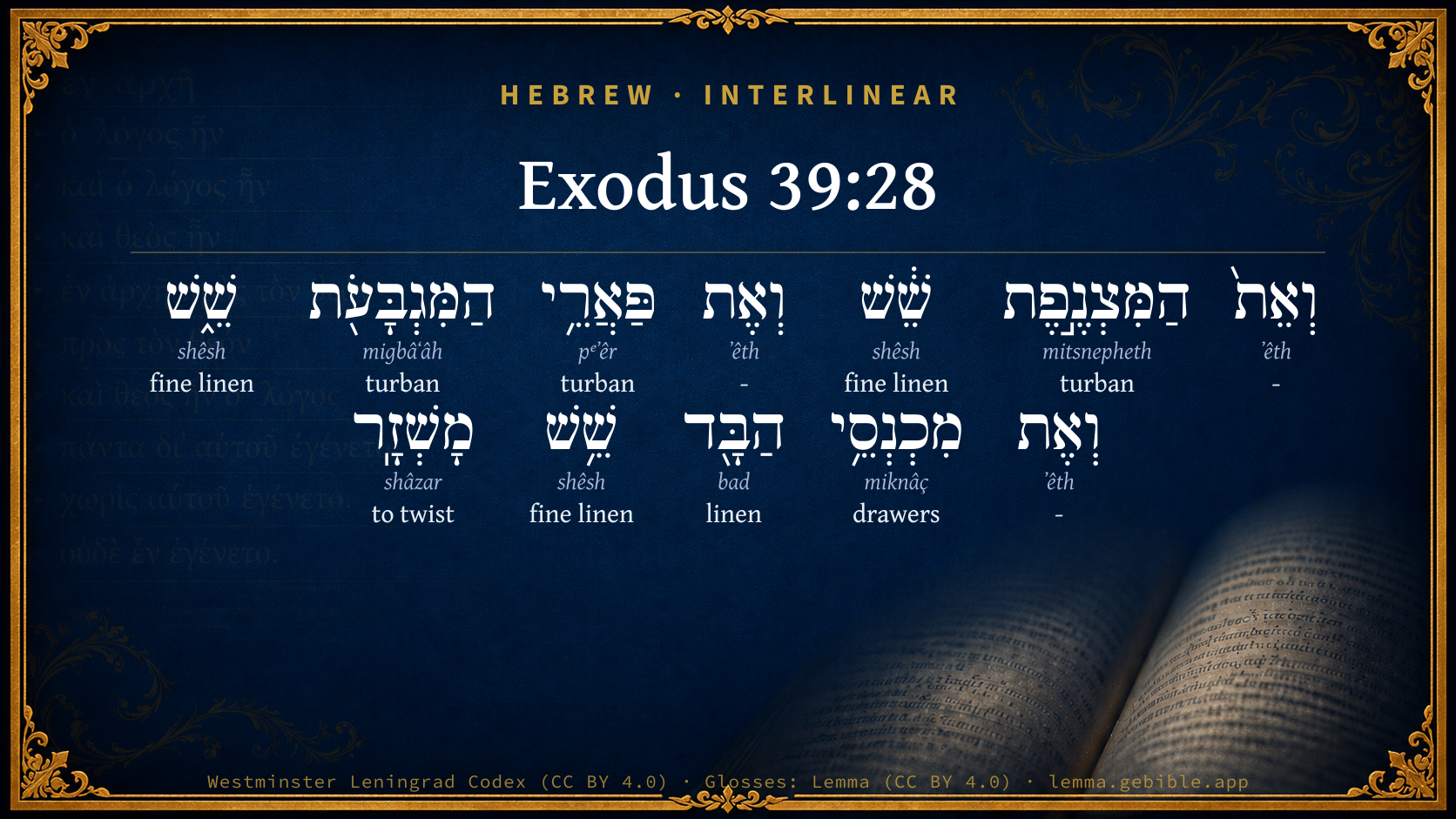
  1. וְאֵת֙ ʼêth H853 “and · -” Conjunction + Particle, Direct Object
  2. הַמִּצְנֶ֣פֶת mitsnepheth H4701 “the · turban” Particle, Definite Article + Noun, Common, Feminine, Singular, Absolute
  3. שֵׁ֔שׁ shêsh H8336 “fine linen” Adjective, Cardinal number, Feminine, Singular, Absolute
  4. וְאֶת ʼêth H853 “and · -” Conjunction + Particle, Direct Object
  5. פַּאֲרֵ֥י pᵉʼêr H6287 “turbans of” Noun, Common, Masculine, Plural, Construct
  6. שֵׁ֑שׁ shêsh H8336 “fine linen” Adjective, Cardinal number, Feminine, Singular, Absolute
  7. וְאֶת ʼêth H853 “and · -” Conjunction + Particle, Direct Object
  8. מִכְנְסֵ֥י miknâç H4370 “drawers of” Noun, Common, Masculine, Plural, Construct
  9. הַבָּ֖ד bad H906 “the · linen” Particle, Definite Article + Noun, Common, Masculine, Singular, Absolute
  10. שֵׁ֥שׁ shêsh H8336 “fine linen” Adjective, Cardinal number, Feminine, Singular, Absolute
  11. מָשְׁזָֽר shâzar H7806 “twisted” Verb, Hophal, Participle Passive, Masculine, Singular, Absolute

About this verse

These counts appear in no published source. They are computed here, from the morphology-tagged text and Lemma’s own curated glosses. What Lemma adds →

12
words
8
distinct lemmas
Pentateuch
section

Notable vocabulary

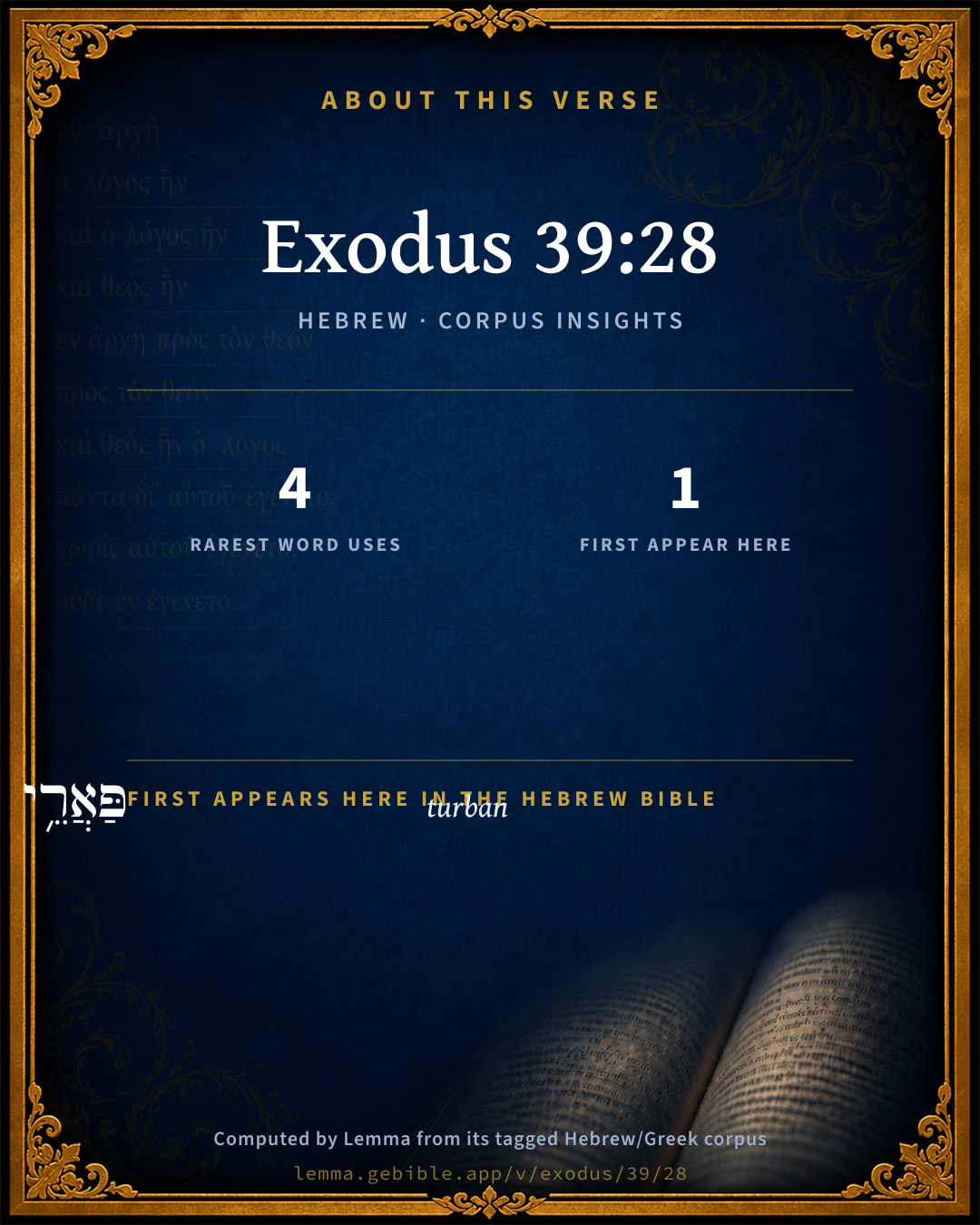
The rarest word here is הַמִּגְבָּעֹ֖ת turban H4021 — appearing just 4 times in the whole Hebrew Bible.

First appearance in Scripture

This word makes its first canonical appearance in the Hebrew Bible here:

  • פַּאֲרֵ֥י turban H6287

Shared distinctive vocabulary

הַמִּגְבָּעֹ֖ת turban H4021 occurs in 4 verses of the Hebrew Bible. Also found in:

Grammatical profile

  • 1 verb
  • 5 nouns
  • 3 adjectives
  • 3 particles

Verb forms

  • מָשְׁזָֽר Hophal · Participle Passive

Repetition

A word recurs within this verse — often emphatic in Hebrew:

  • שֵׁ֔שׁ fine linen H8336 ×3

Cross-references

4

Topical passages linked to Exodus 39:28 in the Treasury of Scripture Knowledge — connected by theme and wording, ordered by reader-vote popularity; previews shown in the World English Bible.

  • Exodus 28:4 These are the garments which they shall make: a breastplate, and an ephod, and a robe, and a coat of checker work, a turban, and a sash: and they shall make holy garments for Aaron your brother, and his sons, that he may minister to me in the priest's office.
  • Exodus 28:39 You shall weave the coat in checker work of fine linen, and you shall make a turban of fine linen, and you shall make a sash, the work of the embroiderer.
  • Exodus 28:42 You shall make them linen breeches to cover the flesh of their nakedness; from the loins even to the thighs they shall reach:
  • Ezekiel 44:18 They shall have linen tires on their heads, and shall have linen breeches on their loins; they shall not gird themselves with [anything that causes] sweat.

Cross-references courtesy of OpenBible.info (CC BY 4.0).

Hebrew and Greek witnesses Masoretic Hebrew ↔ Greek Septuagint

The same verse in the two great witnesses to the Old Testament, shown verse-for-verse.

These are two independent witnesses, not word-aligned to each other, and the Septuagint is shown in lemma (dictionary) form.

Hebrew Exodus 39:28 Masoretic · Westminster Leningrad Codex

וְאֵת֙ הַמִּצְנֶ֣פֶת שֵׁ֔שׁ וְאֶת פַּאֲרֵ֥י הַמִּגְבָּעֹ֖ת שֵׁ֑שׁ וְאֶת מִכְנְסֵ֥י הַבָּ֖ד שֵׁ֥שׁ מָשְׁזָֽר

and the turban of fine linen, and the linen headbands of fine linen, and the linen breeches of fine twined linen,

World English Bible · Public Domain

Hebrew: Westminster Leningrad Codex (CC BY 4.0). Greek: Septuagint (public domain); English from a public-domain English Septuagint. How the Septuagint differs from the Hebrew →

Targum (Aramaic paraphrase)

2

The Targum is the ancient Jewish Aramaic paraphrase of the Hebrew Scriptures — an interpretive translation, not the Hebrew text itself. Onkelos (literal) and Pseudo-Jonathan (expansive) render the Torah, and Jonathan the Prophets. Coverage is partial: where no permissively-licensed English translation exists for a verse, only the Aramaic is shown. This is verse-level text, not a word-by-word alignment to the Hebrew.

  1. Targum Onkelos Torah (Genesis–Deuteronomy)
    וְיָת מִצְנֶפְתָּא דְבוּצָא וְיָת שְׁבַח כּוֹבָעַיָא דְבוּצָא וְיָת מִכְנְסֵי בוּצָא דְבוּץ שְׁזִיר:

    (no public-domain English translation for this verse)

    Targum Onkelos — Aramaic: “Onkelos Genesis” (public domain); “Onkelos Exodus” (public domain); “Onkelos Leviticus” (public domain); “Onkelos Numbers” (public domain); “Onkelos Deuteronomy” (public domain). English: “Sefaria Community Translation” (CC0 1.0 (public-domain dedication)); “J.W. Etheridge. The Targums of Onkelos and Jonathan Ben Uzziel on the Pentateuch. London: Longmans, Green, 1862” (public domain). Text via Sefaria.

  2. Targum Pseudo-Jonathan Torah (Genesis–Deuteronomy)
    וְיַת מִצְנַפְתָּא דְבוּצָא וְיַת בַּרְצִיץ כּוֹבְעַיָא דְבוּצָא וְיַת אַוַורְקִיסֵי בּוּצָא דְבוּץ שְׁזִיר

    (no public-domain English translation for this verse)

    Targum Pseudo-Jonathan — Aramaic: “Targum Jonathan on Genesis” (public domain); “Targum Jonathan on Exodus” (public domain); “Targum Jonathan on Leviticus” (public domain); “Targum Jonathan on Numbers” (public domain); “Targum Jonathan on Deuteronomy” (public domain). English: “The Targum of Jonathan ben Uzziel, trans. J. W. Etheridge, London, 1862” (public domain). Text via Sefaria.

Commentary

Notes on Exodus 39:28 from classic Christian and Jewish commentators (each source and its license shown beneath its notes). The classic Christian expositions comment on the surrounding passage and are grouped to its opening verse, so a note may address several verses; the Jewish commentaries on the Tanakh (Rashi and others) are per-verse, so they appear only where the commentator wrote on this verse.

Lemma curates 59 commentaries, every one of them public domain or Creative Commons licensed, each selected and text-cleaned for this edition rather than reprinted as found. About our sources →

Ellicott's Commentary for English Readers

(28) A mitre . . . and goodly bonnets.—The “mitre,” or rather “turban,” was for Aaron, the “goodly bonnets,” or rather “caps,” for his sons. (See the Notes on Exo_28:36-40.)

Linen breeches.—Rather, linen drawers. These were to be made both for Aaron and for his sons. (See Exo_28:42-43.)

A Bible Commentary for English Readers, edited by Charles John Ellicott (1878–1897) — public domain. Text from a community e-Sword module.

The Cambridge Bible for Schools and Colleges

gen. ed. J. J. S. Perowne

28. the mitre] the turban (for the high-priest); see on Exo_28:39.

the goodly headtires] the ornamental caps (for ‘caps,’ see on Exo_28:40); lit. the ornaments of (i.e. consisting in; G.-K. § 128m) caps. Pe’çr, ‘ornament,’ is however itself also specialized in the sense of ornamental cap: see Eze_24:17; Eze_44:18 (‘tires,’—of the priests, as here). The caps were for the ordinary priests.

breeches] loin-cloths or drawers; see on Exo_28:42-43.

The Cambridge Bible for Schools and Colleges (gen. ed. J. J. S. Perowne; Cambridge University Press, 1878–1918) — public domain. Text from a community e-Sword module.

The Pulpit Commentary

A mitre and goodly bonnets. The "mitre" for Aaron, (Exo_28:37-39) the "goodly bonnets," or rather "caps" for his sons (ib, 40). The linen breeches, or "drawers," were for both (i.b. 42, 43).

The Pulpit Commentary (1880–1919), ed. H.D.M. Spence-Jones & Joseph S. Exell — public domain. Text from a community e-Sword module.

Rashi

Rabbi Shlomo Yitzchaki (Rashi)

ואת פארי המגבעות means the beauty of the high caps — this is equivalent to: the beautiful high caps.

Rashi on the Tanakh — English translations: “The Judaica Press complete Tanach with Rashi, translated by A. J. Rosenberg” (CC BY 4.0); “Pentateuch with Rashi's commentary by M. Rosenbaum and A.M. Silbermann, 1929-1934” (public domain); “The Metsudah Tanach series, Lakewood, N.J” (CC BY 4.0); and “The Book of Joshua, Metsudah Publications, 1997” (CC BY 4.0). Text via Sefaria.

Ramban (Nachmanides)

Rabbi Moshe ben Nachman (Ramban / Nachmanides)

PA’AREI HAMIGBA’OTH.’ The term (the beautiful head-tires) means that these head-dresses rose upon the head like turbans, similar to the expressions, ‘hap’eirim’ (the head-tires) and the armlets; ‘pa’arei’ (tires of) linen they shall have upon their heads. Scripture explained with reference to the belt [in the following verse], that they made it of fine-twined linen, and blue-purple, and red-purple, and scarlet. This, however, was not explained at the command, except for that which it said briefly about the belt, that thou shalt make it the work of the weaver in colors, from which it is known that it was to be woven of these four kinds, as it said with reference to the screen, And thou shalt make a screen for the door of the Tent, of blue-purple, and red-purple, and scarlet, and fine-twined linen, the work of the weaver in colors. This belt referred to was also for both Aaron and his sons, in accordance with the opinion of the Sage who says, b). that the belt of the High Priest was made in the same way as that of the common priest. In the opinion, however, of the Sage who says that the High Priest’s belt was not the same as that of the common priest, [for that of the common priest was merely of plain linen, whilst the High Priest’s was of the above-mentioned four kinds — blue-purple, red-purple, scarlet, and twined linen], Scripture explained with reference to the belt of Aaron that it should be the work of the weaver in colors, but it was not even necessary to mention that the one for his sons should be made of linen, just as it said, And for Aaron’s sons thou shalt make tunics, and thou shalt make for them belts, and head-tires shalt thou make for them, Verse 40. [and it is self-understood] that all of them should be made of linen just like the tunics.

Ramban (Nachmanides) on the Tanakh — English translation: “Commentary on the Torah by Ramban (Nachmanides). Translated and annotated by Charles B. Chavel. New York, Shilo Pub. House, 1971-1976” (CC BY 4.0). Text via Sefaria.

Lesson kit

Teaching starters — assembled from the data on this page, not authored interpretation. Every prompt links to the verse data it draws on. Edit before teaching.

Exodus, in the Pentateuch, opens this verse with 12 words (8 distinct Hebrew lemmas). Its most distinctive word is migbâʻâh (“turban”). A historical commentator’s framing appears above. Read the whole chapter for the surrounding context.

Discussion questions

  1. What does “turban” (migbâʻâh) contribute to the verse as a whole?
  2. The word “turban” first appears here in Scripture. What is being introduced at this debut?
  3. Exodus 28:40 shares the word «turban» with this verse. How do the two illuminate each other?
  4. “fine linen” occurs 3× in this one verse. What is the effect of the repetition?
  5. These translations render this verse differently. What is at stake in choosing one wording over another?
  6. The verb «מָשְׁזָֽר» is Hophal Participle Passive. How does its form color the action?
  7. Reading how Ellicott's Commentary for English Readers and The Cambridge Bible for Schools and Colleges read this verse, where do the two commentators agree and where do they part?

Things to notice

  • 1 word makes its first canonical appearance in Scripture here.
  • These translations choose different wording for 10 words in this verse.
  • “fine linen” occurs 3× in this single verse.
  • 8 distinct Hebrew lemmas span 12 words in this verse.

Reading settings

Reading text

Shown beneath each verse's original-language words.

Old Testament
Old Testament edition

Read the OT as the Masoretic Hebrew (MT) or the Greek Septuagint (LXX).

English shown for the Greek Septuagint (in the Hebrew ↔ Greek comparison).

Comparing translations? Open the Compare panel on any verse page to stack up to four side by side.