
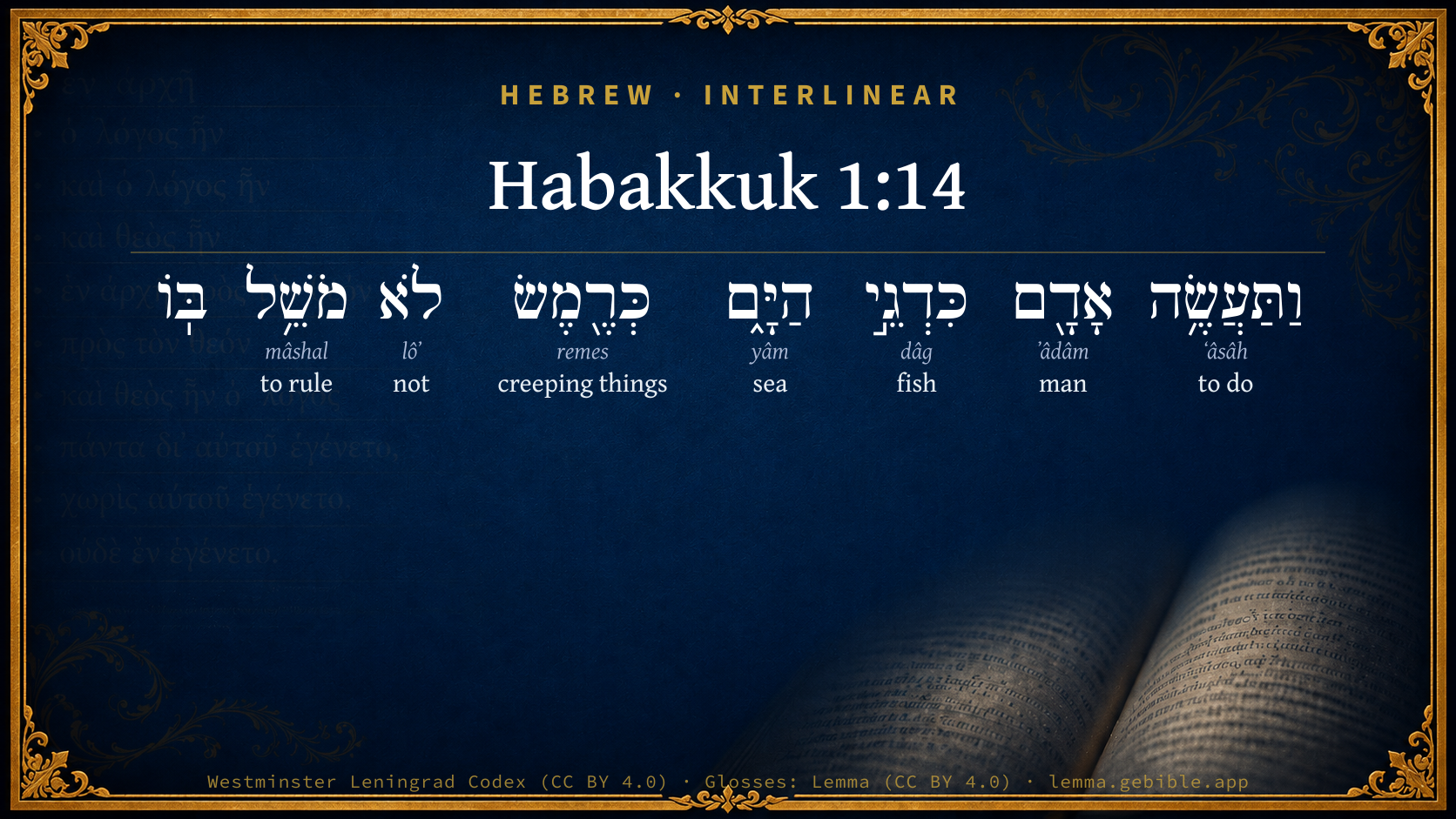
Habakkuk 1:14

Hebrew (Westminster Leningrad Codex) Habakkuk 1:14 appears in the Hebrew Old Testament. The text above is from the Westminster Leningrad Codex. Each word links to its Strong’s number, a concise gloss, and parsing drawn from the Open Scriptures Hebrew Bible morphology. Click any word for its full Brown-Driver-Briggs (BDB) entry.
Download image
Cite this verse

Habakkuk 1:14 (World English Bible). Public Domain. Lemma interlinear Bible study tool, https://lemma.gebible.app/v/habakkuk/1/14.

Show BibTeX & RIS
BibTeX
RIS
English Translation
and make men like the fish of the sea, like the creeping things, that have no ruler over them?
World English Bible · Public Domain
Download a study sheet

One document with this verse’s original text, its word-by-word gloss line, the meaning frame, cross-references with their text, attributed commentary, and full source and license credits — printable, and it pastes into notes with its structure intact.

This verse Autodidact and up

Study sheet (.html) Plain text (.txt)

A passage Seminary Student

Up to 50 verses in one chapter. A passage sheet keeps up to 6 commentary sources and 12 cross-references per verse, in the order this page ranks them, and says so on the sheet whenever that leaves anything out. Ask for a single verse and you get the Autodidact verse sheet above.

Everything on this page stays free to read, with no account — the sheet is a download of what is already on screen, not access to it.

Want to remove ads? Support Godless Engineer
Compare translations 3

The same verse in 3 English versions, stacked beneath the original-language interlinear above. Click any original word for its lexicon entry.

Each is an independent rendering of the whole verse — the interlinear is not word-aligned to these translations.

Highlighted words mark where these versions differ — a whole-verse word diff, not a word-by-word alignment.

  • World English Bible Public Domain
    and make men like the fish of the sea, like the creeping things, that have no ruler over them?
  • King James Version Public Domain
    And makest men as the fishes of the sea, as the creeping things, that have no ruler over them?
  • unfoldingWord Literal Text CC BY-SA 4.0
    And you make man like the fish of the sea, like a creeping thing no ruler over it.

unfoldingWord Literal Text — © unfoldingWord, licensed CC BY-SA 4.0. Word-aligned USFM3 via Door43 (git.door43.org/unfoldingWord/en_ult).

Versions to compare (up to 4)

3 of 4 selected

Show all 18 translations

Every available English version of this verse, each an independent rendering of the whole verse.

  • World English Bible Public Domain
    and make men like the fish of the sea, like the creeping things, that have no ruler over them?
  • Berean Standard Bible Public Domain
    You have made men like the fish of the sea, like creeping things that have no ruler.
  • Majority Standard Bible Public Domain
    You have made men like the fish of the sea, like creeping things that have no ruler.
  • King James Version Public Domain
    And makest men as the fishes of the sea, as the creeping things, that have no ruler over them?
  • American Standard Version (1901) Public Domain
    and makest men as the fishes of the sea, as the creeping things, that have no ruler over them?
  • Revised Version (1885) Public Domain
    and makest men as the fishes of the sea, as the creeping things, that have no ruler over them?
  • Geneva Bible (1599) Public Domain
    And makest men as the fishes of the sea, and as the creeping things, that haue no ruler ouer them.
  • Douay-Rheims (1899) Public Domain
    And thou wilt make men as the fishes of the sea, and as the creeping things that have no ruler.
  • Young's Literal Translation Public Domain
    And Thou makest man as fishes of the sea, As a creeping thing -- none ruling over him.
  • Literal Standard Version CC BY-SA 4.0
    And You make man as fishes of the sea, || As a creeping thing [with] none ruling over him.
  • Unlocked Literal Bible CC BY-SA 4.0
    You make men like fish in the sea, like creeping things without a ruler over them.
  • unfoldingWord Literal Text CC BY-SA 4.0
    And you make man like the fish of the sea, like a creeping thing no ruler over it.
  • Darby Bible Public Domain
    And thou makest men as the fishes of the sea, as the creeping things, that have no ruler over them.
  • World Messianic Bible Public Domain
    and make men like the fish of the sea, like the creeping things that have no ruler over them?
  • Webster's Bible Public Domain
    And makest men as the fishes of the sea, as the creeping animals that have no ruler over them?
  • Free Bible Version CC BY-SA 4.0
    You make people become like fish in the sea, or like crawling insects, that have no ruler.
  • Bible in Basic English Public Domain
    He has made men like the fishes of the sea, like the worms which have no ruler over them.
  • JPS Tanakh (1917) Public Domain
    And makest men as the fishes of the sea, as the creeping things, that have no ruler over them?

Literal Standard Version (2020), Covenant Press — licensed CC BY-SA 4.0. Text via the HelloAO Bible API (eBible.org). Unlocked Literal Bible (unfoldingWord) — licensed CC BY-SA 4.0. Text via the HelloAO Bible API (eBible.org). unfoldingWord Literal Text — © unfoldingWord, licensed CC BY-SA 4.0. Word-aligned USFM3 via Door43 (git.door43.org/unfoldingWord/en_ult). Free Bible Version, Dr. Jonathan Gallagher — licensed CC BY-SA 4.0. Text via the HelloAO Bible API (eBible.org).

Word by word

More ways to search: Search by grammar → Find every occurrence → Compare this word →

Practice this passage: Drill this verse → Learn its vocabulary →

About this verse

These counts appear in no published source. They are computed here, from the morphology-tagged text and Lemma’s own curated glosses. What Lemma adds →

8
words
7
distinct lemmas
Prophets
section

Notable vocabulary

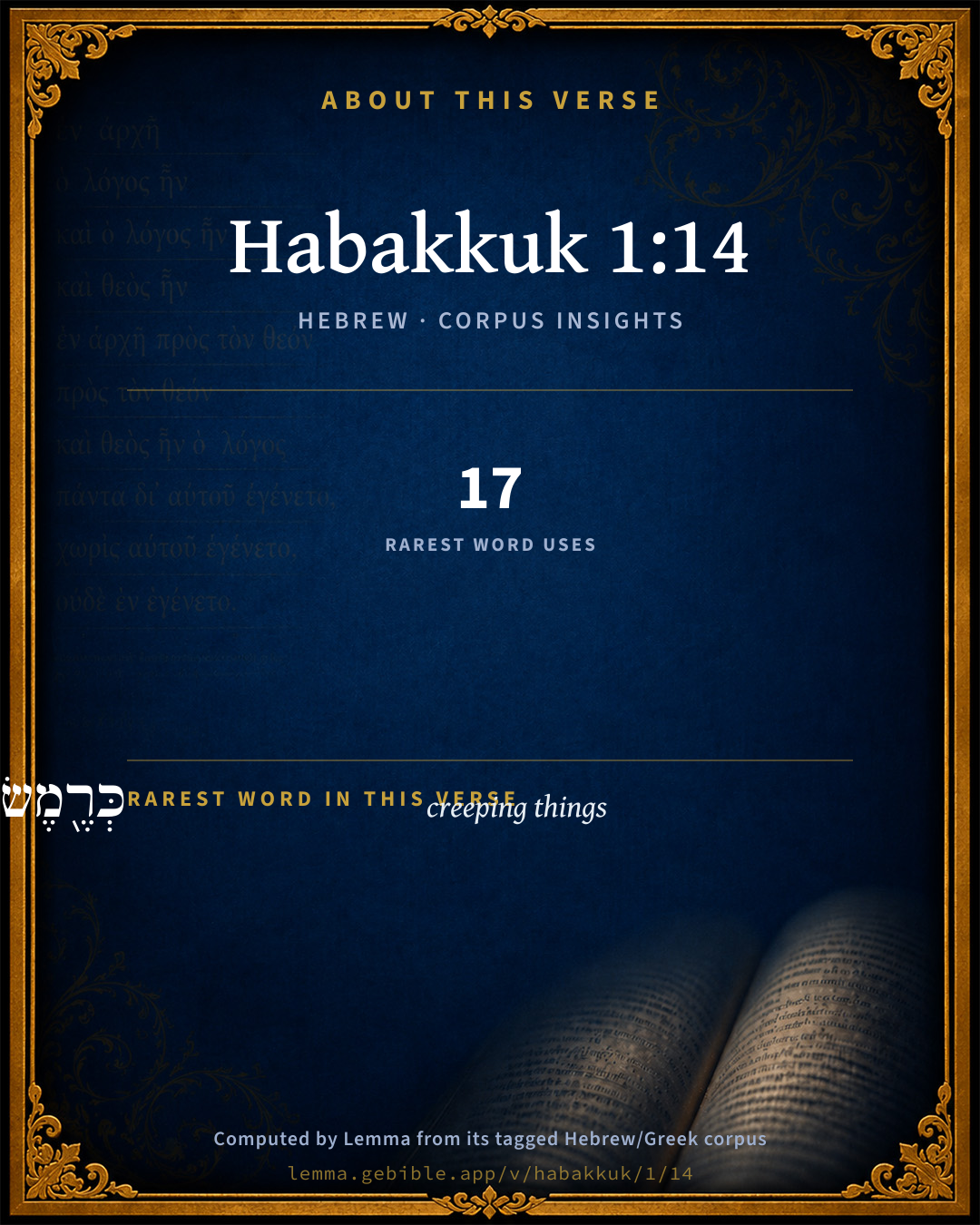
The rarest word here is כְּרֶ֖מֶשׂ creeping things H7431 — appearing just 17 times in the whole Hebrew Bible.

Shared distinctive vocabulary

כְּרֶ֖מֶשׂ creeping things H7431 occurs in 17 verses of the Hebrew Bible. Also found in:

Grammatical profile

  • 2 verbs
  • 4 nouns
  • 1 preposition
  • 1 particle

Verb forms

  • וַתַּעֲשֶׂ֥ה Qal · Sequential Imperfect
  • מֹשֵׁ֥ל Qal · Participle Active

Hebrew & Septuagint length

In English translation the verse runs 19 words from the Hebrew and 19 from the Septuagint (LXX English) — the same length.

A rough comparison of the two English renderings, which tokenize alike — not a word-level alignment.

Word counts can differ between the Hebrew and the Greek without any difference in meaning — e.g. the Hebrew direct-object marker אֵת has no separate Greek word, and Greek often adds the article ὁ.

Hebrew and Greek witnesses Masoretic Hebrew ↔ Greek Septuagint

The same verse in the two great witnesses to the Old Testament, shown verse-for-verse.

These are two independent witnesses, not word-aligned to each other, and the Septuagint is shown in lemma (dictionary) form.

Hebrew Habakkuk 1:14 Masoretic · Westminster Leningrad Codex

וַתַּעֲשֶׂ֥ה אָדָ֖ם כִּדְגֵ֣י הַיָּ֑ם כְּרֶ֖מֶשׂ לֹא מֹשֵׁ֥ל בּֽוֹ

and make men like the fish of the sea, like the creeping things, that have no ruler over them?

World English Bible · Public Domain

Greek LXX Habakkuk 1:14 Septuagint · lemma form

καί ποιέω ὁ ἄνθρωπος ὡς ὁ ἰχθύς ὁ θάλασσα καί ὡς ὁ ἑρπετόν ὁ οὐ ἔχω ἡγέομαι

And will you make men as the fishes of the sea, and as the reptiles which have no guide?

LXX2012 (modern English Septuagint) · Public Domain

Hebrew: Westminster Leningrad Codex (CC BY 4.0). Greek: Septuagint (public domain); English from LXX2012 (modern English Septuagint) (Public Domain). How the Septuagint differs from the Hebrew →

Targum (Aramaic paraphrase)

1

The Targum is the ancient Jewish Aramaic paraphrase of the Hebrew Scriptures — an interpretive translation, not the Hebrew text itself. Onkelos (literal) and Pseudo-Jonathan (expansive) render the Torah, and Jonathan the Prophets. Coverage is partial: where no permissively-licensed English translation exists for a verse, only the Aramaic is shown. This is verse-level text, not a word-by-word alignment to the Hebrew.

  1. Targum Jonathan Prophets (Joshua–Malachi)
    וַעֲבַדְתָּא אֱנָשָׁא כְּנוּנֵי יַמָא כְּרִיחֲשָׁא דְלֵית שׁוּלְטַן עֲלוֹהִי:

    (no public-domain English translation for this verse)

    Targum Jonathan — Aramaic: “Mikraot Gedolot” (public domain). English: “Sefaria Community Translation” (CC0 1.0 (public-domain dedication)); “London "Chaldee Paraphrase," 1871” (public domain). Text via Sefaria.

Commentary

Notes on Habakkuk 1:14 from classic Christian and Jewish commentators (each source and its license shown beneath its notes). The classic Christian expositions comment on the surrounding passage and are grouped to its opening verse, so a note may address several verses; the Jewish commentaries on the Tanakh (Rashi and others) are per-verse, so they appear only where the commentator wrote on this verse.

Lemma curates 59 commentaries, every one of them public domain or Creative Commons licensed, each selected and text-cleaned for this edition rather than reprinted as found. About our sources →

The Cambridge Bible for Schools and Colleges

gen. ed. J. J. S. Perowne

14. And makest men] and hast made men—the condition is one that has supervened. At the last resort it is Jehovah who is the author of all this inhuman violence. Cf. Job_9:24, “if not He, who then is it?” It might be that the Chaldeans were set to chastise, but they exceeded all bounds in their inhumanity (Isa_47:6-7; Zec_1:14-15). Men under their cruel rapacity ceased to be men, the very humanity in them was disregarded, and the brutal conqueror in his pride treated them like the lower creatures.

no ruler over them] This hardly means that the creeping things have no king to protect them, but rather that, as the lowest creatures that have life, they have no higher instincts, no organization, they are a mere swarming disorder, and to this condition do the conquerors reduce mankind. Pro_6:7; Pro_30:27.

The Cambridge Bible for Schools and Colleges (gen. ed. J. J. S. Perowne; Cambridge University Press, 1878–1918) — public domain. Text from a community e-Sword module.

Trapp's Complete Commentary

John Trapp

Hab 1:14 And makest men as the fishes of the sea, as the creeping things, [that have] no ruler over them?

Ver. 14. And makest men as the fishes of the sea] That are easily drawn out with hook or net. So doth Nebuchadnezzar, with little ado, bring whole nations under his power and pleasure. Here, therefore, saith Drusius, Nebuchadnezzar is the fisher, the world is the sea, men are the fishes, the armies and arts of the Chaldees are called the net, drag, hook, to the which Nebuchadnezzar ascribed his victories, and not to God. Whereas he should have written upon them, as the ancients did upon their greatest exploits, Yεος, Yεος, and have said, as Titus did, when some cried him up for his sacking the city of Jerusalem; I only lent mine hand to God, who did the work by me (Pausan.).

As the creeping things] Or, the lesser fishes; for in the sea also are creeping things innumerable, Psa 104:25 Lev 11:46.

That have no ruler over them] To right and revenge them; and are therefore devoured, the lesser by the greater, without remedy. And what will men imagine, but that thy people have no ruler over them, no God to take care of their comfort, or to protect them from their enemies? How will they conclude them to be in as bad condition as those of Brazil, who are said to be Sine rege, sine lege, sine fide, &c. Or, the old Nomades, sub regno Cyclopico?

John Trapp, A Commentary or Exposition upon All the Books of the Old and New Testament (1647–1656) — public domain. Text from a community e-Sword module.

The Biblical Illustrator

Joseph S. Exell

Hab_1:14-17

And makest men as the fishes of the sea

Rapacious selfishness in power

Illustrated in Nebuchadnezzar.

Selfishness is the root and essence of sin. All unregenerate men are therefore more or less selfish, and rapacity is an instinct of selfishness. Selfishness hungers for the things of others.

I. It practically ignores the rights of man as man. And makest man as the fishes of the sea, as the creeping things, that have no ruler over them. The Babylonian tyrant did not see in the population of Judea men possessing natural endowments, sustaining moral relationships, invested with rights and responsibilities similar to his own fellow-men; but merely fishes;--his object was, to catch them and turn them to his own use. It is ever so with selfishness: it blinds man to the claims of his brother. What does the selfish employer care for the man in those who work in his service and build up his fortune? He treats them rather as fishes to be used, than as brethren to be respected. What does the selfish despot care for the moral humanity of the people over whom he sways his sceptre? He values them only as they can fight his battles, enrich his exchequer, and contribute to his pageantry and pomp. What were men to Napoleon? etc.

II. It assiduously works to turn men to its own use. They take up all of them with the angle, they catch them in their net, and gather them in their drag; therefore they rejoice and are glad. Ah me! Human life is like a sea--deep, unresting, treacherous; and the teaming millions of men are but as fishes, the weaker devoured by the stronger. The mighty ones use the hook to oppress individuals one by one, the net and the drag to carry multitudes away. As the fisherman works by various expedients to catch the fish, the selfish man in power is ever active in devising the best expedients to turn human flesh to his own use.

III. It adores self on account of its success. Therefore they sacrifice unto their net, and burn incense unto their drag; because by them their portion is fat, and their meat plenteous. Because men are everywhere selfish, they are everywhere sacrificing unto their net, and burning incense unto their drag. The selfish statesman says, There is no measure like mine; the selfish sectarian, There is no Church like mine; the selfish author, There is no book like mine; the selfish preacher, There is no sermon like mine.

IV. It remains unsatiable notwithstanding its prosperity. Shall they therefore empty their net? etc. An old author thus paraphrases the language, Shall they enrich themselves and fill their own vessels, with that which they have by violence and oppression taken away from their neighbours? Shall they empty their net of what they have caught, that they may cast it into the sea again to catch more? And wilt Thou suffer them to proceed in this wicked course? Shall they not spare continually to slay the nations? Must the numbers and wealth of nations be sacrificed to their net? Conclusion--What an awful picture of the world we have here! (Homilist.)

The baits of Satan

All sorts of baits are used to catch human souls. One of the old fathers of the Church says that Satan is the ape of God. That is, Satan imitates whatever God does, but with a different object. God uses the beautiful things He has made to draw you to Him. Satan uses the same things to lure you into his power, and draw you away from God. Since man has been in the world, he has had to work. And God has blessed work. But Satan takes work, and tries to make mischief with it. He tries to make you care for your work apart from God, and thus it is turned into dead, graceless, unprofitable work. The world--the society of your fellows--may draw the souls of those who move in it to God; for there is a great deal of good in the world. You cannot always say that this or that is bad in itself. It is bad only when Satan has put his hook through it. Consequently you must not rashly denounce an amusement or a pursuit, as bad, unless you can see the hook in it. Look at some scriptural instances of Satans fishing. Case of Job; of David; of Judas Iscariot. As you go through life you will meet with all sorts of temptations. Temptations are Satan s baits. Then, whatever you undertake, keep God before your eyes: keep God in your thoughts. Directly you begin to lose sight of God and to forget Him--then beware! Recover yourself as quickly as you can; you have somehow got hold of a bait which Satan is pulling towards him. (S. Baring-Gould, M. A.)

The Biblical Illustrator, edited by Joseph S. Exell (c. 1880s–1900s) — public domain. Text from a community e-Sword module.

Tyndale Open Study Notes

Tyndale Open Resources

1:14-15 fish . . . hooks . . . nets: Habakkuk portrays the Babylonians as fishermen, drawing in conquered peoples.

Tyndale Open Study Notes — © Tyndale Open Resources, licensed CC BY-SA 4.0. Text via the HelloAO Bible API.

Geneva Bible (1599)

Geneva Bible translators

So that the great devoureth the small, and the Chaldeans destroy all the world.

Geneva Bible (1599) marginal notes — public domain. Text via Bolls.life.

Jamieson, Fausset & Brown

Robert Jamieson, A. R. Fausset & David Brown

And--that is, And so, by suffering oppressors to go unpunished, "Thou makest men as the fishes . . . that have no ruler"; that is, no defender. All may fish in the sea with impunity; so the Chaldeans with impunity afflict Thy people, as these have no longer the God of the theocracy, their King, to defend them. Thou reducest men to such a state of anarchy, by wrong going unpunished, as if there were no God. He compares the world to the sea; men to fishes; Nebuchadnezzar to a fisherman (Hab 1:15-17).

Jamieson, Fausset & Brown — Commentary Critical and Explanatory on the Whole Bible (1871) — public domain (CC PDM 1.0). Text via the HelloAO Bible API.

Adam Clarke's Commentary

Verse 14. Makest men as the fishes of the sea] Easily are we taken and destroyed. We have no leader to guide us, and no power to defend ourselves. Nebuchadnezzar is here represented as a fisherman, who is constantly casting his nets into the sea, and enclosing multitudes of fishes; and, being always successful, he sacrifices to his own net-attributes all his conquests to his own power and prudence; not considering that he is only like a net that after having been used for a while, shall at last be thrown by as useless, or burnt in the fire.

Adam Clarke's Commentary on the Bible (1810–1826) — public domain. Text from a community e-Sword/MySword module.

John Calvin's Commentaries

He goes on, as it has been said, in his complaint; and by a comparison he shows that the judgement would be such as though God turned away from men, so as not to check the violence of the wicked, nor oppose his hand to their wantonness, in order to restrain them. Since, then, every one would oppress another as he exceeded him in power, and would with increased insolence rise up against the miserable and the poor, the Prophet compares man to the fish of the sea,—“What can this mean?” he says. “For men have been created after God’s image: why then does not some justice appear among them? When one devours another, and even one man oppresses almost the whole world, what can be the meaning of this? God seems to sport with human affairs. For if he regards men as his children, why does he not defend them by his power? But we see one man (for he speaks of the Assyrian king) so enraged and so cruel, as though the rest of the world were like fish or reptiles.” Thou makes men, he says, like reptiles or fishes; and then he adds, He draws up the whole by his hook, he collects them into his drag, he gathers them into his net, he exults

We now see what the Prophet means—that God would, as it were, close his eyes, while the Assyrians wantonly laid waste the whole world: and when this tyranny should reach the holy land, what else could the faithful think but that they were forsaken by God? And there is nothing, as I have already said, more monstrous, than that iniquitous tyranny should thus prevail among men; for they have all, from the least to the greatest, been created after God’s image. God then ought to exercise peculiar care in preserving mankind; his paternal love and solicitude ought in this respect to appear evident: but when men are thus destroyed with impunity, and one oppresses almost all the rest, there seems indeed to be no divine providence. For how will it be that he will care for either birds, or oxen, or asses, or trees, or plants, when he will thus forsake men, and bring no aid in so confused a state? We now understand the drift of what the Prophet says.

But yet he does not, as I have already said, take away from God his power, nor does he here rail against fortune, as many cavillers do. Thou makest men, he says: he ascribes to God what cannot be taken from him,—that he governs the world. But as to God’s justice, he hesitates, and appeals to God. Though the Prophet seems here to rush headlong like insane men; yet if we consider all things, we shall see that he strenuously contended with his temptations, and even in these words some sparks at least of faith will shine forth, which are sufficient to show to us the great firmness of the Prophet. For this especially is worthy of being noticed,—that the Prophet turns himself to God. The Epicureans, when they glamour against God, for the most part, seek the ear of the multitude; and so they speak evil of God and withdraw themselves at a distance from him; for they do not think that he exercises any care over the world. But the Prophet continually addresses God. He knew then that God was the governor of all things. He also desires to be extricated from thoughts so thorny and perplexing; and from whom does he seek relief? From God himself. When the profane wantonly deride God, they indulge themselves, and seek nothing else but to become hardened in their own impious conjectures: but the Prophet comes to God himself, “How does this happen, O Lord?” As though he had said,

“Thou sees how I am distracted, and also held fast bound—distracted by many absurd thoughts, so that I am almost confounded, and held fast bound by great perplexities, from which I cannot extricate myself. Do thou, O Lord, unfold to me these knots, and concentrate my scattered thoughts, that I may understand what is true, and what I am to believe; and especially remove from me this doubt, lest it should shake my faith; O Lord, grant that I may at length know and fully understand how thou art just, and overrules, consistently with perfect equity, those things which seem to be so confused.”

It also happens sometimes that the ungodly, as it were, openly revile God, a satanic rage having taken possession on them. But the case was far different with the Prophet; for finding himself overwhelmed and his mind not able to sustain him under so heavy trials, he sought relief, and as we have said, applied to God himself.

By saying, He therefore rejoices and exults, he increases the indignity; for though the Lord may for a time permit the wicked to oppress the innocent, yet when he finds them glorying in their vices and triumphing, so great a wantonness ought the more to kindle his vengeance. That the Lord then should still withhold himself, seems indeed very strange. But the Prophet proceeds—

John Calvin's Commentaries (1540-1563) — public domain. Text from the Calvin Translation Society English edition (1840s-50s) via the Christian Classics Ethereal Library (ccel.org). Calvin's coverage is partial (roughly two-thirds of the Bible); uncommented books and verses are honest gaps, never fabricated. The 19th-century editor's footnotes and remarks are omitted so the notes are faithfully Calvin's own voice.

John Gill's Exposition

And makest men as the fishes of the sea,.... That is, sufferest them to be used as the fishes of the sea, which are easily taken in the net, and are common to everyone; whosoever will may take them up, and kill them, and use them for their food; and which also among themselves are often hardly used, the lesser being devoured by the greater; and in like manner the prophet suggests, that the people of the Jews, who were men made after the image of God, and made for society and usefulness, and moreover were God's covenant people; and it might have been expected, that a more special providence would have attended them, more than other men, and especially than what attended the fishes of the sea; yet it looked as if there were no more care taken of them than of these:

as the creeping things that have no ruler over them; not the creeping things of the earth, but of the water, the lesser sort of fishes that move in the water; or those that more properly creep, as crabs, prawns, and shrimps; see Psa 104:25 who have none to protect and defend them, and restrain others from taking and hurting them: this may seem contrary to what Aristotle (d) and Pliny (e) say of some fishes, that they go in company, and have a leader or governor; but, as Bochart (f) observes, it is one thing to be a leader of the way, a guide and director, which way to steer their course in swimming; and another thing to be as the general of an army, to protect and defend, or under whose directions they might defend themselves; such an one the prophet denies they had: and so, the prophet complains, this was the case of the Jews; they were exposed to the cruelty of their enemies, as if there was no God that governed in the world, and no providence to direct and order things for the preservation of men, and to keep good men from being hurt by evil men; or those that were weak and feeble from being oppressed by the powerful and mighty; this he reasons with the Lord about, and was desirous of an answer to it.

(d) Hist. Animal. l. 8. c. 13. (e) Nat. Hist. l. 9. c. 15. (f) Hierozoic. par. 1. l. 1. c. 6. col. 39.

John Gill's Exposition of the Whole Bible (1746–1763) — public domain (CC PDM 1.0). Text via the HelloAO Bible API.

Albert Barnes' Notes on the Bible

And makest men as the fishes of the sea - mute, helpless, in a stormy, restless element, no cry heard, but themselves swept away in shoals, with no power to resist.

As the creeping things - whether of the land (as it is mostly used), or the sea Psa 104:25. Either way, it is a contemptuous name for the lowest of either.

That have no ruler over them - none to guide, order, protect them, and so a picture of man deprived of the care and providence of God.

Albert Barnes' Notes on the Bible (1834–1885) — public domain. Text from a community e-Sword/MySword module.

Haydock's Catholic Bible Commentary

Ruler. People are subdued by Nabuchodouosor. (Haydock) --- They make little resistance. (Calmet)

George Leo Haydock (1774–1849), Haydock's Catholic Family Bible and Commentary, 1859 edition — public domain. Excludes Psalms (Douay-Rheims chapter numbering differs from Protestant) and Deuterocanonical books (Catholic canon only).

Matthew Poole's English Annotations

Makest; not infusing cruel, ravenous, and unsatiable appetites, but permitting them to act according to such appetite which was already in them.

Men; who should be just to all, and wrong none, who were once framed for mutual help in civil societies, and whose life should be beneficence.

As the fishes; of which the greater live on the lesser, and do greedily and all the day long feed on the smaller fry.

Of the sea; where the devourers are more for number, of greater bulk, and swallow greater numbers of the lesser.

As the creeping things; which in the waters are food for the lesser fry; so the world, like the sea, is wholly oppression.

No ruler; none to defend the weak, to restrain the mighty, and to give law to all.

Matthew Poole's English Annotations on the Holy Bible (1683–1685) — public domain. Text from a community e-Sword/MySword module.

The Pulpit Commentary

The prophet appeals movingly to God by showing the indignity with which the people are treated. As the fishes of the sea. Dumb and helpless, swept off by the fisherman. That have no ruler ever them. None to guide and protect them. (comp. Pro_6:7 Pro_30:27) So the Jews seem to be deprived of God"s care, and left to be the prey of the spoiler, as if of little worth, and no longer having God for their King. (comp. Isa_63:19, Revised Version) The "creeping things" are worms, or small fish. (Psa_104:25)

Vers. 14-17Rapacious selfishness in power.

makest men as the fishes of the sea, as the creeping things, that have no ruler over them. They take up all of them with the angle, they catch them in their net, and gather them in their drag: therefore they rejoice and are glad," etc. In Nebuchadnezzar you have rapacious selfishness in power. He is here represented by implication as treating the Jewish people as a fisherman treats the fish in the sea. His aim is to catch them by "angle," "net," and "drag," and turn them to his own vile use. "These figures are not to be interpreted with such speciality as that the net and fishing net answer to the sword and bow; but the hook, the net, and the fishing net, as the things used for catching fish, refer to all the means which the Chaldeans employ in order to subdue and destroy the nations. Luther interprets it correctly. "These hooks, nets, and fishing nets," he says "are nothing more than his great and powerful armies, by which he gained dominion over all lands and people, and brought home to Babylon the goods, jewels, silver and gold, interest and rent of all the world (Delitzsch). In these verses we have a specimen of rapacious selfishness in power. Selfishness is the root and essence of sin. All unregenerate men are therefore more or less selfish, and rapacity is an instinct of selfishness. Selfishness hungers for the things of others. Whilst this rapacious selfishness is general, mercifully it is not always in power, otherwise the world would be more of a pandemonium than it is. It is ever tyrannic and ruthless in the measure of its power. Here we find it in the power of an absolute monarchy, and it is terrible to contemplate. Four things are suggested.

I IT PRACTICALLY IGNORES THE RIGHTS OF MAN AS MAN. "And makest man as the fishes of the sea, as the creeping things, that have no ruler over them." The Babylonian tyrant did not see in the population of Judea men possessing natural endowments, sustaining moral relationships, invested with rights and responsibilities similar to his own fellow men, but merely "fishes;" his object was to catch them and turn them to his own use. It is ever so with selfishness: it blinds man to the claims of his brother. What does the selfish landlord care for the man in the tenants and labourers on his estate? He only values them as they can subserve his interests. What does the selfish employer care for the man in those who work in his service and build up his fortune? He treats them rather as fishes to be used than as brethren to be respected. What does the selfish despot care for the moral humanity of the people over whom he sways his sceptre? He values them only as they can fight his battles, enrich his exchequer, and contribute to his pageantry and pomp. What were men to Alexander? What were men to Napoleon, etc.?

II IT ASSIDUOUSLY WORKS TO TURN MEN TO ITS OWN USE. "They take up all of them with the angle, they catch them in their net, and gather them in their drag; therefore they rejoice and are glad." Thus they take up all of them, some with the hook one by one, others in shoals as in a net, others in a drag or enclosed net. Ah me! Human life is like a sea deep, unresting, treacherous; and the teeming millions of men are but as fishes, the weaker devoured by the stronger.

the good old rule Sufficeth them, the simple plan That they should take who have the power, And they should keep who can. (Wordsworth)

The mighty ones use the hook to oppress individuals one by one, the net and the drag to carry multitudes away. To a rapacious selfishness in power the man is lost in the labourer, the clerk, the employe, the sailor, the soldier, the subject, etc. Men, what are they? To its eye they are goods, chattels, beasts of burden, "fishes nothing more. As the fisherman works by various expedients to catch the fish, the selfish man in power is ever active in devising the best expedients to turn human flesh to his own use.

III IT ADORES SELF ON ACCOUNT OF ITS SUCCESS. "Therefore they sacrifice unto their net, and burn incense unto their drag; because by them their portion is fat, and their meat plenteous." They glory even in their crimes, because these result in success. They admire their own dexterity and prowess. The selfish man says to himself, "My power and the might of mine hand hath gotten me this wealth". (Deu_8:17) According to the measure of a man"s selfishness is his propensity to self-worship. The more selfish a merchant, a scholar, a religionist, an author, a preacher, etc., is, the more prone to praise himself for his imaginary success. Because men are everywhere selfish, they are everywhere "sacrificing unto their net, and burning incense unto their drag." The selfish statesman says, "There is no measure like mine;" the selfish sectarian, "There is no Church like mine;" the selfish author, "There is no book like mine;" the selfish preacher, "There is no sermon like mine.

To our own nets ne"er bow we down, Lest on the eternal shore The angels, while our draught they own, Reject us evermore. (Keble)

IV IT REMAINS INSATIABLE, NOTWITHSTANDING ITS PROSPERITY, "Shall they therefore empty their net?" etc. An old author thus paraphrases the language: "Shall they enrich themselves and fill their own vessels with that which they have by violence and oppression taken away from their neighbours? Shall they empty their net of what they have caught, that they may cast it into the sea again to catch more? And wilt thou suffer them to proceed in this wicked course? Shall they not spare continually to slay the nations? Must the number and wealth of nations be sacrificed to their net?

CONCLUSION. What an awful picture of the world we have here! All unregenerate men are selfish. Men are everywhere preying on men; and, alas! often those who most lament the universal selfishness are the most selfish. Like the ravenous birds which seem to bewail the sheep when dying, they are ready to pick out their eyes when their opportunity comes. "Where every man is for himself," says an old author, "the devil will have all." This selfishness is the heart of stone in humanity, which must be exchanged for a heart of flesh, or the man will be damned. What but the gospel can effect this change? Oh that those who call themselves Christians would cherish and exemplify that disinterestedness which alone gives title to the name! "I would so live," said Seneca, "as if I knew I had received my being only for the benefit of others. D.T.

The Pulpit Commentary (1880–1919), ed. H.D.M. Spence-Jones & Joseph S. Exell — public domain. Text from a community e-Sword module.

John Wesley's Explanatory Notes

And makest - Not infusing cruel appetites, but permitting them to act according to such appetite which was already in them. As the fishes - Of which the greater greedily devour the smaller. Creeping things - Which in the waters are food for the lesser fry; so the world, like the sea, is wholly oppression. No ruler - None to defend the weak, or restrain the mighty.

John Wesley, Explanatory Notes Upon the Whole Bible (1754–1765) — public domain. Text via the GEBible commentary corpus.

Rashi

Rabbi Shlomo Yitzchaki (Rashi)

And You have made man before this wicked man - free as the fish of the sea, which anyone who wishes may catch.

Rashi on the Tanakh — English translations: “The Judaica Press complete Tanach with Rashi, translated by A. J. Rosenberg” (CC BY 4.0); “Pentateuch with Rashi's commentary by M. Rosenbaum and A.M. Silbermann, 1929-1934” (public domain); “The Metsudah Tanach series, Lakewood, N.J” (CC BY 4.0); and “The Book of Joshua, Metsudah Publications, 1997” (CC BY 4.0). Text via Sefaria.

Lesson kit

Teaching starters — assembled from the data on this page, not authored interpretation. Every prompt links to the verse data it draws on. Edit before teaching.

Habakkuk, in the Prophets, opens this verse with 8 words (7 distinct Hebrew lemmas). Its most distinctive word is remes (“creeping things”). A historical commentator’s framing appears above. Read the whole chapter for the surrounding context.

Discussion questions

  1. What does “creeping things” (remes) contribute to the verse as a whole?
  2. Genesis 1:24 shares the word «creeping things» with this verse. How do the two illuminate each other?
  3. These translations render this verse differently; the difference is in the English rendering, not the original. What questions does that raise?
  4. The verb «וַתַּעֲשֶׂ֥ה» is Qal Sequential Imperfect. How does its form color the action?
  5. Reading how The Cambridge Bible for Schools and Colleges and Trapp's Complete Commentary read this verse, where do the two commentators agree and where do they part?

Things to notice

Reading settings

Reading text

Shown beneath each verse's original-language words.

Old Testament
Old Testament edition

Read the OT as the Masoretic Hebrew (MT) or the Greek Septuagint (LXX).

English shown for the Greek Septuagint (in the Hebrew ↔ Greek comparison).

Comparing translations? Open the Compare panel on any verse page to stack up to four side by side.