

2 Corinthians 6:8
Greek (Tischendorf 8th ed.) 2 Corinthians 6:8 appears in the Greek New Testament. The text above is from the Tischendorf 8th edition. Each word links to its Strong’s number and a concise gloss. Click any word for its full Thayer’s Greek Lexicon entry.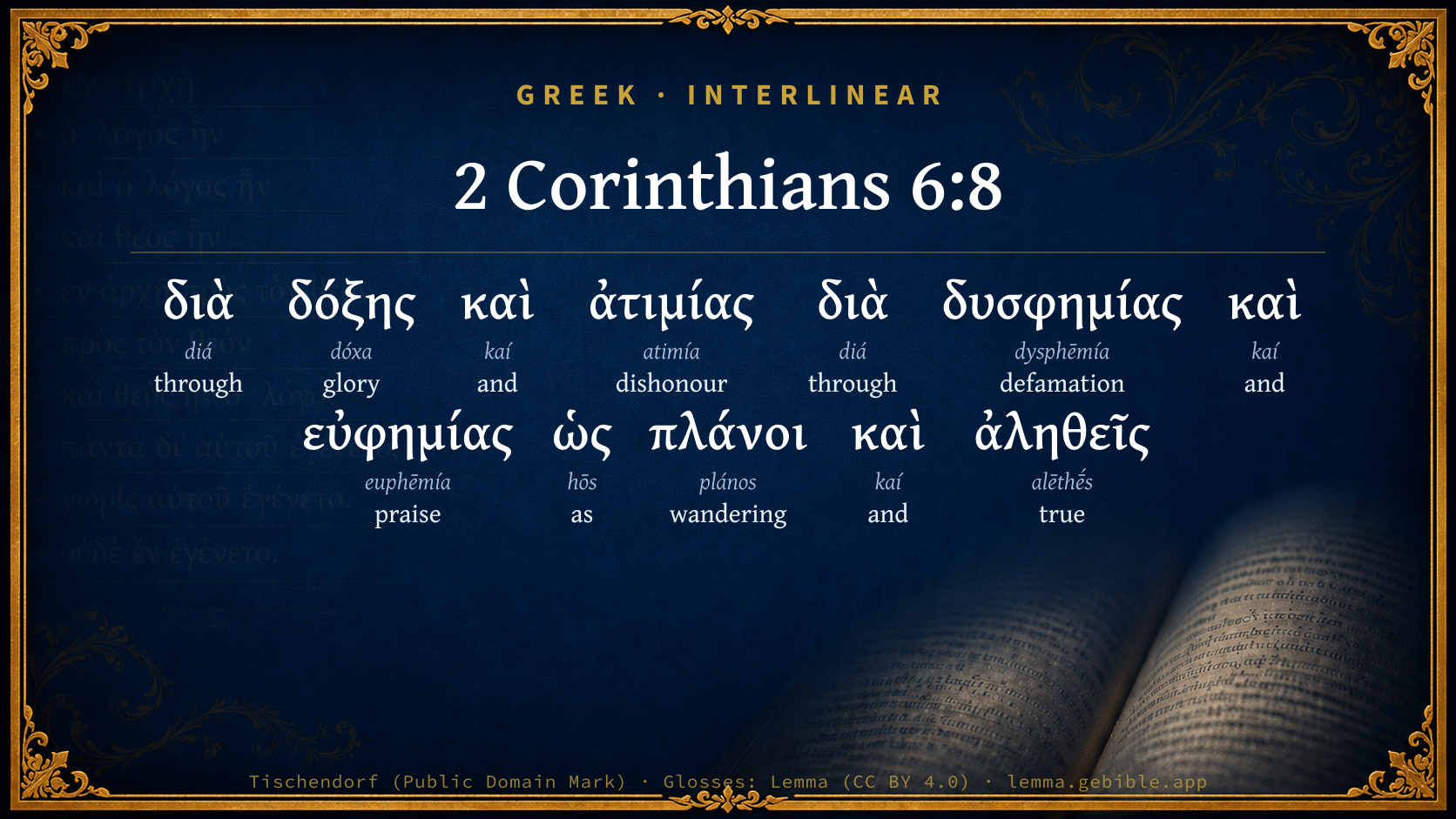
by glory and dishonor, by evil report and good report; as deceivers, and yet true;
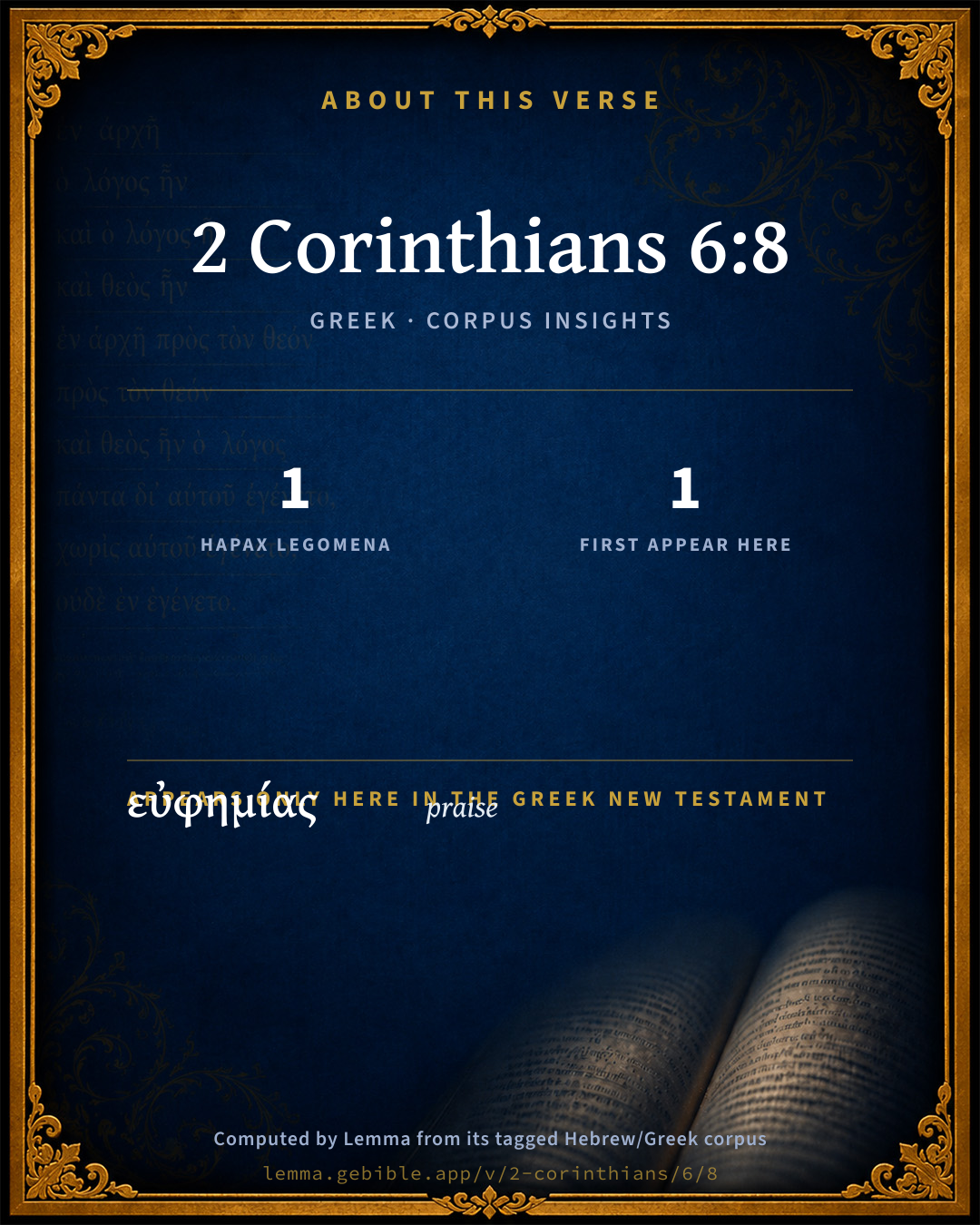
- 1 hapax legomenon — only here in the Greek New Testament
- 1 first appearance in the Greek New Testament
Download a study sheet
One document with this verse’s original text, its word-by-word gloss line, the meaning frame, cross-references with their text, attributed commentary, and full source and license credits — printable, and it pastes into notes with its structure intact.
This verse Autodidact and up
A passage Seminary Student
Up to 50 verses in one chapter. A passage sheet keeps up to 6 commentary sources and 12 cross-references per verse, in the order this page ranks them, and says so on the sheet whenever that leaves anything out. Ask for a single verse and you get the Autodidact verse sheet above.
Everything on this page stays free to read, with no account — the sheet is a download of what is already on screen, not access to it.
Compare translations 3
The same verse in 3 English versions, stacked beneath the original-language interlinear above. Click any original word for its lexicon entry.
Each is an independent rendering of the whole verse — the interlinear is not word-aligned to these translations.
Highlighted words mark where these versions differ — a whole-verse word diff, not a word-by-word alignment.
-
World English Bible Public Domain
by glory and dishonor, by evil report and good report; as deceivers, and yet true;
-
King James Version Public Domain
By honour and dishonour, by evil report and good report: as deceivers, and yet true;
-
unfoldingWord Literal Text CC BY-SA 4.0
through honor and dishonor, through bad report and good report; as deceivers, yet true;
unfoldingWord Literal Text — © unfoldingWord, licensed CC BY-SA 4.0. Word-aligned USFM3 via Door43 (git.door43.org/unfoldingWord/en_ult).
Show all 19 translations
Every available English version of this verse, each an independent rendering of the whole verse.
-
World English Bible Public Domain
by glory and dishonor, by evil report and good report; as deceivers, and yet true;
-
Berean Standard Bible Public Domain
through glory and dishonor, slander and praise; viewed as imposters, yet genuine;
-
Majority Standard Bible Public Domain
through glory and dishonor, slander and praise; viewed as imposters, yet genuine;
-
King James Version Public Domain
By honour and dishonour, by evil report and good report: as deceivers, and yet true;
-
American Standard Version (1901) Public Domain
by glory and dishonor, by evil report and good report; as deceivers, and `yet' true;
-
Revised Version (1885) Public Domain
by glory and dishonour, by evil report and good report; as deceivers, and yet true;
-
Geneva Bible (1599) Public Domain
By honour, and dishonour, by euill report, and good report, as deceiuers, and yet true:
-
Douay-Rheims (1899) Public Domain
By honour and dishonour, by evil report and good report; as deceivers, and yet true; as unknown, and yet known;
-
Young's Literal Translation Public Domain
through glory and dishonour, through evil report and good report, as leading astray, and true;
-
Literal Standard Version CC BY-SA 4.0
through glory and dishonor, through evil report and good report, as leading astray, and true;
-
Unlocked Literal Bible CC BY-SA 4.0
We work in honor and dishonor, in slander and praise. We are accused of being deceitful and yet we are truthful.
-
unfoldingWord Literal Text CC BY-SA 4.0
through honor and dishonor, through bad report and good report; as deceivers, yet true;
-
Darby Bible Public Domain
through glory and dishonour, through evil report and good report: as deceivers, and true;
-
World Messianic Bible Public Domain
by glory and dishonor, by evil report and good report, as deceivers and yet true,
-
Webster's Bible Public Domain
By honor and dishonor, by evil report and good report: as deceivers, and yet true;
-
Free Bible Version CC BY-SA 4.0
We continue whether we are honored or dishonored, whether we are cursed or praised. People call us frauds but we tell the truth.
-
Bible in Basic English Public Domain
By glory and by shame, by an evil name and a good name; as untrue, and still true;
-
Text-Critical English NT CC BY 4.0
through glory and dishonor, through bad report and good report; regarded as deceivers, and yet true;
-
Tyndale New Testament (1534) Public Domain
in honoure and dishonoure in evyll reporte and good reporte as desceauers and yet true
Literal Standard Version (2020), Covenant Press — licensed CC BY-SA 4.0. Text via the HelloAO Bible API (eBible.org). Unlocked Literal Bible (unfoldingWord) — licensed CC BY-SA 4.0. Text via the HelloAO Bible API (eBible.org). unfoldingWord Literal Text — © unfoldingWord, licensed CC BY-SA 4.0. Word-aligned USFM3 via Door43 (git.door43.org/unfoldingWord/en_ult). Free Bible Version, Dr. Jonathan Gallagher — licensed CC BY-SA 4.0. Text via the HelloAO Bible API (eBible.org).
Word by word
More ways to search: Search by grammar → Find every occurrence → Compare this word →
Practice this passage: Drill this verse → Learn its vocabulary →
- Appears 1× in the Greek New Testament
- First appears here
- Part of Speech
- Noun
- Case
- Genitive
- Number
- Singular
- Gender
- Feminine
Full Thayer's Definition
- διὰ diá G1223 “through” Preposition
- δόξης dóxa G1391 “glory” Noun, Genitive, Singular, Feminine
- καὶ kaí G2532 “and” Conjunction
- ἀτιμίας atimía G819 “dishonour” Noun, Genitive, Singular, Feminine
- διὰ diá G1223 “through” Preposition
- δυσφημίας dysphēmía G1426 “defamation” Noun, Genitive, Singular, Feminine
- καὶ kaí G2532 “and” Conjunction
- εὐφημίας euphēmía G2162 “praise” Noun, Genitive, Singular, Feminine
- ὡς hōs G5613 “as” Adverb
- πλάνοι plános G4108 “wandering” Adjective, Nominative, Plural, Masculine
- καὶ kaí G2532 “and” Conjunction
- ἀληθεῖς alēthḗs G227 “true” Adjective, Nominative, Plural, Masculine
About this verse
These counts appear in no published source. They are computed here, from the morphology-tagged text and Lemma’s own curated glosses. What Lemma adds →
- 12
- words
- 9
- distinct lemmas
- Pauline Epistles
- section
Notable vocabulary
1 hapax legomenon — a word that appears only here in the entire Greek New Testament:
- εὐφημίας praise G2162
First appearance in Scripture
This word makes its first canonical appearance in the Greek New Testament here:
- εὐφημίας praise G2162
Shared distinctive vocabulary
δυσφημίας defamation G1426 occurs in 2 verses of the Greek New Testament. Also found in:
Cross-references
27Topical passages linked to 2 Corinthians 6:8 in the Treasury of Scripture Knowledge — connected by theme and wording, ordered by reader-vote popularity; previews shown in the World English Bible.
- Matthew 27:63 saying, "Sir, we remember what that deceiver said while he was still alive: 'After three days I will rise again.'
- 1 Peter 4:14 If you are insulted for the name of Christ, blessed are you; because the Spirit of glory and of God rests on you. On their part he is blasphemed, but on your part he is glorified.
- Acts 24:5 For we have found this man to be a plague, an instigator of insurrections among all the Jews throughout the world, and a ringleader of the sect of the Nazarenes.
- Acts 28:22 But we desire to hear from you what you think. For, as concerning this sect, it is known to us that everywhere it is spoken against."
- 1 Timothy 4:10 For to this end we both labor and suffer reproach, because we have set our trust in the living God, who is the Savior of all men, especially of those who believe.
- Revelation 3:9 Behold, I give of the synagogue of Satan, of those who say they are Jews, and they are not, but lie. Behold, I will make them to come and worship before your feet, and to know that I have loved you.
- Matthew 5:11–12 "Blessed are you when people reproach you, persecute you, and say all kinds of evil against you falsely, for my sake.
- Matthew 10:25 It is enough for the disciple that he be like his teacher, and the servant like his lord. If they have called the master of the house Beelzebul, how much more those of his household!
- Matthew 22:16 They sent their disciples to him, along with the Herodians, saying, "Teacher, we know that you are honest, and teach the way of God in truth, no matter who you teach, for you aren't partial to anyone.
- Mark 12:14 When they had come, they asked him, "Teacher, we know that you are honest, and don't defer to anyone; for you aren't partial to anyone, but truly teach the way of God. Is it lawful to pay taxes to Caesar, or not?
- John 7:12 There was much murmuring among the multitudes concerning him. Some said, "He is a good man." Others said, "Not so, but he leads the multitude astray."
- John 7:17–18 If anyone desires to do his will, he will know about the teaching, whether it is from God, or if I am speaking from myself.
- Acts 4:21 When they had further threatened them, they let them go, finding no way to punish them, because of the people; for everyone glorified God for that which was done.
- Acts 5:13 None of the rest dared to join them, however the people honored them.
- Acts 5:40–41 They agreed with him. Summoning the apostles, they beat them and charged them not to speak in the name of Jesus, and let them go.
- Acts 6:3 Therefore select from among you, brothers, seven men of good report, full of the Holy Spirit and of wisdom, whom we may appoint over this business.
- Acts 10:22 They said, "Cornelius, a centurion, a righteous man and one who fears God, and well spoken of by all the nation of the Jews, was directed by a holy angel to invite you to his house, and to listen to what you say."
- Acts 14:11–20 When the multitude saw what Paul had done, they lifted up their voice, saying in the language of Lycaonia, "The gods have come down to us in the likeness of men!"
- Acts 16:20–22 When they had brought them to the magistrates, they said, "These men, being Jews, are agitating our city,
- Acts 16:39 and they came and begged them. When they had brought them out, they asked them to depart from the city.
- Acts 22:12 One Ananias, a devout man according to the law, well reported of by all the Jews who lived in Damascus,
- Acts 28:4–10 When the natives saw the creature hanging from his hand, they said one to another, "No doubt this man is a murderer, whom, though he has escaped from the sea, yet Justice has not allowed to live."
- Romans 3:8 Why not (as we are slanderously reported, and as some affirm that we say), "Let us do evil, that good may come?" Those who say so are justly condemned.
- Hebrews 13:13 Let us therefore go forth to him outside of the camp, bearing his reproach.
- 3 John 1:12 Demetrius has the testimony of all, and of the truth itself; yes, we also testify, and you know that our testimony is true.
- 1 Corinthians 4:10–13 We are fools for Christ's sake, but you are wise in Christ. We are weak, but you are strong. You have honor, but we have dishonor.
- 1 Timothy 3:7 Moreover he must have good testimony from those who are outside, to avoid falling into reproach and the snare of the devil.
Cross-references courtesy of OpenBible.info (CC BY 4.0).
Lesson kit
Teaching starters — assembled from the data on this page, not authored interpretation. Every prompt links to the verse data it draws on. Edit before teaching.
2 Corinthians, in the Pauline Epistles, opens this verse with 12 words (9 distinct Greek lemmas). Its most distinctive word is euphēmía (“praise”). A historical commentator’s framing appears above. Read the whole chapter for the surrounding context.
Discussion questions
- The word euphēmía carries the sense “praise.” How does it shape the verse?
- This verse holds 1 word here found nowhere else in the Greek New Testament. What might the rare word draw attention to?
- The word “praise” first appears here in Scripture. What is being introduced at this debut?
- 1 Corinthians 4:13 shares the word «defamation» with this verse. How do the two illuminate each other?
- “through” occurs 2× in this one verse. What is the effect of the repetition?
- These translations render this verse differently; the difference is in the English rendering, not the original. What questions does that raise?
- Reading how Albert Barnes' Notes on the Bible and Joseph Benson's Commentary read this verse, where do the two commentators agree and where do they part?
Things to notice
- 1 word in this verse appears nowhere else in the Greek New Testament.
- 1 word makes its first canonical appearance in Scripture here.
- These translations choose different wording for 8 words in this verse.
- “through” occurs 2× in this single verse.
- 9 distinct Greek lemmas span 12 words in this verse.
Commentary
Notes on 2 Corinthians 6:8 from classic Christian and Jewish commentators (each source and its license shown beneath its notes). The classic Christian expositions comment on the surrounding passage and are grouped to its opening verse, so a note may address several verses; the Jewish commentaries on the Tanakh (Rashi and others) are per-verse, so they appear only where the commentator wrote on this verse.
Lemma curates 59 commentaries, every one of them public domain or Creative Commons licensed, each selected and text-cleaned for this edition rather than reprinted as found. About our sources →
Albert Barnes' Notes on the Bible
Albert Barnes' Notes on the Bible (1834–1885) — public domain. Text from a community e-Sword/MySword module.
Joseph Benson's Commentary
Joseph Benson's Commentary on the Old and New Testaments (1811–1818) — public domain. Text from a community e-Sword module.
Tyndale Open Study Notes
Tyndale Open Resources
Tyndale Open Study Notes — © Tyndale Open Resources, licensed CC BY-SA 4.0. Text via the HelloAO Bible API.
Bengel's Gnomon
Johann Albrecht Bengel
Bengel's Gnomon of the New Testament — English translation (T&T Clark, Edinburgh, 1860) — public domain. Text from a community e-Sword module.
Meyer's Critical & Exegetical Commentary
Heinrich August Wilhelm Meyer
Meyer — Critical and Exegetical Commentary on the New Testament — English translation by Peter Christie, edited by Frederick Crombie (T&T Clark, 1880) — public domain. Text from a community e-Sword module.
Expositor's Greek Testament
ed. W. Robertson Nicoll
The Expositor's Greek Testament, edited by W. Robertson Nicoll (1897–1910) — public domain. Text from a community e-Sword module.
Cambridge Greek Testament for Schools and Colleges
Cambridge Greek Testament for Schools and Colleges (Cambridge University Press, 1896; 21 vols, various authors incl. Carr, Maclear, Plummer, Farrar, Lumby, Moule, M. R. James, Simcox) — public domain. Text from a community e-Sword module.
Jamieson, Fausset & Brown
Robert Jamieson, A. R. Fausset & David Brown
Jamieson, Fausset & Brown — Commentary Critical and Explanatory on the Whole Bible (1871) — public domain (CC PDM 1.0). Text via the HelloAO Bible API.
Adam Clarke's Commentary
Adam Clarke's Commentary on the Bible (1810–1826) — public domain. Text from a community e-Sword/MySword module.
John Calvin's Commentaries
John Calvin's Commentaries (1540-1563) — public domain. Text from the Calvin Translation Society English edition (1840s-50s) via the Christian Classics Ethereal Library (ccel.org). Calvin's coverage is partial (roughly two-thirds of the Bible); uncommented books and verses are honest gaps, never fabricated. The 19th-century editor's footnotes and remarks are omitted so the notes are faithfully Calvin's own voice.
Ellicott's Commentary for English Readers
A Bible Commentary for English Readers, edited by Charles John Ellicott (1878–1897) — public domain. Text from a community e-Sword module.
The Cambridge Bible for Schools and Colleges
gen. ed. J. J. S. Perowne
The Cambridge Bible for Schools and Colleges (gen. ed. J. J. S. Perowne; Cambridge University Press, 1878–1918) — public domain. Text from a community e-Sword module.
John Gill's Exposition
John Gill's Exposition of the Whole Bible (1746–1763) — public domain (CC PDM 1.0). Text via the HelloAO Bible API.
Trapp's Complete Commentary
John Trapp
John Trapp, A Commentary or Exposition upon All the Books of the Old and New Testament (1647–1656) — public domain. Text from a community e-Sword module.
Haydock's Catholic Bible Commentary
George Leo Haydock (1774–1849), Haydock's Catholic Family Bible and Commentary, 1859 edition — public domain. Excludes Psalms (Douay-Rheims chapter numbering differs from Protestant) and Deuterocanonical books (Catholic canon only).
Matthew Poole's English Annotations
Matthew Poole's English Annotations on the Holy Bible (1683–1685) — public domain. Text from a community e-Sword/MySword module.
Whedon's Commentary on the Bible
Daniel D. Whedon
Daniel D. Whedon (gen. ed.), Commentary on the Old and New Testaments (1874–1909) — public domain. Text from a community e-Sword module.
The Pulpit Commentary
The Pulpit Commentary (1880–1919), ed. H.D.M. Spence-Jones & Joseph S. Exell — public domain. Text from a community e-Sword module.
John Wesley's Explanatory Notes
John Wesley, Explanatory Notes Upon the Whole Bible (1754–1765) — public domain. Text via the GEBible commentary corpus.
McGarvey & Pendleton's Commentaries
J. W. McGarvey
J. W. McGarvey (with Philip Y. Pendleton), Commentaries on the New Testament (The Fourfold Gospel, 1914; Acts; and the epistles) — public domain. Text from a community e-Sword/MySword module.
The People's New Testament
B. W. Johnson
B. W. Johnson's The People's New Testament with Notes (1889–1891) — public domain. Electronic text from the Christian Classics Ethereal Library (CCEL) ThML edition.
unfoldingWord translationNotes
Door43 World Missions Community
unfoldingWord translationNotes — © Distant Shores Media and the Door43 World Missions Community, licensed CC BY-SA 4.0. Source: git.door43.org/Door43/en_tn.
Alford’s Greek Testament
Henry Alford
Henry Alford, The Greek Testament (1849–1861) — public domain. Text from a community e-Sword module.
International Critical Commentary
International Critical Commentary — older volumes (1896–1929), various authors — public domain. Text from a community e-Sword module.
Vincent's Word Studies in the New Testament
Marvin R. Vincent
Marvin R. Vincent, Word Studies in the New Testament (1887–1900) — public domain. Text from a community e-Sword/MySword module.