
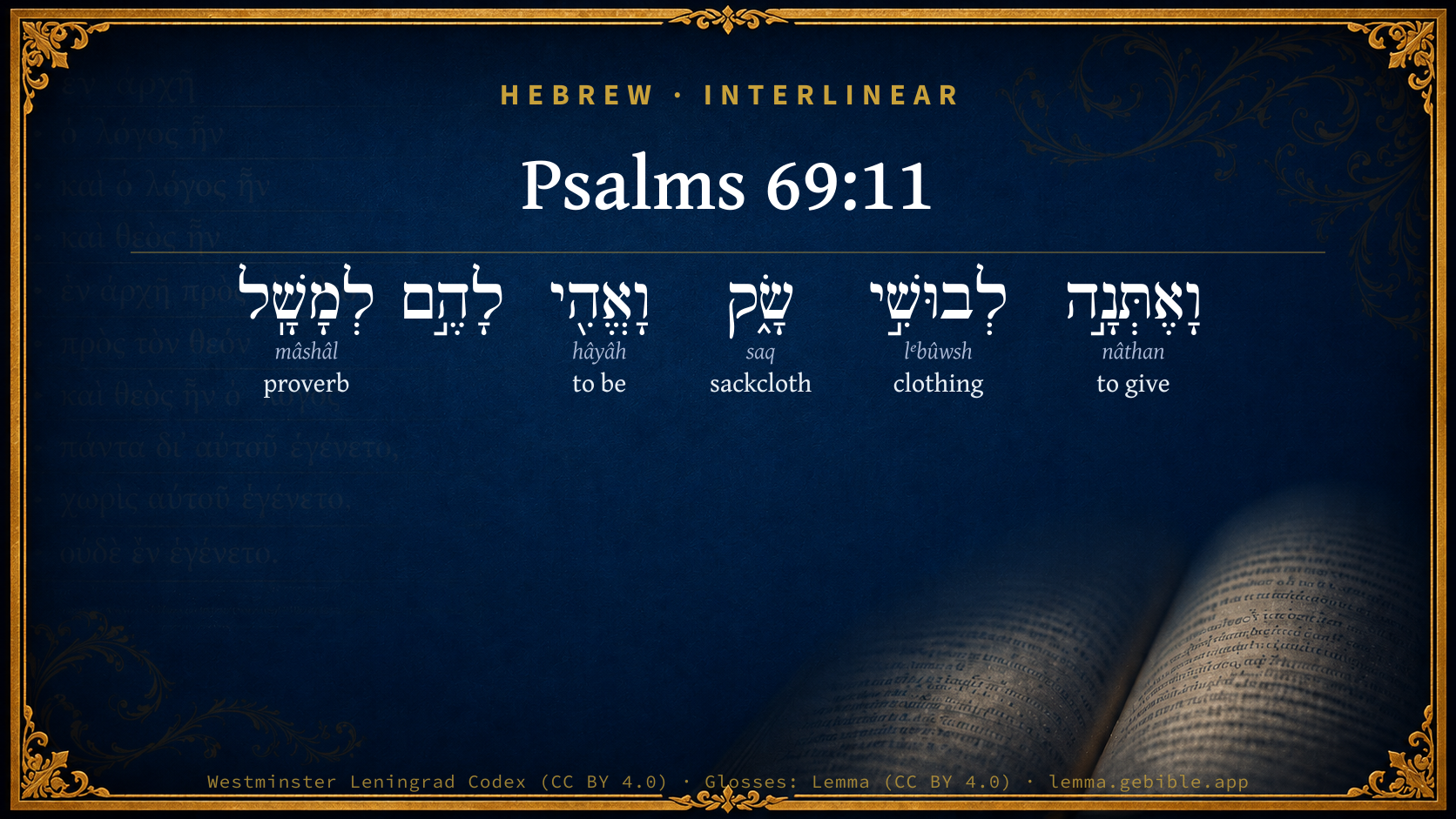
Psalms 69:11

Hebrew (Westminster Leningrad Codex) Psalms 69:11 appears in the Hebrew Old Testament. The text above is from the Westminster Leningrad Codex. Each word links to its Strong’s number, a concise gloss, and parsing drawn from the Open Scriptures Hebrew Bible morphology. Click any word for its full Brown-Driver-Briggs (BDB) entry.
Download image
Cite this verse

Psalms 69:11 (World English Bible). Public Domain. Lemma interlinear Bible study tool, https://lemma.gebible.app/v/psalms/69/11.

Show BibTeX & RIS
BibTeX
RIS
English Translation
When I made sackcloth my clothing, I became a byword to them.
World English Bible · Public Domain
Download a study sheet

One document with this verse’s original text, its word-by-word gloss line, the meaning frame, cross-references with their text, attributed commentary, and full source and license credits — printable, and it pastes into notes with its structure intact.

This verse Autodidact and up

Study sheet (.html) Plain text (.txt)

A passage Seminary Student

Up to 50 verses in one chapter. A passage sheet keeps up to 6 commentary sources and 12 cross-references per verse, in the order this page ranks them, and says so on the sheet whenever that leaves anything out. Ask for a single verse and you get the Autodidact verse sheet above.

Everything on this page stays free to read, with no account — the sheet is a download of what is already on screen, not access to it.

Want to remove ads? Support Godless Engineer
Compare translations 3

The same verse in 3 English versions, stacked beneath the original-language interlinear above. Click any original word for its lexicon entry.

Each is an independent rendering of the whole verse — the interlinear is not word-aligned to these translations.

Highlighted words mark where these versions differ — a whole-verse word diff, not a word-by-word alignment.

  • World English Bible Public Domain
    When I made sackcloth my clothing, I became a byword to them.
  • King James Version Public Domain
    I made sackcloth also my garment; and I became a proverb to them.
  • unfoldingWord Literal Text CC BY-SA 4.0
    though I made my clothing sackcloth, yet I became a proverb to them.

unfoldingWord Literal Text — © unfoldingWord, licensed CC BY-SA 4.0. Word-aligned USFM3 via Door43 (git.door43.org/unfoldingWord/en_ult).

Versions to compare (up to 4)

3 of 4 selected

Show all 18 translations

Every available English version of this verse, each an independent rendering of the whole verse.

  • World English Bible Public Domain
    When I made sackcloth my clothing, I became a byword to them.
  • Berean Standard Bible Public Domain
    I made sackcloth my clothing, and I was sport to them.
  • Majority Standard Bible Public Domain
    I made sackcloth my clothing, and I was sport to them.
  • King James Version Public Domain
    I made sackcloth also my garment; and I became a proverb to them.
  • American Standard Version (1901) Public Domain
    When I made sackcloth my clothing, I became a byword unto them.
  • Revised Version (1885) Public Domain
    When I made sackcloth my clothing, I became a proverb unto them.
  • Geneva Bible (1599) Public Domain
    I put on a sacke also: and I became a prouerbe vnto them.
  • Douay-Rheims (1899) Public Domain
    And I covered my soul in fasting: and it was made a reproach to me.
  • Young's Literal Translation Public Domain
    And I make my clothing sackcloth, And I am to them for a simile.
  • Literal Standard Version CC BY-SA 4.0
    And I make my clothing sackcloth, || And I am for an allegory to them.
  • Unlocked Literal Bible CC BY-SA 4.0
    When I made sackcloth my clothing, I became the object of a proverb to them.
  • unfoldingWord Literal Text CC BY-SA 4.0
    though I made my clothing sackcloth, yet I became a proverb to them.
  • Darby Bible Public Domain
    And I made sackcloth my garment: then I became a proverb to them.
  • World Messianic Bible Public Domain
    When I made sackcloth my clothing, I became a byword to them.
  • Webster's Bible Public Domain
    \\69:10\\When I wept, and chastened my soul with fasting, that was to my reproach.
  • Free Bible Version CC BY-SA 4.0
    I mourned in sackcloth, but they laughed at me.
  • Bible in Basic English Public Domain
    When I put on the clothing of grief, they said evil of me.
  • JPS Tanakh (1917) Public Domain
    (69-12) I made sackcloth also my garment, and I became a byword unto them.

Literal Standard Version (2020), Covenant Press — licensed CC BY-SA 4.0. Text via the HelloAO Bible API (eBible.org). Unlocked Literal Bible (unfoldingWord) — licensed CC BY-SA 4.0. Text via the HelloAO Bible API (eBible.org). unfoldingWord Literal Text — © unfoldingWord, licensed CC BY-SA 4.0. Word-aligned USFM3 via Door43 (git.door43.org/unfoldingWord/en_ult). Free Bible Version, Dr. Jonathan Gallagher — licensed CC BY-SA 4.0. Text via the HelloAO Bible API (eBible.org).

Word by word

More ways to search: Search by grammar → Find every occurrence → Compare this word →

Practice this passage: Drill this verse → Learn its vocabulary →

About this verse

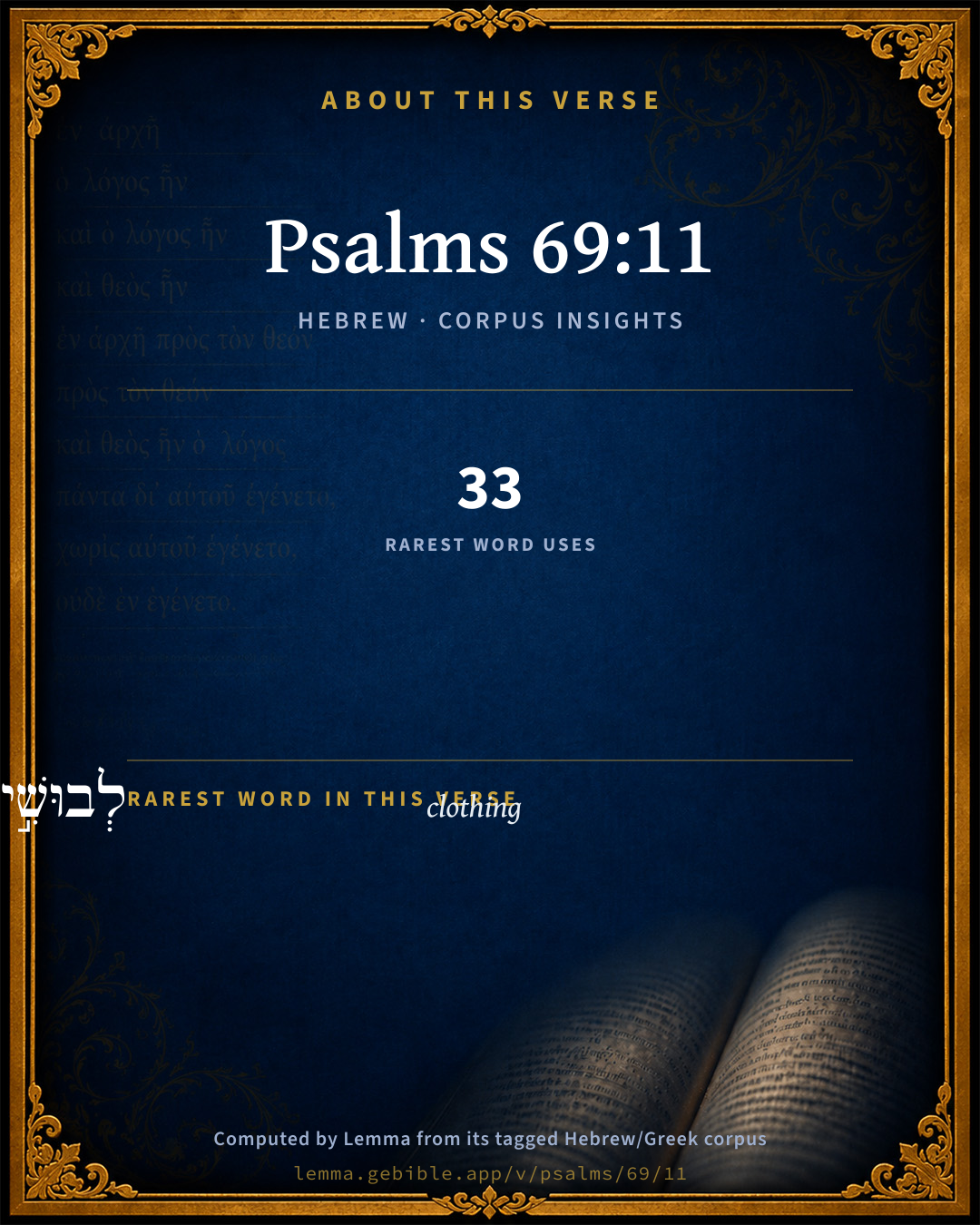
These counts appear in no published source. They are computed here, from the morphology-tagged text and Lemma’s own curated glosses. What Lemma adds →

6
words
5
distinct lemmas
Wisdom
section

Shared distinctive vocabulary

לְבוּשִׁ֣י clothing H3830 occurs in 33 verses of the Hebrew Bible. Also found in:

Grammatical profile

  • 2 verbs
  • 3 nouns
  • 1 preposition

Verb forms

  • וָאֶתְּנָ֣ה Qal · Sequential Imperfect
  • וָאֱהִ֖י Qal · Sequential Imperfect

Hebrew & Septuagint length

In English translation the verse runs 12 words from the Hebrew and 15 from the Septuagint (LXX English) — closely comparable.

A rough comparison of the two English renderings, which tokenize alike — not a word-level alignment.

Word counts can differ between the Hebrew and the Greek without any difference in meaning — e.g. the Hebrew direct-object marker אֵת has no separate Greek word, and Greek often adds the article ὁ.

Cross-references

10

Topical passages linked to Psalms 69:11 in the Treasury of Scripture Knowledge — connected by theme and wording, ordered by reader-vote popularity; previews shown in the World English Bible.

  • 1 Kings 9:7 then will I cut off Israel out of the land which I have given them; and this house, which I have made holy for my name, will I cast out of my sight; and Israel shall be a proverb and a byword among all peoples.
  • Job 17:6 "But he has made me a byword of the people. They spit in my face.
  • Jeremiah 24:9 I will even give them up to be tossed back and forth among all the kingdoms of the earth for evil; to be a reproach and a proverb, a taunt and a curse, in all places where I shall drive them.
  • Deuteronomy 28:37 You shall become an astonishment, a proverb, and a byword, among all the peoples where Yahweh shall lead you away.
  • Psalms 35:13–14 But as for me, when they were sick, my clothing was sackcloth. I afflicted my soul with fasting. My prayer returned into my own bosom.
  • Psalms 44:13–14 You make us a reproach to our neighbors, A scoffing and a derision to those who are around us.
  • Isaiah 20:2 at that time Yahweh spoke by Isaiah the son of Amoz, saying, Go, and loose the sackcloth from off your loins, and put your shoe from off your foot. He did so, walking naked and barefoot.
  • Isaiah 22:12 In that day did the Lord, Yahweh of Hosts, call to weeping, and to mourning, and to baldness, and to girding with sackcloth:
  • Joel 1:8 Mourn like a virgin dressed in sackcloth for the husband of her youth!
  • Joel 1:13 Put on sackcloth and mourn, you priests! Wail, you ministers of the altar. Come, lie all night in sackcloth, you ministers of my God, For the meal offering and the drink offering are withheld from your God's house.

Cross-references courtesy of OpenBible.info (CC BY 4.0).

Hebrew and Greek witnesses Masoretic Hebrew ↔ Greek Septuagint

The same verse in the two great witnesses to the Old Testament, shown verse-for-verse.

You’re reading Greek Psalm 68 (Hebrew Psalm 69). The Septuagint counts the superscription, so verse numbers can differ from the Hebrew — chapter-level alignment, not verse-by-verse. Numbering follows Rahlfs.

These are two independent witnesses, not word-aligned to each other, and the Septuagint is shown in lemma (dictionary) form.

Hebrew Psalms 69:11 Masoretic · Westminster Leningrad Codex

וָאֶתְּנָ֣ה לְבוּשִׁ֣י שָׂ֑ק וָאֱהִ֖י לָהֶ֣ם לְמָשָֽׁל

When I made sackcloth my clothing, I became a byword to them.

World English Bible · Public Domain

Greek LXX Greek Psalm 68:11 Septuagint · lemma form

καί συνκάμπτω ἐν νηστεία ὁ ψυχή ἐγώ καί γίγνομαι εἰς ὀνειδισμός ἐγώ

And I put on sackcloth for my covering; and I became a proverb to them.

LXX2012 (modern English Septuagint) · Public Domain

Hebrew: Westminster Leningrad Codex (CC BY 4.0). Greek: Septuagint (public domain); English from LXX2012 (modern English Septuagint) (Public Domain). How the Septuagint differs from the Hebrew →

Commentary

Notes on Psalms 69:11 from classic Christian and Jewish commentators (each source and its license shown beneath its notes). The classic Christian expositions comment on the surrounding passage and are grouped to its opening verse, so a note may address several verses; the Jewish commentaries on the Tanakh (Rashi and others) are per-verse, so they appear only where the commentator wrote on this verse.

Lemma curates 59 commentaries, every one of them public domain or Creative Commons licensed, each selected and text-cleaned for this edition rather than reprinted as found. About our sources →

Trapp's Complete Commentary

John Trapp

Psa 69:11 I made sackcloth also my garment; and I became a proverb to them.

Ver. 11. I made sackcloth also my garment] A fashion at solemn fasts among the Easterlings; as if they thought the coarsest clothing too good for them; and but for shame would have gone stark naked.

I became a proverb to them] Dicterium. They would say, with mocking Michal, "How glorious was the king of Israel today, as one of the vain fellows!" 2Sa 6:20.

John Trapp, A Commentary or Exposition upon All the Books of the Old and New Testament (1647–1656) — public domain. Text from a community e-Sword module.

J. A. Alexander on Psalms

Joseph Addison Alexander

12. (Psa 69:11). And I gave, put on (as) my clothing, sackcloth, and was to them, in consequence, for a comparison, a proverb, by-word, or became a by-word to them. See above, on Psa 35:13, and Psa 44:14. The context makes it probable that the mourning described in this and the preceding verse was not in reference to his own sufferings merely, but to the sins of the whole people.

Joseph Addison Alexander, The Psalms Translated and Explained (1850) — public domain. Text from a community e-Sword module.

John Gill's Exposition

I made sackcloth also my garment,.... Though we nowhere read that Jesus put on sackcloth upon any occasion, yet it is not improbable that he did; besides, the phrase may only intend that he mourned and sorrowed at certain times, as persons do when they put on sackcloth: moreover, as the common garb of his forerunner was raiment of camels' hair, with a leathern girdle; so it is very likely his own was very mean, suitable to his condition; who, though he was rich, for our sakes became poor;

and I became a proverb to them; a byword; so that when they saw any person in sackcloth, or in vile raiment, behold such an one looks like Jesus of Nazareth.

John Gill's Exposition of the Whole Bible (1746–1763) — public domain (CC PDM 1.0). Text via the HelloAO Bible API.

Albert Barnes' Notes on the Bible

I made sackcloth also my garment - I put on sackcloth. This was often done as expressive of grief and sorrow. See Psa 30:11, note; Psa 35:13, note. Compare Isa 22:12; Dan 9:3. In the case here referred to, this was an act of religion; an expression of penitence and humiliation.

And I became a proverb to them - A jest; a subject of derision; a by-word. They ridiculed me for it. Compare 1Ki 9:7.

Albert Barnes' Notes on the Bible (1834–1885) — public domain. Text from a community e-Sword/MySword module.

Matthew Poole's English Annotations

My garment; wearing it next to my skin, in token of my humiliation and hearty sorrow, as the manner then was in days of fasting.

A proverb to them; they used my name proverbially of any person whom they thought vainly and foolishly religious.

Matthew Poole's English Annotations on the Holy Bible (1683–1685) — public domain. Text from a community e-Sword/MySword module.

The Treasury of David

Charles H. Spurgeon

Ver. 11. I made sackcloth also my garment. This David did literally, but we have no reason to believe that Jesus did. In a spiritual sense he, as one filled with grief, was always a sackcloth wearer.

And I became a proverb to them. He was ridiculed as "the man of sorrows, "quoted as "the acquaintance of grief." He might have said, "here I and sorrow sit." This which should have won him pity only earned him new and more general scorn. To interweave one's name into a mocking proverb is the highest stretch of malice, and to insult one's acts of devotion is to add profanity to cruelty.

Ver. 11. I made sackcloth also my garment, etc. Though we nowhere read that Jesus put on sackcloth on any occasion, yet it is not improbable that he did; besides, the phrase may only intend that he mourned and sorrowed at certain times, as persons do when they put on sackcloth; moreover, as the common garb of his forerunner was raiment of camel's hair, with a leathern girdle; it is very likely his own was very mean, suitable to his condition, who, though he was rich, for our sakes became poor. And I became a proverb to them; a byword; so that, when they saw any person in sackcloth or in vile raiment, behold, such an one looks like Jesus of Nazareth. John Gill.

Ver. 11. I became a proverb. Two things are usually implied when a man is said to be a byword. First, that he is in a very low condition: some men are so high that the tongues of the common people dare not climb over them, but where the hedge is low every man goes over. Secondly, that he is in a despised condition; to be a byword, carries a reflection of disgrace. He that is much spoken of, in this sense, is ill spoken of; and he is quite lost in the opinion of men, who is thus found in their discourse... Hence, observe, great sufferers in many things of this world, are the common subject of discourses, and often the subject of disgrace. Such evils as few men have felt or seen, all men will be speaking of. Great sorrows, especially if they be the sorrows of great men, are turned into songs, and poetry plays its part with the saddest disasters... Holy David met with this measure from men in the day of his sorrows: When I wept, and chastened my soul with fasting, that was to my reproach. I made sackcloth also my garment; and I became a proverb (or a byword) to them. In the next verse he tells us in detail who did this: They that sit in the gate (that is, great ones) speak against me, and I was the song of the drunkard, that is, of the common sort. Joseph Caryl.

Ver. 10-12. A prophecy.

I. Of the Saviour's tears: When I wept.

II. Of his fasting.

III. Of reproach.

IV. Of his humiliation: I made sackcloth, etc.

V. Of the perversion of his words: as, "I will destroy

this temple, "etc.

VI. Of the opposition of the Pharisees, and rulers: They

that sit in the gate, etc.

VII. Of the contempt of the lowest of the people: I was

the song, etc. G. R.

Ver. 11. Proverbial sayings of a scoffing character.

Psalms 69:12*

Charles H. Spurgeon's The Treasury of David (1869–1885) — public domain. Psalms only. Text from a community e-Sword/MySword module.

The Pulpit Commentary

I made sackcloth also my garment; (see Psa_30:12 Psa_35:13) and I became a proverb to them; or, a byword, as the same word, mashal, is rendered in Psa_44:14.

The Pulpit Commentary (1880–1919), ed. H.D.M. Spence-Jones & Joseph S. Exell — public domain. Text from a community e-Sword module.

John Wesley's Explanatory Notes

Proverb - A proverb of reproach.

John Wesley, Explanatory Notes Upon the Whole Bible (1754–1765) — public domain. Text via the GEBible commentary corpus.

Rashi

Rabbi Shlomo Yitzchaki (Rashi)

And I bewailed my soul in fast In my fast.

and it was a disgrace for me When I weep and fast before You, they mock me.

Rashi on the Tanakh — English translations: “The Judaica Press complete Tanach with Rashi, translated by A. J. Rosenberg” (CC BY 4.0); “Pentateuch with Rashi's commentary by M. Rosenbaum and A.M. Silbermann, 1929-1934” (public domain); “The Metsudah Tanach series, Lakewood, N.J” (CC BY 4.0); and “The Book of Joshua, Metsudah Publications, 1997” (CC BY 4.0). Text via Sefaria.

Lesson kit

Teaching starters — assembled from the data on this page, not authored interpretation. Every prompt links to the verse data it draws on. Edit before teaching.

Psalms, in the Wisdom, opens this verse with 6 words (5 distinct Hebrew lemmas). Its most distinctive word is lᵉbûwsh (“clothing”). A historical commentator’s framing appears above. Read the whole chapter for the surrounding context.

Discussion questions

  1. What does “clothing” (lᵉbûwsh) contribute to the verse as a whole?
  2. How does Genesis 49:11, which shares the word «clothing», read alongside this verse?
  3. These translations render this verse differently. What is at stake in choosing one wording over another?
  4. «וָאֶתְּנָ֣ה» is a Qal Sequential Imperfect verb. How does that grammatical form shape the action described?
  5. Compare how Trapp's Complete Commentary and J. A. Alexander on Psalms read this verse. Where do they agree or differ?

Things to notice

Reading settings

Reading text

Shown beneath each verse's original-language words.

Old Testament
Old Testament edition

Read the OT as the Masoretic Hebrew (MT) or the Greek Septuagint (LXX).

English shown for the Greek Septuagint (in the Hebrew ↔ Greek comparison).

Comparing translations? Open the Compare panel on any verse page to stack up to four side by side.