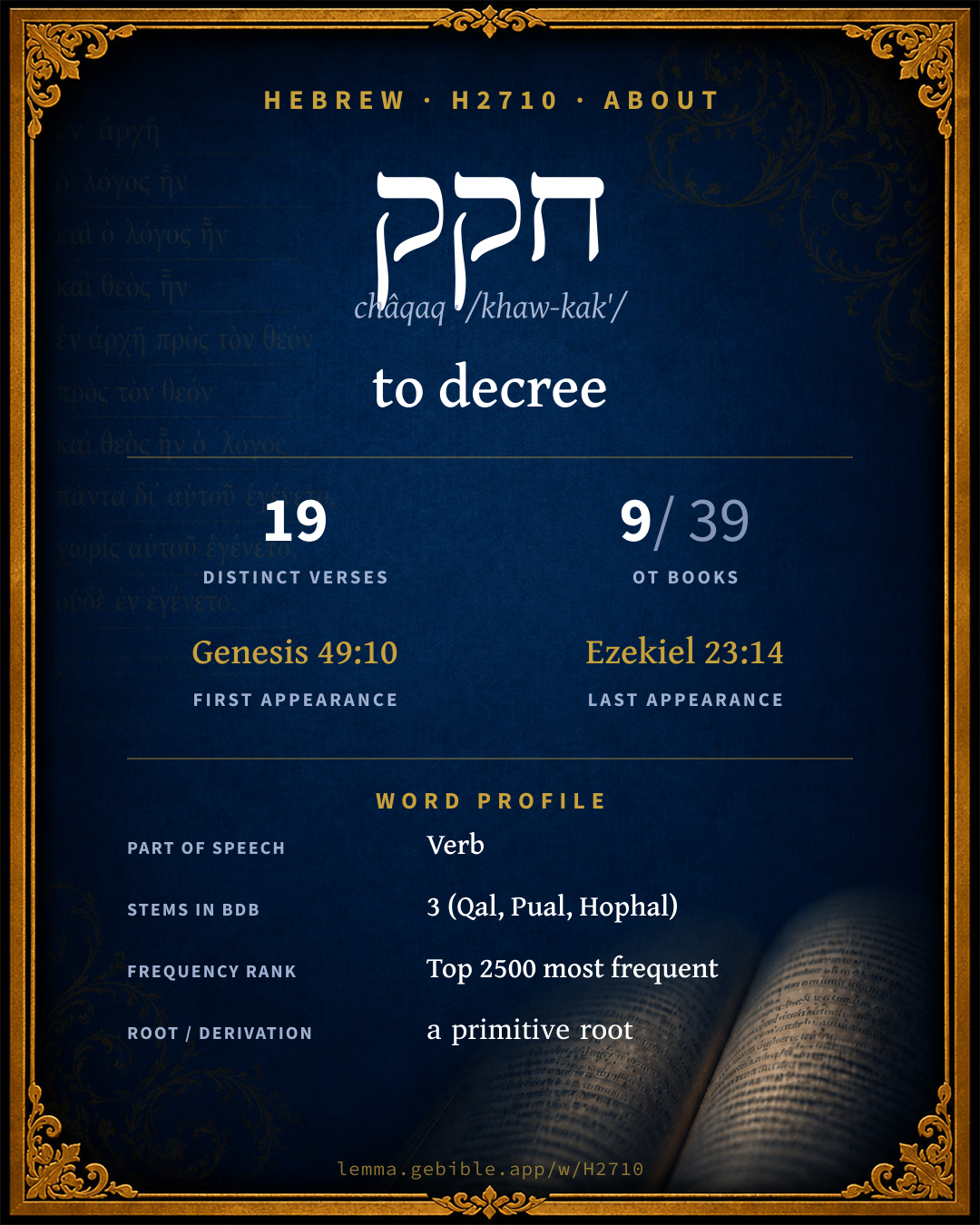
חָקַק
to decree
‘to decree’ is one of 3 main senses fuller range ↓
Full lexicon entry — Brown-Driver-Briggs (BDB)
From Brown-Driver-Briggs (BDB)
Where this word appears
See every Qal verb in the Hebrew Bible →
Grammar key — what these labels mean
Part of speech
- Verb
- An action or state-of-being word.
Stem
- Qal
- The basic, simple active stem — the plain form of the verb (“he wrote”). Here: ‘cut in’
- Piel
- An intensive or resultative active stem.
- Hophal
- The passive counterpart of the Hiphil (“he was caused to…”).
- Pual
- The passive counterpart of the Piel.
Form
- Infinitive Construct
- A bound verbal noun, frequently with prepositions (“to write / in writing”).
- Participle Active
- A verbal adjective expressing ongoing or characteristic action (“writing / one who writes”).
- Imperfect
- An incomplete, ongoing, or future action (“he will / would write”).
- Sequential Perfect
- A perfect with prefixed waw continuing a preceding imperfect or command (waw-consecutive perfect).
- Participle Passive
- A verbal adjective expressing action received (“written”).
- Perfect
- A completed action or state — Hebrew marks aspect (completeness) more than strict tense (“he wrote”).
- Imperative
- A direct command (“write!”).
State
- Construct
- A noun bound to a following noun in a possessive / “of” relationship (the construct chain).
- Absolute
- The independent form of a noun, not bound to a following word.
Person
- 3rd Person
- The one spoken about (“he / she / it / they”).
- 2nd Person
- The one addressed (“you”).
- 1st Person
- The speaker (“I / we”).
Gender
- Masculine
- Grammatically masculine.
- Common
- Either gender — not distinguished for this form.
Number
- Singular
- One.
- Plural
- More than one (in Hebrew, generally three or more).
Grammatical forms 15 distinct
- Verb, Poel, Participle Active, Masculine, Singular, Absolute 3 times (16%)
- Verb, Qal, Infinitive Construct 2 times (11%)
- Verb, Piel, Participle Active, Masculine, Singular, Construct 2 times (11%)
- Verb, Hophal, Imperfect, 3rd Person, Masculine, Plural 1 time (5%)
- Verb, Qal, Sequential Perfect, 2nd Person, Masculine, Singular 1 time (5%)
- Verb, Qal, Participle Active, Masculine, Plural, Construct 1 time (5%)
- Verb, Qal, Participle Active, Masculine, Plural, Absolute 1 time (5%)
- Verb, Pual, Participle Passive, Masculine, Singular, Absolute 1 time (5%)
+7 more forms (7 occurrences)
Parsed forms decoded from the imported morphology (morphhb / Westminster Leningrad Codex — WLC text public domain, morphhb tagging CC BY 4.0), counted across 19 parsed occurrences — not distinct verses.
Every verse where H2710 appears — 19 distinct verses across 9 books. Click any verse to open its interlinear word-by-word view. Verse text shown in the World English Bible for context — . Each verse’s Hebrew form is shown with its reference; the English is not keyword-highlighted, since the data carries no word-level English alignment. Use “Compare translations” on any verse to read it across multiple English versions. This concordance covers the Hebrew Bible; Septuagint (Greek Old Testament) occurrences are not indexed here.
Genesis 1 verse
Numbers 1 verse
Deuteronomy 1 verse
Judges 2 verses
- Judges 5:9 לְ/חוֹקְקֵ֣י prep + Qal ptcp.act mp cs My heart is toward the governors of Israel, Who offered themselves willingly among the people: Bless you Yahweh.
- Judges 5:14 מְחֹ֣קְקִ֔ים Poel ptcp.act mp Out of Ephraim [came down] they whose root is in Amalek; After you, Benjamin, among your peoples; Out of Machir came down governors, Out of Zebulun those who handle the marshal's staff.
Job 1 verse
Psalms 2 verses
Proverbs 4 verses
- Proverbs 8:15 יְחֹ֣קְקוּ Poel impf 3mp By me kings reign, And princes decree justice.
- Proverbs 8:27 בְּ/ח֥וּק/וֹ prep + Qal inf.cs + sfx pers 3ms When he established the heavens, I was there; When he set a circle on the surface of the deep,
- Proverbs 8:29 בְּ֝/חוּק֗/וֹ prep + Qal inf.cs + sfx pers 3ms When he gave to the sea its boundary, That the waters should not violate his commandment, When he marked out the foundations of the earth;
- Proverbs 31:5 מְחֻקָּ֑ק Pual ptcp.pass ms Lest they drink, and forget the law, And pervert the justice due to anyone who is afflicted.
Isaiah 5 verses
- Isaiah 10:1 הַ/חֹֽקְקִ֖ים ptcl def.art + Qal ptcp.act mp Woe to those who decree unrighteous decrees, and to the writers who write perverseness;
- Isaiah 22:16 חֹקְקִ֥י Qal ptcp.act ms cs "What are you doing here? and who has you here, that you have hewed out a tomb here? Cutting him out a tomb on high, chiseling a habitation for himself in the rock!"
- Isaiah 30:8 חֻקָּ֑/הּ Qal impv 2ms + sfx pers 3fs Now go, write it before them on a tablet, and inscribe it in a book, that it may be for the time to come forever and ever.
- Isaiah 33:22 מְחֹקְקֵ֑/נוּ Poel ptcp.act ms cs + sfx pers 1cp For Yahweh is our judge, Yahweh is our lawgiver, Yahweh is our king; he will save us.
- Isaiah 49:16 חַקֹּתִ֑י/ךְ Qal pf 1cs + sfx pers 2fs Behold, I have engraved you on the palms of my hands; your walls are continually before me.
Ezekiel 2 verses
- Ezekiel 4:1 וְ/חַקּוֹתָ֥ conj + Qal wpf 2ms You also, son of man, take a tile, and lay it before you, and portray on it a city, even Jerusalem:
- Ezekiel 23:14 חֲקֻקִ֖ים Qal ptcp.pass mp She increased her prostitution; for she saw men portrayed on the wall, the images of the Chaldeans portrayed with vermilion,
About this entry
At a glance — auto-summarized from this page’s data, not written by a person. Every figure links to its source below. This summary describes the numbers; it doesn’t interpret them.
“to decree” is the headline sense of the Hebrew verb חקק (châqaq). First canonically at Genesis 49:10, it enters the text early. With 19 verses in 9 books, it is an uncommon word in the Hebrew Bible. It concentrates in Isaiah, which alone accounts for 26% of its uses. Different stems carry different senses — BDB groups them under 3 stems, among them Qal and Pual. See the sense tree, 19-verse concordance, and the renderings breakdown below.
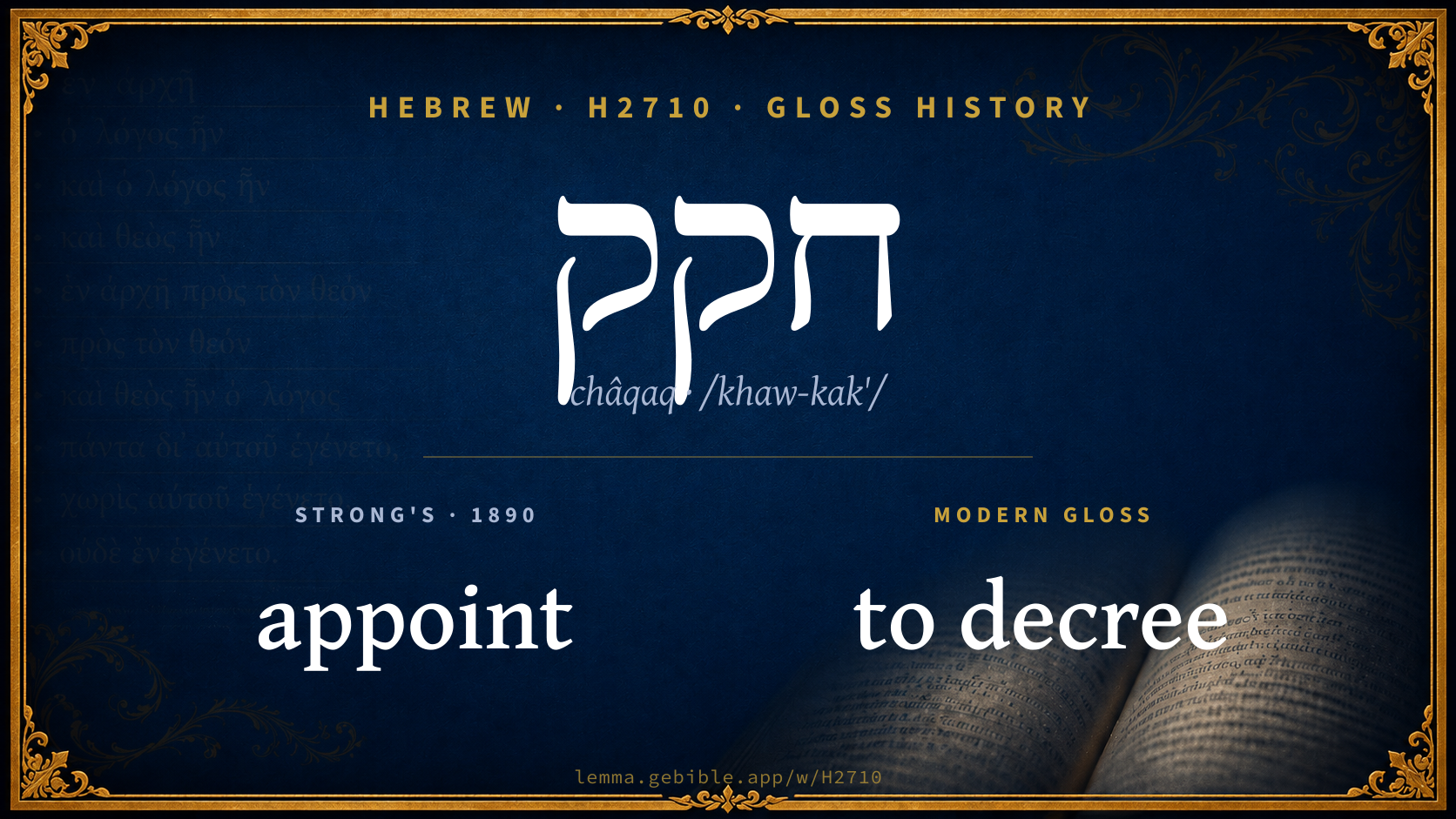
Gloss history
Strong's 1890 vs modern scholarship
About this word
Strong's H2710 catalogs a Hebrew word from the Hebrew Old Testament.
These counts are not copied from any lexicon or concordance. They are computed here, from the morphology-tagged Hebrew Old Testament. What Lemma adds →
- 19
- distinct verses
- The word appears in 19 distinct verses.
- 9 / 39
- OT books
- The word appears in 9 of 39 Old Testament books.
- #1,563
- by frequency
- Top 2500 most frequent Hebrew words (rank 1,563 of 8,640 Hebrew words by occurrence).
View all 19 occurrences in the concordance →
By section of the Old Testament
By traditional corpus
Conventional, traditional groupings — biblical authorship is debated, so this is a traditional corpus grouping, not an authorship claim. Each share is this word’s portion of its verses in that division of the Hebrew canon. Each figure is a share of the word’s 19 distinct verses.
- Prophets (Nevi'im) 9 verses · 47%
- Writings (Ketuvim) 7 verses · 37%
- Torah (Pentateuch) 3 verses · 16%
How translations render this word
Counts come from each version’s own published word-to-Strong’s tagging or interlinear alignment — an approximate guide to how each version renders this word, not a word-level alignment the data otherwise carries. Because each total is that version’s own tagged count, the per-version totals vary from one another and need not match the appearance or distinct-verse counts above. These counts may also differ from a printed concordance because Lemma counts each distinctly tagged rendering and does not collapse phrase taggings into a single head-word total. This is a fixed set of word-tagged versions (KJV, ASV, BSB, ULT) and does not change with the reading translation you choose elsewhere. Each version’s license is shown beside its name below (and on Sources).
- King James Version: Decree 2×, Is my lawgiver 2×, Lawgiver 2×
- American Standard Version: Decree 2×, Is my sceptre 2×
- Berean Standard Bible: Scepter 2×
- unfoldingWord Literal Text: Scepter 3×, He inscribed 2×
King James Version Public Domain
Renders H2710 across 19 tagged occurrences — most commonly:
Plus 13 renderings that appear only once — usually multi-word phrases or single function words the recovered tagging swept in, not distinct renderings.
American Standard Version Public Domain
Renders H2710 across 18 tagged occurrences — most commonly:
Plus 14 renderings that appear only once — usually multi-word phrases or single function words the recovered tagging swept in, not distinct renderings.
Berean Standard Bible Public Domain
Renders H2710 across 19 tagged occurrences — most commonly:
Plus 17 renderings that appear only once — usually multi-word phrases or single function words the recovered tagging swept in, not distinct renderings.
unfoldingWord Literal Text CC BY-SA 4.0
Renders H2710 across 19 tagged occurrences — most commonly:
Plus 14 renderings that appear only once — usually multi-word phrases or single function words the recovered tagging swept in, not distinct renderings.
9 senses and sub-senses in the full BDB
Hebrew verbs can shift meaning by stem (binyan): Qal is the basic action, Niphal is often passive or reflexive, Piel often intensifies or makes it factitive, and Hiphil is typically causative. The senses below are grouped under the stem BDB assigns to each. This entry also uses Pual (the passive of Piel) and Hophal (the passive of Hiphil).
What do BDB’s symbols mean?
BDB uses these scholarly abbreviations:
| Symbol | Meaning |
|---|---|
| 𝔊 | the Septuagint (the ancient Greek translation, LXX) |
| 𝔙 | the Vulgate (the Latin translation) |
| 𝔖 | the Syriac version (the Peshitta) |
| 𝔗 | the Targum (the Aramaic translation) |
| ψ | the Psalms |
| √ | root (the underlying root or stem) |
| ‖ | parallel passage (a synonymous or contrasted parallel) |
| † | the dagger: every passage where the word occurs is cited |
The 9 senses and sub-senses the full Brown-Driver-Briggs lexicon distinguishes for this word, in lexicon order (not ranked by frequency), with BDB’s own verbatim wording and sub-sense lettering. Shown in Hebrew script with BDB’s own scholarly abbreviations. The condensed entry is in the Lexicon Entry tab. See also the Forms in the corpus table below.
Qal
- וְחַקּוֹתָ֫ Ez 4:1; sf. חַקֹּתִיךְ Is 49:16; Inf. sf. בְּחֻקּוֹ Pr 8:27; בְּחוּקוֹ Pr 8:29 (assim. to בְּשׂוּמוֹ); Imv. חֻקָּהּ Is 30:8; Pt. חֹקְקִי Is 22:16 (archaic ending Ges§ 90. 3a) pl. חֹקְקִים Is 10:1; cstr. חוֹקְקֵי Ju 5:9 (poss. Poʿel = מחוקקי with מְ omitted, v. Ges§ 52 (2), note 6); Pt. pass. pl. חֲקֻקִֿים Ez 23:14 (Co חקוקים);— e.g. Ezekiel 4:1
- 1. cut in, with בְּ, Is 22:16, of a dwelling-place = tomb, in a rock. e.g. Isaiah 22:16
- 2. cut in or on, upon, engrave, inscribe, c. על on roll of a book Is 30:8; representation of city on brick (as in Babylonia) Ez 4:1; images on a wall Ez 23:14; fig. of Zion’s walls on palms of י׳ Is 49:16. e.g. Isaiah 30:8
- 3. trace, mark out, a circle, c. על over the face of deep Pr 8:27; c. acc., foundations of earth v 29. e.g. Proverbs 8:27
- 4. of a law, engrave, inscribe (on a tablet), fig. for enact, decree חקקים חקקי און Is 10:1 (‖ כתב עמל); חוֹקְקֵי ישׂראל poet. = commanders (v. Poʿel) Ju 5:9 (‖ מחקקים) v 14). Poʿel Impf. יְחוֹקְקוּ Pr 8:15; Pt. מְחֹקֵק Gn 49:10; Nu 21:18; Dt 33:21; sf. מְחֹקְקִי ψ 60:9; 108:9; מְחֹקְקֵנוּ Is 33:22; pl. מְחֹקְקִים Ju 5:14;—inscribe (as a law), enact (poet.): c. acc. צֶדֶק Pr 8:15 elsewhere pt. e.g. Isaiah 10:1
- a. prescriber of laws, hence (as sovereign authority in a warlike clan) commander Dt 33:21 (of warlike tribe of Gad), Ju 5:14; Is 33:22 (of י׳; ‖ שֹׁפְטֵנוּ, מַלְכֵּנוּ). e.g. Deuteronomy 33:21
- b. commander’s staff Gn 49:10 (‖ שֵׁבֶט), Nu 21:18 (both poet.), ψ 60:9 = 108:9. e.g. Genesis 49:10
Pual
- Pt. מְחֻקָּק that which is decreed Pr 31:5 (late). e.g. Proverbs 31:5
Hophal
- Impf. יֻחָ֑קֿוּ Jb 19:23 inscribed in (בְּ) a book. e.g. Job 19:23
Senses from the full Brown-Driver-Briggs lexicon (Brown, Driver, Briggs; Oxford 1906 — public domain), digitized via Sefaria, supplemented by the OpenScriptures HebrewLexicon (CC BY 4.0). Full attribution on Sources.
Word origin
vb. cut in, inscribe, decree (NH id., Aramaic חֲקַק, Zinj. חקק; Ph. id. Pt. Hiph.; Arabic حَقَّ be just, right, obligatory, also make or decide to be just, etc.; حَقٌّ justness, truth, necessity, obligation; Ethiopic ሕቅ: adj. moderate, sufficient; cf. also חקה)—
— Brown-Driver-Briggs (Oxford 1906, public domain), digitized via Sefaria, supplemented by the OpenScriptures HebrewLexicon (CC BY 4.0). See Sources.
Origin: a primitive root
Jastrow Dictionary
A second Hebrew/Aramaic lexicon for comparison, covering Aramaic and post-biblical (Talmudic, Targumic, Midrashic) usage that the biblical-Hebrew BDB does not. Matched by lemma rather than by Strong’s number, so a lemma may carry more than one Jastrow headword (shown separately below), and the entries cover usage well beyond the Bible.
חָקַק
- to draw a circle, to limit;
- 1. (denom. of חֹק) to legislate. Y. Kil. I, 27ᵇ top, a. e. שחָקַקְתִּי, v. חוֹק. Num. R. s. 19, beg., v. חוּקָּה; a. fr.
- 2. to hollow out, to shape a receptacle. Y. Bets. I, 60ᵇ bot. קערה שחֲקָקָהּ קוף a dish which an ape has hollowed out.—Part. pass. חָקוּק, f. חֲקוּקָה. Tosef. B. Bath. III, 1; B. Bath. 65ᵇ, a. e. מכתשת הח׳ the mortar which has been hollowed out (of stone &c.), opp. הקבועה stationary in the ground.
- 3. to engrave, write with the stilus. Tanḥ. Ki Thissa 14, v. הָרַט. Gitt. 20ᵃ וכתב ולא וח׳ ‘he writes’ (Deut. XXIV, 1) but not ‘he engraves’ (on tablets &c.). Ib. חָק תוכות he chisels out the surroundings (making the letters come out in relief); חק יריכות he digs the sides, i.e. he engraves the letters. Gen. R. s. 68; s. 78 שאיקונין שלך חֲקוּקָה וכ׳ whose picture is engraven above (in the heavenly throne). Y. Yoma IV, beg. 41ᵇ חֲקוּקִים היו the inscriptions were engraven (not written with ink). Y. Ned. VI, 40ᵃ top מפני צלמי … שחקוקים וכ׳ on account of the Chaldean images which were engraven on the walls (Ez. XXIII, 14); a. e. e.g. Deuteronomy 24:1
- to be hollowed out. Y. Erub. II, 20ᵃ top אם תֵּיחָקֵק if the block be hollowed out. Sot. 36ᵇ שיֵחָקֵק על וכ׳ (not שיחקוק) to have his name engraven on the jewels &c.; a. e.
חֲקַק
- Lev. R. s. 6 נטל … וחַקְקֵיה he took a reed and hollowed it out. Ḥull. 25ᵃ; Sabb. 103ᵃ חַק קפיזא וכ׳ he hollowed out &c., v. חֲטַט I.—Part. pass. חָקִיק, חֲקִיק engraven, marked. Targ. Y. Ex. XXVIII, 11 (Ar. חקיין). Targ. Y. Lev. XIX, 28 (h. text קעקע). Targ. Cant. II, 9; a. fr.
- to be engraven, to engrave itself. Targ. Y. Ex. XX, 2; 3.
A Dictionary of the Targumim, the Talmud Babli and Yerushalmi, and the Midrashic Literature (Marcus Jastrow; London, Luzac, 1903) — Public Domain. Digitized via Sefaria. Digitized via Sefaria. Full attribution on Sources.
Forms in the corpus
The 19 distinct written forms H2710 takes in the Hebrew Bible, most frequent first — each parse links to that stem’s occurrences in the concordance. Hebrew forms include their vowel points and cantillation, so a single lemma takes many written forms.
Same root — word family
Other BDB entries built from the same root as H2710, grouped by Strong’s listed origin. These share a root / origin per the lexicon — not necessarily a shared meaning. Each links to that word’s own entry.
Derived from this word
Proper names from this root
People and places named from this root — a name, not an additional meaning of the word.
Compare all same-root words → 1 of the same-root words is a proper name (a person or place). They share a root, not necessarily a meaning.
Septuagint verse parallels
This word appears in 19 verses that also exist in the Greek Old Testament (Septuagint), out of the 19 Hebrew verses it occurs in. You can read those verses in Greek by switching the Old Testament edition to the Septuagint.
Read these verses in the Septuagint
- Genesis 49:10
- Numbers 21:18
- Deuteronomy 33:21
- Judges 5:9
- Job 19:23
- Psalms 60:7
- Proverbs 8:15
- Isaiah 10:1
- Ezekiel 4:1
This is a verse-level parallel only — the same verses exist in both the Hebrew and Greek Old Testaments. No word-level Hebrew↔Greek correspondence is claimed: the data carries no such alignment, so no Greek word is shown as this Hebrew word’s translation. Coverage is not total — the Septuagint omits the deuterocanon and renumbers the Psalms, so some Hebrew verses have no direct Greek parallel.