
Ephesians 2:6

Greek (Tischendorf 8th ed.) Ephesians 2:6 appears in the Greek New Testament. The text above is from the Tischendorf 8th edition. Each word links to its Strong’s number and a concise gloss. Click any word for its full Thayer’s Greek Lexicon entry.
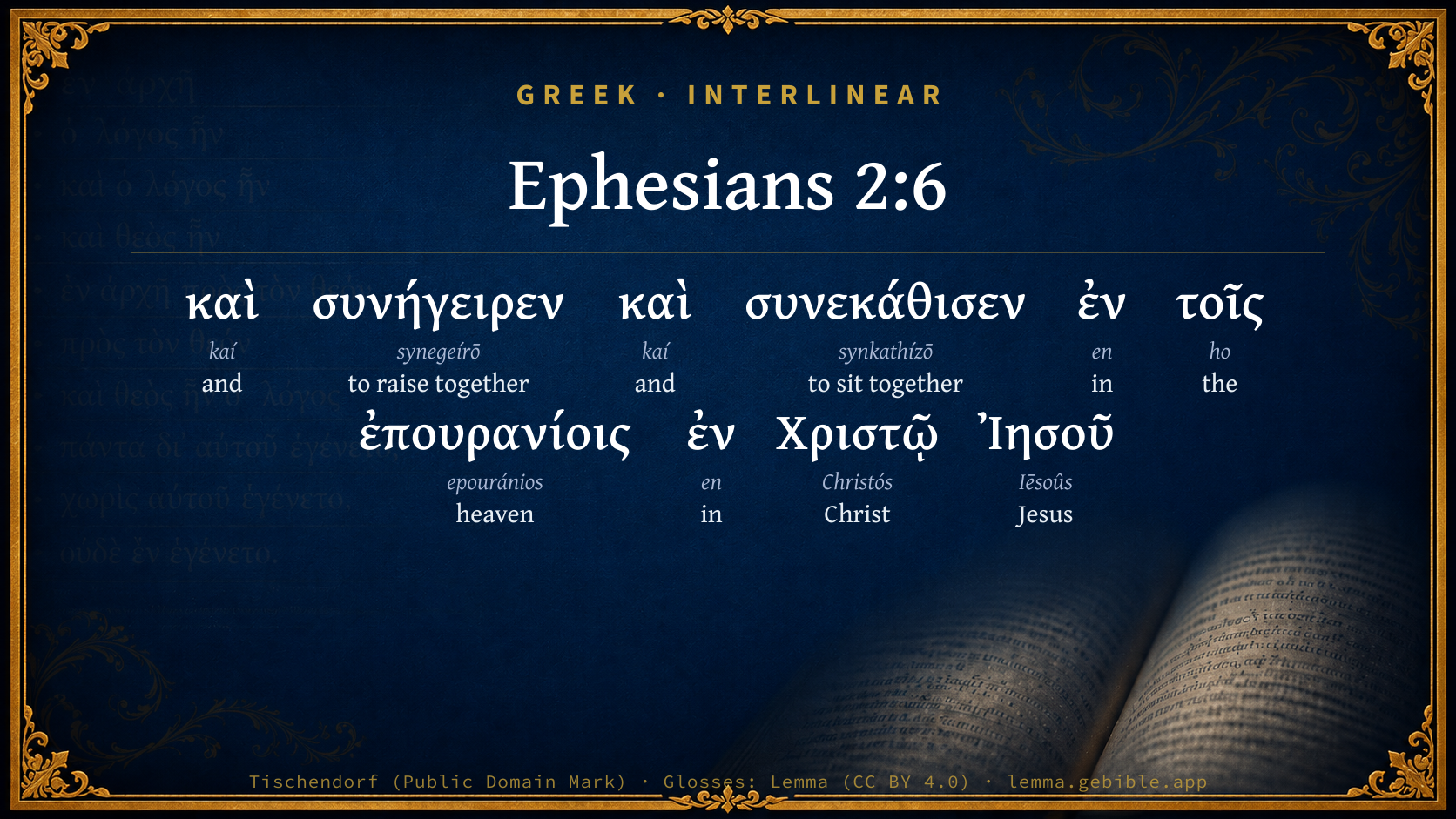
Download image
Cite this verse

Ephesians 2:6 (World English Bible). Public Domain. Lemma interlinear Bible study tool, https://lemma.gebible.app/v/ephesians/2/6.

Show BibTeX & RIS
BibTeX
RIS
English Translation
and raised us up with him, and made us to sit with him in the heavenly places in Christ Jesus,
World English Bible · Public Domain
Highlights
  • 1 first appearance in the Greek New Testament
Full analysis ↓
Download a study sheet

One document with this verse’s original text, its word-by-word gloss line, the meaning frame, cross-references with their text, attributed commentary, and full source and license credits — printable, and it pastes into notes with its structure intact.

This verse Autodidact and up

Study sheet (.html) Plain text (.txt)

A passage Seminary Student

Up to 50 verses in one chapter. A passage sheet keeps up to 6 commentary sources and 12 cross-references per verse, in the order this page ranks them, and says so on the sheet whenever that leaves anything out. Ask for a single verse and you get the Autodidact verse sheet above.

Everything on this page stays free to read, with no account — the sheet is a download of what is already on screen, not access to it.

Want to remove ads? Support Godless Engineer
Compare translations 3

The same verse in 3 English versions, stacked beneath the original-language interlinear above. Click any original word for its lexicon entry.

Each is an independent rendering of the whole verse — the interlinear is not word-aligned to these translations.

Highlighted words mark where these versions differ — a whole-verse word diff, not a word-by-word alignment.

  • World English Bible Public Domain
    and raised us up with him, and made us to sit with him in the heavenly places in Christ Jesus,
  • King James Version Public Domain
    And hath raised us up together, and made us sit together in heavenly places in Christ Jesus:
  • unfoldingWord Literal Text CC BY-SA 4.0
    and raised us up with and seated us with in the heavenly places in Christ Jesus,

unfoldingWord Literal Text — © unfoldingWord, licensed CC BY-SA 4.0. Word-aligned USFM3 via Door43 (git.door43.org/unfoldingWord/en_ult).

Versions to compare (up to 4)

3 of 4 selected

Show all 19 translations

Every available English version of this verse, each an independent rendering of the whole verse.

  • World English Bible Public Domain
    and raised us up with him, and made us to sit with him in the heavenly places in Christ Jesus,
  • Berean Standard Bible Public Domain
    And God raised us up with Christ and seated us with Him in the heavenly realms in Christ Jesus,
  • Majority Standard Bible Public Domain
    And God raised us up with Christ and seated us with Him in the heavenly realms in Christ Jesus,
  • King James Version Public Domain
    And hath raised us up together, and made us sit together in heavenly places in Christ Jesus:
  • American Standard Version (1901) Public Domain
    and raised us up with him, and made us to sit with him in the heavenly `places', in Christ Jesus:
  • Revised Version (1885) Public Domain
    and raised us up with him, and made us to sit with him in the heavenly places, in Christ Jesus:
  • Geneva Bible (1599) Public Domain
    And hath raysed vs vp together, and made vs sit together in the heauenly places in Christ Iesus,
  • Douay-Rheims (1899) Public Domain
    And hath raised us up together, and hath made us sit together in the heavenly places, through Christ Jesus.
  • Young's Literal Translation Public Domain
    and did raise `us' up together, and did seat `us' together in the heavenly `places' in Christ Jesus,
  • Literal Standard Version CC BY-SA 4.0
    and raised [us] up together, and sat [us] together in the heavenly [places] in Christ Jesus,
  • Unlocked Literal Bible CC BY-SA 4.0
    God raised us up together with Christ, and God made us sit together in the heavenly places in Christ Jesus,
  • unfoldingWord Literal Text CC BY-SA 4.0
    and raised us up with and seated us with in the heavenly places in Christ Jesus,
  • Darby Bible Public Domain
    and has raised [us] up together, and has made [us] sit down together in the heavenlies in Christ Jesus,
  • World Messianic Bible Public Domain
    and raised us up with him, and made us to sit with him in the heavenly places in Messiah Yeshua,
  • Webster's Bible Public Domain
    And hath raised us up together, and made us sit together in heavenly places, in Christ Jesus:
  • Free Bible Version CC BY-SA 4.0
    He raised us up with Christ, and in Christ Jesus seated us with him in heaven,
  • Bible in Basic English Public Domain
    So that we came back from death with him, and are seated with him in the heavens, in Christ Jesus;
  • Text-Critical English NT CC BY 4.0
    And God raised us up with Christ and seated us with him in the heavenly places in Christ Jesus,
  • Tyndale New Testament (1534) Public Domain
    and hath raysed vs vp together and made vs sitte together in hevenly thynges thorow Christ Iesus

Literal Standard Version (2020), Covenant Press — licensed CC BY-SA 4.0. Text via the HelloAO Bible API (eBible.org). Unlocked Literal Bible (unfoldingWord) — licensed CC BY-SA 4.0. Text via the HelloAO Bible API (eBible.org). unfoldingWord Literal Text — © unfoldingWord, licensed CC BY-SA 4.0. Word-aligned USFM3 via Door43 (git.door43.org/unfoldingWord/en_ult). Free Bible Version, Dr. Jonathan Gallagher — licensed CC BY-SA 4.0. Text via the HelloAO Bible API (eBible.org).

Word by word

More ways to search: Search by grammar → Find every occurrence → Compare this word →

Practice this passage: Drill this verse → Learn its vocabulary →

About this verse

These counts appear in no published source. They are computed here, from the morphology-tagged text and Lemma’s own curated glosses. What Lemma adds →

10
words
8
distinct lemmas
Pauline Epistles
section

Notable vocabulary

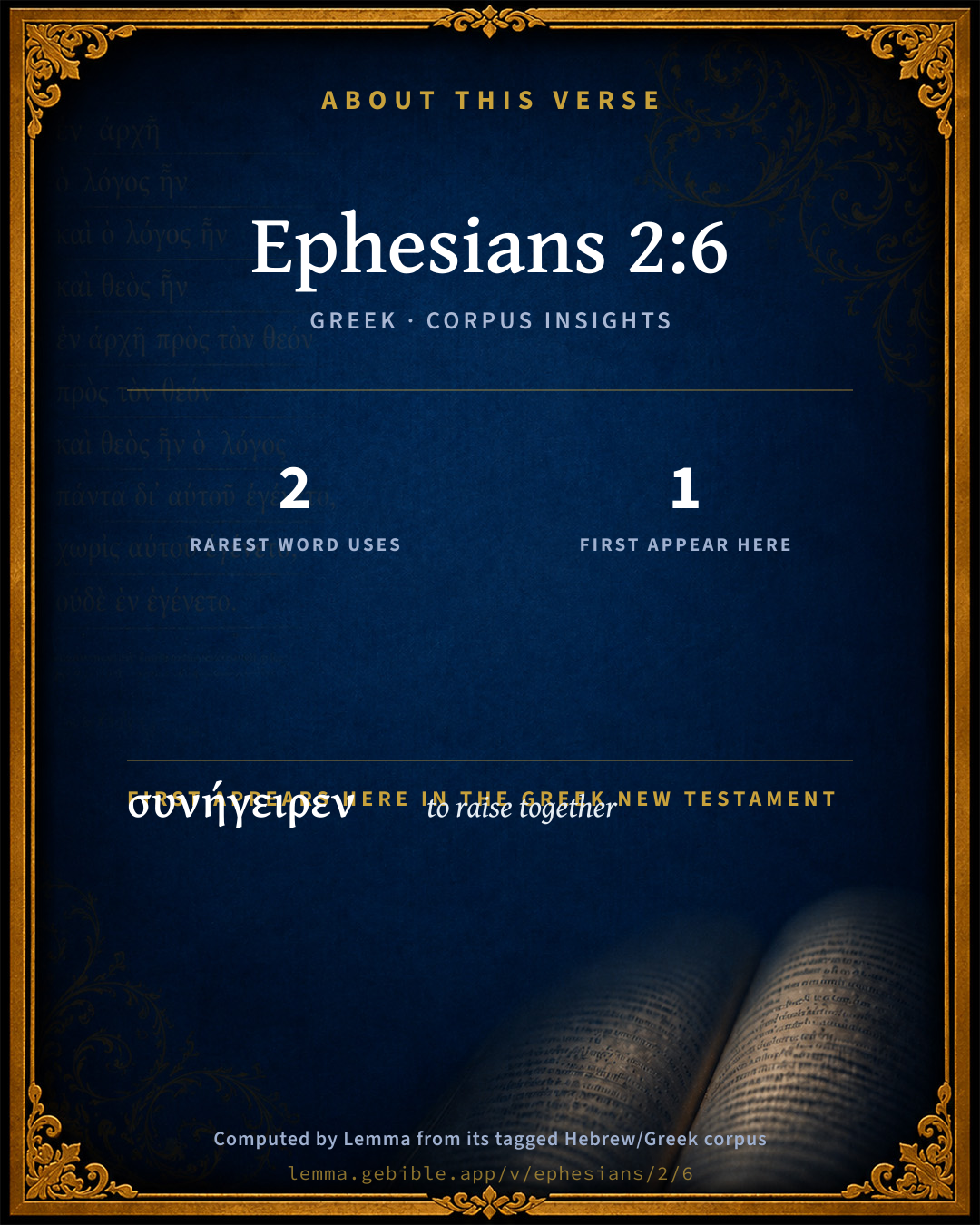
The rarest word here is συνεκάθισεν to sit together G4776 — appearing just 2 times in the whole Greek New Testament.

First appearance in Scripture

This word makes its first canonical appearance in the Greek New Testament here:

  • συνήγειρεν to raise together G4891

Shared distinctive vocabulary

συνεκάθισεν to sit together G4776 occurs in 2 verses of the Greek New Testament. Also found in:
Repetition

Words recur within this verse:

Cross-references

12

Topical passages linked to Ephesians 2:6 in the Treasury of Scripture Knowledge — connected by theme and wording, ordered by reader-vote popularity; previews shown in the World English Bible.

  • Colossians 3:1–3 If then you were raised together with Christ, seek the things that are above, where Christ is, seated on the right hand of God.
  • Ephesians 1:3 Blessed be the God and Father of our Lord Jesus Christ, who has blessed us with every spiritual blessing in the heavenly places in Christ;
  • Romans 6:4–5 We were buried therefore with him through baptism to death, that just like Christ was raised from the dead through the glory of the Father, so we also might walk in newness of life.
  • Colossians 2:12–13 having been buried with him in baptism, in which you were also raised with him through faith in the working of God, who raised him from the dead.
  • John 17:21–26 that they may all be one; even as you, Father, are in me, and I in you, that they also may be one in us; that the world may believe that you sent me.
  • John 12:26 If anyone serves me, let him follow me. Where I am, there will my servant also be. If anyone serves me, the Father will honor him.
  • Revelation 3:20–21 Behold, I stand at the door and knock. If anyone hears my voice and opens the door, then I will come in to him, and will dine with him, and he with me.
  • Ephesians 1:19–20 and what is the exceeding greatness of his power toward us who believe, according to that working of the strength of his might
  • John 14:3 If I go and prepare a place for you, I will come again, and will receive you to myself; that where I am, you may be there also.
  • Luke 22:29–30 I confer on you a kingdom, even as my Father conferred on me,
  • Matthew 26:29 But I tell you that I will not drink of this fruit of the vine from now on, until that day when I drink it anew with you in my Father's Kingdom."
  • Luke 12:37 Blessed are those servants, whom the lord will find watching when he comes. Most assuredly I tell you, that he will dress himself, and make them recline, and will come and serve them.

Cross-references courtesy of OpenBible.info (CC BY 4.0).

Commentary

Notes on Ephesians 2:6 from classic Christian and Jewish commentators (each source and its license shown beneath its notes). The classic Christian expositions comment on the surrounding passage and are grouped to its opening verse, so a note may address several verses; the Jewish commentaries on the Tanakh (Rashi and others) are per-verse, so they appear only where the commentator wrote on this verse.

Lemma curates 59 commentaries, every one of them public domain or Creative Commons licensed, each selected and text-cleaned for this edition rather than reprinted as found. About our sources →

Tyndale Open Study Notes

Tyndale Open Resources

2:6 united with Christ Jesus: Because of this union, believers share God’s glory and blessings, and experience resurrection both now and in the future (see Rom 6:4-14; Col 2:12-13; 3:1-4).

Tyndale Open Study Notes — © Tyndale Open Resources, licensed CC BY-SA 4.0. Text via the HelloAO Bible API.

Bengel's Gnomon

Johann Albrecht Bengel

Eph 2:6. Συνεκάθισεν, made us sit together) Believers are already spiritually raised; they will be raised in the body; and to each of the two resurrections the sitting in heavenly places corresponds. They are not, indeed, present in heaven in the body, but they are so in point of right, and virtually in the spirit, and they have individually a seat expressly assigned to them, which is to be taken possession of at the proper time. They are for a while hidden in God; Col 3:3.—ἐν τοῖς ἐπουρανίοις, in the heavenlies) He does not say, on the right hand. To Christ this is left as His own peculiar pre-eminence [prerogative].—Χριστῷ Ἰησοῦ, in Christ Jesus) In this sublime discourse, especially, Paul calls Him Christ Jesus; oftener on other occasions, Jesus Christ.

Bengel's Gnomon of the New Testament — English translation (T&T Clark, Edinburgh, 1860) — public domain. Text from a community e-Sword module.

Meyer's Critical & Exegetical Commentary

Heinrich August Wilhelm Meyer

Eph_2:6. After the making alive of Christ in the grave followed His resurrection, with which Paul regards that of believers as likewise accomplished. Hence: καὶ συνήγειρε, which in like manner is not to be taken in the spiritual sense (to make them enter upon the new life of grace, Rückert); but see on Eph_2:5. With strange inconsistency several expositors, such as Menochius, Zanchius, Boyd, Estius, Grotius, although taking συνεζωοπ. metaphorically, nevertheless have taken this συνήγειρε (as well as the element that follows) in a literal sense, and mentally supplied nempe spe, or the like.

καὶ συνεκάθισεν ἐν τοῖς ἐπουρ.] and has given to us joint-seat in the heavenly regions (comp. Eph_1:20), so that we have part (see on 1Co_6:2) in the dominion of the Exalted One (2Ti_2:12); which Paul likewise sees as already accomplished[143] with the installing of Christ at the right hand of God; hence, there was no need at all for supplying the thought jure et virtute spirituali (Bengel), or for a transference of the matter to the praescientia Dei (Jerome), and other such expedients.

ἐν Χριστῷ Ἰησοῦ] belongs to ΣΥΝΉΓΕΙΡΕ and ΣΥΝΕΚΆΘΙΣΕΝ ἘΝ ΤΟῖς ἘΠΟΥΡΑΝ., so that what was expressed in the case of ΣΥΝΕΖΩΟΠ. by (ΣΥΝ) Τῷ ΧΡΙΣΤῷ, is here expressed, in yet more exact conception of the relation, by (ΣΥΝ) ἘΝ ΧΡΙΣΤῷ (jointly in Christ). Inasmuch, namely, as God raised and exalted Christ (ἐν Χριστῷ), He has raised and exalted us with Him. ἘΝ ΧΡΙΣΤῷ accordingly is by no means intended to denote the ΣΥΓΚΑΘΊΖΕΙΝ as figurative (Olshausen).

On ἘΝ ΤΟῖς ἘΠΟΥΡΑΝ. (see on Eph_1:3) Bengel, we may add (comp. already Estius), aptly remarks: non dicit in dextra; Christo sua manet excellentia. The transitive συγκαθίζειν is not elsewhere preserved.

[143] Explanations in the spiritual sense. Calixtus: Ea nobis dedit dona, quae civibus coelorum propria sunt. Rosenmüller: Summa felicitate nos ornavit, quasi jam in coelo essemus recepti. Rückert and Bleek remind us of the πολίτευμα of Christians, which is in heaven (Php_3:20; comp. Col_3:1 ff.). Meier: Exaltation into a celestially enlightened, pure and holy, state of life. Matthies: The spiritual kingdom of heaven or of God. Olshausen: The awakening of the heavenly consciousness. Koppe remarks superficially and with hesitation: Nobis quidem in omnibus his ζωοποιεῖσθαι, ἐγείρεσθαι, καθίζειν ἐν ἐπουρ. nihil inesse videtur nisi summae et universae felicitatis, qua Christiani vel jam fruuntur, vel olim magis etiam fruituri sunt, descriptio. According to Baumgarten-Crusius, there is expressed exaltation into a purely spiritual heaven-like state. De Wette takes συνεζωοπ. of the deliverance out of the misery of sin, συνήγειρε of regeneration and, at the same time, of the resurrection of the body guaranteed in the spiritual life, and συνεκάθισεν κ.τ.λ. of the hope of the eternal δόξα. Schenkel interprets it of the presentiment of the future glory.

Meyer — Critical and Exegetical Commentary on the New Testament — English translation by Peter Christie, edited by Frederick Crombie (T&T Clark, 1880) — public domain. Text from a community e-Sword module.

Expositor's Greek Testament

ed. W. Robertson Nicoll

Eph 2:6 . καὶ συνήγειρεν : and raised us with Him . That is, to life now, in a present spiritual renewal. The συνήγειρεν expresses the definite idea of resurrection , and primarily that of the physical resurrection. The introduction of this term and the following makes it not improbable that both ideas, that of the present moral resurrection and that of the future bodily resurrection, were in Paul’s mind, and that he did not sharply distinguish between them, but thought of them as one great gift of life. καὶ συνεκάθισεν ἐν τοῖς ἐπουρανίοις : and seated us (or, enthroned us) with Him in the heavenlies . Made us sharers with Him in dignity and dominion, so that even now, and in foretaste of our future exaltation, our life and thought are raised to the heavenlies where He reigns. But as Bengel notices, Paul pauses here and does not add the ἐν δεξιᾷ αὐτοῦ which is said of Christ in Eph 1:20 ἐν Χριστῷ Ἰησοῦ : in Christ Jesus . Not the συνεκάθισεν only, but the whole statement is qualified by this. This quickening, this resurrection, this seating of us with Him take effect in so far as we are in Him as our Representative, having our life and our completeness in our Head.

The Expositor's Greek Testament, edited by W. Robertson Nicoll (1897–1910) — public domain. Text from a community e-Sword module.

Hodge's Commentary on Romans, Ephesians & First Corinthians

Charles Hodge

Eph_2:6

And hath raised us up and caused us to sit together in heavenly places in Christ Jesus. This is an amplification of what precedes. In its widest sense the life, which in Eph_2:5 is said to be given to us, includes the exaltation expressed in this verse. It is, therefore, only by way of amplification that the apostle, after saying we are made partakers of the life of Christ, adds that we are raised up and enthroned with him in heaven. To understand this we must know what is here meant by heavenly places, and in what sense believers are now the subjects of the exaltation here spoken of. Throughout this epistle the expression heavenly places means heaven. But the latter phrase has in Scripture a wide application. It means not only the atmospheric heavens in which the clouds have their habitation; and the stellar heavens in which the sun, moon and stars dwell; and the third heavens, i.e. the place where God specially manifests his presence and where the glorified body of Christ now is, but also the state into which believers are introduced by their regeneration. In this last sense it coincides with one of the meanings of the phrase kingdom of heaven. It is that state of purity, exaltation and favor with God, into which his children are even in this world introduced. The opposite state is called the kingdom of Satan; and hence men are said to be translated from the kingdom of darkness into the kingdom of Gods dear Son. It is in this sense of the word that we are said, Phi_3:20, to be the citizens of heaven. We, if Christians, belong not to the earth, but heaven; we are within the pale of Gods kingdom; we are under its laws; we have in Christ a title to its privileges and blessings, and possess, alas! in what humble measure, its spirit. Though we occupy the lowest place of this kingdom, the mere suburbs of the heavenly city, still we are in it. The language of the apostle in the context will appear the less strange, if we apprehend aright the greatness of the change which believers, even in this life, experience. They are freed from the condemnation of the law, from the dominion of Satan, from the lethargy and pollution of spiritual death; they are reconciled to God, made partakers of his Spirit, as the principle of everlasting life; they are adopted into his family and have a right to all the privileges of the sons of God both in this life and in that which is to come. This is a change worthy of being expressed by saying: He hath quickened us, and raised us up, and made us to sit together with Christ in heavenly places. All this is in Christ. It is in virtue of their union with Christ that believers are partakers of his life and exaltation. They are to reign with him. The blessings then of which the apostle here speaks, are represented as already conferred for two reasons: first, because they are in a measure already enjoyed; and secondly, because the continuance and consummation of these blessings are rendered certain by the nature of the union between Christ and his people. In him they are already raised from the dead and seated at the right hand of God.

Charles Hodge — Commentary on Romans (1835), First Corinthians (1857), and Ephesians (1856) — public domain. Text from a community e-Sword module.

Geneva Bible (1599)

Geneva Bible translators

To wit, as he addeth afterward in Christ, for as yet this is not fulfilled in us, but only in our head, by whose spirit we have begun to die to sin, and live to God, until that work be fully brought to an end: but yet the hope is certain, for we are as sure of that we look for: as we are of that we have received already.

Geneva Bible (1599) marginal notes — public domain. Text via Bolls.life.

Jamieson, Fausset & Brown

Robert Jamieson, A. R. Fausset & David Brown

raised us up together--with Christ. The "raising up" presupposes previous quickening of Jesus in the tomb, and of us in the grave of our sins.

made us sit together--with Christ, namely, in His ascension. Believers are bodily in heaven in point of right, and virtually so in spirit, and have each their own place assigned there, which in due time they shall take possession of (Phi 3:20-21). He does not say, "on the right hand of God"; a prerogative reserved to Christ peculiarly; though they shall share His throne (Rev 3:21).

in Christ Jesus--Our union with Him is the ground of our present spiritual, and future bodily, resurrection and ascension. "Christ Jesus" is the phrase mostly used in this Epistle, in which the office of the Christ, the Anointed Prophet, Priest and King, is the prominent thought; when the Person is prominent, "Jesus Christ" is the phrase used.

Jamieson, Fausset & Brown — Commentary Critical and Explanatory on the Whole Bible (1871) — public domain (CC PDM 1.0). Text via the HelloAO Bible API.

Adam Clarke's Commentary

Verse 6. And hath raised us up together in Christ] Or rather, by Christ; his resurrection being the proof that he had made the full atonement, and that we might be justified by his blood. Believing, therefore, the record which God gave of his Son, we received this atonement, and were raised from a death of sin to a life of righteousness; and now we sit in heavenly places-we have a right to the kingdom of God, anticipate this glory, and are indescribably happy in the possession of this salvation, and in our fellowship with Christ Jesus.

Adam Clarke's Commentary on the Bible (1810–1826) — public domain. Text from a community e-Sword/MySword module.

John Calvin's Commentaries

6. And hath raised us up together. The resurrection and sitting in heaven, which are here mentioned, are not yet seen by mortal eyes. Yet, as if those blessings were presently in our possession, he states that we have received them; and illustrates the change which has taken place in our condition, when we were led from Adam to Christ. It is as if we had been brought from the deepest hell to heaven itself. And certainly, although, as respects ourselves, our salvation is still the object of hope, yet in Christ we already possess a blessed immortality and glory; and therefore, he adds, in Christ Jesus. Hitherto it does not appear in the members, but only in the head; yet, in consequence of the secret union, it belongs truly to the members. Some render it, through Christ; but, for the reason which has been mentioned, it is better to retain the usual rendering, in Christ. We are thus furnished with the richest consolation. Of everything which we now want, we have a sure pledge and foretaste in the person of Christ.

John Calvin's Commentaries (1540-1563) — public domain. Text from the Calvin Translation Society English edition (1840s-50s) via the Christian Classics Ethereal Library (ccel.org). Calvin's coverage is partial (roughly two-thirds of the Bible); uncommented books and verses are honest gaps, never fabricated. The 19th-century editor's footnotes and remarks are omitted so the notes are faithfully Calvin's own voice.

The Cambridge Bible for Schools and Colleges

gen. ed. J. J. S. Perowne

6. and hath raised us up together, &c.] Better, did raise, &c.—The radical idea of new life is here put into more detail, as a resurrection and ascension; the special form of the Lord’s Revival.—“Together:”—the Gr. grammar allows this to refer to either (1) union with the Church, or (2) union with the Lord; (1) “as a united company,” or (2) “as united to Him.” And the words just below “in Him,” not “with Him,” may seem to favour the former. But the previous verse, and Col_2:12; Col_3:1; are strongly for the reference to Christ. His resurrection and ascension are the basis of the spiritual (as well as future bodily) resurrection and ascension of His Church.

made us sit together, &c.] Our great Representative is there, “sitting at the right hand of God” (Col_3:1). We, as “in Him,” vitally united to Him, are there also, in the sense of a supreme acceptance and welcome by the Eternal Father, and of the sure prospect of heavenly “glorification together [with Christ]” (Rom_8:17).

in heavenly places] See on Eph_1:3.

The Cambridge Bible for Schools and Colleges (gen. ed. J. J. S. Perowne; Cambridge University Press, 1878–1918) — public domain. Text from a community e-Sword module.

John Gill's Exposition

And hath raised us up together,.... Which refers either to a spiritual resurrection, to a resurrection from a death in sin, to a spiritual life; and which is the effect of almighty power, and of rich grace and mercy; and in which Christ is concerned: he is the efficient cause of it, he raises the dead in this sense, and quickens whom he will; and his resurrection is the virtual cause of it; and also the exemplar, between which there is a great likeness; both bear the same name; both are a declaration of sonship; and both the first step to glory in Christ and in his people; and both are instances of the exceeding greatness of God's power: or it may refer to a corporeal resurrection, said to be already, because it is in faith and hope, and because of the certainty of it; and to be together with Christ, because of the conformity of it to his resurrection, and to the influence of which it is owing; and chiefly because that when Christ rose from the dead, all his people rose in him, and with him, as their head and representative, he being the firstfruits of them that slept; so called, in allusion to the firstfruits of the harvest under the law, which represented and sanctified the whole:

and made us sit together in heavenly places in Christ Jesus: Christ is entered into heaven as the forerunner, to take possession of it for his people, in their name; and to prepare mansions of glory for them, and in these they sit; which imports honour, pleasure, rest from labour and weariness, and safety and security: and what adds to the happiness of this is, that it is together with all the saints, and with Christ himself; and in these they are made to sit already; which is so said, because of the certainty of it, for the same glory Christ has, they shall have; and because of their right to such a blessing; and chiefly because Christ their head is set down therein, who sustains their persons, bears their names on his heart, and represents them.

John Gill's Exposition of the Whole Bible (1746–1763) — public domain (CC PDM 1.0). Text via the HelloAO Bible API.

Trapp's Complete Commentary

John Trapp

6 And hath raised us up together, and made us sit together in heavenly places in Christ Jesus:

Ver. 6. And made us sit together] We have taken up our rooms beforehand in heaven, whereunto we have just right upon earth by virtue of the union, the ground of communion, 1Jn 5:12. He that hath the Son hath life; he hath possession of it, as by turf and twig.

John Trapp, A Commentary or Exposition upon All the Books of the Old and New Testament (1647–1656) — public domain. Text from a community e-Sword module.

Albert Barnes' Notes on the Bible

And hath raised us up together - That is, we are raised from the death of sin to the life of religion, in connection with the resurrection of Jesus, and in virtue of that. So close is the connection between him and his people, that his resurrection made theirs certain; compare Col 2:12; notes, Rom 6:5.

And made us sit together - Together with him. That is, we share his honors. So close is our connection with him, that we shall partake of his glory, and in some measure do now; compare the Mat 19:28, note, and Rom 8:17, note.

In heavenly places - see the notes at Eph 1:3. The meaning is, that he has gone to the heavenly world as our Head and Representative. His entrance there is a pledge that we shall also enter there. Even here we have the anticipation of glory, and are admitted to exalted honors, as if we sat in heavenly places, in virtue of our connection with him.

In Christ Jesus - It is in connection with him that we are thus exalted, and thus filled with joy and peace. The meaning of the whole is,” We are united to Christ. We die with him, and live with him. We share his sufferings, and we share his joys. We become dead to the world in virtue of his death; we become alive unto God in virtue of his resurrection. On earth we are exalted to honor, peace, and hope, in virtue of his resurrection; in heaven we shall share his, glory and partake of his triumphs.”

Albert Barnes' Notes on the Bible (1834–1885) — public domain. Text from a community e-Sword/MySword module.

Matthew Poole's English Annotations

And hath raised us up together; either this may be understood of a further degree of spiritual life in the progress of sanctification vouchsafed to believers in this world; or rather, of the resurrection of the body, which is said to be raised together with Christ, because it is to be raised by the same power that raised him up, and by virtue of his resurrection, in which we have fellowship with him, as being united to him.

And made us sit together in heavenly places in Christ Jesus, as our Head, and representative. Our spiritual enlivening {Eph 2:5} we have not only fundamentally in Christ when restored to life, but actually begun in ourselves in our effectual calling; but the resurrection of our bodies, and our sitting in heaven, we have not as yet actually fulfilled in ourselves, yet have it in Christ our Head, who rose for us and we in him, and sits in heaven for us, and we in him may be said to sit there too, by reason of our union with him, and being members of him.

Matthew Poole's English Annotations on the Holy Bible (1683–1685) — public domain. Text from a community e-Sword/MySword module.

Whedon's Commentary on the Bible

Daniel D. Whedon

6. Raised… sit… in heavenly places—As Christ in Eph_1:20.

Daniel D. Whedon (gen. ed.), Commentary on the Old and New Testaments (1874–1909) — public domain. Text from a community e-Sword module.

The Pulpit Commentary

And hath raised us up with him (comp.; (Php_3:10) so that we no longer walk "according to the course of this world," but according to the life of Christ; we walk "in newness of life." And seated us with him in the heavenly places in Christ Jesus. As God placed Jesus at his right hand in heaven, so he has placed his people with him in heavenly places; i.e. places where the privileges of heaven are dispensed, where the air of heaven is breathed, where the fellowship and the enjoyment of heaven are known, where an elevation of spirit is experienced as if heaven were begun. Such was the case of the three disciples on the Mount of Transfiguration; of the two on the way to Emmaus, when their heart burned within them; of the beloved disciple when he was "in the Spirit on the Lord"s day;" of many at the Holy Supper, or in fervent communion with brother and sister believers, when they seem at the very gate of heaven. This is sometimes the experience at conversion, but the vividness of the feeling does not always abide. The repetition of "in Christ Jesus" in this connection emphasizes the fact that this gracious proceeding of God towards us is in immediate connection with the work and person of Christ. It is as being one with Christ Jesus that all this raising up comes to us.

The Pulpit Commentary (1880–1919), ed. H.D.M. Spence-Jones & Joseph S. Exell — public domain. Text from a community e-Sword module.

John Wesley's Explanatory Notes

And hath raised us up together - Both Jews and gentiles already in spirit; and ere long our bodies too will be raised. And made us all sit together in heavenly places - This is spoken by way of anticipation. Believers are not yet possessed of their seats in heaven; but each of them has a place prepared for him.

John Wesley, Explanatory Notes Upon the Whole Bible (1754–1765) — public domain. Text via the GEBible commentary corpus.

Burkitt's Expository Notes on the New Testament

William Burkitt

The apostle here instances in two branches more of that salvation which he had in the foregoing verse affirmed to be of grace, namely, that of our resurrection and glorification; both which are yet to come, and yet they are spoken of as already past: when the Father raised and glorified Christ, all believers were raised and glorified in him; for in his resurrection and glorification he did sustain the quality of a public person, representing his whole church as their head and husband; and, accordingly, believers are and may be said to be raised already, and glorified already, not in their own persons, but in Christ their head. The apostle says, God has raised us up, and has made us sit together; not, he shall raise us, and will make us sit; to denote the dependency which our resurrection and glorification has upon Christ’s, as the effects depend upon the cause, and also the undoubted certainty that they shall come to pass, Christ’s resurrection and glorification being a pledge of ours.

Learn hence, 1. That Christ rose from the dead, and ascended up into heaven, not as a private person, but as the common head and parent, root and representative of his church and people; so that what he has done, they may be said to have done: they rose in him, and are set down in heaven in him; and blessed be God for the well-grounded hopes, that as we now sit together in Christ, so ere long we shall for ever sit together with Christ.

Learn, 2. That Jesus Christ is the cause of our resurrection and glorification, he is the efficient cause, the meritorious cause, and exemplary cause, of our resurrection and glorification.

Learn 3. From the phrase here used of sitting, and of sitting together in Christ, that believers shall certainly partake of the same kingly state and dignity, of the same honour and glory, of the same delight and pleasure, of the same rest and tranquillity, of the same state and security, with Christ in heaven. He hath made us sit together in heavenly places in Christ Jesus.

William Burkitt's Expository Notes on the New Testament (1700–1703) — public domain. Text from a community e-Sword module.

The People's New Testament

B. W. Johnson

6. And hath raised us up together. Buried into the death of Christ, we are risen with Christ (Col. 2:12). We are risen as new creatures to walk with the Risen Christ, with our minds on heavenly things (Col. 3:1). To sit in heavenly places. In our present state, to have our minds above (Col. 3:2).

B. W. Johnson's The People's New Testament with Notes (1889–1891) — public domain. Electronic text from the Christian Classics Ethereal Library (CCEL) ThML edition.

Cambridge Greek Testament for Schools and Colleges

6. καὶ συνήγειρεν καὶ συνεκάθισεν. The new life in which we share is connected both with the Resurrection and with the Ascension of Christ Jesus, cf. Eph 1:20. The union with the Resurrection is emphasized also in Col 2:12; Col 3:1. Union with the Ascension is directly referred to only here; though it is implied on one side in Col 3:3, and on another, for the seat which we share is a throne, in passages like Rom 5:17; Rev 5:10, which speak of Christians as exercising a present sovereignty. In Rev 3:21 the promise of sharing His throne seems to be projected into the future.

Cambridge Greek Testament for Schools and Colleges (Cambridge University Press, 1896; 21 vols, various authors incl. Carr, Maclear, Plummer, Farrar, Lumby, Moule, M. R. James, Simcox) — public domain. Text from a community e-Sword module.

International Critical Commentary

6. συνήγειρε is nearly synonymous with συνεζωοποίησε, but suggests more distinctly physical resurrection. In Col 3:1, as here, the ἐγερθῆναι σὺν Χριστῷ is treated as past, and is made the motive for seeking those things which are above, “… for ye died, and your life is hid with Christ in God.” The present passage expresses this more vividly and strikingly, συνεκάθισεν ἐν τοῖς ἐπουρανίοις. “Non dicit in dextra; Christo sua manet excellentia,” Bengel (and so Estius less tersely). ἐν τοῖς ἐπ. denotes the true or ideal locality of the Church as the “kingdom of heaven.” Comp. Heb 12:22, προσεληλύθατε … πόλει Θεοῦ ζῶντος, Ἱερουσαλὴμ ἐπουρανίῳ.

ἐν Χριστῷ after συν- has caused some perplexity, and led some commentators to understand the συν- in ver. 6 (not in ver. 5) as joining ὑμεῖς and ἡμεῖς together. But it seems better to understand ἐν Χ. as completing and defining with more precision what was intended by σύν, for it is not simply together with Christ that this vivification and exaltation takes place, but also in Him, by virtue of union with Him as the Head.

International Critical Commentary — older volumes (1896–1929), various authors — public domain. Text from a community e-Sword module.

Vincent's Word Studies in the New Testament

Marvin R. Vincent

Raised us up. Compare Rom 6:5.

Made us sit together [συνεκαθισεν] . Compare set Him, ch. 1 20.

Together is ambiguous. Render with Him, as Rev. "Even now we sit there in Him, and shall sit with Him in the end" (Andrews, cited by Ellicott). Compare Rom 8:30; Rev 3:21. Meyer renders hath given us joint seat.

In Christ Jesus. Connect with raised up, made us sit, and in heavenly places. Resurrection, enthronement, heaven, all are in Christ.

Marvin R. Vincent, Word Studies in the New Testament (1887–1900) — public domain. Text from a community e-Sword/MySword module.

Lesson kit

Teaching starters — assembled from the data on this page, not authored interpretation. Every prompt links to the verse data it draws on. Edit before teaching.

Ephesians, in the Pauline Epistles, opens this verse with 10 words (8 distinct Greek lemmas). Its most distinctive word is synkathízō (“to sit together”). A historical commentator’s framing appears above. Read the whole chapter for the surrounding context.

Discussion questions

  1. What does “to sit together” (synkathízō) contribute to the verse as a whole?
  2. The word “to raise together” first appears here in Scripture. What is being introduced at this debut?
  3. Luke 22:55 shares the word «to sit together» with this verse. How do the two illuminate each other?
  4. “and” occurs 2× in this one verse. What is the effect of the repetition?
  5. These translations render this verse differently; the difference is in the English rendering, not the original. What questions does that raise?
  6. Reading how Tyndale Open Study Notes and Bengel's Gnomon read this verse, where do the two commentators agree and where do they part?

Things to notice

  • 1 word makes its first canonical appearance in Scripture here.
  • These translations choose different wording for 5 words in this verse.
  • “and” occurs 2× in this single verse.
  • 8 distinct Greek lemmas span 10 words in this verse.

Reading settings

Reading text

Shown beneath each verse's original-language words.

Old Testament
Old Testament edition

Read the OT as the Masoretic Hebrew (MT) or the Greek Septuagint (LXX).

English shown for the Greek Septuagint (in the Hebrew ↔ Greek comparison).

Comparing translations? Open the Compare panel on any verse page to stack up to four side by side.