
Numbers 20:2

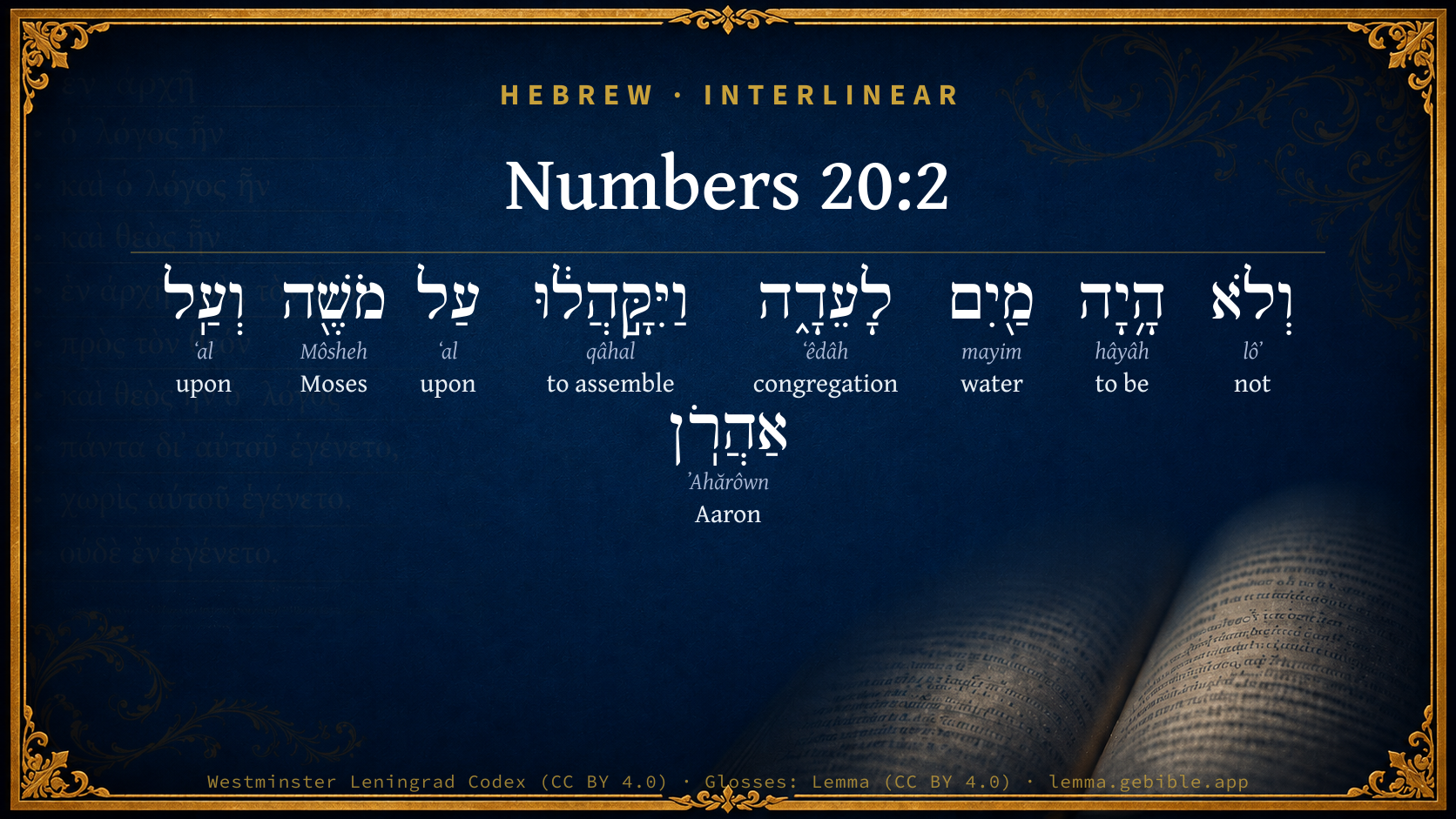
Hebrew (Westminster Leningrad Codex) Numbers 20:2 appears in the Hebrew Old Testament. The text above is from the Westminster Leningrad Codex. Each word links to its Strong’s number, a concise gloss, and parsing drawn from the Open Scriptures Hebrew Bible morphology. Click any word for its full Brown-Driver-Briggs (BDB) entry.
Download image
Cite this verse

Numbers 20:2 (World English Bible). Public Domain. Lemma interlinear Bible study tool, https://lemma.gebible.app/v/numbers/20/2.

Show BibTeX & RIS
BibTeX
RIS
English Translation
There was no water for the congregation: and they assembled themselves together against Moses and against Aaron.
World English Bible · Public Domain
Download a study sheet

One document with this verse’s original text, its word-by-word gloss line, the meaning frame, cross-references with their text, attributed commentary, and full source and license credits — printable, and it pastes into notes with its structure intact.

This verse Autodidact and up

Study sheet (.html) Plain text (.txt)

A passage Seminary Student

Up to 50 verses in one chapter. A passage sheet keeps up to 6 commentary sources and 12 cross-references per verse, in the order this page ranks them, and says so on the sheet whenever that leaves anything out. Ask for a single verse and you get the Autodidact verse sheet above.

Everything on this page stays free to read, with no account — the sheet is a download of what is already on screen, not access to it.

Want to remove ads? Support Godless Engineer
Compare translations 3

The same verse in 3 English versions, stacked beneath the original-language interlinear above. Click any original word for its lexicon entry.

Each is an independent rendering of the whole verse — the interlinear is not word-aligned to these translations.

Highlighted words mark where these versions differ — a whole-verse word diff, not a word-by-word alignment.

  • World English Bible Public Domain
    There was no water for the congregation: and they assembled themselves together against Moses and against Aaron.
  • King James Version Public Domain
    And there was no water for the congregation: and they gathered themselves together against Moses and against Aaron.
  • unfoldingWord Literal Text CC BY-SA 4.0
    And there was no water for the congregation, and they assembled against Moses and against Aaron.

unfoldingWord Literal Text — © unfoldingWord, licensed CC BY-SA 4.0. Word-aligned USFM3 via Door43 (git.door43.org/unfoldingWord/en_ult).

Versions to compare (up to 4)

3 of 4 selected

Show all 18 translations

Every available English version of this verse, each an independent rendering of the whole verse.

  • World English Bible Public Domain
    There was no water for the congregation: and they assembled themselves together against Moses and against Aaron.
  • Berean Standard Bible Public Domain
    Now there was no water for the congregation, so they gathered against Moses and Aaron.
  • Majority Standard Bible Public Domain
    Now there was no water for the congregation, so they gathered against Moses and Aaron.
  • King James Version Public Domain
    And there was no water for the congregation: and they gathered themselves together against Moses and against Aaron.
  • American Standard Version (1901) Public Domain
    And there was no water for the congregation: and they assembled themselves together against Moses and against Aaron.
  • Revised Version (1885) Public Domain
    And there was no water for the congregation: and they assembled themselves together against Moses and against Aaron.
  • Geneva Bible (1599) Public Domain
    But there was no water for the Congregation, and they assembled them selues against Moses and against Aaron.
  • Douay-Rheims (1899) Public Domain
    And the people wanting water, came together against Moses and Aaron:
  • Young's Literal Translation Public Domain
    And there hath been no water for the company, and they are assembled against Moses, and against Aaron,
  • Literal Standard Version CC BY-SA 4.0
    And there has been no water for the congregation, and they are assembled against Moses and against Aaron,
  • Unlocked Literal Bible CC BY-SA 4.0
    There was no water for the community, so they assembled together against Moses and Aaron.
  • unfoldingWord Literal Text CC BY-SA 4.0
    And there was no water for the congregation, and they assembled against Moses and against Aaron.
  • Darby Bible Public Domain
    And there was no water for the assembly, and they gathered themselves together against Moses and against Aaron.
  • World Messianic Bible Public Domain
    There was no water for the congregation; and they assembled themselves together against Moses and against Aaron.
  • Webster's Bible Public Domain
    And there was no water for the congregation: and they assembled themselves against Moses and against Aaron.
  • Free Bible Version CC BY-SA 4.0
    However, there was no water there for anyone to drink, so the people gathered to confront Moses and Aaron.
  • Bible in Basic English Public Domain
    And there was no water for the people: and they came together against Moses and against Aaron.
  • JPS Tanakh (1917) Public Domain
    And there was no water for the congregation; and they assembled themselves together against Moses and against Aaron.

Literal Standard Version (2020), Covenant Press — licensed CC BY-SA 4.0. Text via the HelloAO Bible API (eBible.org). Unlocked Literal Bible (unfoldingWord) — licensed CC BY-SA 4.0. Text via the HelloAO Bible API (eBible.org). unfoldingWord Literal Text — © unfoldingWord, licensed CC BY-SA 4.0. Word-aligned USFM3 via Door43 (git.door43.org/unfoldingWord/en_ult). Free Bible Version, Dr. Jonathan Gallagher — licensed CC BY-SA 4.0. Text via the HelloAO Bible API (eBible.org).

Word by word

More ways to search: Search by grammar → Find every occurrence → Compare this word →

Practice this passage: Drill this verse → Learn its vocabulary →

וַיִּקָּ֣הֲל֔וּ
qâhal
H6950
“and · to assemble”
Conjunction + Verb, Niphal, Sequential Imperfect, 3rd Person, Masculine, Plural
Part of Speech
Conjunction + Verb
Stem
Niphal
Form
Sequential Imperfect
Person
3rd Person
Gender
Masculine
Number
Plural
Full BDB Definition

Origin: a primitive root

TWOT: 1991

to assemble, gather - (Niphal) to assemble - for religious reasons - for political reasons - (Hiphil) to summon an assembly - for war, judgment - for religious purposes
  1. וְלֹא lôʼ H3808 “and · not” Conjunction + Particle, Negative
  2. הָ֥יָה hâyâh H1961 “to be” Verb, Qal, Perfect, 3rd Person, Masculine, Singular
  3. מַ֖יִם mayim H4325 “water(s)” Noun, Common, Masculine, Plural, Absolute
  4. לָעֵדָ֑ה ʻêdâh H5712 “to/for the · congregation” Preposition, Determined + Noun, Common, Feminine, Singular, Absolute
  5. עַל ʻal H5921 “upon” Preposition
  6. מֹשֶׁ֖ה Môsheh H4872 “Moses” Noun, Proper
  7. וְעַֽל ʻal H5921 “and · upon” Conjunction + Preposition
  8. אַהֲרֹֽן ʼAhărôwn H175 “Aaron” Noun, Proper

About this verse

These counts appear in no published source. They are computed here, from the morphology-tagged text and Lemma’s own curated glosses. What Lemma adds →

9
words
8
distinct lemmas
Pentateuch
section

Shared distinctive vocabulary

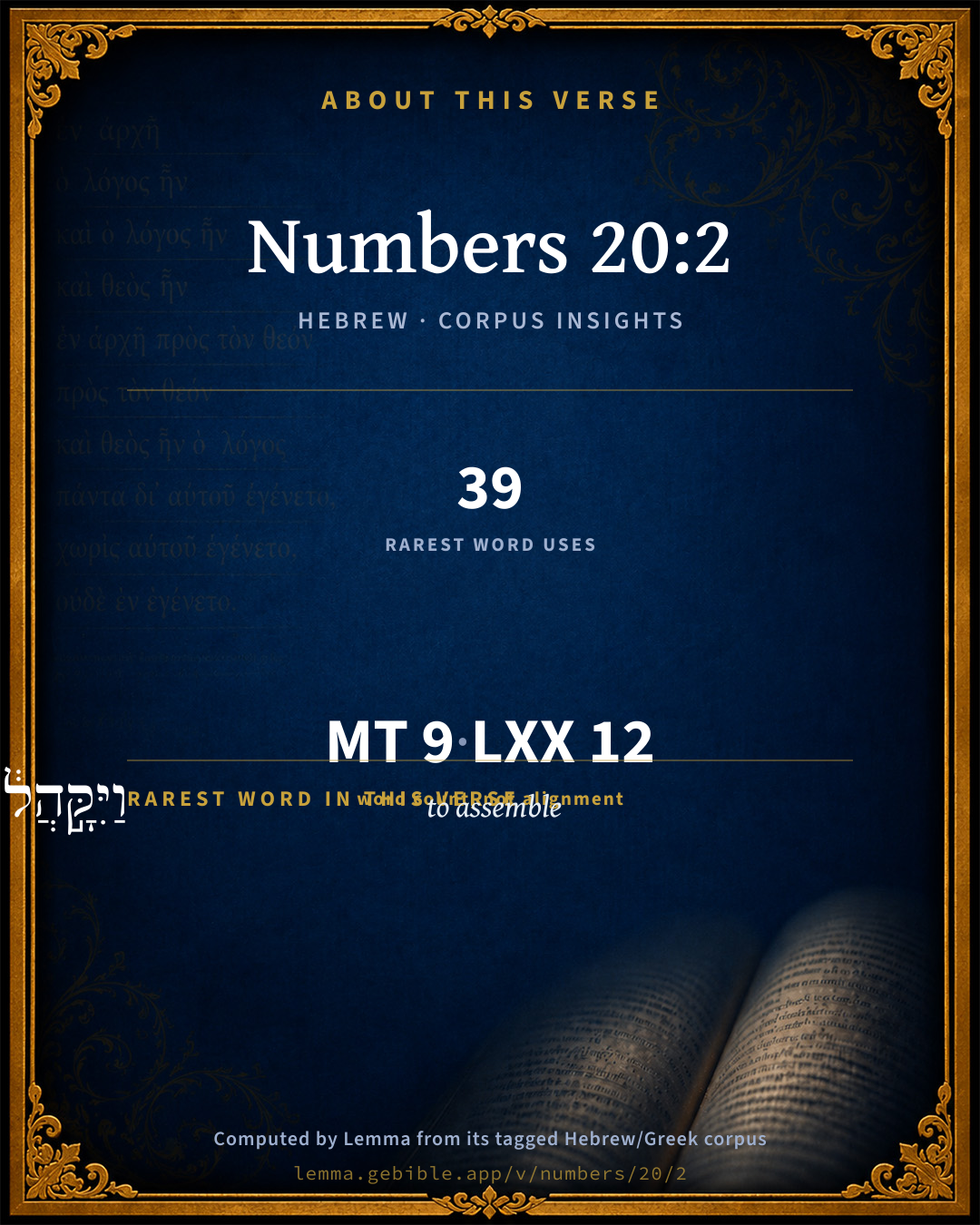
וַיִּקָּ֣הֲל֔וּ to assemble H6950 occurs in 39 verses of the Hebrew Bible. Also found in:

Grammatical profile

  • 2 verbs
  • 4 nouns
  • 2 prepositions
  • 1 particle

Verb forms

  • הָ֥יָה Qal · Perfect
  • וַיִּקָּ֣הֲל֔וּ Niphal · Sequential Imperfect

Repetition

A word recurs within this verse — often emphatic in Hebrew:

Hebrew & Septuagint length

In English translation the verse runs 17 words from the Hebrew and 17 from the Septuagint (LXX English) — the same length.

A rough comparison of the two English renderings, which tokenize alike — not a word-level alignment.

Word counts can differ between the Hebrew and the Greek without any difference in meaning — e.g. the Hebrew direct-object marker אֵת has no separate Greek word, and Greek often adds the article ὁ.

In the original languages it is 9 Hebrew tokens and 12 Greek tokens — but the two are counted differently (Hebrew bundles its prefixes and suffixes into one token; the Greek is in lemma form), so that isn’t a like-for-like length.

Cross-references

11

Topical passages linked to Numbers 20:2 in the Treasury of Scripture Knowledge — connected by theme and wording, ordered by reader-vote popularity; previews shown in the World English Bible.

  • Numbers 16:19 Korah assembled all the congregation against them to the door of the tent of meeting: and the glory of Yahweh appeared to all the congregation.
  • Numbers 16:42 It happened, when the congregation was assembled against Moses and against Aaron, that they looked toward the tent of meeting: and, behold, the cloud covered it, and the glory of Yahweh appeared.
  • Exodus 15:23–24 When they came to Marah, they couldn't drink from the waters of Marah, for they were bitter. Therefore the name of it was called Marah.
  • Exodus 16:2 The whole congregation of the children of Israel murmured against Moses and against Aaron in the wilderness;
  • Exodus 16:7 and in the morning, then you shall see the glory of Yahweh; because he hears your murmurings against Yahweh. Who are we, that you murmur against us?"
  • Exodus 16:12 "I have heard the murmurings of the children of Israel. Speak to them, saying, 'At evening you shall eat meat, and in the morning you shall be filled with bread: and you shall know that I am Yahweh your God.'"
  • Exodus 17:1–4 All the congregation of the children of Israel traveled from the wilderness of Sin, by their journeys, according to Yahweh's commandment, and encamped in Rephidim; but there was no water for the people to drink.
  • Numbers 11:1–6 The people were as murmurers, [speaking] evil in the ears of Yahweh: and when Yahweh heard it, his anger was kindled; and the fire of Yahweh burnt among them, and devoured in the uttermost part of the camp.
  • Numbers 16:3 and they assembled themselves together against Moses and against Aaron, and said to them, You take too much on you, seeing all the congregation are holy, everyone of them, and Yahweh is among them: why then lift yourselves up above the assembly of Yahweh?
  • Numbers 21:5 The people spoke against God, and against Moses, Why have you brought us up out of Egypt to die in the wilderness? for there is no bread, and there is no water; and our soul loathes this light bread.
  • 1 Corinthians 10:10–11 Neither grumble, as some of them also grumbled, and perished by the destroyer.

Cross-references courtesy of OpenBible.info (CC BY 4.0).

Hebrew and Greek witnesses Masoretic Hebrew ↔ Greek Septuagint

The same verse in the two great witnesses to the Old Testament, shown verse-for-verse.

These are two independent witnesses, not word-aligned to each other, and the Septuagint is shown in lemma (dictionary) form.

Hebrew Numbers 20:2 Masoretic · Westminster Leningrad Codex

וְלֹא הָ֥יָה מַ֖יִם לָעֵדָ֑ה וַיִּקָּ֣הֲל֔וּ עַל מֹשֶׁ֖ה וְעַֽל אַהֲרֹֽן

There was no water for the congregation: and they assembled themselves together against Moses and against Aaron.

World English Bible · Public Domain

Greek LXX Numbers 20:2 Septuagint · lemma form

καί οὐ εἰμί ὕδωρ ὁ συναγωγή καί ἀθροίζω ἐπί μωυσῆς καί ἀαρών

And there was no water for the congregation: and they gathered themselves together against Moses and Aaron.

LXX2012 (modern English Septuagint) · Public Domain

Hebrew: Westminster Leningrad Codex (CC BY 4.0). Greek: Septuagint (public domain); English from LXX2012 (modern English Septuagint) (Public Domain). How the Septuagint differs from the Hebrew →

Targum (Aramaic paraphrase)

2

The Targum is the ancient Jewish Aramaic paraphrase of the Hebrew Scriptures — an interpretive translation, not the Hebrew text itself. Onkelos (literal) and Pseudo-Jonathan (expansive) render the Torah, and Jonathan the Prophets. Coverage is partial: where no permissively-licensed English translation exists for a verse, only the Aramaic is shown. This is verse-level text, not a word-by-word alignment to the Hebrew.

  1. Targum Onkelos Torah (Genesis–Deuteronomy)
    וְלָא הֲוָה מַיָא לִכְנִשְׁתָּא וְאִתְכַּנָשׁוּ עַל משֶׁה וְעַל אַהֲרֹן

    (no public-domain English translation for this verse)

    Targum Onkelos — Aramaic: “Onkelos Genesis” (public domain); “Onkelos Exodus” (public domain); “Onkelos Leviticus” (public domain); “Onkelos Numbers” (public domain); “Onkelos Deuteronomy” (public domain). English: “Sefaria Community Translation” (CC0 1.0 (public-domain dedication)); “J.W. Etheridge. The Targums of Onkelos and Jonathan Ben Uzziel on the Pentateuch. London: Longmans, Green, 1862” (public domain). Text via Sefaria.

  2. Targum Pseudo-Jonathan Torah (Genesis–Deuteronomy)
    וּלְפוּם דְבִזְכוּתָא דְמִרְיָם אִתְיְהִיבַת בֵּירָא כַּד שְׁכִיבַת אִתְגְנִיזַת בֵּירָא וְלָא הֲוָה מוֹי לִכְנִישְׁתָּא וְאִתְכְּנִישׁוּ עַל משֶׁה וְעַל אַהֲרן

    And as on account of the innocency of Miriam a well had been given, so when she died the well was hidden, and the congregation had no water.

    Targum Pseudo-Jonathan — Aramaic: “Targum Jonathan on Genesis” (public domain); “Targum Jonathan on Exodus” (public domain); “Targum Jonathan on Leviticus” (public domain); “Targum Jonathan on Numbers” (public domain); “Targum Jonathan on Deuteronomy” (public domain). English: “The Targum of Jonathan ben Uzziel, trans. J. W. Etheridge, London, 1862” (public domain). Text via Sefaria.

Commentary

Notes on Numbers 20:2 from classic Christian and Jewish commentators (each source and its license shown beneath its notes). The classic Christian expositions comment on the surrounding passage and are grouped to its opening verse, so a note may address several verses; the Jewish commentaries on the Tanakh (Rashi and others) are per-verse, so they appear only where the commentator wrote on this verse.

Lemma curates 59 commentaries, every one of them public domain or Creative Commons licensed, each selected and text-cleaned for this edition rather than reprinted as found. About our sources →

The Biblical Illustrator

Joseph S. Exell

Num_20:2-13

Neither is there any water to drink.

The privations of man and the resources of God

I. There are privations in the pilgrimage of human life. One man thinks that without health his life would be worthless; yet he has to submit to its loss for a time. To another man prosperity seems essential; to another, friendship, or some one friend or relative; yet of these they are sometimes deprived. Life, in our view, has many privations. This characteristic of our pilgrimage is for wise and gracious ends. Privation should remind us that we are pilgrims--incite us to confide in God--and discipline our spirits into patience and power.

II. The privations in the pilgrimage of life sometimes develop the evil tendencies of human nature. This murmuring of the Israelites was--

1. Unreasonable.

2. Cruel.

3. Ungrateful.

4. Degraded.

5. Audaciously wicked.

III. The privations in the pilgrimage of life, and the evils which are sometimes occasioned by them, impel the good to seek help of God.

1. Consciousness of need.

2. Faith in the sufficiency of the Divine help.

3. Faith in the efficacy of prayer to obtain the Divine help.

4. Faith in the efficacy of unspoken prayer.

IV. The privations in the pilgrimage of life are sometimes removed in answer to the prayer of the good. (W. Jones.)

No water

I. The place here spoken of. The wilderness. The people were led thither--

1. For discipline.

2. For solitude.

3. For proving. How sadly they failed.

II. The want. Water--

1. A necessity for sustenance.

2. A necessity for purity.

3. A want which they were unable to provide for themselves.

III. The peoples action. They murmured. An act natural to the human heart; but very sinful and foolish--

1. Because it distrusted God.

2. Because it did no good.

3. Because it made themselves more wretched and miserable still.

IV. The provision made.

1. Unexpected in its source.

2. Unexpected in the manner of its attainment.

3. Unexpected in quantity.

V. The instruction afforded. That rock was a type of Christ. He was appointed of God, stricken of man, means of salvation to those appointed to die, &c. (Preachers Analyst.)

The muddy bottom

The heart of man is like a peeler standing water. Look at it on a summers day, when not a breeze ruffles the surface, not a bird flies over to cast its light shadow on its face. It is so clear, so bright, you may see your own image reflected there. Now cast a stone to the bottom, and watch the effect. The dark mud is rising all around, rank weeds are floating up which you never saw before; the whole pool is in a state of motion, and hardly a drop of water has escaped the foul pollution. Look at your heart when all outward things go well. No vexing, crossing care mars its tranquil calm, and you think you see the image of Jesus reflected there. It is so long since sin has molested you that you think it has left you quite, and that all is sure within. Now let a sudden offence come, an unkind, undeserved rebuke; let pride be touched, or self-will roused, and presently all is lost. Like the waves of an angry sea, the poor mind is tossed from thought to thought, and finds no rest. The mud is raised from the bottom, and not one comer of that wretched heart is free from its polluting influence. All gentle, soothing thoughts are gone, and one by one the dark weeds are floating on the surface. (Quiet Thoughts for Quiet Hours.)

Speak ye unto the rock.--

Gods use of insufficient means

He told Moses to speak to the rock, and it should give forth water. On a former occasion he was to smite the rock; now he was only to speak to it. If there were any unbelievers in the camp they might mock at this command, and say, How is it possible to get water out of a rock? let us rather dig wells, if haply we may find water. And truly to the eye and ear of sense these observations might appear plausible. Now Gods way of bringing sinners to glory is just the same. The life of the Christian is a life of faith throughout. The appointed means have no inherent efficacy. God tries the faith of His people; disappoint it He never will. He has provided strength equal to their day, yet will He send it in such a way as to make them feel their utter helplessness. They see most of Gods love and gracious designs, and have most peace and comfort in their afflictions, who live most by faith. (George Breay, B. A.)

With his rod he smote the rock twice.--

The smitten rock

I. The sinful attitude of the people. They were discontented, enraged, and faithless. And so men grow discontented and cry out against God, as if trouble were the only experience they knew anything about--the most unhappy and morbid state of mind into which any Christian believer can come. It is strange also how, when one thing goes wrong with us, everything seems to be awry. The children of Israel were thirsty, and therefore they complained that the desert of Zin was not the garden of the Lord, full of all manner of fruits. Put a red lamp into a mass of shrubbery, and leaf and blossom are forthwith dyed an angry crimson. Thwart some cherished purpose of a man, and immediately everything takes on the colour of his disappointment. Society is disintegrating, the Church is going to destruction, life is a vale of tears. Nothing but immovable faith in God can save us from this wretched partialism.

II. The merciful attitude of God. What might He be expected to do under the circumstances? What wonder if He should say, It is of no use to be patient any longer. This people will not have Me for their Ruler. Let them perish. But that is not Gods way. He recognises the weakness of men, pities their sufferings, relieves their wants, and so gives the people another chance to understand Him. And how often that ancient wonder is wrought anew in human experience! Some critical event occurs in our history, which for a time at least shatters our faith in the Divine goodness and justice, well established as that faith ought to be when we remember the general tenor of our life, and God, instead of flaming out against our inconstancy and leaving us to our own devices, makes that very event the occasion of a new and gracious revelation of His love. With time and pains we arrange some well-compacted plan, on whose success it seems to us all our good fortune depends, and it thrives for a while; but suddenly all things are against us, and our hopes are wrecked, and we grow bitter and rebellious, and then God uses that very disaster to teach us juster views of life and to create in us a nobler frame of mind, and develop a broader manhood, and we have a nobler ambition and are better equipped than ever before. And then from the barren rock of bereavement God brings streams of refreshing. The remaining members of the household are more closely welded together, a more tender sympathy with each other springs up, the unseen life becomes a grander reality, and, as in the flush of the sunset that follows the storm, we forget the fury of the blast in the glory of the transfigured heavens, so men and women, in the chastened spirit that results from trials, and in the light of new and larger hopes which have been kindled, bear glad testimony: It is good for us that we have been afflicted.

III. The unwarrantable attitude of Moses and Aaron. They were angry with the people and called them hard names, addressing them as rebels. They spoke as if they were the chief agents of the miracle which God wrought. Hear now, ye rebels, they said to the people, must we fetch you water out of this rock? So far as their words went, they were taking upon themselves the glory which belonged to God alone. Then, too, they were not satisfied with the Divine directions. For these assumptions Moses and Aaron were rebuked on the spot, and a sentence of punishment pronounced upon them. There is important practical instruction here for those who teach or preach Gods Word to sinful men. It is not to be done in a self-satisfied way, with the assumption of superior sanctity. Neither are we to take credit to ourselves for good results which may follow our administration of Divine truth. It is not our wisdom or eloquence, but the Word of God which is quick, and powerful, and sharper than any two-edged sword. Humility and self-distrust are eminently becoming in those who undertake to do Gods work of influencing men for good. (E. S. Atwood.)

Moses at the rock

1. Did you ever hear people cry out, I wish I were dead? That is what the Israelites said--Would God we had died! These wishes were hasty, and as insincere as hasty. No doubt those people would flee from death with terror at the first sign of his approach. It has been well said that a discontented heart makes a reckless tongue.

2. Now we come to Moses sin. He did not attend carefully to Gods Word, nor obey it, because he was angry. Notice his bitter words. Let us beware of the sin of anger. Look at the fifth of Galatians, and it tells you that wrath is one of the lusts of the flesh. In Proverbs we are told that he that is slow to anger is better than the mighty, and he that ruleth his spirit than he that taketh a city. Why is a person who conquers himself better than a great general who takes a city? There are three reasons.

(1) He is a greater hero; he does a more difficult thing.

(2) Because it leaves a happier feeling behind.

(3) It pleases God, The more you conquer your sins, the more you will be growing like Christ.

Do you know heaven is full of conquerors? And Rev_12:11 tells us how they conquered: They overcame by the blood of the Lamb. (British Weekly Pulpit.)

The scene at Meribah

This is a memorable incident in the Jews history, rich in warning to us at this day. Moses had failed in his duty towards God in three particulars.

1. He had failed in strict obedience.

2. He had shown temper, used hard language.

3. He had taken to himself the credit of supplying the Israelites with water.

I. The danger of departing, in the least jot or tittle, from any law of God.

II. The immense importance attached to temperate speech, the necessity of keeping a check on temper and not letting ourselves be moved to hot and angry words.

III. This scene is further useful as carrying our thoughts upwards to Him who is the source of all our hopes, the nourishment of our soul, the very life of our religion, the Lord Jesus Christ. (R. D. B. Rawnsley, M. A.)

Moses striking the rock

The Biblical writers are charmingly candid. Do they speak of other mens faults? They take care also to record their own. Reputation is sacrificed on the altar of truth; the unselfish lawgiver informs us of his own transgression and its terrible penalty. What may we learn from his sin?

I. We must not seek right ends by wrong means. Here Moses erred. How often has his sin been repeated! Look at Caiaphas. He says in reference to the Saviour, It is expedient that one man die, and not that the whole nation should perish. The latter part of the sentence is admirable, the former is atrocious . . . Error should be opposed; we ought to stop its progress as quickly as possible--but by persuasion, not persecution.

II. We must beware of doing more than God commands. There are two opposite ways of sinning--by defect, and by excess. A child who, in adding up a sum, makes it come to too much, blunders as completely as if he made it come to too little. And such a form of wrong-doing is possible spiritually. We as much violate our duty as followers of God, if we get ahead of our Guide, as though we lagged so far behind that we could no longer see Him or tread in His steps. Are we not all, for instance, harder in our judgments, more exacting, more stringent and rigorous in our demands, than He is whom we profess to follow; and is not this to go before God, and to go before Him not to prepare His way, but to scare men from His presence?

III. Precedent is a perilous guide. Moses had struck the rock before by Gods command, and probably he argued that what was right then could not be wrong now. But let us remember, that circumstances alter cases. A thing which is wise for one time may be folly for another. (T. R. Stevenson.)

The sin of Moses

I. What there was sinful in Moses.

1. Disobedience to the Divine command.

2. Immoderate heat and passion.

3. Unbelief.

4. It was all publicly done, and so the more dishonouring to God.

II. What we may learn from this tragical story.

1. What a holy and jealous God He is with whom we have to do.

2. The Lords children need not think it strange if they get abundance to exercise that grace in which they most excel.

3. Let us not be surprised to see or hear the saints failing even in the exercise of that grace wherein they most excel.

4. Never think yourselves secure from failing till ye be at the end of your race.

5. What need we have to guard constantly our unruly passions, and put a bridle on our lips.

6. Though God pardons the iniquity of His servants, yet He will take vengeance on their inventions (Psa_99:8).

7. If God punishes His children thus for falling into the snare, how shall they escape who lay the snare for them?

8. Observe the ingenuousness of the penmen of the Holy Scripture--Moses records his own fault. (T. Boston, D. D.)

Sin in the child of God

I. Very painful to God.

II. Most inexcusable.

III. Most disastrous in its results,

IV. Very certain of punishment.

Let this incident--

1. Make Gods people more watchful.

2. Lead others to ponder their ways ; for if God visits His own children for sin, a fortiori, He will not let the wicked escape.

3. Let none forget that God can forgive sin--all sin--through Jesus Christ. (David Lloyd.)

The sins of holy men, and their punishment

The sin of Moses and Aaron seems to have included--

1. Want of faith.

2. Irritation of spirit.

3. Departure from Divine directions.

4. Assumption of power.

5. The publicity of the whole.

I. The liability of the good to sin.

II. The danger of good men failing in those excellences which most distinguish them.

III. The impartiality of the administration of the Divine government.

IV. The great guilt of those who by their wickedness occasion sin in the good.

V. The means which God uses to deter men from sin. Divine judgments, expostulations with the sinner, encouragements and aids to obedience, are all so employed. By the voice of history, by the law from Sinai, by the gospel of His Son, by the Cross of Jesus Christ, by the influences of His Spirit, God is ever crying to the sinner, Oh! do not this abominable thing that I hate. Let Christians guard against temptation; let them cultivate a watchful and prayerful spirit. (W. Jones.)

How it went ill with Moses

It was but one act, one little act, but it blighted the fair flower of a noble life, and shut the one soul, whose faith had sustained the responsibilities of the Exodus with unflinching fortitude, from the reward which seemed so nearly within its grasp.

I. How it befell. The demand of the people on the water supply at Kadesh was so great that the streams were drained, whereupon there broke out again that spirit of murmuring and complaint which had cursed the former generation, and was now reproduced in their children. They professed to wish that they had died in the plague that Aarons censer had stayed. They accused the brothers of malicious designs to effect the destruction of the whole assembly by thirst. It could hardly have been otherwise than that he should feel strongly provoked. However, he resumed his old position, prostrating himself at the door of the tent of meeting until the growing light that welled forth from the Secret Place indicated that the Divine answer was near. Moses was bidden, though betook the rod, not to use it, but to speak to the rock with a certainty that the accents of his voice, smiting on its flinty face, would have as much effect as ever the rod had had previously, and would be followed by s rush of crystal water. Yes, when God is with you, words are equivalent to rods. Rods are well enough to use at the commencement of faiths nurture, and when its strength is small, but they may be laid aside without hesitance in the later stages of the education of the soul. For as faith grows, the mere machinery and apparatus it employs becomes ever less, and its miracles are wrought with the slightest possible introduction of the material. Moses might have entered into these thoughts of God in quieter moments, but just now he was irritated, indignant, and hot with disappointment and anger. The people did not suffer through their leaders sin. The waters gushed from out the rock as plentifully as they would have done if the Divine injunctions had been precisely complied with. Mans unbelief does not make the faith of God of none effect; though we believe not, yet He remaineth faithful, He cannot deny Himself, or desert the people of His choice.

II. The principle that underlay the divine decision.

1. There was distinct disobedience. No doubt was possible about the Divine command, and it had been distinctly infringed. This could not be tolerated in one who was set to lead and teach the people. God is sanctified whenever we put an inviolable fence around Himself and His words; treating them as unquestionable and decisive; obeying them with instant and utter loyalty. It is a solemn question for us all whether we are sufficiently accurate in our obedience.

2. There was unbelief. It was as if he had felt that a word was not enough. As if there must be something more of human might and instrumentality. He did not realise how small an act on his part was sufficient to open the sluice-gates of Omnipotence. It reminds us of the shattering of the Hell-Gate Rock at the entrance of New York Harbour. The touching of a tiny button by a little child set in action the train of gunpowder by which that vast obstruction was blasted to atoms, and heaved for all time out of the path of the ships. A touch is enough to set Omnipotence in action. It is very wonderful to hear God say to Moses, Ye believed not in Me. Was not this the man by whose faith the plagues of Egypt had fallen on that unhappy land, and the Red Sea had cleft its waters? Had the wanderings impaired that mighty soul, and robbed it of its olden strength, and left it like any other? Surely something of this sort must have happened. One act could only have wrought such havoc by being the symptom of some unsuspected wrong beneath. Oaks do not fall beneath a single storm, unless they have become rotten at their heart. Let us watch and pray, lest there be in any of us an evil heart of unbelief, lest we depart in our most secret thought from simple faith in the living God. Let us especially set a watch at our strongest point. But how much there is of this reliance on the rod in all Christian endeavour! Some special method has been owned of God in times past, in the conversion of the unsaved or in the edification of Gods people, and we instantly regard it as a kind of fetish. We try to meet new conditions by bringing out the rod and using it as of yore. It is a profound mistake. God never repeats Himself. He suits novel instrumentalities to new emergencies. Where a rod was needful once He sees that a word is better now. What does it matter if the means He ordains appear to our judgment inferior to those which He commanded once? This is no business of ours.

3. There was the spoiling of the type. That Rock was Christ, from whose heart, smitten in death on Calvary, the river of water of life has flowed to make glad the city of God, and to transform deserts into Edens. But death came to Him and can come to Him but once. Christ was once offered to bear the sins of many. It is clear that for the completeness of the likeness between substance and shadow, the rock should have been stricken but once. Instead of that it was smitten at the beginning and at the close of the desert march. But this was a misrepresentation of an eternal fact, and the perpetrator of the heedless act of iconoclasm must suffer the extreme penalty, even as Uzzah died for trying to steady the swaying ark.

III. The irrevocableness of the Divine decisions. Moses drank very deeply of the bitter cup of disappointment. And no patriot ever yearned for fatherland as Moses to tread that blessed soil. With all the earnestness that he had used to plead for the people, he now pleaded for himself. But it was not to be. The Lord said unto him, Let it suffice thee; speak no more unto Me of this matter. The sin was forgiven, but its consequences were allowed to work out to their sorrowful issue. There are experiences with us all in which God forgives our sin, but takes vengeance on our inventions. We reap as we have sown. We suffer where we have sinned. At such times our prayer is not literally answered. By the voice of His Spirit, by a spiritual instinct, we become conscious that it is useless to pray further. But, oh! that God would undertake the keeping of our souls, else, when we least expect it, we may be overtaken by some sudden temptation, which befalling us in the middle, or towards the close of our career, may blight our hopes, tarnish our fair name, bring dishonour to Him, and rob our life of the worthy capstone of its edifice. (F. B. Meyer, B. A.)

The Biblical Illustrator, edited by Joseph S. Exell (c. 1880s–1900s) — public domain. Text from a community e-Sword module.

Joseph Benson's Commentary

Num 20:2. No water — Which, as is generally thought, having followed them through all their former journeys, began to fail them here, because they were now come near countries where waters might be had by ordinary means, and therefore God would not use extraordinary, lest he should seem to prostitute the honour of miracles. This story, though like that Exodus 17., is different from it, as appears by divers circumstances.

Joseph Benson's Commentary on the Old and New Testaments (1811–1818) — public domain. Text from a community e-Sword module.

Whedon's Commentary on the Bible

Daniel D. Whedon

CLAMOUR FOR WATER — THE ROCK SMITTEN, Num_20:2-13.

2. No water — Twice before had the cry for water come up into the ears of Moses. On the first occasion the bitter waters were miraculously sweetened. Exo_15:25. While at Rephidim, apparently near Horeb, (Exo_17:6,) water gushed from the smitten rock. The recurrence of the same want is not surprising, in view of the multitude of the people and their flocks in a desert. At Kadesh En-Mishpat was the “fountain of judgment.” Gen_14:7. It was now, probably, dry, and so insufficient for the demands of the people.

Against Moses and… Aaron — The logic of the congregation is very defective. If Moses and Aaron are mere men they cannot create a supply of water, and hence are not worthy of blame. If they are the representatives of Jehovah, to execrate them is to curse Him.

In either case blame is folly. Patience and trust were qualities which would have made them victorious over their most forbidding surroundings.

Daniel D. Whedon (gen. ed.), Commentary on the Old and New Testaments (1874–1909) — public domain. Text from a community e-Sword module.

Tyndale Open Study Notes

Tyndale Open Resources

20:2-13 In the face of yet another complaint by the people of Israel about a lack of water and food (cp. 11:4-35; 21:4-5; Exod 15:22-25), Moses and Aaron disobeyed the Lord and lost the privilege of entering the Promised Land.

20:2 There was no water: Throughout most of the year, Sinai and the Negev are very hot and dry.

Tyndale Open Study Notes — © Tyndale Open Resources, licensed CC BY-SA 4.0. Text via the HelloAO Bible API.

Geneva Bible (1599)

Geneva Bible translators

Another rebellion was in Raphidim, Exod. 17, and this was in Kadesh.

Geneva Bible (1599) marginal notes — public domain. Text via Bolls.life.

Jamieson, Fausset & Brown

Robert Jamieson, A. R. Fausset & David Brown

there was no water for the congregation--There was at Kadesh a fountain, En-Mishpat (Gen 14:7), and at the first encampment of the Israelites there was no want of water. It was then either partially dried up by the heat of the season, or had been exhausted by the demands of so vast a multitude.

Jamieson, Fausset & Brown — Commentary Critical and Explanatory on the Whole Bible (1871) — public domain (CC PDM 1.0). Text via the HelloAO Bible API.

Adam Clarke's Commentary

Verse 2. And there was no water for the congregation] The same occurrence took place to the children of Israel at Kadesh, as did formerly to their fathers at Rephidim, see Ex 17:1; and as the fathers murmured, so also did the children.

Adam Clarke's Commentary on the Bible (1810–1826) — public domain. Text from a community e-Sword/MySword module.

Ellicott's Commentary for English Readers

(2) And there was no water . . . —Kadesh may have comprised a considerable portion of the wilderness of Zin, and there may have been a supply of water in some parts of the district and a scarcity in others; or the supply may have proved insufficient for the wants of so great a multitude; or the miraculous supply which was given at Rephidim may have continued, with more or less frequent intermissions, up to the time to which this statement refers, and may have been suddenly withdrawn at this time in order to try the faith of the Israelites.

A Bible Commentary for English Readers, edited by Charles John Ellicott (1878–1897) — public domain. Text from a community e-Sword module.

The Cambridge Bible for Schools and Colleges

gen. ed. J. J. S. Perowne

2–13. The striking of the rock at Meribah. Many characteristics of language indicate that this is mainly the work of P . In Exo_17:1-7 there is another account (E ) of the striking of the rock, the place being similarly named Meribah. It is probable that these are two traditions of the same event. In E it is placed at Horeb, early in the journeyings; here it is placed at their close. This two-fold striking of the rock appears to have influenced S. Paul’s language in 1Co_10:4. See on Num_21:18.

The Cambridge Bible for Schools and Colleges (gen. ed. J. J. S. Perowne; Cambridge University Press, 1878–1918) — public domain. Text from a community e-Sword module.

John Gill's Exposition

And there was no water for the congregation,.... Which was so ordered, for the trial of this new generation, to see whether they would behave any better than their fathers had done in a like circumstance, the first year they came out of Egypt, Exo 17:1.

and they gathered themselves together against Moses and against Aaron; just as their fathers had done before them, being of the like temper and disposition.

John Gill's Exposition of the Whole Bible (1746–1763) — public domain (CC PDM 1.0). Text via the HelloAO Bible API.

Albert Barnes' Notes on the Bible

The language of the murmurers is noteworthy. It has the air of a traditional remonstrance handed down from the last generation. Compare marginal references.

Albert Barnes' Notes on the Bible (1834–1885) — public domain. Text from a community e-Sword/MySword module.

Matthew Poole's English Annotations

The water having followed them through all their former journeys, began now to fail them here, because they were now come near Canaan and other countries, where waters might be had by ordinary means, and therefore God would not use extraordinary, lest he should seem to prostitute the honour of miracles. This story, though like that Exo 17, is different from it, as appears by divers circumstances.

Matthew Poole's English Annotations on the Holy Bible (1683–1685) — public domain. Text from a community e-Sword/MySword module.

The Pulpit Commentary

There was no water. There was a large natural spring at Kadesh, and during the time of their previous sojourn there no complaint of this sort seems to have arisen. At this time, however, the bulk of the encampment may have lain in a different direction, (cf. verse 1 with Num_13:26) or the supply may have failed frorn temporary causes. In either case a total absence of water need not be imagined, but only an insufficient supply.

The Pulpit Commentary (1880–1919), ed. H.D.M. Spence-Jones & Joseph S. Exell — public domain. Text from a community e-Sword module.

John Wesley's Explanatory Notes

No water - Which having followed them through all their former journeys, began to fail them here, because they were now come near countries, where waters might be had by ordinary means, and therefore God would not use extraordinary, lest he should seem to prostitute the honour of miracles. This story, though like that, Exod. xvii, 1-7, is different from it, as appears by divers circumstances. It is a great mercy, to have plenty of water; a mercy which if we found the want of, we should own the worth of.

John Wesley, Explanatory Notes Upon the Whole Bible (1754–1765) — public domain. Text via the GEBible commentary corpus.

Keil & Delitzsch

C. F. Keil & F. Delitzsch

Sin of Moses and Aaron at the Water of Strife at Kadesh. - In the arid desert the congregation was in want of water, and the people quarrelled with Moses in consequence. In connection with the first stay in Kadesh there is nothing said about any deficiency of water. But as the name Kadesh embraces a large district of the desert of Zin, and is not confined to one particular spot, there might easily be a want of water in this place or the other. In their faithless discontent, the people wished that they had died when their brethren died before Jehovah. The allusion is not to Korah's company, as Knobel supposes, and the word גּוע, "to expire," would be altogether inapplicable to their destruction; but the reference is to those who had died one by one during the thirty-seven years. "Why," they murmured once more against Moses and Aaron, "have ye brought the congregation of God into this desert, to perish there with their cattle? Why have ye brought it out of Egypt into this evil land, where there is no seed, no fig-trees and pomegranates, no vines, and no water to drink?"

Keil & Delitzsch — Biblical Commentary on the Old Testament (1861–1891) — public domain (CC PDM 1.0). Text via the HelloAO Bible API. (Old Testament only.)

unfoldingWord translationNotes

Door43 World Missions Community

they assembled

Here "they" refers to the community.

assembled together

"came as a mob"

in front of Yahweh

This represents being in front of Yahweh's tent. (See: Metonymy)

translationWords

Moses

Aaron

Yahweh

unfoldingWord translationNotes — © Distant Shores Media and the Door43 World Missions Community, licensed CC BY-SA 4.0. Source: git.door43.org/Door43/en_tn.

Rashi

Rabbi Shlomo Yitzchaki (Rashi)

ולא היה מים לעדה AND THERE WAS NO WATER FOR THE CONGREGATION — Since this statement follows immediately after the mention of Miriam’s death, we may learn from it that during the entire forty years they had the “well” through Miriam’s merit (Taanit 9a).

Rashi on the Tanakh — English translations: “The Judaica Press complete Tanach with Rashi, translated by A. J. Rosenberg” (CC BY 4.0); “Pentateuch with Rashi's commentary by M. Rosenbaum and A.M. Silbermann, 1929-1934” (public domain); “The Metsudah Tanach series, Lakewood, N.J” (CC BY 4.0); and “The Book of Joshua, Metsudah Publications, 1997” (CC BY 4.0). Text via Sefaria.

Lesson kit

Teaching starters — assembled from the data on this page, not authored interpretation. Every prompt links to the verse data it draws on. Edit before teaching.

Numbers, in the Pentateuch, opens this verse with 9 words (8 distinct Hebrew lemmas). Its most distinctive word is qâhal (“to assemble”). A historical commentator’s framing appears above. Read the whole chapter for the surrounding context.

Discussion questions

  1. The word qâhal carries the sense “to assemble.” How does it shape the verse?
  2. Exodus 32:1 shares the word «to assemble» with this verse. How do the two illuminate each other?
  3. “upon” occurs 2× in this one verse. What is the effect of the repetition?
  4. These translations render this verse differently; the difference is in the English rendering, not the original. What questions does that raise?
  5. The verb «הָ֥יָה» is Qal Perfect. How does its form color the action?
  6. Reading how The Biblical Illustrator and Joseph Benson's Commentary read this verse, where do the two commentators agree and where do they part?

Things to notice

Reading settings

Reading text

Shown beneath each verse's original-language words.

Old Testament
Old Testament edition

Read the OT as the Masoretic Hebrew (MT) or the Greek Septuagint (LXX).

English shown for the Greek Septuagint (in the Hebrew ↔ Greek comparison).

Comparing translations? Open the Compare panel on any verse page to stack up to four side by side.