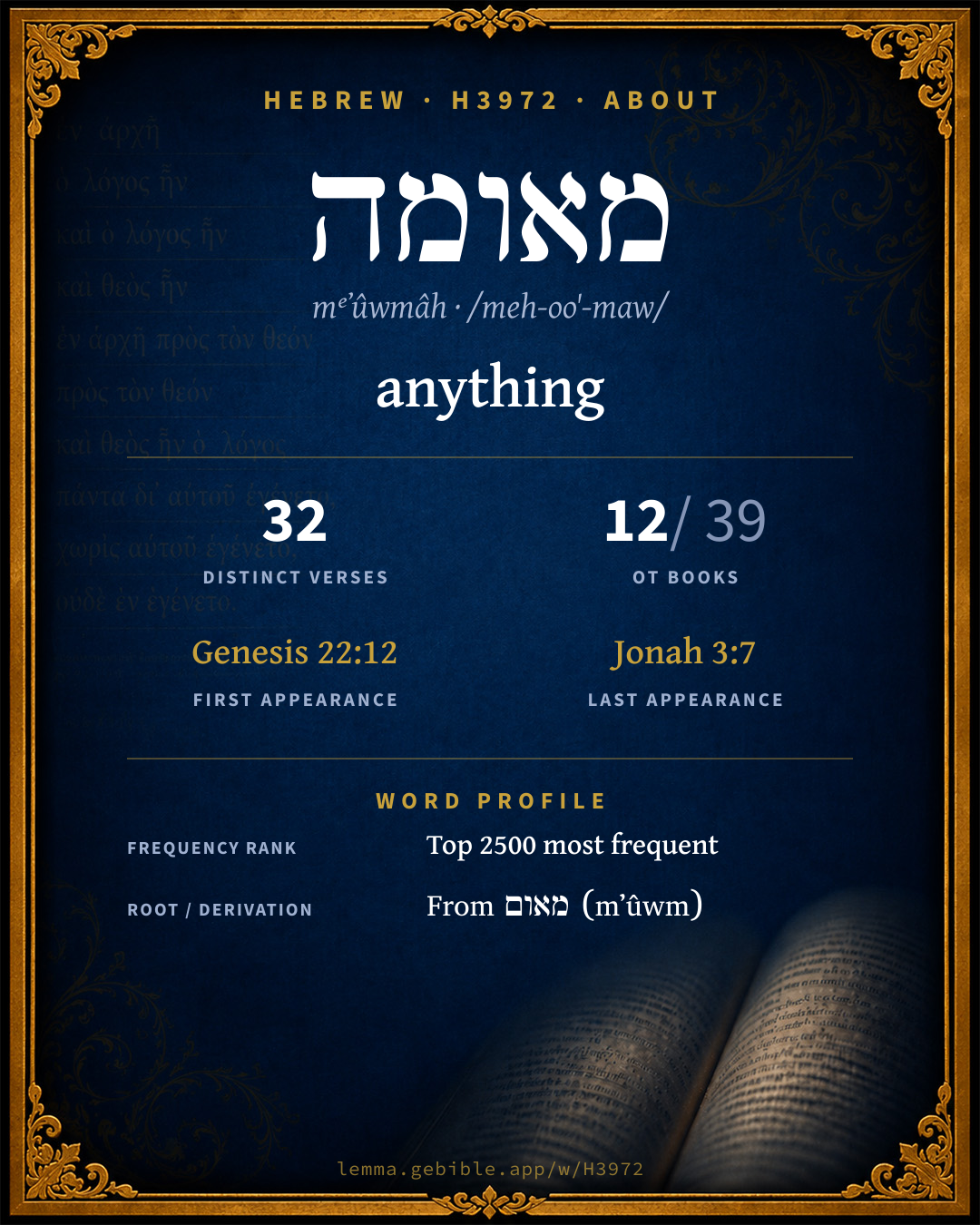
מְא֫וּמָה
anything
Full lexicon entry — Brown-Driver-Briggs (BDB)
From Brown-Driver-Briggs (BDB)
Where this word appears
Grammar key — what these labels mean
Part of speech
- Noun
- A naming word — a person, place, thing, or idea.
Noun type
- Common
- A common noun — a general class of person, place, or thing (“king,” “city,” “water”), not a specific name.
State
- Absolute
- The independent form of a noun, not bound to a following word.
Gender
- Feminine
- Grammatically feminine.
Number
- Singular
- One.
Every verse where H3972 appears — 32 distinct verses across 12 books. Click any verse to open its interlinear word-by-word view. Verse text shown in the World English Bible for context — . Each verse’s Hebrew form is shown with its reference; the English is not keyword-highlighted, since the data carries no word-level English alignment. Use “Compare translations” on any verse to read it across multiple English versions. This concordance covers the Hebrew Bible; Septuagint (Greek Old Testament) occurrences are not indexed here.
Genesis 6 verses
- Genesis 22:12 מְא֑וּמָּה n c fs He said, "Don't lay your hand on the boy, neither do anything to him. For now I know that you fear God, seeing you have not withheld your son, your only son, from me."
- Genesis 30:31 מְא֔וּמָה n c fs He said, "What shall I give you?" Jacob said, "You shall not give me anything. If you will do this thing for me, I will again feed your flock and keep it.
- Genesis 39:6 מְא֔וּמָה n c fs He left all that he had in Joseph's hand. He didn't concern himself with anything, except for the food which he ate. Joseph was well-built and handsome.
- Genesis 39:9 מְא֔וּמָה n c fs He isn't greater in this house than I, neither has he kept back anything from me but you, because you are his wife. How then can I do this great wickedness, and sin against God?"
- Genesis 39:23 מְא֨וּמָה֙ n c fs The keeper of the prison didn't look after anything that was under his hand, because Yahweh was with him; and that which he did, Yahweh made it prosper.
- Genesis 40:15 מְא֔וּמָה n c fs For indeed, I was stolen away out of the land of the Hebrews, and here also have I done nothing that they should put me into the dungeon."
Numbers 1 verse
Deuteronomy 2 verses
- Deuteronomy 13:17 מְא֖וּמָה n c fs There shall cleave nothing of the devoted thing to your hand; that Yahweh may turn from the fierceness of his anger, and show you mercy, and have compassion on you, and multiply you, as he has sworn to your fathers;
- Deuteronomy 24:10 מְא֑וּמָה n c fs When you do lend your neighbor any manner of loan, you shall not go into his house to get his pledge.
Judges 1 verse
1 Samuel 9 verses
- 1 Samuel 12:4 מְאֽוּמָה n c fs They said, You have not defrauded us, nor oppressed us, neither have you taken anything of any man's hand.
- 1 Samuel 12:5 מְא֑וּמָה n c fs He said to them, Yahweh is witness against you, and his anointed is witness this day, that you have not found anything in my hand. They said, He is witness.
- 1 Samuel 20:26 מְא֖וּמָה n c fs Nevertheless Saul didn't say anything that day: for he thought, Something has happened to him. He is not clean. Surely he is not clean.
- 1 Samuel 20:39 מְא֑וּמָה n c fs But the boy didn't know anything: only Jonathan and David knew the matter.
- 1 Samuel 21:2 מְא֛וּמָה n c fs David said to Ahimelech the priest, The king has commanded me a business, and has said to me, Let no man know anything of the business about which I send you, and what I have commanded you: and I have appointed the young men to such and such a place.
- 1 Samuel 25:7 מְא֔וּמָה n c fs Now I have heard that you have shearers: your shepherds have now been with us, and we did them no hurt, neither was there anything missing to them, all the while they were in Carmel.
- 1 Samuel 25:15 מְא֔וּמָה n c fs But the men were very good to us, and we were not hurt, neither missed we anything, as long as we went with them, when we were in the fields:
- 1 Samuel 25:21 מְא֑וּמָה n c fs Now David had said, Surely in vain have I kept all that this fellow has in the wilderness, so that nothing was missed of all that pertained to him: and he has returned me evil for good.
- 1 Samuel 29:3 מְא֔וּמָה n c fs Then said the princes of the Philistines, What [do] these Hebrews [here]? Achish said to the princes of the Philistines, Isn't this David, the servant of Saul the king of Israel, who has been with me these days, or [rather] these years, and I have found no fault in him since he fell away [to me] to this day?
2 Samuel 2 verses
- 2 Samuel 3:35 מְאֽוּמָה n c fs All the people came to cause David to eat bread while it was yet day; but David swore, saying, God do so to me, and more also, if I taste bread, or anything else, until the sun be down.
- 2 Samuel 13:2 מְאֽוּמָה n c fs Amnon was so vexed that he fell sick because of his sister Tamar; for she was a virgin; and it seemed hard to Amnon to do anything to her.
1 Kings 2 verses
- 1 Kings 10:21 לִ/מְאֽוּמָה prep + n c fs All king Solomon's drinking vessels were of gold, and all the vessels of the house of the forest of Lebanon were of pure gold: none were of silver; it was nothing accounted of in the days of Solomon.
- 1 Kings 18:43 מְא֑וּמָה n c fs He said to his servant, Go up now, look toward the sea. He went up, and looked, and said, There is nothing. He said, Go again seven times.
2 Kings 1 verse
2 Chronicles 1 verse
Ecclesiastes 4 verses
- Ecclesiastes 5:14 מְאֽוּמָה n c fs Those riches perish by misfortune, and if he has fathered a son, there is nothing in his hand.
- Ecclesiastes 5:15 וּ/מְא֨וּמָה֙ conj + n c fs As he came forth from his mother's womb, naked shall he go again as he came, and shall take nothing for his labor, which he may carry away in his hand.
- Ecclesiastes 7:14 מְאֽוּמָה n c fs In the day of prosperity be joyful, and in the day of adversity consider; yes, God has made the one side by side with the other, to the end that man should not find out anything after him.
- Ecclesiastes 9:5 מְא֗וּמָה n c fs For the living know that they will die, but the dead don't know anything, neither do they have any more a reward; for the memory of them is forgotten.
Jeremiah 2 verses
- Jeremiah 39:10 מְא֔וּמָה n c fs But Nebuzaradan the captain of the guard left of the poor of the people, who had nothing, in the land of Judah, and gave them vineyards and fields at the same time.
- Jeremiah 39:12 מְא֣וּמָה n c fs Take him, and look well to him, and do him no harm; but do to him even as he shall tell you.
Jonah 1 verse
About this entry
At a glance — auto-summarized from this page’s data, not written by a person. Every figure links to its source below. This summary describes the numbers; it doesn’t interpret them.
“anything” is the headline sense of the Hebrew word מאומה (mᵉʼûwmâh). Translators differ — “any thing” in the King James Version, then “anything” (Berean Standard Bible), as the renderings breakdown shows. It turns up in 32 verses across 12 books, a moderately common footprint. It concentrates in 1 Samuel, which alone accounts for 28% of its uses. First canonically at Genesis 22:12, it enters the text early. The sections below give every sense, occurrence, and version rendering.
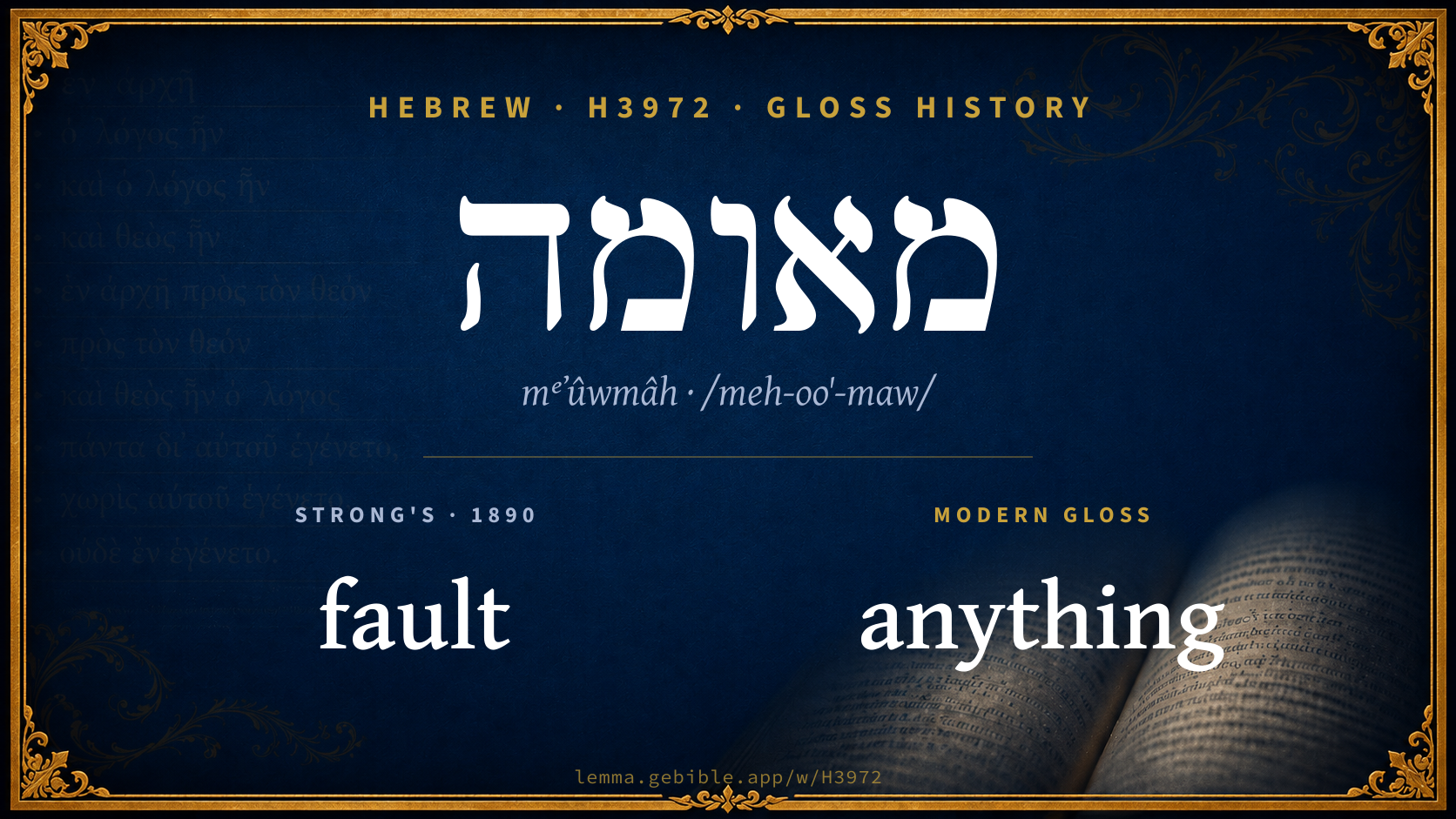
Gloss history
Strong's 1890 vs modern scholarship
About this word
Strong's H3972 catalogs a Hebrew word from the Hebrew Old Testament.
These counts are not copied from any lexicon or concordance. They are computed here, from the morphology-tagged Hebrew Old Testament. What Lemma adds →
- 32
- distinct verses
- The word appears in 32 distinct verses.
- 12 / 39
- OT books
- The word appears in 12 of 39 Old Testament books.
- #1,086
- by frequency
- Top 2500 most frequent Hebrew words (rank 1,086 of 8,640 Hebrew words by occurrence).
View all 32 occurrences in the concordance →
Most concentrated in
- 1 Samuel 9 verses 28%
- Genesis 6 verses 19%
- Ecclesiastes 4 verses 13%
By section of the Old Testament
By traditional corpus
Conventional, traditional groupings — biblical authorship is debated, so this is a traditional corpus grouping, not an authorship claim. Each share is this word’s portion of its verses in that division of the Hebrew canon. Each figure is a share of the word’s 32 distinct verses.
- Prophets (Nevi'im) 18 verses · 56%
- Torah (Pentateuch) 9 verses · 28%
- Writings (Ketuvim) 5 verses · 16%
How translations render this word
Counts come from each version’s own published word-to-Strong’s tagging or interlinear alignment — an approximate guide to how each version renders this word, not a word-level alignment the data otherwise carries. Because each total is that version’s own tagged count, the per-version totals vary from one another and need not match the appearance or distinct-verse counts above. These counts may also differ from a printed concordance because Lemma counts each distinctly tagged rendering and does not collapse phrase taggings into a single head-word total. This is a fixed set of word-tagged versions (KJV, ASV, BSB, ULT) and does not change with the reading translation you choose elsewhere. Each version’s license is shown beside its name below (and on Sources).
- King James Version: Any thing 11×, Nothing 4×, Ought 3×
- American Standard Version: Anything 10×, Nothing 4×, Aught 3×
- Berean Standard Bible: Anything 8×, Nothing 3×
- unfoldingWord Literal Text: Anything 26×, And 2×
King James Version Public Domain
Renders H3972 across 32 tagged occurrences — most commonly:
Plus 12 renderings that appear only once — usually multi-word phrases or single function words the recovered tagging swept in, not distinct renderings.
American Standard Version Public Domain
Renders H3972 across 32 tagged occurrences — most commonly:
Plus 11 renderings that appear only once — usually multi-word phrases or single function words the recovered tagging swept in, not distinct renderings.
Berean Standard Bible Public Domain
Renders H3972 across 17 tagged occurrences — most commonly:
Plus 6 renderings that appear only once — usually multi-word phrases or single function words the recovered tagging swept in, not distinct renderings. Not rendered by a distinct English word in 15 further occurrences.
unfoldingWord Literal Text CC BY-SA 4.0
Renders H3972 across 32 tagged occurrences — most commonly:
Plus 4 renderings that appear only once — usually multi-word phrases or single function words the recovered tagging swept in, not distinct renderings.
Senses in BDB
The 1 sense BDB distinguishes for this word, in lexicon order (not ranked by frequency or importance). The full entry — with sub-senses — is in the Lexicon Entry tab.
- anything
Word origin
pron.indef. anything (according to Thes from מָה וּמָה, like quidquid, against which is the Mil‘el tone; according to Ol254, 255, 386 Köii. 146 an old accus. from מאוּם in sense of speck, particle, cf. Fr point: in Assyrian manman (proposes who? who?), assim. mamman, or manma (man, who? + generalizing ma), mamma, is any one, minma (min, what? + ma), mimma, is anything, Dl§ 60,DlHWB 418 f. WSG 125 f.);—anything, usually in negative sentences, as Gn 22:12 ואל־תעשׂ לו מאומה (euphem. for something bad), 30:31 לֹא־תִתֶּן־לִי מאומה, 39:6, 9; 40:15 (euphem.), 1 S 12:4, 5; 20:26, 39; 25:7, 15, 21; 29:3 etc., Ju 14:6 ומאומה אין בידו, Ec 5:14 ומ׳ לא ישׂא בעמלו, 1 K 18:43 אין מ׳ lit. nought of anything! Je 39:12 ואל תעשׂ לו מאומה רָּע; strengthened by כֹּל †Gn 39:23; 2 S 3:35; after אִם = surely not, 2 S 3:35; in interrog. sentence Nu 22:38; in affirm. sentence Dt 24:10 כִּי־תַשֶּׁה בֳרֵעֲךָ מַשַּׁאת מ׳ a pledge of (= consisting in) anything, 2 S 13:2 (euphem.), 2 K 5:20 (var. מוּמָח). Adverbially, 1 S 21:3 אישׁ אל ידע מ׳ את הדבר let no one know of the matter in anything at all.
— Brown-Driver-Briggs (Oxford 1906, public domain), digitized via Sefaria, supplemented by the OpenScriptures HebrewLexicon (CC BY 4.0). See Sources.
Derived from מאום (mʼûwm) (H3971) — blemish.
Forms in the corpus
The 12 distinct written forms H3972 takes in the Hebrew Bible, most frequent first — each parse links to that state’s occurrences in the concordance. Hebrew forms include their vowel points and cantillation, so a single lemma takes many written forms.
| Form | Parsing | Example | Uses |
|---|---|---|---|
| מְא֔וּמָה | Noun, Common, Feminine, Singular, Absolute | Genesis 30:31 | 9 |
| מְא֑וּמָה | Noun, Common, Feminine, Singular, Absolute | Deuteronomy 24:10 | 6 |
| מְאֽוּמָה | Noun, Common, Feminine, Singular, Absolute | Ecclesiastes 5:14 | 6 |
| לִ/מְאֽוּמָה | Noun, Common, Feminine, Singular, Absolute | 1 Kings 10:21 | 2 |
| מְא֖וּמָה | Noun, Common, Feminine, Singular, Absolute | Deuteronomy 13:17 | 2 |
| וּ/מְא֖וּמָה | Noun, Common, Feminine, Singular, Absolute | Judges 14:6 | 1 |
| וּ/מְא֨וּמָה֙ | Noun, Common, Feminine, Singular, Absolute | Ecclesiastes 5:15 | 1 |
| מְא֑וּמָּה | Noun, Common, Feminine, Singular, Absolute | Genesis 22:12 | 1 |
| מְא֗וּמָה | Noun, Common, Feminine, Singular, Absolute | Ecclesiastes 9:5 | 1 |
| מְא֛וּמָה | Noun, Common, Feminine, Singular, Absolute | 1 Samuel 21:2 | 1 |
| מְא֣וּמָה | Noun, Common, Feminine, Singular, Absolute | Jeremiah 39:12 | 1 |
| מְא֨וּמָה֙ | Noun, Common, Feminine, Singular, Absolute | Genesis 39:23 | 1 |
Septuagint verse parallels
This word appears in 32 verses that also exist in the Greek Old Testament (Septuagint), out of the 32 Hebrew verses it occurs in. You can read those verses in Greek by switching the Old Testament edition to the Septuagint.
Read these verses in the Septuagint
- Genesis 22:12
- Numbers 22:38
- Deuteronomy 13:17
- Judges 14:6
- 1 Samuel 12:4
- 2 Samuel 3:35
- 1 Kings 10:21
- 2 Kings 5:20
- 2 Chronicles 9:20
- Ecclesiastes 5:14
- Jeremiah 39:10
- Jonah 3:7
This is a verse-level parallel only — the same verses exist in both the Hebrew and Greek Old Testaments. No word-level Hebrew↔Greek correspondence is claimed: the data carries no such alignment, so no Greek word is shown as this Hebrew word’s translation. Coverage is not total — the Septuagint omits the deuterocanon and renumbers the Psalms, so some Hebrew verses have no direct Greek parallel.