Colossians 1:17

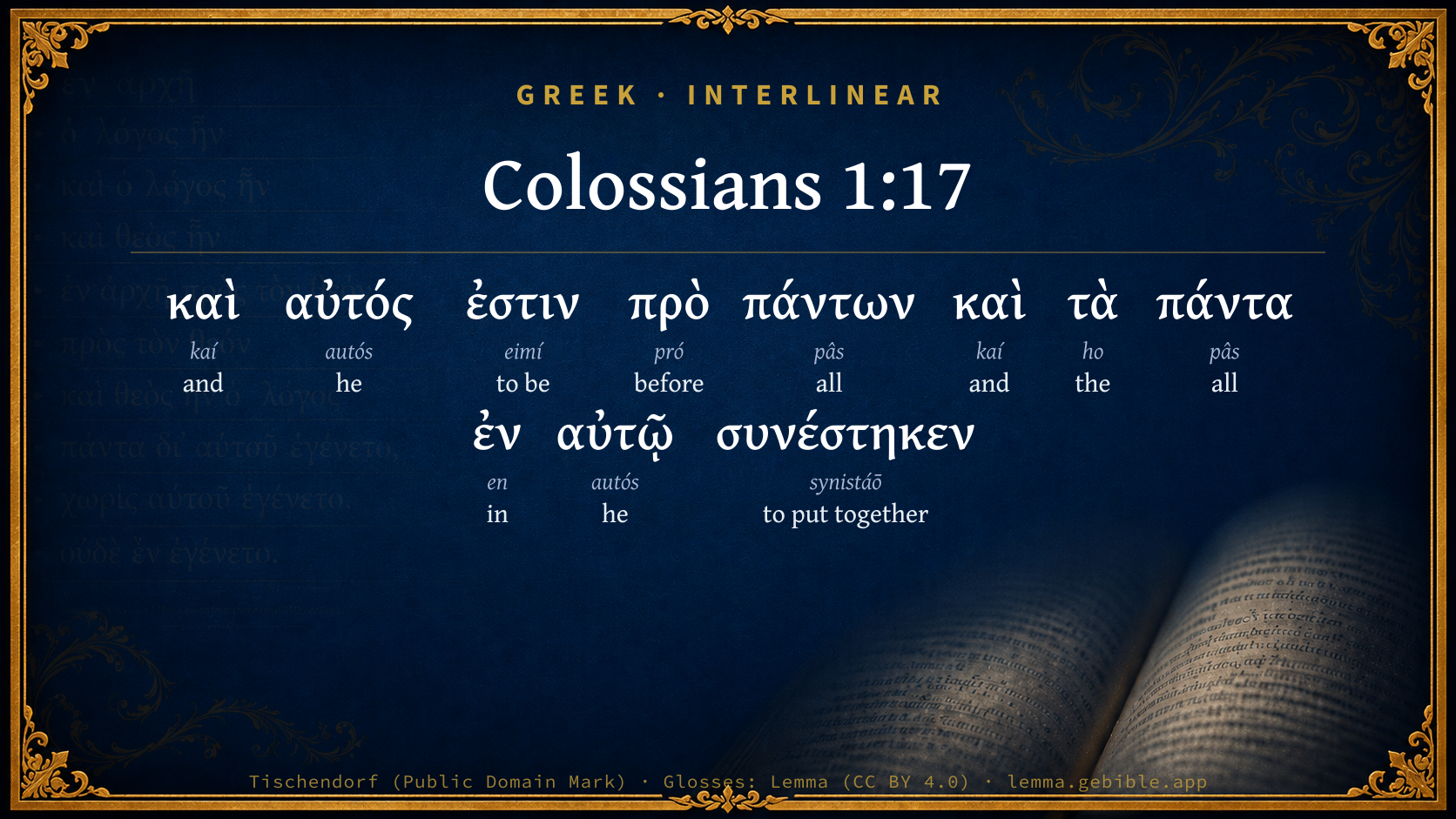
Greek (Tischendorf 8th ed.) Colossians 1:17 appears in the Greek New Testament. The text above is from the Tischendorf 8th edition. Each word links to its Strong’s number and a concise gloss. Click any word for its full Thayer’s Greek Lexicon entry.
Download image
Cite this verse

Colossians 1:17 (World English Bible). Public Domain. Lemma interlinear Bible study tool, https://lemma.gebible.app/v/colossians/1/17.

Show BibTeX & RIS
BibTeX
RIS
English Translation
He is before all things, and in him all things are held together.
World English Bible · Public Domain
Download a study sheet

One document with this verse’s original text, its word-by-word gloss line, the meaning frame, cross-references with their text, attributed commentary, and full source and license credits — printable, and it pastes into notes with its structure intact.

This verse Autodidact and up

Study sheet (.html) Plain text (.txt)

A passage Seminary Student

Up to 50 verses in one chapter. A passage sheet keeps up to 6 commentary sources and 12 cross-references per verse, in the order this page ranks them, and says so on the sheet whenever that leaves anything out. Ask for a single verse and you get the Autodidact verse sheet above.

Everything on this page stays free to read, with no account — the sheet is a download of what is already on screen, not access to it.

Want to remove ads? Support Godless Engineer
Compare translations 3

The same verse in 3 English versions, stacked beneath the original-language interlinear above. Click any original word for its lexicon entry.

Each is an independent rendering of the whole verse — the interlinear is not word-aligned to these translations.

Highlighted words mark where these versions differ — a whole-verse word diff, not a word-by-word alignment.

  • World English Bible Public Domain
    He is before all things, and in him all things are held together.
  • King James Version Public Domain
    And he is before all things, and by him all things consist.
  • unfoldingWord Literal Text CC BY-SA 4.0
    And he is before all things, and in him all things hold together.

unfoldingWord Literal Text — © unfoldingWord, licensed CC BY-SA 4.0. Word-aligned USFM3 via Door43 (git.door43.org/unfoldingWord/en_ult).

Versions to compare (up to 4)

3 of 4 selected

Show all 19 translations

Every available English version of this verse, each an independent rendering of the whole verse.

  • World English Bible Public Domain
    He is before all things, and in him all things are held together.
  • Berean Standard Bible Public Domain
    He is before all things, and in Him all things hold together.
  • Majority Standard Bible Public Domain
    He is before all things, and in Him all things hold together.
  • King James Version Public Domain
    And he is before all things, and by him all things consist.
  • American Standard Version (1901) Public Domain
    and he is before all things, and in him all things consist.
  • Revised Version (1885) Public Domain
    and he is before all things, and in him all things consist.
  • Geneva Bible (1599) Public Domain
    And hee is before all things, and in him all things consist.
  • Douay-Rheims (1899) Public Domain
    And he is before all, and by him all things consist.
  • Young's Literal Translation Public Domain
    and himself is before all, and the all things in him have consisted.
  • Literal Standard Version CC BY-SA 4.0
    and He is before all, and all things have consisted in Him.
  • Unlocked Literal Bible CC BY-SA 4.0
    He himself is before all things, and in him all things hold together.
  • unfoldingWord Literal Text CC BY-SA 4.0
    And he is before all things, and in him all things hold together.
  • Darby Bible Public Domain
    And *he* is before all, and all things subsist together by him.
  • World Messianic Bible Public Domain
    He is before all things, and in him all things are held together.
  • Webster's Bible Public Domain
    And he is before all things, and by him all things consist.
  • Free Bible Version CC BY-SA 4.0
    He existed before everything, and he holds everything together.
  • Bible in Basic English Public Domain
    He is before all things, and in him all things have being.
  • Text-Critical English NT CC BY 4.0
    He is before all things, and in him all things hold together.
  • Tyndale New Testament (1534) Public Domain
    and he is before all thinges and in him all thynges have their beynge.

Literal Standard Version (2020), Covenant Press — licensed CC BY-SA 4.0. Text via the HelloAO Bible API (eBible.org). Unlocked Literal Bible (unfoldingWord) — licensed CC BY-SA 4.0. Text via the HelloAO Bible API (eBible.org). unfoldingWord Literal Text — © unfoldingWord, licensed CC BY-SA 4.0. Word-aligned USFM3 via Door43 (git.door43.org/unfoldingWord/en_ult). Free Bible Version, Dr. Jonathan Gallagher — licensed CC BY-SA 4.0. Text via the HelloAO Bible API (eBible.org).

Word by word

More ways to search: Search by grammar → Find every occurrence → Compare this word →

Practice this passage: Drill this verse → Learn its vocabulary →

συνέστηκεν
synistáō
G4921
“to put together”
Verb, Perfect, Active, Indicative, 3rd person, Singular
Part of Speech
Verb
Tense
Perfect
Voice
Active
Mood
Indicative
Person
3rd person
Number
Singular
Full Thayer's Definition

Origin: from G4862 and G2476 (including its collat. forms)

TDNT: 21:56,1

1. to place together, to set in the same place,to bring or band together a. to stand with (or near) 2. to set one with another a. by way of presenting or introducing him b. to comprehend 3. to put together by way of composition or combination, to teach by combining and comparing a. to show, prove, establish, exhibit 4. to put together, unite parts into one whole a. to be composed of, consist
  1. καὶ kaí G2532 “and” Conjunction
  2. αὐτός autós G846 “he” Personal pronoun, Nominative, Singular, Masculine
  3. ἐστιν eimí G1510 “to be” Verb, Present, Active, Indicative, 3rd person, Singular
  4. πρὸ pró G4253 “before” Preposition
  5. πάντων pâs G3956 “all” Adjective, Genitive, Plural, Masculine
  6. καὶ kaí G2532 “and” Conjunction
  7. τὰ ho G3588 “the” Article, Nominative, Plural, Neuter
  8. πάντα pâs G3956 “all” Adjective, Nominative, Plural, Neuter
  9. ἐν en G1722 “in” Preposition
  10. αὐτῷ autós G846 “he” Personal pronoun, Dative, Singular, Masculine

About this verse

These counts appear in no published source. They are computed here, from the morphology-tagged text and Lemma’s own curated glosses. What Lemma adds →

11
words
8
distinct lemmas
Pauline Epistles
section

Notable vocabulary

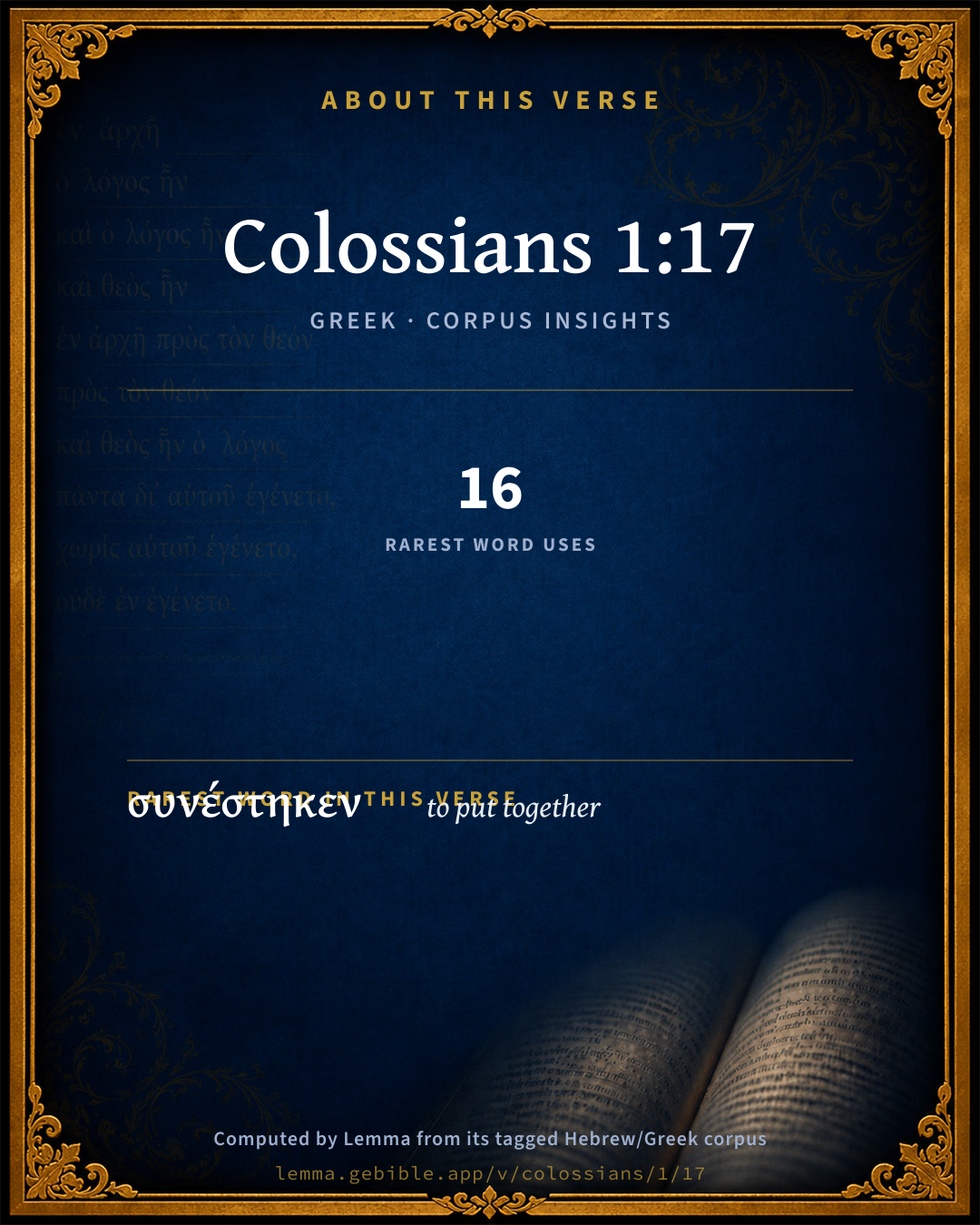
The rarest word here is συνέστηκεν to put together G4921 — appearing just 16 times in the whole Greek New Testament.

Shared distinctive vocabulary

συνέστηκεν to put together G4921 occurs in 15 verses of the Greek New Testament. Also found in:

Repetition

Words recur within this verse:

  • πάντων all G3956 ×2
  • καὶ and G2532 ×2
  • αὐτός he G846 ×2

Cross-references

19

Topical passages linked to Colossians 1:17 in the Treasury of Scripture Knowledge — connected by theme and wording, ordered by reader-vote popularity; previews shown in the World English Bible.

  • Hebrews 1:3 His Son is the radiance of his glory, the very image of his substance, and upholding all things by the word of his power, when he had by himself made purification for our sins, sat down on the right hand of the Majesty on high;
  • 1 Corinthians 8:6 yet to us there is one God, the Father, of whom are all things, and we for him; and one Lord, Jesus Christ, through whom are all things, and we live through him.
  • John 1:1–3 In the beginning was the Word, and the Word was with God, and the Word was God.
  • John 8:58 Jesus said to them, "Most assuredly, I tell you, before Abraham came into existence, I AM."
  • John 17:5 Now, Father, glorify me with your own self with the glory which I had with you before the world existed.
  • Acts 17:28 'For in him we live, and move, and have our being.' As some of your own poets have said, 'For we are also his offspring.'
  • Psalms 75:3 The earth and all its inhabitants quake. I firmly hold its pillars. Selah.
  • Colossians 1:15 who is the image of the invisible God, the firstborn of all creation.
  • Revelation 1:8 "I am the Alpha and the Omega," says the Lord God, "who is and who was and who is to come, the Almighty."
  • Proverbs 8:22–23 "Yahweh possessed me in the beginning of his work, Before his deeds of old.
  • Isaiah 44:6 Thus says Yahweh, the King of Israel, and his Redeemer, Yahweh of Hosts: I am the first, and I am the last; and besides me there is no God.
  • Isaiah 43:11–13 I, even I, am Yahweh; and besides me there is no savior.
  • Revelation 1:17 When I saw him, I fell at his feet like a dead man. He laid his right hand on me, saying, "Don't be afraid. I am the first and the last,
  • Hebrews 13:8 Jesus Christ is the same yesterday, today, and forever.
  • Revelation 2:8 "To the angel of the assembly in Smyrna write: "The first and the last, who was dead, and has come to life says these things:
  • 1 Samuel 2:8 He raises up the poor out of the dust, He lifts up the needy from the dunghill, To make them sit with princes, Inherit the throne of glory: For the pillars of the earth are Yahweh's, He has set the world on them.
  • Micah 5:2 But you, Bethlehem Ephrathah, Being small among the clans of Judah, Out of you one will come forth to me that is to be ruler in Israel; Whose goings forth are from of old, from everlasting.
  • John 5:17–18 But Jesus answered them, "My Father is still working, so I am working, too."
  • Revelation 1:11 saying, "What you see, write in a book and send to the seven assemblies: to Ephesus, Smyrna, Pergamum, Thyatira, Sardis, Philadelphia, and to Laodicea."

Cross-references courtesy of OpenBible.info (CC BY 4.0).

Commentary

Notes on Colossians 1:17 from classic Christian and Jewish commentators (each source and its license shown beneath its notes). The classic Christian expositions comment on the surrounding passage and are grouped to its opening verse, so a note may address several verses; the Jewish commentaries on the Tanakh (Rashi and others) are per-verse, so they appear only where the commentator wrote on this verse.

Lemma curates 59 commentaries, every one of them public domain or Creative Commons licensed, each selected and text-cleaned for this edition rather than reprinted as found. About our sources →

The Biblical Illustrator

Joseph S. Exell

Col_1:17

By Him all things consist.

That is, Christ upholds, rules, and governs all things by His providence, as is shown elsewhere (Heb_1:2-3; Pro_8:15; Joh_5:12). Christ is not like a carpenter that makes his house and then.. leaves it, or like a shipwright that frames his ship and never guides it.

I. All things are said to consist in Him in respect of

1. Conservation: in that He keeps all things in their being.

2. Precept: in that from Him are prescribed the laws by which nature, policy, and religion are governed.

3. Operation: in that all things move in Him.

4. His position of means to end.

5. As the universal cause of nature and natural instincts in all creatures, by which they further their own preservation.

II. Is Him all things consist.

1. As He is God--

(1) In respect of ubiquity; He comprehends all things, and is comprehended of nothing. The nations are but a drop of His bucket, and time but a drop of His eternity.

(2) In respect of power; in that this whole frame stirreth.

(3) In respect of omniscience and wisdom, for all is within His knowledge, and receiveth order from His wisdom.

(4) In respect of decree, for the world to he made did from everlasting hang in the foreknowledge and pro-ordination of Christ.

2. As He is Redeemer. All things consist in Him--

(1) Because He is that atonement which kept the world from being dissolved.

(2) Because the respect of Him and His Church is that which keeps up the world to this day. Were His body complete the world could not stand one hour.

(3) Because the promise made to man concerning His prosperity in the use of all creatures is made in Christ.

III. In Him all things consist. Which word notes--

1. Order. By an excellent order the creatures agree together in a glorious frame; for God is the God of order, not of confusion.

(1) But are there not many evils in the world?

(a) There may be order in respect of God, though not in respect of us.

(b) It follows not that there is no order because we see none (Rom_11:33).

(c) Many of the reasons of human misery are revealed--sin entailing punishment.

(d) There may be order in respect of the whole, though not in respect of every part.

(2) But there are many sins in the world, and those con-Mist not in Christ, neither tend they to order.

(a) These are restrained by Christ.

(b) Work out His purposes.

2. Continuance. The world, men, and lower creatures, etc., are maintained in being by Christ,

3. Co-operation. By the providence of Christ all things work together.

(1) For Christs glory;

(2) for His peoples good.

4. Immortality.

Uses--

1. For reproof of mens security in sin. Seeing that all things consist in Christ, they cannot stir but He seeth them.

2. It should teach us to trust in Christ, not in second causes.

3. If all things consist in Christ, then much more are the righteous preserved with a special preservation. (N. Byfield.)

All things exist in Christ

All things stand together in Him as the causal and conditional sphere of their continued existence. In Him they live and move and have their being, and in Him the sustentation or upholding of the universe rests. How wondrous, then, the glory and power of the Son of God! Without Him the sun would not shine, nor the seasons revolve; without Him the rain would not descend, nor the rivers run, nor the trees grow, nor the oceans ebb and flow. His power is necessary to summer and winter, seed.time and harvest, to earth and sky. He upholdeth all things by the word of His power, and without Him creation would collapse. Every province of the empire of immensity, with all its contents of life, force, and motion, depends on Him. The intellect of angels reflects His light, the fire of seraphs is the glow of His love, the energy of our own souls is an evidence of His beneficence and skill. In Him all things consist--the power of their support, the primal centre of their order, the rule of their operation. This is the Being in whom we have redemption. What sublimity His greatness sheds around the gospel! What moral richness His gospel throws around nature and humanity! How lofty should be our adoration, how strong our confidence, how warm our love, how complete our submission! (J. Spence, D. D.)

The Biblical Illustrator, edited by Joseph S. Exell (c. 1880s–1900s) — public domain. Text from a community e-Sword module.

The Pulpit Commentary

And he is before all things (ver. 15; Joh_1:1 Joh_8:58; Rev_3:14; Pro_8:22-31) This emphatic "he" (aujtov) meets us in every clause and in every possible grammatical form, as though in the very grammar of the sentence Christ must be "all in all." "He" is kept ringing in the cars of those who were in danger of forgetting him in the charm of other sounds (Col_2:4, 19: comp. Col_2:9-15; Eph_2:14-18, for the same rhetorical feature; also (Eph_4:11; 1Jn_2:2 Rev_19:15, Greek) We now pass from the origination (ver. 16 a), through the continuance (ver. 16 b, present perfect ektistai), to the present constitution (ver. 17 b) of the universe as Jesting upon this antecedent and perpetual He Is, which affords the underlying basis uniting in one the redemptional and the creative offices of Christ (vers. 17, 18). In the mouth of a Hebraist like St. Paul, the coincidence of the doubly emphatic "He Is" with the etymological sense of Jehovah (Yahweh; oJ wn, LXX), as interpreted in. Exo_3:6., can scarcely be accidental (see Lightfoot) And Greek readers of the LXX might be reminded of such declarations as those of Isa_41:4 Isa_44:6 Isa_48:12. (comp. Joh_1:1, 2 8:24, 28, 58 13:19; Rom_1:8, Rom_1:17) In St. Paul"s Christ, as in Isaiah"s Jehovah, sovereignty of redeeming, rests upon sovereignty of creative power, and both alike upon that perpetuity of being which "the Son of God"s love" shares with the Father. Socinian exegetes give to "before" an ethical sense ("at the head of," "superior to"), in harmony with their reference of vers. 15-18 to the relation of Christ to the Church. But pro never has this sense in St. Paul: comp. also the "Firstborn" of ver. 15, and again "Beginning," "Firstborn" (ver. 18). If ver. 15 left us in any doubt as to the writer"s intention to assert Christ"s pro-mundane existence, this expression ought to remove it. Language can hardly be more explicit. And all things in him consist (Joh_1:3, Joh_1:4, R.V margin; Heb_1:3 Heb_11:3) i.e. have their common standing, are constituted a whole. The apostle speaks here the language of philosophy. In Plato and Aristotle, the term consist (consistence) is found expressing the essentially philosophical conception of the inherent unity, in virtue of which the universe is such and forms a single, correlated whole. The Alexandrine Judaists had already found this unifying principle in the Loges: "He is the Image of God, to whom alone fulness belongs. For other things of themselves are loose; and if they happen to be consolidated anywhere, it is the Divine Word by which they are tied fast. For it is the cement and the bond of things, that has filled all things with its essence. And having chained and woven together everything, it is itself absolutely full of itself" (Philo, "Who is Heir of Divine Things?" St. Paul"s declaration meets the questionings indicated by language of this kind (see the more extended references of Meyer and Lightfoot).

The Pulpit Commentary (1880–1919), ed. H.D.M. Spence-Jones & Joseph S. Exell — public domain. Text from a community e-Sword module.

Bengel's Gnomon

Johann Albrecht Bengel

Col 1:17. ἜΣΤΙ, He is) He does not say, He was made; nor, He was, of which the latter might, however, have been used in a dignified sense, comp. Joh 1:1; but He is, in the present; comp. Joh 8:58.—πρὸ πάντων, before all things) even before time, i.e. from eternity.—καὶ τὰ πάντα ἐν αὐτῳ συνέστηκε) and all things in Him came together into one system [Engl. Vers. By Him all things consist, i.e. are maintained.] The universe found its completion in Him. LXX. τὰ συστἡματα τῶν ὑδάτων, Gen 1:10. He is the first and the last, Rev 22:13. [Isa 41:4, in regard to the origin: I the Lord am first, and I am with the last.—V. g.]

Bengel's Gnomon of the New Testament — English translation (T&T Clark, Edinburgh, 1860) — public domain. Text from a community e-Sword module.

Meyer's Critical & Exegetical Commentary

Heinrich August Wilhelm Meyer

Col_1:17. Καὶ αὐτός] which is to be separated from the preceding by a comma only (see on Col_1:16), places, in contradistinction to the created objects in Col_1:16 (τὰ πάντα), the subject, the creating self: and He Himself, on His part, has an earlier existence than all things, and the collective whole subsists in Him. Never is αὐτός in the nominative[39] the mere unemphatic he of the previous subject (de Wette), either in Greek authors or in the N. T., not even in passages such as Buttmann (Neut. Gr. p. 94 [E. T. 107]) brings forward; see Fritzsche, ad Matth. p. 47; Winer, p. 141 f. [E. T. 187]; Kühner, II. 1, p. 563.

πρὸ πάντων] like ΠΡΩΤΌΤΟΚΟς, referring to time, not to rank (as the Socinians, Nösselt, Heinrichs, Schleiermacher, Baumgarten-Crusius, and others hold); Paul thus repeatedly and emphatically lays stress on the pre-existence of Christ. Instead of ἐστί, he might have written ἦν (Joh_1:1); but he makes use of the former, because he has in view and sets forth the permanence of Christs existence, and does not wish to narrate about Him historically, which is done only in the auxiliary clauses with ὅτι, Col_1:16; Col_1:19. On the present, comp. Joh_8:58. His existence is more ancient than that of all things (ΠΆΝΤΩΝ, not masculine, as the Vulgate and Luther translate).

ἘΝ ΑὐΤῷ] as in Col_1:16, referring to the causal dependence of the subsistence of all existing things on Christ.

συνέστηκε] denotes the subsistence of the whole, the state of lasting interdependence and order,an idea which is not equivalent to that of creation, but presupposes it. Reiske, Ind. Dem. ed. Schaef. p. 481: Corpus unum, integrum, perfectum, secum consentiens esse et permanere. Comp. 2Pe_3:5; Plat. Rep. p. 530 A: ξυνεστάναι τῷ τοῦ οὐρανοῦ δημιουργῷ αὐτόν τε καὶ τὰ ἐν αὐτῷ, Tim. 61 A: γῆν … ξυνεστηκυῖαν, Legg. vii. p. 817 B: ἡ πολιτεία ξυνέστηκε μίμησις τοῦ καλλίστου … βίου. Herod. vii. 225; Philo, quis rer. div. haer. p. 489: ὁ ἔναιμος ὄγκος, ἐξ ἑαυτοῦ διαλυτὸς ὢν καὶ νεκρὸς, συνέστηκε κ. ζωπυρεῖται προνοίᾳ Θεοῦ κ.τ.λ. It expresses that there is in Christ not merely the creative cause, but also the cause which brings about organic stability and continuance in unity (preserving and governing) for the whole of existing things. Comp. Heb_1:3. Of attempts at explanation under the moral interpretation, we may note that of Schleiermacher: the consolidating of earthly relations and institutions; and that of Baumgarten-Crusius: in this new world He is Lord in recognition and in sway

[39] Bengel correctly observes on ver. 16: Ipse hic saepe positum magnam significat majestatem et omnem excludit creaturam.

REMARK.

The intentional prominence given to the fact of the creation of all things through Christ, and in particular of the creation of the angels in their various classes, justifies the supposition that the false teachers disparaged Christ in this respect, and that they possessed at least elements of the Gnostic-demiurgic doctrine which was afterwards systematically elaborated. There is no evidence, however, of their particular views, and the further forms assumed by the Gnostic elements, as they showed themselves according to the Fathers in Simon Magus (Iren. Haer. i. 20 Eunoiam … generare angelos et potestates, a quibus et mundum hunc factum dixit; comp. Epiph. Haer. xxi. 4), Cerinthus, etc., and especially among the Valentinians, while certainly to be recognised as fundamentally akin to the Colossian doctrinal errors (comp. Heinrici, Valentinian. Gnosis, 1871), are not to be identified with them; nor are those elements to be made use of as a proof of the post-apostolic origin of the epistle, as still is done by Hilgenfeld (see his Zeitschr. 1870, p. 246 f.), and more cautiously by Holtzmann. Of Ebionitism only Essene elements are to be found in Colossae, mingled with other Gnostic doctrines, which were not held by the later Ebionites. In particular, the πρὸ πάντων εἶναι, on which Paul lays so much stress, must have been doubted in Colossae, although a portion of the Ebionites expressly and emphatically taught it (λέγουσιν ἄνωθεν μὲν ὄντα πρὸ πάντων δὲ κτισθέντα, Epiph. Haer. XXX. 3). Moreover, the opinion that Paul derived the appellations of the classes of angels in Col_1:16 from the language of the heretics themselves (Böhmer, comp. Olshausen) is to be rejected, because in other passages also, where there is no contrast to the Gnostic doctrine of Aeons, he makes use in substance of these names (Rom_8:38; 1Co_15:24; comp. Eph_1:20 ff; Eph_3:10; Eph_6:11 ff.). They are rather to be regarded as well-known and generally-current appellations, which were derived from the terminology of later Judaism, and which heretics made use of in common with the orthodox. The anti-Gnostic element is contained, not in the technical expressions, but in the doctrinal contents of the passage; and it was strong enough to induce Marcion, who took offence at it, to omit Col_1:15-17 (Tertullian, c. Marcion, v. 19). See, besides, Räbiger, Christol. Paul. p. 51 f.; Lechler, apost. Zeit. p. 55 f.; Klöpper, l.c.

Meyer — Critical and Exegetical Commentary on the New Testament — English translation by Peter Christie, edited by Frederick Crombie (T&T Clark, 1880) — public domain. Text from a community e-Sword module.

Expositor's Greek Testament

ed. W. Robertson Nicoll

Col 1:17 . αὐτός ἐστιν . αὐτ . is emphatic, He and no other. Lightfoot (followed by Westcott and Hort and Ellicott) accents ἔστιν , “He exists,” on account of the present, and compares ἐγὼ εἰμί (Joh 8:58 ). But there ἐγὼ εἰμί stands alone, whereas here αὐτ . ἐστ . is completed by πρὸ πάντων . Besides, there is no object in the assertion of the existence of the Son here. The sense of ἐστὶν depends to some extent on that of πρὸ πάντων . If, as is usual, πρὸ is taken here as temporal, αὐτός will be the pre-incarnate Son. If, however, with Haupt, it be taken to assert superiority in rank, αὐτός will be the exalted Christ, and the present will be quite regular. It is urged that for this some other preposition, such as ἐπὶ or ὑπέρ , would have been expected. Gess says that in each of the eleven other passages in which it occurs in Paul it is temporal, and in the other N.T. passages (37) it is used of place or, as generally, of time, except in Jas 5:12 , 1Pe 4:8 , where it is used of rank. It is used, however, in classical Greek in this latter sense. Perhaps it is safest to allow the general Pauline usage to determine the sense here. In this case πρὸ is temporal and ἐστιν a timeless present. πάντων is, of course, neuter, like τὰ πάντα , not masculine. συνέστηκεν : “hold together”. The Son is the centre of unity for the universe. He keeps all its parts in their proper place and due relations and combines them into an ordered whole. Apart from Him it would go to pieces. Philo ascribes a similar function to the Logos. Haupt thinks that this thought that Christ is the principle of coherence for the universe is not in the passage, which means no more than that He sustains it ( cf. Heb 1:3 , φέρων τὰ πάντα ).

The interpretation of Col 1:15-17 given by Oltramare should not be passed over. He eliminates the idea of pre-existence from the passage, and says that the reference is throughout to Christ as Redeemer. God had in creation to provide by a plan of Redemption for the entrance of evil into the universe, and only on that condition could it take place. So since Christ is the Redeemer, creation is based upon Him, He is the means to it, and the end which it contemplates. He objects to the common view on the following grounds: (1) Elsewhere Paul speaks of God, not Christ, as the Creator and goal of the universe; (2) Paul starts from the Christ in whom we have redemption as πρωτότ . π . κτίσεως , and in Col 1:18 , which refers to the same Person as Col 1:17 , He is spoken of as the Head of the Church, therefore the context is against any reference to a pre-incarnate Christ; (3) He carefully avoids saying that the Son has created all things, though he has to change the subject of the sentence. In reply to (1) it may be said that the Son acts as Agent of the Father, and so creation may be referred to either, and that while Paul contemplates the final surrender by the Son of the kingdom to the Father, he also contemplates a prior subjection of everything to the Son. Oltramare himself, for another purpose, points to apparent inconsistency in John (Joh 1:2 compared with Rev 3:14 ; Rev 4:11 ; Rev 10:6 ) and the author of Hebrews (Heb 1:2 compared with Heb 2:10 , Heb 11:3 ). If these writers did not find the two views incompatible, why should Paul have done so? In reply to (2) it may be urged that Paul’s hold on the personal identity of the Son in the states through which He passed was strong enough to enable Him to glide from one to the other without any sense of incongruity. As to (3), the change in the form of sentence is probably to prepare for διʼ αὐτοῦ κ . εἰς αὐτὸν . There is a similar change at Col 1:19 , where ὅτι ἐν αὐτῷ corresponds to ὅτι ἐν αὐτῷ (Col 1:16 ). His own view is open to fatal objections. It is not clear that the creation of the angels who did not fall would be conditional on provision being made for Redemption, nor yet how this would prove the superiority of the Redeemer to these angels. The insuperable difficulty, however, is that the thought is so far-fetched and not naturally suggested by the words. ἐν αὐτῷ ἐκτίσθη τὰ πάντα can hardly be consistent with the creation of the universe long before the Son came into existence. Nor can διʼ αὐτοῦ mean merely that the Son was an indispensable condition for the creation of the universe, it implies active agency. Nor is any adequate explanation of τ . πάντα ἐν αὐτῷ συνέστηκεν given. Besides, Phi 2:5-8 sufficiently proves that Paul believed in the pre-existence of Christ, and that makes it less than ever justifiable to take the passage in other than its plain sense. Gess, it may be added, explains that the firstborn is the one who opens for those who follow the path of life, and by his consecration to God must purchase for them the Divine good pleasure. Exo 13:2 ; Exo 13:12 sq. and Num 3:12 sq. are quoted to prove this, but neither says anything of the purchase of Divine favour for those born after. Exo 4:22 and Psa 89:27 are explained to mean, accordingly, that Israel and David, not the nations and their kings, are objects of God’s good pleasure and mediators of it to the world. πρωτότ . π . κτ . is therefore explained as the opener of the path of life and mediator of God’s love to every creature. But this is to overlook the fact that in Psa 89 . the firstborn is further defined as the highest of the kings of the earth.

The Expositor's Greek Testament, edited by W. Robertson Nicoll (1897–1910) — public domain. Text from a community e-Sword module.

Jamieson, Fausset & Brown

Robert Jamieson, A. R. Fausset & David Brown

(Joh 8:58.) Translate as Greek, "And He Himself (the great HE) is (implying divine essential being) before all things," in time, as well as in dignity. Since He is before all things, He is before even time, that is, from eternity. Compare "the first-born of every creature" (Col 1:15).

by him--Greek, "IN Him" (as the conditional element of existence, Col 1:16) [ALFORD].

consist--"subsist." Not only are called into being from nothing, but are maintained in their present state. The Son of God is the Conserver, as well as the Creator of all things [PEARSON]. BENGEL less probably explains, "All things in Him come together into one system: the universe found its completion in Him" (Isa 41:4; Rev 22:13). Compare as to GOD, Rom 11:36 : similar language; therefore Christ must be God.

Jamieson, Fausset & Brown — Commentary Critical and Explanatory on the Whole Bible (1871) — public domain (CC PDM 1.0). Text via the HelloAO Bible API.

Adam Clarke's Commentary

Verse 17. See Clarke on Col 1:16

Adam Clarke's Commentary on the Bible (1810–1826) — public domain. Text from a community e-Sword/MySword module.

John Calvin's Commentaries

17. All things were created by him, and for him. He places angels in subjection to Christ, that they may not obscure his glory, for four reasons: In the first place, because they were created by him; secondly, because their creation ought to be viewed as having a relation to him, as their legitimate end; thirdly, because he himself existed always, prior to their creation; fourthly, because he sustains them by his power, and upholds them in their condition. At the same time, he does not affirm this merely as to angels, but also as to the whole world. Thus he places the Son of God in the Highest seat of honor, that he may have the pre-eminence over angels as well as men, and may bring under control all creatures in heaven and in earth.

John Calvin's Commentaries (1540-1563) — public domain. Text from the Calvin Translation Society English edition (1840s-50s) via the Christian Classics Ethereal Library (ccel.org). Calvin's coverage is partial (roughly two-thirds of the Bible); uncommented books and verses are honest gaps, never fabricated. The 19th-century editor's footnotes and remarks are omitted so the notes are faithfully Calvin's own voice.

Ellicott's Commentary for English Readers

(17) He is before all things.—The words “He is” are both emphatic. He, and He only, is; all else is created. It is impossible not to refer to the “I am” of Eternal existence, as claimed by our Lord for Himself. “Before Abraham was, I am” (Joh_8:58; comp. also Joh_1:15). Hence the word “before” should be taken, not of supreme dignity, but of pre-existence.

By him all things consist.—That is, hold together in unity, obeying the primæval law of their being. In this clause is attributed to our Lord, not only the creative act, but also the constant sustaining power, “in which all lives and moves and has its being,” and which, even less than the creative agency, can be supposed to be a derivative and finite power, such as that of the Demiurgus of Gnostic speculation.

A Bible Commentary for English Readers, edited by Charles John Ellicott (1878–1897) — public domain. Text from a community e-Sword module.

The Cambridge Bible for Schools and Colleges

gen. ed. J. J. S. Perowne

17. he] Emphatic in the Greek; He, and no other who could even seem to rival or obscure His sublime eminence.

is before all things] ante omnes, Latin Versions. The Greek genitive form is ambiguous; it might be either masculine or neuter. But the mention in the last clause, in the unambiguous nominative, of “all things,” decides for a similar reference here.

Lightfoot prints his rendering here, “and He is before all things,” comparing Joh_8:58, and Exo_3:14, and adding, “The imperfect [‘was’] might have sufficed, … but the present [‘is’] declares that this pre-existence is absolute existence.” He quotes Basil of Cæsarea (adv. Eunom., iv.) as emphasizing the special force of “is” (as against e.g. “was” or “became”) in this very passage: “(the Apostle) indicates thus that He ever is while the creation came to be.”

“Before:”—i.e., as the whole context shews, in respect of priority of existence; the priority of eternity.

by him] Lit. and better, in Him; see above on Col_1:16.

consist] I.e., literally, stand together, hold together. The Latin-English “consist” (Latin versions, constant) exactly renders the Greek. “He is the principle of cohesion in the Universe. He impresses upon creation that unity and solidarity which makes it a cosmos instead of a chaos” (Lightfoot). And Lightfoot quotes Philo to shew that the “Logos” of Alexandrian Judaism was similarly regarded as the “Bond” of the universe.

“Christ was the conditional element of their creation, the causal element of their persistence … The declaration, as Waterland observes, is in fact tantamount to ‘in Him they live, and move, and have their being’ ” (Ellicott).

Natural philosophy, after all observation and classification of phenomena and their processes, asks necessarily but in vain (so long as it asks only “Nature”), what is their ultimate secret, what is, for instance, the last reason of universal gravitation. Revelation discloses that reason in the Person and Will of the Son of God.

Thus far the Apostle has unfolded the glory of Christ as the Cause and Bond of all being in the sphere of “Nature,” material and otherwise. Now he turns to the sphere of Grace.

The Cambridge Bible for Schools and Colleges (gen. ed. J. J. S. Perowne; Cambridge University Press, 1878–1918) — public domain. Text from a community e-Sword module.

John Gill's Exposition

And he is before all things,.... Not only in dignity, being preferable to angels and men in his nature, names, offices, and works, and worthy of more honour than all creatures; but he is before them in existence, as he must needs be, since they are all made by him; he was not only before John the Baptist, his forerunner, before Abraham who saw his day and was glad, before the first man was made, but before the angels were in being, or the heavens and the earth, or any creature were formed; and therefore must be God, who is from everlasting to everlasting:

and by him all things consist; he upholds all things by the word of his power; the heavens have their stability and continuance from him; the pillars of the earth are bore up by him, otherwise that and the inhabitants of it would be dissolved; the angels in heaven are confirmed in their estate by him, and have their standing and security in him; the elector God are in his hands, and are his peculiar care and charge, and therefore shall never perish; yea, all mankind live and move, and have their being in him; the whole frame of nature would burst asunder and break in pieces, was it not held together by him; every created being has its support from him, and its consistence in him; and all the affairs of Providence relating to all creatures are governed, directed, and managed by him, in conjunction with the Father and the blessed Spirit.

John Gill's Exposition of the Whole Bible (1746–1763) — public domain (CC PDM 1.0). Text via the HelloAO Bible API.

Trapp's Complete Commentary

John Trapp

17 And he is before all things, and by him all things consist.

Ver. 17. By him all things consist] They would soon fall asunder, had not Christ undertaken to uphold the shattered condition thereof, by the word of his power.

John Trapp, A Commentary or Exposition upon All the Books of the Old and New Testament (1647–1656) — public domain. Text from a community e-Sword module.

Albert Barnes' Notes on the Bible

And he is before all things - As he must be, if he created all things. Those who regard this as referring to a moral creation, interpret it as meaning that he has the pre-eminence over all things; not as referring to his pre-existence. But the fair and proper meaning of the word “before” (πρὸ pro) is, that he was before all things in the order of existence; compare Mat 8:29; Joh 11:55; Joh 13:1; Act 5:36; Act 21:38; 2Co 12:2. It is equivalent to saying that he was eternal - for he that had an existence before any thing was created, must be eternal. Thus, it is equivalent to the phrase, “In the beginning;” Gen 1:1; compare the notes at Joh 1:1.

And by him all things subsist - Or are sustained; see the notes at Heb 1:3. The meaning is, that they are kept in the present state; their existence, order, and arrangement are continued by his power. If unsupported by him, they would fall into disorder, or sink back to nothing. If this be the proper interpretation, then it is the ascription to Christ of infinite power - for nothing less could be sufficient to uphold the universe; and of infinite wisdom - for this is needed to preserve the harmonious action of the suns and systems of which it is composed. None could do this but one who is divine; and hence we see the reason why he is represented as the image of the invisible God. He is the great and glorious and everactive agent by whom the perfections of God are made known.

Albert Barnes' Notes on the Bible (1834–1885) — public domain. Text from a community e-Sword/MySword module.

Matthew Poole's English Annotations

And he is before all things: to obviate all exceptions to what he had said before, the apostle doth expressly assert (what was implied before) Christ’s pre-existence to all the things that were created, and therefore that he himself was not made, but eternally begotten, and so did exist, and was actually before all creatures in causality, dignity, and time; which proves his eternity, (consonant to other scriptures, Pro 8:22; Isa 44:6; Mic 5:2; Joh 1:1; 17:5; Rev 1:8,11,17; Re 22:13), because before all things there was nothing but proper eternity, Psa 90:2.

And by him all things consist: then follows this further argument of Christ’s excellency and perfection, that he is not only the Creator or Founder, but likewise the Supporter or Upholder, of all things whatsoever are created, yea, even of the most excellent and useful of them, who in him do live and move, Act 17:28; Heb 1:3; he being the conservant as well as procreant cause of the heavens and earth, with all things therein, because in respect of God it is the same action which is continued in conservation and providence whielt was in creation, not breaking off the same influence which was exerted in producing them out of nothing into being, Isa 46:4; Joh 5:19.

Matthew Poole's English Annotations on the Holy Bible (1683–1685) — public domain. Text from a community e-Sword/MySword module.

Whedon's Commentary on the Bible

Daniel D. Whedon

17. And he is before—Rather, and he is himself before all things. Observe, it is not said that he was, or became, but he is—the word of eternity. If he existed before any act of creation, he is eternal.

All things consist—He holds the universe together, preserves its permanence, and maintains its order as its sustainer. The Son of God is therefore omnipresent, as well as omnipotent and eternal.

Daniel D. Whedon (gen. ed.), Commentary on the Old and New Testaments (1874–1909) — public domain. Text from a community e-Sword module.

John Wesley's Explanatory Notes

And he is before all things - It is not said, he was: he is from everlasting to everlasting. And by him all things consist - The original expression not only implies, that he sustains all things in being, but more directly, All things were and are compacted in him into one system. He is the cement, as well as support, of the universe. And is he less than the supreme God?

John Wesley, Explanatory Notes Upon the Whole Bible (1754–1765) — public domain. Text via the GEBible commentary corpus.

The People's New Testament

B. W. Johnson

17. And he is before all things. He was before them all in time, and through him they came into existence.

B. W. Johnson's The People's New Testament with Notes (1889–1891) — public domain. Electronic text from the Christian Classics Ethereal Library (CCEL) ThML edition.

Cambridge Greek Testament for Schools and Colleges

17. ἐν αὐτῷ. The Greek Texts of F and of G omit ἐν. So also Origenint 1.89 et omnia illi constant, and Hilary.

17. καὶ αὐτὸς. Col 1:18, note.

ἔστιν. “Non dicit, factus est [ἐγένετο]; neque erat, quorum hoc tamen angusto sensu dici poterat, coll. Joh 1:1, sed est, in praesenti, conf. Joh 8:58” (Beng.). So St Basil, long before (as quoted by Lightfoot), ὁ ἀπόστολος εἰπών, Πάντα διʼ αὐτοῦ καὶ εἰς αὐτὸν ἔκτισται, ὤφειλεν εἰπεῖν, Καὶ αὐτὸς ἐγένετο πρὸ πάντων, εἰπὼν δὲ, Καὶ αὐτὸς ἔστι πρὸ πάντων, ἔδειξε τὸν μὲν ἀεὶ ὄντα τὴν δὲ κτίσιν γενομένην (adv. Eunom. iv. vol. I. p. 294).

St Paul, that is to say, here speaks of the existence of the Son above, and apart from, all time. Cf. πρὶν Ἀβραὰμ γενέσθαι ἐγὼ εἰμί (Joh 8:58), thus contrasting Him with τὰ πάντα already summed up under ἔκτισται. Only in such a Being who “is,” independently of all, can all be created and maintain existence.

πρὸ. Doubtless of time, as apparently always in St Paul, thus pointing out the special reference of ἔστιν. If it were of rank it would be superfluous, after the greatness attributed to the Son in Col 1:16. It repeats a part of the thought of πρωτότοκος πάσης κτίσεως (Col 1:15).

πάντων. Certainly neuter because of τὰ πάντα on either side. Contrast Vulg. et ipse est ante omnes et omnia in ipso constant. If omnes was hot originally due to confusion with the et following (especially if the original omnia was contracted) it came presumably from a desire to emphasize the inferiority of the throni, dominationes, principatus, potestates.

πάντων, all things considered one by one; τὰ πάντα, in their totality.

καὶ τὰ πάντα ἐν αὐτῷ. See notes on Textual Criticism. Ellicott, comparing ἐν αὐτῷ ἐκτίσθη, says that the change of verb modifies the meaning of ἐν: “Christ was the conditional element of their creation, the causal element of their persistence.” Yet even their persistence is conditioned by the fact of Christ’s existence as well as caused by it. So Chrysostom asks Πῶς συνέστηκεν ἐν τῷ οὐκ ὄντι;

συνίστημι, “hold together,” “endure.” The perf. act. of συνίστημι occurs here only in the N.T.

The word would probably be suggested to the Aramaic-speaking Apostle by the Aramaic אִתְקַיַּים, of which it is a very literal equivalent. Compare Targ. Job XV. 29, וְלָא יִתְקַיַּים עוּתְרֵיה, “for neither shall his substance continue” (R.V.). So in Onkelos, Gen 19:20; Gen 42:18; Deu 8:3 it is used of men continuing in life.

Thus the Son is here spoken of as the One in whom all coheres, who is the Bond of all. Compare Philo, de Profug. (= de Fuga et Invent.) 20 § 112, Wendland I. p. 562, 5 ὅ τε γὰρ τοῦ ὄντος λόγος δεσμὸς ὤν τῶν ἁπάντων, ὡς εἴρηται, καὶ συνέχει τὰ μέρη πάντα.

Part of the same thought is expressed in the Rabbinic saying, הקב׳ה מקומו של עולם ואין עולמו מקומו, “The Holy One, blessed be He, is the place of the world, and not the world His place” (Gen. R. § 68 middle).

For a slightly different aspect of Christ’s preservation of all things see Heb 1:3.

Cambridge Greek Testament for Schools and Colleges (Cambridge University Press, 1896; 21 vols, various authors incl. Carr, Maclear, Plummer, Farrar, Lumby, Moule, M. R. James, Simcox) — public domain. Text from a community e-Sword module.

International Critical Commentary

17. καὶ αὐτός ἐστιν πρὸ πάντων. αὐτός is emphatic, as always in the nom. “He himself,” in contrast, namely, to the created things. πρὸ πάντων, like πρωτότοκος, is of priority in time not in rank (which would be ἐπὶ πάντων, ὑπὲρ πάντα, or the like). In Jas 5:12; 1Pe 4:8, πρὸ πάντων is adverbial, “above all,” “especially,” and if so taken here, we should render “He especially exists.” The words repeat with emphasis the assertion of preexistence. ἦν might have been used, but ἐστιν is more suitable to express immutability of existence. As we might say, “His existence is before all things”; compare Joh 8:58, πρὶνἈβραὰμ γίνεσθαι, ἐγώ εἰμι. Lightfoot accentuates the verb αὐτὸς ἐστιν; but as the predicate is πρὸ πάντων, ἐστίν appears to be only the copula.

The Latin takes πάντων as masculine, “ante omnes,” i.e thronos, etc.; but the following τὰ πάντα is decisive against this.

συνἐστηκε. “Consist,” “maintain their coherence.” “Corpus unum, integrum, perfectum, secum consentiens esse et permanere” (Reiske, Index Demosth.). ἐκ τοῦ Θεοῦ τὰ πάντα, καὶ διὰ Θεοῦ ἡμῖν συνέστηκεν (Aristot. De Mundo, vi. 471): ξυνεστάναι τῷ τοῦ οὐρανοῦ δημιουργῷ αὐτόν τε καὶ τὰ ἐν αὐτῷ (Plato, Rep. 530 A). Compare also Philo, ὁ ἔναιμος ὅγκος, ἐξ ἑαυτοῦ διαλυτὸς ὢν καὶ νεκρός, συνέστηκε καὶ ζωπυρἐιται προνοίᾳ Θεοῦ (Quis Rer. Div. haeres. p. 489). The Logos is called by Philo the δεσμός of the universe.

International Critical Commentary — older volumes (1896–1929), various authors — public domain. Text from a community e-Sword module.

Vincent's Word Studies in the New Testament

Marvin R. Vincent

He is [αυτος εστιν] . Both words are emphatic. Estin is, is used as in Joh 8:58 (see note), to express Christ 's absolute existence. "He emphasizes the personality, is the preexistence" (Lightfoot). For similar emphasis on the pronoun, see Eph 2:14; Eph 4:10, 11; 1Jo 2:2; Rev 19:15.

Before all things. In time.

By Him [εν αυτω] . In Him as ver. 16. So Rev.

Consist [συνεστηκεν] . Cohere, in mutual dependence. Compare Act 27:28; Heb 1:3. For other meanings of the verb, see on Rom 3:5. Christ not only creates, but maintains in continuous stability and productiveness. "He, the All - powerful, All - holy Word of the Father, spreads His power over all things everywhere, enlightening things seen and unseen, holding and binding all together in Himself. Nothing is left empty of His presence, but to all things and through all, severally and collectively, He is the giver and sustainer of life.... He, the Wisdom of God, holds the universe in tune together. He it is who, binding all with each, and ordering all things by His will and pleasure, produces the perfect unity of nature and the harmonious reign of law. While He abides unmoved forever with the Father, He yet moves all things by His own appointment according to the Father 's will" (Athanasius).

Marvin R. Vincent, Word Studies in the New Testament (1887–1900) — public domain. Text from a community e-Sword/MySword module.

Lightfoot's Colossians and Philemon

J. B. Lightfoot

17. καὶ αὐτος κ.τ.λ.] ‘and HE IS before all things’: comp. Joh. viii. 58 πρὶν Ἀβραὰμ γενέσθαι, ἐγὼ εἰμὶ (and perhaps also viii. 24, 28, xiii. 19). The imperfect ἦν might have sufficed (comp. Joh. i. 1), but the present ἔστιν declares that this pre-existence is absolute existence. The αυτοϲ εϲτιν here corresponds exactly to the εγω ειμι in St John, and this again is illustrated by Exod. iii. 14. The verb therefore is not an enclitic, but should be accentuated ἔστιν. See Basil adv. Eunom. iv (I. p. 294) ὁ ἀπόστολος εἰπών, Πάντα δι’ αὐτοῦ καὶ εἰς αὐτὸν ἔκτισται, ὤφειλεν εἰπεῖν, Κὰι αὐτὸς ἐγένετο πρὸ πάντων, εἰπὼν δὲ, Καί αὐτὸς ἔστι πρὸ πάντων, ἔδειξε τον μὲν ἀεὶ ὄντα τὴν δὲ κτίσιν γενομένην. The αὐτός is as necessary for the completeness of the meaning, as the ἔστιν. The one emphasizes the personality, as the other declares the pre-existence. For this emphatic αὐτός see again ver. 18; comp. Ephes. ii. 14, iv. 10, 11, 1 Joh. ii. 2, and esp. Rev. xix. 15 καὶ αὐτὸς ποιμανεῖ ... καὶ αὐτὸς πατεῖ. The other interpretation which explains πρὸ πάντων of superiority in rank, and not of priority in time, is untenable for several reasons. (1) This would most naturally be expressed otherwise in Biblical language, as ἐπὶ πάντων (e.g. Rom. ix. 5, Eph. iv. 6), or ὑπὲρ πάντα (Eph. i. 22), or ὑπεράνω πάντων (Eph. i. 21, iv. 10). (2) The key to the interpretation is given by the analogous words in the context, esp. πρωτότοκος, vv. 15, 18. (3) Nothing short of this declaration of absolute pre-existence would be adequate to introduce the statement which follows, καὶ τὰ πάντα ἐν αὐτῷ συνέστηκεν.

πρὸ πάντων] ‘before all things.’ In the Latin it was translated ‘ante omnes,’ i.e. thronos, dominationes, etc.; and so Tertullian adv. Marc. v. 19 ‘Quomodo enim ante omnes, si non ante omnia? Quomodo ante omnia, si non primogenitus conditionis?’ But the neuter τὰ πάντα, standing in the context before and after, requires the neuter here also.

J. B. Lightfoot, St Paul's Epistles to the Colossians and Philemon: a revised text with introductions, notes and dissertations (London: Macmillan, 1875) — public domain. Electronic text from Project Gutenberg (ebook #50857). Covers Colossians and Philemon only (the verse-by-verse notes; introductions and dissertations are omitted); Lightfoot's companion Galatians and Philippians volumes are not included, as the available public-domain scans carry garbled Greek that cannot be faithfully reproduced.

Lesson kit

Teaching starters — assembled from the data on this page, not authored interpretation. Every prompt links to the verse data it draws on. Edit before teaching.

Colossians, in the Pauline Epistles, opens this verse with 11 words (8 distinct Greek lemmas). Its most distinctive word is synistáō (“to put together”). A historical commentator’s framing appears above. Read the whole chapter for the surrounding context.

Discussion questions

  1. What does “to put together” (synistáō) contribute to the verse as a whole?
  2. How does Luke 9:32, which shares the word «to put together», read alongside this verse?
  3. What does the repetition of “all” (2× in this one verse) do in this verse?
  4. These translations render this verse differently; the difference is in the English rendering, not the original. What questions does that raise?
  5. Compare how The Biblical Illustrator and The Pulpit Commentary read this verse. Where do they agree or differ?

Things to notice

  • These translations choose different wording for 4 words in this verse.
  • “all” occurs 2× in this single verse.
  • 8 distinct Greek lemmas span 11 words in this verse.

Reading settings

Reading text

Shown beneath each verse's original-language words.

Old Testament
Old Testament edition

Read the OT as the Masoretic Hebrew (MT) or the Greek Septuagint (LXX).

English shown for the Greek Septuagint (in the Hebrew ↔ Greek comparison).

Comparing translations? Open the Compare panel on any verse page to stack up to four side by side.