Deuteronomy 28:60

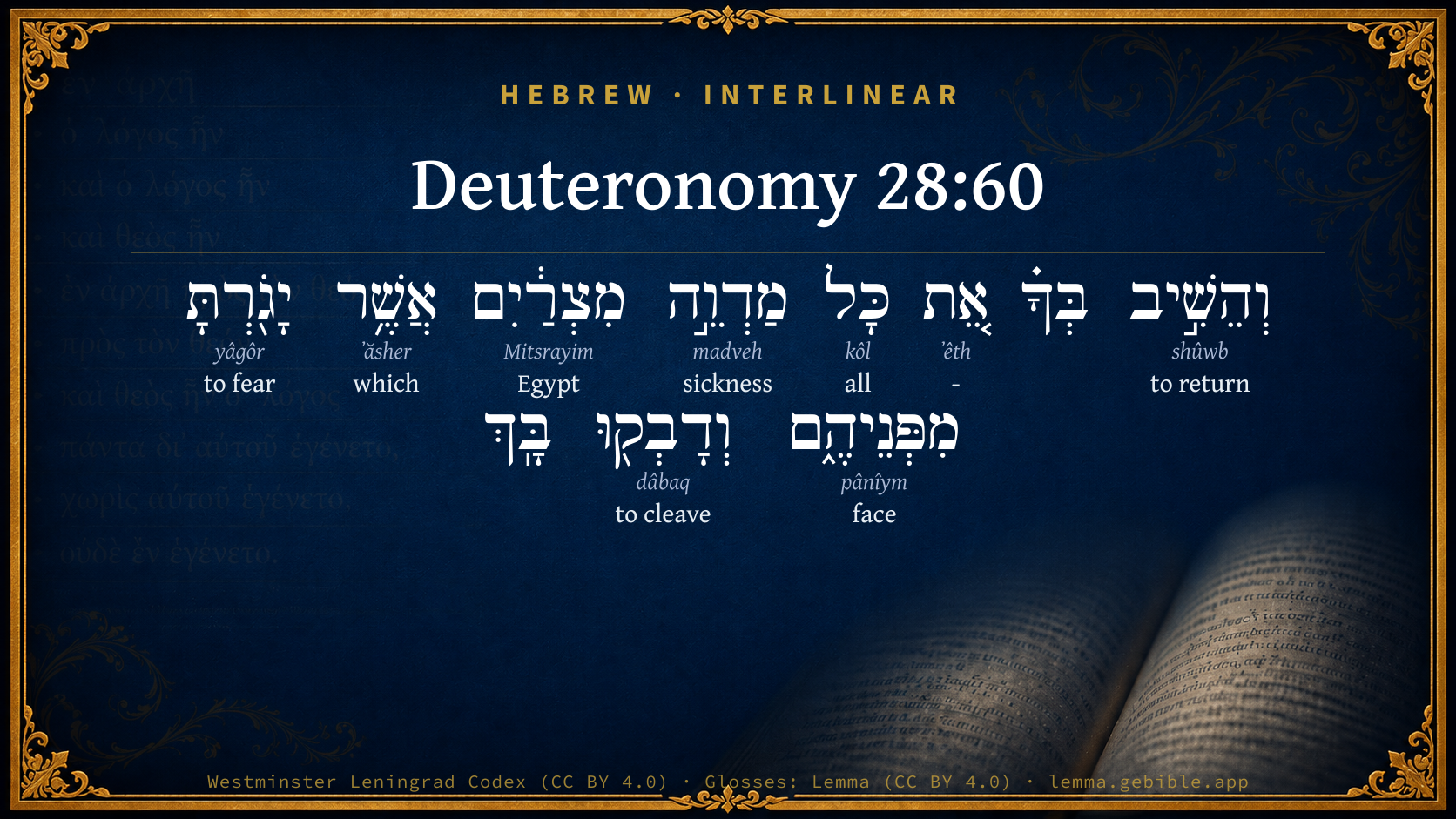
Hebrew (Westminster Leningrad Codex) Deuteronomy 28:60 appears in the Hebrew Old Testament. The text above is from the Westminster Leningrad Codex. Each word links to its Strong’s number, a concise gloss, and parsing drawn from the Open Scriptures Hebrew Bible morphology. Click any word for its full Brown-Driver-Briggs (BDB) entry.
Download image
Cite this verse

Deuteronomy 28:60 (World English Bible). Public Domain. Lemma interlinear Bible study tool, https://lemma.gebible.app/v/deuteronomy/28/60.

Show BibTeX & RIS
BibTeX
RIS
English Translation
He will bring on you again all the diseases of Egypt, which you were afraid of; and they shall cleave to you.
World English Bible · Public Domain
Download a study sheet

One document with this verse’s original text, its word-by-word gloss line, the meaning frame, cross-references with their text, attributed commentary, and full source and license credits — printable, and it pastes into notes with its structure intact.

This verse Autodidact and up

Study sheet (.html) Plain text (.txt)

A passage Seminary Student

Up to 50 verses in one chapter. A passage sheet keeps up to 6 commentary sources and 12 cross-references per verse, in the order this page ranks them, and says so on the sheet whenever that leaves anything out. Ask for a single verse and you get the Autodidact verse sheet above.

Everything on this page stays free to read, with no account — the sheet is a download of what is already on screen, not access to it.

Want to remove ads? Support Godless Engineer
Compare translations 3

The same verse in 3 English versions, stacked beneath the original-language interlinear above. Click any original word for its lexicon entry.

Each is an independent rendering of the whole verse — the interlinear is not word-aligned to these translations.

Highlighted words mark where these versions differ — a whole-verse word diff, not a word-by-word alignment.

  • World English Bible Public Domain
    He will bring on you again all the diseases of Egypt, which you were afraid of; and they shall cleave to you.
  • King James Version Public Domain
    Moreover he will bring upon thee all the diseases of Egypt, which thou wast afraid of; and they shall cleave unto thee.
  • unfoldingWord Literal Text CC BY-SA 4.0
    And he will bring back to you all the diseases of Egypt, of which you were afraid of their faces, and they will cling to you.

unfoldingWord Literal Text — © unfoldingWord, licensed CC BY-SA 4.0. Word-aligned USFM3 via Door43 (git.door43.org/unfoldingWord/en_ult).

Versions to compare (up to 4)

3 of 4 selected

Show all 18 translations

Every available English version of this verse, each an independent rendering of the whole verse.

  • World English Bible Public Domain
    He will bring on you again all the diseases of Egypt, which you were afraid of; and they shall cleave to you.
  • Berean Standard Bible Public Domain
    He will afflict you again with all the diseases you dreaded in Egypt, and they will cling to you.
  • Majority Standard Bible Public Domain
    He will afflict you again with all the diseases you dreaded in Egypt, and they will cling to you.
  • King James Version Public Domain
    Moreover he will bring upon thee all the diseases of Egypt, which thou wast afraid of; and they shall cleave unto thee.
  • American Standard Version (1901) Public Domain
    And he will bring upon thee again all the diseases of Egypt, which thou wast afraid of; and they shall cleave unto thee.
  • Revised Version (1885) Public Domain
    And he will bring upon thee again all the diseases of Egypt, which thou wast afraid of; and they shall cleave unto thee.
  • Geneva Bible (1599) Public Domain
    Moreouer, he will bring vpon thee all the diseases of Egypt, whereof thou wast afraide, and they shall cleaue vnto thee.
  • Douay-Rheims (1899) Public Domain
    And he shall bring back on thee all the afflictions of Egypt, which thou wast afraid of, and they shall stick fast to thee.
  • Young's Literal Translation Public Domain
    `And He hath brought back on thee all the diseases of Egypt, of the presence of which thou hast been afraid, and they have cleaved to thee;
  • Literal Standard Version CC BY-SA 4.0
    And He has brought back all the diseases of Egypt on you, from the presence of which you have been afraid, and they have cleaved to you.
  • Unlocked Literal Bible CC BY-SA 4.0
    He will bring on you again all the diseases of Egypt that you were afraid of; they will cling to you.
  • unfoldingWord Literal Text CC BY-SA 4.0
    And he will bring back to you all the diseases of Egypt, of which you were afraid of their faces, and they will cling to you.
  • Darby Bible Public Domain
    and he will bring upon thee all the diseases of Egypt which thou art afraid of, and they shall cleave unto thee.
  • World Messianic Bible Public Domain
    He will bring on you again all the diseases of Egypt, which you were afraid of; and they will cling to you.
  • Webster's Bible Public Domain
    Moreover, he will bring upon thee all the diseases of Egypt, of which thou wast afraid; and they shall cleave to thee.
  • Free Bible Version CC BY-SA 4.0
    He will give you all the diseases you were terrified of in Egypt, and they will stay with you.
  • Bible in Basic English Public Domain
    He will send on you again all the diseases of Egypt, which were a cause of fear to you, and they will take you in their grip.
  • JPS Tanakh (1917) Public Domain
    And He will bring back upon thee all the diseases of Egypt, which thou wast in dread of; and they shall cleave unto thee.

Literal Standard Version (2020), Covenant Press — licensed CC BY-SA 4.0. Text via the HelloAO Bible API (eBible.org). Unlocked Literal Bible (unfoldingWord) — licensed CC BY-SA 4.0. Text via the HelloAO Bible API (eBible.org). unfoldingWord Literal Text — © unfoldingWord, licensed CC BY-SA 4.0. Word-aligned USFM3 via Door43 (git.door43.org/unfoldingWord/en_ult). Free Bible Version, Dr. Jonathan Gallagher — licensed CC BY-SA 4.0. Text via the HelloAO Bible API (eBible.org).

Word by word

More ways to search: Search by grammar → Find every occurrence → Compare this word →

Practice this passage: Drill this verse → Learn its vocabulary →

מַדְוֵ֣ה
madveh
H4064
“sickness of”
Noun, Common, Masculine, Singular, Construct
Part of Speech
Noun
Type
Common
Gender
Masculine
Number
Singular
State
Construct
Full BDB Definition

Origin: from H1738

TWOT: 411c

sickness, disease
  1. וְהֵשִׁ֣יב shûwb H7725 “and · to return” Conjunction + Verb, Hiphil, Sequential Perfect, 3rd Person, Masculine, Singular
  2. אֵ֚ת ʼêth H853 “-” Particle, Direct Object
  3. כָּל kôl H3605 “all of” Noun, Common, Masculine, Singular, Construct
  4. מִצְרַ֔יִם Mitsrayim H4714 “Egypt” Noun, Proper
  5. אֲשֶׁ֥ר ʼăsher H834 “which” Particle, Relative
  6. יָגֹ֖רְתָּ yâgôr H3025 “to fear” Verb, Qal, Perfect, 2nd Person, Masculine, Singular
  7. מִפְּנֵיהֶ֑ם pânîym H6440 “from · face(s) · their” Preposition + Noun, Common, Both, Plural, Construct + Suffix, Personal, 3rd Person, Masculine, Plural
  8. וְדָבְק֖וּ dâbaq H1692 “and · to cleave” Conjunction + Verb, Qal, Sequential Perfect, 3rd Person, Common, Plural

About this verse

These counts appear in no published source. They are computed here, from the morphology-tagged text and Lemma’s own curated glosses. What Lemma adds →

11
words
9
distinct lemmas
Pentateuch
section

Notable vocabulary

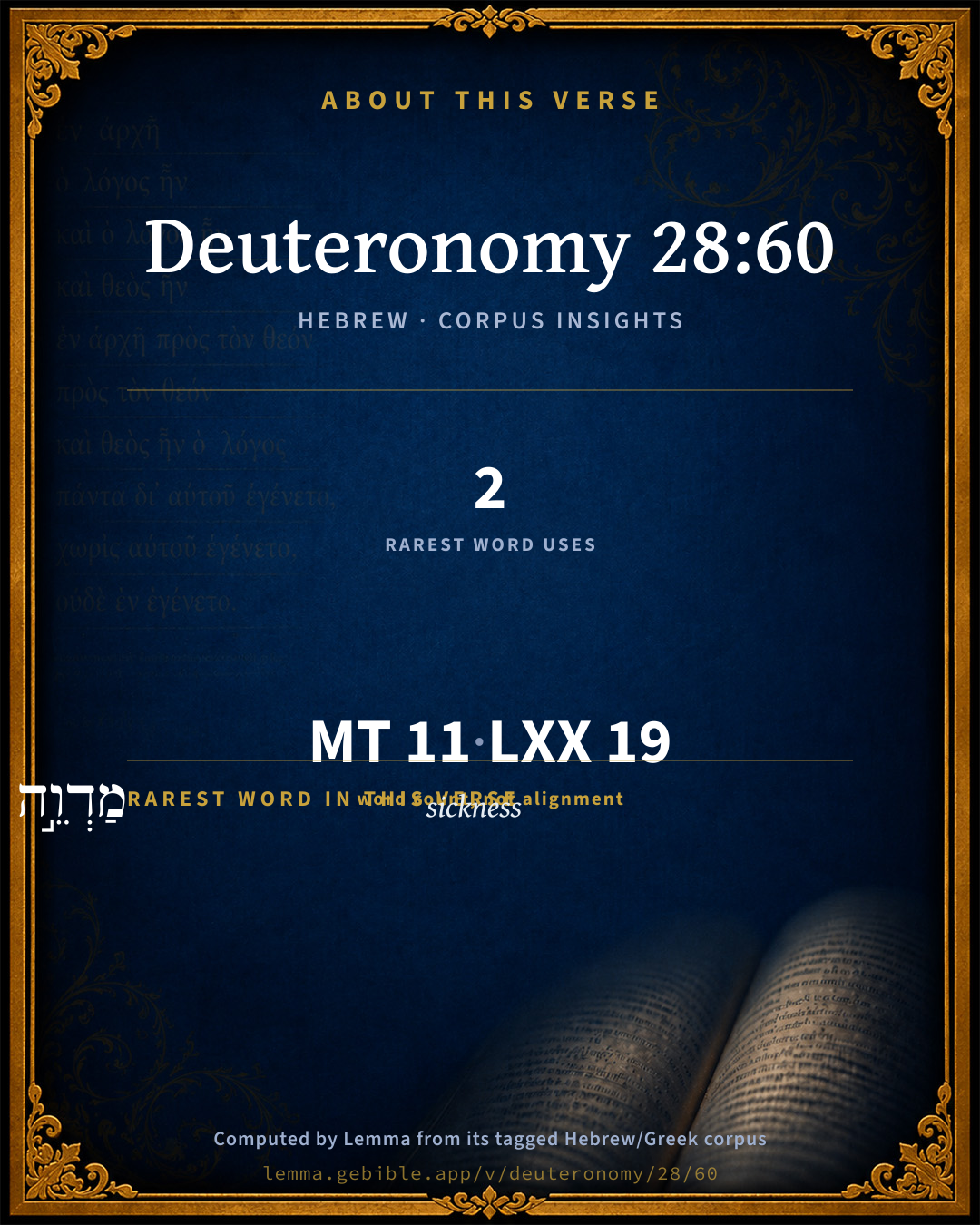
The rarest word here is מַדְוֵ֣ה sickness H4064 — appearing just 2 times in the whole Hebrew Bible.

Shared distinctive vocabulary

מַדְוֵ֣ה sickness H4064 occurs in 2 verses of the Hebrew Bible. Also found in:

Grammatical profile

  • 3 verbs
  • 4 nouns
  • 2 prepositions
  • 2 particles

Verb forms

  • וְהֵשִׁ֣יב Hiphil · Sequential Perfect
  • יָגֹ֖רְתָּ Qal · Perfect
  • וְדָבְק֖וּ Qal · Sequential Perfect

Hebrew & Septuagint length

In English translation the verse runs 22 words from the Hebrew and 23 from the Septuagint (LXX English) — closely comparable.

A rough comparison of the two English renderings, which tokenize alike — not a word-level alignment.

Word counts can differ between the Hebrew and the Greek without any difference in meaning — e.g. the Hebrew direct-object marker אֵת has no separate Greek word, and Greek often adds the article ὁ.

In the original languages it is 11 Hebrew tokens and 19 Greek tokens — but the two are counted differently (Hebrew bundles its prefixes and suffixes into one token; the Greek is in lemma form), so that isn’t a like-for-like length.

Cross-references

3

Topical passages linked to Deuteronomy 28:60 in the Treasury of Scripture Knowledge — connected by theme and wording, ordered by reader-vote popularity; previews shown in the World English Bible.

  • Deuteronomy 7:15 Yahweh will take away from you all sickness; and none of the evil diseases of Egypt, which you know, will he put on you, but will lay them on all those who hate you.
  • Exodus 15:26 and he said, "If you will diligently listen to the voice of Yahweh your God, and will do that which is right in his eyes, and will pay attention to his commandments, and keep all his statutes, I will put none of the diseases on you, which I have put on the Egyptians; for I am Yahweh who heals you."
  • Deuteronomy 28:27 Yahweh will strike you with the boil of Egypt, and with the tumors, and with the scurvy, and with the itch, of which you can not be healed.

Cross-references courtesy of OpenBible.info (CC BY 4.0).

Hebrew and Greek witnesses Masoretic Hebrew ↔ Greek Septuagint

The same verse in the two great witnesses to the Old Testament, shown verse-for-verse.

These are two independent witnesses, not word-aligned to each other, and the Septuagint is shown in lemma (dictionary) form.

Hebrew Deuteronomy 28:60 Masoretic · Westminster Leningrad Codex

וְהֵשִׁ֣יב בְּךָ֗ אֵ֚ת כָּל מַדְוֵ֣ה מִצְרַ֔יִם אֲשֶׁ֥ר יָגֹ֖רְתָּ מִפְּנֵיהֶ֑ם וְדָבְק֖וּ בָּֽךְ

He will bring on you again all the diseases of Egypt, which you were afraid of; and they shall cleave to you.

World English Bible · Public Domain

Greek LXX Deuteronomy 28:60 Septuagint · lemma form

καί ἐπιστρέφω ἐπί σύ πᾶς ὁ ὀδύνη αἴγυπτος ὁ πονηρός ὅς διαεὐλαβέομαι ἀπό πρόσωπον αὐτός καί κολλάω ἐν σύ

And he shall bring upon you all the evil pain of Egypt, of which you were afraid, and they shall cleave to you.

LXX2012 (modern English Septuagint) · Public Domain

Hebrew: Westminster Leningrad Codex (CC BY 4.0). Greek: Septuagint (public domain); English from LXX2012 (modern English Septuagint) (Public Domain). How the Septuagint differs from the Hebrew →

Targum (Aramaic paraphrase)

2

The Targum is the ancient Jewish Aramaic paraphrase of the Hebrew Scriptures — an interpretive translation, not the Hebrew text itself. Onkelos (literal) and Pseudo-Jonathan (expansive) render the Torah, and Jonathan the Prophets. Coverage is partial: where no permissively-licensed English translation exists for a verse, only the Aramaic is shown. This is verse-level text, not a word-by-word alignment to the Hebrew.

  1. Targum Onkelos Torah (Genesis–Deuteronomy)
    וְיָתֵב בָּךְ יָת כָּל מַכְתְּשֵׁי מִצְרַיִם דִי דְחֶלְתָּא מִקֳדָמֵיהוֹן וְיִדְבְּקוּן בָּךְ

    (no public-domain English translation for this verse)

    Targum Onkelos — Aramaic: “Onkelos Genesis” (public domain); “Onkelos Exodus” (public domain); “Onkelos Leviticus” (public domain); “Onkelos Numbers” (public domain); “Onkelos Deuteronomy” (public domain). English: “Sefaria Community Translation” (CC0 1.0 (public-domain dedication)); “J.W. Etheridge. The Targums of Onkelos and Jonathan Ben Uzziel on the Pentateuch. London: Longmans, Green, 1862” (public domain). Text via Sefaria.

  2. Targum Pseudo-Jonathan Torah (Genesis–Deuteronomy)
    וִיתִיב בְּכוֹן יַת כָּל אַרְעַיָא דְאִתְגְרִייוּ בְּמִצְרָאֵי דִדְחִילַת מִן קֳדָמֵיהוֹן וְיִתְאַדְקוּן בְּכוֹן

    and will turn upon you all the woes which were sent upon the Mizraee before which thou wast afraid, and they shall cleave to you;

    Targum Pseudo-Jonathan — Aramaic: “Targum Jonathan on Genesis” (public domain); “Targum Jonathan on Exodus” (public domain); “Targum Jonathan on Leviticus” (public domain); “Targum Jonathan on Numbers” (public domain); “Targum Jonathan on Deuteronomy” (public domain). English: “The Targum of Jonathan ben Uzziel, trans. J. W. Etheridge, London, 1862” (public domain). Text via Sefaria.

Commentary

Notes on Deuteronomy 28:60 from classic Christian and Jewish commentators (each source and its license shown beneath its notes). The classic Christian expositions comment on the surrounding passage and are grouped to its opening verse, so a note may address several verses; the Jewish commentaries on the Tanakh (Rashi and others) are per-verse, so they appear only where the commentator wrote on this verse.

Lemma curates 59 commentaries, every one of them public domain or Creative Commons licensed, each selected and text-cleaned for this edition rather than reprinted as found. About our sources →

Trapp's Complete Commentary

John Trapp

Deu 28:60 Moreover he will bring upon thee all the diseases of Egypt, which thou wast afraid of; and they shall cleave unto thee.

Ver. 60. All the diseases of Egypt.] Which what they were, see Exo 8:2; Exo 8:16; Exo 8:21; Exo 9:3; Exo 9:9; Exo 9:15; Exo 9:18; Exo 10:4; Exo 10:21; Exo 11:5

John Trapp, A Commentary or Exposition upon All the Books of the Old and New Testament (1647–1656) — public domain. Text from a community e-Sword module.

Tyndale Open Study Notes

Tyndale Open Resources

28:60 The diseases of Egypt were not just general plagues but those associated with physical illness (see Exod 9:8-12).

Tyndale Open Study Notes — © Tyndale Open Resources, licensed CC BY-SA 4.0. Text via the HelloAO Bible API.

Ellicott's Commentary for English Readers

(60) The diseases of Egypt, which thou wast afraid of.—Contrast Exo_15:26. “If thou wilt diligently hearken to the voice of Jehovah . . . I will put none of these diseases of Egypt which thou knowest, upon thee; for I am Jehovah, that healeth thee” But, on the other hand, it is said (Eze_7:9), “Ye shall know that I am Jehovah that smiteth.” eJehovah-Rophêka and Jehovah-Makkeh are one Jehovah.

A Bible Commentary for English Readers, edited by Charles John Ellicott (1878–1897) — public domain. Text from a community e-Sword module.

The Cambridge Bible for Schools and Colleges

gen. ed. J. J. S. Perowne

60. diseases of Egypt] As in Deu_7:15; cp. above Deu_28:27. On cleave cp. Deu_28:21.

The Cambridge Bible for Schools and Colleges (gen. ed. J. J. S. Perowne; Cambridge University Press, 1878–1918) — public domain. Text from a community e-Sword module.

John Gill's Exposition

And the Lord shall scatter thee among all people, from the one end of the earth even to the other,.... Which refers to their present dispersion, being now, more or fewer, in all parts of the world, east, west, north, and south:

and there thou shalt serve other gods, which neither thou nor thy fathers have known, even wood and stone: it may be observed, that the phrase, "which either thou nor fathers have known", is fitly added here, which is not used of them, Deu 28:36; and well agrees with the idols of the Papists, their images of the Virgin Mary, and saints departed, made of wood and stone, which were such the fathers of the Jews never knew; just as it is said of the host, the consecrated wafer, the breaden god honoured by antichrist, that it is "a god who his fathers knew not", Dan 11:38; the apostles and ancient fathers of the church. Now in Popish countries the Jews have often been prevailed upon to change, or at least dissemble their religion, and embrace Popery: and have worshipped images of wood and stone. The author of the history of their calamities and sufferings owns this;"multitudes (he says (p)) in Spain and Portugal forsook the law of Moses, and joined the Papists, pretending at least to be of their religion.''

He makes mention of sixteen thousand at one time (q), and some, he say (r),"that were driven out of Spain, came into Italy, where the young men pressed with famine could not bear it, and changed their religion, and began to worship images that they might have to satisfy their hunger; and the Papists used to go about with a crucifix in one hand, and a piece of bread in the other, promising the bread to those that would worship the crucifix; and so many famishing persons forsook the law of Moses, and mixed with them:''and to this day the convents of monks and nuns in Spain are full of them; and most of their canons, inquisitors, and bishops, are Jews (s). The Targum of Jonathan indeed, to clear them from idolatry itself, gives another sense of these words, paraphrasing them,"ye shall pay tribute to the worshippers of idols.''

(p) Shebet Judah, p. 108, 154, 312, 313, 338, 339. (q) Ibid. p. 312. (r) Ibid. sect. 56. p. 327. (s) See Addison's present State of the Jews, c. 3. p. 3o, 31. Dr. Newton ut supra, (Prophesies, vol. 1. Dissert. 7.) sect. 15. p. 197.

John Gill's Exposition of the Whole Bible (1746–1763) — public domain (CC PDM 1.0). Text via the HelloAO Bible API.

Whedon's Commentary on the Bible

Daniel D. Whedon

60. All the diseases of Egypt — Comp. Deu_7:15; also Exo_9:1-10; Exo_12:29; and Exo_7:10.

Daniel D. Whedon (gen. ed.), Commentary on the Old and New Testaments (1874–1909) — public domain. Text from a community e-Sword module.

The Pulpit Commentary

Vers. 60, 61. The diseases of Egypt are the plagues sent on Pharaoh and his people, as recorded in Exodus 7-11. Besides these, other plagues, not recorded in the Book of the Law, should come on rebellious Israel, so that they should be almost utterly destroyed.

The Pulpit Commentary (1880–1919), ed. H.D.M. Spence-Jones & Joseph S. Exell — public domain. Text from a community e-Sword module.

unfoldingWord translationNotes

Door43 World Missions Community

General Information:

Moses speaks to the Israelites as if they were one man, so the words "you" and "your" here are singular. (See: Forms of You)

He will bring on you again all the diseases of Egypt

This is an idiom. AT: "He will make sure that you again suffer from the diseases of Egypt" (See: Idiom)

they will cling to you

This is an idiom. AT: "the diseases will not stop, and no one will be able to heal you of them" (See: Idiom)

every sickness and plague that is not written

Here "every" is a generalization that means "many." This can be stated in active form. AT: "even other sicknesses and plagues that I have not written" (See: Hyperbole and Generalization and Active or Passive)

until you are destroyed

This can be stated in active form. AT: "until he has destroyed you" (See: Active or Passive)

You will be left ... you were like ... you did not listen

Moses is speaking to the Israelites as a group, so all instances of "you" are plural. (See: Forms of You)

you were like the stars of the heavens in number

This means that in the past there were many Israelites. (See: Simile)

to the voice of Yahweh

Here the metonym "voice of Yahweh" refers to what Yahweh says. AT: "to what Yahweh says" (See: Metonymy)

translationWords

Egypt

plague

law

heaven

voice

God

unfoldingWord translationNotes — © Distant Shores Media and the Door43 World Missions Community, licensed CC BY-SA 4.0. Source: git.door43.org/Door43/en_tn.

Rashi

Rabbi Shlomo Yitzchaki (Rashi)

אשר יגרת מפניהם [HE WILL BRING UPON THEE ALL THE DISEASES OF EGYPT] OF WHICH THOU ART AFRAID — i.e. afraid of the plagues (not of Egypt). When the Israelites saw the strange plagues that came upon the Egyptians they were afraid of them — that they might not befall them also. You may know this, for so it states, (Exodus 15:26) “If thou wilt indeed hearken [to the voice of the Lord …], none of the diseases which I have put upon Egypt, will I put on you”, since one threatens a person only with things of which he is afraid.

Rashi on the Tanakh — English translations: “The Judaica Press complete Tanach with Rashi, translated by A. J. Rosenberg” (CC BY 4.0); “Pentateuch with Rashi's commentary by M. Rosenbaum and A.M. Silbermann, 1929-1934” (public domain); “The Metsudah Tanach series, Lakewood, N.J” (CC BY 4.0); and “The Book of Joshua, Metsudah Publications, 1997” (CC BY 4.0). Text via Sefaria.

Lesson kit

Teaching starters — assembled from the data on this page, not authored interpretation. Every prompt links to the verse data it draws on. Edit before teaching.

Deuteronomy, in the Pentateuch, opens this verse with 11 words (9 distinct Hebrew lemmas). Its most distinctive word is madveh (“sickness”). A historical commentator’s framing appears above. Read the whole chapter for the surrounding context.

Discussion questions

  1. What does “sickness” (madveh) contribute to the verse as a whole?
  2. How does Deuteronomy 7:15, which shares the word «sickness», read alongside this verse?
  3. These translations render this verse differently; the difference is in the English rendering, not the original. What questions does that raise?
  4. «וְהֵשִׁ֣יב» is a Hiphil Sequential Perfect verb. How does that grammatical form shape the action described?
  5. Compare how Trapp's Complete Commentary and Tyndale Open Study Notes read this verse. Where do they agree or differ?

Things to notice

Reading settings

Reading text

Shown beneath each verse's original-language words.

Old Testament
Old Testament edition

Read the OT as the Masoretic Hebrew (MT) or the Greek Septuagint (LXX).

English shown for the Greek Septuagint (in the Hebrew ↔ Greek comparison).

Comparing translations? Open the Compare panel on any verse page to stack up to four side by side.