
Acts 26:21

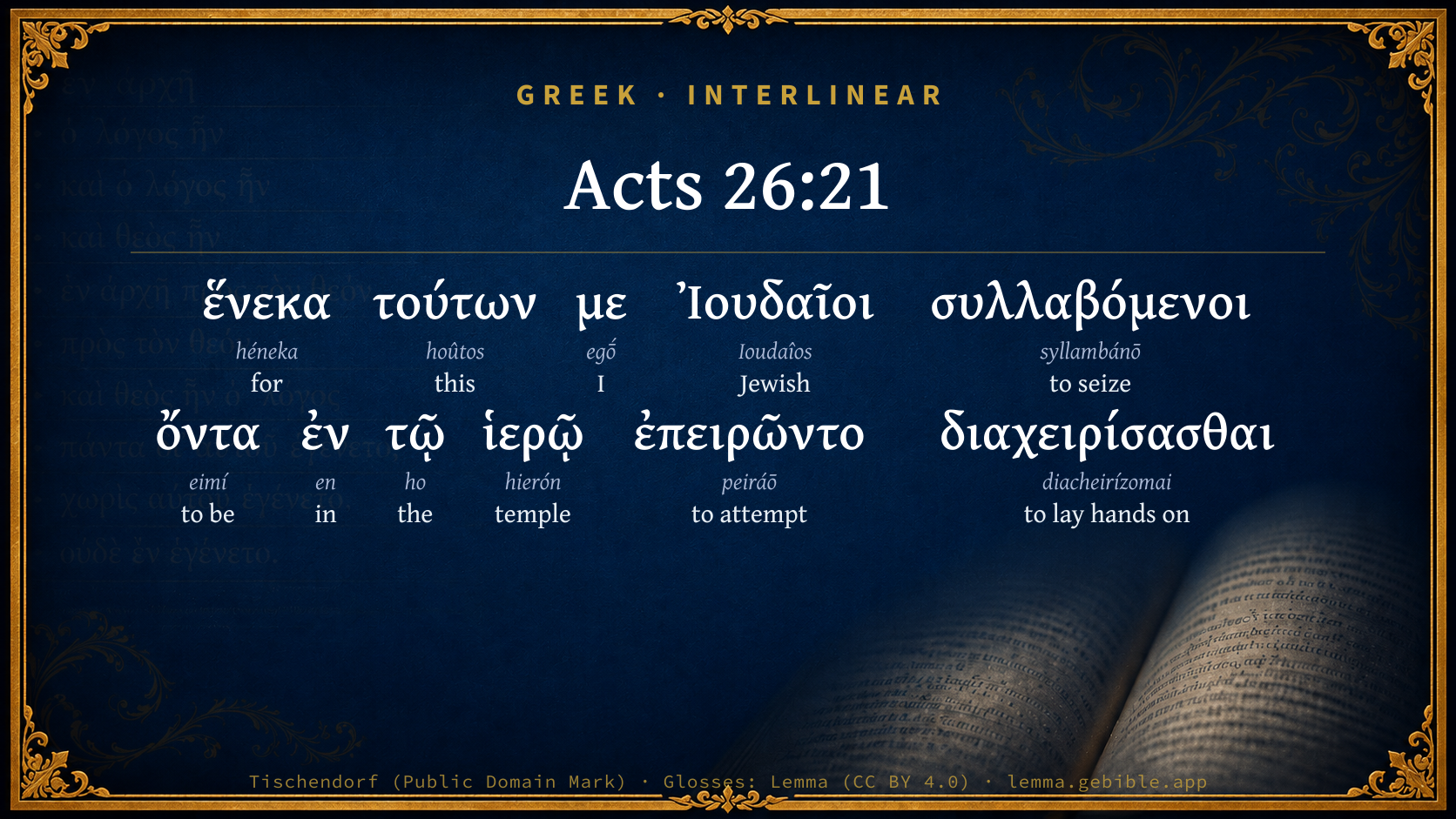
Greek (Tischendorf 8th ed.) Acts 26:21 appears in the Greek New Testament. The text above is from the Tischendorf 8th edition. Each word links to its Strong’s number and a concise gloss. Click any word for its full Thayer’s Greek Lexicon entry.
Download image
Cite this verse

Acts 26:21 (World English Bible). Public Domain. Lemma interlinear Bible study tool, https://lemma.gebible.app/v/acts/26/21.

Show BibTeX & RIS
BibTeX
RIS
English Translation
For this reason the Jews seized me in the temple, and tried to kill me.
World English Bible · Public Domain
Highlights
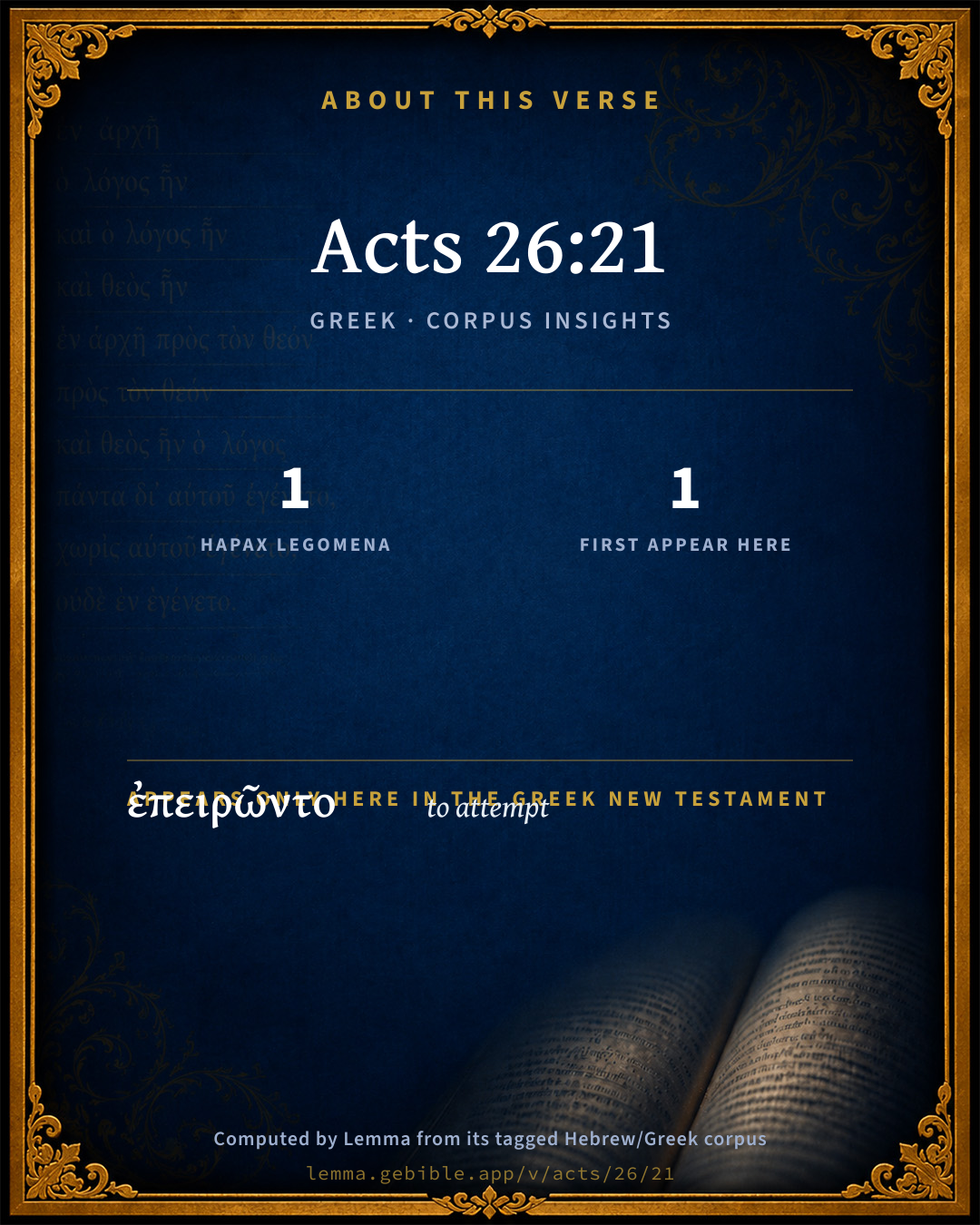
  • 1 hapax legomenon — only here in the Greek New Testament
  • 1 first appearance in the Greek New Testament
Full analysis ↓
Download a study sheet

One document with this verse’s original text, its word-by-word gloss line, the meaning frame, cross-references with their text, attributed commentary, and full source and license credits — printable, and it pastes into notes with its structure intact.

This verse Autodidact and up

Study sheet (.html) Plain text (.txt)

A passage Seminary Student

Up to 50 verses in one chapter. A passage sheet keeps up to 6 commentary sources and 12 cross-references per verse, in the order this page ranks them, and says so on the sheet whenever that leaves anything out. Ask for a single verse and you get the Autodidact verse sheet above.

Everything on this page stays free to read, with no account — the sheet is a download of what is already on screen, not access to it.

Want to remove ads? Support Godless Engineer
Compare translations 3

The same verse in 3 English versions, stacked beneath the original-language interlinear above. Click any original word for its lexicon entry.

Each is an independent rendering of the whole verse — the interlinear is not word-aligned to these translations.

Highlighted words mark where these versions differ — a whole-verse word diff, not a word-by-word alignment.

  • World English Bible Public Domain
    For this reason the Jews seized me in the temple, and tried to kill me.
  • King James Version Public Domain
    For these causes the Jews caught me in the temple, and went about to kill me.
  • unfoldingWord Literal Text CC BY-SA 4.0
    Because of these things, the Jews, having seized me in the temple, were trying to kill me.

unfoldingWord Literal Text — © unfoldingWord, licensed CC BY-SA 4.0. Word-aligned USFM3 via Door43 (git.door43.org/unfoldingWord/en_ult).

Versions to compare (up to 4)

3 of 4 selected

Show all 19 translations

Every available English version of this verse, each an independent rendering of the whole verse.

  • World English Bible Public Domain
    For this reason the Jews seized me in the temple, and tried to kill me.
  • Berean Standard Bible Public Domain
    For this reason the Jews seized me in the temple courts and tried to kill me.
  • Majority Standard Bible Public Domain
    For this reason the Jews seized me in the temple courts and tried to kill me.
  • King James Version Public Domain
    For these causes the Jews caught me in the temple, and went about to kill me.
  • American Standard Version (1901) Public Domain
    For this cause the Jews seized me in the temple, and assayed to kill me.
  • Revised Version (1885) Public Domain
    For this cause the Jews seized me in the temple, and assayed to kill me.
  • Geneva Bible (1599) Public Domain
    For this cause the Iewes caught me in the Temple, and went about to kill me.
  • Douay-Rheims (1899) Public Domain
    For this cause the Jews, when I was in the temple, having apprehended me, went about to kill me.
  • Young's Literal Translation Public Domain
    because of these things the Jews -- having caught me in the temple -- were endeavouring to kill `me'.
  • Literal Standard Version CC BY-SA 4.0
    because of these things the Jews—having caught me in the temple—were endeavoring to kill [me].
  • Unlocked Literal Bible CC BY-SA 4.0
    For this cause the Jews arrested me in the temple and tried to kill me.
  • unfoldingWord Literal Text CC BY-SA 4.0
    Because of these things, the Jews, having seized me in the temple, were trying to kill me.
  • Darby Bible Public Domain
    On account of these things the Jews, having seized me in the temple, attempted to lay hands on and destroy me.
  • World Messianic Bible Public Domain
    For this reason Jews seized me in the temple and tried to kill me.
  • Webster's Bible Public Domain
    For these causes the Jews caught me in the temple, and went about to kill me.
  • Free Bible Version CC BY-SA 4.0
    That's why the Jews seized me in the Temple and tried to kill me.
  • Bible in Basic English Public Domain
    For this reason, the Jews took me in the Temple, and made an attempt to put me to death.
  • Text-Critical English NT CC BY 4.0
    That is why the Jews seized me in the temple courts and were trying to kill me.
  • Tyndale New Testament (1534) Public Domain
    For this cause the Iewes caught me in the temple and went about to kyll me.

Literal Standard Version (2020), Covenant Press — licensed CC BY-SA 4.0. Text via the HelloAO Bible API (eBible.org). Unlocked Literal Bible (unfoldingWord) — licensed CC BY-SA 4.0. Text via the HelloAO Bible API (eBible.org). unfoldingWord Literal Text — © unfoldingWord, licensed CC BY-SA 4.0. Word-aligned USFM3 via Door43 (git.door43.org/unfoldingWord/en_ult). Free Bible Version, Dr. Jonathan Gallagher — licensed CC BY-SA 4.0. Text via the HelloAO Bible API (eBible.org).

Word by word

More ways to search: Search by grammar → Find every occurrence → Compare this word →

Practice this passage: Drill this verse → Learn its vocabulary →

ἐπειρῶντο
peiráō
G3987
“to attempt”
Verb, Imperfect, Middle or Passive deponent, Indicative, 3rd person, Plural
Part of Speech
Verb
Tense
Imperfect
Voice
Middle or Passive deponent
Mood
Indicative
Person
3rd person
Number
Plural
Full Thayer's Definition

Origin: from G3984

TDNT: 06:23,8

1. to make a trial of, to attempt a. taught by trial, experienced 2. to test, to make trial of one, put him to proof a. his mind, sentiments, temper b. in particular, to attempt to induce one to commit some (esp. carnal) crime c. tempted to sin
  1. ἕνεκα héneka G1752 “for” Preposition
  2. τούτων hoûtos G3778 “this” Demonstrative pronoun, Genitive, Plural, Neuter
  3. με egṓ G1473 “I” Personal pronoun, 1st person, Accusative, Singular
  4. Ἰουδαῖοι Ioudaîos G2453 “Jewish” Adjective, Nominative, Plural, Masculine
  5. συλλαβόμενοι syllambánō G4815 “to seize” Verb, Aorist, Middle, Participle, Nominative, Plural, Masculine
  6. ὄντα eimí G1510 “to be” Verb, Present, Active, Participle, Accusative, Singular, Masculine
  7. ἐν en G1722 “in” Preposition
  8. τῷ ho G3588 “the” Article, Dative, Singular, Neuter
  9. ἱερῷ hierón G2411 “temple” Noun, Dative, Singular, Neuter
  10. διαχειρίσασθαι diacheirízomai G1315 “to lay hands on” Verb, Aorist, Middle, Infinitive

About this verse

These counts appear in no published source. They are computed here, from the morphology-tagged text and Lemma’s own curated glosses. What Lemma adds →

11
words
11
distinct lemmas
Acts
section

Notable vocabulary

1 hapax legomenon — a word that appears only here in the entire Greek New Testament:

  • ἐπειρῶντο to attempt G3987

First appearance in Scripture

This word makes its first canonical appearance in the Greek New Testament here:

  • ἐπειρῶντο to attempt G3987

Shared distinctive vocabulary

διαχειρίσασθαι to lay hands on G1315 occurs in 2 verses of the Greek New Testament. Also found in:
Cross-references

5

Topical passages linked to Acts 26:21 in the Treasury of Scripture Knowledge — connected by theme and wording, ordered by reader-vote popularity; previews shown in the World English Bible.

  • Acts 21:30–31 All the city was moved, and the people ran together. They seized Paul and dragged him out of the temple. Immediately the doors were shut.
  • Acts 21:27 When the seven days were almost completed, the Jews from Asia, when they saw him in the temple, stirred up all the multitude and laid hands on him,
  • Acts 22:22 They listened to him until he said that; then they lifted up their voice, and said, "Rid the earth of this fellow, for he isn't fit to live!"
  • Acts 23:12–15 When it was day, some of the Jews banded together, and bound themselves under a curse, saying that they would neither eat nor drink until they had killed Paul.
  • Acts 25:3 asking a favor against him, that he would summon him to Jerusalem; plotting to kill him on the way.

Cross-references courtesy of OpenBible.info (CC BY 4.0).

Commentary

Notes on Acts 26:21 from classic Christian and Jewish commentators (each source and its license shown beneath its notes). The classic Christian expositions comment on the surrounding passage and are grouped to its opening verse, so a note may address several verses; the Jewish commentaries on the Tanakh (Rashi and others) are per-verse, so they appear only where the commentator wrote on this verse.

Lemma curates 59 commentaries, every one of them public domain or Creative Commons licensed, each selected and text-cleaned for this edition rather than reprinted as found. About our sources →

Joseph Benson's Commentary

Act 26:21-23. For these causes — And for no other; the Jews — Who have the same inveteracy against the gospel of Jesus that I once had; caught (seized) me in the temple, and went about (attempted) to kill me — Διαχειρισασθαι, to kill me with their own hands. So the word properly signifies; but, having obtained help of God — By the protection and care of his watchful providence; I continue unto this day — Am still preserved and upheld, and employ my spared life to the purposes for which it is prolonged; witnessing both to small and great — What is really a matter of infinite concern, both to the meanest and most exalted of mankind, the gospel of Christ, and the way of salvation for lost sinners through him; saying none other things than those which the prophets and Moses did say — Advancing no new doctrine whatever; that Christ should suffer — Not only be a man, and therefore should be capable of suffering, but that, as Messiah, he should be appointed to suffer; and that his sufferings and ignominious death should not only be consistent with, but pursuant of, his undertaking. The cross of Christ was a stumbling-block to the Jews, and Paul’s preaching it was one great thing that exasperated them; but Paul adheres to that doctrine, and insists that, in preaching it, he preached the fulfilling of the Old Testament predictions; and that therefore they ought not only not to be offended at what he preached, but to believe, and embrace it with all their hearts. And that he should be the first that should rise from the dead — Namely, to an immortal life; the first that should rise to die no more, opening, as it were, the womb of the grave to all the pious dead who should rise after him, and none of whom could have risen, if he had not risen first. Accordingly, to show that the resurrection of all believers is in virtue of his resurrection, just when he rose, many dead bodies of the saints arose, and went into the holy city, Mat 27:53. And should show light unto the people — The Jews in the first place, for he was to be the glory of his people Israel: to them he showed light by himself, and then to the Gentiles by the ministry of his apostles; for he was to be a light to lighten them who sat in darkness. In this Paul refers to his commission, Act 26:18. He rose from the dead on purpose that he might show light to Jews and Gentiles; that he might give a convincing proof of the truth of his doctrine, and might send it with so much the greater power among both descriptions of persons. All this was foretold by the Old Testament prophets; and what was there in it that the Jews could justly be displeased at?

Joseph Benson's Commentary on the Old and New Testaments (1811–1818) — public domain. Text from a community e-Sword module.

Bengel's Gnomon

Johann Albrecht Bengel

Act 26:21. Ἕνεκα τούτων, for these causes) Now Paul brings together all that went before, for the purpose of his defence.

Bengel's Gnomon of the New Testament — English translation (T&T Clark, Edinburgh, 1860) — public domain. Text from a community e-Sword module.

Meyer's Critical & Exegetical Commentary

Heinrich August Wilhelm Meyer

Act_26:21-22. Ἕνεκα τούτων] because I have preached this μετανοεῖν and ἐπιστρέφειν among Jews and Gentiles.

διαχειρ.] Beza correctly explains: manibus suis interficere (see on Act_5:30). Comp. Act_21:30-31.

ἐπικουρίας οὖν … Θεοῦ] This οὖν infers from the preceding ἐπειρ. διαχειρ. that the ἕστηκα ἄχρι τῆς ἡμέρ. ταύτης is effected through help of God (without which no deliverance from such extreme danger to life could come). Observe withal the triumphant ἕστηκα, I stand, keep my ground!

μαρτυρούμενος μικρῷ τε καὶ μεγάλῳ] as one witnessed to by small and great, i.e. who has a good testimony from young and old (Act_8:10). Accordingly, μαρτυρούμενος is to be taken quite regularly as passive, and that in its very current sense, as in Act_6:3, Act_10:22 al.; while μικρῷ and μεγάλῳ are the datives usual with the passive construction (see on Mat_5:21), instead of which ὑπό is used in Act_10:22, Act_16:2, Act_22:12. The usual rendering, following the Vulgate: witnessing to small and great,[163] i.e. instituens omnis generis homines (Kuinoel), arbitrarily assumes a deviation from linguistic usage, as μαρτυρεῖσθαι is always used passively (on which account, in 1Th_2:12, the reading ΜΑΡΤΥΡΌΜΕΝΟΙ is necessarily to be defended; see Lünemann in loc.). See Rinck, Lucubr. crit. p. 91, who, however (as also de Wette, Baumgarten, Ewald), declares for the reading μαρτυρόμ.; this, although strongly attested (see the critical remarks), is an old, hasty emendation, which was regarded as necessary to suit the dative. But in what a significant contrast to that deadly hatred of his enemies appears the statement (Act_26:21): By help of God I stand till this day, well attested by small and great! The following words then give the reason of this μαρτυρούμευος: because I set forth nothing else than what (ὧν = τούτων ἅ) the prophets, etc.

μελλόντων] On the attraction, see Lobeck, ad Aj. 1006; Buttmann, neut. Gr. p. 261 [E. T. 305]; and on the expression τὰ μέλλοντα γίνεσθαι, Jacobs, ad Philostr. p. 630.

[163] Erasmus, Castalio, Calvin, Bengel, and others take μικρ. τ. κ. μεγαλ. in the sense of rank: to persons of low and of high degree. This is historically unsuitable to the correct view of μαρτυρούμ., as Paul was despised and persecuted by the great of this world. The wisdom, which he preached, was not at all theirs, 1Co_2:6 ff.

Meyer — Critical and Exegetical Commentary on the New Testament — English translation by Peter Christie, edited by Frederick Crombie (T&T Clark, 1880) — public domain. Text from a community e-Sword module.

Expositor's Greek Testament

ed. W. Robertson Nicoll

Act 26:21 . ἔνεκα τούτων : because I preached to Jews and Gentiles alike, proclaiming one Gospel to both, and placing both on an equality before God (not for profaning the Temple), cf. Act 21:28 . On ἕνεκα see Blass, Gram. , p. 21. This Attic form of the word is read here by all authorities, and Blass notes it as characteristic of the literary style of this address before Agrippa, see above on Act 26:4 . συλλαβόμενοι , Act 1:16 , Act 12:3 . So also in each of the Gospels in the active voice, of a violent arrest; in passive see above, Act 23:27 , and frequent in same sense in LXX, and 1 and 2 Macc. ἐπειρῶντο : here only in N.T. in middle, but see critical note on Act 9:26 . Cf. 1Ma 12:10 , 2Ma 10:12 , 3Ma 1:25 ; 3Ma 2:32 , 4Ma 12:3 . Imperfect because the attempt was not actually made. διαχειρ ., see on Act 5:30 . The whole description ranks as a summary without giving all the details of the events which led up to the Apostle’s imprisonment.

The Expositor's Greek Testament, edited by W. Robertson Nicoll (1897–1910) — public domain. Text from a community e-Sword module.

Adam Clarke's Commentary

Verse 21. For these causes the Jews - went about to kill me.] These causes may be reduced to four heads:-

1. He had maintained the resurrection of the dead.

2. The resurrection of Christ, whom they had crucified and slain.

3. That this Jesus was the promised Messiah.

4. He had offered salvation to the Gentiles as well as to the Jews. He does not mention the accusation of having defiled the temple, nor of disloyalty to the Roman government; probably, because his adversaries had abandoned these charges at his preceding trial before Festus: see Ac 25:8; and see Calmet.

Adam Clarke's Commentary on the Bible (1810–1826) — public domain. Text from a community e-Sword/MySword module.

John Calvin's Commentaries

21. They went about to kill me. He complaineth in this place of the iniquity of his adversaries, that it may thereby appear that their cause and conscience were both evil. For if Paul had offended they might have gone to law with him; and even there should they have stand [stood] in better state, seeing they did far pass him both in favor and authority. Therefore, their madness doth testify that they are destitute of reason. Whereas Paul saith that he was saved by the help of God, it maketh for the confirmation of his doctrine. For how is it that he reacheth out his hand to help him, save only because he acknowledged his minister, and because he will defend the cause which he alloweth [approveth?]. Moreover, this ought to have encouraged him to go forward so much the more boldly in his office, in that he was thus holpen by God. For it had been a point of an unthankful man to withdraw himself from him which had holpen him. By which example we be taught, that so often as we be delivered from danger, the Lord doth not therefore prolong our days that we may afterward live idly, but that we may do our duty cheerfully, and be ready to die every hour to his glory, who hath reserved us to himself. And yet Paul did not forget how much he was indebted to the chief captain; but in this place he commendeth the help of God, that he may show that it became him to spend all the rest of his course in his service by whom he was delivered, though that came to pass, and were done through the industry and by the hand of man.

Testifying both to small and great. We have said elsewhere that it is more to testify than to teach, as if there were some solemn contestation made between God and men, that the gospel may have his [its] majesty. And he saith that he is a witness both to great and small, that king Agrippa may perceive that this doth appertain even to him; and that when the gospel is offered even to every simple man, that doth no whit hinder but that it may ascend even unto the throne of princes. For Christ doth gather all men into his bosom with one and the same embracing, that those who lay before in the dunghill, and are now extolled unto so great honor, may rejoice in his free goodness; and that those who are placed in high degree of honor may willingly humble themselves, and not grudge to have some of the base and contemptible multitude for their brethren, that they may be made the children of God. So in the first chapter to the Romans, he saith that he is indebted both to the fools and to the wise, lest the Romans should be kept back with the confidence which they might repose in their wisdom from submitting themselves to his doctrine. By this let us learn that it is not in the teacher’s will to make choice of his hearers, and that they do no less injury to God than defraud men of their right, whosoever they be which restrain their labor unto great men, whom God doth join with those which are small. It were too cold to restrain this unto ages. Wherefore, I do not doubt but that Paul taketh away the exception which used to be between the noble and ignoble, because he was neither afraid of the dignity of the one, neither did he loathe the baseness of the other, but did show himself a faithful teacher to both alike.

Saying no other thing. First, this is worth the noting, that Paul, to the end he may bring in fit and substantial witnesses of his doctrine, doth not take the same from among men, but he citeth Moses and the prophets, to whom the Lord had granted undoubted authority. And surely this is one principle to be observed, when we will teach soundly, to utter nothing but that which did proceed out of the mouth of God. Secondly, this is worth the noting, that these were the principal points of the disputation which Luke doth now touch; that this was the proper office of Christ, by his death to make satisfaction for the sins of the world, by his resurrection to purchase righteousness and life for men; and that the fruit of his death and resurrection is common both to Jews and Gentiles. But forasmuch as there is no manifest and (as they say) literal testimony extant in the law concerning the death and resurrection of Christ, undoubtedly they had some doctrine delivered by hand from the fathers, out of which they did learn to refer all figures unto Christ. And as the prophets, which did prophesy more plainly of Christ, had their doctrine from that fountain, so they made the men of their time believe that they delivered unto them no new thing, or which did dissent from Moses. And now Paul did either not finish his apology, or else he gathered more evident testimonies of all those things wherein he professed Moses and the prophets to be his authors.

The first of those which. There were some other whose resurrection went before Christ’s in time; namely, if we admit that the saints of whom the Evangelists speak (Matthew 27:52) did come out of their graves before Christ, which may likewise be said of the taking up of Enoch and Elias (Genesis 5:24; 2 Kings 2:11). But he calleth him in this place the first; as in another place the first fruits of those which rise again (1 Corinthians 15:23). Therefore, this word doth rather note out the cause than the order of time, because, when Christ did rise again, he became the conqueror of death and Lord of life, that he might reign forever, and make those who are his partakers of [his own] blessed immortality. Under this word light, he comprehendeth whatsoever doth pertain unto perfect felicity, as by darkness is meant death and all manner of misery. And I do not doubt but that Paul alluded unto the sayings of the prophets,

“The people which walked in darkness saw great light,” (Isaiah 9:2).

And again,

“Behold, darkness shall cover the earth, and a mist the people: but the Lord shall be seen upon thee,” (Isaiah 60:2).

Again,

“Behold, those which are in darkness shall see light,” (Isaiah 42:16).

Again,

“I have made thee a light of the Gentiles,” (Isaiah 49:6).

And it appeareth by many oracles that the light of life should come out of Judea, and should be spread abroad among the Gentiles.

John Calvin's Commentaries (1540-1563) — public domain. Text from the Calvin Translation Society English edition (1840s-50s) via the Christian Classics Ethereal Library (ccel.org). Calvin's coverage is partial (roughly two-thirds of the Bible); uncommented books and verses are honest gaps, never fabricated. The 19th-century editor's footnotes and remarks are omitted so the notes are faithfully Calvin's own voice.

Ellicott's Commentary for English Readers

(21) For these causes . . .—Better, perhaps, on account of these things. With this brief touch, avoiding any elaborate vindication of his own character, St. Paul indicates the real cause of the hostility of the Jews. The one unpardonable sin, in their eyes, was that he taught the Gentiles that they might claim every gift and grace which had once been looked on as the privilege and prerogative of Israel. The historical precedence of the Jew remained (see Notes on Act_13:46; Rom_3:1-2), but in all essential points they were placed on a footing of equality.

A Bible Commentary for English Readers, edited by Charles John Ellicott (1878–1897) — public domain. Text from a community e-Sword module.

The Cambridge Bible for Schools and Colleges

gen. ed. J. J. S. Perowne

21. For these causes] Lit. “on account of these things” which the R. V. better represents by “for this cause.”

the Jews caught me [R. V. seized me] The word implies an arrest with violence.

and went about [R. V. assayed] to kill me] St Paul combines the riot in the Temple with the subsequent plot before he was sent to Cæsarea. Or he may be alluding only to the violence by which he was nearly torn in pieces before the chief captain came to his rescue. The verb rendered “kill” indicates the laying violent hands on any one, and so favours the latter view.

The Cambridge Bible for Schools and Colleges (gen. ed. J. J. S. Perowne; Cambridge University Press, 1878–1918) — public domain. Text from a community e-Sword module.

John Gill's Exposition

For these causes the Jews caught me in the temple,.... He means the Asiatic Jews, who finding him in the temple, laid hold on him, and dragged him out of it: and, as he says, went about to kill me; for no other reason, but for preaching to the Gentiles, and for preaching the above doctrines to them: what he refers to is in Act 21:27.

.

Acts 26:22

act 26:22

act 26:22

act 26:22Having therefore obtained help of God,.... Both to preach the Gospel, and escape danger; for he had delivered him many a time both from Jews and Gentiles, according to his promise, Act 26:17 and particularly from the Asiatic Jews, when they were about to kill him, by the means of Lysias the chief captain, who rescued him out of their hands; and also from the lying in wait of the Jews to take away his life, and the various methods they used both with Felix and Festus to get him into their power: but the Lord appeared for him, and saved him from all their pernicious designs against him; and therefore he could say as follows,

I continue unto this day: in the land of the living, though in bonds:

witnessing both to small and great; to kings and subjects, as now to Agrippa, Festus, the chief captains and principal inhabitants of Caesarea, and to the common people assembled; to high and low, rich and poor, bond and free, male and female, young and old; to persons of every state, age, and sex:

saying none other things than those which the prophets and Moses did say should come. This he mentions in opposition to the charge against him, as that he spoke against the law of Moses, as well as against the temple, and the people of the Jews; whereas his doctrine was perfectly agreeable to the writings of Moses, and the prophets, concerning the Messiah, they speak of in many places, and the Jews expected. There is an entire harmony and agreement between the writings of Moses, and the prophets of the Old Testament, and the apostles of the New, in all the doctrines of the Gospel revelation; in the doctrine of a trinity of persons in the unity of the divine essence, and of the proper deity of each person; in the doctrines respecting the person, offices, and work of Christ; that he is the Son of God, God and man in one person, and the only Mediator between God and man; and that he is prophet, priest, and King; and that the great work he was appointed to, undertook, and came about, and has fulfilled, is the redemption of his people; and in the several doctrines of grace concerning the choice of men to salvation, the covenant made with Christ on account of them, their redemption, justification, and pardon, their repentance and good works, the resurrection of the dead, and a future state: the particular things instanced in, the apostle preached, and Moses and the prophets said should be, and in which they agreed, are as follow.

John Gill's Exposition of the Whole Bible (1746–1763) — public domain (CC PDM 1.0). Text via the HelloAO Bible API.

Trapp's Complete Commentary

John Trapp

21 For these causes the Jews caught me in the temple, and went about to kill me.

Ver. 21. Went about to kill me] Gr. διαχειρισασθαι, to tear me in pieces, or pull me limb from limb with their own hands, as the Senators did Romulus, and afterward Caesar. The Italians that served the French king, having taken the town of Barre, did out of hatred of religion rip up a living child, and taking out his liver, being as yet red hot, they did eat it as meat. Many children there at the same time had their hearts pulled out, which in rage those cannibal Papists gnawed with their teeth. (Acts and Mon.)

John Trapp, A Commentary or Exposition upon All the Books of the Old and New Testament (1647–1656) — public domain. Text from a community e-Sword module.

Albert Barnes' Notes on the Bible

Caught me in the temple - Act 21:30.

And went about ... - Endeavored to put me to death.

Albert Barnes' Notes on the Bible (1834–1885) — public domain. Text from a community e-Sword/MySword module.

Matthew Poole's English Annotations

By violent hands and indirect means, as we see, Act 21:31, and as they had done unto our Saviour, Act 5:30, where the same word is used.

Matthew Poole's English Annotations on the Holy Bible (1683–1685) — public domain. Text from a community e-Sword/MySword module.

Whedon's Commentary on the Bible

Daniel D. Whedon

21. Went about—Undertook.

Daniel D. Whedon (gen. ed.), Commentary on the Old and New Testaments (1874–1909) — public domain. Text from a community e-Sword module.

The Pulpit Commentary

This cause for these causes, A.V.; seized for caught, A.V.; essayed for went about, A.V.. For this cause. Here again is a most telling statement. "I have spent my life in trying to persuade men to repent and turn to God, and for doing so the Jews seek to kill me. Can this be right? Will not you, O King Agrippa, protect me from such an unjust requital?" To kill me; diaceirisasqai, here and in Act_5:30 only in the New Testament; not in the LXX, but in Polybius, and in Hippocrates and Galen, of surgical operations.

The Pulpit Commentary (1880–1919), ed. H.D.M. Spence-Jones & Joseph S. Exell — public domain. Text from a community e-Sword module.

John Wesley's Explanatory Notes

For these things - The apostle now applies all that he had said.

John Wesley, Explanatory Notes Upon the Whole Bible (1754–1765) — public domain. Text via the GEBible commentary corpus.

McGarvey & Pendleton's Commentaries

J. W. McGarvey

See notes on verse 19

J. W. McGarvey (with Philip Y. Pendleton), Commentaries on the New Testament (The Fourfold Gospel, 1914; Acts; and the epistles) — public domain. Text from a community e-Sword/MySword module.

The People's New Testament

B. W. Johnson

21–23. For these causes the Jews caught me. Because he obeyed and preached Christ.

I continue to this day. By the divine help. That had protected him, because he was doing God's work, and he was enabled to witness to all ranks. Both to small and great. What he witnessed was only what Moses and the prophets had said should come, viz.:

That Christ should suffer, rise, shew light to the people, and to the Gentiles. In these things he had the support of Moses and the prophets, and for these things he was accused. He was not at variance with Moses and the law, but preached their meaning.

B. W. Johnson's The People's New Testament with Notes (1889–1891) — public domain. Electronic text from the Christian Classics Ethereal Library (CCEL) ThML edition.

Cambridge Greek Testament for Schools and Colleges

21. ἕνεκα τούτων, on account of these things. R.V. very well ‘for this cause.’

Ἰουδαῖοι συλλαβόμενοι, the Jews having seized me. The verb implies an arrest with violence.

ἐπειρῶντο διαχειρίσαθαι, endeavoured to kill me. St Paul combines the riot in the Temple with the subsequent plot before he was sent to Cæsarea, or he may be alluding only to the violence by which he was nearly torn in pieces before the chief captain came to his rescue. The verb διαχειρίζομαι indicates the laying violent hands on any one, and so favours the latter view. It is found above, Act 5:30.

Cambridge Greek Testament for Schools and Colleges (Cambridge University Press, 1896; 21 vols, various authors incl. Carr, Maclear, Plummer, Farrar, Lumby, Moule, M. R. James, Simcox) — public domain. Text from a community e-Sword module.

Lesson kit

Teaching starters — assembled from the data on this page, not authored interpretation. Every prompt links to the verse data it draws on. Edit before teaching.

Acts, in the Acts, opens this verse with 11 words (11 distinct Greek lemmas). Its most distinctive word is peiráō (“to attempt”). A historical commentator’s framing appears above. Read the whole chapter for the surrounding context.

Discussion questions

  1. What does “to attempt” (peiráō) contribute to the verse as a whole?
  2. This verse holds 1 word here found nowhere else in the Greek New Testament. What might the rare word draw attention to?
  3. The word “to attempt” first appears here in Scripture. What is being introduced at this debut?
  4. Acts 5:30 shares the word «to lay hands on» with this verse. How do the two illuminate each other?
  5. The translations on this page render this verse differently — a whole-verse word diff, not a word-by-word alignment. What might account for the different wordings?
  6. Reading how Joseph Benson's Commentary and Bengel's Gnomon read this verse, where do the two commentators agree and where do they part?

Things to notice

  • 1 word in this verse appears nowhere else in the Greek New Testament.
  • 1 word makes its first canonical appearance in Scripture here.
  • These translations choose different wording for 11 words in this verse.
  • 11 distinct Greek lemmas span 11 words in this verse.

Reading settings

Reading text

Shown beneath each verse's original-language words.

Old Testament
Old Testament edition

Read the OT as the Masoretic Hebrew (MT) or the Greek Septuagint (LXX).

English shown for the Greek Septuagint (in the Hebrew ↔ Greek comparison).

Comparing translations? Open the Compare panel on any verse page to stack up to four side by side.