
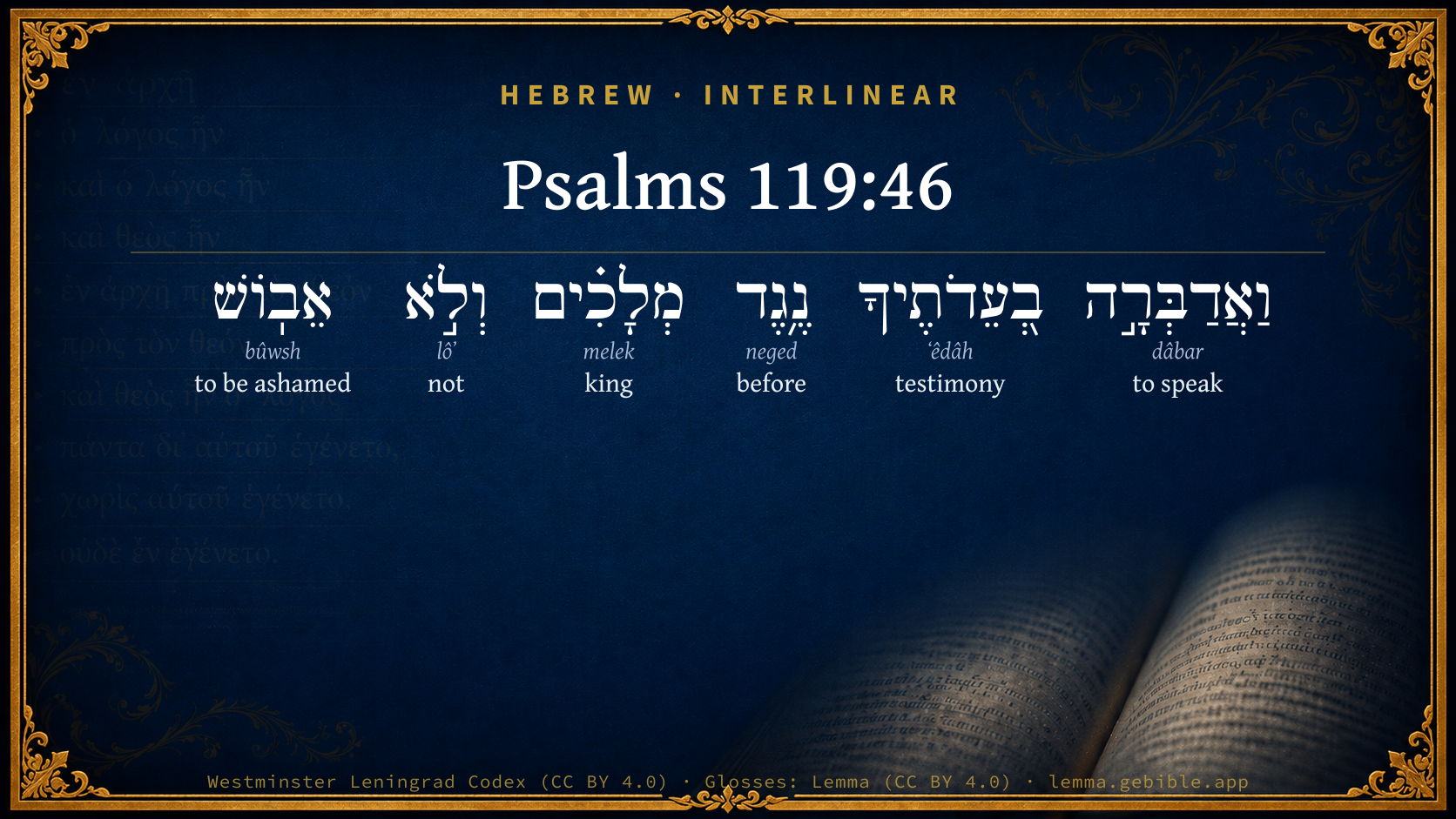
Psalms 119:46

Hebrew (Westminster Leningrad Codex) Psalms 119:46 appears in the Hebrew Old Testament. The text above is from the Westminster Leningrad Codex. Each word links to its Strong’s number, a concise gloss, and parsing drawn from the Open Scriptures Hebrew Bible morphology. Click any word for its full Brown-Driver-Briggs (BDB) entry.
Download image
Cite this verse

Psalms 119:46 (World English Bible). Public Domain. Lemma interlinear Bible study tool, https://lemma.gebible.app/v/psalms/119/46.

Show BibTeX & RIS
BibTeX
RIS
English Translation
I will also speak of your statutes before kings, And will not be disappointed.
World English Bible · Public Domain
Download a study sheet

One document with this verse’s original text, its word-by-word gloss line, the meaning frame, cross-references with their text, attributed commentary, and full source and license credits — printable, and it pastes into notes with its structure intact.

This verse Autodidact and up

Study sheet (.html) Plain text (.txt)

A passage Seminary Student

Up to 50 verses in one chapter. A passage sheet keeps up to 6 commentary sources and 12 cross-references per verse, in the order this page ranks them, and says so on the sheet whenever that leaves anything out. Ask for a single verse and you get the Autodidact verse sheet above.

Everything on this page stays free to read, with no account — the sheet is a download of what is already on screen, not access to it.

Want to remove ads? Support Godless Engineer
Compare translations 3

The same verse in 3 English versions, stacked beneath the original-language interlinear above. Click any original word for its lexicon entry.

Each is an independent rendering of the whole verse — the interlinear is not word-aligned to these translations.

Highlighted words mark where these versions differ — a whole-verse word diff, not a word-by-word alignment.

  • World English Bible Public Domain
    I will also speak of your statutes before kings, And will not be disappointed.
  • King James Version Public Domain
    I will speak of thy testimonies also before kings, and will not be ashamed.
  • unfoldingWord Literal Text CC BY-SA 4.0
    And I will speak of your testimonies before kings, and I will not have shame.

unfoldingWord Literal Text — © unfoldingWord, licensed CC BY-SA 4.0. Word-aligned USFM3 via Door43 (git.door43.org/unfoldingWord/en_ult).

Versions to compare (up to 4)

3 of 4 selected

Show all 17 translations

Every available English version of this verse, each an independent rendering of the whole verse.

  • World English Bible Public Domain
    I will also speak of your statutes before kings, And will not be disappointed.
  • Berean Standard Bible Public Domain
    I will speak of Your testimonies before kings, and I will not be ashamed.
  • Majority Standard Bible Public Domain
    I will speak of Your testimonies before kings, and I will not be ashamed.
  • King James Version Public Domain
    I will speak of thy testimonies also before kings, and will not be ashamed.
  • American Standard Version (1901) Public Domain
    I will also speak of thy testimonies before kings, And shall not be put to shame.
  • Revised Version (1885) Public Domain
    I will also speak of thy testimonies before kings, and will not be ashamed.
  • Geneva Bible (1599) Public Domain
    I will speake also of thy testimonies before Kings, and will not be ashamed.
  • Young's Literal Translation Public Domain
    And I speak of Thy testimonies before kings, And I am not ashamed.
  • Literal Standard Version CC BY-SA 4.0
    And I speak of Your testimonies before kings, || And I am not ashamed.
  • Unlocked Literal Bible CC BY-SA 4.0
    I will speak of your solemn commands before kings and will not be ashamed.
  • unfoldingWord Literal Text CC BY-SA 4.0
    And I will speak of your testimonies before kings, and I will not have shame.
  • Darby Bible Public Domain
    And I will speak of thy testimonies before kings, and will not be ashamed;
  • World Messianic Bible Public Domain
    I will also speak of your statutes before kings, and will not be disappointed.
  • Webster's Bible Public Domain
    I will speak of thy testimonies also before kings, and will not be ashamed.
  • Free Bible Version CC BY-SA 4.0
    I will instruct kings about your laws—I won't be embarrassed.
  • Bible in Basic English Public Domain
    So that I may give knowledge of your unchanging word before kings, and not be put to shame.
  • JPS Tanakh (1917) Public Domain
    I will also speak of Thy testimonies before kings, and will not be ashamed.

Literal Standard Version (2020), Covenant Press — licensed CC BY-SA 4.0. Text via the HelloAO Bible API (eBible.org). Unlocked Literal Bible (unfoldingWord) — licensed CC BY-SA 4.0. Text via the HelloAO Bible API (eBible.org). unfoldingWord Literal Text — © unfoldingWord, licensed CC BY-SA 4.0. Word-aligned USFM3 via Door43 (git.door43.org/unfoldingWord/en_ult). Free Bible Version, Dr. Jonathan Gallagher — licensed CC BY-SA 4.0. Text via the HelloAO Bible API (eBible.org).

Word by word

More ways to search: Search by grammar → Find every occurrence → Compare this word →

Practice this passage: Drill this verse → Learn its vocabulary →

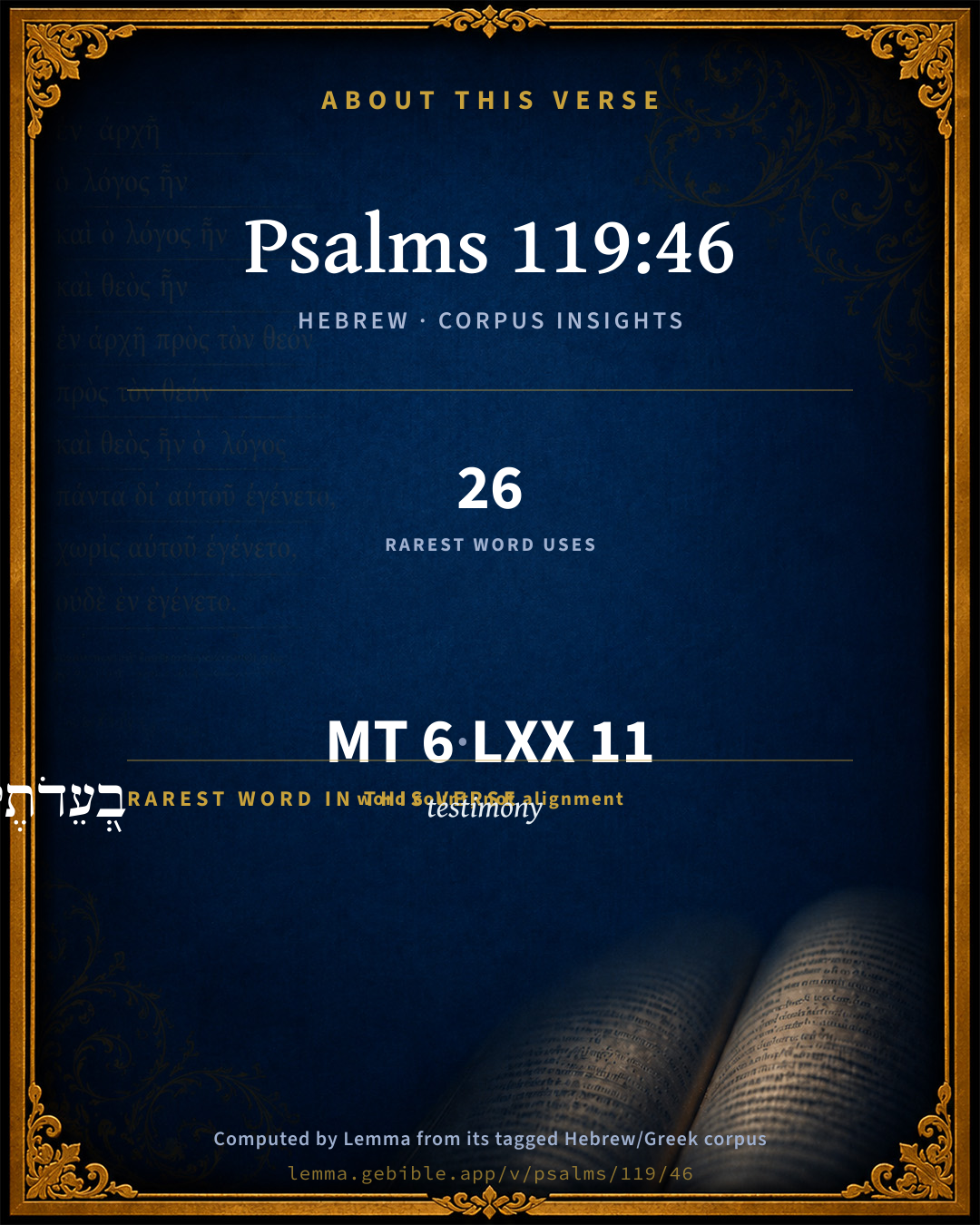
About this verse

These counts appear in no published source. They are computed here, from the morphology-tagged text and Lemma’s own curated glosses. What Lemma adds →

6
words
6
distinct lemmas
Wisdom
section

Shared distinctive vocabulary

בְ֭עֵדֹתֶיךָ testimony H5713 occurs in 25 verses of the Hebrew Bible. Also found in:

Grammatical profile

  • 2 verbs
  • 2 nouns
  • 1 preposition
  • 1 particle

Verb forms

  • וַאֲדַבְּרָ֣ה Piel · Cohortative
  • אֵבֽוֹשׁ Qal · Imperfect

Hebrew & Septuagint length

In English translation the verse runs 14 words from the Hebrew and 12 from the Septuagint (LXX English) — closely comparable.

A rough comparison of the two English renderings, which tokenize alike — not a word-level alignment.

Word counts can differ between the Hebrew and the Greek without any difference in meaning — e.g. the Hebrew direct-object marker אֵת has no separate Greek word, and Greek often adds the article ὁ.

In the original languages it is 6 Hebrew tokens and 11 Greek tokens — but the two are counted differently (Hebrew bundles its prefixes and suffixes into one token; the Greek is in lemma form), so that isn’t a like-for-like length.

Cross-references

14

Topical passages linked to Psalms 119:46 in the Treasury of Scripture Knowledge — connected by theme and wording, ordered by reader-vote popularity; previews shown in the World English Bible.

  • Romans 1:16 For I am not ashamed of the Gospel of Christ, for it is the power of God for salvation for everyone who believes; for the Jew first, and also for the Greek.
  • Matthew 10:18–19 Yes, and you will be brought before governors and kings for my sake, for a testimony to them and to the Gentiles.
  • Acts 26:1–2 Agrippa said to Paul, "You may speak for yourself." Then Paul stretched out his hand, and made his defense.
  • Mark 8:38 For whoever will be ashamed of me and of my words in this adulterous and sinful generation, the Son of Man also will be ashamed of him, when he comes in the glory of his Father with the holy angels."
  • Psalms 138:1 I will give you thanks with my whole heart. Before the gods, I will sing praises to you.
  • Daniel 3:16–18 Shadrach, Meshach, and Abednego answered the king, Nebuchadnezzar, we have no need to answer you in this matter.
  • Daniel 4:1–3 Nebuchadnezzar the king, to all the peoples, nations, and languages, who dwell in all the earth: Peace be multiplied to you.
  • Daniel 4:25–27 that you shall be driven from men, and your dwelling shall be with the animals of the field, and you shall be made to eat grass as oxen, and shall be wet with the dew of the sky, and seven times shall pass over you; until you know that the Most High rules in the kingdom of men, and gives it to whoever he will.
  • Acts 26:24–29 As he thus made his defense, Festus said with a loud voice, "Paul, you are crazy! Your great learning is driving you insane!"
  • Philippians 1:20 according to my earnest expectation and hope, that I will in no way be disappointed, but with all boldness, as always, now also Christ will be magnified in my body, whether by life, or by death.
  • 2 Timothy 1:8 Therefore don't be ashamed of the testimony of our Lord, nor of me his prisoner; but endure hardship for the Gospel according to the power of God,
  • 1 Peter 4:14–16 If you are insulted for the name of Christ, blessed are you; because the Spirit of glory and of God rests on you. On their part he is blasphemed, but on your part he is glorified.
  • 2 Timothy 1:16 May the Lord grant mercy to the house of Onesiphorus, for he often refreshed me, and was not ashamed of my chain,
  • 1 John 2:28 Now, little children, remain in him, that when he appears, we may have boldness, and not be ashamed before him at his coming.

Cross-references courtesy of OpenBible.info (CC BY 4.0).

Hebrew and Greek witnesses Masoretic Hebrew ↔ Greek Septuagint

The same verse in the two great witnesses to the Old Testament, shown verse-for-verse.

You’re reading Greek Psalm 118 (Hebrew Psalm 119). The Septuagint counts the superscription, so verse numbers can differ from the Hebrew — chapter-level alignment, not verse-by-verse. Numbering follows Rahlfs.

These are two independent witnesses, not word-aligned to each other, and the Septuagint is shown in lemma (dictionary) form.

Hebrew Psalms 119:46 Masoretic · Westminster Leningrad Codex

וַאֲדַבְּרָ֣ה בְ֭עֵדֹתֶיךָ נֶ֥גֶד מְלָכִ֗ים וְלֹ֣א אֵבֽוֹשׁ

I will also speak of your statutes before kings, And will not be disappointed.

World English Bible · Public Domain

Greek LXX Greek Psalm 118:46 Septuagint · lemma form

καί λαλέω ἐν ὁ μαρτύριον σύ ἐναντίον βασιλεύς καί οὐ αἰσχύνω

And I spoke of your testimonies before kings, and was not ashamed.

LXX2012 (modern English Septuagint) · Public Domain

On this verse, Ellicott's Commentary for English Readers discusses the Septuagint’s reading. Read the note in Commentary ↓

Hebrew: Westminster Leningrad Codex (CC BY 4.0). Greek: Septuagint (public domain); English from LXX2012 (modern English Septuagint) (Public Domain). How the Septuagint differs from the Hebrew →

Commentary

Notes on Psalms 119:46 from classic Christian and Jewish commentators (each source and its license shown beneath its notes). The classic Christian expositions comment on the surrounding passage and are grouped to its opening verse, so a note may address several verses; the Jewish commentaries on the Tanakh (Rashi and others) are per-verse, so they appear only where the commentator wrote on this verse.

Lemma curates 59 commentaries, every one of them public domain or Creative Commons licensed, each selected and text-cleaned for this edition rather than reprinted as found. About our sources →

Trapp's Complete Commentary

John Trapp

Psa 119:46 I will speak of thy testimonies also before kings, and will not be ashamed.

Ver. 46. I will speak of thy testimonies, &c.] Nullo vel terrore vel splendore mundano impeditus. Kings commonly abound with all things but only truth, as Alphonsus, king of Arragon, complained. David would deal plainly with them, though never so high; especially when he should come to be of equal level with them, and so to have better opportunity.

John Trapp, A Commentary or Exposition upon All the Books of the Old and New Testament (1647–1656) — public domain. Text from a community e-Sword module.

The Biblical Illustrator

Joseph S. Exell

Psa_119:46

I will speak of Thy testimonies also before kings, and will not be ashamed.

The moral martyr

Religion is proposed to us in two different points of view, a point of speculation, and a point of practice. Accordingly, there are two sorts of martyrdom; a martyrdom for doctrine, and a martyrdom for morality. It is for the last that the prophet prepares us in the words of the text.

I. The authors, or, as they may be justly denominated, the executioners, who punish men with martyrdom for morality, I understand, then, by the vague term, kings, all who have any pre-eminence over the lowest orders of men, and these are they who exercise tyranny and inflict the martyrdom for which the prophet in the text prepares us.

II. The magnanimity of such as expose them-selves to it.

III. The horrors that accompany it.

IV. The obligation of spearing of the testimonies of God before kings. We ground this on the nature of this duty. You have heard, that it consists in urging the rights of God before great men; and, though it be at the hazard of all the comforts and pleasures of life, in professing to respect the moral part of religion. How often have we denied our holy religion? How often, when it hath been jeeringly said to us, Thou also wast with Jesus, have we sneakingly replied, I know not what thou sayest?

V. The crown of moral martyrdom. A man who can say to God, as our prophet said, finds a rich reward, first in the ideas which a sound reason gives him of shame and glory; secondly, in the testimony of his own conscience; thirdly, in the approbation of good people; and lastly, in the prerogatives of martyrdom. These, if I may so express myself, are four jewels of his crown. (J. Saurin.)

Boldness in religion

There are several reasons to justify this boldness in religion:--

I. It is a Divine system.

1. All the arguments for the Divinity of this book may be ranged under one word--congruity.

(1) The congruity of its contents with collateral history.

(2) The congruity of its Contents with itself. Though written by different men in different ages, in different lands, there is no essential contradiction.

(3) Congruity with our antecedent notions of God.

(4) Congruity with mans reason, intuitions, wants.

2. What folly to be ashamed of speaking of a book whose author is God Himself.

II. It is a rational system.

1. In saying this we do not say--

(1) That mens interpretations of it are rational. Nor--

(2) That all it contains can be comprehended by reason.

2. Its incomprehensibles answer two purposes--furnish an argument for its Divinity, and a schooling energy for the student.

3. There are two facts in favour of this rationality.

(1) That its most thoughtful students have ever been impressed with its reasonableness.

(2) That it has ever proved itself the most powerful agent in developing the rationality of mankind. Why, then, should we be ashamed of speaking of a system so rational, a system that can bear the scrutiny of the keenest intellect, the analysis of the severest philosophy?

III. It is a powerful system.

1. Because it is true. All truth is powerful.

2. Because it is moral truth. Truth for the affections and conscience is the most powerful kind of truth.

3. Because it is remedial truth. Truth revealing provisions for recovering sinners.

4. Because it is embodied truth:--Truth, coming, not in mere proposition or precept, but in example, in the example of God Himself. It is, indeed, the power of God. Every page in the history of its triumphs demonstrates its almighty power. Then you may well glory in it.

IV. It is a restorative system. It is a power, not to destroy, but to save.

V. It is a universal system. It is not for a class, a sect, a province, a period; it is for universal man. (Homilist.)

Guilty silence

A silent religion, or a speaking religion--which shall it be? David says, I will speak;--what do we say? Too often we resolve that we will keep silence. The theme on which David says he will speak is Gods testimonies. Has he chosen a barren topic? Look at the range, the explicitness, and the emphasis of those testimonies, and you will say that never did man choose so fruitful, so abounding a theme. The fact is that there is not a single aspect of life which lies beyond the circumference of the Divine testimonies. God has anticipated everything, provided for everything. David, then, is ready for all occasions, for all men, at all times, and in all places. What, then, is the urgent practical lesson to be deduced from all this affluent provision? If there is one lesson clearer than another suggested by these circumstances, it is that we are left without excuse if we fail to speak of the Divine testimonies. Opportunities occur every day. Circumstances arise under which no words can be so beautiful, so touching, so pithy, so real. There are many curious and startling inconsistencies perpetrated in connection with this matter of not being faithful to the Divine testimonies. We have before the minds eye a man who is a large employer of labour. He might have an immense moral influence over those who work in his employment. By a wise word here, and an encouraging word there, he might achieve untold good. That man is a member of the Church, but his own servants are perfectly unaware of his piety until they see his name advertised as a speaker at a religious meeting. Is this right? (J. Parker, D. D.)

Religion acknowledged

There is a splendid tonic in the biography of Hadley Vicars, who, when he was converted, put his Bible on his mess-room table as the best answer to the jeers of his fellow-officers in the British army. (T. L. Cuyler, D. D.)

The Biblical Illustrator, edited by Joseph S. Exell (c. 1880s–1900s) — public domain. Text from a community e-Sword module.

The Treasury of David

Charles H. Spurgeon

Ver. 46. I will speak of thy testimonies also before kings, and will not be ashamed. This is part of his liberty; he is free from fear of the greatest, proudest, and most tyrannical of men. David was called to stand before kings when he was an exile; and afterwards, when he was himself a monarch, he knew the tendency of men to sacrifice their religion to pomp and statecraft; but it was his resolve to do nothing of the kind. He would sanctify politics, and make cabinets know that the Lord alone is governor among the nations. As a king he would speak to kings concerning the King of kings. He says, "I will speak": prudence might have suggested that his life and conduct would be enough, and that it would be better not to touch upon religion in the presence of royal personages who worshipped other gods, and claimed to be right in so doing. He had already most fittingly preceded this resolve by the declaration, "I will walk, "but he does not make his personal conduct an excuse for sinful silence, for he adds, "I will speak." David claimed religious liberty, and took care to use it, for he spoke out what he believed, even when he was in the highest company. In what he said he took care to keep to God's own word, for he says, "I will speak of thy testimonies." No theme is like this, and there is no way of handling that theme like keeping close to the book, and using its thought and language. The great hindrance to our speaking upon holy topics in all companies is shame, but the Psalmist will "not be ashamed"; there is nothing to be ashamed of, and there is no excuse for being ashamed, and yet many are as quiet as the dead for fear some creature like themselves should be offended. When God gives grace, cowardice soon vanishes. He who speaks for God in God's power, will not be ashamed when beginning to speak, nor while speaking, nor after speaking; for his theme is one which is fit for kings, needful to kings, and beneficial to kings. If kings object, we may well be ashamed of them, but never of our Master who sent us, or of his message, or of his design in sending it.

Ver. 46. I will speak of thy testimonies also before kings. In words he seems to believe that he is in possession of that which he formerly prayed for. He had said, "Take not the word of truth out of my mouth, "and now, as if he had obtained what he requested, he rises up, and maintains that he would not be dumb, even were he called upon to speak in presence of kings. He affirms that he would willingly stand forward vindication of the glory of God in the face of the whole world. John Calvin.

Ver. 46. I will speak of thy testimonies also before kings. The terror of kings and of men in power is an ordinary hindrance of free confession God's truth in time of persecution; but faith in the truth sustained in heart by God is able to bring forth a confession at all hazards. David Dickson.

Ver. 46. I will speak of thy testimonies also before kings. Before came to the crown kings were sometimes his judges, as Saul and Achish: but if he were called before them to give a reason of the hope that was in: him, he would speak of God's testimonies, and profess to build his hope upon them, and make them his council, his guard, his crown, his all. We must never be afraid to own our religion, though it should expose us to the wrath of kings, but speak of it as that which we will live and die by, like the three children before Nebuchadnezzar, Da 3:16 Ac 4:20. After David came to the crown kings were sometimes his companions, they visited him, and he returned their visits; but he did not, in complaisance to them, talk of everything but religion for fear of affronting them, and making his converse uneasy to them: no, God's testimonies shall be the principal subject of his discourse with the kings, not only to show that he was not ashamed of his religion, but to instruct them in it, and bring them over to it. It is good for kings to hear of God's testimonies, and it will adorn the conversation of princes themselves to speak of them. Matthew Henry.

Ver. 46. I will speak of thy testimonies also before kings. Men of greatest holiness have been men of greatest boldness; witness Nehemiah, the three children, Daniel, and all the holy prophets and apostles: Pr 23:1, "The wicked flee when no man pursueth: but the righteous are bold as a lion, "yea, as a young lion, as the Hebrew has it, one that is in his hot blood and fears no colours, and that is more bold than any others. Holiness made Daniel not only as bold as a lion, but also to daunt the lions with his boldness. Luther was a man of great holiness, and a man of great boldness: witness his standing out against all the world; and when the emperor sent for him to Worms, and his friends dissuaded him from going, as sometimes Paul's did him, "Go, "said he, "I will surely go, since I am sent for, in the name of our Lord Jesus Christ; yea, though I knew that there were as many devils in Worms to resist me as there be tiles to cover the houses, yet I would go." And when the same author and his associates were threatened with many dangers from opposers on all hands, he lets fall this heroic and magnanimous speech: "Come, let us sing the 46th Psalm, and then let them do their worst." Latimer was a man of much holiness, counting the darkness and profaneness of those times wherein he lived, and a man of much courage and boldness; witness his presenting to King Henry the Eighth, for a New Year's gift, a New Testament, wrapped up in a napkin, with this posie or motto about it; "Whoremongers and adulterers God will judge." Thomas Brooks.

Ver. 46. Note that in this verse we are taught to shun four vices. First, overmuch silence: hence he says, "I will speak." Secondly, useless talkativeness: "of thy testimonies." The Hebrew doctors say that ten measures of speaking had descended to the earth, that nine had been carried off by the women, but one left for all the rest of the world. Hieronymus rightly exhorts all Christians: "Consecrate thy mouth to the Gospel: be unwilling to open it with trifles or fables." Thirdly, we are taught to shun cowardice: "before kings." For, as it is said (Pr 29:25), "The fear of man bringeth a snare." Fourthly, and lastly, we are taught to shun cowardly bashfulness: "and will not be ashamed." Thomas Le Blanc.

Ver. 46. I will not be ashamed. That is, I shall not be cast down from my position or my hope; I shall not be afraid; nor will I, from fear of danger or reproach, shun or renounce the confession; nor shall I be overcome by terrors or threats. D. H. Mollerus.

Ver. 46-48. In these three last verses David promises a threefold duty of thankfulness. First, the service of his tongue. Next, the service of his affections. Thirdly, the service of his actions. A good conscience renders always great consolation; and an honest life makes great boldness to speak without fear or shame, as ye see in David towards Saul, in Elias to Ahab, in Paul to Agrippa, to Festus, and to Felix. William Cowper.

Ver. 46-48. Lips, heart, and hands.

1. Public profession of God's word ("I will speak, "Ps 119:46) must be warranted by

2. Private delight in God's word ("I will delight myself, " Ps 119:47), which must result in

3. Practical obedience to God's word ("I will lift up my hands, " Ps 119:48).

Ver. 46.

1. The truly earnest must speak.

2. They are at no loss for good subjects: "Thy testimonies." The range is boundless the variety endless.

3. They never fear any audience: "before kings." W.W.

Psalms 119:47*

Charles H. Spurgeon's The Treasury of David (1869–1885) — public domain. Psalms only. Text from a community e-Sword/MySword module.

J. A. Alexander on Psalms

Joseph Addison Alexander

46. (Psa 119:46) And I will speak of thy testimonies before kings, and will not be ashamed. Here again some eminent interpreters have found an indication of the national design and meaning of the whole psalm, as the individual believer could not be expected to bear witness to the truth in such a presence. He might, however, do so, as one of the component parts of the whole body. But the words are really expressive only of a readiness to declare the divine testimony against sin, in any presence, even the most august, if it should be necessary. This passage seems to have been present to our Saviour's mind when he uttered the prediction in Mat 10:18. Ashamed has here its strict sense, as denoting a painful feeling of humiliation.

Joseph Addison Alexander, The Psalms Translated and Explained (1850) — public domain. Text from a community e-Sword module.

Geneva Bible (1599)

Geneva Bible translators

He showeth that the children of God ought not to suffer their father’s glory to be obscured by the vain pomp of princes.

Geneva Bible (1599) marginal notes — public domain. Text via Bolls.life.

Adam Clarke's Commentary

Verse 46. I will speak - before kings] Dr. Delaney supposes that this is spoken in reference to Achish, king of Gath, whom David had instructed in the Jewish religion; but we have already seen that it is most likely that the Psalm was compiled under the Babylonish captivity. But the words may with more propriety be referred to the case of Daniel, and other bold and faithful Israelites, who spoke courageously before Nebuchadnezzar, Belshazzar, and Darius. See the books of Daniel, Ezra, and Nehemiah.

Adam Clarke's Commentary on the Bible (1810–1826) — public domain. Text from a community e-Sword/MySword module.

John Calvin's Commentaries

46. And I will steal, of thy testimonies before kings In these words he seems to believe that he is in possession of that which he formerly prayed for. Having said, “Take not away the word out of my mouths” and now, as if he had obtained what he requested, he rises up, and maintains he will not be dumb, even were he called upon to speak in the presence of kings. There can be no question that he affirms he would willingly stand forward in vindication of the glory of God in the face of the whole world. He selects kings, who are generally more to be dreaded than other men, and haughtily shut the mouths of God’s witnesses. Sometimes, indeed, it happens we will not hold out even in the presence of men in the humblest ranks of life. The moment a man sets himself in opposition to the word of God, we instinctively shrink back from fear; and that boldness of speech, of which we boasted at first, instantly disappears: but our want of courage is most palpable when we are summoned before the thrones of kings. And this is the reason why David asserts, that he will not only hold out against enemies among the meanest of men, but also will remain firm and fearless before kings. These words inform us that we have profited well and truly by God’s word, when our hearts are so completely fortified against the fear of man, that we do not dread the presence of kings, even though all the world attempts; to fill us with dejection and dismay. It is most unbecoming that God’s glory should be obscured by their empty splendor.

John Calvin's Commentaries (1540-1563) — public domain. Text from the Calvin Translation Society English edition (1840s-50s) via the Christian Classics Ethereal Library (ccel.org). Calvin's coverage is partial (roughly two-thirds of the Bible); uncommented books and verses are honest gaps, never fabricated. The 19th-century editor's footnotes and remarks are omitted so the notes are faithfully Calvin's own voice.

Ellicott's Commentary for English Readers

(46) The Vulgate (which in the tenses follows the LXX.) of this verse was the motto of the Augsburg Confession, Et loquebar in testimoniis tuis in conspectu regum, et non confundebar.”

A Bible Commentary for English Readers, edited by Charles John Ellicott (1878–1897) — public domain. Text from a community e-Sword module.

The Cambridge Bible for Schools and Colleges

gen. ed. J. J. S. Perowne

46. before kings] Like Daniel and his companions, or Nehemiah, or the martyrs of the Maccabaean period, he is ready, if need be, to confess his faith boldly before the highest human authorities. Cp. Mat_10:18; Act_26:1-2.

The Cambridge Bible for Schools and Colleges (gen. ed. J. J. S. Perowne; Cambridge University Press, 1878–1918) — public domain. Text from a community e-Sword module.

John Gill's Exposition

My hands also will I lift up unto thy commandments, which I have loved,.... Showing by such a gesture his great esteem of them, and affection for them; stretching out his hands, and embracing them with both arms, as it were: and this being a praying gesture, Ti2 2:8, may signify his earnest desire and request that he might have grace and spiritual strength to enable him to observe them; and it being used in swearing, Gen 14:22, may express his firm resolution in the strength of divine grace to keep them; and the phrase signifying a doing or an attempt to do anything, Gen 41:44, may denote his practical observance of the commands, his putting his hand to do them with all his might;

and I will meditate in thy statutes; and thereby get a better understanding of them, and be in a better disposition and capacity to keep them.

John Gill's Exposition of the Whole Bible (1746–1763) — public domain (CC PDM 1.0). Text via the HelloAO Bible API.

Albert Barnes' Notes on the Bible

I will speak of thy testimonies also before kings ... - In the presence of men of most elevated rank. I will not be ashamed to avow my belief in thy word before those in power - whether friendly or unfriendly to thee and to thy cause. I will not disguise my belief in thy truth with any desire to secure their favor; I will not be intimidated from expressing my faith by any dread of their frowns. Compare Mat 10:18-19; Act 4:19; Act 5:29; Act 26:2.

Albert Barnes' Notes on the Bible (1834–1885) — public domain. Text from a community e-Sword/MySword module.

Matthew Poole's English Annotations

Before kings; who commonly entertain all godly discourses with scorn and contempt.

Matthew Poole's English Annotations on the Holy Bible (1683–1685) — public domain. Text from a community e-Sword/MySword module.

The Pulpit Commentary

I will speak of thy testimonies also before kings. If occasion offer, I will bear my witness to the excellence of thy Law, even before kings. And will not be ashamed; i.e. will not allow shame to stop my mouth. The writer is evidently not a king himself, probably not among the great ones of the earth (see vers. 51, 69, 78, 85, etc.).

The Pulpit Commentary (1880–1919), ed. H.D.M. Spence-Jones & Joseph S. Exell — public domain. Text from a community e-Sword module.

Lesson kit

Teaching starters — assembled from the data on this page, not authored interpretation. Every prompt links to the verse data it draws on. Edit before teaching.

Psalms, in the Wisdom, opens this verse with 6 words (6 distinct Hebrew lemmas). Its most distinctive word is ʻêdâh (“testimony”). A historical commentator’s framing appears above. Read the whole chapter for the surrounding context.

Discussion questions

  1. How does “testimony” (ʻêdâh) shape what this verse is saying?
  2. How does Genesis 21:30, which shares the word «testimony», read alongside this verse?
  3. The translations on this page render this verse differently — a whole-verse word diff, not a word-by-word alignment. What might account for the different wordings?
  4. «וַאֲדַבְּרָ֣ה» is a Piel Cohortative verb. How does that grammatical form shape the action described?
  5. Compare how Trapp's Complete Commentary and The Biblical Illustrator read this verse. Where do they agree or differ?

Things to notice

Reading settings

Reading text

Shown beneath each verse's original-language words.

Old Testament
Old Testament edition

Read the OT as the Masoretic Hebrew (MT) or the Greek Septuagint (LXX).

English shown for the Greek Septuagint (in the Hebrew ↔ Greek comparison).

Comparing translations? Open the Compare panel on any verse page to stack up to four side by side.