Isaiah 39:7

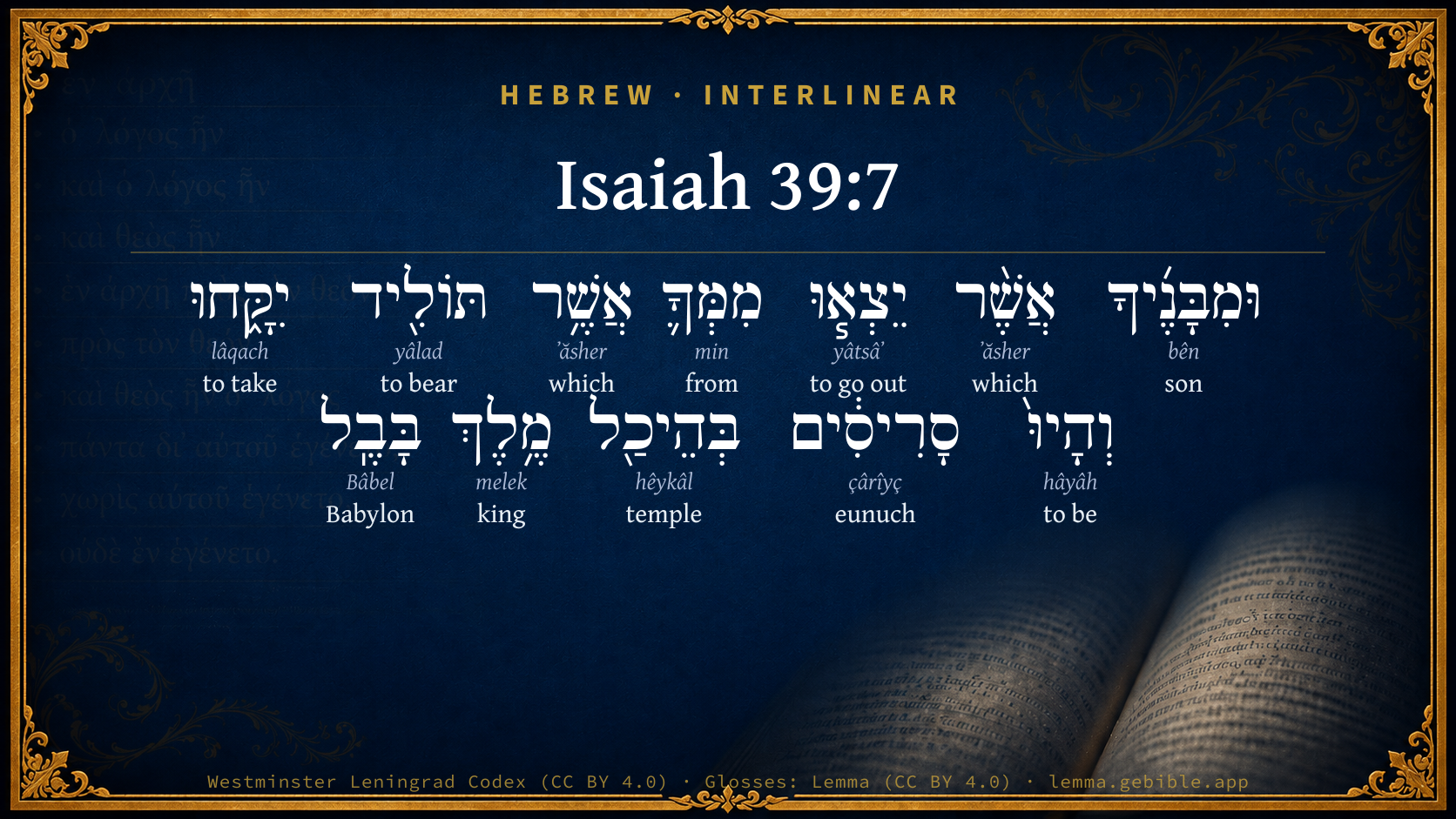
Hebrew (Westminster Leningrad Codex) Isaiah 39:7 appears in the Hebrew Old Testament. The text above is from the Westminster Leningrad Codex. Each word links to its Strong’s number, a concise gloss, and parsing drawn from the Open Scriptures Hebrew Bible morphology. Click any word for its full Brown-Driver-Briggs (BDB) entry.
Download image
Cite this verse

Isaiah 39:7 (World English Bible). Public Domain. Lemma interlinear Bible study tool, https://lemma.gebible.app/v/isaiah/39/7.

Show BibTeX & RIS
BibTeX
RIS
English Translation
Of your sons who shall issue from you, whom you shall father, shall they take away; and they shall be eunuchs in the palace of the king of Babylon.
World English Bible · Public Domain
Download a study sheet

One document with this verse’s original text, its word-by-word gloss line, the meaning frame, cross-references with their text, attributed commentary, and full source and license credits — printable, and it pastes into notes with its structure intact.

This verse Autodidact and up

Study sheet (.html) Plain text (.txt)

A passage Seminary Student

Up to 50 verses in one chapter. A passage sheet keeps up to 6 commentary sources and 12 cross-references per verse, in the order this page ranks them, and says so on the sheet whenever that leaves anything out. Ask for a single verse and you get the Autodidact verse sheet above.

Everything on this page stays free to read, with no account — the sheet is a download of what is already on screen, not access to it.

Want to remove ads? Support Godless Engineer
Compare translations 3

The same verse in 3 English versions, stacked beneath the original-language interlinear above. Click any original word for its lexicon entry.

Each is an independent rendering of the whole verse — the interlinear is not word-aligned to these translations.

Highlighted words mark where these versions differ — a whole-verse word diff, not a word-by-word alignment.

  • World English Bible Public Domain
    Of your sons who shall issue from you, whom you shall father, shall they take away; and they shall be eunuchs in the palace of the king of Babylon.
  • King James Version Public Domain
    And of thy sons that shall issue from thee, which thou shalt beget, shall they take away; and they shall be eunuchs in the palace of the king of Babylon.
  • unfoldingWord Literal Text CC BY-SA 4.0
    ‘And they will take some of your sons who will come forth from you, whom you will beget, and they will be eunuchs in the palace of the king of Babylon.’”

unfoldingWord Literal Text — © unfoldingWord, licensed CC BY-SA 4.0. Word-aligned USFM3 via Door43 (git.door43.org/unfoldingWord/en_ult).

Versions to compare (up to 4)

3 of 4 selected

Show all 18 translations

Every available English version of this verse, each an independent rendering of the whole verse.

  • World English Bible Public Domain
    Of your sons who shall issue from you, whom you shall father, shall they take away; and they shall be eunuchs in the palace of the king of Babylon.
  • Berean Standard Bible Public Domain
    And some of your descendants, your own flesh and blood, will be taken away to be eunuchs in the palace of the king of Babylon.”
  • Majority Standard Bible Public Domain
    And some of your descendants, your own flesh and blood, will be taken away to be eunuchs in the palace of the king of Babylon.”
  • King James Version Public Domain
    And of thy sons that shall issue from thee, which thou shalt beget, shall they take away; and they shall be eunuchs in the palace of the king of Babylon.
  • American Standard Version (1901) Public Domain
    And of thy sons that shall issue from thee, whom thou shalt beget, shall they take away; and they shall be eunuchs in the palace of the king of Babylon.
  • Revised Version (1885) Public Domain
    And of thy sons that shall issue from thee, which thou shalt beget, shall they take away; and they shall be eunuchs in the palace of the king of Babylon.
  • Geneva Bible (1599) Public Domain
    And of thy sonnes, that shall proceede out of thee, and which thou shalt beget, shall they take away, and they shall be eunuches in the palace of the King of Babel.
  • Douay-Rheims (1899) Public Domain
    And of thy children, that shall issue from thee, whom thou shalt beget, they shall take away, and they shall be eunuchs in the palace of the king of Babylon.
  • Young's Literal Translation Public Domain
    and of thy sons who come forth from thee, whom thou begettest, they take, and they have been eunuchs in a palace of the king of Babylon.'
  • Literal Standard Version CC BY-SA 4.0
    and of your sons who come forth from you, whom you beget, they take, and they have been eunuchs in a palace of the king of Babylon.”
  • Unlocked Literal Bible CC BY-SA 4.0
    The sons born from you, whom you yourself have fathered—they will take them away, and they will become eunuchs in the palace of the king of Babylon.'”
  • unfoldingWord Literal Text CC BY-SA 4.0
    ‘And they will take some of your sons who will come forth from you, whom you will beget, and they will be eunuchs in the palace of the king of Babylon.’”
  • Darby Bible Public Domain
    And of thy sons that shall issue from thee, whom thou shalt beget, shall they take away; and they shall be eunuchs in the palace of the king of Babylon.
  • World Messianic Bible Public Domain
    ‘They will take away your sons who will issue from you, whom you shall father, and they will be eunuchs in the king of Babylon’s palace.’”
  • Webster's Bible Public Domain
    And of thy sons that shall issue from thee, which thou shalt beget, shall they take away; and they shall be eunuchs in the palace of the king of Babylon.
  • Free Bible Version CC BY-SA 4.0
    Some of your sons, your own offspring, will be taken to serve as eunuchs in the palace of the king of Babylon.”
  • Bible in Basic English Public Domain
    And your sons, even your offspring, will they take away to be unsexed servants in the house of the king of Babylon.
  • JPS Tanakh (1917) Public Domain
    And of thy sons that shall issue from thee, whom thou shalt beget, shall they take away; and they shall be officers in the palace of the king of Babylon.'

Literal Standard Version (2020), Covenant Press — licensed CC BY-SA 4.0. Text via the HelloAO Bible API (eBible.org). Unlocked Literal Bible (unfoldingWord) — licensed CC BY-SA 4.0. Text via the HelloAO Bible API (eBible.org). unfoldingWord Literal Text — © unfoldingWord, licensed CC BY-SA 4.0. Word-aligned USFM3 via Door43 (git.door43.org/unfoldingWord/en_ult). Free Bible Version, Dr. Jonathan Gallagher — licensed CC BY-SA 4.0. Text via the HelloAO Bible API (eBible.org).

Word by word

More ways to search: Search by grammar → Find every occurrence → Compare this word →

Practice this passage: Drill this verse → Learn its vocabulary →

סָרִיסִ֔ים
çârîyç
H5631
“eunuchs”
Noun, Common, Masculine, Plural, Absolute
Part of Speech
Noun
Type
Common
Gender
Masculine
Number
Plural
State
Absolute
Full BDB Definition

Origin: from an unused root meaning to castrate

TWOT: 1545

official, eunuch
  1. וּמִבָּנֶ֜יךָ bên H1121 “and · from · sons · your” Conjunction + Preposition + Noun, Common, Masculine, Plural, Construct + Suffix, Personal, 2nd Person, Masculine, Singular
  2. אֲשֶׁ֨ר ʼăsher H834 “which” Particle, Relative
  3. יֵצְא֧וּ yâtsâʼ H3318 “to go out” Verb, Qal, Imperfect, 3rd Person, Masculine, Plural
  4. מִמְּךָ֛ min H4480 “from · you” Preposition + Suffix, Personal, 2nd Person, Masculine, Singular
  5. אֲשֶׁ֥ר ʼăsher H834 “which” Particle, Relative
  6. תּוֹלִ֖יד yâlad H3205 “to bear” Verb, Hiphil, Imperfect, 2nd Person, Masculine, Singular
  7. יִקָּ֑חוּ lâqach H3947 “to take” Verb, Qal, Imperfect, 3rd Person, Masculine, Plural
  8. וְהָיוּ֙ hâyâh H1961 “and · to be” Conjunction + Verb, Qal, Sequential Perfect, 3rd Person, Common, Plural
  9. בְּהֵיכַ֖ל hêykâl H1964 “in/at · temple of” Preposition + Noun, Common, Masculine, Singular, Construct
  10. מֶ֥לֶךְ melek H4428 “king of” Noun, Common, Masculine, Singular, Construct
  11. בָּבֶֽל Bâbel H894 “Babylon” Noun, Proper

About this verse

These counts appear in no published source. They are computed here, from the morphology-tagged text and Lemma’s own curated glosses. What Lemma adds →

12
words
11
distinct lemmas
Prophets
section

Shared distinctive vocabulary

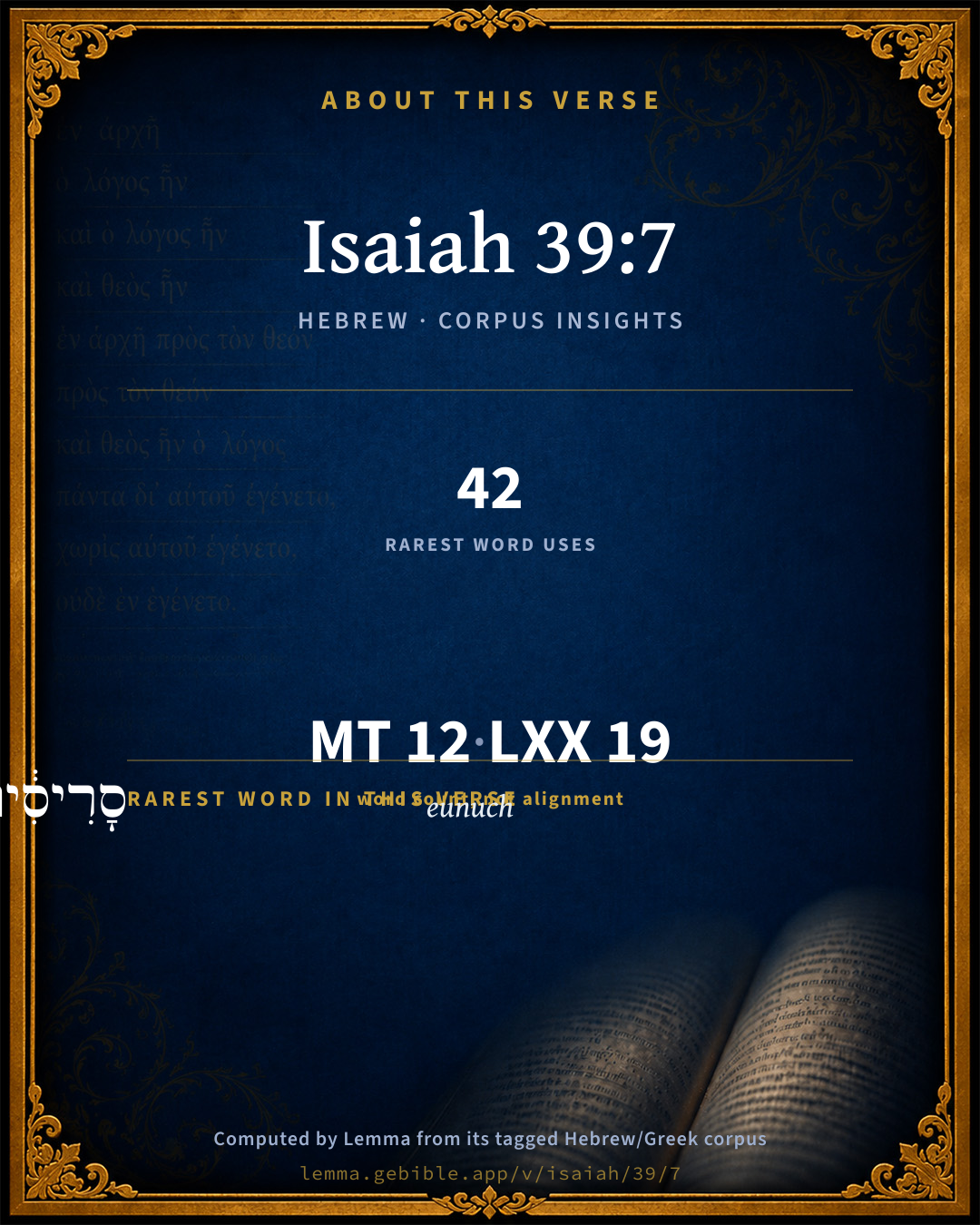
סָרִיסִ֔ים eunuch H5631 occurs in 42 verses of the Hebrew Bible. Also found in:

Grammatical profile

  • 4 verbs
  • 5 nouns
  • 1 preposition
  • 2 particles

Verb forms

  • יֵצְא֧וּ Qal · Imperfect
  • תּוֹלִ֖יד Hiphil · Imperfect
  • יִקָּ֑חוּ Qal · Imperfect
  • וְהָיוּ֙ Qal · Sequential Perfect

Repetition

A word recurs within this verse — often emphatic in Hebrew:

  • אֲשֶׁ֨ר which H834 ×2

Hebrew & Septuagint length

In English translation the verse runs 29 words from the Hebrew and 27 from the Septuagint (LXX English) — closely comparable.

A rough comparison of the two English renderings, which tokenize alike — not a word-level alignment.

Word counts can differ between the Hebrew and the Greek without any difference in meaning — e.g. the Hebrew direct-object marker אֵת has no separate Greek word, and Greek often adds the article ὁ.

In the original languages it is 12 Hebrew tokens and 19 Greek tokens — but the two are counted differently (Hebrew bundles its prefixes and suffixes into one token; the Greek is in lemma form), so that isn’t a like-for-like length.

Cross-references

9

Topical passages linked to Isaiah 39:7 in the Treasury of Scripture Knowledge — connected by theme and wording, ordered by reader-vote popularity; previews shown in the World English Bible.

  • Daniel 1:1–7 In the third year of the reign of Jehoiakim king of Judah came Nebuchadnezzar king of Babylon to Jerusalem, and besieged it.
  • 2 Kings 24:12 and Jehoiachin the king of Judah went out to the king of Babylon, he, and his mother, and his servants, and his princes, and his officers: and the king of Babylon took him in the eighth year of his reign.
  • 2 Chronicles 36:10 At the return of the year king Nebuchadnezzar sent, and brought him to Babylon, with the goodly vessels of the house of Yahweh, and made Zedekiah his brother king over Judah and Jerusalem.
  • 2 Kings 24:15 He carried away Jehoiachin to Babylon; and the king's mother, and the king's wives, and his officers, and the chief men of the land, carried he into captivity from Jerusalem to Babylon.
  • 2 Kings 25:6–7 Then they took the king, and carried him up to the king of Babylon to Riblah; and they gave judgment on him.
  • 2 Chronicles 33:11 Therefore Yahweh brought on them the captains of the host of the king of Assyria, who took Manasseh in chains, and bound him with fetters, and carried him to Babylon.
  • 2 Chronicles 36:20 Those who had escaped from the sword carried he away to Babylon; and they were servants to him and his sons until the reign of the kingdom of Persia:
  • Jeremiah 39:7 Moreover he put out Zedekiah's eyes, and bound him in fetters, to carry him to Babylon.
  • Ezekiel 17:12–20 Say now to the rebellious house, Don't you know what these things mean? tell them, Behold, the king of Babylon came to Jerusalem, and took the king of it, and the princes of it, and brought them to him to Babylon:

Cross-references courtesy of OpenBible.info (CC BY 4.0).

Hebrew and Greek witnesses Masoretic Hebrew ↔ Greek Septuagint

The same verse in the two great witnesses to the Old Testament, shown verse-for-verse.

These are two independent witnesses, not word-aligned to each other, and the Septuagint is shown in lemma (dictionary) form.

Hebrew Isaiah 39:7 Masoretic · Westminster Leningrad Codex

וּמִבָּנֶ֜יךָ אֲשֶׁ֨ר יֵצְא֧וּ מִמְּךָ֛ אֲשֶׁ֥ר תּוֹלִ֖יד יִקָּ֑חוּ וְהָיוּ֙ סָרִיסִ֔ים בְּהֵיכַ֖ל מֶ֥לֶךְ בָּבֶֽל

Of your sons who shall issue from you, whom you shall father, shall they take away; and they shall be eunuchs in the palace of the king of Babylon.

World English Bible · Public Domain

Greek LXX Isaiah 39:7 Septuagint · lemma form

ὅτι καί ἀπό ὁ τέκνον σύ ὅς γεννάω λαμβάνω καί ποιέω σπάδων ἐν ὁ οἶκος ὁ βασιλεύς ὁ βαβυλώνιος

that they shall take also of your children whom you shall beget; and they shall make them eunuchs in the house of the king of the Babylonians.

LXX2012 (modern English Septuagint) · Public Domain

Hebrew: Westminster Leningrad Codex (CC BY 4.0). Greek: Septuagint (public domain); English from LXX2012 (modern English Septuagint) (Public Domain). How the Septuagint differs from the Hebrew →

Targum (Aramaic paraphrase)

1

The Targum is the ancient Jewish Aramaic paraphrase of the Hebrew Scriptures — an interpretive translation, not the Hebrew text itself. Onkelos (literal) and Pseudo-Jonathan (expansive) render the Torah, and Jonathan the Prophets. Coverage is partial: where no permissively-licensed English translation exists for a verse, only the Aramaic is shown. This is verse-level text, not a word-by-word alignment to the Hebrew.

  1. Targum Jonathan Prophets (Joshua–Malachi)
    וּמִבְּנָךְ דְיִפְקוּן מִנָךְ דְתוֹלִיד יַדְבְּרוּן וִיהוֹן רַבְרְבִין בְּהֵיכָלָא מַלְכָּא דְבָבֶל:

    And thy sons which shall come forth from thee shall be in the palace of the king of Babylon.

    Targum Jonathan — Aramaic: “Mikraot Gedolot” (public domain). English: “Sefaria Community Translation” (CC0 1.0 (public-domain dedication)); “London "Chaldee Paraphrase," 1871” (public domain). Text via Sefaria.

Commentary

Notes on Isaiah 39:7 from classic Christian and Jewish commentators (each source and its license shown beneath its notes). The classic Christian expositions comment on the surrounding passage and are grouped to its opening verse, so a note may address several verses; the Jewish commentaries on the Tanakh (Rashi and others) are per-verse, so they appear only where the commentator wrote on this verse.

Lemma curates 59 commentaries, every one of them public domain or Creative Commons licensed, each selected and text-cleaned for this edition rather than reprinted as found. About our sources →

Geneva Bible (1599)

Geneva Bible translators

That is, officers and servants.

Geneva Bible (1599) marginal notes — public domain. Text via Bolls.life.

Jamieson, Fausset & Brown

Robert Jamieson, A. R. Fausset & David Brown

sons . . . from thee--The sons which Hezekiah (as JOSEPHUS tells us) wished to have (see on Isa 28:3, on "wept sore") will be among the foremost in suffering.

eunuchs--fulfilled (Dan 1:2-3, Dan 1:7).

Jamieson, Fausset & Brown — Commentary Critical and Explanatory on the Whole Bible (1871) — public domain (CC PDM 1.0). Text via the HelloAO Bible API.

The Cambridge Bible for Schools and Colleges

gen. ed. J. J. S. Perowne

7. The words which thou shalt beget seem, according to usage, to imply that the calamity would fall on Hezekiah’s own children.

The Cambridge Bible for Schools and Colleges (gen. ed. J. J. S. Perowne; Cambridge University Press, 1878–1918) — public domain. Text from a community e-Sword module.

John Gill's Exposition

And of thy sons that shall issue from thee, which thou shalt beget, shall they take away,.... Manasseh his immediate son was taken and carried to Babylon, though afterwards released; nor does it appear that he was made a eunuch or an officer there; this had its fulfilment in Jeconiah and his children, and in others that were of the seed royal, as Daniel, Hananiah, Mishael, and Azariah, to whom the Jewish commentators apply this; this is expressed in different words, signifying much the same, to affect the mind of Hezekiah the more:

and they shall be eunuchs in the palace of the king of Babylon; or "chamberlains"; and who very often were castrated for that purpose, though it does not necessarily signify such, being used of officers in general. The Targum renders it "princes" (f); and such an one was Daniel in the court of the king of Babylon; and his three companions were also promoted, Dan 2:48.

(f) So Kimchi and Ben Melech interpret it princes and governors.

John Gill's Exposition of the Whole Bible (1746–1763) — public domain (CC PDM 1.0). Text via the HelloAO Bible API.

Albert Barnes' Notes on the Bible

And of that sons - Thy posterity (see the note at Mat 1:1).

That shall issue from thee - Of the royal family. The captivity at Babylon occurred more than a hundred years after this, and of course those who were carried there were somewhat remote descendants of Hezekiah.

And they shall be eunuchs - The word used here (סריסים sâriysiym) denotes properly and strictly eunuchs, or such persons as were accustomed to attend on the harems of Oriental monarchs Est 2:3, Est 2:14-15. These persons were also employed often in various offices of the court Est 1:10, Est 1:12, Est 1:15, and hence, the word often means a minister of court, a court-officer, though not literally an eunuch Gen 37:6; Gen 39:1. It is not easy, however, to tell when the word is to be understood literally, and when not. The Targum understands it of those who should be nurtured, or become great in the kingdom of Babylon. That the Jews were advanced to some offices of trust and power in Babylon, is evident from the case of Daniel Dan 1:2-7. It is by no means improbable, also, that the king of Babylon would have a pride in having among the attendants at his court, or even over the harem, the descendants of the once magnificent monarchs of the Jews.

Albert Barnes' Notes on the Bible (1834–1885) — public domain. Text from a community e-Sword/MySword module.

Whedon's Commentary on the Bible

Daniel D. Whedon

7. Of thy sons — Descendants. The king was childless till three years after his recovery, when Manasseh was born. “He wept sore,” (chapter Isa_38:7,) most probably because he was childless. God gave him a son, but what a son he proved!

Shall be eunuchs — Household vassals of oriental royalty: a retribution for the sins, not of Hezekiah, most probably, but of Manasseh and later descendants.

Daniel D. Whedon (gen. ed.), Commentary on the Old and New Testaments (1874–1909) — public domain. Text from a community e-Sword module.

The Pulpit Commentary

Of thy sons that shall issue from thee. Hezekiah had at the time, probably, no son, since Manasseh, who succeeded him upon the throne, was not born till two years later. Besides Manasseh, he appears to have had a son, Amariah, who was an ancestor of the Prophet Zephaniah. (Zep_1:1) He may, of course, have also had others. His descendants, rather than his actual sons, seem to be here intended; and the fulfilment of the prophecy is to be found in Dan_1:3, where certain "of the king"s seed" are mentioned among the Israelites who served as eunuchs in the palace of Nebuchadnezzar.

The Pulpit Commentary (1880–1919), ed. H.D.M. Spence-Jones & Joseph S. Exell — public domain. Text from a community e-Sword module.

J. A. Alexander on Isaiah

Joseph Addison Alexander

“And of thy sons that shall issue from thee, which thou shall beget, shall they take away, and they shall be eunuchs in the palace of the king of Babylon.” The future form of the expression in the first clause has respect to the fact that Hezekiah had as yet no children. (See above on Isa 38:2). ‘They shall take’ may either be an indefinite construction, or agree with ‘the Babylonians’ understood. Instead of ‘they shall take’, the parallel passage (2Ki 20:17) has the singular ‘he shall take’, which is equally correct and regular, in a case of indefinite construction. The fulfillment of this prophecy is recorded in 2Ki 24:12-16 and Dan 1:1-7, and that so clearly, that the neologists are driven to their usual supposition of an interpolation, or of such an alteration as to make the terms of the prediction more determinate.

Joseph Addison Alexander, The Prophecies of Isaiah (1846–1847; New York: Scribner, 1870–1878) — public domain. Text from a community e-Sword module.

unfoldingWord translationNotes

Door43 World Missions Community

General Information:

Isaiah continues to speak Yahweh's message to Hezekiah.

The sons born from you

"Your sons"

they will take them

"the Babylonians will take them"

translationWords

son

ancestor

eunuch

Babylon

Hezekiah

Isaiah

word of God

good

peace

unfoldingWord translationNotes — © Distant Shores Media and the Door43 World Missions Community, licensed CC BY-SA 4.0. Source: git.door43.org/Door43/en_tn.

Rashi

Rabbi Shlomo Yitzchaki (Rashi)

And...[some] of your sons Hananiah, Mishael, and Azariah.

Rashi on the Tanakh — English translations: “The Judaica Press complete Tanach with Rashi, translated by A. J. Rosenberg” (CC BY 4.0); “Pentateuch with Rashi's commentary by M. Rosenbaum and A.M. Silbermann, 1929-1934” (public domain); “The Metsudah Tanach series, Lakewood, N.J” (CC BY 4.0); and “The Book of Joshua, Metsudah Publications, 1997” (CC BY 4.0). Text via Sefaria.

Lesson kit

Teaching starters — assembled from the data on this page, not authored interpretation. Every prompt links to the verse data it draws on. Edit before teaching.

Isaiah, in the Prophets, opens this verse with 12 words (11 distinct Hebrew lemmas). Its most distinctive word is çârîyç (“eunuch”). A historical commentator’s framing appears above. Read the whole chapter for the surrounding context.

Discussion questions

  1. The word çârîyç carries the sense “eunuch.” How does it shape the verse?
  2. Genesis 37:36 shares the word «eunuch» with this verse. How do the two illuminate each other?
  3. “which” occurs 2× in this one verse. What is the effect of the repetition?
  4. These translations render this verse differently; the difference is in the English rendering, not the original. What questions does that raise?
  5. The verb «יֵצְא֧וּ» is Qal Imperfect. How does its form color the action?
  6. Reading how Geneva Bible (1599) and Jamieson, Fausset & Brown read this verse, where do the two commentators agree and where do they part?

Things to notice

Reading settings

Reading text

Shown beneath each verse's original-language words.

Old Testament
Old Testament edition

Read the OT as the Masoretic Hebrew (MT) or the Greek Septuagint (LXX).

English shown for the Greek Septuagint (in the Hebrew ↔ Greek comparison).

Comparing translations? Open the Compare panel on any verse page to stack up to four side by side.