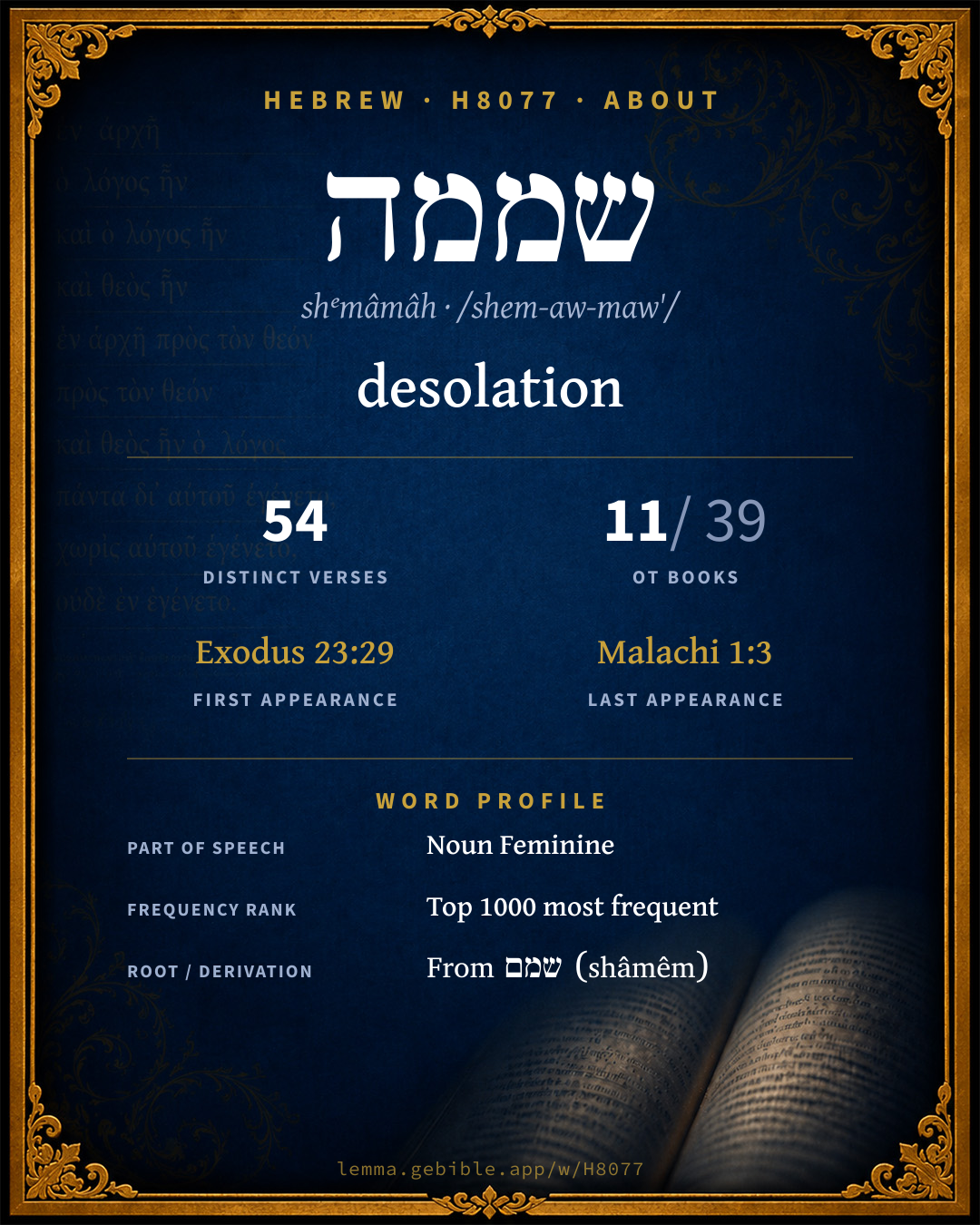
שממה
desolation
Full lexicon entry — Brown-Driver-Briggs (BDB)
From Brown-Driver-Briggs (BDB)
Where this word appears
See every Absolute-state word in the Hebrew Bible →
Grammar key — what these labels mean
Part of speech
- Noun
- A naming word — a person, place, thing, or idea.
- Verb
- An action or state-of-being word.
Noun type
- Common
- A common noun — a general class of person, place, or thing (“king,” “city,” “water”), not a specific name.
Stem
- Qal
- The basic, simple active stem — the plain form of the verb (“he wrote”).
Form
- Participle Active
- A verbal adjective expressing ongoing or characteristic action (“writing / one who writes”).
State
- Absolute
- The independent form of a noun, not bound to a following word.
- Construct
- A noun bound to a following noun in a possessive / “of” relationship (the construct chain).
Gender
- Feminine
- Grammatically feminine.
Number
- Singular
- One.
- Plural
- More than one (in Hebrew, generally three or more).
19 verses where H8077 appears in the Absolute state in the Book of Ezekiel. Filtered view — show all forms. Click any verse to open its interlinear word-by-word view. Verse text shown in the World English Bible for context — . Each verse’s Hebrew form is shown with its reference; the English is not keyword-highlighted, since the data carries no word-level English alignment. Use “Compare translations” on any verse to read it across multiple English versions. This concordance covers the Hebrew Bible; Septuagint (Greek Old Testament) occurrences are not indexed here.
Ezekiel
- Ezekiel 6:14 שְׁמָמָ֤ה n c fs I will stretch out my hand on them, and make the land desolate and waste, from the wilderness toward Diblah, throughout all their habitations: and they shall know that I am Yahweh.
- Ezekiel 7:27 שְׁמָמָ֔ה n c fs The king shall mourn, and the prince shall be clothed with desolation, and the hands of the people of the land shall be troubled: I will do to them after their way, and according to their deserts will I judge them; and they shall know that I am Yahweh.
- Ezekiel 12:20 שְׁמָמָ֣ה n c fs The cities that are inhabited shall be laid waste, and the land shall be a desolation; and you shall know that I am Yahweh.
- Ezekiel 14:15 שְׁמָמָה֙ n c fs If I cause evil animals to pass through the land, and they ravage it, and it be made desolate, so that no man may pass through because of the animals;
- Ezekiel 14:16 שְׁמָמָֽה n c fs though these three men were in it, as I live, says the Lord Yahweh, they should deliver neither sons nor daughters; they only should be delivered, but the land should be desolate.
- Ezekiel 15:8 שְׁמָמָ֑ה n c fs I will make the land desolate, because they have committed a trespass, says the Lord Yahweh.
- Ezekiel 23:33 וּ/שְׁמָמָ֔ה conj + n c fs You shall be filled with drunkenness and sorrow, with the cup of astonishment and desolation, with the cup of your sister Samaria.
- Ezekiel 29:9 לִ/שְׁמָמָ֣ה prep + n c fs The land of Egypt shall be a desolation and a waste; and they shall know that I am Yahweh. Because he has said, The river is mine, and I have made it;
- Ezekiel 29:10 שְׁמָמָ֔ה n c fs therefore, behold, I am against you, and against your rivers, and I will make the land of Egypt an utter waste and desolation, from the tower of Seveneh even to the border of Ethiopia.
- Ezekiel 29:12 שְׁמָמָ֜ה שְׁמָמָ֔ה n c fs n c fs I will make the land of Egypt a desolation in the midst of the countries that are desolate; and her cities among the cities that are laid waste shall be a desolation forty years; and I will scatter the Egyptians among the nations, and will disperse them through the countries.
- Ezekiel 32:15 שְׁמָמָ֣ה n c fs When I shall make the land of Egypt desolate and waste, a land destitute of that of which it was full, when I shall strike all those who dwell therein, then shall they know that I am Yahweh.
- Ezekiel 33:28 שְׁמָמָ֣ה n c fs I will make the land a desolation and an astonishment; and the pride of her power shall cease; and the mountains of Israel shall be desolate, so that none shall pass through.
- Ezekiel 33:29 שְׁמָמָ֣ה n c fs Then shall they know that I am Yahweh, when I have made the land a desolation and an astonishment, because of all their abominations which they have committed.
- Ezekiel 35:3 שְׁמָמָ֥ה n c fs and tell it, Thus says the Lord Yahweh: Behold, I am against you, Mount Seir, and I will stretch out my hand against you, and I will make you a desolation and an astonishment.
- Ezekiel 35:4 שְׁמָמָ֣ה n c fs I will lay your cities waste, and you shall be desolate; and you shall know that I am Yahweh.
- Ezekiel 35:7 לְ/שִֽׁמְמָ֖ה וּ/שְׁמָמָ֑ה prep + n c fs conj + n c fs Thus will I make Mount Seir an astonishment and a desolation; and I will cut off from it him who passes through and him who returns.
- Ezekiel 35:14 שְׁמָמָ֖ה n c fs Thus says the Lord Yahweh: When the whole earth rejoices, I will make you desolate.
- Ezekiel 35:15 שְׁמָמָ֨ה n c fs As you did rejoice over the inheritance of the house of Israel, because it was desolate, so will I do to you: you shall be desolate, Mount Seir, and all Edom, even all of it; and they shall know that I am Yahweh.
- Ezekiel 36:34 שְׁמָמָ֔ה n c fs The land that was desolate shall be tilled, whereas it was a desolation in the sight of all who passed by.
About this entry
At a glance — auto-summarized from this page’s data, not written by a person. Every figure links to its source below. This summary describes the numbers; it doesn’t interpret them.
The Hebrew noun שממה centers on the idea of “desolation.” First canonically at Exodus 23:29, it enters the text early. It turns up in 54 verses across 11 books, a moderately common footprint. The word gravitates to Ezekiel (37%), then Jeremiah and Isaiah. Dig into 54-verse concordance and the renderings breakdown below.
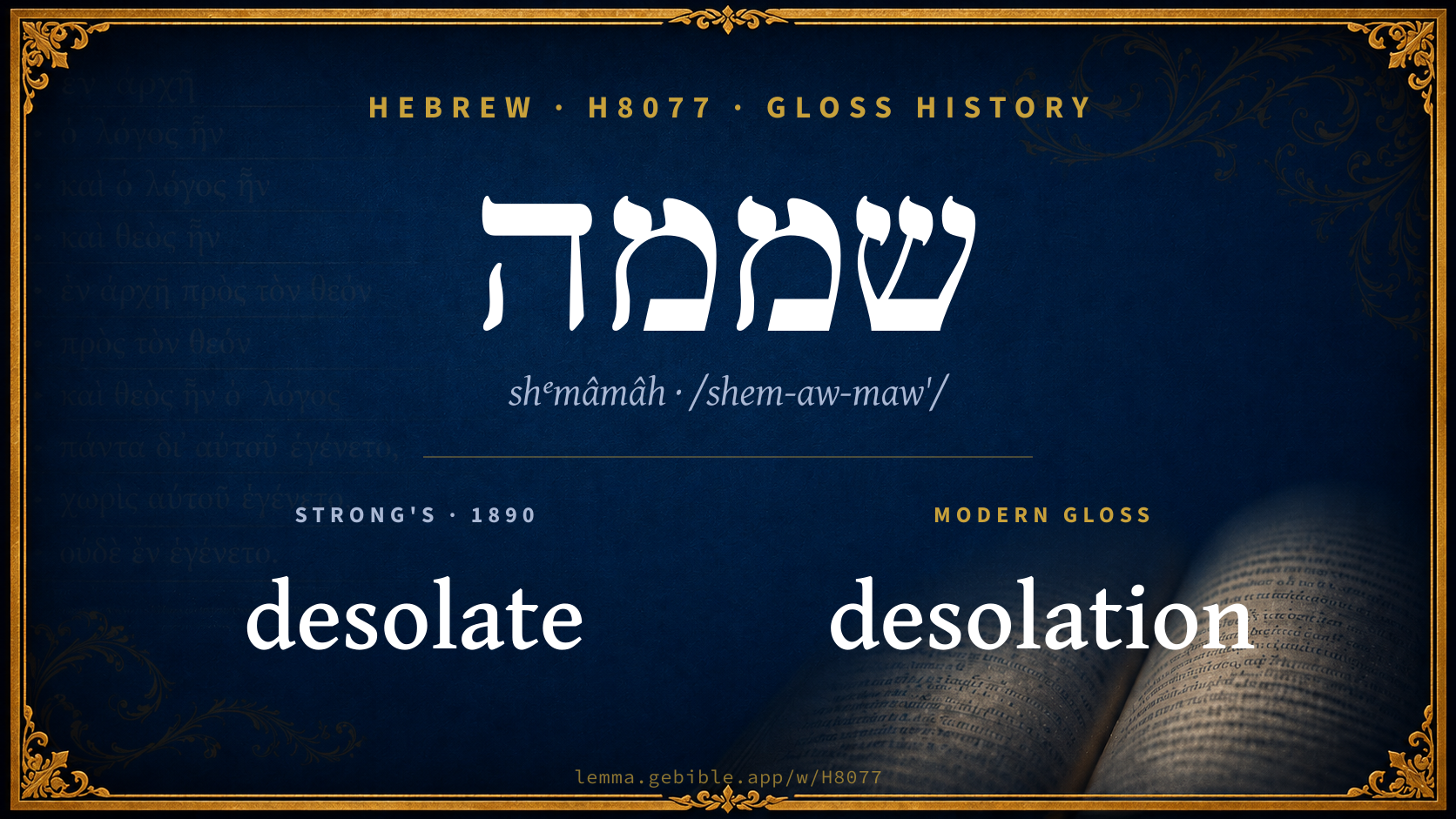
Gloss history
Strong's 1890 vs modern scholarship
About this word
Strong's H8077 catalogs a Hebrew word from the Hebrew Old Testament.
These counts are not copied from any lexicon or concordance. They are computed here, from the morphology-tagged Hebrew Old Testament. What Lemma adds →
- 54
- distinct verses
- The word appears in 54 distinct verses.
- 11 / 39
- OT books
- The word appears in 11 of 39 Old Testament books.
- #658
- by frequency
- Top 1000 most frequent Hebrew words (rank 658 of 8,640 Hebrew words by occurrence).
View all 54 occurrences in the concordance →
By section of the Old Testament
By traditional corpus
Conventional, traditional groupings — biblical authorship is debated, so this is a traditional corpus grouping, not an authorship claim. Each share is this word’s portion of its verses in that division of the Hebrew canon. Each figure is a share of the word’s 54 distinct verses.
- Prophets (Nevi'im) 51 verses · 94%
- Torah (Pentateuch) 2 verses · 4%
- Writings (Ketuvim) 1 verse · 2%
How translations render this word
Counts come from each version’s own published word-to-Strong’s tagging or interlinear alignment — an approximate guide to how each version renders this word, not a word-level alignment the data otherwise carries. Because each total is that version’s own tagged count, the per-version totals vary from one another and need not match the appearance or distinct-verse counts above. These counts may also differ from a printed concordance because Lemma counts each distinctly tagged rendering and does not collapse phrase taggings into a single head-word total. This is a fixed set of word-tagged versions (KJV, ASV, BSB, ULT) and does not change with the reading translation you choose elsewhere. Each version’s license is shown beside its name below (and on Sources).
BDB lists this Strong’s number as 2 distinct words (homographs). Each count above pools all of them and is not split by sense — see the Senses section below. A low-frequency rendering may belong to a different one of those words, not the primary meaning.
- King James Version†: Desolate 17×, Desolation 10×, Shall be desolate 8×
- American Standard Version†: Desolation 19×, Desolate 9×, Shall be a desolation 6×
- Berean Standard Bible†: Desolate 24×, Desolation 18×, Wasteland 4×
- unfoldingWord Literal Text†: Desolation 22×, Desolate 5×, Devastation 4×
King James Version Public Domain
Renders H8077 across 57† tagged occurrences — most commonly:
Plus 12 renderings that appear only once — usually multi-word phrases or single function words the recovered tagging swept in, not distinct renderings. Not rendered by a distinct English word in 1 further occurrence.
American Standard Version Public Domain
Renders H8077 across 61† tagged occurrences — most commonly:
Plus 19 renderings that appear only once — usually multi-word phrases or single function words the recovered tagging swept in, not distinct renderings.
Berean Standard Bible Public Domain
Renders H8077 across 56† tagged occurrences — most commonly:
Plus 10 renderings that appear only once — usually multi-word phrases or single function words the recovered tagging swept in, not distinct renderings. Not rendered by a distinct English word in 1 further occurrence.
unfoldingWord Literal Text CC BY-SA 4.0
Renders H8077 across 51† tagged occurrences — most commonly:
Plus 10 renderings that appear only once — usually multi-word phrases or single function words the recovered tagging swept in, not distinct renderings.
Senses in BDB
The 1 sense BDB distinguishes for this word, in lexicon order (not ranked by frequency or importance). The full entry — with sub-senses — is in the Lexicon Entry tab.
- devastation, waste, desolation
Word origin
I. n.f. a devastation, waste;—abs. שׁ׳ Ex 23:29 +; pl. cstr. שִׁמְמוֹת Je 51:26 +;—waste, usually of land, city, houses, etc., Ex 23:29 (E), Is 1:7 (prob. del., with words foll. StuJPTh. 1877, 714 FBJBL (1890), 84), Lv 26:33 (H), Je 4:27 + 14 times Je (‖ מֵאֵין אָדָם וגו׳ 32:43, מֵאֵין ישֵׁב 34:22), Ez 6:14 + 18 times Ez (35:7a read שְׁמָמָה וּמְשַׁמָּה for MT שִֽׁמְמָה וּשְׁמָמָה, so Hi Co Toy Krae al.) +; of prince, יִלְבַּשׁ שׁ׳ Ez 7:27; of idols Mi 1:7; כּוֹס שַׁמָּה וּשׁ׳ Ez 23:33.—Ez 35:12 v. שׁמם Qal.
I. Ez 35:7 v. foregoing.
— Brown-Driver-Briggs (Oxford 1906, public domain), digitized via Sefaria, supplemented by the OpenScriptures HebrewLexicon (CC BY 4.0). See Sources.
Derived from שמם (shâmêm) (H8076) — desolate.
Jastrow Dictionary
A second Hebrew/Aramaic lexicon for comparison, covering Aramaic and post-biblical (Talmudic, Targumic, Midrashic) usage that the biblical-Hebrew BDB does not. Matched by lemma rather than by Strong’s number, so a lemma may carry more than one Jastrow headword (shown separately below), and the entries cover usage well beyond the Bible.
שְׁמָמָה
- preced. wds.) waste, desolation. M. Kat. 17ᵃ, v. שַׁמְתָּא.—Pl. שְׁמָמוֹת, constr. שִׁמְמוֹת. Cant. R. to III, 4 (ref. to Is. XXI, 1) דרך ש׳ מדבר בא he (Nebuchadnezzar) came by the way of the deserts of the wilderness. Lam. R. introd., end (in an obscure passage) מש׳ הארץ from the deserts of the land. e.g. Isaiah 21:1
A Dictionary of the Targumim, the Talmud Babli and Yerushalmi, and the Midrashic Literature (Marcus Jastrow; London, Luzac, 1903) — Public Domain. Digitized via Sefaria. Digitized via Sefaria. Full attribution on Sources.
Forms in the corpus
The 23 distinct written forms H8077 takes in the Hebrew Bible, most frequent first — each parse links to that state’s occurrences in the concordance. Hebrew forms include their vowel points and cantillation, so a single lemma takes many written forms.
Septuagint verse parallels
This word appears in 50 verses that also exist in the Greek Old Testament (Septuagint), out of the 54 Hebrew verses it occurs in. You can read those verses in Greek by switching the Old Testament edition to the Septuagint.
Read these verses in the Septuagint
- Exodus 23:29
- Leviticus 26:33
- Joshua 8:28
- Isaiah 1:7
- Jeremiah 4:27
- Ezekiel 6:14
- Daniel 9:18
- Joel 2:3
- Micah 1:7
- Zephaniah 1:13
- Malachi 1:3
This is a verse-level parallel only — the same verses exist in both the Hebrew and Greek Old Testaments. No word-level Hebrew↔Greek correspondence is claimed: the data carries no such alignment, so no Greek word is shown as this Hebrew word’s translation. Coverage is not total — the Septuagint omits the deuterocanon and renumbers the Psalms, so some Hebrew verses have no direct Greek parallel.