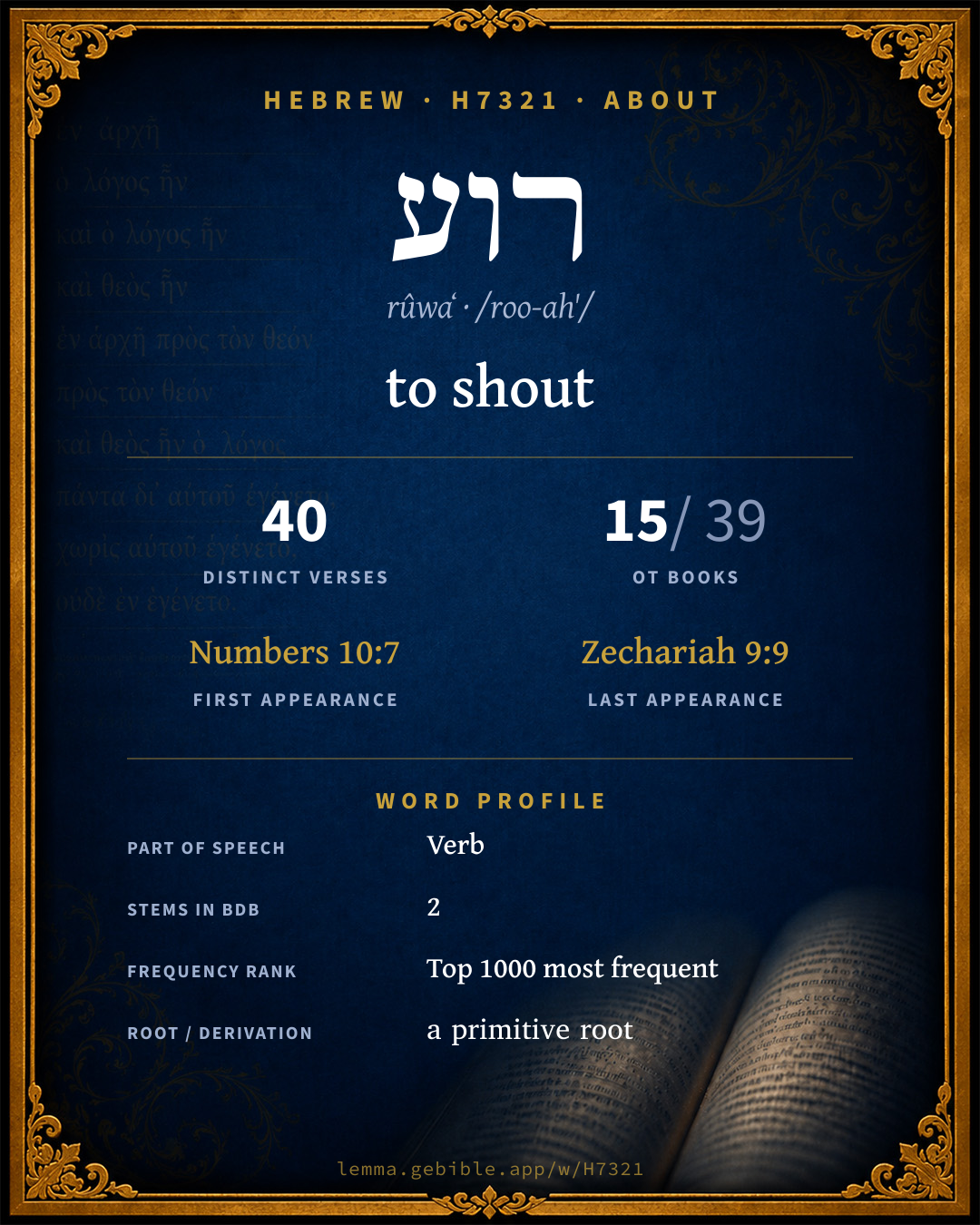
רוּעַ
to shout
also: raise a sound, cry out, give a blast fuller range ↓
Full lexicon entry — Brown-Driver-Briggs (BDB)
From Brown-Driver-Briggs (BDB)
Where this word appears
See every Hiphil verb in the Hebrew Bible →
Grammar key — what these labels mean
Part of speech
- Verb
- An action or state-of-being word.
Stem
- Hiphil
- The causative active stem (“he caused / brought about”).
- Polal
- The passive counterpart of the Polel.
- Hithpolel
- The reflexive counterpart of the Polel.
Form
- Imperative
- A direct command (“write!”).
- Sequential Imperfect
- An imperfect with prefixed waw — the standard past-narrative form (waw-consecutive imperfect).
- Imperfect
- An incomplete, ongoing, or future action (“he will / would write”).
- Sequential Perfect
- A perfect with prefixed waw continuing a preceding imperfect or command (waw-consecutive perfect).
- Infinitive Construct
- A bound verbal noun, frequently with prepositions (“to write / in writing”).
- Cohortative
- A first-person volitional form expressing wish or resolve (“let me / let us write”).
- Perfect
- A completed action or state — Hebrew marks aspect (completeness) more than strict tense (“he wrote”).
- Participle Active
- A verbal adjective expressing ongoing or characteristic action (“writing / one who writes”).
State
- Absolute
- The independent form of a noun, not bound to a following word.
Person
- 2nd Person
- The one addressed (“you”).
- 3rd Person
- The one spoken about (“he / she / it / they”).
- 1st Person
- The speaker (“I / we”).
Gender
- Masculine
- Grammatically masculine.
- Common
- Either gender — not distinguished for this form.
- Feminine
- Grammatically feminine.
Number
- Plural
- More than one (in Hebrew, generally three or more).
- Singular
- One.
36 distinct verses where H7321 appears in the Hiphil stem, across 15 books. Filtered view — show all forms. Click any verse to open its interlinear word-by-word view. Verse text shown in the World English Bible for context — . Each verse’s Hebrew form is shown with its reference; the English is not keyword-highlighted, since the data carries no word-level English alignment. Use “Compare translations” on any verse to read it across multiple English versions. This concordance covers the Hebrew Bible; Septuagint (Greek Old Testament) occurrences are not indexed here.
Numbers 2 verses
- Numbers 10:7 תָרִֽיעוּ Hiphil impf 2mp But when the assembly is to be gathered together, you shall blow, but you shall not sound an alarm.
- Numbers 10:9 וַ/הֲרֵעֹתֶ֖ם conj + Hiphil wpf 2mp When you go to war in your land against the adversary who oppresses you, then you shall sound an alarm with the trumpets; and you shall be remembered before Yahweh your God, and you shall be saved from your enemies.
Joshua 4 verses
- Joshua 6:5 יָרִ֥יעוּ Hiphil impf 3mp It shall be that when they make a long blast with the ram's horn, and when you hear the sound of the trumpet, all the people shall shout with a great shout; and the wall of the city shall fall down flat, and the people shall go up every man straight before him.
- Joshua 6:10 תָרִ֨יעוּ֙ הָרִ֖יעוּ וַ/הֲרִיעֹתֶֽם Hiphil impf 2mp Hiphil impv 2mp conj + Hiphil wpf 2mp Joshua commanded the people, saying, You shall not shout, nor let your voice be heard, neither shall any word proceed out of your mouth, until the day I bid you shout; then shall you shout.
- Joshua 6:16 הָרִ֔יעוּ Hiphil impv 2mp It happened at the seventh time, when the priests blew the trumpets, Joshua said to the people, Shout; for Yahweh has given you the city.
- Joshua 6:20 וַ/יָּ֣רַע וַ/יָּרִ֤יעוּ conj + Hiphil wimpf 3ms conj + Hiphil wimpf 3mp So the people shouted, and [the priests] blew the trumpets; and it happened, when the people heard the sound of the trumpet, that the people shouted with a great shout, and the wall fell down flat, so that the people went up into the city, every man straight before him, and they took the city.
Judges 2 verses
- Judges 7:21 וַ/יָּרִ֖יעוּ conj + Hiphil wimpf 3mp They stood every man in his place round about the camp; and all the host ran; and they shouted, and put [them] to flight.
- Judges 15:14 הֵרִ֣יעוּ Hiphil pf 3cp When he came to Lehi, the Philistines shouted as they met him: and the Spirit of Yahweh came mightily on him, and the ropes that were on his arms became as flax that was burnt with fire, and his bands dropped from off his hands.
1 Samuel 4 verses
- 1 Samuel 4:5 וַ/יָּרִ֥עוּ conj + Hiphil wimpf 3mp When the ark of the covenant of Yahweh came into the camp, all Israel shouted with a great shout, so that the earth rang again.
- 1 Samuel 10:24 וַ/יָּרִ֧עוּ conj + Hiphil wimpf 3mp Samuel said to all the people, "You see him whom Yahweh has chosen, that there is none like him among all the people?" All the people shouted, and said, [Long] live the king.
- 1 Samuel 17:20 וְ/הֵרֵ֖עוּ conj + Hiphil pf 3cp David rose up early in the morning, and left the sheep with a keeper, and took, and went, as Jesse had commanded him; and he came to the place of the wagons, as the host which was going forth to the fight shouted for the battle.
- 1 Samuel 17:52 וַ/יָּרִ֗עוּ conj + Hiphil wimpf 3mp The men of Israel and of Judah arose, and shouted, and pursued the Philistines, until you come to Gai, and to the gates of Ekron. The wounded of the Philistines fell down by the way to Shaaraim, even to Gath, and to Ekron.
2 Chronicles 2 verses
- 2 Chronicles 13:12 לְ/הָרִ֣יעַ prep + Hiphil inf.cs Behold, God is with us at our head, and his priests with the trumpets of alarm to sound an alarm against you. Children of Israel, don't you fight against Yahweh, the God of your fathers; for you shall not prosper.
- 2 Chronicles 13:15 וַ/יָּרִ֖יעוּ בְּ/הָרִ֨יעַ֙ conj + Hiphil wimpf 3mp prep + Hiphil inf.cs Then the men of Judah gave a shout: and as the men of Judah shouted, it happened, that God struck Jeroboam and all Israel before Abijah and Judah.
Ezra 2 verses
- Ezra 3:11 הֵרִיעוּ֩ Hiphil pf 3cp They sang one to another in praising and giving thanks to Yahweh, [saying], For he is good, for his loving kindness endures forever toward Israel. All the people shouted with a great shout, when they praised Yahweh, because the foundation of the house of Yahweh was laid.
- Ezra 3:13 מְרִיעִים֙ Hiphil ptcp.act mp so that the people could not discern the noise of the shout of joy from the noise of the weeping of the people; for the people shouted with a loud shout, and the noise was heard afar off.
Job 2 verses
Psalms 9 verses
- Psalms 41:11 יָרִ֖יעַ Hiphil impf 3ms By this I know that you delight in me, Because my enemy doesn't triumph over me.
- Psalms 47:1 הָרִ֥יעוּ Hiphil impv 2mp Oh clap your hands, all you nations. Shout to God with the voice of triumph!
- Psalms 66:1 הָרִ֥יעוּ Hiphil impv 2mp Make a joyful shout to God, all the earth!
- Psalms 81:1 הָ֝רִ֗יעוּ Hiphil impv 2mp Sing aloud to God, our strength! Make a joyful shout to the God of Jacob!
- Psalms 95:1 נָ֝רִ֗יעָה Hiphil coh 1cp Oh come, let's sing to Yahweh. Let's shout aloud to the rock of our salvation!
- Psalms 95:2 נָרִ֥יעַֽ Hiphil coh 1cp Let's come before his presence with thanksgiving. Let's extol him with songs!
- Psalms 98:4 הָרִ֣יעוּ Hiphil impv 2mp Make a joyful noise to Yahweh, all the earth! Burst out and sing for joy, yes, sing praises!
- Psalms 98:6 הָ֝רִ֗יעוּ Hiphil impv 2mp With trumpets and sound of the ram's horn, Make a joyful noise before the King, Yahweh.
- Psalms 100:1 הָרִ֥יעוּ Hiphil impv 2mp Shout for joy to Yahweh, all you lands!
Isaiah 3 verses
- Isaiah 15:4 יָרִ֔יעוּ Hiphil impf 3mp Heshbon cries out, and Elealeh; their voice is heard even to Jahaz: therefore the armed men of Moab cry aloud; his soul trembles within him.
- Isaiah 42:13 יָרִ֨יעַ֙ Hiphil impf 3ms Yahweh will go forth as a mighty man; he will stir up [his] zeal like a man of war: he will cry, yes, he will shout aloud; he will do mightily against his enemies.
- Isaiah 44:23 הָרִ֨יעוּ֙ Hiphil impv 2mp Sing, you heavens, for Yahweh has done it; shout, you lower parts of the earth; break forth into singing, you mountains, O forest, and every tree therein: for Yahweh has redeemed Jacob, and will glorify himself in Israel.
Jeremiah 1 verse
Hosea 1 verse
Joel 1 verse
Micah 1 verse
Zephaniah 1 verse
Zechariah 1 verse
About this entry
At a glance — auto-summarized from this page’s data, not written by a person. Every figure links to its source below. This summary describes the numbers; it doesn’t interpret them.
“to shout” is the headline sense of the Hebrew verb רוע (rûwaʻ). Where the King James Version says “shouted,” newer translations reach for “shout” (Berean Standard Bible); the renderings breakdown has the detail. The Hebrew Bible uses it across 40 verses — moderately common. More than a quarter of its appearances fall in Psalms. Not a single-sense word: its full sense range also takes in “raise a sound”, “cry out”, and “give a blast”. The sections below give every sense, occurrence, and version rendering.
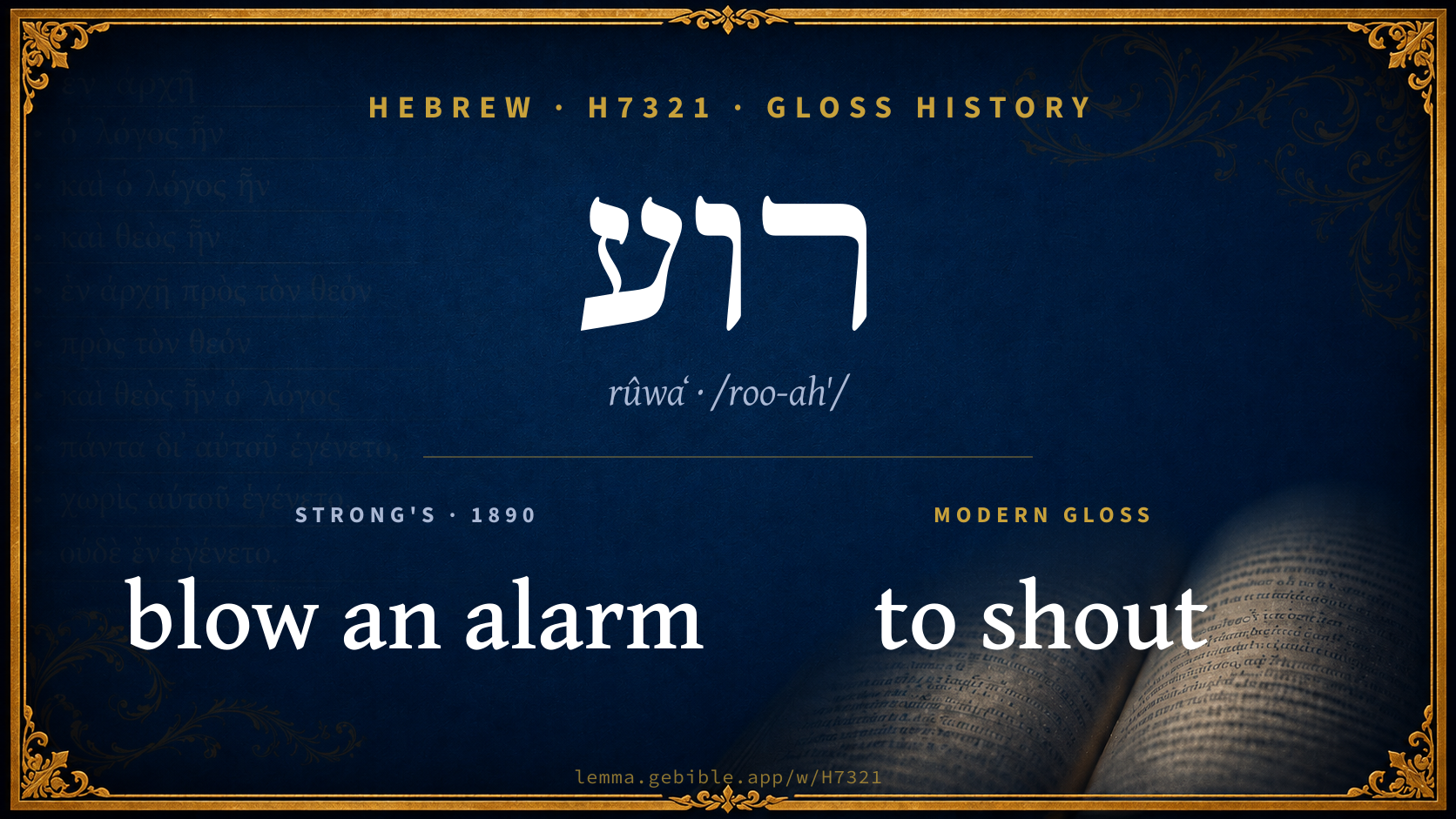
Gloss history
Strong's 1890 vs modern scholarship
About this word
Strong's H7321 catalogs a Hebrew word from the Hebrew Old Testament.
These counts are not copied from any lexicon or concordance. They are computed here, from the morphology-tagged Hebrew Old Testament. What Lemma adds →
- 40
- distinct verses
- The word appears in 40 distinct verses.
- 15 / 39
- OT books
- The word appears in 15 of 39 Old Testament books.
- #819
- by frequency
- Top 1000 most frequent Hebrew words (rank 819 of 8,640 Hebrew words by occurrence).
View all 40 occurrences in the concordance →
By section of the Old Testament
By traditional corpus
Conventional, traditional groupings — biblical authorship is debated, so this is a traditional corpus grouping, not an authorship claim. Each share is this word’s portion of its verses in that division of the Hebrew canon. Each figure is a share of the word’s 40 distinct verses.
- Prophets (Nevi'im) 20 verses · 50%
- Writings (Ketuvim) 18 verses · 45%
- Torah (Pentateuch) 2 verses · 5%
How translations render this word
Counts come from each version’s own published word-to-Strong’s tagging or interlinear alignment — an approximate guide to how each version renders this word, not a word-level alignment the data otherwise carries. Because each total is that version’s own tagged count, the per-version totals vary from one another and need not match the appearance or distinct-verse counts above. These counts may also differ from a printed concordance because Lemma counts each distinctly tagged rendering and does not collapse phrase taggings into a single head-word total. This is a fixed set of word-tagged versions (KJV, ASV, BSB, ULT) and does not change with the reading translation you choose elsewhere. Each version’s license is shown beside its name below (and on Sources).
- King James Version: Shouted 11×, Make a joyful noise 6×, Shout 6×
- American Standard Version: Shouted 10×, Shout 6×, Make a joyful noise 5×
- Berean Standard Bible: Shout 8×, Make a joyful noise 4×, Shouted 3×
- unfoldingWord Literal Text: Shout 14×, Shouted 7×, And 5×
King James Version Public Domain
Renders H7321 across 46 tagged occurrences — most commonly:
Plus 23 renderings that appear only once — usually multi-word phrases or single function words the recovered tagging swept in, not distinct renderings.
American Standard Version Public Domain
Renders H7321 across 49 tagged occurrences — most commonly:
Plus 23 renderings that appear only once — usually multi-word phrases or single function words the recovered tagging swept in, not distinct renderings.
Berean Standard Bible Public Domain
Renders H7321 across 44 tagged occurrences — most commonly:
Plus 25 renderings that appear only once — usually multi-word phrases or single function words the recovered tagging swept in, not distinct renderings.
unfoldingWord Literal Text CC BY-SA 4.0
Renders H7321 across 55 tagged occurrences — most commonly:
Plus 21 renderings that appear only once — usually multi-word phrases or single function words the recovered tagging swept in, not distinct renderings.
Senses in the full BDB
Hebrew verbs can shift meaning by stem (binyan): Qal is the basic action, Niphal is often passive or reflexive, Piel often intensifies or makes it factitive, and Hiphil is typically causative. The senses below are grouped under the stem BDB assigns to each. This entry also uses one or more reduplicated stems (the Pōlēl/Pilpēl type), which for hollow or geminate roots behave much like Piel — often intensive or iterative.
What do BDB’s symbols mean?
BDB uses these scholarly abbreviations:
| Symbol | Meaning |
|---|---|
| 𝔊 | the Septuagint (the ancient Greek translation, LXX) |
| 𝔙 | the Vulgate (the Latin translation) |
| 𝔖 | the Syriac version (the Peshitta) |
| 𝔗 | the Targum (the Aramaic translation) |
| ψ | the Psalms |
| √ | root (the underlying root or stem) |
| ‖ | parallel passage (a synonymous or contrasted parallel) |
| † | the dagger: every passage where the word occurs is cited |
The 3 senses and sub-senses the full Brown-Driver-Briggs lexicon distinguishes for this word, in lexicon order (not ranked by frequency), with BDB’s own verbatim wording and sub-sense lettering. Shown in Hebrew script with BDB’s own scholarly abbreviations. The condensed entry is in the Lexicon Entry tab. See also the Forms in the corpus table below.
Pō‛lal
- . a shout shall not be uttered
Hithpō‛l
- 1. shout in triumph
- 2. shout for joy
Senses from the full Brown-Driver-Briggs lexicon (Brown, Driver, Briggs; Oxford 1906 — public domain), digitized via Sefaria, supplemented by the OpenScriptures HebrewLexicon (CC BY 4.0). Full attribution on Sources.
Word origin
[ רוּעַ ] vb. Hiph. 40 1. raise a shout. 2. give a blast with clarion or horn
— Brown-Driver-Briggs (Oxford 1906, public domain), digitized via Sefaria, supplemented by the OpenScriptures HebrewLexicon (CC BY 4.0). See Sources.
Origin: a primitive root
Jastrow Dictionary
A second Hebrew/Aramaic lexicon for comparison, covering Aramaic and post-biblical (Talmudic, Targumic, Midrashic) usage that the biblical-Hebrew BDB does not. Matched by lemma rather than by Strong’s number, so a lemma may carry more than one Jastrow headword (shown separately below), and the entries cover usage well beyond the Bible.
רוּעַ I
- to strike against; to shake.
- (cmp. תָּקַע) to produce a tremulous sound; (b. h. also to shout); to blow the horn. Sot. 42ᵇ מגיפין ומְרִיעִין וכ׳ the gentile troops shut their cuirasses with noise, blow their horns, shout and tramp; Yalk. Deut. 923; a. e.—Esp. to sound a תְּרוּעָה, to blow tremolo. Succ. V, 4 תקעו והֵרִיעוּ ותקעו they sounded the plain note (תקיעה), and the tremolo, and the plain note. R. Hash. IV, 9 תוקע ומֵרִיעַ וכ׳ he sounds a T’ḳiʿa, a Truʿah &c. Ib. 16ᵃ sq. למה תוקעין ומריעין וכ׳ why do we blow the Shofar in plain notes and tremolo while seated and then again while standing? Taan. 16ᵇ (at a public fast) חזן … הָרִיעוּ בני אהרן הֵרִיעוּ the superintendent of the prayer meeting says, sound the Truʿah, sons of Aaron; they do so. R. Hash. 16ᵇ כל שנה … מריעין לה בסופה if people neglect to sound the Shofar in the beginning of the year (on New Year’s Day), they will sound the Truʿah for it at its end (on public fast days on account of calamities); a. fr.—V. תָּרע.
רוּעַ II
- (preced.) to shake; to be weak, bad, v. רָעַע.
A Dictionary of the Targumim, the Talmud Babli and Yerushalmi, and the Midrashic Literature (Marcus Jastrow; London, Luzac, 1903) — Public Domain. Digitized via Sefaria. Digitized via Sefaria. Full attribution on Sources.
Forms in the corpus
The 37 distinct written forms H7321 takes in the Hebrew Bible, most frequent first — each parse links to that stem’s occurrences in the concordance. Hebrew forms include their vowel points and cantillation, so a single lemma takes many written forms.
Same root — word family
Other BDB entries built from the same root as H7321, grouped by Strong’s listed origin. These share a root / origin per the lexicon — not necessarily a shared meaning. Each links to that word’s own entry.
Derived from this word
Compare all same-root words → They share a root, not necessarily a meaning.
Septuagint verse parallels
This word appears in 38 verses that also exist in the Greek Old Testament (Septuagint), out of the 40 Hebrew verses it occurs in. You can read those verses in Greek by switching the Old Testament edition to the Septuagint.
Read these verses in the Septuagint
- Numbers 10:7
- Joshua 6:5
- Judges 7:21
- 1 Samuel 4:5
- 2 Chronicles 13:12
- Ezra 3:11
- Job 30:5
- Psalms 41:11
- Isaiah 15:4
- Hosea 5:8
- Joel 2:1
- Micah 4:9
This is a verse-level parallel only — the same verses exist in both the Hebrew and Greek Old Testaments. No word-level Hebrew↔Greek correspondence is claimed: the data carries no such alignment, so no Greek word is shown as this Hebrew word’s translation. Coverage is not total — the Septuagint omits the deuterocanon and renumbers the Psalms, so some Hebrew verses have no direct Greek parallel.