
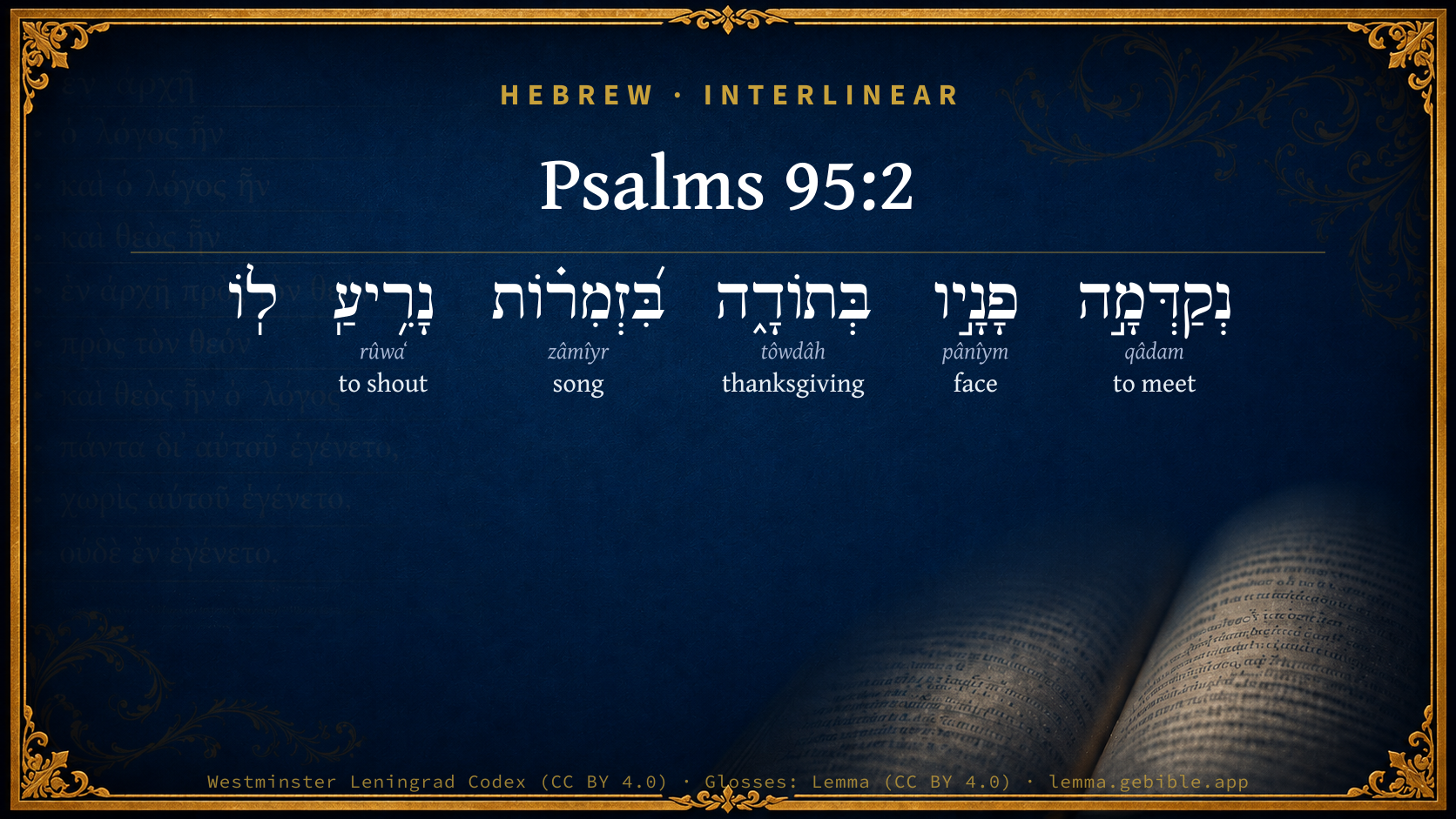
Psalms 95:2

Hebrew (Westminster Leningrad Codex) Psalms 95:2 appears in the Hebrew Old Testament. The text above is from the Westminster Leningrad Codex. Each word links to its Strong’s number, a concise gloss, and parsing drawn from the Open Scriptures Hebrew Bible morphology. Click any word for its full Brown-Driver-Briggs (BDB) entry.
Download image
Cite this verse

Psalms 95:2 (World English Bible). Public Domain. Lemma interlinear Bible study tool, https://lemma.gebible.app/v/psalms/95/2.

Show BibTeX & RIS
BibTeX
RIS
English Translation
Let's come before his presence with thanksgiving. Let's extol him with songs!
World English Bible · Public Domain
Download a study sheet

One document with this verse’s original text, its word-by-word gloss line, the meaning frame, cross-references with their text, attributed commentary, and full source and license credits — printable, and it pastes into notes with its structure intact.

This verse Autodidact and up

Study sheet (.html) Plain text (.txt)

A passage Seminary Student

Up to 50 verses in one chapter. A passage sheet keeps up to 6 commentary sources and 12 cross-references per verse, in the order this page ranks them, and says so on the sheet whenever that leaves anything out. Ask for a single verse and you get the Autodidact verse sheet above.

Everything on this page stays free to read, with no account — the sheet is a download of what is already on screen, not access to it.

Want to remove ads? Support Godless Engineer
Compare translations 3

The same verse in 3 English versions, stacked beneath the original-language interlinear above. Click any original word for its lexicon entry.

Each is an independent rendering of the whole verse — the interlinear is not word-aligned to these translations.

Highlighted words mark where these versions differ — a whole-verse word diff, not a word-by-word alignment.

  • World English Bible Public Domain
    Let's come before his presence with thanksgiving. Let's extol him with songs!
  • King James Version Public Domain
    Let us come before his presence with thanksgiving, and make a joyful noise unto him with psalms.
  • unfoldingWord Literal Text CC BY-SA 4.0
    Let us meet his face with thanksgiving; with psalms, let us sing joyfully to him.

unfoldingWord Literal Text — © unfoldingWord, licensed CC BY-SA 4.0. Word-aligned USFM3 via Door43 (git.door43.org/unfoldingWord/en_ult).

Versions to compare (up to 4)

3 of 4 selected

Show all 18 translations

Every available English version of this verse, each an independent rendering of the whole verse.

  • World English Bible Public Domain
    Let's come before his presence with thanksgiving. Let's extol him with songs!
  • Berean Standard Bible Public Domain
    Let us enter His presence with thanksgiving; let us make a joyful noise to Him in song.
  • Majority Standard Bible Public Domain
    Let us enter His presence with thanksgiving; let us make a joyful noise to Him in song.
  • King James Version Public Domain
    Let us come before his presence with thanksgiving, and make a joyful noise unto him with psalms.
  • American Standard Version (1901) Public Domain
    Let us come before his presence with thanksgiving; Let us make a joyful noise unto him with psalms.
  • Revised Version (1885) Public Domain
    Let us come before his presence with thanksgiving, let us make a joyful noise unto him with psalms.
  • Geneva Bible (1599) Public Domain
    Let vs come before his face with praise: let vs sing loude vnto him with Psalmes.
  • Douay-Rheims (1899) Public Domain
    Let us come before his presence with thanksgiving; and make a joyful noise to him with psalms.
  • Young's Literal Translation Public Domain
    We come before His face with thanksgiving, With psalms we shout to Him.
  • Literal Standard Version CC BY-SA 4.0
    We come before His face with thanksgiving, || We shout to Him with psalms.
  • Unlocked Literal Bible CC BY-SA 4.0
    Let us enter his presence with thanksgiving; let us sing to him with psalms of praise.
  • unfoldingWord Literal Text CC BY-SA 4.0
    Let us meet his face with thanksgiving; with psalms, let us sing joyfully to him.
  • Darby Bible Public Domain
    Let us come before his face with thanksgiving; let us shout aloud unto him with psalms.
  • World Messianic Bible Public Domain
    Let’s come before his presence with thanksgiving. Let’s extol him with songs!
  • Webster's Bible Public Domain
    Let us come before his presence with thanksgiving, and make a joyful noise to him with psalms.
  • Free Bible Version CC BY-SA 4.0
    Let's go before him with thanksgiving! Let's sing loudly to him in celebration!
  • Bible in Basic English Public Domain
    Let us come before his face with praises; and make melody with holy songs.
  • JPS Tanakh (1917) Public Domain
    Let us come before His presence with thanksgiving, let us shout for joy unto Him with psalms.

Literal Standard Version (2020), Covenant Press — licensed CC BY-SA 4.0. Text via the HelloAO Bible API (eBible.org). Unlocked Literal Bible (unfoldingWord) — licensed CC BY-SA 4.0. Text via the HelloAO Bible API (eBible.org). unfoldingWord Literal Text — © unfoldingWord, licensed CC BY-SA 4.0. Word-aligned USFM3 via Door43 (git.door43.org/unfoldingWord/en_ult). Free Bible Version, Dr. Jonathan Gallagher — licensed CC BY-SA 4.0. Text via the HelloAO Bible API (eBible.org).

Word by word

More ways to search: Search by grammar → Find every occurrence → Compare this word →

Practice this passage: Drill this verse → Learn its vocabulary →

About this verse

These counts appear in no published source. They are computed here, from the morphology-tagged text and Lemma’s own curated glosses. What Lemma adds →

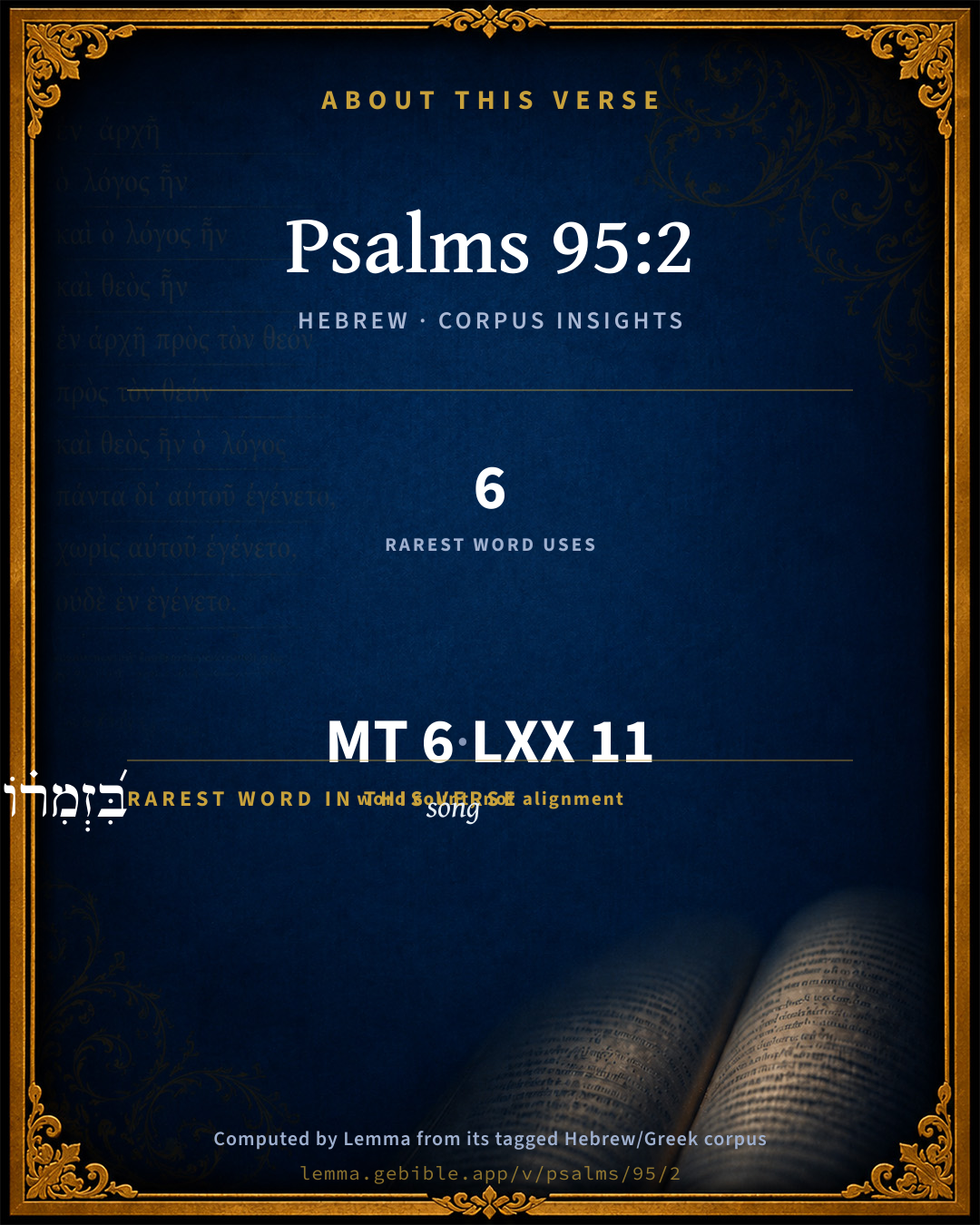
6
words
5
distinct lemmas
Wisdom
section

Notable vocabulary

The rarest word here is בִּ֝זְמִר֗וֹת song H2158 — appearing just 6 times in the whole Hebrew Bible.

Shared distinctive vocabulary

בִּ֝זְמִר֗וֹת song H2158 occurs in 6 verses of the Hebrew Bible. Also found in:

Grammatical profile

  • 2 verbs
  • 3 nouns
  • 1 preposition

Verb forms

  • נְקַדְּמָ֣ה Piel · Cohortative
  • נָרִ֥יעַֽ Hiphil · Cohortative

Hebrew & Septuagint length

In English translation the verse runs 12 words from the Hebrew and 17 from the Septuagint (LXX English) — closely comparable.

A rough comparison of the two English renderings, which tokenize alike — not a word-level alignment.

Word counts can differ between the Hebrew and the Greek without any difference in meaning — e.g. the Hebrew direct-object marker אֵת has no separate Greek word, and Greek often adds the article ὁ.

In the original languages it is 6 Hebrew tokens and 11 Greek tokens — but the two are counted differently (Hebrew bundles its prefixes and suffixes into one token; the Greek is in lemma form), so that isn’t a like-for-like length.

Cross-references

10

Topical passages linked to Psalms 95:2 in the Treasury of Scripture Knowledge — connected by theme and wording, ordered by reader-vote popularity; previews shown in the World English Bible.

  • Psalms 100:4 Enter into his gates with thanksgiving, Into his courts with praise. Give thanks to him, and bless his name.
  • Ephesians 5:19 speaking to one another in psalms, hymns, and spiritual songs; singing, and singing praises in your heart to the Lord;
  • Psalms 105:2 Sing to him, sing praises to him! Tell of all his marvelous works.
  • Jeremiah 31:12–13 They shall come and sing in the height of Zion, and shall flow to the goodness of Yahweh, to the grain, and to the new wine, and to the oil, and to the young of the flock and of the herd: and their soul shall be as a watered garden; and they shall not sorrow any more at all.
  • Micah 6:6 How shall I come before Yahweh, And bow myself before the exalted God? Shall I come before him with burnt offerings, With calves a year old?
  • Psalms 17:13 Arise, Yahweh, Confront him, cast him down. Deliver my soul from the wicked by your sword;
  • Psalms 100:2 Serve Yahweh with gladness. Come before his presence with singing.
  • Psalms 7:7 Let the congregation of the peoples surround you. Rule over them on high.
  • James 5:13 Is any among you suffering? Let him pray. Is any cheerful? Let him sing praises.
  • Psalms 81:2 Raise a song, and bring here the tambourine, The pleasant lyre with the harp.

Cross-references courtesy of OpenBible.info (CC BY 4.0).

Hebrew and Greek witnesses Masoretic Hebrew ↔ Greek Septuagint

The same verse in the two great witnesses to the Old Testament, shown verse-for-verse.

You’re reading Greek Psalm 94 (Hebrew Psalm 95). The Septuagint counts the superscription, so verse numbers can differ from the Hebrew — chapter-level alignment, not verse-by-verse. Numbering follows Rahlfs.

These are two independent witnesses, not word-aligned to each other, and the Septuagint is shown in lemma (dictionary) form.

Hebrew Psalms 95:2 Masoretic · Westminster Leningrad Codex

נְקַדְּמָ֣ה פָנָ֣יו בְּתוֹדָ֑ה בִּ֝זְמִר֗וֹת נָרִ֥יעַֽ לֽוֹ

Let's come before his presence with thanksgiving. Let's extol him with songs!

World English Bible · Public Domain

Greek LXX Greek Psalm 94:2 Septuagint · lemma form

προφθάνω ὁ πρόσωπον αὐτός ἐν ἐξομολόγησις καί ἐν ψαλμός ἀλαλάζω αὐτός

Let us come before his presence with thanksgiving, and make a joyful noise to him with psalms.

LXX2012 (modern English Septuagint) · Public Domain

Hebrew: Westminster Leningrad Codex (CC BY 4.0). Greek: Septuagint (public domain); English from LXX2012 (modern English Septuagint) (Public Domain). How the Septuagint differs from the Hebrew →

Commentary

Notes on Psalms 95:2 from classic Christian and Jewish commentators (each source and its license shown beneath its notes). The classic Christian expositions comment on the surrounding passage and are grouped to its opening verse, so a note may address several verses; the Jewish commentaries on the Tanakh (Rashi and others) are per-verse, so they appear only where the commentator wrote on this verse.

Lemma curates 59 commentaries, every one of them public domain or Creative Commons licensed, each selected and text-cleaned for this edition rather than reprinted as found. About our sources →

Trapp's Complete Commentary

John Trapp

Psa 95:2 Let us come before his presence with thanksgiving, and make a joyful noise unto him with psalms.

Ver. 2. Let us come before his presence] Heb. prevent his face, be there with the first. "Let us go speedily … I will go also," Zec 8:21. Let praise wait for God in Sion, Psa 65:1. Rabbi Gaon, Praeveniamus et ante diem iudicii, Let us make haste, saith he, to do it, before the day of judgment; and lest we be taken with our task undone. Others, Let us anticipate his face, that is, prepare our hearts at home, before we come into the public; or, let us give thanks for mercies already received, that we may make way for more.

With psalms] Oratione prorsa et vorsa.

John Trapp, A Commentary or Exposition upon All the Books of the Old and New Testament (1647–1656) — public domain. Text from a community e-Sword module.

The Treasury of David

Charles H. Spurgeon

Ver. 2. Let us come before his presence with thanksgiving. Here is probably a reference to the peculiar presence of God in the Holy of Holies above the mercy seat, and also to the glory which shone forth out of the cloud which rested above the tabernacle. Everywhere God is present, but there is a peculiar presence of grace and glory into which men should never come without the profoundest reverence. We may make bold to come before the immediate presence of the Lordfor the voice of the Holy Ghost in this psalm invites us, and when we do draw near to him we should remember his great goodness to us and cheerfully confess it. Our worship should have reference to the past as well as to the future; if we do not bless the Lord for what we have already received, how can we reasonably look for more. We are permitted to bring our petitions, and therefore we are in honour bound to bring our thanksgivings.

And make a joyful noise unto him with psalms. We should shout as exultingly as those do who triumph in war, and as solemnly as those whose utterance is a psalm. It is not always easy to unite enthusiasm with reverence, and it is a frequent fault to destroy one of these qualities while straining after the other. The perfection of singing is that which unites joy with gravity, exultation with humility, fervency with sobriety. The invitation given in the first verse (Ps 95:1) is thus repeated in the second (Ps 95:2) with the addition of directions, which indicate more fully the intent of the writer. One can imagine David in earnest tones persuading his people to go up with him to the worship of Jehovah with sound of harp and hymn, and holy delight. The happiness of his exhortation is noteworthy, the noise is to be joyful; this quality he insists upon twice. It is to be feared that this is too much overlooked in ordinary services, people are so impressed with the idea that they ought to be serious that they put on the aspect of misery, and quite forget that joy is as much a characteristic of true worship as solemnity itself.

Ver. 2. Let us come before his presence. Hebrew, prevent his face, be there with the first. "Let us go speedily...I will go also", Zec 8:21. Let praise wait for God in Sion, Ps 65:1. John Trapp.

Ver. 2. (second clause). Let us chant aloud to him the measured lay. twrmz, I take to be songs, in measured verse, adjusted to the bars of a chaunt. S. Horsley.

Ver. 2.

1. What is meant by coming before his presence? Certainly not the holiness of places, etc.

2. What offering is most appropriate when we come into his presence?

Psalms 95:3*

Charles H. Spurgeon's The Treasury of David (1869–1885) — public domain. Psalms only. Text from a community e-Sword/MySword module.

J. A. Alexander on Psalms

Joseph Addison Alexander

2. (Psa 95:2) Let us come before his face with thanksgiving, and in songs let us shout unto him. The first verb is here used in its primary and proper sense. See above, on Psa 17:13. That of surprising, or taking by surprise, upon which some interpreters insist, is neither intelligible in itself, nor suited to the context, nor justified by usage. To shout in songs is to sing aloud and with a voice of triumph.

Joseph Addison Alexander, The Psalms Translated and Explained (1850) — public domain. Text from a community e-Sword module.

Adam Clarke's Commentary

Verse 2. Let us come before his presence] פניו panaiv, his faces, with thanksgiving, בתודה bethodah, with confession, or with the confession-offering. Praise him for what he has already done, and confess your unworthiness of any of his blessings. The confession-offering, the great atoning sacrifice, can alone render your acknowledgment of sin and thanksgiving acceptable to a holy and just God.

Adam Clarke's Commentary on the Bible (1810–1826) — public domain. Text from a community e-Sword/MySword module.

Ellicott's Commentary for English Readers

(2) Come before.—Literally, go to meet. It is the word rendered “prevent” in Psa_18:5, where see Note.

A Bible Commentary for English Readers, edited by Charles John Ellicott (1878–1897) — public domain. Text from a community e-Sword module.

The Cambridge Bible for Schools and Colleges

gen. ed. J. J. S. Perowne

2. Let us present ourselves before his face with thanksgiving,

Let us shout unto him with psalms.

Let us present ourselves before Him in His Temple, bringing with us the sacrifice of thanksgiving. Cp. Mic_6:6; Psa_50:14; Psa_50:23.

The Cambridge Bible for Schools and Colleges (gen. ed. J. J. S. Perowne; Cambridge University Press, 1878–1918) — public domain. Text from a community e-Sword module.

John Gill's Exposition

Let us come before his presence with thanksgiving,.... Come with the sacrifice of praise, there being no other in the days of the Messiah, all ceremonial sacrifices being put an end to when his sacrifice was offered up; so Arama observes, that the offering of thanksgiving shall remain, or be left in the days of the Messiah; come with this to Christ as a priest, to offer it by him to God his Father, to whom it is acceptable through him, and with this to himself for the great salvation he has wrought out: "to come before his presence", or "face" (b), supposes his being come in the flesh, his being God manifest in it, and also as clear and free from the veil of types and shadows; these all being gone now he is come, and to be beheld with open face; and likewise his having done his work as a Saviour, and now upon his throne as a King; into whose presence chamber saints are admitted to make their acknowledgments to him, and profess their allegiance and subjection to him, and their gratitude for favours received. It signifies an attendance on him in his house and ordinances, where he shows his face, and grants his presence; and intends not merely bodily exercise, or a presentation of our bodies only to him, but a drawing nigh to him with true hearts, and serving him in a spiritual manner:

and make a joyful noise unto him with psalms; with a melodious voice, and grace in the heart, with psalms, hymns, and spiritual songs; this belonging to Gospel times shows that singing of psalms vocally in a musical way is an ordinance of Christ, to be performed to him under the Gospel dispensation, Eph 5:19.

(b) "faciem ejus", V. L. Pagninus, Montanus, Tigurine version, &c.

John Gill's Exposition of the Whole Bible (1746–1763) — public domain (CC PDM 1.0). Text via the HelloAO Bible API.

Albert Barnes' Notes on the Bible

Let us come before his presence - Margin, as in Hebrew, “prevent his face.” The word in Hebrew means literally to come before; to anticipate. It is the word which is commonly rendered “prevent.” See Job 3:12, note; Psa 17:13, note; Psa 59:10, note; 1Th 4:15, note. Here it means to come before, in the sense of “in front of.” Let us stand before his face; that is, in his very presence.

With thanksgiving - Expressing our thanks.

And make a joyful noise unto him - The same word which occurs in Psa 95:1.

With psalms - Songs of praise.

Albert Barnes' Notes on the Bible (1834–1885) — public domain. Text from a community e-Sword/MySword module.

Matthew Poole's English Annotations

His presence; which he will then afford us in a singular manner, in his Son the Messiah, in and by whom he will be visibly present with the sons of men.

Matthew Poole's English Annotations on the Holy Bible (1683–1685) — public domain. Text from a community e-Sword/MySword module.

The Pulpit Commentary

Let us come before his presence with thanksgiving. Our first duty, when we come before God"s presence, is to thank him (see the Exhortation in the Order for Daily Prayer). And make a joyful noise unto him with psalms. A "psalm" is properly a "song of praise the natural concomitant of thanksgiving.

The Pulpit Commentary (1880–1919), ed. H.D.M. Spence-Jones & Joseph S. Exell — public domain. Text from a community e-Sword module.

Lesson kit

Teaching starters — assembled from the data on this page, not authored interpretation. Every prompt links to the verse data it draws on. Edit before teaching.

Psalms, in the Wisdom, opens this verse with 6 words (5 distinct Hebrew lemmas). Its most distinctive word is zâmîyr (“song”). A historical commentator’s framing appears above. Read the whole chapter for the surrounding context.

Discussion questions

  1. How does “song” (zâmîyr) shape what this verse is saying?
  2. 2 Samuel 23:1 shares the word «song» with this verse. How do the two illuminate each other?
  3. These translations render this verse differently; the difference is in the English rendering, not the original. What questions does that raise?
  4. The verb «נְקַדְּמָ֣ה» is Piel Cohortative. How does its form color the action?
  5. Reading how Trapp's Complete Commentary and The Treasury of David read this verse, where do the two commentators agree and where do they part?

Things to notice

Reading settings

Reading text

Shown beneath each verse's original-language words.

Old Testament
Old Testament edition

Read the OT as the Masoretic Hebrew (MT) or the Greek Septuagint (LXX).

English shown for the Greek Septuagint (in the Hebrew ↔ Greek comparison).

Comparing translations? Open the Compare panel on any verse page to stack up to four side by side.