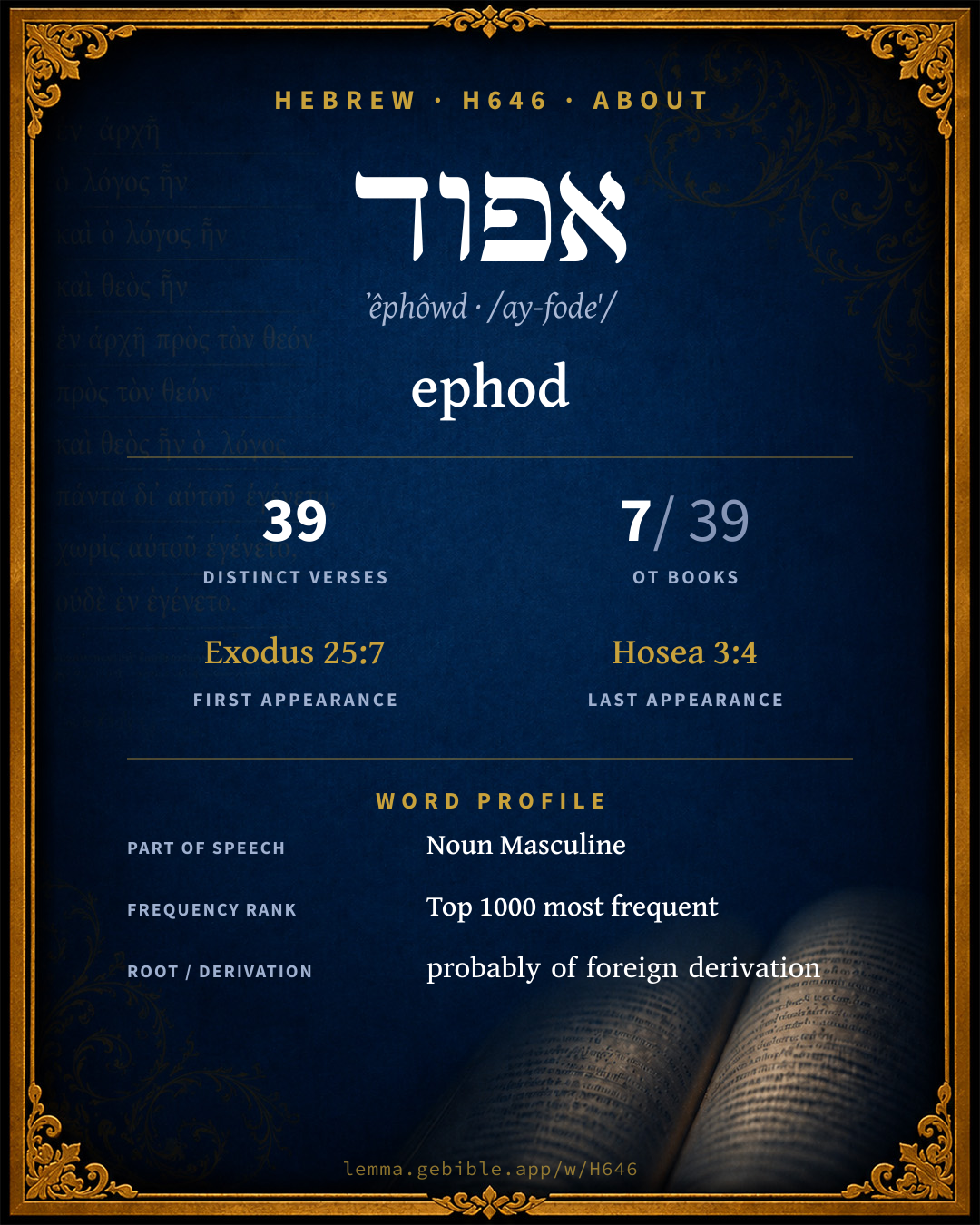
אֵפוֹד
ephod
‘ephod’ is one of 2 main senses fuller range ↓
Full lexicon entry — Brown-Driver-Briggs (BDB)
From Brown-Driver-Briggs (BDB)
Where this word appears
See every Absolute-state word in the Hebrew Bible →
Grammar key — what these labels mean
Part of speech
- Noun
- A naming word — a person, place, thing, or idea.
Noun type
- Common
- A common noun — a general class of person, place, or thing (“king,” “city,” “water”), not a specific name.
State
- Absolute
- The independent form of a noun, not bound to a following word.
- Construct
- A noun bound to a following noun in a possessive / “of” relationship (the construct chain).
Gender
- Masculine
- Grammatically masculine.
Number
- Singular
- One.
Grammatical forms
- Noun, Common, Masculine, Singular, Absolute 45 times (92%)
- Noun, Common, Masculine, Singular, Construct 4 times (8%)
Parsed forms decoded from the imported morphology (morphhb / Westminster Leningrad Codex — WLC text public domain, morphhb tagging CC BY 4.0), counted across 49 parsed occurrences — not distinct verses.
Every verse where H646 appears — 39 distinct verses across 7 books. Click any verse to open its interlinear word-by-word view. Verse text shown in the World English Bible for context — . Each verse’s Hebrew form is shown with its reference; the English is not keyword-highlighted, since the data carries no word-level English alignment. Use “Compare translations” on any verse to read it across multiple English versions. This concordance covers the Hebrew Bible; Septuagint (Greek Old Testament) occurrences are not indexed here.
Exodus 21 verses
- Exodus 25:7 לָ/אֵפֹ֖ד prep det + n c ms onyx stones, and stones to be set for the ephod and for the breastplate.
- Exodus 28:4 וְ/אֵפוֹד֙ conj + n c ms These are the garments which they shall make: a breastplate, and an ephod, and a robe, and a coat of checker work, a turban, and a sash: and they shall make holy garments for Aaron your brother, and his sons, that he may minister to me in the priest's office.
- Exodus 28:6 הָ/אֵפֹ֑ד ptcl def.art + n c ms "They shall make the ephod of gold, of blue, and purple, scarlet, and fine twined linen, the work of the skillful workman.
- Exodus 28:12 הָֽ/אֵפֹ֔ד ptcl def.art + n c ms You shall put the two stones on the shoulder-pieces of the ephod, to be stones of memorial for the children of Israel: and Aaron shall bear their names before Yahweh on his two shoulders for a memorial.
- Exodus 28:15 אֵפֹ֖ד n c ms "You shall make a breastplate of judgment, the work of the skillful workman; like the work of the ephod you shall make it; of gold, of blue, and purple, and scarlet, and fine twined linen, shall you make it.
- Exodus 28:25 הָ/אֵפֹ֖ד ptcl def.art + n c ms The other two ends of the two braided chains you shall put on the two settings, and put them on the shoulder-pieces of the ephod in the forepart of it.
- Exodus 28:26 הָ/אֵפֹ֖ד ptcl def.art + n c ms You shall make two rings of gold, and you shall put them on the two ends of the breastplate, on its edge, which is toward the side of the ephod inward.
- Exodus 28:27 הָ/אֵפ֤וֹד הָ/אֵפֽוֹד ptcl def.art + n c ms ptcl def.art + n c ms You shall make two rings of gold, and shall put them on the two shoulder-pieces of the ephod underneath, in the forepart of it, close by the coupling of it, above the skillfully woven band of the ephod.
- Exodus 28:28 הָ/אֵפֹד֙ הָ/אֵפ֑וֹד הָ/אֵפֽוֹד ptcl def.art + n c ms ptcl def.art + n c ms ptcl def.art + n c ms They shall bind the breastplate by the rings of it to the rings of the ephod with a lace of blue, that it may be on the skillfully woven band of the ephod, and that the breastplate may not swing out from the ephod.
- Exodus 28:31 הָ/אֵפ֖וֹד ptcl def.art + n c ms "You shall make the robe of the ephod all of blue.
- Exodus 29:5 הָ/אֵפֹ֔ד הָ/אֵפֹ֖ד הָ/אֵפֹֽד ptcl def.art + n c ms ptcl def.art + n c ms ptcl def.art + n c ms You shall take the garments, and put on Aaron the coat, the robe of the ephod, the ephod, and the breastplate, and dress him with the skillfully woven band of the ephod;
- Exodus 35:9 לָ/אֵפ֖וֹד prep det + n c ms onyx stones, and stones to be set for the ephod and for the breastplate.
- Exodus 35:27 לָ/אֵפ֖וֹד prep det + n c ms The rulers brought the onyx stones, and the stones to be set, for the ephod and for the breastplate;
- Exodus 39:2 הָ/אֵפֹ֑ד ptcl def.art + n c ms He made the ephod of gold, blue, purple, scarlet, and fine twined linen.
- Exodus 39:7 הָ/אֵפֹ֔ד ptcl def.art + n c ms He put them on the shoulder-pieces of the ephod, to be stones of memorial for the children of Israel, as Yahweh commanded Moses.
- Exodus 39:8 אֵפֹ֑ד n c ms He made the breastplate, the work of a skillful workman, like the work of the ephod; of gold, of blue, purple, scarlet, and fine twined linen.
- Exodus 39:18 הָ/אֵפֹ֖ד ptcl def.art + n c ms The other two ends of the two braided chains they put on the two settings, and put them on the shoulder-pieces of the ephod, in the front of it.
- Exodus 39:19 הָ/אֵפֹ֖ד ptcl def.art + n c ms They made two rings of gold, and put them on the two ends of the breastplate, on the edge of it, which was toward the side of the ephod inward.
- Exodus 39:20 הָ/אֵפֹ֤ד הָ/אֵפֹֽד ptcl def.art + n c ms ptcl def.art + n c ms They made two rings of gold, and put them on the two shoulder-pieces of the ephod underneath, in the front of it, close by its coupling, above the skillfully woven band of the ephod.
- Exodus 39:21 הָ/אֵפֹ֜ד הָ/אֵפֹ֔ד הָ/אֵפֹ֑ד ptcl def.art + n c ms ptcl def.art + n c ms ptcl def.art + n c ms They bound the breastplate by its rings to the rings of the ephod with a lace of blue, that it might be on the skillfully woven band of the ephod, and that the breastplate might not come loose from the ephod, as Yahweh commanded Moses.
- Exodus 39:22 הָ/אֵפֹ֖ד ptcl def.art + n c ms He made the robe of the ephod of woven work, all of blue.
Leviticus 1 verse
Judges 6 verses
- Judges 8:27 לְ/אֵפ֗וֹד prep + n c ms Gideon made an ephod of it, and put it in his city, even in Ophrah: and all Israel played the prostitute after it there; and it became a snare to Gideon, and to his house.
- Judges 17:5 אֵפוֹד֙ n c ms The man Micah had a house of gods, and he made an ephod, and teraphim, and consecrated one of his sons, who became his priest.
- Judges 18:14 אֵפ֣וֹד n c ms Then the five men who went to spy out the country of Laish answered, and said to their brothers, Do you know that there is in these houses an ephod, and teraphim, and an engraved image, and a molten image? now therefore consider what you have to do.
- Judges 18:17 הָ֣/אֵפ֔וֹד ptcl def.art + n c ms The five men who went to spy out the land went up, and came in there, and took the engraved image, and the ephod, and the teraphim, and the molten image: and the priest stood by the entrance of the gate with the six hundred men girt with weapons of war.
- Judges 18:18 הָ/אֵפ֔וֹד ptcl def.art + n c ms When these went into Micah's house, and fetched the engraved image, the ephod, and the teraphim, and the molten image, the priest said to them, What do you?
- Judges 18:20 הָ֣/אֵפ֔וֹד ptcl def.art + n c ms The priest's heart was glad, and he took the ephod, and the teraphim, and the engraved image, and went in the midst of the people.
1 Samuel 8 verses
- 1 Samuel 2:18 אֵפ֥וֹד n c ms cs But Samuel ministered before Yahweh, being a child, girded with a linen ephod.
- 1 Samuel 2:28 אֵפ֖וֹד n c ms and did I choose him out of all the tribes of Israel to be my priest, to go up to my altar, to burn incense, to wear an ephod before me? and did I give to the house of your father all the offerings of the children of Israel made by fire?
- 1 Samuel 14:3 אֵפ֑וֹד n c ms and Ahijah, the son of Ahitub, Ichabod's brother, the son of Phinehas, the son of Eli, the priest of Yahweh in Shiloh, wearing an ephod. The people didn't know that Jonathan was gone.
- 1 Samuel 21:9 הָ/אֵפוֹד֒ ptcl def.art + n c ms The priest said, The sword of Goliath the Philistine, whom you killed in the valley of Elah, behold, it is here wrapped in a cloth behind the ephod: if you will take that, take it; for there is no other except that here. David said, There is none like that; give it me.
- 1 Samuel 22:18 אֵפ֥וֹד n c ms cs The king said to Doeg, Turn you, and fall on the priests. Doeg the Edomite turned, and he fell on the priests, and he killed on that day eighty-five persons who wore a linen ephod.
- 1 Samuel 23:6 אֵפ֖וֹד n c ms It happened, when Abiathar the son of Ahimelech fled to David to Keilah, that he came down with an ephod in his hand.
- 1 Samuel 23:9 הָ/אֵפֽוֹד ptcl def.art + n c ms David knew that Saul was devising mischief against him; and he said to Abiathar the priest, Bring here the ephod.
- 1 Samuel 30:7 הָ/אֵפֹ֑ד הָ/אֵפֹ֖ד ptcl def.art + n c ms ptcl def.art + n c ms David said to Abiathar the priest, the son of Ahimelech, Please bring me here the ephod. Abiathar brought there the ephod to David.
2 Samuel 1 verse
1 Chronicles 1 verse
Hosea 1 verse
About this entry
At a glance — auto-summarized from this page’s data, not written by a person. Every figure links to its source below. This summary describes the numbers; it doesn’t interpret them.
“ephod” is the headline sense of the Hebrew noun אפוד (ʼêphôwd). It clusters heavily in Exodus, which alone accounts for 54% of its uses. With 39 verses in 7 books, it is a moderately common word in the Hebrew Bible. First canonically at Exodus 25:7, it enters the text early. Its meaning spans more than one sense — see its full sense range. The sections below give every sense, occurrence, and version rendering.
Gloss history
Strong's 1890 vs modern scholarship
About this word
Strong's H646 catalogs a Hebrew word from the Hebrew Old Testament.
These counts are not copied from any lexicon or concordance. They are computed here, from the morphology-tagged Hebrew Old Testament. What Lemma adds →
- 39
- distinct verses
- The word appears in 39 distinct verses.
- 7 / 39
- OT books
- The word appears in 7 of 39 Old Testament books.
- #752
- by frequency
- Top 1000 most frequent Hebrew words (rank 752 of 8,640 Hebrew words by occurrence).
View all 39 occurrences in the concordance →
By section of the Old Testament
By traditional corpus
Conventional, traditional groupings — biblical authorship is debated, so this is a traditional corpus grouping, not an authorship claim. Each share is this word’s portion of its verses in that division of the Hebrew canon. Each figure is a share of the word’s 39 distinct verses.
- Torah (Pentateuch) 22 verses · 56%
- Prophets (Nevi'im) 16 verses · 41%
- Writings (Ketuvim) 1 verse · 3%
How translations render this word
Counts come from each version’s own published word-to-Strong’s tagging or interlinear alignment — an approximate guide to how each version renders this word, not a word-level alignment the data otherwise carries. Because each total is that version’s own tagged count, the per-version totals vary from one another and need not match the appearance or distinct-verse counts above. These counts may also differ from a printed concordance because Lemma counts each distinctly tagged rendering and does not collapse phrase taggings into a single head-word total. This is a fixed set of word-tagged versions (KJV, ASV, BSB, ULT) and does not change with the reading translation you choose elsewhere. Each version’s license is shown beside its name below (and on Sources).
BDB lists this Strong’s number as 2 distinct words (homographs). Each count above pools all of them and is not split by sense — see the Senses section below. A low-frequency rendering may belong to a different one of those words, not the primary meaning.
- King James Version†: Ephod 46×
- American Standard Version†: Ephod 41×, Like the work of the ephod 2×
- Berean Standard Bible†: Ephod 45×
- unfoldingWord Literal Text†: Ephod 46×, Ephod of 3×
King James Version Public Domain
Renders H646 across 49† tagged occurrences — most commonly:
Plus 3 renderings that appear only once — usually multi-word phrases or single function words the recovered tagging swept in, not distinct renderings.
American Standard Version Public Domain
Renders H646 across 49† tagged occurrences — most commonly:
Plus 6 renderings that appear only once — usually multi-word phrases or single function words the recovered tagging swept in, not distinct renderings.
Berean Standard Bible Public Domain
Renders H646 across 47† tagged occurrences — most commonly:
Plus 2 renderings that appear only once — usually multi-word phrases or single function words the recovered tagging swept in, not distinct renderings. Not rendered by a distinct English word in 2 further occurrences.
unfoldingWord Literal Text CC BY-SA 4.0
Renders H646 across 52† tagged occurrences — most commonly:
Plus 3 renderings that appear only once — usually multi-word phrases or single function words the recovered tagging swept in, not distinct renderings.
8 senses and sub-senses in the full BDB
What do BDB’s symbols mean?
BDB uses these scholarly abbreviations:
| Symbol | Meaning |
|---|---|
| 𝔊 | the Septuagint (the ancient Greek translation, LXX) |
| 𝔙 | the Vulgate (the Latin translation) |
| 𝔖 | the Syriac version (the Peshitta) |
| 𝔗 | the Targum (the Aramaic translation) |
| ψ | the Psalms |
| √ | root (the underlying root or stem) |
| ‖ | parallel passage (a synonymous or contrasted parallel) |
| † | the dagger: every passage where the word occurs is cited |
The 8 senses and sub-senses the full Brown-Driver-Briggs lexicon distinguishes for this word, in lexicon order (not ranked by frequency), with BDB’s own verbatim wording and sub-sense lettering. Shown in Hebrew script with BDB’s own scholarly abbreviations. The condensed entry is in the Lexicon Entry tab. See also the Forms in the corpus table below.
אפוד I (28 times) & אֵפֹד (20 times) n.m. Ex 28
- 1. ephod, priestly garment, shoulder-cape or mantle;
- a. as worn by ordinary priest made of white stuff (בַּד) 1 S 22:18; נֹשֵׂא א׳ cf. 2; so Samuel as a temple-servant 2:8, חָגוּר א׳ girt with an eph.; so David when dancing before ark 2 S 6:14 (id.) 1 Ch 15:27 וְעַל דויד א׳; e.g. 1 Samuel 22:18
- b. as prescribed in P for high priest, more costly, woven of gold, blue, purple, scarlet, & linen (? שֵׁשׁ) threads, provided with shoulder-pieces & breast-piece of like material, ornamented with gems and gold, Ex 25:7; 28:4, 6, 12, 15; 29:5; 35:9, 27; 39:2, 7 + 17 times Ex 28, 39, also Lv 8:7; cf. prob. 1 S 2:28 (נֹשֵׂא א׳) 14:3; 21:10 (v. sub 2); חֵשֶׁב הָא׳ Ex 28:27, 28; 29:5; 39:20, 21 Lv 8:7; מְעִיל הָא׳ Ex 29:5; 39:22 (cf. Lv 8:7); with vb. נָתַן אֶת־הָא׳ עַל־ put the ephod on Aaron Lv 8:7. e.g. Exodus 25:7
- 2. ephod used in consulting י׳ 1 S 23:6 א׳ borne in hand (read יָרַד וְהָא׳ בְּיָדוֹ 𝔊 We Dr) v 9 30:7(×2) (all c. הִגִּישׁ) + 14:18a (הגישׁ) & v 18b, in both read הָא׳ for ארון & v 18b also נֹשֵׂא 𝔊 Klo Dr; e.g. 1 Samuel 23:6
- a. according to Thes MV Di Ex 28:6 al. properly sub 1 b; consultation of י׳ in that case by Urim & Thummim in the breast-piece attached to the ephod (cf. Ex 28:28–30 & v. אוּרִים); if so, in view of נשׂא 1 S 2:28; 14:3, 18 (cf. supr.), not used elsewhere = wear except 22:18, & of 23:6, the word might be used by meton. for the breast-piece itself; e.g. Exodus 28:6
- b. others, e.g. StaGesch. i. 466, 471 BuRS 115 al., think of an image representing י׳; cf. following.
- 3.
- a. ephod of gold made by Gideon Ju 8:27 for a local sanctuary, by which Isr. was ensnared; = 2 b according to 𝔖 Thes (‘sine controversia’) Stu al. + Sta Bu l.c.; orig. = gold sheathing of an image (cf. etymol. supr. & Is 30:22 sub אֲפֻדָּה); MV Be KöHauptprobleme 59 think of garment, as sub 1 v. supr. e.g. Judges 8:27
- b. made (material not given) for a private, local sanctuary Ju 17:5; 18:14, 17, 18, 20 (‖ פֶּסֶל, מַסֵּכָה, תְּרָפִים in all, for 𝔊 gives מַסֵּכָה v 20, om. ℌ); cf. Ho 3:4 Isr. shall abide without king, prince, sacrifice, pillar, ephod or teraphim; according to Thes al. + Sta Bu l.c. = 2 b; Stu Be Ry al. regard as sub 1; in view of distinction from פסל, מסכה & תרפים it seems more likely that this is not an image, but some means of consulting deity, perhaps in imitation of Urim & Thummim. e.g. Judges 17:5
אפוד II m. father of a chief of Manasseh Nu 34
Senses from the full Brown-Driver-Briggs lexicon (Brown, Driver, Briggs; Oxford 1906 — public domain), digitized via Sefaria, supplemented by the OpenScriptures HebrewLexicon (CC BY 4.0). Full attribution on Sources.
Word origin
I. (28 times) & אֵפֹד (20 times) n.m. Ex 28:7 ephod (Ethiopic ኤፉድ cf. Aramaic ܦܶܕܬܳܐ id. (on meaning v. Lagl.c.), perhaps also Assyrian pid, pittu ZimBP 39; on form v. Ges§ 84 a 12. R. but Lagl.c. comp. وفاد, & thinks אֵפוֹד shortened from חֵשֶׁב הָא׳ ‘robe of approach’ to God)—א׳ abs. Ex 25:7 +; cstr. 1 S 2:18 +;—
I. n.pr.m. father of a chief of Manasseh Nu 34:23.
— Brown-Driver-Briggs (Oxford 1906, public domain), digitized via Sefaria, supplemented by the OpenScriptures HebrewLexicon (CC BY 4.0). See Sources.
Origin: probably of foreign derivation
Forms in the corpus
The 26 distinct written forms H646 takes in the Hebrew Bible, most frequent first — each parse links to that state’s occurrences in the concordance. Hebrew forms include their vowel points and cantillation, so a single lemma takes many written forms.
Same root — word family
Other BDB entries built from the same root as H646, grouped by Strong’s listed origin. These share a root / origin per the lexicon — not necessarily a shared meaning. Each links to that word’s own entry.
Derived from this word
Proper names from this root
People and places named from this root — a name, not an additional meaning of the word.
Compare all same-root words → 1 of the same-root words is a proper name (a person or place). They share a root, not necessarily a meaning.
Septuagint verse parallels
This word appears in 35 verses that also exist in the Greek Old Testament (Septuagint), out of the 39 Hebrew verses it occurs in. You can read those verses in Greek by switching the Old Testament edition to the Septuagint.
Read these verses in the Septuagint
This is a verse-level parallel only — the same verses exist in both the Hebrew and Greek Old Testaments. No word-level Hebrew↔Greek correspondence is claimed: the data carries no such alignment, so no Greek word is shown as this Hebrew word’s translation. Coverage is not total — the Septuagint omits the deuterocanon and renumbers the Psalms, so some Hebrew verses have no direct Greek parallel.