
Exodus 39:21

Hebrew (Westminster Leningrad Codex) Exodus 39:21 appears in the Hebrew Old Testament. The text above is from the Westminster Leningrad Codex. Each word links to its Strong’s number, a concise gloss, and parsing drawn from the Open Scriptures Hebrew Bible morphology. Click any word for its full Brown-Driver-Briggs (BDB) entry.
Download image
Cite this verse

Exodus 39:21 (World English Bible). Public Domain. Lemma interlinear Bible study tool, https://lemma.gebible.app/v/exodus/39/21.

Show BibTeX & RIS
BibTeX
RIS
English Translation
They bound the breastplate by its rings to the rings of the ephod with a lace of blue, that it might be on the skillfully woven band of the ephod, and that the breastplate might not come loose from the ephod, as Yahweh commanded Moses.
World English Bible · Public Domain
Download a study sheet

One document with this verse’s original text, its word-by-word gloss line, the meaning frame, cross-references with their text, attributed commentary, and full source and license credits — printable, and it pastes into notes with its structure intact.

This verse Autodidact and up

Study sheet (.html) Plain text (.txt)

A passage Seminary Student

Up to 50 verses in one chapter. A passage sheet keeps up to 6 commentary sources and 12 cross-references per verse, in the order this page ranks them, and says so on the sheet whenever that leaves anything out. Ask for a single verse and you get the Autodidact verse sheet above.

Everything on this page stays free to read, with no account — the sheet is a download of what is already on screen, not access to it.

Want to remove ads? Support Godless Engineer
Compare translations 3

The same verse in 3 English versions, stacked beneath the original-language interlinear above. Click any original word for its lexicon entry.

Each is an independent rendering of the whole verse — the interlinear is not word-aligned to these translations.

Highlighted words mark where these versions differ — a whole-verse word diff, not a word-by-word alignment.

  • World English Bible Public Domain
    They bound the breastplate by its rings to the rings of the ephod with a lace of blue, that it might be on the skillfully woven band of the ephod, and that the breastplate might not come loose from the ephod, as Yahweh commanded Moses.
  • King James Version Public Domain
    And they did bind the breastplate by his rings unto the rings of the ephod with a lace of blue, that it might be above the curious girdle of the ephod, and that the breastplate might not be loosed from the ephod; as the LORD commanded Moses.
  • unfoldingWord Literal Text CC BY-SA 4.0
    And they tied the breastpiece by its rings to the rings of the ephod with a cord of blue to be on the finely crafted waistband of the ephod, so the breastpiece could not become detached from with the ephod just as Yahweh had commanded Moses.

unfoldingWord Literal Text — © unfoldingWord, licensed CC BY-SA 4.0. Word-aligned USFM3 via Door43 (git.door43.org/unfoldingWord/en_ult).

Versions to compare (up to 4)

3 of 4 selected

Show all 18 translations

Every available English version of this verse, each an independent rendering of the whole verse.

  • World English Bible Public Domain
    They bound the breastplate by its rings to the rings of the ephod with a lace of blue, that it might be on the skillfully woven band of the ephod, and that the breastplate might not come loose from the ephod, as Yahweh commanded Moses.
  • Berean Standard Bible Public Domain
    Then they tied the rings of the breastpiece to the rings of the ephod with a cord of blue yarn, so that the breastpiece was above the waistband of the ephod and would not swing out from the ephod, just as the LORD had commanded Moses.
  • Majority Standard Bible Public Domain
    Then they tied the rings of the breastpiece to the rings of the ephod with a cord of blue yarn, so that the breastpiece was above the waistband of the ephod and would not swing out from the ephod, just as the LORD had commanded Moses.
  • King James Version Public Domain
    And they did bind the breastplate by his rings unto the rings of the ephod with a lace of blue, that it might be above the curious girdle of the ephod, and that the breastplate might not be loosed from the ephod; as the LORD commanded Moses.
  • American Standard Version (1901) Public Domain
    And they did bind the breastplate by the rings thereof unto the rings of the ephod with a lace of blue, that it might be upon the skilfully woven band of the ephod, and that the breastplate might not be loosed from the ephod; as Jehovah commanded Moses.
  • Revised Version (1885) Public Domain
    And they did bind the breastplate by the rings thereof unto the rings of the ephod with a lace of blue, that it might be upon the cunningly woven band of the ephod, and that the breastplate might not be loosed from the ephod; as the LORD commanded Moses.
  • Geneva Bible (1599) Public Domain
    Then they fastened the brest plate by his rings vnto the rings of the Ephod, with a lace of blewe silke, that it might bee fast vpon the broydered garde of the Ephod, and that the brest plate should not be loosed from the Ephod, as the Lord had commanded Moses.
  • Douay-Rheims (1899) Public Domain
    And a hole for the head in the upper part at the middle, and a woven border round about the hole:
  • Young's Literal Translation Public Domain
    and they bind the breastplate by its rings unto the rings of the ephod, with a ribbon of blue, to be above the girdle of the ephod, and the breastplate is not loosed from off the ephod, as Jehovah hath commanded Moses.
  • Literal Standard Version CC BY-SA 4.0
    and they bind the breastplate by its rings to the rings of the ephod, with a ribbon of blue, to be above the girdle of the ephod, and the breastplate is not loosed from off the ephod, as YHWH has commanded Moses.
  • Unlocked Literal Bible CC BY-SA 4.0
    They tied the breastpiece by its rings to the ephod's rings with a blue cord, so that it might be attached just above the ephod's finely-woven waistband. This was so that the breastpiece might not become unattached from the ephod. This was done as Yahweh had commanded Moses.
  • unfoldingWord Literal Text CC BY-SA 4.0
    And they tied the breastpiece by its rings to the rings of the ephod with a cord of blue to be on the finely crafted waistband of the ephod, so the breastpiece could not become detached from with the ephod just as Yahweh had commanded Moses.
  • Darby Bible Public Domain
    And they bound the breastplate with its rings to the rings of the ephod with lace of blue, that it might be above the girdle of the ephod, and that the breastplate might not be loosed from the ephod; as Jehovah had commanded Moses.
  • World Messianic Bible Public Domain
    They bound the breastplate by its rings to the rings of the ephod with a lace of blue, that it might be on the skillfully woven band of the ephod, and that the breastplate might not come loose from the ephod, as the LORD commanded Moses.
  • Webster's Bible Public Domain
    And they bound the breast-plate by its rings to the rings of the ephod with a lace of blue, that it might be above the curious girdle of the ephod, and that the breast-plate might not be loosed from the ephod; as the LORD commanded Moses.
  • Free Bible Version CC BY-SA 4.0
    They tied the rings of the breastpiece to the rings of the ephod with a cord of blue thread, so that the breastpiece wouldn't come loose from the ephod, as the Lord had ordered Moses to do.
  • Bible in Basic English Public Domain
    And the rings on the bag were fixed to the rings of the ephod by a blue cord, keeping it in place over the band, so that the bag might not get loose, as the Lord gave orders to Moses.
  • JPS Tanakh (1917) Public Domain
    And they did bind the breastplate by the rings thereof unto the rings of the ephod with a thread of blue, that it might be upon the skilfully woven band of the ephod, and that the breastplate might not be loosed from the ephod; as the LORD commanded Moses.

Literal Standard Version (2020), Covenant Press — licensed CC BY-SA 4.0. Text via the HelloAO Bible API (eBible.org). Unlocked Literal Bible (unfoldingWord) — licensed CC BY-SA 4.0. Text via the HelloAO Bible API (eBible.org). unfoldingWord Literal Text — © unfoldingWord, licensed CC BY-SA 4.0. Word-aligned USFM3 via Door43 (git.door43.org/unfoldingWord/en_ult). Free Bible Version, Dr. Jonathan Gallagher — licensed CC BY-SA 4.0. Text via the HelloAO Bible API (eBible.org).

Word by word

More ways to search: Search by grammar → Find every occurrence → Compare this word →

Practice this passage: Drill this verse → Learn its vocabulary →

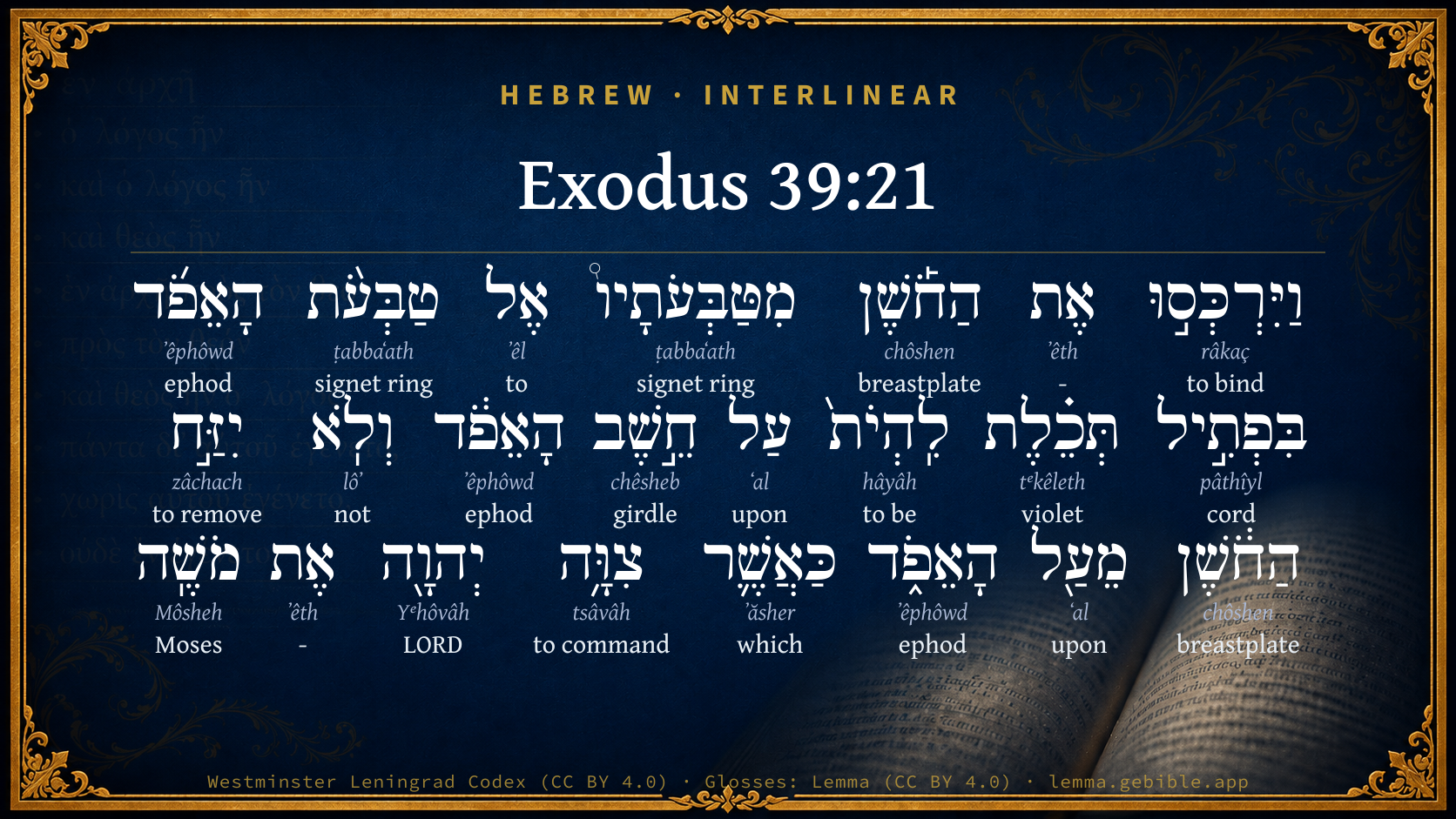
וַיִּרְכְּס֣וּ
râkaç
H7405
“and · to bind”
Conjunction + Verb, Qal, Sequential Imperfect, 3rd Person, Masculine, Plural
Part of Speech
Conjunction + Verb
Stem
Qal
Form
Sequential Imperfect
Person
3rd Person
Gender
Masculine
Number
Plural
Full BDB Definition

Origin: a primitive root

TWOT: 2166

(Qal) to bind
  1. אֶת ʼêth H853 “-” Particle, Direct Object
  2. הַחֹ֡שֶׁן chôshen H2833 “the · breastplate” Particle, Definite Article + Noun, Common, Masculine, Singular, Absolute
  3. מִטַּבְּעֹתָיו֩ ṭabbaʻath H2885 “from · signet rings · his” Preposition + Noun, Common, Feminine, Plural, Construct + Suffix, Personal, 3rd Person, Masculine, Singular
  4. אֶל ʼêl H413 “to” Preposition
  5. טַבְּעֹ֨ת ṭabbaʻath H2885 “signet rings of” Noun, Common, Feminine, Plural, Construct
  6. הָאֵפֹ֜ד ʼêphôwd H646 “the · ephod” Particle, Definite Article + Noun, Common, Masculine, Singular, Absolute
  7. בִּפְתִ֣יל pâthîyl H6616 “in/at · cord of” Preposition + Noun, Common, Masculine, Singular, Construct
  8. תְּכֵ֗לֶת tᵉkêleth H8504 “violet” Noun, Common, Feminine, Singular, Absolute
  9. לִֽהְיֹת֙ hâyâh H1961 “to be” Preposition + Verb, Qal, Infinitive Construct
  10. עַל ʻal H5921 “upon” Preposition
  11. חֵ֣שֶׁב chêsheb H2805 “girdle of” Noun, Common, Masculine, Singular, Construct
  12. הָאֵפֹ֔ד ʼêphôwd H646 “the · ephod” Particle, Definite Article + Noun, Common, Masculine, Singular, Absolute
  13. וְלֹֽא lôʼ H3808 “and · not” Conjunction + Particle, Negative
  14. יִזַּ֣ח zâchach H2118 “to remove” Verb, Niphal, Imperfect, 3rd Person, Masculine, Singular
  15. הַחֹ֔שֶׁן chôshen H2833 “the · breastplate” Particle, Definite Article + Noun, Common, Masculine, Singular, Absolute
  16. מֵעַ֖ל ʻal H5921 “from · upon” Preposition + Preposition
  17. הָאֵפֹ֑ד ʼêphôwd H646 “the · ephod” Particle, Definite Article + Noun, Common, Masculine, Singular, Absolute
  18. כַּאֲשֶׁ֛ר ʼăsher H834 “like/as · which” Preposition + Particle, Relative
  19. צִוָּ֥ה tsâvâh H6680 “to command” Verb, Piel, Perfect, 3rd Person, Masculine, Singular
  20. יְהוָ֖ה Yᵉhôvâh H3068 “LORD” Noun, Proper
  21. אֶת ʼêth H853 “-” Particle, Direct Object
  22. מֹשֶֽׁה Môsheh H4872 “Moses” Noun, Proper

About this verse

These counts appear in no published source. They are computed here, from the morphology-tagged text and Lemma’s own curated glosses. What Lemma adds →

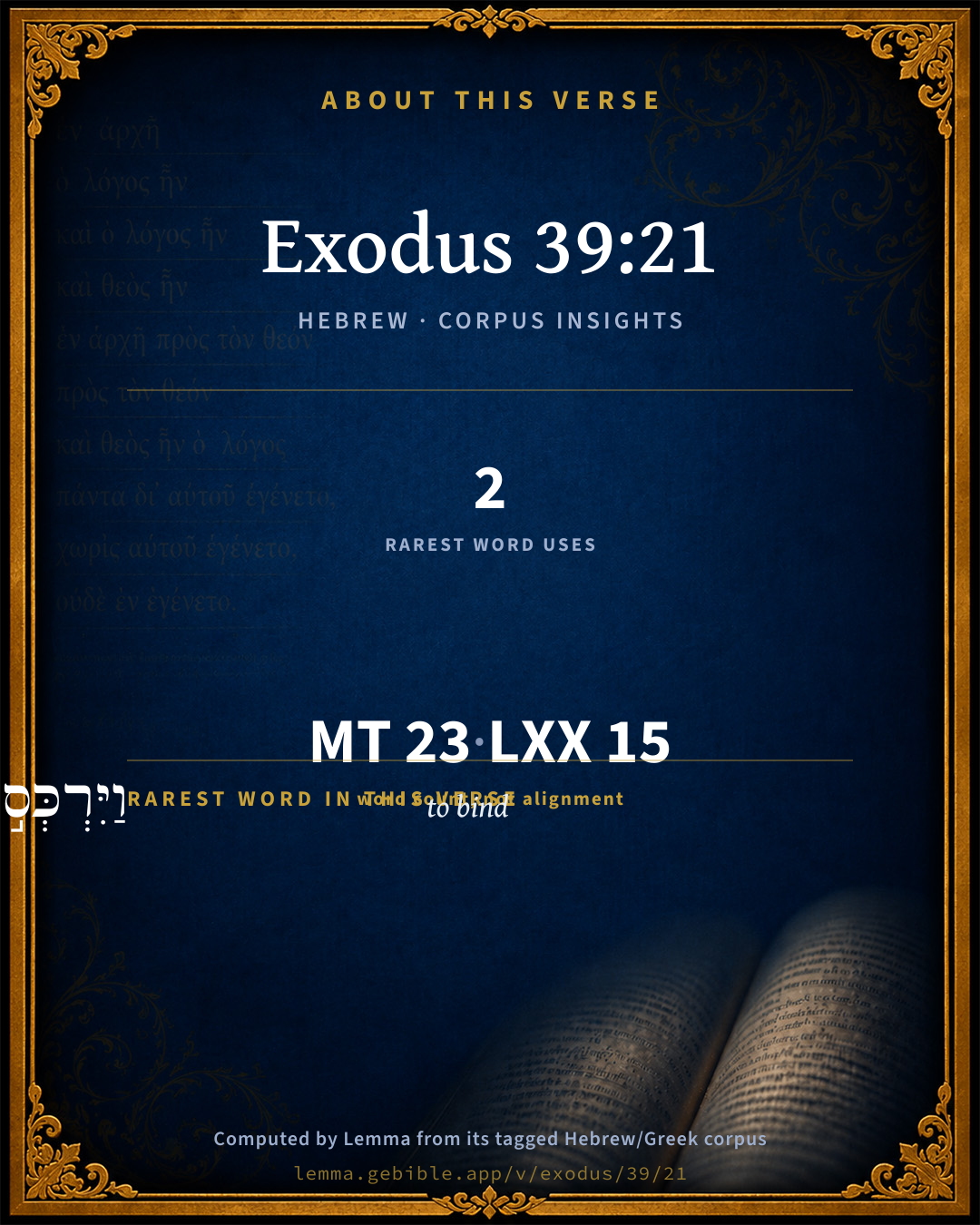
23
words
17
distinct lemmas
Pentateuch
section

Notable vocabulary

The rarest word here is וַיִּרְכְּס֣וּ to bind H7405 — appearing just 2 times in the whole Hebrew Bible.

Shared distinctive vocabulary

וַיִּרְכְּס֣וּ to bind H7405 occurs in 2 verses of the Hebrew Bible. Also found in:

Grammatical profile

  • 4 verbs
  • 12 nouns
  • 3 prepositions
  • 4 particles

Verb forms

  • וַיִּרְכְּס֣וּ Qal · Sequential Imperfect
  • לִֽהְיֹת֙ Qal · Infinitive Construct
  • יִזַּ֣ח Niphal · Imperfect
  • צִוָּ֥ה Piel · Perfect

Repetition

Words recur within this verse — often emphatic in Hebrew:

  • הָאֵפֹ֜ד ephod H646 ×3
  • הַחֹ֡שֶׁן breastplate H2833 ×2
  • מִטַּבְּעֹתָיו֩ signet ring H2885 ×2
  • עַל upon H5921 ×2

Hebrew & Septuagint length

In English translation the verse runs 45 words from the Hebrew and 45 from the Septuagint (LXX English) — the same length.

A rough comparison of the two English renderings, which tokenize alike — not a word-level alignment.

Word counts can differ between the Hebrew and the Greek without any difference in meaning — e.g. the Hebrew direct-object marker אֵת has no separate Greek word, and Greek often adds the article ὁ.

In the original languages it is 23 Hebrew tokens and 15 Greek tokens — but the two are counted differently (Hebrew bundles its prefixes and suffixes into one token; the Greek is in lemma form), so that isn’t a like-for-like length.

Cross-references

3

Topical passages linked to Exodus 39:21 in the Treasury of Scripture Knowledge — connected by theme and wording, ordered by reader-vote popularity; previews shown in the World English Bible.

  • Matthew 16:24 Then Jesus said to his disciples, "If anyone desires to come after me, let him deny himself, and take up his cross, and follow me.
  • 1 Corinthians 1:25 Because the foolishness of God is wiser than men, and the weakness of God is stronger than men.
  • 1 Corinthians 1:27 but God chose the foolish things of the world that he might put to shame those who are wise. God chose the weak things of the world, that he might put to shame the things that are strong;

Cross-references courtesy of OpenBible.info (CC BY 4.0).

Hebrew and Greek witnesses Masoretic Hebrew ↔ Greek Septuagint

The same verse in the two great witnesses to the Old Testament, shown verse-for-verse.

These are two independent witnesses, not word-aligned to each other, and the Septuagint is shown in lemma (dictionary) form.

Hebrew Exodus 39:21 Masoretic · Westminster Leningrad Codex

וַיִּרְכְּס֣וּ אֶת הַחֹ֡שֶׁן מִטַּבְּעֹתָיו֩ אֶל טַבְּעֹ֨ת הָאֵפֹ֜ד בִּפְתִ֣יל תְּכֵ֗לֶת לִֽהְיֹת֙ עַל חֵ֣שֶׁב הָאֵפֹ֔ד וְלֹֽא יִזַּ֣ח הַחֹ֔שֶׁן מֵעַ֖ל הָאֵפֹ֑ד כַּאֲשֶׁ֛ר צִוָּ֥ה יְהוָ֖ה אֶת מֹשֶֽׁה

They bound the breastplate by its rings to the rings of the ephod with a lace of blue, that it might be on the skillfully woven band of the ephod, and that the breastplate might not come loose from the ephod, as Yahweh commanded Moses.

World English Bible · Public Domain

Greek LXX Exodus 39:21 Septuagint · lemma form

καί ὁ πάσσαλος καί πᾶς ὁ ἐργαλεῖον ὁ εἰς ὁ ἔργον ὁ σκηνή ὁ μαρτύριον

and all the vessels of the tabernacle and all its instruments: and the skins, even rams' skins dyed red, and the blue coverings, and the coverings of the other things, and the pins, and all the instruments for the works of the tabernacle of witness.

LXX2012 (modern English Septuagint) · Public Domain

Hebrew: Westminster Leningrad Codex (CC BY 4.0). Greek: Septuagint (public domain); English from LXX2012 (modern English Septuagint) (Public Domain). How the Septuagint differs from the Hebrew →

Targum (Aramaic paraphrase)

2

The Targum is the ancient Jewish Aramaic paraphrase of the Hebrew Scriptures — an interpretive translation, not the Hebrew text itself. Onkelos (literal) and Pseudo-Jonathan (expansive) render the Torah, and Jonathan the Prophets. Coverage is partial: where no permissively-licensed English translation exists for a verse, only the Aramaic is shown. This is verse-level text, not a word-by-word alignment to the Hebrew.

  1. Targum Onkelos Torah (Genesis–Deuteronomy)
    וְיַחֲדוּן יָת חוּשְׁנָא מֵעִזְקְתֵהּ לְעִזְקָתָא דְאֵפוֹדָא בְּחוּטָּא דִתְכֶלְתָּא לְמֶהֱוֵי עַל הֶמְיַן אֵפוֹדָא וְלָא יִתְפָּרֵק חוּשְׁנָא מֵעִלָוֵי אֵפוֹדָא כְּמָא דִי פַקִיד יְיָ יָת משֶׁה:

    (no public-domain English translation for this verse)

    Targum Onkelos — Aramaic: “Onkelos Genesis” (public domain); “Onkelos Exodus” (public domain); “Onkelos Leviticus” (public domain); “Onkelos Numbers” (public domain); “Onkelos Deuteronomy” (public domain). English: “Sefaria Community Translation” (CC0 1.0 (public-domain dedication)); “J.W. Etheridge. The Targums of Onkelos and Jonathan Ben Uzziel on the Pentateuch. London: Longmans, Green, 1862” (public domain). Text via Sefaria.

  2. Targum Pseudo-Jonathan Torah (Genesis–Deuteronomy)
    וְטָכִיסוּ יַת חוּשְׁנָא מֵעִזְקָתָא לְעִזְקַת אֵיפוֹדָא בִּשְׁזִיר תִּכְלָא לְמֶהֱוֵי אָדִיק עַל הֶמְיַין אֵיפוֹדָא וְלָא יִתְפְּרַק חוּשְׁנָא מֵעִילַוֵי אֵיפוֹדָא הֵיכְמָא דְפַקֵּיד יְיָ יַת משֶׁה

    and fitted the breastplate by its rings to the rings of the ephod by a ribbon of hyacinth, that it might adhere to the band of the ephod, and that the breastplate be not loosened from being upon the ephod, as the Lord commanded Mosheh.

    Targum Pseudo-Jonathan — Aramaic: “Targum Jonathan on Genesis” (public domain); “Targum Jonathan on Exodus” (public domain); “Targum Jonathan on Leviticus” (public domain); “Targum Jonathan on Numbers” (public domain); “Targum Jonathan on Deuteronomy” (public domain). English: “The Targum of Jonathan ben Uzziel, trans. J. W. Etheridge, London, 1862” (public domain). Text via Sefaria.

Commentary

Notes on Exodus 39:21 from classic Christian and Jewish commentators (each source and its license shown beneath its notes). The classic Christian expositions comment on the surrounding passage and are grouped to its opening verse, so a note may address several verses; the Jewish commentaries on the Tanakh (Rashi and others) are per-verse, so they appear only where the commentator wrote on this verse.

Lemma curates 59 commentaries, every one of them public domain or Creative Commons licensed, each selected and text-cleaned for this edition rather than reprinted as found. About our sources →

unfoldingWord translationNotes

Door43 World Missions Community

General Information:

Bezalel's work crew continues to make the priestly garments as commanded in Exodus 28:28.

so that it might be attached

This can be stated in active form. AT: "so they could attach it" (See: Active or Passive)

the breastpiece might not become unattached from the ephod

The double negative can be translated as a positive. AT: "the breastpiece would stay attached to the ephod" (See: Double Negatives)

translationWords

breastplate

ephod

Yahweh

command

Moses

unfoldingWord translationNotes — © Distant Shores Media and the Door43 World Missions Community, licensed CC BY-SA 4.0. Source: git.door43.org/Door43/en_tn.

Lesson kit

Teaching starters — assembled from the data on this page, not authored interpretation. Every prompt links to the verse data it draws on. Edit before teaching.

Exodus, in the Pentateuch, opens this verse with 23 words (17 distinct Hebrew lemmas). Its most distinctive word is râkaç (“to bind”). Read the whole chapter for the surrounding context.

Discussion questions

  1. What does “to bind” (râkaç) contribute to the verse as a whole?
  2. How does Exodus 28:28, which shares the word «to bind», read alongside this verse?
  3. What does the repetition of “ephod” (3× in this one verse) do in this verse?
  4. These translations render this verse differently. What is at stake in choosing one wording over another?
  5. «וַיִּרְכְּס֣וּ» is a Qal Sequential Imperfect verb. How does that grammatical form shape the action described?

Things to notice

Reading settings

Reading text

Shown beneath each verse's original-language words.

Old Testament
Old Testament edition

Read the OT as the Masoretic Hebrew (MT) or the Greek Septuagint (LXX).

English shown for the Greek Septuagint (in the Hebrew ↔ Greek comparison).

Comparing translations? Open the Compare panel on any verse page to stack up to four side by side.