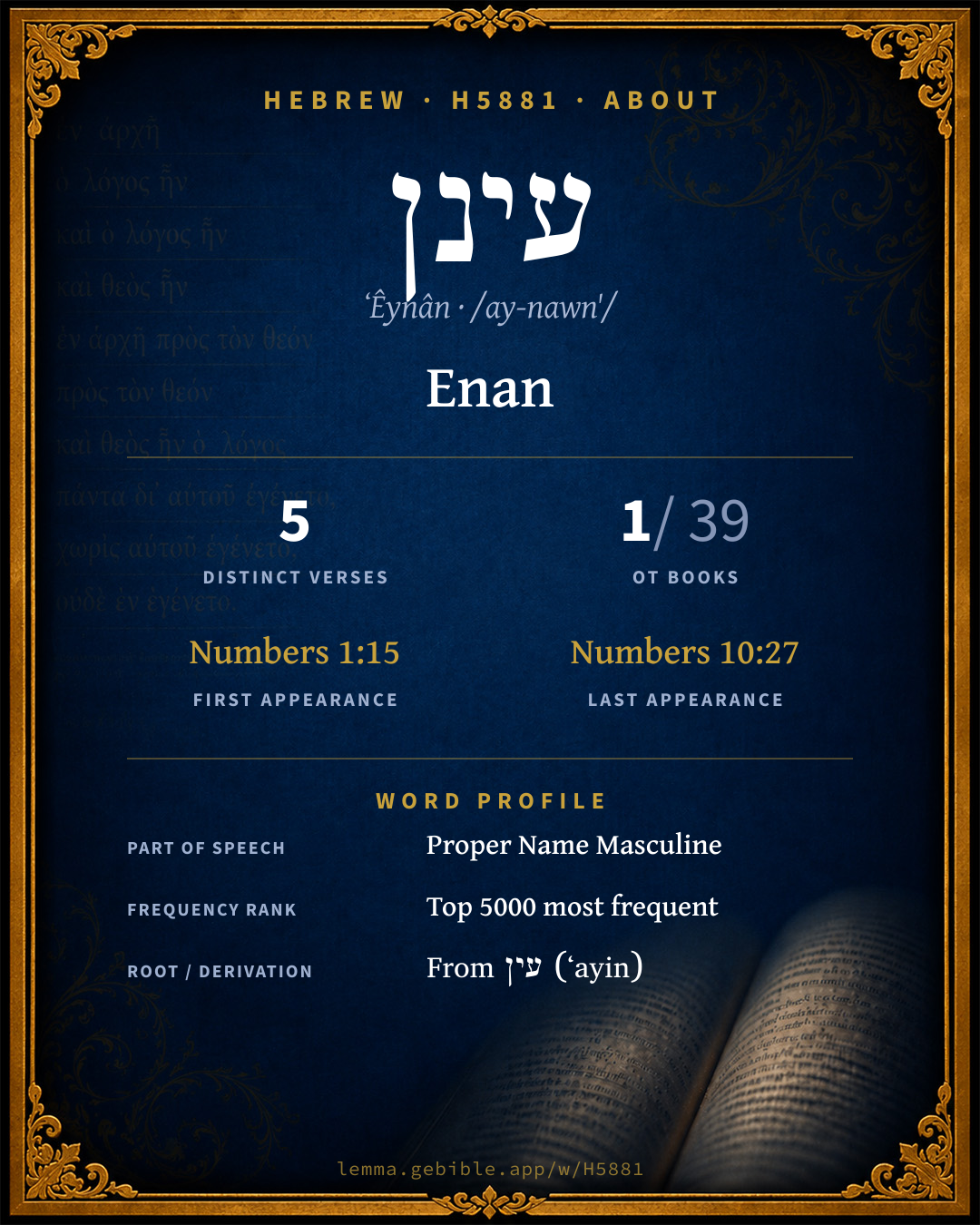
עֵינָן
Enan
BDB lists 2 entries for ‘Enan’ fuller range ↓
Full lexicon entry — Brown-Driver-Briggs (BDB)
From Brown-Driver-Briggs (BDB)
Where this word appears
Grammar key — what these labels mean
Part of speech
- Noun
- A naming word — a person, place, thing, or idea.
Noun type
- Proper
- A name of a specific person, place, or people (e.g. Abraham, Zion, Israel).
Every verse where H5881 appears — 5 distinct verses across 1 book. Click any verse to open its interlinear word-by-word view. Verse text shown in the World English Bible for context — . Each verse’s Hebrew form is shown with its reference; the English is not keyword-highlighted, since the data carries no word-level English alignment. Use “Compare translations” on any verse to read it across multiple English versions. This concordance covers the Hebrew Bible; Septuagint (Greek Old Testament) occurrences are not indexed here.
Numbers 5 verses
- Numbers 1:15 עֵינָֽן n Proper Of Naphtali: Ahira the son of Enan."
- Numbers 2:29 עֵינָֽן n Proper "The tribe of Naphtali: and the prince of the children of Naphtali shall be Ahira the son of Enan.
- Numbers 7:78 עֵינָֽן n Proper On the twelfth day Ahira the son of Enan, prince of the children of Naphtali
- Numbers 7:83 עֵינָֽן n Proper and for the sacrifice of peace offerings, two oxen, five rams, five male goats, and five male lambs a year old. This was the offering of Ahira the son of Enan.
- Numbers 10:27 עֵינָֽן n Proper Over the host of the tribe of the children of Naphtali was Ahira the son of Enan.
About this entry
At a glance — auto-summarized from this page’s data, not written by a person. Every figure links to its source below. This summary describes the numbers; it doesn’t interpret them.
עינן (ʻÊynân) is a Hebrew name most often rendered “Enan.” A scarce word — 5 verses in all of the Hebrew Bible. Numbers dominates its distribution — 5 of 5 verses. Debuting at Numbers 1:15, it then recurs through the corpus. For the data behind this summary, explore 5-verse concordance and the renderings breakdown below.
Gloss history
Strong's 1890 vs modern scholarship
About this word
Strong's H5881 catalogs a Hebrew word from the Hebrew Old Testament.
These counts are not copied from any lexicon or concordance. They are computed here, from the morphology-tagged Hebrew Old Testament. What Lemma adds →
- 5
- distinct verses
- The word appears in 5 distinct verses.
- 1 / 39
- OT books
- The word appears in 1 of 39 Old Testament books.
- #3,337
- by frequency
- Top 5000 most frequent Hebrew words (rank 3,337 of 8,640 Hebrew words by occurrence).
View all 5 occurrences in the concordance →
Most concentrated in
- Numbers 5 verses 100%
By section of the Old Testament
By traditional corpus
Conventional, traditional groupings — biblical authorship is debated, so this is a traditional corpus grouping, not an authorship claim. Each share is this word’s portion of its verses in that division of the Hebrew canon. Each figure is a share of the word’s 5 distinct verses.
- Torah (Pentateuch) 5 verses · 100%
How translations render this word
Counts come from each version’s own published word-to-Strong’s tagging or interlinear alignment — an approximate guide to how each version renders this word, not a word-level alignment the data otherwise carries. Because each total is that version’s own tagged count, the per-version totals vary from one another and need not match the appearance or distinct-verse counts above. These counts may also differ from a printed concordance because Lemma counts each distinctly tagged rendering and does not collapse phrase taggings into a single head-word total. This is a fixed set of word-tagged versions (KJV, ASV, BSB, ULT) and does not change with the reading translation you choose elsewhere. Each version’s license is shown beside its name below (and on Sources).
BDB lists this Strong’s number as 4 distinct words (homographs). Each count above pools all of them and is not split by sense — see the Senses section below. A low-frequency rendering may belong to a different one of those words, not the primary meaning.
- King James Version†: Enan 5×
- American Standard Version†: Enan 5×
- Berean Standard Bible†: Enan 5×
- unfoldingWord Literal Text†: Enan 5×
King James Version Public Domain
Renders H5881 across 5† tagged occurrences — most commonly:
American Standard Version Public Domain
Renders H5881 across 5† tagged occurrences — most commonly:
Berean Standard Bible Public Domain
Renders H5881 across 5† tagged occurrences — most commonly:
unfoldingWord Literal Text CC BY-SA 4.0
Renders H5881 across 5† tagged occurrences — most commonly:
39 senses and sub-senses in the full BDB
What do BDB’s symbols mean?
BDB uses these scholarly abbreviations:
| Symbol | Meaning |
|---|---|
| 𝔊 | the Septuagint (the ancient Greek translation, LXX) |
| 𝔙 | the Vulgate (the Latin translation) |
| 𝔖 | the Syriac version (the Peshitta) |
| 𝔗 | the Targum (the Aramaic translation) |
| ψ | the Psalms |
| √ | root (the underlying root or stem) |
| ‖ | parallel passage (a synonymous or contrasted parallel) |
| † | the dagger: every passage where the word occurs is cited |
The 39 senses and sub-senses the full Brown-Driver-Briggs lexicon distinguishes for this word, in lexicon order (not ranked by frequency), with BDB’s own verbatim wording and sub-sense lettering. Shown in Hebrew script with BDB’s own scholarly abbreviations. The condensed entry is in the Lexicon Entry tab.
עינן I
- 1. lit. as physical organ,
- a. of man Ex 21:6(×3) (E), Gn 3:6 (J) +, Lv 21:20; 24:20(×2); 26:16 (H; very rarely P, e.g. Dt 34:4, 7), 2 K 4:34(×2) +; once שְׁתֵּי עֵינַי Ju 16:28. e.g. Exodus 21:6
- b. anthropomorph. of י׳ ψ 33:18; 34:16 (אֶל) +. e.g. Psalms 33:18
- c. of idols ψ 115:5; 135:16. e.g. Psalms 115:5
- d. of beasts Gn 30:41 (J), Jb 40:24 (hippop., si vera l., but prob. crpt. Di Siegf Bu Du where see conj.), 41:10 (crocod.); bird Jb 28:7; 39:29; Pr 1:17. e.g. Genesis 30:41
- e. in wheels Ez 1:18 cf. 10:12; on stone Zc 3:9 (all in visions). e.g. Ezekiel 1:18
- f. subj. of ראה see Gn 45:12(×2) (E), + (often Dt), c. חזה ψ 11:4; men see בְּע׳ Dt 3:27; 2 K 7:12 +; especially נָשָׂא ע׳ + ראה Gn 13:10, 14 (J) +; cf. לְכָל־מַרְאֵה עֵינֵי הַכֹּהֵן Lv 13:12 = as far as the priest can see, מַרְאֵה ע׳ Dt 28:34 what is seen by the eyes = v 67 Ec 6:9. e.g. Genesis 45:12
- g. as affected by sleep, v. שֵׁנָה sub [יָשֵׁן].
- h. as weeping, ע׳ מְקוֹר דִּמְעָה Je 8:23, ע׳ נִגְּרָה La 3:49, דָּֽלְפָה ע׳ Jb 16:20; v. also Je 31:16 ψ 116:8, and ירד Qal 3 c. e.g. Jeremiah 8:23
- i. as growing dim, v. I. כָּהָה, חָשַׁךְ 3; c. כָּבֵד Gn 48:10 (E), קוּם 1 S 4:15 1 K 14:4, שָׁעַע Is 32:3; 6:10 (Hiph.); c. כָּלָה pine, languish, v. כ׳ Qal 2 b, Pi. 2 b, c. דָּאַב ψ 88:10, עָשַׁשׁ 6:8; 31:10, דָּלַל Is 38:14. e.g. Genesis 48:10
- j. c. פָּקַח open, after sleep Jb 27:19, sleep of death 2 K 4:35; = keep awake Pr 20:13 (opp. שֵׁנָה); of new power of vision Gn 3:5, 7 (J), given by God 21:19 (E), 2 K 6:17(×2); so (c. וַיְגַל) Nu 22:31 (JE); = give sight to blind 2 K 6:20(×2); Is 35:5; 42:7 ψ 146:8; of God (י׳) opening his eyes, פָּקַח ע׳ 2 K 19:16 = Is 37:17, Dn 9:18, + עַל־ Je 32:19; Zc 12:4; Jb 14:3 שִׂים ע׳ עַל Gn 44:21 (J) Je 39:12; 40:4, + לטובה 24:6, + לרעה Am 9:4; c. פָּתַח, + אֶל־ 1 K 8:29 = 2 Ch 6:20; 1 K 8:52; Ne 1:6, + ל 2 Ch 6:40; 7:15; + inf. Ne 1:6. e.g. Job 27:19
- k. אוֹר ע׳ etc., = revive, v. אור vb. Qal, Hiph.; noun, 10.
- l. קָרַץ ע׳ = wink ψ 35:19; Pr 10:10, ק׳ בְּע׳ 6:13. e.g. Psalms 35:19
- m. יִרְזְמוּן ע׳ Jb 15:12 i.e. roll (in anger). e.g. Job 15:12
- n. לָטַשׁ ע׳ ל׳ Jb 16:9 whet eyes against = ‘look daggers at.’ e.g. Job 16:9
- o. put out eye, v. עִוֵּר, נקר.
- p. as feature of beauty, יְפֵה ע׳ Dt 16:12; cf. Ct 4:9; 7:5, ע׳ יוֹנִים 1:15; 4:1 and 5:12 (כְּיוֹנִים); on other hand, ע׳ לֵאָה רַכּוֹת Gn 29:17 (E); וַתָּשֶׂם בַּפּוּךְ ע׳ †2 K 9:30 (v. פּוּךְ), cf. Je 4:30, כָּחַל ע׳ Ez 23:40 paint the eyes †. e.g. Deuteronomy 16:12
- q. apple of the eye, v. אִישׁוֹן, [בָּבָה], בַּת 6.
- r. גַּבֹּת ע׳ Lv 14:9 eyebrows. e.g. Leviticus 14:9
- s. חַכְלִילִי ע׳ מִיָּ֑יִן Gn 49:12, חַכְלִילוּת ע ׳ Pr 23:29 (v. ח׳); מְאוֹר ע׳ Pr 15:30, v. Toy.—v. שׁתם for Nu 24:3, 15. e.g. Genesis 49:12
- 2.
- a. eyes as shewing mental qualities: arrogance ע׳ גַבְהוּת Is 2:11, ע׳ גְבֹהִים 5:15, גְּבַהּ־ע׳ ψ 101:5, תִּפְאֶרֶת רוּם ע׳ Is 10:12; c. רוּם also ψ 18:28 (so read also ‖ 2 S 22:28 Hup HPS), 131:1 Pr 6:17; 21:4; humility, שַׁח ע׳ Jb 22:29; mockery, ע׳ תִּלְעַג לְ Pr 30:17; cf. רָעָה ע׳ בְּ Dt 15:9 (grudging), 28:54, 56 (id.); especially (עַל) ע׳ אַל־תָּחֹס not have pity on Dt 7:16 + 4 times Dt, Ez 5:11 + 8 times Ez, Is 13:18, also Gn 45:20 (E; = not regret); cf. נֹחַם יִסָּתֵר מֵע׳ Ho 13:14. e.g. Isaiah 2:11
- b. מַחְמַד ע׳ Ez 24:16 desire of the eyes, so v 21, 25; שִׁקּוּצֵי ע׳ 20:7 abominations of the eyes, so v 3.—ψ 73:7 v. חֵלֶב. e.g. Ezekiel 24:16
- 3. Fig. of mental and spiritual faculties, acts and states:
- a. תִּפָּקַחְנָה ע׳ Gn 3:5, 7 (J) Is 42:7, גִּלוּי ע׳ Nu 24:4, 16 (JE); also טַח מֵרְאוֹת ע׳ Is 44:18; ע׳ אֶל־י׳ ψ 123:2 (see v 2(×2) for origin of fig.), +; of י׳, 33:18 (i.e. his favour) 34:16 (id.) +. e.g. Genesis 3:5
- b. ע׳ הַזֹּנוֹת Ez 6:9; תִּשְׂבַּע ע׳ Ec 1:8; 4:8; שָֽׁאֲלוּ ע׳ 2:10; ע׳ לְנֹכַח יַבִּיטוּ Pr 4:25; טוֹב־ע׳ 22:9 = bountiful, רַע עָ֑יִן 23:6 = niggardly one, so 28:22; eye as avenue of temptation Jb 31:1, 7; שִׁית ע׳ ψ 17:11 = design. e.g. Ezekiel 6:9
- c. especially בְּעֵינֵי, c. adj. and intrans. verbs, in the view, opinion, of Gn 16:4, 5 (J), 21:11, 12 (E), 34:18 (P), + often; c. act. vb. 2 S 10:3 = 1 Ch 19:3; Est 1:17; 3:6; הַטּוֹב בְּע׳ Gn 16:6; 19:14 (J), +, i.e. what one pleases, Nu 36:6 (P) whom they please; הַיָּשָׁר בְּע׳ Dt 12:8, 25 +, הַטּוֹב וְהַיָּשָׁר בְּע׳ v 28 Jos 9:25 (D), הָרַע בְּע׳ Ju 2:11; 3:7; Dt 4:25 + especially D and K (RD); so לְנֶגֶד עיניו 2 S 22:25 = ψ 18:25; אַחֲרֵי עֵינֵיכֶם Nu 15:39 = according to your wish, fancy (+ לְבַבְכֶם). e.g. Genesis 16:4
- d. נֶעְלָם מֵע׳ Lv 4:13 i.e. hid from knowledge of, so Nu 5:13 (both P), Jb 28:21; מֵע׳ Nu 15:24 (P) without the knowledge of; אַעְלִים ע׳ מִן Is 1:15 = disregard, pay no attention; cf. Lv 20:4 (H) Ez 22:26; without מִן, abs., Pr 28:27; נִסְתְּרוּ מֵע׳ Is 65:16, וַיַּסְתֵּר עָמָל מֵע׳ Jb 3:10; אַעְלִים ע׳ בּוֹ (i.e. בַּכֹּפֶר) 1 S 12:3 (נעלים sandals + ענו בי 𝔊 Th We Kit, cf. Ecclusxlvi. 19; Bu HPS ins. ענו בי); הַשֹּׁחַד יְעַוֵּר ע׳ Dt 16:19, cf. כְּסוּת ע׳ Gn 20:16 (E). e.g. Leviticus 4:13
- 4. Transferred meanings:
- a. visible surface of earth Ex 10:5, 15 (J) Nu 22:5, 11 (JE). e.g. Exodus 10:5
- b. appearance Lv 13:5 (P; reading בְּעֵינוֹ Di Kau Dr-Wh), v 37 (P; reading id.), v 55 (P) Nu 11:7(×2) (JE); so appar. dual 1 S 16:7. e.g. Leviticus 13:5
- c. gleam, sparkle (of metal, jewels, etc.) Ez 1:4, 7, 16, 22, 27; 8:2; 10:9 Dn 10:6; of wine Pr 23:31. e.g. Ezekiel 1:4
- 5. Other phrases are: ע׳ תַּחַת ע׳ Ex 21:24 (E) = Lv 24:20 (H), = ע׳ בְּע׳ Dt 19:21, all = an eye for an eye; ע׳ בְּע׳ = eye to eye, Nu 14:14 (P) Is 52:8 (fig.), cf. וְע׳ אֶת־ע׳ תִּרְאֶינָה Je 32:4; 34:3; especially לְעֵינֵי in the presence of, in full view of Gn 42:24 (E) 47:19 (J) Ex 4:30 (J) Nu 19:5 (P), + often of business transaction Je 32:12(×2); Gn 23:11, 18 (P); so נֶגֶד ע׳ Jo 1:16, לְנֶגֶד ע׳ Jb 4:16, בְּע׳ Jos 3:7; 4:14 1 S 21:14 Ezr 3:12; נִגְרַזְתִּי מִנֶּגֶד ע׳ ψ 31:23; בֵּין ע׳ = on the forehead Ex 13:9, 16 (JE) Dt 6:8; 11:18; 14:1; Dn 8:5, 21. e.g. Exodus 21:24
עינן II spring (of water) (connexion with i. ע׳ dub.
- a. ע׳ חֲרֹד Ju 7:1 (on loc. cf. GFM). e.g. Judges 7:1
- b. ע׳ הַקּוֹרֵא (partridge-spring) Ju 15:19 (cf. id.). e.g. Judges 15:19
- c. ע׳ רֹגֵל near Jerus. (early sanctuary RSSem i. 157, 2nd ed. 172) 2 S 17:17 cf. 1 K 1:9, on border of Judah Jos 15:7, and Benj. 18:16. e.g. 2 Samuel 17:17
- d. ע׳ הַתַּנִּין (dragonspring) Ne 2:13 (= c.? so RSl.c.).—On שַׁעַר הָעַיִן Ne 2:14; 3:15; 12:37 v. שַׁעַר. e.g. Nehemiah 2:13
עינן III loc.
- 1. לָעָ֑יִן, on NE. border of Can. Nu 34:11, 𝔊 ἐπὶ πηγάς. e.g. Numbers 34:11
- 2.
- a. in Negeb of Judah Jos 15:32 (+ וְרִמּוֹן), Levit. city 21:16 (but 𝔊B Ασα read עָשָׁן, as 1 Ch 6:44), appar. = e.g. Joshua 15:32
- b. 19:7 (+ ר׳; assigned to Simeon), וָע׳ ר׳ 1 Ch 4:32 (read prob. וְעֵין ר׳); prob. mod. Umm er-Ramāmīn, c. 18 mils SW. from Hebron, BuhlGeogr.183.—Vid. עֵין רִמּוֹן. e.g. 1 Chronicles 19:7
עינן IV m. Αιναν, name in Naphtali Nu 1
Senses from the full Brown-Driver-Briggs lexicon (Brown, Driver, Briggs; Oxford 1906 — public domain), digitized via Sefaria, supplemented by the OpenScriptures HebrewLexicon (CC BY 4.0). Full attribution on Sources.
Word origin
I. n.f. Gn 3:7 and (Zc 3:9; 4:10 AlbrZAW xvi (1896), 75) m. eye (ancient Sem. word; √ and relation to ii. ע׳ unknown; NH id.; Ph. ען; 𝔗 עֵינָא, עַיְינָא; Palm. עינא, Zinj. sf. עיני, עינך; Syriac ܥܰܝܢܳܐ; Assyrian ênu, enu, TelAm. sf. inaya and (appar. Can. gloss) ḫinaya; Arabic عَيْنٌ; Ethiopic ዐይን );—abs. ע׳ Ex 21:4 +, cstr. עֵין v 26 +; sf. עֵינִי Gn 44:21 + (2 S 16:12 read עָנְיִי Vrss Comm.), עֵינֵךָ Dt 7:16 +, עֵינֵנוּ ψ 35:21 (2 S 20:6 v. נצל Hiph.); sf. 3 mpl. עֵינָם Is 13:18 (Zc 5:6 read עֲוֹנָם 𝔊 We Gr Now), עֵינֵמוֹ ψ 73:7 (but read עֲוֹנָמוֹ v. Comm.); usually du. עֵינַיִם Gn 20:16 +, עֵינָ֑יִם Is 3:16 +, especially cstr. עֵינֵי Gn 3:7 +, עֵנֵי Is 3:8; sf. עֵינַי Gn 31:10 +, עֵינֶיךָ Ju 6:17 +, etc. (Ho 10:10 read עֲוֹנֹתָם) cf. 𝔊 𝔙 Che We Gr Now);—eye:
II. n.f. spring (of water) (connexion with i. ע׳ dub.; NH id., Ph. ען; Assyrian ênu, înu; Arabic عَيْنٌ; Ethiopic ዐይን; Palm. עינא, 𝔗 עֵינָא, עַיְינָא; Syriac ܥܰܝܢܳܐ );—abs. ע׳ 1 S 29:1 +, עָ֑יִן Gn 49:22 +, הָעַ֫יְנָה 24:16, 45; cstr. עֵין v 13 +; pl. עֲיָנֹת Dt 8:7, -וֹת 2 Ch 32:3; cstr. עֵינוֹת Ex 15:27 = Nu 33:9, עִינוֹת Pr 8:28 (Ges§93 v);—spring Gn 16:7; 24:16, 29, 30, 42, 45 (all J) 49:22 (poem in J), 1 S 29:1; עֵין הַמַּיִם Gn 16:7; 24:13, 43 (J), cf. Ex 15:27 (J) Nu 33:9 (P); נַחֲלֵי מַיִם ע׳ וּתְהֹמֹת Dt 8:7; מֵימֵי הָעֲיָנוֹת 2 Ch 32:3; ע׳ תְּהוֹם Pr 8:28 (i.e. of the sea); fig. עֵין יַעֲקֹב Dt 33:28 (poem), i.e. Jacob’s descendants. Particular springs are:
I. n.pr.m. Αιναν, name in Naphtali Nu 1:15; 2:29; 7:78, 83; 10:27.—Vid. also חֲצַר עֵינוֹן.
— Brown-Driver-Briggs (Oxford 1906, public domain), digitized via Sefaria, supplemented by the OpenScriptures HebrewLexicon (CC BY 4.0). See Sources.
Derived from עין (ʻayin) (H5869) — eye.
Jastrow Dictionary
A second Hebrew/Aramaic lexicon for comparison, covering Aramaic and post-biblical (Talmudic, Targumic, Midrashic) usage that the biblical-Hebrew BDB does not. Matched by lemma rather than by Strong’s number, so a lemma may carry more than one Jastrow headword (shown separately below), and the entries cover usage well beyond the Bible.
עֵינָן
- ʿEnan (Springs). Targ. Y. I Num. XXXIV, 11 (Y. II עינותא; h. text עַיִן).
A Dictionary of the Targumim, the Talmud Babli and Yerushalmi, and the Midrashic Literature (Marcus Jastrow; London, Luzac, 1903) — Public Domain. Digitized via Sefaria. Digitized via Sefaria. Full attribution on Sources.
Same root — word family
Other BDB entries built from the same root as H5881, grouped by Strong’s listed origin. These share a root / origin per the lexicon — not necessarily a shared meaning. Each links to that word’s own entry.
Derives from
Shares the same root
Proper names from this root
People and places named from this root — a name, not an additional meaning of the word.
- עין ʻAyin H5871 Ain
- עין גדי ʻÊyn Gedîy H5872 En-gedi
- עין גנים ʻÊyn Gannîym H5873 En-gannim
- עיןדאר ʻÊyn-Dôʼr H5874 En-dor
- עין הקורא ʻÊyn haq-Qôwrêʼ H5875 En-hakkore
- עין חדה ʻÊyn Chaddâh H5876 En-haddah
- עין חצור ʻÊyn Châtsôwr H5877 En-hazor
- עין חרד ʻÊyn Chărôd H5878 En-harod
- עינים ʻÊynayim H5879 Enam
- עין משפט ʻÊyn Mishpâṭ H5880 En-mishpat
- עין עגלים ʻÊyn ʻEglayim H5882 En-eglaim
- עין רגל ʻÊyn Rôgêl H5883 En-rogel
- עין רמון ʻÊyn Rimmôwn H5884 En-rimmon
- עין שמש ʻÊyn Shemesh H5885 En-shemesh
- עין תנים ʻÊyn Tannîym H5886 dragon well
- עין תפוח ʻÊyn Tappûwach H5887 En-tappuah
- ענים ʻÂnîym H6044 Anim
- ענם ʻÂnêm H6046 Anem
Compare all same-root words → Showing 4 of 23 — not the complete family. 18 of the same-root words are proper names (people or places). They share a root, not necessarily a meaning.
Bible dictionary
Public-domain dictionary articles matched to this entry by name (Enan). A biblical name can be shared by more than one person or place, so an article may treat several.
Smith's Bible Dictionary · William Smith, 1863
(having eyes.). Ahira ben-Enan was "prince" of the tribe of Naphtali at the time of the numbering of Israel in the wilderness of Sinai. (Numbers 1:15) (B.C. 1491.)
Hitchcock's Bible Names Dictionary · Roswell D. Hitchcock, 1869
cloud
Classic public-domain reference works; full attribution on Sources.
Septuagint verse parallels
This word appears in 5 verses that also exist in the Greek Old Testament (Septuagint), out of the 5 Hebrew verses it occurs in. You can read those verses in Greek by switching the Old Testament edition to the Septuagint.
Read these verses in the Septuagint
This is a verse-level parallel only — the same verses exist in both the Hebrew and Greek Old Testaments. No word-level Hebrew↔Greek correspondence is claimed: the data carries no such alignment, so no Greek word is shown as this Hebrew word’s translation. Coverage is not total — the Septuagint omits the deuterocanon and renumbers the Psalms, so some Hebrew verses have no direct Greek parallel.