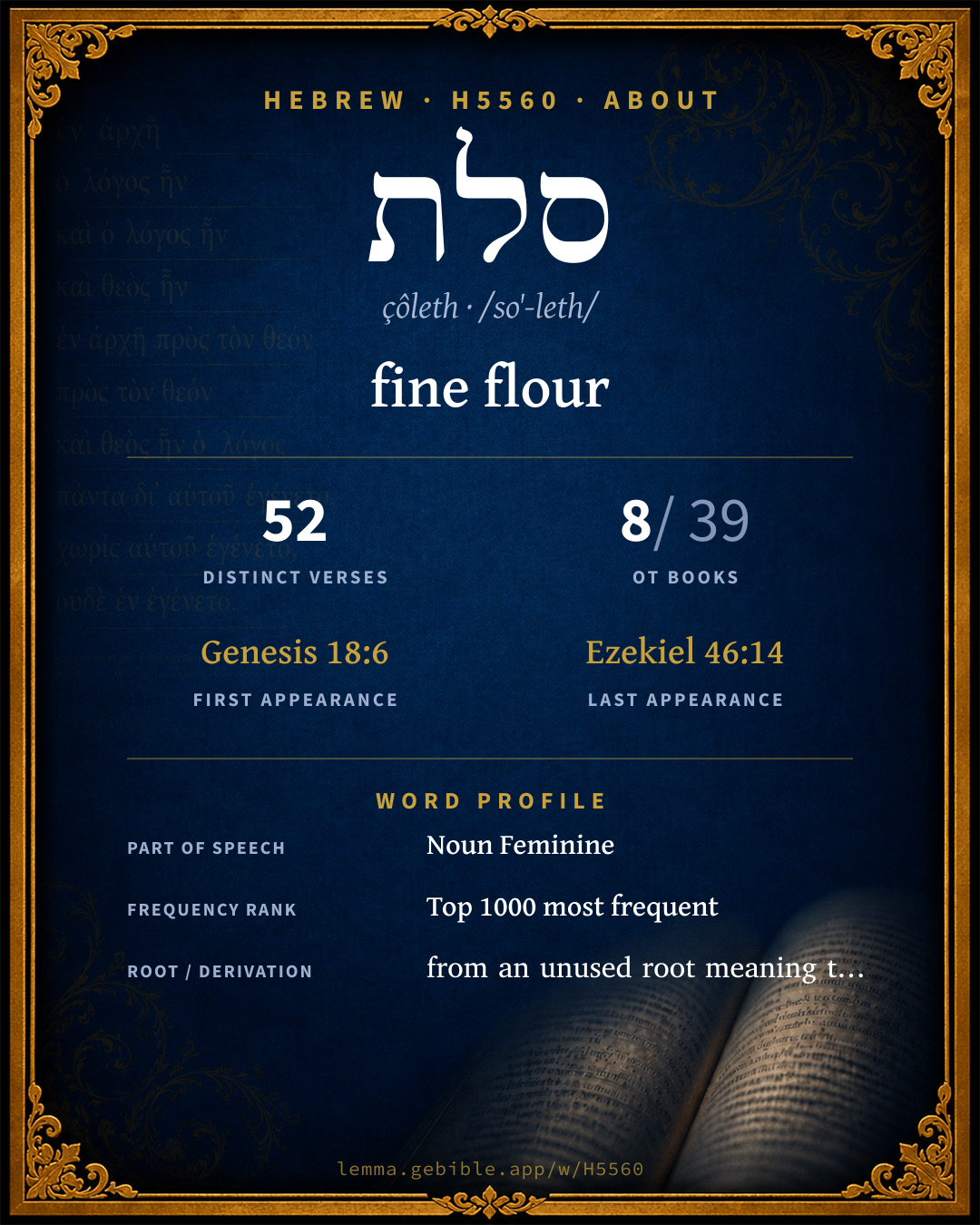
סֹ֫לֶת
fine flour
Full lexicon entry — Brown-Driver-Briggs (BDB)
From Brown-Driver-Briggs (BDB)
Where this word appears
See every Absolute-state word in the Hebrew Bible →
Grammar key — what these labels mean
Part of speech
- Noun
- A naming word — a person, place, thing, or idea.
Noun type
- Common
- A common noun — a general class of person, place, or thing (“king,” “city,” “water”), not a specific name.
State
- Absolute
- The independent form of a noun, not bound to a following word.
- Construct
- A noun bound to a following noun in a possessive / “of” relationship (the construct chain).
Gender
- Feminine
- Grammatically feminine.
Number
- Singular
- One.
Grammatical forms
- Noun, Common, Feminine, Singular, Absolute 48 times (91%)
- Noun, Common, Feminine, Singular, Construct 5 times (9%)
Parsed forms decoded from the imported morphology (morphhb / Westminster Leningrad Codex — WLC text public domain, morphhb tagging CC BY 4.0), counted across 53 parsed occurrences — not distinct verses.
Every verse where H5560 appears — 52 distinct verses across 8 books. Click any verse to open its interlinear word-by-word view. Verse text shown in the World English Bible for context — . Each verse’s Hebrew form is shown with its reference; the English is not keyword-highlighted, since the data carries no word-level English alignment. Use “Compare translations” on any verse to read it across multiple English versions. This concordance covers the Hebrew Bible; Septuagint (Greek Old Testament) occurrences are not indexed here.
Genesis 1 verse
Exodus 2 verses
- Exodus 29:2 סֹ֥לֶת n c fs cs unleavened bread, unleavened cakes mixed with oil, and unleavened wafers anointed with oil: you shall make them of fine wheat flour.
- Exodus 29:40 סֹ֜לֶת n c fs and with the one lamb a tenth part of an ephah of fine flour mixed with the fourth part of a hin of beaten oil, and the fourth part of a hin of wine for a drink-offering.
Leviticus 14 verses
- Leviticus 2:1 סֹ֖לֶת n c fs "'When anyone offers an offering of a meal offering to Yahweh, his offering shall be of fine flour; and he shall pour oil on it, and put frankincense on it.
- Leviticus 2:2 מִ/סָּלְתָּ/הּ֙ prep + n c fs cs + sfx pers 3fs He shall bring it to Aaron's sons the priests; and he shall take his handful of its fine flour, and of its oil, with all its frankincense; and the priest shall burn the memorial of it on the altar, an offering made by fire, of a sweet savor to Yahweh.
- Leviticus 2:4 סֹ֣לֶת n c fs cs "'When you offer an offering of a meal offering baked in the oven, it shall be unleavened cakes of fine flour mixed with oil, or unleavened wafers anointed with oil.
- Leviticus 2:5 סֹ֛לֶת n c fs If your offering is a meal offering of the baking pan, it shall be of unleavened fine flour, mixed with oil.
- Leviticus 2:7 סֹ֥לֶת n c fs If your offering is a meal offering of the frying pan, it shall be made of fine flour with oil.
- Leviticus 5:11 סֹ֖לֶת n c fs "'But if he can't afford two turtledoves, or two young pigeons, then he shall bring his offering for that in which he has sinned, the tenth part of an ephah of fine flour for a sin offering. He shall put no oil on it, neither shall he put any frankincense on it, for it is a sin offering.
- Leviticus 6:15 מִ/סֹּ֤לֶת prep + n c fs cs He shall take from there his handful of the fine flour of the meal offering, and of its oil, and all the frankincense which is on the meal offering, and shall burn it on the altar for a sweet savor, as its memorial, to Yahweh.
- Leviticus 6:20 סֹ֛לֶת n c fs "This is the offering of Aaron and of his sons, which they shall offer to Yahweh in the day when he is anointed: the tenth part of an ephah of fine flour for a meal offering perpetually, half of it in the morning, and half of it in the evening.
- Leviticus 7:12 וְ/סֹ֣לֶת conj + n c fs If he offers it for a thanksgiving, then he shall offer with the sacrifice of thanksgiving unleavened cakes mixed with oil, and unleavened wafers anointed with oil, and cakes mixed with oil.
- Leviticus 14:10 סֹ֤לֶת n c fs "On the eighth day he shall take two male lambs without blemish, and one ewe lamb a year old without blemish, and three tenths of an ephah of fine flour for a meal offering, mingled with oil, and one log of oil.
- Leviticus 14:21 סֹ֜לֶת n c fs "If he is poor, and can't afford so much, then he shall take one male lamb for a trespass offering to be waved, to make atonement for him, and one tenth of an ephah of fine flour mingled with oil for a meal offering, and a log of oil;
- Leviticus 23:13 סֹ֣לֶת n c fs The meal offering with it shall be two tenth parts of an ephah of fine flour mingled with oil, an offering made by fire to Yahweh for a sweet savor; and the drink offering with it shall be of wine, the fourth part of a hin.
- Leviticus 23:17 סֹ֣לֶת n c fs You shall bring out of your habitations two wave-loaves of two tenth parts of an ephah: they shall be of fine flour, they shall be baked with yeast, for first fruits to Yahweh.
- Leviticus 24:5 סֹ֔לֶת n c fs "You shall take fine flour, and bake twelve cakes of it: two tenth parts of an ephah shall be in one cake.
Numbers 26 verses
- Numbers 6:15 סֹ֤לֶת n c fs cs and a basket of unleavened bread, cakes of fine flour mixed with oil, and unleavened wafers anointed with oil, and their meal offering, and their drink offerings.
- Numbers 7:13 סֹ֛לֶת n c fs and his offering was: one silver platter, the weight of which was one hundred thirty shekels, one silver bowl of seventy shekels, after the shekel of the sanctuary; both of them full of fine flour mixed with oil for a meal offering;
- Numbers 7:19 סֹ֛לֶת n c fs He offered for his offering: one silver platter, the weight of which was one hundred thirty shekels, one silver bowl of seventy shekels, after the shekel of the sanctuary; both of them full of fine flour mixed with oil for a meal offering;
- Numbers 7:25 סֹ֛לֶת n c fs gave his offering: one silver platter, the weight of which was a hundred and thirty shekels, one silver bowl of seventy shekels, after the shekel of the sanctuary; both of them full of fine flour mixed with oil for a meal offering;
- Numbers 7:31 סֹ֛לֶת n c fs gave his offering: one silver platter, the weight of which was one hundred thirty shekels, one silver bowl of seventy shekels, after the shekel of the sanctuary; both of them full of fine flour mixed with oil for a meal offering;
- Numbers 7:37 סֹ֛לֶת n c fs gave his offering: one silver platter, the weight of which was one hundred thirty shekels, one silver bowl of seventy shekels, after the shekel of the sanctuary; both of them full of fine flour mixed with oil for a meal offering;
- Numbers 7:43 סֹ֛לֶת n c fs gave his offering: one silver platter, the weight of which was one hundred thirty shekels, one silver bowl of seventy shekels, after the shekel of the sanctuary; both of them full of fine flour mixed with oil for a meal offering;
- Numbers 7:49 סֹ֛לֶת n c fs gave his offering: one silver platter, the weight of which was one hundred thirty shekels, one silver bowl of seventy shekels, after the shekel of the sanctuary; both of them full of fine flour mixed with oil for a meal offering;
- Numbers 7:55 סֹ֛לֶת n c fs gave his offering: one silver platter, the weight of which was one hundred thirty shekels, one silver bowl of seventy shekels, after the shekel of the sanctuary; both of them full of fine flour mixed with oil for a meal offering;
- Numbers 7:61 סֹ֛לֶת n c fs gave his offering: one silver platter, the weight of which was one hundred thirty shekels, one silver bowl of seventy shekels, after the shekel of the sanctuary; both of them full of fine flour mixed with oil for a meal offering;
- Numbers 7:67 סֹ֛לֶת n c fs gave his offering: one silver platter, the weight of which was one hundred thirty shekels, one silver bowl of seventy shekels, after the shekel of the sanctuary; both of them full of fine flour mixed with oil for a meal offering;
- Numbers 7:73 סֹ֛לֶת n c fs gave his offering: one silver platter, the weight of which was one hundred thirty shekels, one silver bowl of seventy shekels, after the shekel of the sanctuary; both of them full of fine flour mixed with oil for a meal offering;
- Numbers 7:79 סֹ֛לֶת n c fs gave his offering: one silver platter, the weight of which was one hundred thirty shekels, one silver bowl of seventy shekels, after the shekel of the sanctuary; both of them full of fine flour mixed with oil for a meal offering;
- Numbers 8:8 סֹ֖לֶת n c fs Then let them take a young bull, and its meal offering, fine flour mixed with oil; and another young bull you shall take for a sin offering.
- Numbers 15:4 סֹ֣לֶת n c fs then shall he who offers his offering offer to Yahweh a meal-offering of a tenth part [of an ephah] of fine flour mixed with the fourth part of a hin of oil:
- Numbers 15:6 סֹ֖לֶת n c fs Or for a ram, you shall prepare for a meal-offering two tenth parts [of an ephah] of fine flour mixed with the third part of a hin of oil:
- Numbers 15:9 סֹ֖לֶת n c fs then shall he offer with the bull a meal-offering of three tenth parts [of an ephah] of fine flour mixed with half a hin of oil:
- Numbers 28:5 סֹ֖לֶת n c fs and the tenth part of an ephah of fine flour for a meal-offering, mixed with the fourth part of a hin of beaten oil.
- Numbers 28:9 סֹ֧לֶת n c fs On the Sabbath day two he-lambs a year old without blemish, and two tenth parts [of an ephah] of fine flour for a meal-offering, mixed with oil, and the drink-offering of it:
- Numbers 28:12 סֹ֤לֶת סֹ֤לֶת n c fs n c fs and three tenth parts [of an ephah] of fine flour for a meal-offering, mixed with oil, for each bull; and two tenth parts of fine flour for a meal-offering, mixed with oil, for the one ram;
- Numbers 28:13 סֹ֤לֶת n c fs and a tenth part of fine flour mixed with oil for a meal-offering to every lamb; for a burnt offering of a sweet savor, an offering made by fire to Yahweh.
- Numbers 28:20 סֹ֖לֶת n c fs and their meal-offering, fine flour mixed with oil: three tenth parts shall you offer for a bull, and two tenth parts for the ram;
- Numbers 28:28 סֹ֖לֶת n c fs and their meal-offering, fine flour mixed with oil, three tenth parts for each bull, two tenth parts for the one ram,
- Numbers 29:3 סֹ֖לֶת n c fs and their meal-offering, fine flour mixed with oil, three tenth parts for the bull, two tenth parts for the ram,
- Numbers 29:9 סֹ֖לֶת n c fs and their meal-offering, fine flour mixed with oil, three tenth parts for the bull, two tenth parts for the one ram,
- Numbers 29:14 סֹ֖לֶת n c fs and their meal-offering, fine flour mixed with oil, three tenth parts for every bull of the thirteen bulls, two tenth parts for each ram of the two rams,
1 Kings 1 verse
2 Kings 3 verses
- 2 Kings 7:1 סֹ֣לֶת n c fs Elisha said, Hear you the word of Yahweh: thus says Yahweh, Tomorrow about this time shall a measure of fine flour be [sold] for a shekel, and two measures of barley for a shekel, in the gate of Samaria.
- 2 Kings 7:16 סֹ֜לֶת n c fs The people went out, and plundered the camp of the Syrians. So a measure of fine flour was [sold] for a shekel, and two measures of barley for a shekel, according to the word of Yahweh.
- 2 Kings 7:18 סֹ֨לֶת֙ n c fs It happened, as the man of God had spoken to the king, saying, Two measures of barley for a shekel, and a measure of fine flour for a shekel, shall be tomorrow about this time in the gate of Samaria;
1 Chronicles 2 verses
- 1 Chronicles 9:29 הַ/סֹּ֨לֶת֙ ptcl def.art + n c fs Some of them also were appointed over the furniture, and over all the vessels of the sanctuary, and over the fine flour, and the wine, and the oil, and the frankincense, and the spices.
- 1 Chronicles 23:29 וּ/לְ/סֹ֤לֶת conj + prep + n c fs for the show bread also, and for the fine flour for a meal-offering, whether of unleavened wafers, or of that which is baked in the pan, or of that which is soaked, and for all manner of measure and size;
Ezekiel 3 verses
- Ezekiel 16:13 סֹ֧לֶת n c fs Thus was you decked with gold and silver; and your clothing was of fine linen, and silk, and embroidered work; you ate fine flour, and honey, and oil; and you were exceeding beautiful, and you did prosper to royal estate.
- Ezekiel 16:19 סֹ֣לֶת n c fs My bread also which I gave you, fine flour, and oil, and honey, with which I fed you, you did even set it before them for a sweet savor; and [thus] it was, says the Lord Yahweh.
- Ezekiel 46:14 הַ/סֹּ֑לֶת ptcl def.art + n c fs You shall prepare a meal-offering with it morning by morning, the sixth part of an ephah, and the third part of a hin of oil, to moisten the fine flour; a meal-offering to Yahweh continually by a perpetual ordinance.
About this entry
At a glance — auto-summarized from this page’s data, not written by a person. Every figure links to its source below. This summary describes the numbers; it doesn’t interpret them.
סלת — transliterated çôleth — is a Hebrew noun carrying the sense “fine flour.” Its uses cluster heavily in Numbers (50% of all occurrences). Spanning 52 verses in 8 books, it ranks among the moderately common words of the Hebrew Bible. Its earliest occurrence is Genesis 18:6. Each statement above links to its evidence; the full detail follows below.
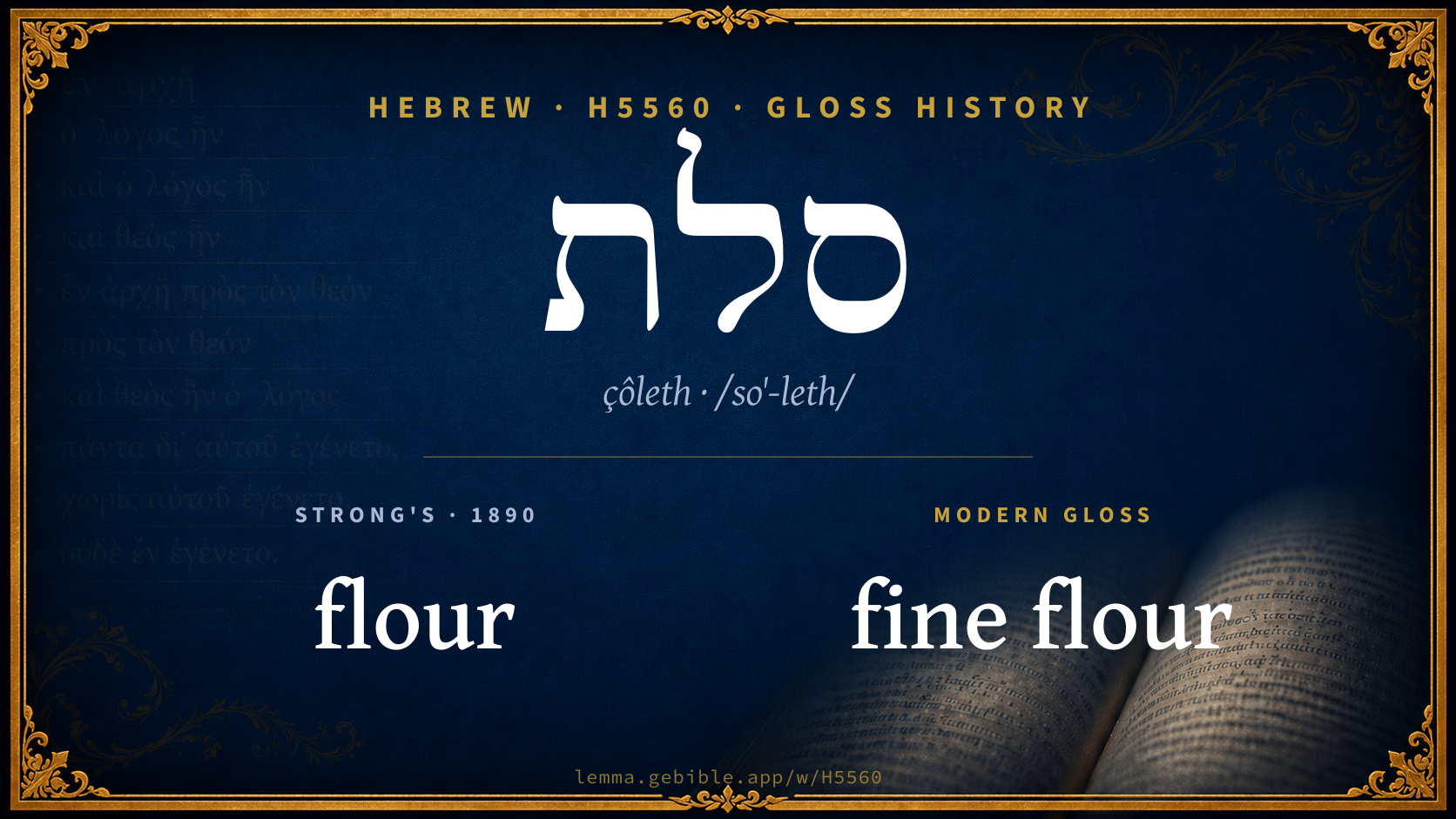
Gloss history
Strong's 1890 vs modern scholarship
About this word
Strong's H5560 catalogs a Hebrew word from the Hebrew Old Testament.
These counts are not copied from any lexicon or concordance. They are computed here, from the morphology-tagged Hebrew Old Testament. What Lemma adds →
- 52
- distinct verses
- The word appears in 52 distinct verses.
- 8 / 39
- OT books
- The word appears in 8 of 39 Old Testament books.
- #709
- by frequency
- Top 1000 most frequent Hebrew words (rank 709 of 8,640 Hebrew words by occurrence).
View all 52 occurrences in the concordance →
By section of the Old Testament
By traditional corpus
Conventional, traditional groupings — biblical authorship is debated, so this is a traditional corpus grouping, not an authorship claim. Each share is this word’s portion of its verses in that division of the Hebrew canon. Each figure is a share of the word’s 52 distinct verses.
- Torah (Pentateuch) 43 verses · 83%
- Prophets (Nevi'im) 7 verses · 13%
- Writings (Ketuvim) 2 verses · 4%
How translations render this word
Counts come from each version’s own published word-to-Strong’s tagging or interlinear alignment — an approximate guide to how each version renders this word, not a word-level alignment the data otherwise carries. Because each total is that version’s own tagged count, the per-version totals vary from one another and need not match the appearance or distinct-verse counts above. These counts may also differ from a printed concordance because Lemma counts each distinctly tagged rendering and does not collapse phrase taggings into a single head-word total. This is a fixed set of word-tagged versions (KJV, ASV, BSB, ULT) and does not change with the reading translation you choose elsewhere. Each version’s license is shown beside its name below (and on Sources).
- King James Version: Fine flour 31×, Flour 10×, Shall be of flour 4×
- American Standard Version: Fine flour 41×, Shall be of fine flour 2×
- Berean Standard Bible: Fine flour 44×, Flour 2×, Must consist of fine flour 2×
- unfoldingWord Literal Text: Flour 30×, Fine flour 12×, Shall be fine flour 4×
King James Version Public Domain
Renders H5560 across 53 tagged occurrences — most commonly:
Plus 4 renderings that appear only once — usually multi-word phrases or single function words the recovered tagging swept in, not distinct renderings.
American Standard Version Public Domain
Renders H5560 across 53 tagged occurrences — most commonly:
Plus 10 renderings that appear only once — usually multi-word phrases or single function words the recovered tagging swept in, not distinct renderings.
Berean Standard Bible Public Domain
Renders H5560 across 53 tagged occurrences — most commonly:
Plus 5 renderings that appear only once — usually multi-word phrases or single function words the recovered tagging swept in, not distinct renderings.
unfoldingWord Literal Text CC BY-SA 4.0
Renders H5560 across 54 tagged occurrences — most commonly:
Plus 6 renderings that appear only once — usually multi-word phrases or single function words the recovered tagging swept in, not distinct renderings.
Senses in BDB
The 1 sense BDB distinguishes for this word, in lexicon order (not ranked by frequency or importance). The full entry — with sub-senses — is in the Lexicon Entry tab.
- fine flour
Word origin
n.f. Lv 2:5 (cf. on gender AlbrechtZAW xvi (1896), 106) fine flour (𝔊 σεμίδαλις, 𝔙 simila) (NH id.; Aramaic סוּלְתָּא; Arabic سُلْتٌ a kind of barley without husks Lane 1401; Assyrian sillatu, or šillatu, a kind of grain (?) Meissner-RostBAS iii. 361; also ṯulṯȧ, ṯuruti̥, flour, as loan-word in Egyptian, Bondi84 WMMAs. u. Eur. 101);—abs. ס׳ Gn 18:6 +, cstr. ס׳ Ex 29:2 +; sf. סָלְתָּהּ Lv 2:2;—fine flour, used in king’s household 1 K 5:2 (‖ קֶמַח), for honoured guests קֶמַח ס׳ Gn 18:6 (J), a se’āh of it sold for a shekel in time of scarcity 2 K 7:1, 16, 18 (v. Benz); luxurious food Ez 16:13, 19 (of Jerus. under fig. of woman); elsewhere only in offerings Ez 46:14; 1 Ch 9:29; 23:29, and P; ס׳ חִטִּים Ex 29:2, ס׳ v 40, Lv 2:1 + 13 times Lv., Nu 6:15 + 26 times Nu.
— Brown-Driver-Briggs (Oxford 1906, public domain), digitized via Sefaria, supplemented by the OpenScriptures HebrewLexicon (CC BY 4.0). See Sources.
Origin: from an unused root meaning to strip
Jastrow Dictionary
A second Hebrew/Aramaic lexicon for comparison, covering Aramaic and post-biblical (Talmudic, Targumic, Midrashic) usage that the biblical-Hebrew BDB does not. Matched by lemma rather than by Strong’s number, so a lemma may carry more than one Jastrow headword (shown separately below), and the entries cover usage well beyond the Bible.
סָלַת
- , Pi. סִילֵּת (denom. of סֹלֶת) to sift, select, produce fine flour. Ter. XI, 5 המְסַלֵּת קב וכ׳ he who gets one or two Kab out of one S’ah of wheat. Y. ib. 47ᵈ bot. מסלת בחטים וכ׳ the priest may sift out of the (flour of) wheat (of T’rumah) as much as he wants (and abandon the rest). Tanḥ. T’tsavveh 5 וסַלֵּית לי מתוכה וכ׳ and get me out of it flour for one loaf (v. גְּלוּסְקָא) fine and well sifted.—Part. pass. מְסוּלָּת, pl. מְסוּלָּתִים. Sifré Deut. 21 מן … מן המס׳ שבכם out of the chosen, out of the select among you, v. בָּרוּר.
סְלַת
- , Pa. סַלֵּית (denom. of סִילְּתָא II) to cut chips, trim. Sabb. 74ᵇ, v. סִילְתָּא. Ib. 150ᵇ ומְסַלְּתִינָן סילתי Rashi (ed. ומסלתיה, corr. acc.; Ms. M. וסַלְּתִינָן) and we chopped kindling wood. Bets. 19ᵇ השתא סַלּוּתֵי מסלתינן וכ׳ since we are permitted to chop kindling wood (during the festive week), can there be a question about offering &c.? B. Kam. 113ᵇ זבין דיקלא … לסַלּוּתֵי Ar. (ed. לצלחא) bought a palm-tree … to cut it for fuel.
סַלָּת
- (סָלַת) flour-sifter, fancy-baker (siliquiarius).—Pl. סַלָּתִים, סַלָּתִין, סִילָּ׳. Kel. XV, 3 ים נפה של סיל׳ (Talm. ed. סילתית) the bakers’ frame for the reception of sifted flour, opp. של בעל הבית. Ib. 4 נפה של סל׳ (Talm. ed. סלתית, corr. acc.). Tosef. Kel. B. Mets. V, 5 (ed. Zuck. סולתין, סלתון, corr. acc.).
סֹלֶת
- , v. סִלְסֵל)
- 1. sifted fine flour. Men. XII, 3 קמח יביא ס׳ if one vows an offering of flour, he must bring fine flour. Sifré Deut. 315 ונושרות סוֹלְתָן וכ׳ and drop their flour on the ground. Cant. R. to I, 1 כל … לא ס׳ is not all of Solomon’s wisdom fine flour (choice)?; a. fr.—Kidd. 69ᵇ; 71ᵇ Ezra did not leave Babylonia, עד שעשאה כס׳ נקיה until he made her (the Jews in Babylonia) like the purest sifted flour, i.e. established the purity of descent of their families by careful investigation (cmp. עִיסָה).—Pl. סֳלָתוֹת. Shek. IV, 3. Ab. Zar. 37ᵇ bot. Esth. R. to I, 14, v. מָרַס; a. fr.
- 2. a dish made of fine flour, pudding. Ber. 37ᵃ (v. Rabb. D. S. a. l. note 20). Y. ib. VI, 10ᵇ; a. e.
סֹלַת
- Targ. O. Ex. XXIX, 2. Targ. O. Gen. XVIII, 6 (ed. Vien. סָלְ׳); a. fr.—Y. Ber. VI, 10ᶜ bot. סלת (ed. Krot. a. oth. סֹלִית), a. סולתא flour-dish, v. preced.
A Dictionary of the Targumim, the Talmud Babli and Yerushalmi, and the Midrashic Literature (Marcus Jastrow; London, Luzac, 1903) — Public Domain. Digitized via Sefaria. Digitized via Sefaria. Full attribution on Sources.
Forms in the corpus
The 15 distinct written forms H5560 takes in the Hebrew Bible, most frequent first — each parse links to that state’s occurrences in the concordance. Hebrew forms include their vowel points and cantillation, so a single lemma takes many written forms.
Septuagint verse parallels
This word appears in 51 verses that also exist in the Greek Old Testament (Septuagint), out of the 52 Hebrew verses it occurs in. You can read those verses in Greek by switching the Old Testament edition to the Septuagint.
Read these verses in the Septuagint
This is a verse-level parallel only — the same verses exist in both the Hebrew and Greek Old Testaments. No word-level Hebrew↔Greek correspondence is claimed: the data carries no such alignment, so no Greek word is shown as this Hebrew word’s translation. Coverage is not total — the Septuagint omits the deuterocanon and renumbers the Psalms, so some Hebrew verses have no direct Greek parallel.