
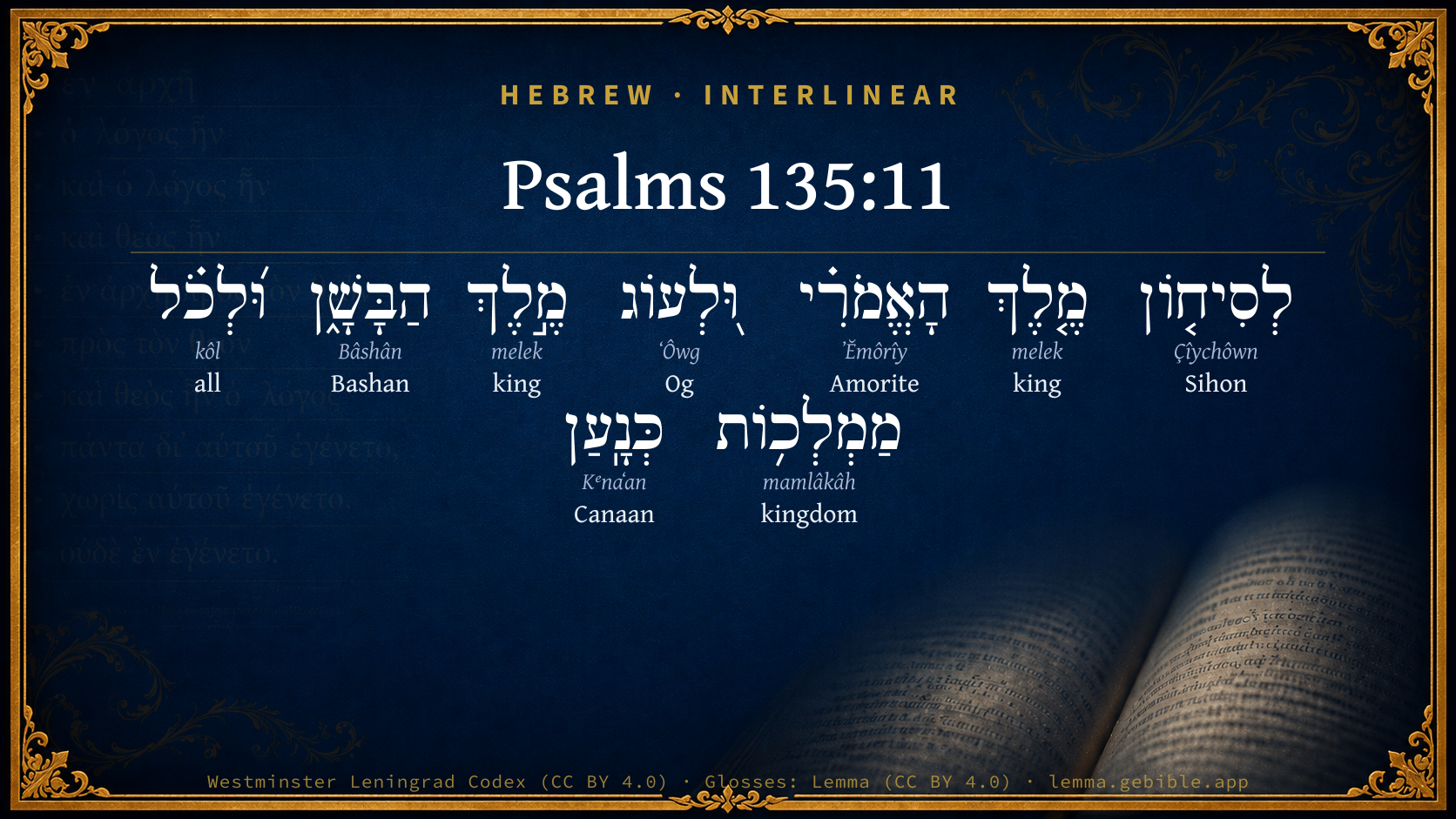
Psalms 135:11

Hebrew (Westminster Leningrad Codex) Psalms 135:11 appears in the Hebrew Old Testament. The text above is from the Westminster Leningrad Codex. Each word links to its Strong’s number, a concise gloss, and parsing drawn from the Open Scriptures Hebrew Bible morphology. Click any word for its full Brown-Driver-Briggs (BDB) entry.
Download image
Cite this verse

Psalms 135:11 (World English Bible). Public Domain. Lemma interlinear Bible study tool, https://lemma.gebible.app/v/psalms/135/11.

Show BibTeX & RIS
BibTeX
RIS
English Translation
Sihon king of the Amorites, Og king of Bashan, And all the kingdoms of Canaan,
World English Bible · Public Domain
Download a study sheet

One document with this verse’s original text, its word-by-word gloss line, the meaning frame, cross-references with their text, attributed commentary, and full source and license credits — printable, and it pastes into notes with its structure intact.

This verse Autodidact and up

Study sheet (.html) Plain text (.txt)

A passage Seminary Student

Up to 50 verses in one chapter. A passage sheet keeps up to 6 commentary sources and 12 cross-references per verse, in the order this page ranks them, and says so on the sheet whenever that leaves anything out. Ask for a single verse and you get the Autodidact verse sheet above.

Everything on this page stays free to read, with no account — the sheet is a download of what is already on screen, not access to it.

Want to remove ads? Support Godless Engineer
Compare translations 3

The same verse in 3 English versions, stacked beneath the original-language interlinear above. Click any original word for its lexicon entry.

Each is an independent rendering of the whole verse — the interlinear is not word-aligned to these translations.

Highlighted words mark where these versions differ — a whole-verse word diff, not a word-by-word alignment.

  • World English Bible Public Domain
    Sihon king of the Amorites, Og king of Bashan, And all the kingdoms of Canaan,
  • King James Version Public Domain
    Sihon king of the Amorites, and Og king of Bashan, and all the kingdoms of Canaan:
  • unfoldingWord Literal Text CC BY-SA 4.0
    Sihon, king of the Amorite, and Og, king of the Bashan, and all the kingdoms of Canaan.

unfoldingWord Literal Text — © unfoldingWord, licensed CC BY-SA 4.0. Word-aligned USFM3 via Door43 (git.door43.org/unfoldingWord/en_ult).

Versions to compare (up to 4)

3 of 4 selected

Show all 17 translations

Every available English version of this verse, each an independent rendering of the whole verse.

  • World English Bible Public Domain
    Sihon king of the Amorites, Og king of Bashan, And all the kingdoms of Canaan,
  • Berean Standard Bible Public Domain
    Sihon king of the Amorites, Og king of Bashan, and all the kings of Canaan.
  • Majority Standard Bible Public Domain
    Sihon king of the Amorites, Og king of Bashan, and all the kings of Canaan.
  • King James Version Public Domain
    Sihon king of the Amorites, and Og king of Bashan, and all the kingdoms of Canaan:
  • American Standard Version (1901) Public Domain
    Sihon king of the Amorites, And Og king of Bashan, And all the kingdoms of Canaan,
  • Revised Version (1885) Public Domain
    Sihon king of the Amorites, and Og king of Bashan, and all the kingdoms of Canaan:
  • Geneva Bible (1599) Public Domain
    As Sihon King of the Amorites, and Og King of Bashan, and all the kingdomes of Canaan:
  • Young's Literal Translation Public Domain
    Even Sihon king of the Amorite, And Og king of Bashan, And all kingdoms of Canaan.
  • Literal Standard Version CC BY-SA 4.0
    Even Sihon king of the Amorite, || And Og king of Bashan, || And all kingdoms of Canaan.
  • Unlocked Literal Bible CC BY-SA 4.0
    Sihon king of the Amorites and Og king of Bashan and all the kingdoms of Canaan.
  • unfoldingWord Literal Text CC BY-SA 4.0
    Sihon, king of the Amorite, and Og, king of the Bashan, and all the kingdoms of Canaan.
  • Darby Bible Public Domain
    Sihon king of the Amorites, and Og king of Bashan, and all the kingdoms of Canaan;
  • World Messianic Bible Public Domain
    Sihon king of the Amorites, Og king of Bashan, and all the kingdoms of Canaan—
  • Webster's Bible Public Domain
    Sihon king of the Amorites, and Og king of Bashan, and all the kingdoms of Canaan:
  • Free Bible Version CC BY-SA 4.0
    Sihon, king of the Amorites, Og, king of Bashan, and all the kings who ruled in Canaan.
  • Bible in Basic English Public Domain
    Sihon, king of the Amorites, and Og, king of Bashan, and all the kingdoms of Canaan;
  • JPS Tanakh (1917) Public Domain
    Sihon king of the Amorites, and Og king of Bashan, and all the kingdoms of Canaan;

Literal Standard Version (2020), Covenant Press — licensed CC BY-SA 4.0. Text via the HelloAO Bible API (eBible.org). Unlocked Literal Bible (unfoldingWord) — licensed CC BY-SA 4.0. Text via the HelloAO Bible API (eBible.org). unfoldingWord Literal Text — © unfoldingWord, licensed CC BY-SA 4.0. Word-aligned USFM3 via Door43 (git.door43.org/unfoldingWord/en_ult). Free Bible Version, Dr. Jonathan Gallagher — licensed CC BY-SA 4.0. Text via the HelloAO Bible API (eBible.org).

Word by word

More ways to search: Search by grammar → Find every occurrence → Compare this word →

Practice this passage: Drill this verse → Learn its vocabulary →

About this verse

These counts appear in no published source. They are computed here, from the morphology-tagged text and Lemma’s own curated glosses. What Lemma adds →

9
words
8
distinct lemmas
Wisdom
section

Notable vocabulary

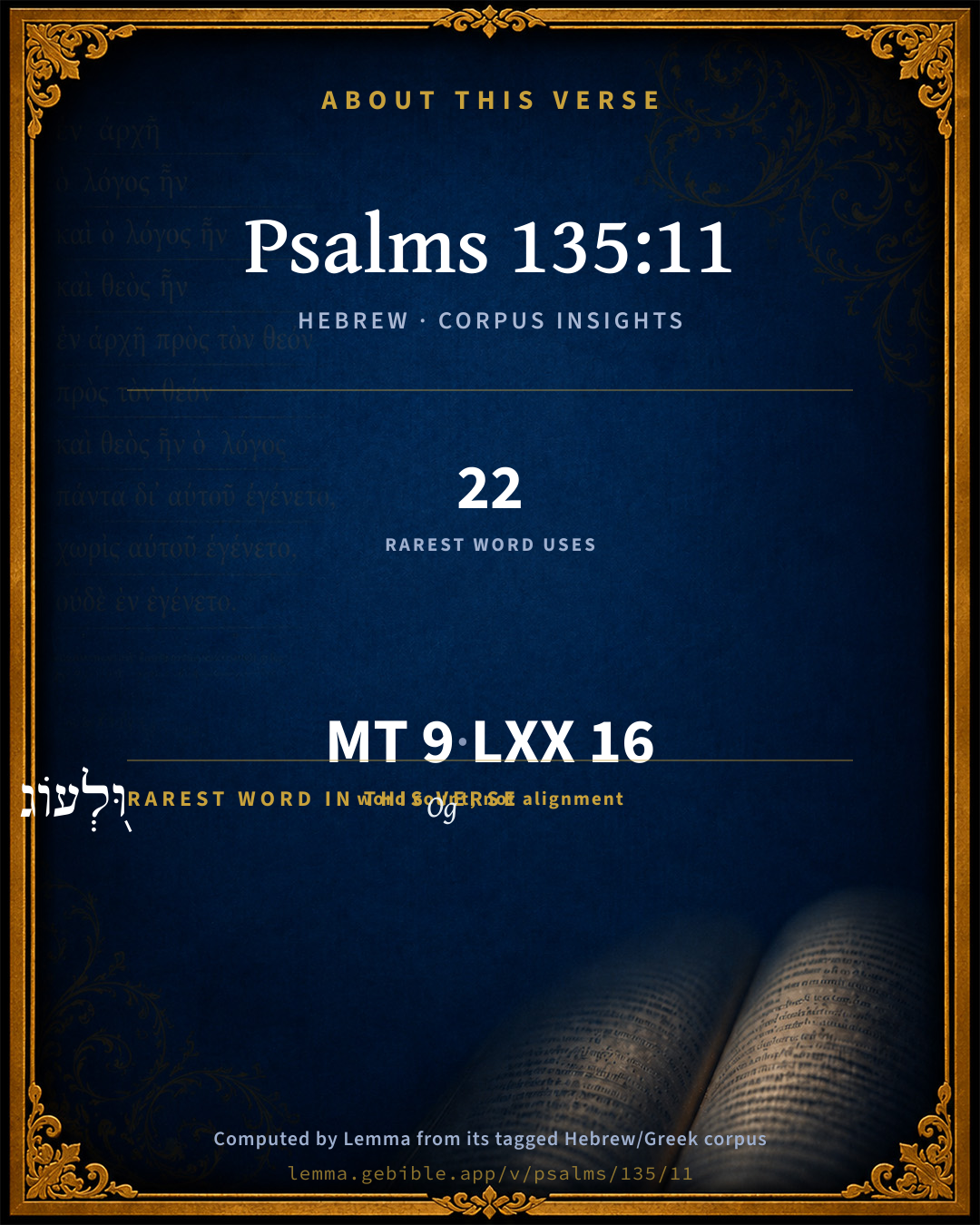
The rarest word here is וּ֭לְעוֹג Og H5747 — appearing just 22 times in the whole Hebrew Bible.

Shared distinctive vocabulary

וּ֭לְעוֹג Og H5747 occurs in 22 verses of the Hebrew Bible. Also found in:

Grammatical profile

  • 9 nouns

Repetition

A word recurs within this verse — often emphatic in Hebrew:

  • מֶ֤לֶךְ king H4428 ×2

Hebrew & Septuagint length

In English translation the verse runs 15 words from the Hebrew and 16 from the Septuagint (LXX English) — closely comparable.

A rough comparison of the two English renderings, which tokenize alike — not a word-level alignment.

Word counts can differ between the Hebrew and the Greek without any difference in meaning — e.g. the Hebrew direct-object marker אֵת has no separate Greek word, and Greek often adds the article ὁ.

In the original languages it is 9 Hebrew tokens and 16 Greek tokens — but the two are counted differently (Hebrew bundles its prefixes and suffixes into one token; the Greek is in lemma form), so that isn’t a like-for-like length.

Cross-references

6

Topical passages linked to Psalms 135:11 in the Treasury of Scripture Knowledge — connected by theme and wording, ordered by reader-vote popularity; previews shown in the World English Bible.

  • Joshua 12:7–24 These are the kings of the land whom Joshua and the children of Israel struck beyond the Jordan westward, from Baal Gad in the valley of Lebanon even to Mount Halak, that goes up to Seir; and Joshua gave it to the tribes of Israel for a possession according to their divisions;
  • Deuteronomy 29:7 When you came to this place, Sihon the king of Heshbon, and Og the king of Bashan, came out against us to battle, and we struck them:
  • Nehemiah 9:22 Moreover you gave them kingdoms and peoples, which you did allot after their portions: so they possessed the land of Sihon, even the land of the king of Heshbon, and the land of Og king of Bashan.
  • Numbers 21:21–35 Israel sent messengers to Sihon king of the Amorites, saying,
  • Deuteronomy 2:30–3:11 But Sihon king of Heshbon would not let us pass by him; for Yahweh your God hardened his spirit, and made his heart obstinate, that he might deliver him into your hand, as at this day.
  • Joshua 10:1–12 Now it happened, when Adoni-zedek king of Jerusalem heard how Joshua had taken Ai, and had utterly destroyed it; as he had done to Jericho and her king, so he had done to Ai and her king; and how the inhabitants of Gibeon had made peace with Israel, and were among them;

Cross-references courtesy of OpenBible.info (CC BY 4.0).

Hebrew and Greek witnesses Masoretic Hebrew ↔ Greek Septuagint

The same verse in the two great witnesses to the Old Testament, shown verse-for-verse.

You’re reading Greek Psalm 134 (Hebrew Psalm 135). The Septuagint counts the superscription, so verse numbers can differ from the Hebrew — chapter-level alignment, not verse-by-verse. Numbering follows Rahlfs.

These are two independent witnesses, not word-aligned to each other, and the Septuagint is shown in lemma (dictionary) form.

Hebrew Psalms 135:11 Masoretic · Westminster Leningrad Codex

לְסִיח֤וֹן מֶ֤לֶךְ הָאֱמֹרִ֗י וּ֭לְעוֹג מֶ֣לֶךְ הַבָּשָׁ֑ן וּ֝לְכֹ֗ל מַמְלְכ֥וֹת כְּנָֽעַן

Sihon king of the Amorites, Og king of Bashan, And all the kingdoms of Canaan,

World English Bible · Public Domain

Greek LXX Greek Psalm 134:11 Septuagint · lemma form

ὁ σηων βασιλεύς ὁ ἀμορραῖος καί ὁ ωγ βασιλεύς ὁ βασαν καί πᾶς ὁ βασιλεία χανάαν

Seon king of the Amorites, and Og king of Basan, and all the kingdoms of Chanaan:

LXX2012 (modern English Septuagint) · Public Domain

Hebrew: Westminster Leningrad Codex (CC BY 4.0). Greek: Septuagint (public domain); English from LXX2012 (modern English Septuagint) (Public Domain). How the Septuagint differs from the Hebrew →

Commentary

Notes on Psalms 135:11 from classic Christian and Jewish commentators (each source and its license shown beneath its notes). The classic Christian expositions comment on the surrounding passage and are grouped to its opening verse, so a note may address several verses; the Jewish commentaries on the Tanakh (Rashi and others) are per-verse, so they appear only where the commentator wrote on this verse.

Lemma curates 59 commentaries, every one of them public domain or Creative Commons licensed, each selected and text-cleaned for this edition rather than reprinted as found. About our sources →

Trapp's Complete Commentary

John Trapp

Psa 135:11 Sihon king of the Amorites, and Og king of Bashan, and all the kingdoms of Canaan:

Ver. 11. Sihon king of the Amorites] A giant like Cyclops.

And Og king of Bashan] Of whom the Jews fable, that, being one of the antediluvian giants, he escaped the flood, by riding astride upon the ark.

John Trapp, A Commentary or Exposition upon All the Books of the Old and New Testament (1647–1656) — public domain. Text from a community e-Sword module.

J. A. Alexander on Psalms

Joseph Addison Alexander

11. (Psa 135:11) Sihon king of the Amorites, and Og king of Bashan, and all the kingdoms of Canaan. Each of these three particulars is preceded in Hebrew by the preposition to or for; and that this is not an inadvertence or an accident, appears from its repetition in the next psalm (Psa 136:19-20). Though not in accordance with the usage of the verb which is construed elsewhere with the verb directly, the particle must be regarded here as an objective sign, as in Psa 129:3, unless we suppose the sense to be, that what had just been said in general is true in particular as to Sihon, as to Og, and as to the kingdoms (here put for the kings) of Canaan.

Joseph Addison Alexander, The Psalms Translated and Explained (1850) — public domain. Text from a community e-Sword module.

The Cambridge Bible for Schools and Colleges

gen. ed. J. J. S. Perowne

11. Sihon and Og, “the two kings of the Amorites,” are mentioned as the first and some of the most formidable enemies whom the Israelites met. See Num_21:21 ff., Num_21:33 ff.; Deu_2:30 ff; Deu_3:1 ff.; and cp. Amo_2:9.

kingdoms] Cp. Deu_3:21; Jos_12:7-24.

The Cambridge Bible for Schools and Colleges (gen. ed. J. J. S. Perowne; Cambridge University Press, 1878–1918) — public domain. Text from a community e-Sword module.

John Gill's Exposition

And gave their land for an heritage,.... The land of the two kings before mentioned, which was given to the Reubenites, and Gadites, and half tribe of Manasseh, Deu 3:12; and the lands belonging to the several kingdoms of Canaan were given to the rest of the tribes;

an heritage unto Israel his people; a type of the heavenly Canaan, the glorious, incorruptible, undefiled, and eternal inheritance; which is of God's free grace, chosen, prepared, and given; even a right unto it, and meetness for it, to the true and spiritual Israel of God, to his special people, his chosen, redeemed, and called ones.

John Gill's Exposition of the Whole Bible (1746–1763) — public domain (CC PDM 1.0). Text via the HelloAO Bible API.

Albert Barnes' Notes on the Bible

Sihon king of the Amorites ... - These are specimens of what was done, or instances of the mighty kings who were subdued. It is not pretended that all were enumerated. The subjugation of these nations and kings showed the power of God, and laid the foundation for praise.

Albert Barnes' Notes on the Bible (1834–1885) — public domain. Text from a community e-Sword/MySword module.

The Treasury of David

Charles H. Spurgeon

Ver. 11. Sihon king of the Amorites, and Og king of Bashan. These two kings were the first to oppose, and they were amongst the most notable of the adversaries: their being smitten is therefore a special object of song for loyal Israelites. The enmity of these two kings was wanton and unprovoked, and hence their overthrow was the more welcome to Israel. Sihon had been victorious in his war with Moab, and thought to make short work with Israel, but he was speedily overthrown: Og was of the race of the giants, and by his huge size inspired the tribes with dread; but they were encouraged by the previous overthrow of Sihon, and soon the giant king fell beneath their sword. And all the kingdoms Of Canaan. Many were these petty principalities, and some of them were populous and valiant; but they all fell beneath the conquering hand of Joshua, for the Lord was with him. Even so shall all the foes of the Lord's believing people in these days be put to the rout: Satan and the world shall be overthrown, and all the hosts of sin shall be destroyed, for our greater Joshua leads forth our armies, conquering and to conquer. Note that in this verse we have the details of matters which were mentioned in the bulk in the previous stanza: it is well when we have sting of mercies in the gross to consider them one by one, and give to each individual blessing a share in our song. It is well to preserve abundant memorials of the Lord's deliverance, so that we not only sing of mighty kings as a class but also of "Sihon king of the Amorites and Og king of Bashan" as distinct persons.

Ver. 11. Sihon king of the Amorites, and Og. Notice is taken of two kings, Sihon and Og, not as being more powerful than the rest, but because shutting up the entrance to the land in front they were the most formidable enemies met with, and the people, besides, were not as yet habituated to war. John Calvin.

Ver. 11. Sihon king of the Amorites. When Israel arrived on the borders of the Promised Land they encountered Sihon. (Nu 21:21.) He was evidently a man of very great courage and audacity. Shortly before the time of Israel's arrival he had dispossessed the Moabites of a splendid territory, driving them south of the natural bulwark of the Arnon with great slaughter and the loss of a great number of captives (Nu 21:26-29). When the Israelite host appears, he does not hesitate or temporize like Balak, but at once gathers his people together and attacks them. But the battle was his last. He and all his host were destroyed, and their district from Arnon to Jabbok became at once the possession of the conqueror.

Josephus (Ant. 4:5,2) has preserved some singular details of the battle, which have not survived in the text either of the Hebrew or 70. He represents the Amorite army as containing every man in the nation fit to bear arms. He states that they were unable to fight when away from the shelter of their cities, and that being especially galled by the slings and arrows of the Hebrews, and at last suffering severely from thirst, they rushed to the stream and to the recesses of the ravine of the Arnon. Into these recesses they were pursued by their active enemy and slaughtered in vast numbers.

Whether we accept these details or not, it is plain, from the manner in which the name of Sihon fixes itself in the national mind, and the space which his image occupies in the official records, and in the later poetry of Israel, that he was a truly formidable chieftain. George Grove, in Smith's Dictionary of the Bible. 1863.

Psalms 135:12*

Charles H. Spurgeon's The Treasury of David (1869–1885) — public domain. Psalms only. Text from a community e-Sword/MySword module.

The Pulpit Commentary

Sihon King of the Amorites. (comp. Num_21:24 Deu_2:33) And Og King of Bashan. (see Num_21:35 Deu_3:3) And all the kingdoms of Canaan. Joshua destroyed thirty-one Canaanite kingdoms. (Jos_12:24)

The Pulpit Commentary (1880–1919), ed. H.D.M. Spence-Jones & Joseph S. Exell — public domain. Text from a community e-Sword module.

Lesson kit

Teaching starters — assembled from the data on this page, not authored interpretation. Every prompt links to the verse data it draws on. Edit before teaching.

Psalms, in the Wisdom, opens this verse with 9 words (8 distinct Hebrew lemmas). Its most distinctive word is ʻÔwg (“Og”). A historical commentator’s framing appears above. Read the whole chapter for the surrounding context.

Discussion questions

  1. How does “Og” (ʻÔwg) shape what this verse is saying?
  2. How does Numbers 21:33, which shares the word «Og», read alongside this verse?
  3. What does the repetition of “king” (2× in this one verse) do in this verse?
  4. The translations on this page render this verse differently — a whole-verse word diff, not a word-by-word alignment. What might account for the different wordings?
  5. Compare how Trapp's Complete Commentary and J. A. Alexander on Psalms read this verse. Where do they agree or differ?

Things to notice

Reading settings

Reading text

Shown beneath each verse's original-language words.

Old Testament
Old Testament edition

Read the OT as the Masoretic Hebrew (MT) or the Greek Septuagint (LXX).

English shown for the Greek Septuagint (in the Hebrew ↔ Greek comparison).

Comparing translations? Open the Compare panel on any verse page to stack up to four side by side.