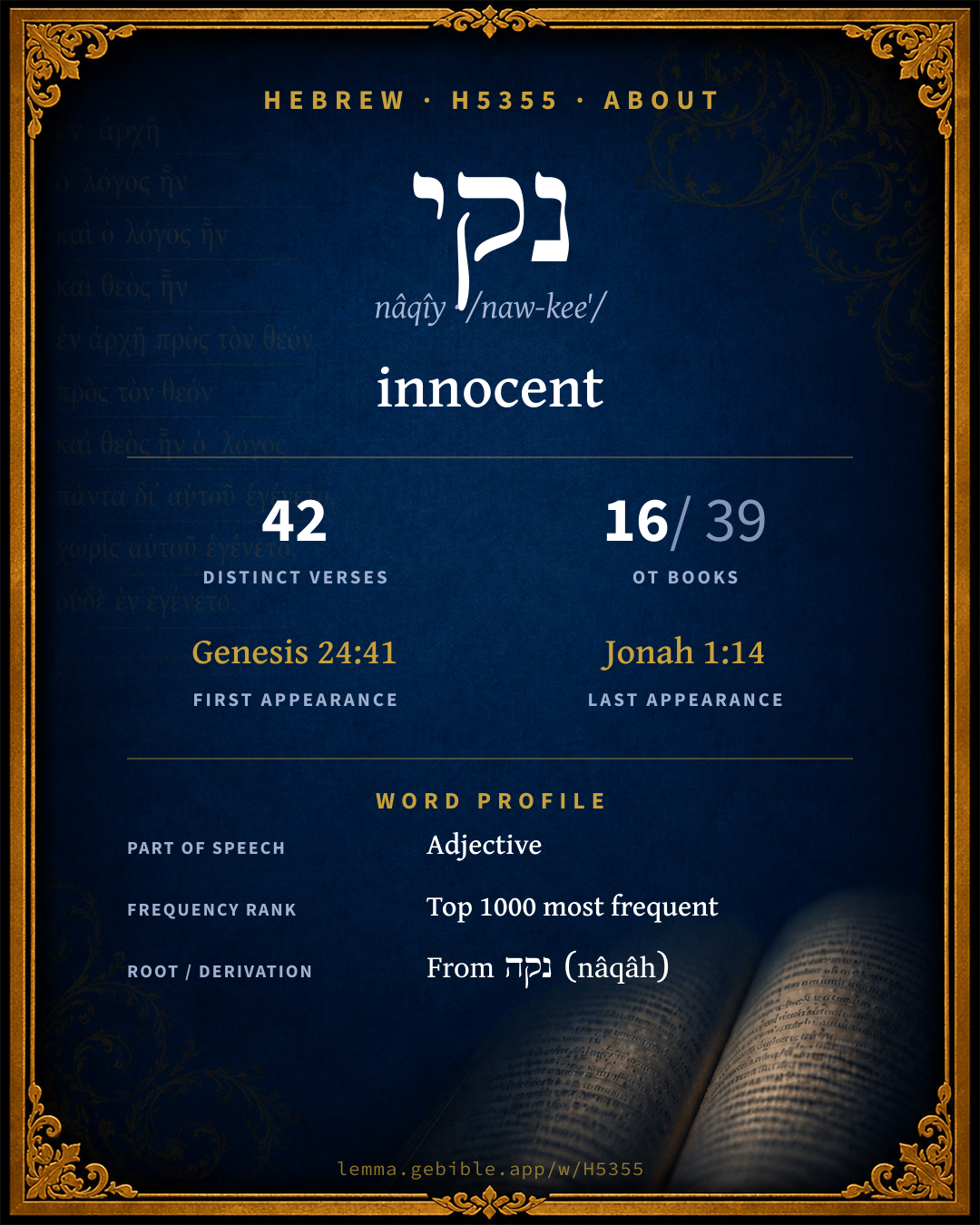
נָקִי
innocent
also: clean, free from, exempt, clear fuller range ↓
Full lexicon entry — Brown-Driver-Briggs (BDB)
From Brown-Driver-Briggs (BDB)
Where this word appears
Grammar key — what these labels mean
Part of speech
- Adjective
- A word that describes or qualifies a noun.
State
- Absolute
- The independent form of a noun, not bound to a following word.
- Construct
- A noun bound to a following noun in a possessive / “of” relationship (the construct chain).
Gender
- Masculine
- Grammatically masculine.
Number
- Singular
- One.
- Plural
- More than one (in Hebrew, generally three or more).
Every verse where H5355 appears in the Book of 2 Kings — 2 distinct verses. Click any verse to open its interlinear word-by-word view. Verse text shown in the World English Bible for context — . Each verse’s Hebrew form is shown with its reference; the English is not keyword-highlighted, since the data carries no word-level English alignment. Use “Compare translations” on any verse to read it across multiple English versions. This concordance covers the Hebrew Bible; Septuagint (Greek Old Testament) occurrences are not indexed here.
2 Kings
- 2 Kings 21:16 נָקִ֜י adj Adjective ms Moreover Manasseh shed innocent blood very much, until he had filled Jerusalem from one end to another; besides his sin with which he made Judah to sin, in doing that which was evil in the sight of Yahweh.
- 2 Kings 24:4 הַ/נָּקִי֙ נָקִ֑י ptcl def.art + Adjective Adjective ms adj Adjective ms and also for the innocent blood that he shed; for he filled Jerusalem with innocent blood: and Yahweh would not pardon.
About this entry
At a glance — auto-summarized from this page’s data, not written by a person. Every figure links to its source below. This summary describes the numbers; it doesn’t interpret them.
נקי (nâqîy) is a Hebrew adjective most often rendered “innocent.” It first appears in Genesis 24:41. The Hebrew Bible uses it across 42 verses — moderately common. Beyond its headline sense, its full sense range takes in “clean”, “free from”, and “exempt”. Sharing its root, it stands alongside נקה, מנקית and נקא. The sections below give every sense, occurrence, and version rendering.
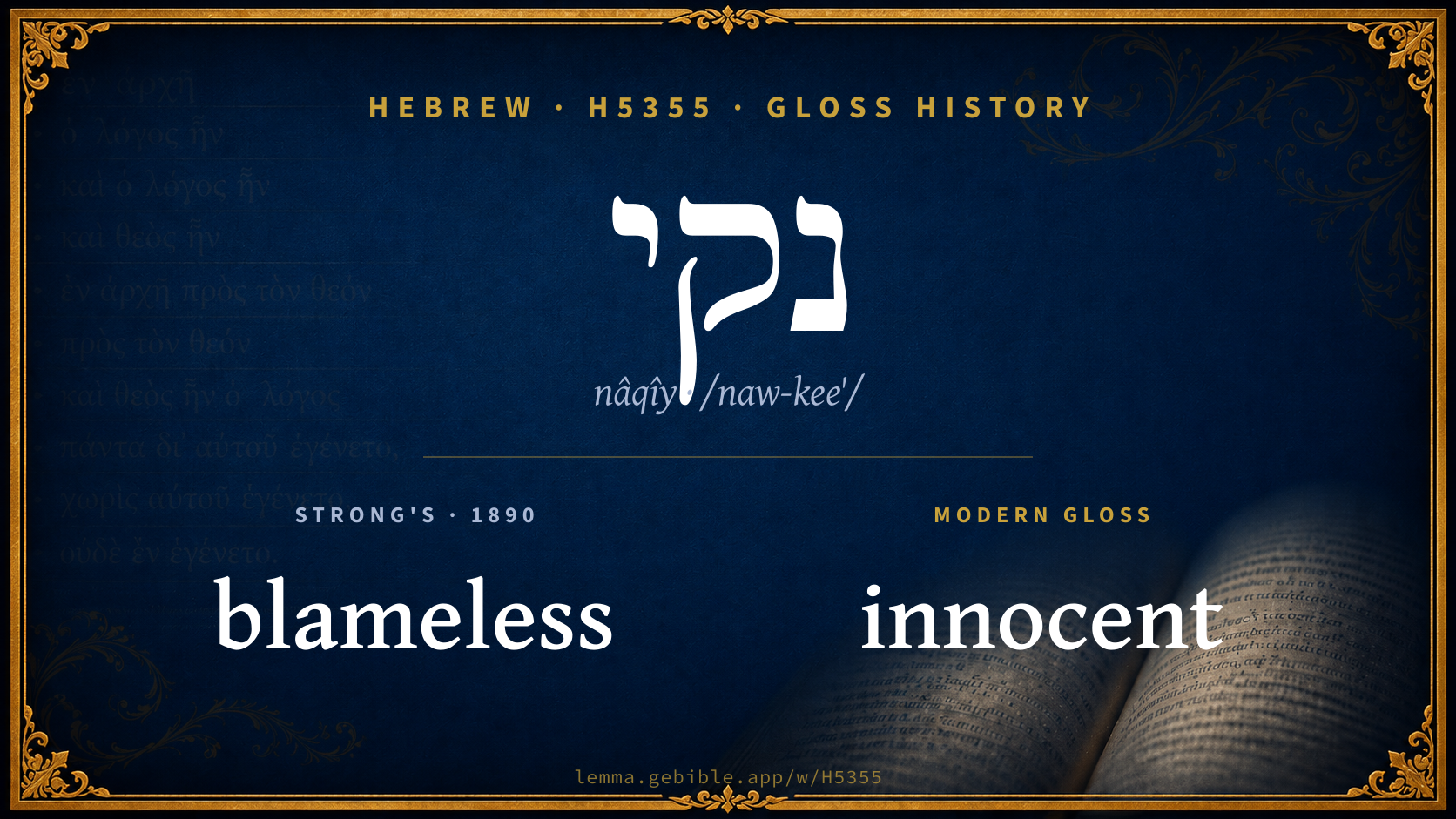
Gloss history
Strong's 1890 vs modern scholarship
About this word
Strong's H5355 catalogs a Hebrew word from the Hebrew Old Testament.
These counts are not copied from any lexicon or concordance. They are computed here, from the morphology-tagged Hebrew Old Testament. What Lemma adds →
- 42
- distinct verses
- The word appears in 42 distinct verses.
- 16 / 39
- OT books
- The word appears in 16 of 39 Old Testament books.
- #837
- by frequency
- Top 1000 most frequent Hebrew words (rank 837 of 8,640 Hebrew words by occurrence).
View all 42 occurrences in the concordance →
Most concentrated in
- Deuteronomy 6 verses 14%
- Job 6 verses 14%
- Jeremiah 6 verses 14%
By section of the Old Testament
By traditional corpus
Conventional, traditional groupings — biblical authorship is debated, so this is a traditional corpus grouping, not an authorship claim. Each share is this word’s portion of its verses in that division of the Hebrew canon. Each figure is a share of the word’s 42 distinct verses.
- Prophets (Nevi'im) 18 verses · 43%
- Writings (Ketuvim) 13 verses · 31%
- Torah (Pentateuch) 11 verses · 26%
How translations render this word
Counts come from each version’s own published word-to-Strong’s tagging or interlinear alignment — an approximate guide to how each version renders this word, not a word-level alignment the data otherwise carries. Because each total is that version’s own tagged count, the per-version totals vary from one another and need not match the appearance or distinct-verse counts above. These counts may also differ from a printed concordance because Lemma counts each distinctly tagged rendering and does not collapse phrase taggings into a single head-word total. This is a fixed set of word-tagged versions (KJV, ASV, BSB, ULT) and does not change with the reading translation you choose elsewhere. Each version’s license is shown beside its name below (and on Sources).
BDB lists this Strong’s number as 2 distinct words (homographs). Each count above pools all of them and is not split by sense — see the Senses section below. A low-frequency rendering may belong to a different one of those words, not the primary meaning.
- King James Version†: Innocent 23×, Be guiltless 2×, Guilt of innocent 2×
- American Standard Version†: Innocent 22×, Be guiltless 2×, We shall be guiltless 2×
- Berean Standard Bible†: Innocent 26×, Free 2×, Guilt of shedding innocent 2×
- unfoldingWord Literal Text†: Innocent 29×
King James Version Public Domain
Renders H5355 across 43† tagged occurrences — most commonly:
Plus 14 renderings that appear only once — usually multi-word phrases or single function words the recovered tagging swept in, not distinct renderings. Not rendered by a distinct English word in 1 further occurrence.
American Standard Version Public Domain
Renders H5355 across 43† tagged occurrences — most commonly:
Plus 17 renderings that appear only once — usually multi-word phrases or single function words the recovered tagging swept in, not distinct renderings.
Berean Standard Bible Public Domain
Renders H5355 across 43† tagged occurrences — most commonly:
Plus 9 renderings that appear only once — usually multi-word phrases or single function words the recovered tagging swept in, not distinct renderings.
unfoldingWord Literal Text CC BY-SA 4.0
Renders H5355 across 47† tagged occurrences — most commonly:
Plus 18 renderings that appear only once — usually multi-word phrases or single function words the recovered tagging swept in, not distinct renderings.
Senses in the full BDB
What do BDB’s symbols mean?
BDB uses these scholarly abbreviations:
| Symbol | Meaning |
|---|---|
| 𝔊 | the Septuagint (the ancient Greek translation, LXX) |
| 𝔙 | the Vulgate (the Latin translation) |
| 𝔖 | the Syriac version (the Peshitta) |
| 𝔗 | the Targum (the Aramaic translation) |
| ψ | the Psalms |
| √ | root (the underlying root or stem) |
| ‖ | parallel passage (a synonymous or contrasted parallel) |
| † | the dagger: every passage where the word occurs is cited |
The 3 senses and sub-senses the full Brown-Driver-Briggs lexicon distinguishes for this word, in lexicon order (not ranked by frequency), with BDB’s own verbatim wording and sub-sense lettering. Shown in Hebrew script with BDB’s own scholarly abbreviations. The condensed entry is in the Lexicon Entry tab. See also the Forms in the corpus table below.
נקי I clean, free from, exempt
- 1. free from guilt, clean, innocent, ‖ צַדִּיק: נָקִי וְצַדִּיק Ex 23:7 (E), נָקִי innocent person Jb 4:7; 17:8; 22:19, 30; 27:17 ψ 10:8; 15:5; Pr 1:11; נקיים Jb 9:23; דם נקי innocent blood, first used in D, Dt 19:10; 27:25; 1 S 19:5; 2 K 21:16; 24:4 ψ 94:21; 106:38; Pr 6:17; Is 59:7; Je 7:6; 22:3; 26:15; דם הנקי Dt 19:13 2 K 24:4 Je 22:17; הדם הנקי Dt 21:9; דם נקיים Je 19:4; נָקִי מִדְּמֵי 2 S 3:28 (+ מֵעִם י׳); נְקִי כַפַּיִם ψ 24:4; אביונים נקיים Je 2:34. e.g. Exodus 23:7
- 2. free from punishment Ex 21:28 (E) 2 S 14:9. e.g. Exodus 21:28
- 3. free, exempt from obligations Gn 44:10 (J); from service in war Nu 32:22 (P; + מִן pers., v. מִן 2 d), Dt 24:5 1 K 15:22 (cf. Arabic نَقِىَّ and WetzstZMG xxii (1868), 129); c. מן, from oaths Gn 24:41 (J) Jos 2:17, 19, 20 (JE). e.g. Genesis 44:10
נקי II innocent
Senses from the full Brown-Driver-Briggs lexicon (Brown, Driver, Briggs; Oxford 1906 — public domain), digitized via Sefaria, supplemented by the OpenScriptures HebrewLexicon (CC BY 4.0). Full attribution on Sources.
Word origin
I. adj. clean, free from, exempt;—נ׳ Gn 24:41 + 31 times; cstr. נְקִי ψ 24:4; pl. נְקִיִּים Je 2:34; נְקִיִּם Gn 44:10 + 6 times;—
I. adj. innocent;—דָּם נָקִיא innocent blood Jo 4:19 Jon 1:14 (both Kt; Qr נָקִי).
— Brown-Driver-Briggs (Oxford 1906, public domain), digitized via Sefaria, supplemented by the OpenScriptures HebrewLexicon (CC BY 4.0). See Sources.
Derived from נקה (nâqâh) (H5352) — to be pure.
Jastrow Dictionary
A second Hebrew/Aramaic lexicon for comparison, covering Aramaic and post-biblical (Talmudic, Targumic, Midrashic) usage that the biblical-Hebrew BDB does not. Matched by lemma rather than by Strong’s number, so a lemma may carry more than one Jastrow headword (shown separately below), and the entries cover usage well beyond the Bible.
נָקַאי
- Nacai (Lucas, v. Neub., v. Neub. Stud. Bibl. I, p. 61); נ׳ ספרא N. the scribe (or teacher). Gen. R. s. 79 שמע קליה דנ׳ ס׳ he heard N. say; Koh. R. to X, 8 קליה דינ׳ ס׳; Yalk. Gen. 133 דנקא׳; Pesik. B’shall., p. 90ᵃ דמינקי (corr. acc.).
- 2. N., one of the disciples of Jesus of Nazareth. Snh. 43ᵃ Ms. M. a. early eds. (v. נֵצֶר IV).
נקי
- (b. h.) [to be rubbed off, be white,] to be clean, clear (cmp. זָכָה).
- 1. to cleanse. Ex. R. s. 1 ומְנַקֶּה אותם and cleansed them (the new-born); Yalk. ib. 164; Yalk. Ez. 354; (Sot. 11ᵇ מנקיר). B. Kam. 93ᵇ פשתן ונִיקָּהוּ if he stole flax and cleansed (bleached) it; Tosef. ib. X, 2; a. e.
- 2. to clear, let go unpunished. Yoma 86ᵃ (ref. to Ex. XXXIV, 7) מנקה הוא וכ׳ he clears the repentant sinners &c. Tem. 3ᵇ. Pesik. R. s. 42 כדי לנַקּוֹת את שרה in order to clear Sarah (from suspicion); a. fr.—Part. pass. מְנוּקֶּה, pl. מְנוּקִּין clear, clean, bare. Snh. 49ᵃ מנ׳ מגזל innocent of robbery. Sot. 28ᵃ. Snh. 36ᵇ, a. e. כשם שב"ד מנ׳ בצדק … מנ׳ מכל מום as the judges must be clear (from suspicion) as to righteousness, so must they be clear of every blemish (of descent). Gitt. 86ᵃ מ׳ מכל מום free from all objectionable qualities; a. e. e.g. Exodus 34:7
- to be cleared, vindicated. Tosef. Sot. II, 3 שנ׳ ונקתה נִקְּתָה מכל פורעניות וכ׳ (v. ed. Zuck. note) the text says (Num. V, 28) ‘and she shall be cleared’, she shall be cleared (released) from all the evils which might come upon her deservedly (because she gave rise to suspicion through her conduct). Ib. שניקללה ניוולה (Var. שניקל) read: שניקתה בניוולה she is released from further visitation (being sufficiently punished) by her exposure to disgrace. Pesik. R. l. c. היאך … מִתְנַקֵּת by what severe means has Sarah been vindicated! e.g. Numbers 5:28
- to clear, remove. Kidd. 62ᵃ (ref. to הִנָּקִי, Num. V, 19) הַנְקִי כתיב it may be read hanḳi, clear thy life out of thy body (die, if thou art guilty); v. חָנַק. e.g. Numbers 5:19
נְקֵי
- [Targ. Prov. XVII, 3, v. בְּקָא.]
- to cleanse, clear. Targ. Is. I, 25.—Keth. 87ᵃ נַקִּו נפשך בשבועתא clear thyself by means of an oath. Part. pass. מְנַקֵּי. Ib. מְנַקִּית משבועתא thou art free from the obligation of an oath.
- to be cleansed. Targ. Ez. XVI, 4; v. נְקַר II.
נָּקִי I
- preced.) clean, clear; bare. Tosef. Toh. III, 8, opp. מלוכלך. Pes. 22ᵇ (ref. to Ex. XXI, 28) as one says to his neighbor יצא פלוני נ׳ מנכסיו that man went out of his possessions empty-handed; B. Kam. 41ᵃ. Ib. 41ᵇ נ׳ מחצי כופר free from paying the half-fine. Taan. 23ᵃ (ref. to Job XXII, 30) דור שלא היה נ׳ וכ׳ thou hast saved with thy prayer a generation which was not clear from sin. Y. Meg. I, 71ᶜ; Y. Ber. II, 4ᵈ top (ref. to Koh. V, 17) שמור … שתהא טהור ונ׳ guard thy foot, that thou be pure and guiltless when thou art called to the house of God; a. fr.—Erub. 62ᵇ, a. fr. קב ונ׳ only a Kab (little in quantity), but well-sifted (v. infra).—(Adv.) נְקֵי נדר, נ׳ שבועה without vow (as an oath), without oath; or: cleared by means of a vow &c. Keth. 87ᵃ.—Pl. נְקִיִּים, נְקִיִּין. Gen. R. s. 98, v. נִקָּיוֹן. Gitt. IX, 10 נְקִיֵּי הדעת the pure-minded; a. e.—Fem. נְקִיָּה, נְקִיָּיה. Nidd. 31ᵇ נ̇ק̇ב̇ה̇ נ̇ק̇ייה ב̇אה a female comes into the world poor (without the means of making a livelihood). Y. Maasr. II, 49ᵈ דעתו נ׳ his mind is clear (he is wise). Y. Ḥag. II, 77ᵇ top אין דעתן נ׳ their minds are not clear enough (for esoteric wisdom). Num. R. s. 9 כדי שתהיי נ׳ לבעליך וכ׳ in order that thou be clean for thy husband through these waters. Y. Shek. V, 48ᵈ bot. פת נ׳ bread of fine (sifted) flour; Pes. 37ᵃ, v. הַדְרָאָה. Kidd. 82ᵇ אומנות נ׳ וקלה a cleanly and easy trade; Tosef. ib. V, 15; a. fr. e.g. Exodus 21:28
נָקִי II
- (preced.) a young lamb (v. Syr. נקיא, P. Sm. 2446). Sabb. 54ᵃ; Shebu. 6ᵇ, v. כָּבַן.
נָקַי
- , v. נָקַאי
A Dictionary of the Targumim, the Talmud Babli and Yerushalmi, and the Midrashic Literature (Marcus Jastrow; London, Luzac, 1903) — Public Domain. Digitized via Sefaria. Digitized via Sefaria. Full attribution on Sources.
Forms in the corpus
The 26 distinct written forms H5355 takes in the Hebrew Bible, most frequent first — each parse links to that state’s occurrences in the concordance. Hebrew forms include their vowel points and cantillation, so a single lemma takes many written forms.
Same root — word family
Other BDB entries built from the same root as H5355, grouped by Strong’s listed origin. These share a root / origin per the lexicon — not necessarily a shared meaning. Each links to that word’s own entry.
Derives from
Shares the same root
Compare all same-root words → Showing 4 of 5 — not the complete family. They share a root, not necessarily a meaning.
Septuagint verse parallels
This word appears in 39 verses that also exist in the Greek Old Testament (Septuagint), out of the 42 Hebrew verses it occurs in. You can read those verses in Greek by switching the Old Testament edition to the Septuagint.
Read these verses in the Septuagint
- Genesis 24:41
- Exodus 21:28
- Numbers 32:22
- Deuteronomy 19:10
- Joshua 2:17
- 1 Samuel 19:5
- 2 Samuel 3:28
- 1 Kings 15:22
- 2 Kings 21:16
- Job 4:7
- Psalms 15:5
- Proverbs 1:11
This is a verse-level parallel only — the same verses exist in both the Hebrew and Greek Old Testaments. No word-level Hebrew↔Greek correspondence is claimed: the data carries no such alignment, so no Greek word is shown as this Hebrew word’s translation. Coverage is not total — the Septuagint omits the deuterocanon and renumbers the Psalms, so some Hebrew verses have no direct Greek parallel.