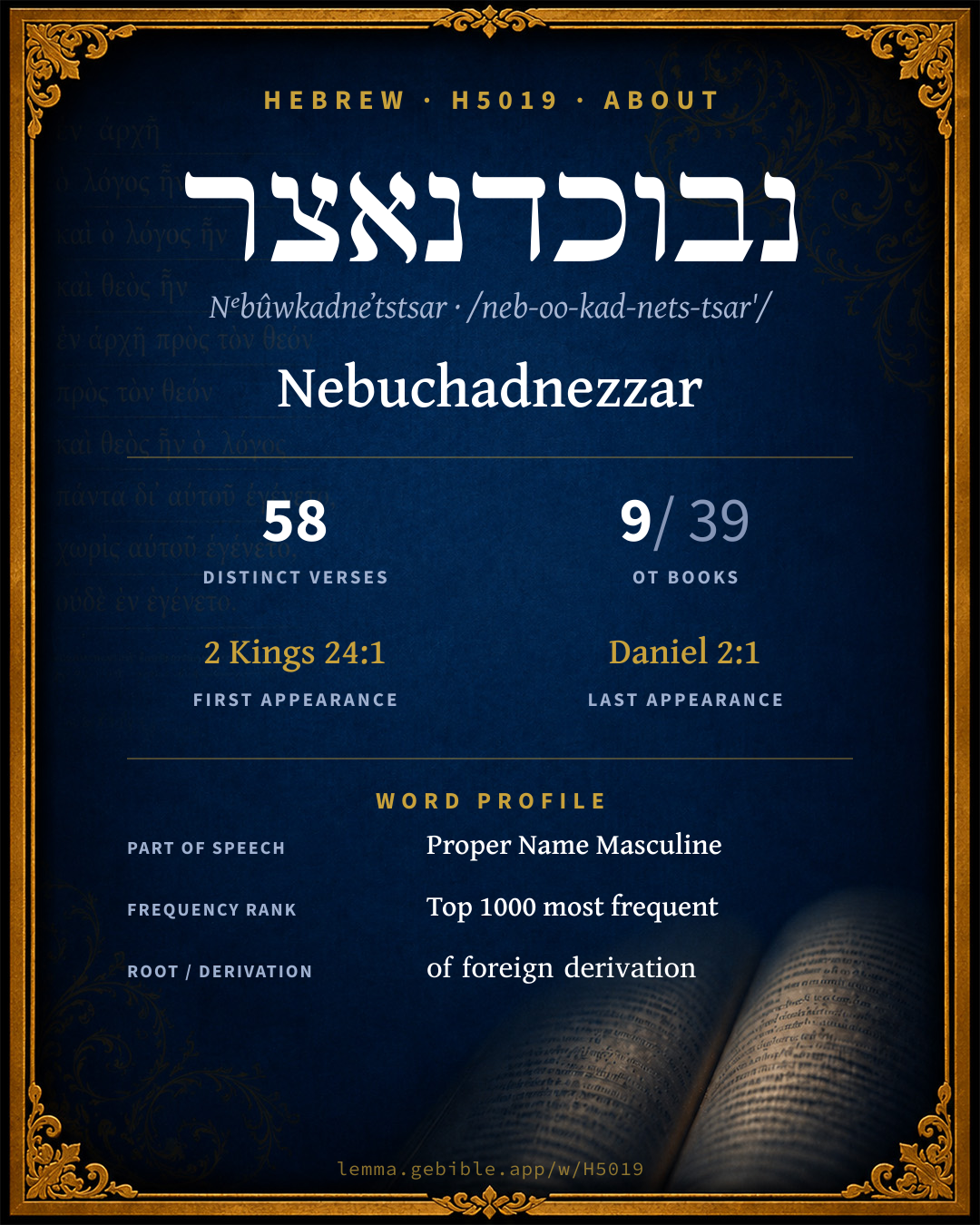
נְבוּכַדְרֶאצַּר
Nebuchadnezzar
BDB lists 2 entries for ‘Nebuchadnezzar’ fuller range ↓
Full lexicon entry — Brown-Driver-Briggs (BDB)
From Brown-Driver-Briggs (BDB)
Where this word appears
Grammar key — what these labels mean
Part of speech
- Noun
- A naming word — a person, place, thing, or idea.
Noun type
- Proper
- A name of a specific person, place, or people (e.g. Abraham, Zion, Israel).
Every verse where H5019 appears in the Book of Nehemiah — 1 distinct verse. Click any verse to open its interlinear word-by-word view. Verse text shown in the World English Bible for context — . Each verse’s Hebrew form is shown with its reference; the English is not keyword-highlighted, since the data carries no word-level English alignment. Use “Compare translations” on any verse to read it across multiple English versions. This concordance covers the Hebrew Bible; Septuagint (Greek Old Testament) occurrences are not indexed here.
Nehemiah
About this entry
At a glance — auto-summarized from this page’s data, not written by a person. Every figure links to its source below. This summary describes the numbers; it doesn’t interpret them.
At its core, נבוכדנאצר (Nᵉbûwkadneʼtstsar) means “Nebuchadnezzar.” The word gravitates to Jeremiah (64%), then 2 Kings and 2 Chronicles. It appears 58 verses across 9 books of the Hebrew Bible, among its moderately common vocabulary. Scripture first uses it in 2 Kings 24:1. Each statement above links to its evidence; the full detail follows below.
Gloss history
Strong's 1890 vs modern scholarship
About this word
Strong's H5019 catalogs a Hebrew word from the Hebrew Old Testament.
These counts are not copied from any lexicon or concordance. They are computed here, from the morphology-tagged Hebrew Old Testament. What Lemma adds →
- 58
- distinct verses
- The word appears in 58 distinct verses.
- 9 / 39
- OT books
- The word appears in 9 of 39 Old Testament books.
- #639
- by frequency
- Top 1000 most frequent Hebrew words (rank 639 of 8,640 Hebrew words by occurrence).
View all 58 occurrences in the concordance →
Most concentrated in
- Jeremiah 37 verses 64%
- 2 Kings 6 verses 10%
- 2 Chronicles 4 verses 7%
By section of the Old Testament
By traditional corpus
Conventional, traditional groupings — biblical authorship is debated, so this is a traditional corpus grouping, not an authorship claim. Each share is this word’s portion of its verses in that division of the Hebrew canon. Each figure is a share of the word’s 58 distinct verses.
- Prophets (Nevi'im) 47 verses · 81%
- Writings (Ketuvim) 11 verses · 19%
How translations render this word
Counts come from each version’s own published word-to-Strong’s tagging or interlinear alignment — an approximate guide to how each version renders this word, not a word-level alignment the data otherwise carries. Because each total is that version’s own tagged count, the per-version totals vary from one another and need not match the appearance or distinct-verse counts above. These counts may also differ from a printed concordance because Lemma counts each distinctly tagged rendering and does not collapse phrase taggings into a single head-word total. This is a fixed set of word-tagged versions (KJV, ASV, BSB, ULT) and does not change with the reading translation you choose elsewhere. Each version’s license is shown beside its name below (and on Sources).
- King James Version: Nebuchadnezzar 28×, Nebuchadrezzar 28×
- American Standard Version: Nebuchadnezzar 27×, Nebuchadrezzar 26×
- Berean Standard Bible: Nebuchadnezzar 50×, Nebuchadnezzar’s 4×
- unfoldingWord Literal Text: Nebuchadnezzar 34×
King James Version Public Domain
Renders H5019 across 60 tagged occurrences — most commonly:
Plus 4 renderings that appear only once — usually multi-word phrases or single function words the recovered tagging swept in, not distinct renderings.
American Standard Version Public Domain
Renders H5019 across 59 tagged occurrences — most commonly:
Plus 6 renderings that appear only once — usually multi-word phrases or single function words the recovered tagging swept in, not distinct renderings.
Berean Standard Bible Public Domain
Renders H5019 across 58 tagged occurrences — most commonly:
Plus 4 renderings that appear only once — usually multi-word phrases or single function words the recovered tagging swept in, not distinct renderings.
unfoldingWord Literal Text CC BY-SA 4.0
Renders H5019 across 34 tagged occurrences — most commonly:
Senses in BDB
The 2 senses BDB distinguishes for this word, in lexicon order (not ranked by frequency or importance). The full entry — with sub-senses — is in the Lexicon Entry tab.
- Nebuchadnezzar or Nebuchadrezzar = "may Nebo protect the crown"
- the great king of Babylon who captured Jerusalem and carried Judah captive
Word origin
and (incorrectly) נְבוּכַדְנֶאצַּר (v. also infr.) n.pr.m. Nebuchadrezzar, Nebuchadnezzar (Bab. Nabû-kudurri-uṣur = (prob.) Nebo, protect the boundary! DlCalwer BL BudgeNebuchadn. (on kudurru, boundary, v DlHWB 319); poss. is also crown, and so SchrCOT 2 K 24, 1; JägerBAS i. 471 proposes (thy) servant);—𝔊 Ναβον-χοδονοσ(σ)ορ; Can. Ptol Ναβοκολασσαρον SchrCOT 490, Abydenos etc. Ναβουκοδρόσορος, v. Schrib. 2 K 24, 1;—the great king of Babylon (reigned b. c. 605–562), who captured Jerus. and carried Judah captive: most often נְבוּכַדְרֶאצַּר מֶלֶךְ בָּבֶל (נ׳ often om. in 𝔊 Je 21:2, 7 (but om. 𝔊 Gie), 22:25; 25:1, 9; 29:21; 32:28; 34:1 (v. Baer’s note; van d. H נבוכדנ׳), 35:11; 37:1; 39:1, 5 (v. on 34:1), v 11 43:10; 44:30; 46:2, 13, 26; 49:30; 50:17; 51:34; 52:4, 12 Ez 26:7; 29:18, 19, 30:10; so Qr Je 49:28 (Kt נבוכדראצור מ׳ ב׳); נְבוּכַדְרֶאצַּר֑ (מֶלֶךְ בָּבֶל om.) Je 32:1; 52:28, 29, 30. Spelt corruptly with n, נְבוּכַדְנֶאצַּר מ׳ ב׳ (cf. SchrCOT 2 K 24, 1 n.) 2 Ch 36:6 Dn 1:1 Je 27:6, 8, 20; 28:3; 29:3 Ezr 2:1 Qr (Kt נבוכדנצור מ׳ ב׳, cf. Je 49:28 supr.); נְבוּכַדְנֶאצַּר alone 2 Ch 36:7, 10, 13 (הַמֶּלֶךְ נ׳), Je 29:1; נְבֻכַדְנֶאצַּר מ׳ ב׳ 2 K 24:1, 10, 11; 25:1, 8, 22 Je 28:11, 14; נְבֻכַדְנֶאצַּר֑ 1 Ch 5:41; נְבוּכַדְנֶצַּר מ׳ ב׳ Ne 7:6 Est 2:6; נְבוּכַדְנֶצַּר Ezr 1:7 (מ׳ ב׳ om.), נְבֻכַדְנֶצַּר Dn 2:1(×2), נְבֻכַדְנֶצַּר֑ 1:18 (v. also Tobit 14:5, Jud 1:1 + often, as 𝔊 supr.)—On N. v. further TieleBab.-Assyrian Gesch, 421 ff., 454 ff.
— Brown-Driver-Briggs (Oxford 1906, public domain), digitized via Sefaria, supplemented by the OpenScriptures HebrewLexicon (CC BY 4.0). See Sources.
Origin: of foreign derivation
Jastrow Dictionary
A second Hebrew/Aramaic lexicon for comparison, covering Aramaic and post-biblical (Talmudic, Targumic, Midrashic) usage that the biblical-Hebrew BDB does not. Matched by lemma rather than by Strong’s number, so a lemma may carry more than one Jastrow headword (shown separately below), and the entries cover usage well beyond the Bible.
נְבוּכַדְנֶאצַּר
- (also in two words נבו כ׳) (b. h.) Nebuchadnezzar, king of Babylonia. Ber. 57ᵇ ראה ביתו של נ׳ when one sees the ruined palace of N. Ib., a. fr. נ׳ הרשע. Ex. R. s. 8 (among the four kings that declared themselves gods); a. v. fr.
A Dictionary of the Targumim, the Talmud Babli and Yerushalmi, and the Midrashic Literature (Marcus Jastrow; London, Luzac, 1903) — Public Domain. Digitized via Sefaria. Digitized via Sefaria. Full attribution on Sources.
Forms in the corpus
The 39 distinct written forms H5019 takes in the Hebrew Bible, most frequent first — each parse links to that state’s occurrences in the concordance. Hebrew forms include their vowel points and cantillation, so a single lemma takes many written forms.
| Form | Parsing | Example | Uses |
|---|---|---|---|
| נְבוּכַדְרֶאצַּ֥ר | Noun, Proper | Ezekiel 30:10 | 6 |
| נְבוּכַדְרֶאצַּ֣ר | Noun, Proper | Ezekiel 29:18 | 4 |
| נְבֽוּכַדְרֶאצַּ֣ר | Noun, Proper | Jeremiah 25:9 | 3 |
| נְבוּכַדְנֶאצַּ֖ר | Noun, Proper | Esther 2:6 | 3 |
| נְבוּכַדְרֶאצַּ֧ר | Noun, Proper | Ezekiel 26:7 | 3 |
| נְבֻכַדְנֶאצַּ֥ר | Noun, Proper | 2 Kings 24:10 | 2 |
| נְבֽוּכַדְנֶאצַּר֙ | Noun, Proper | 2 Chronicles 36:13 | 2 |
| נְבֽוּכַדְרֶאצַּ֥ר | Noun, Proper | Jeremiah 32:28 | 2 |
| נְבֽוּכַדְרֶאצַּר֙ | Noun, Proper | Jeremiah 46:2 | 2 |
| נְבוּכַדְנֶאצַּ֥ר | Noun, Proper | 2 Kings 24:11 | 2 |
| נְבוּכַדְרֶאצַּ֤ר | Noun, Proper | Jeremiah 43:10 | 2 |
| נְבוּכַדְרֶאצַּ֨ר | Noun, Proper | Jeremiah 39:1 | 2 |
| וּ/נְבוּכַדְרֶאצַּ֣ר | Noun, Proper | Jeremiah 34:1 | 1 |
| לִ/נְבֽוּכַדְרֶאצַּ֑ר | Noun, Proper | Jeremiah 52:29 | 1 |
| לִ/נְבֽוּכַדְרֶאצַּ֖ר | Noun, Proper | Jeremiah 25:1 | 1 |
| לִ/נְבֽוּכַדְרֶאצַּֽר | Noun, Proper | Jeremiah 32:1 | 1 |
| לִ/נְבֽוּכַדְרֶאצַּר֒ | Noun, Proper | Jeremiah 52:30 | 1 |
| לִ/נְבוּכַדְרֶאצַּ֥ר | Noun, Proper | Ezekiel 29:19 | 1 |
| נְבֻֽכַדְנֶאצַּ֣ר | Noun, Proper | Jeremiah 28:11 | 1 |
| נְבֻֽכַדְנֶצַּ֔ר | Noun, Proper | Daniel 2:1 | 1 |
| נְבֻֽכַדְנֶצַּ֖ר | Noun, Proper | Daniel 2:1 | 1 |
| נְבֻכַדְנֶאצַּ֖ר | Noun, Proper | 2 Kings 24:1 | 1 |
| נְבֻכַדְנֶאצַּ֣ר | Noun, Proper | 2 Kings 25:8 | 1 |
| נְבֻכַדְנֶאצַּ֨ר | Noun, Proper | 2 Kings 25:1 | 1 |
| נְבֻכַדְנֶאצַּֽר | Noun, Proper | 1 Chronicles 6:15 | 1 |
| נְבֻכַדְנֶצַּֽר | Noun, Proper | Daniel 1:18 | 1 |
| נְבֽוּכַדְנֶאצַּ֔ר | Noun, Proper | 2 Chronicles 36:10 | 1 |
| נְבֽוּכַדְנֶאצַּ֖ר | Noun, Proper | 2 Kings 25:22 | 1 |
| נְבֽוּכַדְנֶאצַּ֛ר | Noun, Proper | Jeremiah 29:1 | 1 |
| נְבֽוּכַדְנֶצַּר֙ | Noun, Proper | Ezra 1:7 | 1 |
| נְבֽוּכַדְרֶאצַּ֑ר | Noun, Proper | Jeremiah 52:28 | 1 |
| נְבוּכַדְנֶאצַּ֛ר | Noun, Proper | Jeremiah 29:3 | 1 |
| נְבוּכַדְנֶאצַּ֣ר | Noun, Proper | Jeremiah 27:8 | 1 |
| נְבוּכַדְנֶאצַּ֧ר | Noun, Proper | Daniel 1:1 | 1 |
| נְבוּכַדְנֶצַּ֖ר | Noun, Proper | Nehemiah 7:6 | 1 |
| נְבוּכַדְרֶאצַּ֖ר | Noun, Proper | Jeremiah 50:17 | 1 |
| נְבוּכַדְרֶאצַּר֮ | Noun, Proper | Jeremiah 51:34 | 1 |
| נְבוּכַדנֶאצַּ֤ר | Noun, Proper | Jeremiah 28:3 | 1 |
| נבוכדראצור | Noun, Proper | Jeremiah 49:28 | 1 |
Same root — word family
Other BDB entries built from the same root as H5019, grouped by Strong’s listed origin. These share a root / origin per the lexicon — not necessarily a shared meaning. Each links to that word’s own entry.
Proper names from this root
People and places named from this root — a name, not an additional meaning of the word.
Compare all same-root words → 1 of the same-root words is a proper name (a person or place). They share a root, not necessarily a meaning.
Bible dictionary
Public-domain dictionary articles matched to this entry by name (Nebuchadnezzar). A biblical name can be shared by more than one person or place, so an article may treat several.
Easton's Bible Dictionary · M. G. Easton, 1897
In the Babylonian orthography Nabu-kudur-uzur, which means "Nebo, protect the crown!" or the "frontiers." In an inscription he styles himself "Nebo's favourite." He was the son and successor of Nabopolassar, who delivered Babylon from its dependence on Assyria and laid Nineveh in ruins. He was the greatest and most powerful of all the Babylonian kings. He married the daughter of Cyaxares, and thus the Median and Babylonian dynasties were united.
Necho II., the king of Egypt, gained a victory over the Assyrians at Carchemish. (See JOSIAH; MEGIDDO.) This secured to Egypt the possession of the Syrian provinces of Assyria, including Palestine. The remaining provinces of the Assyrian empire were divided between Babylonia and Media. But Nabopolassar was ambitious of reconquering from Necho the western provinces of Syria, and for this purpose he sent his son with a powerful army westward (Dan. 1:1). The Egyptians met him at Carchemish, where a furious battle was fought, resulting in the complete rout of the Egyptians, who were driven back (Jer. 46:2-12), and Syria and Phoenicia brought under the sway of Babylon (B.C. 606). From that time "the king of Egypt came not again any more out of his land" (2 Kings 24:7). Nebuchadnezzar also subdued the whole of Palestine, and took Jerusalem, carrying away captive a great multitude of the Jews, among whom were Daniel and his companions (Dan. 1:1, 2; Jer. 27:19; 40:1).
Three years after this, Jehoiakim, who had reigned in Jerusalem as a Babylonian vassal, rebelled against the oppressor, trusting to help from Egypt (2 Kings 24:1). This led Nebuchadnezzar to march an army again to the conquest of Jerusalem, which at once yielded to him (B.C. 598). A third time he came against it, and deposed Jehoiachin, whom he carried into Babylon, with a large portion of the population of the city, and the sacred vessels of the temple, placing Zedekiah on the throne of Judah in his stead. He also, heedless of the warnings of the prophet, entered into an alliance with Egypt, and rebelled against Babylon. This brought about the final siege of the city, which was at length taken and utterly destroyed (B.C. 586). Zedekiah was taken captive, and had his eyes put out by order of the king of Babylon, who made him a prisoner for the remainder of his life.
An onyx cameo, now in the museum of Florence, bears on it an arrow-headed inscription, which is certainly ancient and genuine. The helmeted profile is said (Schrader) to be genuine also, but it is more probable that it is the portrait of a usurper in the time of Darius (Hystaspes), called Nidinta-Bel, who took the name of "Nebuchadrezzar." The inscription has been thus translated:, "In honour of Merodach, his lord, Nebuchadnezzar, king of Babylon, in his lifetime had this made."
A clay tablet, now in the British Museum, bears the following inscription, the only one as yet found which refers to his wars: "In the thirty-seventh year of Nebuchadnezzar, king of the country of Babylon, he went to Egypt [Misr] to make war. Amasis, king of Egypt, collected [his army], and marched and spread abroad." Thus were fulfilled the words of the prophet (Jer. 46:13-26; Ezek. 29:2-20). Having completed the subjugation of Phoenicia, and inflicted chastisement on Egypt, Nebuchadnezzar now set himself to rebuild and adorn the city of Babylon (Dan. 4:30), and to add to the greatness and prosperity of his kingdom by constructing canals and aqueducts and reservoirs surpassing in grandeur and magnificence everything of the kind mentioned in history (Dan. 2:37). He is represented as a "king of kings," ruling over a vast kingdom of many provinces, with a long list of officers and rulers under him, "princes, governors, captains," etc. (3:2, 3, 27). He may, indeed, be said to have created the mighty empire over which he ruled.
"Modern research has shown that Nebuchadnezzar was the greatest monarch that Babylon, or perhaps the East generally, ever produced. He must have possessed an enormous command of human labour, nine-tenths of Babylon itself, and nineteen-twentieths of all the other ruins that in almost countless profusion cover the land, are composed of bricks stamped with his name. He appears to have built or restored almost every city and temple in the whole country. His inscriptions give an elaborate account of the immense works which he constructed in and about Babylon itself, abundantly illustrating the boast, Is not this great Babylon which I have build?'" Rawlinson, Hist. Illustrations.
After the incident of the "burning fiery furnace" (Dan. 3) into which the three Hebrew confessors were cast, Nebuchadnezzar was afflicted with some peculiar mental aberration as a punishment for his pride and vanity, probably the form of madness known as lycanthropy (i.e, "the change of a man into a wolf"). A remarkable confirmation of the Scripture narrative is afforded by the recent discovery of a bronze door-step, which bears an inscription to the effect that it was presented by Nebuchadnezzar to the great temple at Borsippa as a votive offering on account of his recovery from a terrible illness. (See DANIEL.)
He survived his recovery for some years, and died B.C. 562, in the eighty-third or eighty-fourth year of his age, after a reign of forty-three years, and was succeeded by his son Evil-merodach, who, after a reign of two years, was succeeded by Neriglissar (559-555), who was succeeded by Nabonadius (555-538), at the close of whose reign (less than a quarter of a century after the death of Nebuchadnezzar) Babylon fell under Cyrus at the head of the combined armies of Media and Persia.
"I have examined," says Sir H. Rawlinson, "the bricks belonging perhaps to a hundred different towns and cities in the neighbourhood of Baghdad, and I never found any other legend than that of Nebuchadnezzar, son of Nabopolassar, king of Babylon." Nine-tenths of all the bricks amid the ruins of Babylon are stamped with his name.
Hitchcock's Bible Names Dictionary · Roswell D. Hitchcock, 1869
Nebuchadrezzar, tears and groans of judgment
Classic public-domain reference works; full attribution on Sources.
Septuagint verse parallels
This word appears in 45 verses that also exist in the Greek Old Testament (Septuagint), out of the 58 Hebrew verses it occurs in. You can read those verses in Greek by switching the Old Testament edition to the Septuagint.
Read these verses in the Septuagint
- 2 Kings 24:1
- 1 Chronicles 6:15
- 2 Chronicles 36:6
- Ezra 1:7
- Esther 2:6
- Jeremiah 21:2
- Ezekiel 26:7
- Daniel 1:1
This is a verse-level parallel only — the same verses exist in both the Hebrew and Greek Old Testaments. No word-level Hebrew↔Greek correspondence is claimed: the data carries no such alignment, so no Greek word is shown as this Hebrew word’s translation. Coverage is not total — the Septuagint omits the deuterocanon and renumbers the Psalms, so some Hebrew verses have no direct Greek parallel.