
Jeremiah 28:3

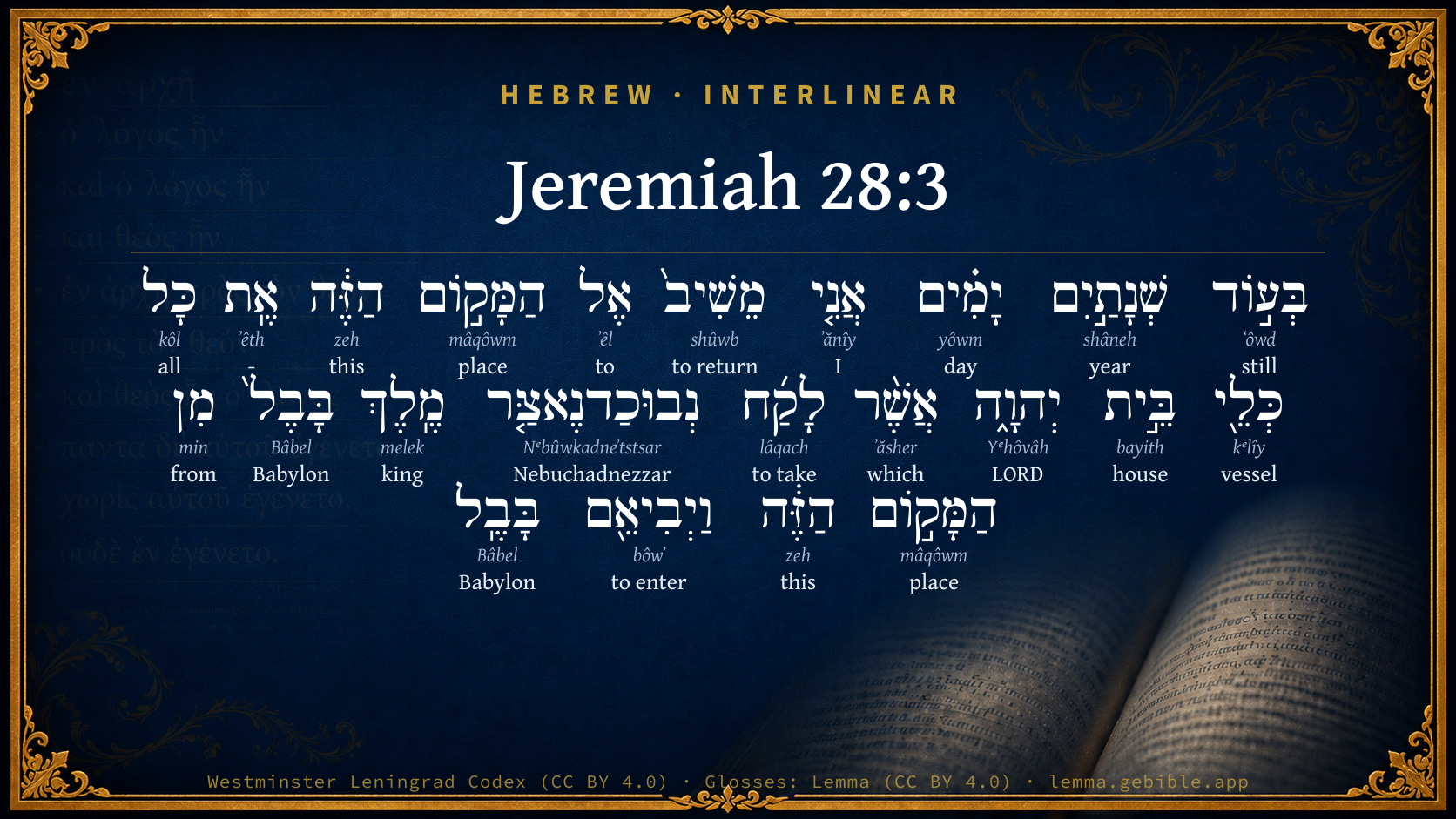
Hebrew (Westminster Leningrad Codex) Jeremiah 28:3 appears in the Hebrew Old Testament. The text above is from the Westminster Leningrad Codex. Each word links to its Strong’s number, a concise gloss, and parsing drawn from the Open Scriptures Hebrew Bible morphology. Click any word for its full Brown-Driver-Briggs (BDB) entry.
Download image
Cite this verse

Jeremiah 28:3 (World English Bible). Public Domain. Lemma interlinear Bible study tool, https://lemma.gebible.app/v/jeremiah/28/3.

Show BibTeX & RIS
BibTeX
RIS
English Translation
Within two full years will I bring again into this place all the vessels of Yahweh's house, that Nebuchadnezzar king of Babylon took away from this place, and carried to Babylon:
World English Bible · Public Domain
Download a study sheet

One document with this verse’s original text, its word-by-word gloss line, the meaning frame, cross-references with their text, attributed commentary, and full source and license credits — printable, and it pastes into notes with its structure intact.

This verse Autodidact and up

Study sheet (.html) Plain text (.txt)

A passage Seminary Student

Up to 50 verses in one chapter. A passage sheet keeps up to 6 commentary sources and 12 cross-references per verse, in the order this page ranks them, and says so on the sheet whenever that leaves anything out. Ask for a single verse and you get the Autodidact verse sheet above.

Everything on this page stays free to read, with no account — the sheet is a download of what is already on screen, not access to it.

Want to remove ads? Support Godless Engineer
Compare translations 3

The same verse in 3 English versions, stacked beneath the original-language interlinear above. Click any original word for its lexicon entry.

Each is an independent rendering of the whole verse — the interlinear is not word-aligned to these translations.

Highlighted words mark where these versions differ — a whole-verse word diff, not a word-by-word alignment.

  • World English Bible Public Domain
    Within two full years will I bring again into this place all the vessels of Yahweh's house, that Nebuchadnezzar king of Babylon took away from this place, and carried to Babylon:
  • King James Version Public Domain
    Within two full years will I bring again into this place all the vessels of the LORD's house, that Nebuchadnezzar king of Babylon took away from this place, and carried them to Babylon:
  • unfoldingWord Literal Text CC BY-SA 4.0
    Within two more years of days, I am bringing back to this place all the vessels of the house of Yahweh that Nebuchadnezzar king of Babylon took from this place and brought them Babylon.

unfoldingWord Literal Text — © unfoldingWord, licensed CC BY-SA 4.0. Word-aligned USFM3 via Door43 (git.door43.org/unfoldingWord/en_ult).

Versions to compare (up to 4)

3 of 4 selected

Show all 18 translations

Every available English version of this verse, each an independent rendering of the whole verse.

  • World English Bible Public Domain
    Within two full years will I bring again into this place all the vessels of Yahweh's house, that Nebuchadnezzar king of Babylon took away from this place, and carried to Babylon:
  • Berean Standard Bible Public Domain
    Within two years I will restore to this place all the articles of the house of the LORD that Nebuchadnezzar king of Babylon removed from here and carried to Babylon.
  • Majority Standard Bible Public Domain
    Within two years I will restore to this place all the articles of the house of the LORD that Nebuchadnezzar king of Babylon removed from here and carried to Babylon.
  • King James Version Public Domain
    Within two full years will I bring again into this place all the vessels of the LORD's house, that Nebuchadnezzar king of Babylon took away from this place, and carried them to Babylon:
  • American Standard Version (1901) Public Domain
    Within two full years will I bring again into this place all the vessels of Jehovah's house, that Nebuchadnezzar king of Babylon took away from this place, and carried to Babylon:
  • Revised Version (1885) Public Domain
    Within two full years will I bring again into this place all the vessels of the LORD’S house, that Nebuchadnezzar king of Babylon took away from this place, and carried them to Babylon:
  • Geneva Bible (1599) Public Domain
    Within two yeeres space I will bring into this place all the vessels of the Lords House, that Nebuchad-nezzar King of Babel tooke away from this place, and caried them into Babel.
  • Douay-Rheims (1899) Public Domain
    As yet two years of days, and I will cause all the vessels of the house of the Lord to be brought back into this place, which Nabuchodonosor king of Babylon took away from this place, and carried them to Babylon.
  • Young's Literal Translation Public Domain
    Within two years of days I am bringing back unto this place all the vessels of the house of Jehovah that Nebuchadnezzar king of Babylon hath taken from this place, and doth carry to Babylon,
  • Literal Standard Version CC BY-SA 4.0
    within two years of days I am bringing back to this place all the vessels of the house of YHWH that Nebuchadnezzar king of Babylon has taken from this place, and carries to Babylon,
  • Unlocked Literal Bible CC BY-SA 4.0
    Within two years I will bring back to this place all the objects belonging to Yahweh's house that Nebuchadnezzar king of Babylon took from this place and transported to Babylon.
  • unfoldingWord Literal Text CC BY-SA 4.0
    Within two more years of days, I am bringing back to this place all the vessels of the house of Yahweh that Nebuchadnezzar king of Babylon took from this place and brought them Babylon.
  • Darby Bible Public Domain
    Within two full years will I bring again into this place all the vessels of Jehovah's house, that Nebuchadnezzar king of Babylon took away from this place, and carried to Babylon;
  • World Messianic Bible Public Domain
    Within two full years I will bring again into this place all the vessels of the LORD’s house that Nebuchadnezzar king of Babylon took away from this place and carried to Babylon.
  • Webster's Bible Public Domain
    Within two full years will I bring again into this place all the vessels of the LORD'S house, that Nebuchadnezzar king of Babylon took away from this place, and carried them to Babylon:
  • Free Bible Version CC BY-SA 4.0
    Before two years have passed I'm going to bring back to Jerusalem all the Temple objects that Nebuchadnezzar king of Babylon removed and took to Babylon.
  • Bible in Basic English Public Domain
    In the space of two years I will send back into this place all the vessels of the Lord's house which Nebuchadnezzar, king of Babylon, took away from this place to Babylon:
  • JPS Tanakh (1917) Public Domain
    Within two full years will I bring back into this place all the vessels of the LORD'S house, that Nebuchadnezzar king of Babylon took away from this place, and carried them to Babylon;

Literal Standard Version (2020), Covenant Press — licensed CC BY-SA 4.0. Text via the HelloAO Bible API (eBible.org). Unlocked Literal Bible (unfoldingWord) — licensed CC BY-SA 4.0. Text via the HelloAO Bible API (eBible.org). unfoldingWord Literal Text — © unfoldingWord, licensed CC BY-SA 4.0. Word-aligned USFM3 via Door43 (git.door43.org/unfoldingWord/en_ult). Free Bible Version, Dr. Jonathan Gallagher — licensed CC BY-SA 4.0. Text via the HelloAO Bible API (eBible.org).

Word by word

More ways to search: Search by grammar → Find every occurrence → Compare this word →

Practice this passage: Drill this verse → Learn its vocabulary →

נְבוּכַדנֶאצַּ֤ר
Nᵉbûwkadneʼtstsar
H5019
“Nebuchadnezzar”
Noun, Proper
Part of Speech
Noun
Type
Proper
Full BDB Definition

Origin: of foreign derivation

TWOT: None

Nebuchadnezzar or Nebuchadrezzar = "may Nebo protect the crown" - the great king of Babylon who captured Jerusalem and carried Judah captive
  1. בְּע֣וֹד ʻôwd H5750 “in/at · still” Preposition + Adverb
  2. שְׁנָתַ֣יִם shâneh H8141 “years” Noun, Common, Feminine, Dual, Absolute
  3. יָמִ֗ים yôwm H3117 “days” Noun, Common, Masculine, Plural, Absolute
  4. אֲנִ֤י ʼănîy H589 “I” Pronoun, Personal, 1st Person, Common, Singular
  5. מֵשִׁיב֙ shûwb H7725 “returning” Verb, Hiphil, Participle Active, Masculine, Singular, Absolute
  6. אֶל ʼêl H413 “to” Preposition
  7. הַמָּק֣וֹם mâqôwm H4725 “the · place” Particle, Definite Article + Noun, Common, Masculine, Singular, Absolute
  8. הַזֶּ֔ה zeh H2088 “the · this” Particle, Definite Article + Pronoun, Demonstrative, Masculine, Singular
  9. אֶֽת ʼêth H853 “-” Particle, Direct Object
  10. כָּל kôl H3605 “all of” Noun, Common, Masculine, Singular, Construct
  11. כְּלֵ֖י kᵉlîy H3627 “vessels of” Noun, Common, Masculine, Plural, Construct
  12. בֵּ֣ית bayith H1004 “house of” Noun, Common, Masculine, Singular, Construct
  13. יְהוָ֑ה Yᵉhôvâh H3068 “LORD” Noun, Proper
  14. אֲשֶׁ֨ר ʼăsher H834 “which” Particle, Relative
  15. לָקַ֜ח lâqach H3947 “to take” Verb, Qal, Perfect, 3rd Person, Masculine, Singular
  16. מֶֽלֶךְ melek H4428 “king of” Noun, Common, Masculine, Singular, Construct
  17. בָּבֶל֙ Bâbel H894 “Babylon” Noun, Proper
  18. מִן min H4480 “from” Preposition
  19. הַמָּק֣וֹם mâqôwm H4725 “the · place” Particle, Definite Article + Noun, Common, Masculine, Singular, Absolute
  20. הַזֶּ֔ה zeh H2088 “the · this” Particle, Definite Article + Pronoun, Demonstrative, Masculine, Singular
  21. וַיְבִיאֵ֖ם bôwʼ H935 “and · to enter · them” Conjunction + Verb, Hiphil, Sequential Imperfect, 3rd Person, Masculine, Singular + Suffix, Personal, 3rd Person, Masculine, Plural
  22. בָּבֶֽל Bâbel H894 “Babylon” Noun, Proper

About this verse

These counts appear in no published source. They are computed here, from the morphology-tagged text and Lemma’s own curated glosses. What Lemma adds →

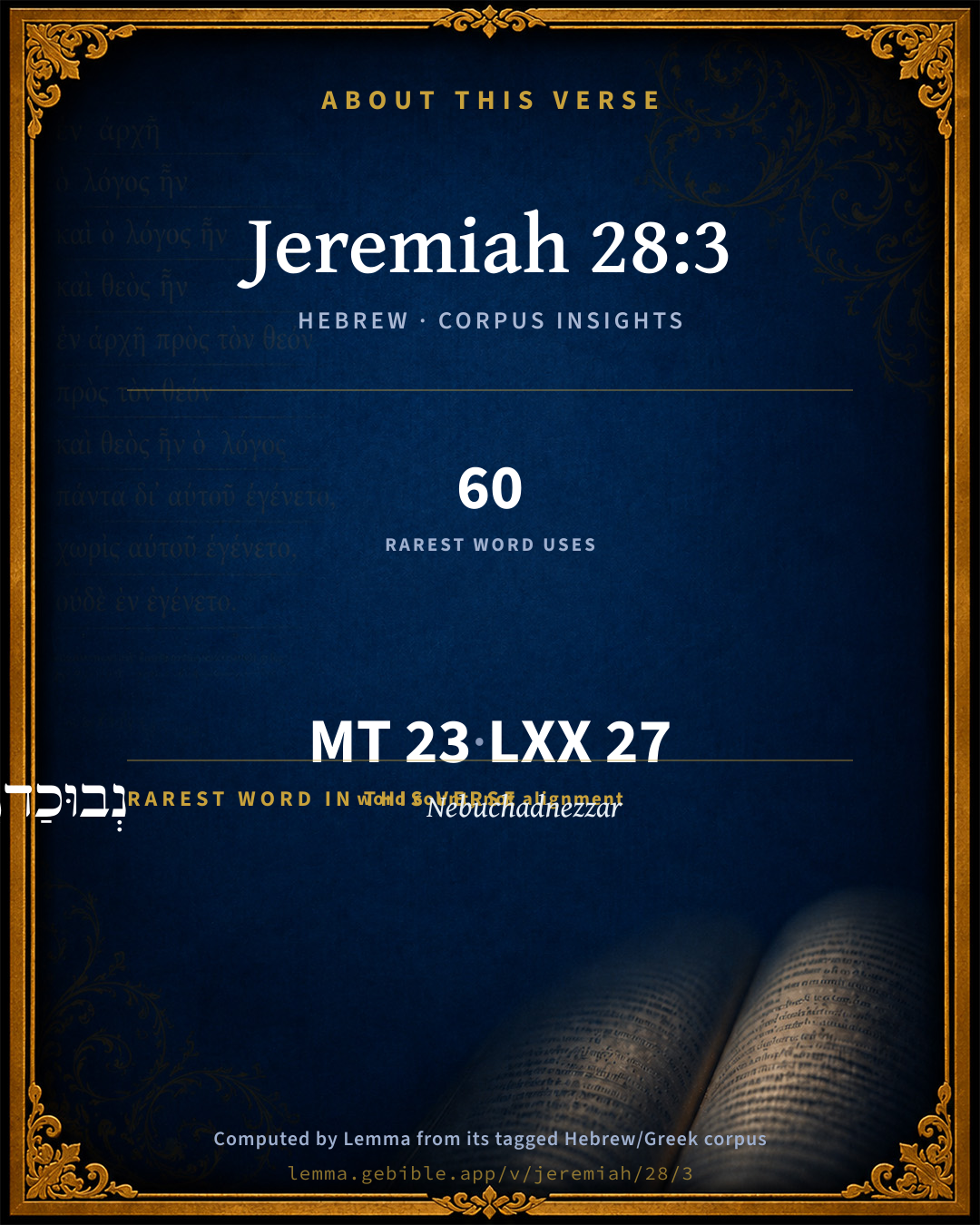
23
words
20
distinct lemmas
Prophets
section

Shared distinctive vocabulary

נְבוּכַדנֶאצַּ֤ר Nebuchadnezzar H5019 occurs in 58 verses of the Hebrew Bible. Also found in:

Grammatical profile

  • 3 verbs
  • 12 nouns
  • 3 pronouns
  • 2 prepositions
  • 1 adverb
  • 2 particles

Verb forms

  • מֵשִׁיב֙ Hiphil · Participle Active
  • לָקַ֜ח Qal · Perfect
  • וַיְבִיאֵ֖ם Hiphil · Sequential Imperfect

Repetition

Words recur within this verse — often emphatic in Hebrew:

  • הַמָּק֣וֹם place H4725 ×2
  • בָּבֶל֙ Babylon H894 ×2
  • הַזֶּ֔ה this H2088 ×2

Hebrew & Septuagint length

In the original languages it is 23 Hebrew tokens and 27 Greek tokens — but the two are counted differently (Hebrew bundles its prefixes and suffixes into one token; the Greek is in lemma form), so that isn’t a like-for-like length.

Cross-references

7

Topical passages linked to Jeremiah 28:3 in the Treasury of Scripture Knowledge — connected by theme and wording, ordered by reader-vote popularity; previews shown in the World English Bible.

  • 2 Kings 24:13 He carried out there all the treasures of the house of Yahweh, and the treasures of the king's house, and cut in pieces all the vessels of gold, which Solomon king of Israel had made in the temple of Yahweh, as Yahweh had said.
  • 2 Chronicles 36:10 At the return of the year king Nebuchadnezzar sent, and brought him to Babylon, with the goodly vessels of the house of Yahweh, and made Zedekiah his brother king over Judah and Jerusalem.
  • Daniel 1:2 The Lord gave Jehoiakim king of Judah into his hand, with part of the vessels of the house of God; and he carried them into the land of Shinar to the house of his god: and he brought the vessels into the treasure-house of his god.
  • Genesis 47:9 Jacob said to Pharaoh, "The days of the years of my pilgrimage are one hundred thirty years. Few and evil have been the days of the years of my life, and they have not attained to the days of the years of the life of my fathers in the days of their pilgrimage."
  • Genesis 47:28 Jacob lived in the land of Egypt seventeen years. So the days of Jacob, the years of his life, were one hundred forty-seven years.
  • Psalms 90:10 The days of our years are seventy, Or even by reason of strength eighty years; Yet their pride is but labor and sorrow, For it passes quickly, and we fly away.
  • Jeremiah 27:16–22 Also I spoke to the priests and to all this people, saying, Thus says Yahweh: Don't listen to the words of your prophets who prophesy to you, saying, Behold, the vessels of Yahweh's house shall now shortly be brought again from Babylon; for they prophesy a lie to you.

Cross-references courtesy of OpenBible.info (CC BY 4.0).

Hebrew and Greek witnesses Masoretic Hebrew ↔ Greek Septuagint

The same verse in the two great witnesses to the Old Testament, shown verse-for-verse.

These are two independent witnesses, not word-aligned to each other, and the Septuagint is shown in lemma (dictionary) form.

Hebrew Jeremiah 28:3 Masoretic · Westminster Leningrad Codex

בְּע֣וֹד שְׁנָתַ֣יִם יָמִ֗ים אֲנִ֤י מֵשִׁיב֙ אֶל הַמָּק֣וֹם הַזֶּ֔ה אֶֽת כָּל כְּלֵ֖י בֵּ֣ית יְהוָ֑ה אֲשֶׁ֨ר לָקַ֜ח נְבוּכַדנֶאצַּ֤ר מֶֽלֶךְ בָּבֶל֙ מִן הַמָּק֣וֹם הַזֶּ֔ה וַיְבִיאֵ֖ם בָּבֶֽל

Within two full years will I bring again into this place all the vessels of Yahweh's house, that Nebuchadnezzar king of Babylon took away from this place, and carried to Babylon:

World English Bible · Public Domain

Greek LXX Structure differs

In the Septuagint, Jeremiah is about an eighth shorter than the Hebrew and arranges its material differently — the Oracles Against the Nations (Hebrew chapters 46–51) appear in the middle of the Greek book, after 25:13. Because the chapter and verse boundaries do not line up, a verse-for-verse comparison with the Hebrew is not shown.

A verse-for-verse comparison isn’t shown here because the chapters and verses don’t line up. Switch to the LXX edition with the MT / LXX toggle above to read the Greek directly.

On this verse, The Cambridge Bible for Schools and Colleges discusses the Septuagint’s reading. Read the note in Commentary ↓

Hebrew: Westminster Leningrad Codex (CC BY 4.0). Greek: Septuagint (public domain); English from a public-domain English Septuagint. How the Septuagint differs from the Hebrew →

Targum (Aramaic paraphrase)

1

The Targum is the ancient Jewish Aramaic paraphrase of the Hebrew Scriptures — an interpretive translation, not the Hebrew text itself. Onkelos (literal) and Pseudo-Jonathan (expansive) render the Torah, and Jonathan the Prophets. Coverage is partial: where no permissively-licensed English translation exists for a verse, only the Aramaic is shown. This is verse-level text, not a word-by-word alignment to the Hebrew.

  1. Targum Jonathan Prophets (Joshua–Malachi)
    בְּסוֹף תַּרְתֵּין שְׁנִין אֲנָא מֵתִיב לְאַתְרָא הָדֵין יַת כָּל מָנֵי בֵּית מַקְדְשָׁא דַייָ דִשְׁבָא נְבוּכַדְנֶאצַר מַלְכָּא דְבָבֶל מִן אַתְרָא הָדֵין וְאוֹבְלִינוּן לְבָבֶל:

    (no public-domain English translation for this verse)

    Targum Jonathan — Aramaic: “Mikraot Gedolot” (public domain). English: “Sefaria Community Translation” (CC0 1.0 (public-domain dedication)); “London "Chaldee Paraphrase," 1871” (public domain). Text via Sefaria.

Commentary

Notes on Jeremiah 28:3 from classic Christian and Jewish commentators (each source and its license shown beneath its notes). The classic Christian expositions comment on the surrounding passage and are grouped to its opening verse, so a note may address several verses; the Jewish commentaries on the Tanakh (Rashi and others) are per-verse, so they appear only where the commentator wrote on this verse.

Lemma curates 59 commentaries, every one of them public domain or Creative Commons licensed, each selected and text-cleaned for this edition rather than reprinted as found. About our sources →

Trapp's Complete Commentary

John Trapp

Jer 28:3 Within two full years will I bring again into this place all the vessels of the LORD’S house, that Nebuchadnezzar king of Babylon took away from this place, and carried them to Babylon:

Ver. 3. Within two full years.] Jeremiah had said seventy; Hananiah, a man of prime authority, some say high priest, within two years. This was some trial to good Jeremiah to be thus confronted. Jeremiah’s discourse was so much the more distasted, because he not only contradicted Hananiah and his complices, but also persuaded Zedekiah to submit to the King of Babylon, and afterwards to yield up the city; whereas the prophet Isaiah, not long before, had dissuaded Hezekiah from so doing.

John Trapp, A Commentary or Exposition upon All the Books of the Old and New Testament (1647–1656) — public domain. Text from a community e-Sword module.

Geneva Bible (1599)

Geneva Bible translators

Hebrew, two years of days.

Geneva Bible (1599) marginal notes — public domain. Text via Bolls.life.

Jamieson, Fausset & Brown

Robert Jamieson, A. R. Fausset & David Brown

two full years--literally, "years of days." So "a month of days," that is, all its days complete (Gen 29:14, Margin; Gen 41:1). It was marvellous presumption to speak so definitely without having any divine revelation.

Jamieson, Fausset & Brown — Commentary Critical and Explanatory on the Whole Bible (1871) — public domain (CC PDM 1.0). Text via the HelloAO Bible API.

Adam Clarke's Commentary

Verse 3. Within two full years] Time sufficient for the Chaldeans to destroy the city, and carry away the rest of the sacred vessels; but he did not live to see the end of this short period.

Adam Clarke's Commentary on the Bible (1810–1826) — public domain. Text from a community e-Sword/MySword module.

John Calvin's Commentaries

We now see that what Hananiah had in view was to promise impunity to the people, and not only this, but also to soothe them with vain confidence, as though the people would have their king soon restored, together with the spoils which the enemy had taken away. But he began by referring to the power of the king, lest that terrible sight should occupy the minds of the people so as to prevent them to receive this joyful prophecy. He then says, Further, when two years shall pass, I will bring back to this place all the vessels which King Nebuchadnezzar has taken away Jeremiah had assigned to the people’s exile seventy years, as it has been stated before, and as we shall hereafter often see; but here the false prophet says, that after two years the exile of the king and of the people would come to an end, and that the vessels which had been taken away would be restored; he speaks also of the king himself, —

John Calvin's Commentaries (1540-1563) — public domain. Text from the Calvin Translation Society English edition (1840s-50s) via the Christian Classics Ethereal Library (ccel.org). Calvin's coverage is partial (roughly two-thirds of the Bible); uncommented books and verses are honest gaps, never fabricated. The 19th-century editor's footnotes and remarks are omitted so the notes are faithfully Calvin's own voice.

Ellicott's Commentary for English Readers

(3) Within two full years.—Literally, two years of days. Hananiah, not deterred by the previous warnings of Jeremiah, becomes bolder in the definiteness of his prediction. The conspiracy of Judah and the neighbouring states against Nebuchadnezzar was clearly ripening, and he looked on its success as certain. Prediction stood against prediction, and, as there were no signs or wonders wrought, men had to judge from what they knew of the lives of the men who uttered them which of them was most worthy of credit. The contest between the two prophets reminds us of Deu_18:20-22.

A Bible Commentary for English Readers, edited by Charles John Ellicott (1878–1897) — public domain. Text from a community e-Sword module.

The Cambridge Bible for Schools and Colleges

gen. ed. J. J. S. Perowne

3. that Nebuchadnezzar … carried them to Babylon] LXX omit.

The Cambridge Bible for Schools and Colleges (gen. ed. J. J. S. Perowne; Cambridge University Press, 1878–1918) — public domain. Text from a community e-Sword module.

John Gill's Exposition

Within two full years,.... Or, "within two years of days" (o); when they are up to a day. The Targum is,

"at the end of two years;''

what the false prophets before had said would be done in a very little time; this fixes the precise time of doing it; a very short time, in comparison of the seventy years that Jeremiah had spoken of, Jer 25:11;

will I bring again into this place all the vessels of the Lord's house, that Nebuchadnezzar king of Babylon took away from this place; the temple, where he now was; namely, all such vessels as before this time had been taken by him, both in Jehoiakim's reign, and at the captivity of Jeconiah:

and carried them to Babylon; where they still remained, and according to Jeremiah still would; and were so far from being brought back in a short time, that what were left would be carried thither also, Jer 27:19.

(o) "in adhuc duobis anois dierum", Montanus; "intra adhuc biennium dierum", Schmidt; "intra biennum dierum", Cocceius.

John Gill's Exposition of the Whole Bible (1746–1763) — public domain (CC PDM 1.0). Text via the HelloAO Bible API.

Albert Barnes' Notes on the Bible

Within two full years - literally, In yet two years even days. Hananiah probably was induced to fix this date by the expectation that the confederacy then on foot would defeat Nebuchadnezzar.

Albert Barnes' Notes on the Bible (1834–1885) — public domain. Text from a community e-Sword/MySword module.

Haydock's Catholic Bible Commentary

Years. Some were brought back in the 4th of Sedecias; (chap. xxvii. 16.; Haydock) so that this must be false, whether he spoke in the 1st or 4th year of his reign. (Calmet)

George Leo Haydock (1774–1849), Haydock's Catholic Family Bible and Commentary, 1859 edition — public domain. Excludes Psalms (Douay-Rheims chapter numbering differs from Protestant) and Deuterocanonical books (Catholic canon only).

Matthew Poole's English Annotations

It appeareth by what we met with Jer 27:16, that this was the constant song of the city prophets at that time, but we read not of any but this Hananiah, who was so confident as to limit a time; nor doth he mention any long time, he saith

within two full years; but he spake falsely, for it appeareth, from Jer 52:31, that Jeconiah was there thirty-seven years.

Matthew Poole's English Annotations on the Holy Bible (1683–1685) — public domain. Text from a community e-Sword/MySword module.

Whedon's Commentary on the Bible

Daniel D. Whedon

3. Two… years — Certainly a very agreeable contrast to Jeremiah’s seventy years. The expression used is unusually definite. Literally, two years in days, as though it were not a general period, but one of mathematical exactness. In this exactitude, as well as in the opening formula, Hananiah seeks to give his deliverance the impress of a God-inspired prophecy.

Daniel D. Whedon (gen. ed.), Commentary on the Old and New Testaments (1874–1909) — public domain. Text from a community e-Sword module.

unfoldingWord translationNotes

Door43 World Missions Community

General Information:

Hananiah continues to speak.

Jehoiachin

The Hebrew text has "Jeconiah," which is a variation of the name "Jehoiachin." Many modern versions have "Jehoiachin" in order to make it clear that the same king is being referred to.

who were sent

This can be translated in active form. AT: "whom I sent" (See: Active or Passive)

this is Yahweh's declaration

Yahweh speaks of himself by name to express the certainty of what he is declaring. See how you translated this in Jeremiah 1:8. AT: "this is what Yahweh has declared" or "this is what I, Yahweh, have declared" (See: First, Second, or Third Person)

translationWords

Nebuchadnezzar

Jehoiachin

Jehoiakim

captive

unfoldingWord translationNotes — © Distant Shores Media and the Door43 World Missions Community, licensed CC BY-SA 4.0. Source: git.door43.org/Door43/en_tn.

Lesson kit

Teaching starters — assembled from the data on this page, not authored interpretation. Every prompt links to the verse data it draws on. Edit before teaching.

Jeremiah, in the Prophets, opens this verse with 23 words (20 distinct Hebrew lemmas). Its most distinctive word is Nᵉbûwkadneʼtstsar (“Nebuchadnezzar”). A historical commentator’s framing appears above. Read the whole chapter for the surrounding context.

Discussion questions

  1. The word Nᵉbûwkadneʼtstsar carries the sense “Nebuchadnezzar.” How does it shape the verse?
  2. 2 Kings 24:1 shares the word «Nebuchadnezzar» with this verse. How do the two illuminate each other?
  3. “place” occurs 2× in this one verse. What is the effect of the repetition?
  4. These translations render this verse differently; the difference is in the English rendering, not the original. What questions does that raise?
  5. The verb «מֵשִׁיב֙» is Hiphil Participle Active. How does its form color the action?
  6. Reading how Trapp's Complete Commentary and Geneva Bible (1599) read this verse, where do the two commentators agree and where do they part?

Things to notice

Reading settings

Reading text

Shown beneath each verse's original-language words.

Old Testament
Old Testament edition

Read the OT as the Masoretic Hebrew (MT) or the Greek Septuagint (LXX).

English shown for the Greek Septuagint (in the Hebrew ↔ Greek comparison).

Comparing translations? Open the Compare panel on any verse page to stack up to four side by side.