
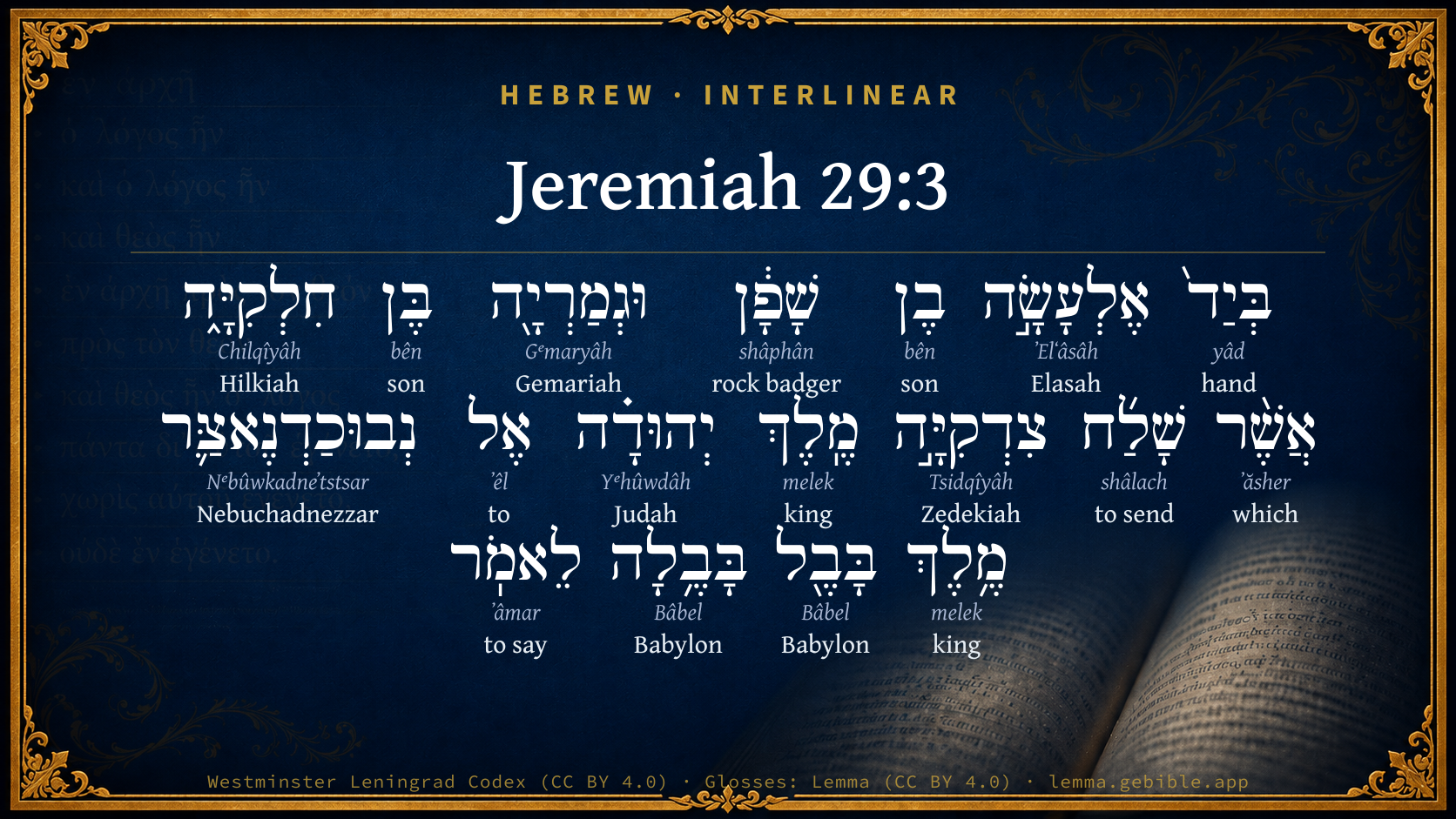
Jeremiah 29:3

Hebrew (Westminster Leningrad Codex) Jeremiah 29:3 appears in the Hebrew Old Testament. The text above is from the Westminster Leningrad Codex. Each word links to its Strong’s number, a concise gloss, and parsing drawn from the Open Scriptures Hebrew Bible morphology. Click any word for its full Brown-Driver-Briggs (BDB) entry.
Download image
Cite this verse

Jeremiah 29:3 (World English Bible). Public Domain. Lemma interlinear Bible study tool, https://lemma.gebible.app/v/jeremiah/29/3.

Show BibTeX & RIS
BibTeX
RIS
English Translation
by the hand of Elasah the son of Shaphan, and Gemariah the son of Hilkiah, (whom Zedekiah king of Judah sent to Babylon to Nebuchadnezzar king of Babylon), saying,
World English Bible · Public Domain
Highlights
  • 1 first appearance in the Hebrew Bible
Full analysis ↓
Download a study sheet

One document with this verse’s original text, its word-by-word gloss line, the meaning frame, cross-references with their text, attributed commentary, and full source and license credits — printable, and it pastes into notes with its structure intact.

This verse Autodidact and up

Study sheet (.html) Plain text (.txt)

A passage Seminary Student

Up to 50 verses in one chapter. A passage sheet keeps up to 6 commentary sources and 12 cross-references per verse, in the order this page ranks them, and says so on the sheet whenever that leaves anything out. Ask for a single verse and you get the Autodidact verse sheet above.

Everything on this page stays free to read, with no account — the sheet is a download of what is already on screen, not access to it.

Want to remove ads? Support Godless Engineer
Compare translations 3

The same verse in 3 English versions, stacked beneath the original-language interlinear above. Click any original word for its lexicon entry.

Each is an independent rendering of the whole verse — the interlinear is not word-aligned to these translations.

Highlighted words mark where these versions differ — a whole-verse word diff, not a word-by-word alignment.

  • World English Bible Public Domain
    by the hand of Elasah the son of Shaphan, and Gemariah the son of Hilkiah, (whom Zedekiah king of Judah sent to Babylon to Nebuchadnezzar king of Babylon), saying,
  • King James Version Public Domain
    By the hand of Elasah the son of Shaphan, and Gemariah the son of Hilkiah, (whom Zedekiah king of Judah sent unto Babylon to Nebuchadnezzar king of Babylon) saying,
  • unfoldingWord Literal Text CC BY-SA 4.0
    He sent this scroll by the hand of Elasah son of Shapan and Gemariah son of Hilkiah whom Zedekiah, king of Judah, had sent to Nebuchadnezzar king of Babylon.

unfoldingWord Literal Text — © unfoldingWord, licensed CC BY-SA 4.0. Word-aligned USFM3 via Door43 (git.door43.org/unfoldingWord/en_ult).

Versions to compare (up to 4)

3 of 4 selected

Show all 18 translations

Every available English version of this verse, each an independent rendering of the whole verse.

  • World English Bible Public Domain
    by the hand of Elasah the son of Shaphan, and Gemariah the son of Hilkiah, (whom Zedekiah king of Judah sent to Babylon to Nebuchadnezzar king of Babylon), saying,
  • Berean Standard Bible Public Domain
    The letter was entrusted to Elasah son of Shaphan and Gemariah son of Hilkiah, whom Zedekiah king of Judah sent to King Nebuchadnezzar in Babylon. It stated:
  • Majority Standard Bible Public Domain
    The letter was entrusted to Elasah son of Shaphan and Gemariah son of Hilkiah, whom Zedekiah king of Judah sent to King Nebuchadnezzar in Babylon. It stated:
  • King James Version Public Domain
    By the hand of Elasah the son of Shaphan, and Gemariah the son of Hilkiah, (whom Zedekiah king of Judah sent unto Babylon to Nebuchadnezzar king of Babylon) saying,
  • American Standard Version (1901) Public Domain
    by the hand of Elasah the son of Shaphan, and Gemariah the son of Hilkiah, (whom Zedekiah king of Judah sent unto Babylon to Nebuchadnezzar king of Babylon,) saying,
  • Revised Version (1885) Public Domain
    by the hand of Elasah the son of Shaphan, and Gemariah the son of Hilkiah, (whom Zedekiah king of Judah sent unto Babylon to Nebuchadnezzar king of Babylon,) saying,
  • Geneva Bible (1599) Public Domain
    By the hand of Elasah the sonne of Shaphan and Gemariah the sonne of Hilkiah, (whom Zedekiah King of Iudah sent vnto Babel to Nebuchad-nezzar King of Babel) saying,
  • Douay-Rheims (1899) Public Domain
    By the hand of Elasa the son of Saphan, and Gamarias the son of Helcias, whom Sedecias king of Juda sent to Babylon to Nabuchodonosor king of Babylon, saying:
  • Young's Literal Translation Public Domain
    By the hand of Eleasah son of Shaphan, and Gemariah son of Hilkijah, whom Zedekiah king of Judah sent unto Nebuchadnezzar king of Babylon -- to Babylon, saying,
  • Literal Standard Version CC BY-SA 4.0
    by the hand of Eleasah son of Shaphan, and Gemariah son of Hilkiah, whom Zedekiah king of Judah sent to Babylon, to Nebuchadnezzar king of Babylon, saying,
  • Unlocked Literal Bible CC BY-SA 4.0
    He sent this scroll by the hand of Elasah son of Shapan and Gemariah son of Hilkiah whom Zedekiah, king of Judah, had sent to Nebuchadnezzar king of Babylon.
  • unfoldingWord Literal Text CC BY-SA 4.0
    He sent this scroll by the hand of Elasah son of Shapan and Gemariah son of Hilkiah whom Zedekiah, king of Judah, had sent to Nebuchadnezzar king of Babylon.
  • Darby Bible Public Domain
    by the hand of Elasah the son of Shaphan, and Gemariah the son of Hilkijah (whom Zedekiah king of Judah sent to Babylon, unto Nebuchadnezzar king of Babylon), saying,
  • World Messianic Bible Public Domain
    by the hand of Elasah the son of Shaphan and Gemariah the son of Hilkiah, (whom Zedekiah king of Judah sent to Babylon to Nebuchadnezzar king of Babylon). It said:
  • Webster's Bible Public Domain
    By the hand of Elasah the son of Shaphan, and Gemariah the son of Hilkiah, (whom Zedekiah king of Judah sent to Babylon to Nebuchadnezzar king of Babylon) saying,
  • Free Bible Version CC BY-SA 4.0
    Elasah, son of Shaphan, and Gemariah, son of Hilkiah, took the letter with them when Zedekiah king of Judah sent them to King Nebuchadnezzar in Babylon. In the letter Jeremiah wrote:
  • Bible in Basic English Public Domain
    By the hand of Elasah, the son of Shaphan, and Gemariah, the son of Hilkiah, (whom Zedekiah, king of Judah, sent to Babylon, to Nebuchadnezzar, king of Babylon,) saying,
  • JPS Tanakh (1917) Public Domain
    by the hand of Elasah the son of Shaphan, and Gemariah the son of Hilkiah, whom Zedekiah king of Judah sent unto Babylon to Nebuchadnezzar king of Babylon, saying:

Literal Standard Version (2020), Covenant Press — licensed CC BY-SA 4.0. Text via the HelloAO Bible API (eBible.org). Unlocked Literal Bible (unfoldingWord) — licensed CC BY-SA 4.0. Text via the HelloAO Bible API (eBible.org). unfoldingWord Literal Text — © unfoldingWord, licensed CC BY-SA 4.0. Word-aligned USFM3 via Door43 (git.door43.org/unfoldingWord/en_ult). Free Bible Version, Dr. Jonathan Gallagher — licensed CC BY-SA 4.0. Text via the HelloAO Bible API (eBible.org).

Word by word

More ways to search: Search by grammar → Find every occurrence → Compare this word →

Practice this passage: Drill this verse → Learn its vocabulary →

וּגְמַרְיָ֖ה
Gᵉmaryâh
H1587
“and · Gemariah”
Conjunction + Noun, Proper
Part of Speech
Conjunction + Noun
Type
Proper
Full BDB Definition

Origin: from H1584 and H3050

TWOT: None

Gemariah = "Jehovah has accomplished" - the son of Shaphan the scribe and father of Michaiah; one of the nobles of Judah who had a chamber in the temple from which Baruch read Jeremiah's alarming prophecy to all the people - the son of Hilkiah who bore Jeremiah's letter to the captive Jews
  1. בְּיַד֙ yâd H3027 “in/at · hand of” Preposition + Noun, Common, Both, Singular, Construct
  2. אֶלְעָשָׂ֣ה ʼElʻâsâh H501 “Elasah” Noun, Proper
  3. בֶן bên H1121 “son of” Noun, Common, Masculine, Singular, Construct
  4. שָׁפָ֔ן shâphân H8227 “rock badger” Noun, Proper
  5. בֶּן bên H1121 “son of” Noun, Common, Masculine, Singular, Construct
  6. חִלְקִיָּ֑ה Chilqîyâh H2518 “Hilkiah” Noun, Proper
  7. אֲשֶׁ֨ר ʼăsher H834 “which” Particle, Relative
  8. שָׁלַ֜ח shâlach H7971 “to send” Verb, Qal, Perfect, 3rd Person, Masculine, Singular
  9. צִדְקִיָּ֣ה Tsidqîyâh H6667 “Zedekiah” Noun, Proper
  10. מֶֽלֶךְ melek H4428 “king of” Noun, Common, Masculine, Singular, Construct
  11. יְהוּדָ֗ה Yᵉhûwdâh H3063 “Judah” Noun, Proper
  12. אֶל ʼêl H413 “to” Preposition
  13. נְבוּכַדְנֶאצַּ֛ר Nᵉbûwkadneʼtstsar H5019 “Nebuchadnezzar” Noun, Proper
  14. מֶ֥לֶךְ melek H4428 “king of” Noun, Common, Masculine, Singular, Construct
  15. בָּבֶ֖ל Bâbel H894 “Babylon” Noun, Proper
  16. בָּבֶ֥לָה Bâbel H894 “Babylon · toward” Noun, Proper + Suffix, Demonstrative
  17. לֵאמֹֽר ʼâmar H559 “to say” Preposition + Verb, Qal, Infinitive Construct

About this verse

These counts appear in no published source. They are computed here, from the morphology-tagged text and Lemma’s own curated glosses. What Lemma adds →

18
words
15
distinct lemmas
Prophets
section

Notable vocabulary

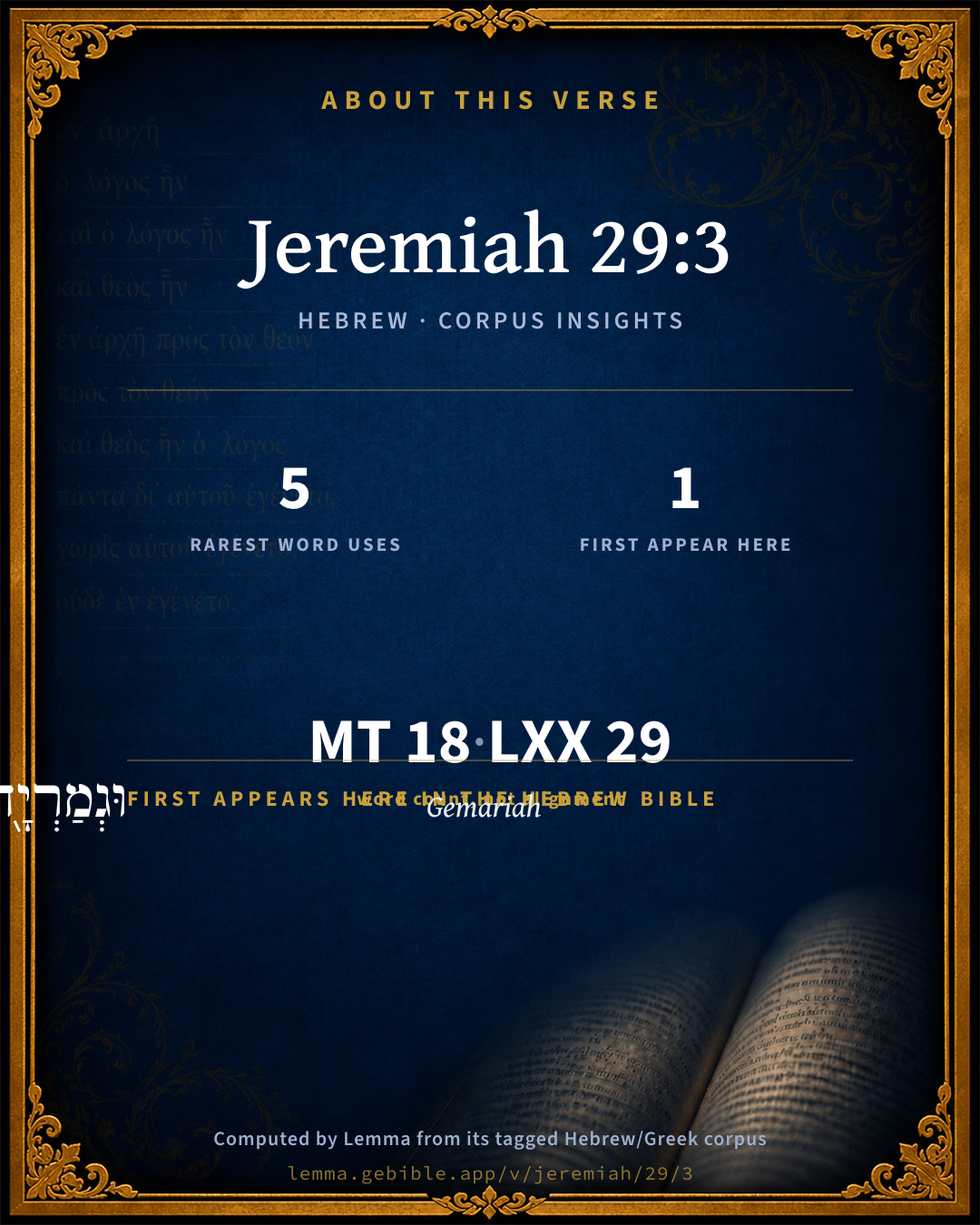
The rarest word here is וּגְמַרְיָ֖ה Gemariah H1587 — appearing just 5 times in the whole Hebrew Bible.

First appearance in Scripture

This word makes its first canonical appearance in the Hebrew Bible here:

  • וּגְמַרְיָ֖ה Gemariah H1587

Shared distinctive vocabulary

וּגְמַרְיָ֖ה Gemariah H1587 occurs in 5 verses of the Hebrew Bible. Also found in:

Grammatical profile

  • 2 verbs
  • 14 nouns
  • 1 preposition
  • 1 particle

Verb forms

  • שָׁלַ֜ח Qal · Perfect
  • לֵאמֹֽר Qal · Infinitive Construct

Repetition

Words recur within this verse — often emphatic in Hebrew:

  • בֶן son H1121 ×2
  • מֶֽלֶךְ king H4428 ×2
  • בָּבֶ֖ל Babylon H894 ×2

Hebrew & Septuagint length

In the original languages it is 18 Hebrew tokens and 29 Greek tokens — but the two are counted differently (Hebrew bundles its prefixes and suffixes into one token; the Greek is in lemma form), so that isn’t a like-for-like length.

Cross-references

8

Topical passages linked to Jeremiah 29:3 in the Treasury of Scripture Knowledge — connected by theme and wording, ordered by reader-vote popularity; previews shown in the World English Bible.

  • 2 Kings 22:8 Hilkiah the high priest said to Shaphan the scribe, I have found the book of the law in the house of Yahweh. Hilkiah delivered the book to Shaphan, and he read it.
  • 2 Kings 22:12 The king commanded Hilkiah the priest, and Ahikam the son of Shaphan, and Achbor the son of Micaiah, and Shaphan the scribe, and Asaiah the king's servant, saying,
  • 1 Chronicles 6:13 and Shallum became the father of Hilkiah, and Hilkiah became the father of Azariah,
  • 2 Chronicles 34:20 The king commanded Hilkiah, and Ahikam the son of Shaphan, and Abdon the son of Micah, and Shaphan the scribe, and Asaiah the king's servant, saying,
  • Jeremiah 26:24 But the hand of Ahikam the son of Shaphan was with Jeremiah, that they should not give him into the hand of the people to put him to death.
  • Jeremiah 36:25 Moreover Elnathan and Delaiah and Gemariah had made intercession to the king that he would not burn the scroll; but he would not hear them.
  • Jeremiah 39:14 they sent, and took Jeremiah out of the court of the guard, and committed him to Gedaliah the son of Ahikam, the son of Shaphan, that he should carry him home: so he lived among the people.
  • Ezekiel 8:11 There stood before them seventy men of the elders of the house of Israel; and in the midst of them stood Jaazaniah the son of Shaphan, every man with his censer in his hand; and the odor of the cloud of incense went up.

Cross-references courtesy of OpenBible.info (CC BY 4.0).

Hebrew and Greek witnesses Masoretic Hebrew ↔ Greek Septuagint

The same verse in the two great witnesses to the Old Testament, shown verse-for-verse.

These are two independent witnesses, not word-aligned to each other, and the Septuagint is shown in lemma (dictionary) form.

Hebrew Jeremiah 29:3 Masoretic · Westminster Leningrad Codex

בְּיַד֙ אֶלְעָשָׂ֣ה בֶן שָׁפָ֔ן וּגְמַרְיָ֖ה בֶּן חִלְקִיָּ֑ה אֲשֶׁ֨ר שָׁלַ֜ח צִדְקִיָּ֣ה מֶֽלֶךְ יְהוּדָ֗ה אֶל נְבוּכַדְנֶאצַּ֛ר מֶ֥לֶךְ בָּבֶ֖ל בָּבֶ֥לָה לֵאמֹֽר

by the hand of Elasah the son of Shaphan, and Gemariah the son of Hilkiah, (whom Zedekiah king of Judah sent to Babylon to Nebuchadnezzar king of Babylon), saying,

World English Bible · Public Domain

Greek LXX Structure differs

In the Septuagint, Jeremiah is about an eighth shorter than the Hebrew and arranges its material differently — the Oracles Against the Nations (Hebrew chapters 46–51) appear in the middle of the Greek book, after 25:13. Because the chapter and verse boundaries do not line up, a verse-for-verse comparison with the Hebrew is not shown.

A verse-for-verse comparison isn’t shown here because the chapters and verses don’t line up. Switch to the LXX edition with the MT / LXX toggle above to read the Greek directly.

Hebrew: Westminster Leningrad Codex (CC BY 4.0). Greek: Septuagint (public domain); English from a public-domain English Septuagint. How the Septuagint differs from the Hebrew →

Targum (Aramaic paraphrase)

1

The Targum is the ancient Jewish Aramaic paraphrase of the Hebrew Scriptures — an interpretive translation, not the Hebrew text itself. Onkelos (literal) and Pseudo-Jonathan (expansive) render the Torah, and Jonathan the Prophets. Coverage is partial: where no permissively-licensed English translation exists for a verse, only the Aramaic is shown. This is verse-level text, not a word-by-word alignment to the Hebrew.

  1. Targum Jonathan Prophets (Joshua–Malachi)
    בְּיַד אֶלְעָשָׂה בַר שָׁפָן וּגְמַרְיָה בַּר חִלְקִיָה דִשְׁלַח צִדְקִיָה מְלַךְ שִׁבְטָא דְבֵית יְהוּדָה לְוַת נְבוּכַדְנֶאצַר מַלְכָּא דְבָבֶל לְבָבֶל לְמֵימָר:

    (no public-domain English translation for this verse)

    Targum Jonathan — Aramaic: “Mikraot Gedolot” (public domain). English: “Sefaria Community Translation” (CC0 1.0 (public-domain dedication)); “London "Chaldee Paraphrase," 1871” (public domain). Text via Sefaria.

Commentary

Notes on Jeremiah 29:3 from classic Christian and Jewish commentators (each source and its license shown beneath its notes). The classic Christian expositions comment on the surrounding passage and are grouped to its opening verse, so a note may address several verses; the Jewish commentaries on the Tanakh (Rashi and others) are per-verse, so they appear only where the commentator wrote on this verse.

Lemma curates 59 commentaries, every one of them public domain or Creative Commons licensed, each selected and text-cleaned for this edition rather than reprinted as found. About our sources →

Trapp's Complete Commentary

John Trapp

Jer 29:3 By the hand of Elasah the son of Shaphan, and Gemariah the son of Hilkiah, (whom Zedekiah king of Judah sent unto Babylon to Nebuchadnezzar king of Babylon) saying,

Ver. 3. By the hand of Elasah the son of Shaphan, &c.] Zedekiah, having heard by Hananiah the prophet, that within two full years Jeconiah and the captives should come back to Jerusalem, and knowing that if that should be so, he must give place and part with his royal dignity, sendeth an embassy to Nebuchadnezzar to show his obsequiousness, and is content that his messenger should carry Jeremiah’s letters (of whom, haply, he had a better conceit after the death of Hananiah) to those of the captivity, to persuade them to live quietly in Babylon, and not yet to think of returning to his disturbance. {a}

{a} Calvin.

John Trapp, A Commentary or Exposition upon All the Books of the Old and New Testament (1647–1656) — public domain. Text from a community e-Sword module.

Geneva Bible (1599)

Geneva Bible translators

To entreat of some equal conditions.

Geneva Bible (1599) marginal notes — public domain. Text via Bolls.life.

Jamieson, Fausset & Brown

Robert Jamieson, A. R. Fausset & David Brown

Zedekiah . . . sent unto Babylon--In Jer 51:59, Zedekiah himself goes to Babylon; here he sends ambassadors. Whatever was the object of the embassy, it shows that Zedekiah only reigned at the pleasure of the king of Babylon, who might have restored Jeconiah, had he pleased. Hence, Zedekiah permitted Jeremiah's letter to be sent, not only as being led by Hananiah's death to attach greater credit to the prophet's words, but also as the letter accorded with his own wish that the Jews should remain in Chaldea till Jeconiah's death.

Hilkiah--the high priest who found the book of the law in the house of the Lord, and showed it to "Shaphan" the scribe (the same Shaphan probably as here), who showed it to King Josiah (Kg2 22:8, &c.). The sons of Hilkiah and Shaphan inherited from their fathers some respect for sacred things. So in Jer 36:25, "Gemariah" interceded with King Jehoiakim that the prophet's roll should not be burned.

Jamieson, Fausset & Brown — Commentary Critical and Explanatory on the Whole Bible (1871) — public domain (CC PDM 1.0). Text via the HelloAO Bible API.

John Calvin's Commentaries

This is the substance of the message, which the Prophet, no doubt, explained to them at large; but here he touches but briefly on what he wrote to the captives, even that they were patiently to endure their exile until the time of their deliverance, which was not to be such as many imagined, but such as God had fixed. Well known indeed at that time was Jeremiah’s prophecy, not only in Judea, but also to the captives, that their exile could not be completed in a shorter time than seventy years.

It is said that he sent his letter by the hand of the king’s ambassadors. It is probable that this was done by the permission of Zedekiah; for there is no doubt but that in sending his ambassadors he intended to obtain favor with King Nebuchadnezzar, by whose nod he had come to the throne; for he was not of such dignity as to be made king, though of the royal seed, had not Nebuchadnezzar thought that it would be more advantageous to himself. For had he appointed any other governor over the Jews, a sedition might have been easily raised; he therefore intended in a measure to pacify them, for he knew that they were a very refractory people. However, Zedekiah ruled only by permission, not through his own power, nor on account of his wealth, but through the good pleasure of a conqueror. He then sent his ambassadors to promise all kinds of homage, and to know what was to be done in future. As, then, he did not wish the return of Jeconiah, he permitted his ambassadors to carry the letter of Jeremiah, not indeed that he wished to obey God. It was not, then, owing to any sincere regard for religion, but because he thought that it would be advantageous to him, that the Jews should remain in Chaldea till the death of Jeconiah; for he thus hoped that his kingdom would be confirmed, for Jeconiah was, as it were, his rival. Nor is there a doubt, but that Nebuchadnezzar wished to hold Zedekiah bound by this fetter; for he could any day restore Jeconiah, who was his captive, to his former state.

Now, then, we understand why Zedekiah did not prohibit Jeremiah’s letter to be carried to the captives: he thought that it would serve to tranquilize his kingdom. But the holy Prophet had another thing in view; for his anxious object was, not to gain the favor of the king, but to shew, as God had commanded him, how long the captivity would be. Zedekiah indeed might have wished that a permission should be given to the exiles to return; for those who remained in Judea were only the dregs and offscourings of society; it was not an honorable state of things: and it may be that he had also this in view, in sending ambassadors to Nebuchadnezzar, that Jerusalem might not remain desolate, but that a portion at least of the exiles might return, and that there might also be some to cultivate the land which had been nearly stripped of its inhabitants. But Jeremiah declared what he knew was by no means acceptable to the king, that a return was in vain expected before the termination of seventy years. We hence see that he spoke nothing to gain the favor of the king; and yet the king did not regard with displeasure, that the letter was sent to allay all commotions, and to restrain all the violence of those who would have been otherwise too prone to make some new attempts. This accounts for the circumstance, that the letter was sent by the hand of Elasah and Gemariah

He adds, at the same time, that they were sent by Zedekiah to Babylon, that is, to gain the favor of King Nebuchadnezzar, or, at least, to secure his friendship. I now come to the message itself:

John Calvin's Commentaries (1540-1563) — public domain. Text from the Calvin Translation Society English edition (1840s-50s) via the Christian Classics Ethereal Library (ccel.org). Calvin's coverage is partial (roughly two-thirds of the Bible); uncommented books and verses are honest gaps, never fabricated. The 19th-century editor's footnotes and remarks are omitted so the notes are faithfully Calvin's own voice.

Ellicott's Commentary for English Readers

(3) By the hand of Elasah . . .—The names of the messengers are of some interest. Elasah, the son of Shaphan, was the brother of Jeremiah’s protector. Ahikam (Jer_26:24). Gemariah (to be distinguished from his namesake the son of Shaphan in Jer_36:12) was probably the son of Hilkiah, the high-priest under Josiah who found the lost Book of the Law (2Ki_22:4), and took a prominent part in the work of reformation. Each would therefore naturally take his place among the prophet’s friends and supporters. They carried his letter as well as the diplomatic missive of the king. That they had been sent as envoys by Zedekiah indicates that the policy of the weak and vacillating king had been to some extent affected by the counsels of Jeremiah, and that he had at least half abandoned the idea of revolt, and had sent to acknowledge the suzerainty of Nebuchadnezzar. It is hardly likely, at least, that the letter from the prophet, of which they were the bearers, should have been in flagrant antagonism with their mission as envoys from the king. The embassy was probably prior to the personal visit of Zechariah recorded in Jer_51:59.

A Bible Commentary for English Readers, edited by Charles John Ellicott (1878–1897) — public domain. Text from a community e-Sword module.

The Cambridge Bible for Schools and Colleges

gen. ed. J. J. S. Perowne

3. Elasah] As the son of Shaphan he was probably brother of Ahikam (Jer_26:24) who, taking Jeremiah’s side in political matters, would be well received at Babylon.

Gemariah] Perhaps his father was identical with the chief priest (2Ki_22:4).

The Cambridge Bible for Schools and Colleges (gen. ed. J. J. S. Perowne; Cambridge University Press, 1878–1918) — public domain. Text from a community e-Sword module.

John Gill's Exposition

By the hand of Elasah the son of Shaphan,.... Perhaps the brother of Ahikam, and of Jaazaniah, Jer 26:24;

and Gemariah the son of Hilkiah; to distinguish him from Gemariah the son of Shaphan the scribe, Jer 36:10;

whom Zedekiah king of Judah sent unto Babylon, to Nebuchadnezzar king of Babylon; as his ambassadors, on what account it is not certain; perhaps to pay the tribute money to him; or to treat with him about the restoration of some of the captives; or to cultivate friendship, and promise submission, and that he would faithfully keep the covenant he had made with him: and perhaps he might be jealous of Jeconiah using his interest with the king of Babylon for his restoration, which could not be acceptable to Zedekiah; and this might be one reason why he admitted his messengers to carry Jeremiah's letter to the captives, if he knew of it, or saw it; since it exhorted them not to think of a returns, but provide for a long continuance where they were; however, by the hand of these messengers Jeremiah sent his letter to them:

saying; as follows:

John Gill's Exposition of the Whole Bible (1746–1763) — public domain (CC PDM 1.0). Text via the HelloAO Bible API.

Albert Barnes' Notes on the Bible

Elasah - Probably brother of Ahikam Jer 26:24, and therefore an acceptable person at the Chaldaean court. As Zedekiah had to go in person to Babylon in his fourth year Jer 51:59, this embassy was probably sent two or three years earlier. Its date, however, was subsequent to the vision in Jer 24:1-10. It is appended therefore to Jer. 28, not as later in point of time, but because of the similarity of subject.

Albert Barnes' Notes on the Bible (1834–1885) — public domain. Text from a community e-Sword/MySword module.

Haydock's Catholic Bible Commentary

Gamarias, the son of Saphan, is different. These two are unknown.

George Leo Haydock (1774–1849), Haydock's Catholic Family Bible and Commentary, 1859 edition — public domain. Excludes Psalms (Douay-Rheims chapter numbering differs from Protestant) and Deuterocanonical books (Catholic canon only).

Matthew Poole's English Annotations

Zedekiah the king of Judah having some occasion to send two messengers, named Elasah and Gemariah, to Babylon, whether to carry his tribute money or upon what other errand is not expressed; Jeremiah, knowing that as there were some false prophets at Jerusalem, who fed people with hopes of a speedy return, so there were some with them in Babylon who did the like, (two of which he afterwards in this chapter reflecteth upon,) writeth the following letter, and sends it by these two messengers, to quiet the people’s minds, and to help to compose their spirits, disturbed by these false prophets, and raised up to vain and idle hopes, for which there was no ground at all.

Matthew Poole's English Annotations on the Holy Bible (1683–1685) — public domain. Text from a community e-Sword/MySword module.

John Wesley's Explanatory Notes

By the hand - Zedekiah having some occasion to send two messengers to Babylon. Jeremiah knowing that as there were false prophets at Jerusalem, who fed people with hopes of a speedy return, so there were some with them in Babylon, writes the following letter, and sends it by these two messengers, to quiet the peoples minds.

John Wesley, Explanatory Notes Upon the Whole Bible (1754–1765) — public domain. Text via the GEBible commentary corpus.

Lesson kit

Teaching starters — assembled from the data on this page, not authored interpretation. Every prompt links to the verse data it draws on. Edit before teaching.

Jeremiah, in the Prophets, opens this verse with 18 words (15 distinct Hebrew lemmas). Its most distinctive word is Gᵉmaryâh (“Gemariah”). A historical commentator’s framing appears above. Read the whole chapter for the surrounding context.

Discussion questions

  1. The word Gᵉmaryâh carries the sense “Gemariah.” How does it shape the verse?
  2. This is the first place “Gemariah” appears in Scripture (first appears here). What does its debut here establish?
  3. How does Jeremiah 36:10, which shares the word «Gemariah», read alongside this verse?
  4. What does the repetition of “son” (2× in this one verse) do in this verse?
  5. The translations on this page render this verse differently — a whole-verse word diff, not a word-by-word alignment. What might account for the different wordings?
  6. «שָׁלַ֜ח» is a Qal Perfect verb. How does that grammatical form shape the action described?
  7. Compare how Trapp's Complete Commentary and Geneva Bible (1599) read this verse. Where do they agree or differ?

Things to notice

Reading settings

Reading text

Shown beneath each verse's original-language words.

Old Testament
Old Testament edition

Read the OT as the Masoretic Hebrew (MT) or the Greek Septuagint (LXX).

English shown for the Greek Septuagint (in the Hebrew ↔ Greek comparison).

Comparing translations? Open the Compare panel on any verse page to stack up to four side by side.