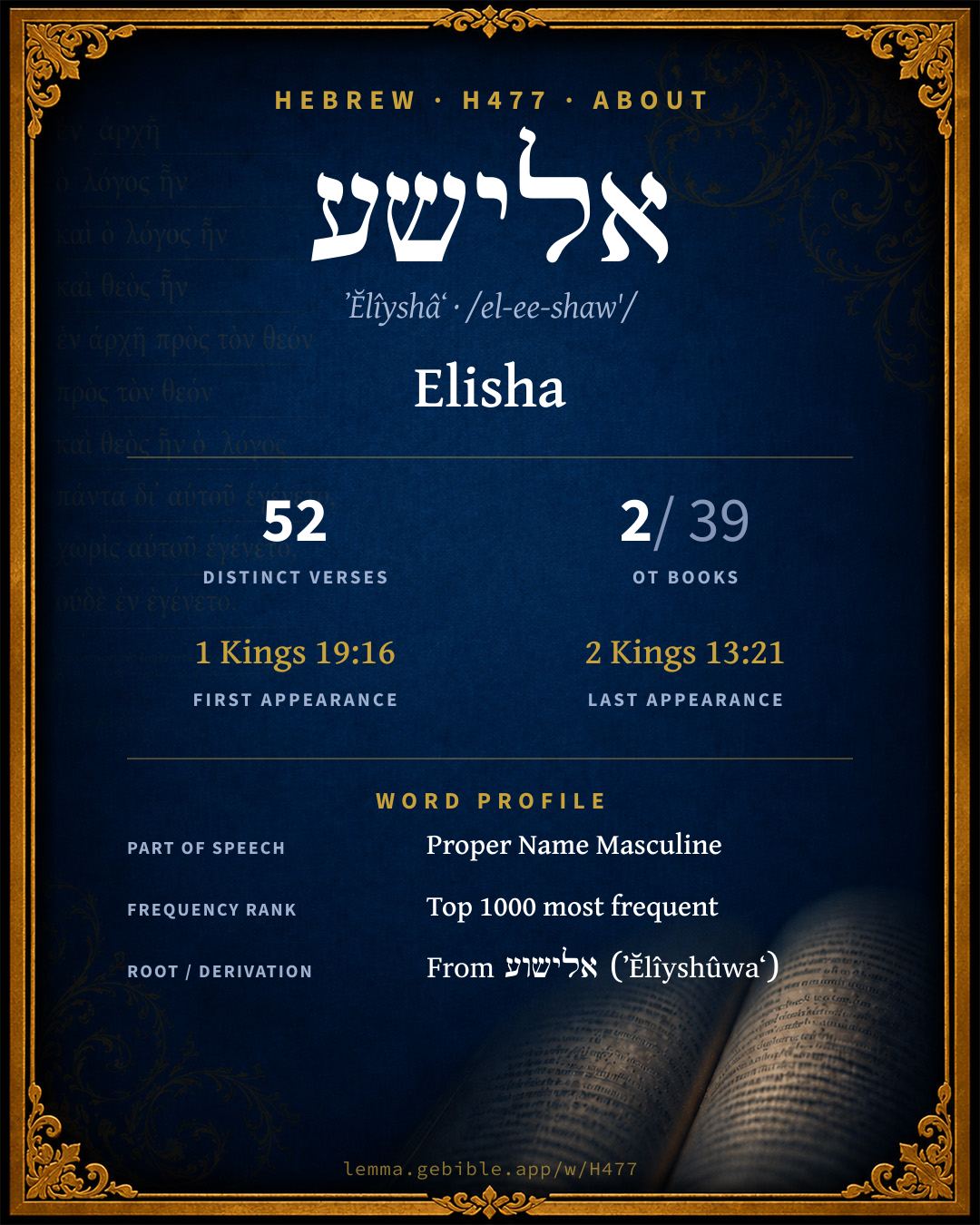
אֱלִישָׁע
Elisha
BDB lists 2 entries for ‘Elisha’ fuller range ↓
Full lexicon entry — Brown-Driver-Briggs (BDB)
From Brown-Driver-Briggs (BDB)
Where this word appears
Grammar key — what these labels mean
Part of speech
- Noun
- A naming word — a person, place, thing, or idea.
Noun type
- Proper
- A name of a specific person, place, or people (e.g. Abraham, Zion, Israel).
Every verse where H477 appears in the Book of 2 Kings — 49 distinct verses. Click any verse to open its interlinear word-by-word view. Verse text shown in the World English Bible for context — . Each verse’s Hebrew form is shown with its reference; the English is not keyword-highlighted, since the data carries no word-level English alignment. Use “Compare translations” on any verse to read it across multiple English versions. This concordance covers the Hebrew Bible; Septuagint (Greek Old Testament) occurrences are not indexed here.
2 Kings
- 2 Kings 2:1 וֶ/אֱלִישָׁ֖ע conj + n Proper It happened, when Yahweh would take up Elijah by a whirlwind into heaven, that Elijah went with Elisha from Gilgal.
- 2 Kings 2:2 אֱלִישָׁ֜ע אֱלִישָׁ֔ע n Proper n Proper Elijah said to Elisha, Please wait here, for Yahweh has sent me as far as Bethel. Elisha said, As Yahweh lives, and as your soul lives, I will not leave you. So they went down to Bethel.
- 2 Kings 2:3 אֱלִישָׁע֒ n Proper The sons of the prophets who were at Bethel came forth to Elisha, and said to him, "Do you know that Yahweh will take away your master from your head today?" He said, "Yes, I know it; hold your peace."
- 2 Kings 2:4 אֱלִישָׁ֣ע n Proper Elijah said to him, Elisha, please wait here, for Yahweh has sent me to Jericho. He said, As Yahweh lives, and as your soul lives, I will not leave you. So they came to Jericho.
- 2 Kings 2:5 אֱלִישָׁע֒ n Proper The sons of the prophets who were at Jericho came near to Elisha, and said to him, "Do you know that Yahweh will take away your master from your head today?" He answered, "Yes, I know it. Hold your peace."
- 2 Kings 2:9 אֱלִישָׁע֙ אֱלִישָׁ֔ע n Proper n Proper It happened, when they had gone over, that Elijah said to Elisha, Ask what I shall do for you, before I am taken from you. Elisha said, please let a double portion of your spirit be on me.
- 2 Kings 2:12 וֶ/אֱלִישָׁ֣ע conj + n Proper Elisha saw it, and he cried, My father, my father, the chariots of Israel and the horsemen of it! He saw him no more: and he took hold of his own clothes, and tore them in two pieces.
- 2 Kings 2:14 אֱלִישָֽׁע n Proper He took the mantle of Elijah that fell from him, and struck the waters, and said, Where is Yahweh, the God of Elijah? and when he also had struck the waters, they were divided here and there; and Elisha went over.
- 2 Kings 2:15 אֱלִישָׁ֑ע n Proper When the sons of the prophets who were at Jericho over against him saw him, they said, The spirit of Elijah does rest on Elisha. They came to meet him, and bowed themselves to the ground before him.
- 2 Kings 2:19 אֱלִישָׁ֔ע n Proper The men of the city said to Elisha, Behold, we pray you, the situation of this city is pleasant, as my lord sees: but the water is bad, and the land miscarries.
- 2 Kings 2:22 אֱלִישָׁ֖ע n Proper So the waters were healed to this day, according to the word of Elisha which he spoke.
- 2 Kings 3:11 אֱלִישָׁ֣ע n Proper But Jehoshaphat said, Isn't there here a prophet of Yahweh, that we may inquire of Yahweh by him? One of the king of Israel's servants answered, Elisha the son of Shaphat is here, who poured water on the hands of Elijah.
- 2 Kings 3:13 אֱלִישָׁ֜ע n Proper Elisha said to the king of Israel, What have I to do with you? get you to the prophets of your father, and to the prophets of your mother. The king of Israel said to him, No; for Yahweh has called these three kings together to deliver them into the hand of Moab.
- 2 Kings 3:14 אֱלִישָׁ֗ע n Proper Elisha said, As Yahweh of Hosts lives, before whom I stand, surely, were it not that I regard the presence of Jehoshaphat the king of Judah, I would not look toward you, nor see you.
- 2 Kings 4:1 אֱלִישָׁ֜ע n Proper Now there cried a certain woman of the wives of the sons of the prophets to Elisha, saying, Your servant my husband is dead; and you know that your servant did fear Yahweh: and the creditor is come to take to him my two children to be bondservants.
- 2 Kings 4:2 אֱלִישָׁע֙ n Proper Elisha said to her, What shall I do for you? tell me; what have you in the house? She said, Your handmaid has nothing in the house, except a pot of oil.
- 2 Kings 4:8 אֱלִישָׁ֣ע n Proper It fell on a day, that Elisha passed to Shunem, where was a great woman; and she constrained him to eat bread. So it was, that as often as he passed by, he turned in there to eat bread.
- 2 Kings 4:17 אֱלִישָֽׁע n Proper The woman conceived, and bore a son at that season, when the time came round, as Elisha had said to her.
- 2 Kings 4:32 אֱלִישָׁ֖ע n Proper When Elisha was come into the house, behold, the child was dead, and laid on his bed.
- 2 Kings 4:38 וֶ/אֱלִישָׁ֞ע conj + n Proper Elisha came again to Gilgal. There was a dearth in the land; and the sons of the prophets were sitting before him; and he said to his servant, Set on the great pot, and boil stew for the sons of the prophets.
- 2 Kings 5:8 אֱלִישָׁ֣ע n Proper It was so, when Elisha the man of God heard that the king of Israel had torn his clothes, that he sent to the king, saying, Why have you torn your clothes? let him come now to me, and he shall know that there is a prophet in Israel.
- 2 Kings 5:9 לֶ/אֱלִישָֽׁע prep + n Proper So Naaman came with his horses and with his chariots, and stood at the door of the house of Elisha.
- 2 Kings 5:10 אֱלִישָׁ֖ע n Proper Elisha sent a messenger to him, saying, Go and wash in the Jordan seven times, and your flesh shall come again to you, and you shall be clean.
- 2 Kings 5:20 אֱלִישָׁ֣ע n Proper But Gehazi the servant of Elisha the man of God, said, Behold, my master has spared this Naaman the Syrian, in not receiving at his hands that which he brought: as Yahweh lives, I will run after him, and take somewhat of him.
- 2 Kings 5:25 אֱלִישָׁ֔ע n Proper But he went in, and stood before his master. Elisha said to him, Whence come you, Gehazi? He said, Your servant went no where.
- 2 Kings 6:1 אֱלִישָׁ֑ע n Proper The sons of the prophets said to Elisha, See now, the place where we dwell before you is too strait for us.
- 2 Kings 6:12 אֱלִישָׁ֤ע n Proper One of his servants said, No, my lord, O king; but Elisha, the prophet who is in Israel, tells the king of Israel the words that you speak in your bedchamber.
- 2 Kings 6:17 אֱלִישָׁע֙ אֱלִישָֽׁע n Proper n Proper Elisha prayed, and said, Yahweh, Please open his eyes, that he may see. Yahweh opened the eyes of the young man; and he saw: and, behold, the mountain was full of horses and chariots of fire round about Elisha.
- 2 Kings 6:18 אֱלִישָׁ֤ע אֱלִישָֽׁע n Proper n Proper When they came down to him, Elisha prayed to Yahweh, and said, Please smite this people with blindness. He struck them with blindness according to the word of Elisha.
- 2 Kings 6:19 אֱלִישָׁ֗ע n Proper Elisha said to them, This is not the way, neither is this the city: follow me, and I will bring you to the man whom you seek. He led them to Samaria.
- 2 Kings 6:20 אֱלִישָׁ֔ע n Proper It happened, when they were come into Samaria, that Elisha said, Yahweh, open the eyes of these men, that they may see. Yahweh opened their eyes, and they saw; and, behold, they were in the midst of Samaria.
- 2 Kings 6:21 אֱלִישָׁ֔ע n Proper The king of Israel said to Elisha, when he saw them, My father, shall I strike them? shall I strike them?
- 2 Kings 6:31 אֱלִישָׁ֧ע n Proper Then he said, God do so to me, and more also, if the head of Elisha the son of Shaphat shall stand on him this day.
- 2 Kings 6:32 וֶ/אֱלִישָׁע֙ conj + n Proper But Elisha was sitting in his house, and the elders were sitting with him; and [the king] sent a man from before him: but before the messenger came to him, he said to the elders, See you how this son of a murderer has sent to take away my head? behold, when the messenger comes, shut the door, and hold the door fast against him: isn't the sound of his master's feet behind him?
- 2 Kings 7:1 אֱלִישָׁ֔ע n Proper Elisha said, Hear you the word of Yahweh: thus says Yahweh, Tomorrow about this time shall a measure of fine flour be [sold] for a shekel, and two measures of barley for a shekel, in the gate of Samaria.
- 2 Kings 8:1 וֶ/אֱלִישָׁ֡ע conj + n Proper Now Elisha had spoken to the woman, whose son he had restored to life, saying, Arise, and go you and your household, and sojourn wherever you can sojourn: for Yahweh has called for a famine; and it shall also come on the land seven years.
- 2 Kings 8:4 אֱלִישָֽׁע n Proper Now the king was talking with Gehazi the servant of the man of God, saying, Please tell me all the great things that Elisha has done.
- 2 Kings 8:5 אֱלִישָֽׁע n Proper It happened, as he was telling the king how he had restored to life him who was dead, that behold, the woman, whose son he had restored to life, cried to the king for her house and for her land. Gehazi said, My lord, O king, this is the woman, and this is her son, whom Elisha restored to life.
- 2 Kings 8:7 אֱלִישָׁע֙ n Proper Elisha came to Damascus; and Benhadad the king of Syria was sick; and it was told him, saying, The man of God is come here.
- 2 Kings 8:10 אֱלִישָׁ֔ע n Proper Elisha said to him, Go, tell him, You shall surely recover; however Yahweh has shown me that he shall surely die.
- 2 Kings 8:13 אֱלִישָׁ֔ע n Proper Hazael said, But what is your servant, who is but a dog, that he should do this great thing? Elisha answered, Yahweh has shown me that you shall be king over Syria.
- 2 Kings 8:14 אֱלִישָׁ֗ע אֱלִישָׁ֑ע n Proper n Proper Then he departed from Elisha, and came to his master; who said to him, What said Elisha to you? He answered, He told me that you would surely recover.
- 2 Kings 9:1 וֶ/אֱלִישָׁע֙ conj + n Proper Elisha the prophet called one of the sons of the prophets, and said to him, Gird up your loins, and take this vial of oil in your hand, and go to Ramoth-gilead.
- 2 Kings 13:14 וֶֽ/אֱלִישָׁע֙ conj + n Proper Now Elisha was fallen sick of his sickness of which he died: and Joash the king of Israel came down to him, and wept over him, and said, My father, my father, the chariots of Israel and the horsemen of it!
- 2 Kings 13:15 אֱלִישָׁ֔ע n Proper Elisha said to him, Take bow and arrows; and he took to him bow and arrows.
- 2 Kings 13:16 אֱלִישָׁ֛ע n Proper He said to the king of Israel, Put your hand on the bow; and he put his hand [on it]. Elisha laid his hands on the king's hands.
- 2 Kings 13:17 אֱלִישָׁ֤ע n Proper He said, Open the window eastward; and he opened it. Then Elisha said, Shoot; and he shot. He said, Yahweh's arrow of victory, even the arrow of victory over Syria; for you shall strike the Syrians in Aphek, until you have consumed them.
- 2 Kings 13:20 אֱלִישָׁ֖ע n Proper Elisha died, and they buried him. Now the bands of the Moabites invaded the land at the coming in of the year.
- 2 Kings 13:21 אֱלִישָׁ֑ע אֱלִישָׁ֔ע n Proper n Proper It happened, as they were burying a man, that behold, they spied a band; and they cast the man into the tomb of Elisha: and as soon as the man touched the bones of Elisha, he revived, and stood up on his feet.
About this entry
At a glance — auto-summarized from this page’s data, not written by a person. Every figure links to its source below. This summary describes the numbers; it doesn’t interpret them.
“Elisha” is the headline sense of the Hebrew name אלישע (ʼĔlîyshâʻ). More than three-quarters of its appearances fall in 2 Kings. It appears 52 verses across 2 books of the Hebrew Bible, among its moderately common vocabulary. Scripture first uses it in 1 Kings 19:16. See 52-verse concordance and the renderings breakdown below.
Gloss history
Strong's 1890 vs modern scholarship

About this word
Strong's H477 catalogs a Hebrew word from the Hebrew Old Testament.
These counts are not copied from any lexicon or concordance. They are computed here, from the morphology-tagged Hebrew Old Testament. What Lemma adds →
- 52
- distinct verses
- The word appears in 52 distinct verses.
- 2 / 39
- OT books
- The word appears in 2 of 39 Old Testament books.
- #658
- by frequency
- Top 1000 most frequent Hebrew words (rank 658 of 8,640 Hebrew words by occurrence).
View all 52 occurrences in the concordance →
By traditional corpus
Conventional, traditional groupings — biblical authorship is debated, so this is a traditional corpus grouping, not an authorship claim. Each share is this word’s portion of its verses in that division of the Hebrew canon. Each figure is a share of the word’s 52 distinct verses.
- Prophets (Nevi'im) 52 verses · 100%
How translations render this word
Counts come from each version’s own published word-to-Strong’s tagging or interlinear alignment — an approximate guide to how each version renders this word, not a word-level alignment the data otherwise carries. Because each total is that version’s own tagged count, the per-version totals vary from one another and need not match the appearance or distinct-verse counts above. These counts may also differ from a printed concordance because Lemma counts each distinctly tagged rendering and does not collapse phrase taggings into a single head-word total. This is a fixed set of word-tagged versions (KJV, ASV, BSB, ULT) and does not change with the reading translation you choose elsewhere. Each version’s license is shown beside its name below (and on Sources).
- King James Version: Elisha 52×
- American Standard Version: Elisha 43×, Him 2×, It 2×
- Berean Standard Bible: Elisha 51×, Now elisha 3×, Elisha’s 2×
- unfoldingWord Literal Text: Elisha 56×, Now elisha 2×
King James Version Public Domain
Renders H477 across 58 tagged occurrences — most commonly:
Plus 6 renderings that appear only once — usually multi-word phrases or single function words the recovered tagging swept in, not distinct renderings.
American Standard Version Public Domain
Renders H477 across 58 tagged occurrences — most commonly:
Plus 9 renderings that appear only once — usually multi-word phrases or single function words the recovered tagging swept in, not distinct renderings.
Berean Standard Bible Public Domain
Renders H477 across 58 tagged occurrences — most commonly:
Plus 2 renderings that appear only once — usually multi-word phrases or single function words the recovered tagging swept in, not distinct renderings.
unfoldingWord Literal Text CC BY-SA 4.0
Renders H477 across 58 tagged occurrences — most commonly:
Senses in BDB
The 2 senses BDB distinguishes for this word, in lexicon order (not ranked by frequency or importance). The full entry — with sub-senses — is in the Lexicon Entry tab.
- Elisha = "God is salvation"
- the great prophet who succeeded Elijah
Word origin
n.pr.m. (God is salvation, cf. אֱלִישׁוּעַ, Sab. יתֿעאל DHMZMG 1883, 15) the prophet Elisha, the successor of Elijah 1 K 19:16 + 57 times all K; Ἐλισα, Ἐλισαιε 𝔊; Ἐλισαιος Lu 4:27.
— Brown-Driver-Briggs (Oxford 1906, public domain), digitized via Sefaria, supplemented by the OpenScriptures HebrewLexicon (CC BY 4.0). See Sources.
Derived from אלישוע (ʼĔlîyshûwaʻ) (H474) — Elishua.
Jastrow Dictionary
A second Hebrew/Aramaic lexicon for comparison, covering Aramaic and post-biblical (Talmudic, Targumic, Midrashic) usage that the biblical-Hebrew BDB does not. Matched by lemma rather than by Strong’s number, so a lemma may carry more than one Jastrow headword (shown separately below), and the entries cover usage well beyond the Bible.
אֶלִישָׁע
- Elisha,
- 1. the prophet. Ber. 10ᵇ. Gen. R. s. 25; a. e.
- 2. E. ben Abuyah, surnamed אַחֵר, q. v. Aboth. IV, 20; M. Kat. 20ᵃ
- 3. one E. surnamed בעל כנפים ‘winged’. Sabb. 49ᵃ; 130ᵃ. Y. Ber. II, 4ᶜ bot.
A Dictionary of the Targumim, the Talmud Babli and Yerushalmi, and the Midrashic Literature (Marcus Jastrow; London, Luzac, 1903) — Public Domain. Digitized via Sefaria. Digitized via Sefaria. Full attribution on Sources.
Forms in the corpus
The 19 distinct written forms H477 takes in the Hebrew Bible, most frequent first — each parse links to that state’s occurrences in the concordance. Hebrew forms include their vowel points and cantillation, so a single lemma takes many written forms.
| Form | Parsing | Example | Uses |
|---|---|---|---|
| אֱלִישָׁ֔ע | Noun, Proper | 2 Kings 2:2 | 11 |
| אֱלִישָֽׁע | Noun, Proper | 1 Kings 19:17 | 7 |
| אֱלִישָׁ֣ע | Noun, Proper | 2 Kings 2:4 | 5 |
| אֱלִישָׁ֤ע | Noun, Proper | 1 Kings 19:16 | 5 |
| אֱלִישָׁ֑ע | Noun, Proper | 2 Kings 2:15 | 4 |
| אֱלִישָׁ֖ע | Noun, Proper | 2 Kings 2:22 | 4 |
| אֱלִישָׁע֙ | Noun, Proper | 2 Kings 2:9 | 4 |
| אֱלִישָׁ֗ע | Noun, Proper | 2 Kings 3:14 | 3 |
| אֱלִישָׁ֜ע | Noun, Proper | 2 Kings 2:2 | 3 |
| אֱלִישָׁע֒ | Noun, Proper | 2 Kings 2:3 | 2 |
| וֶ/אֱלִישָׁע֙ | Noun, Proper | 2 Kings 6:32 | 2 |
| אֱלִישָׁ֛ע | Noun, Proper | 2 Kings 13:16 | 1 |
| אֱלִישָׁ֧ע | Noun, Proper | 2 Kings 6:31 | 1 |
| וֶ/אֱלִישָׁ֖ע | Noun, Proper | 2 Kings 2:1 | 1 |
| וֶ/אֱלִישָׁ֞ע | Noun, Proper | 2 Kings 4:38 | 1 |
| וֶ/אֱלִישָׁ֡ע | Noun, Proper | 2 Kings 8:1 | 1 |
| וֶ/אֱלִישָׁ֣ע | Noun, Proper | 2 Kings 2:12 | 1 |
| וֶֽ/אֱלִישָׁע֙ | Noun, Proper | 2 Kings 13:14 | 1 |
| לֶ/אֱלִישָֽׁע | Noun, Proper | 2 Kings 5:9 | 1 |
Same root — word family
Other BDB entries built from the same root as H477, grouped by Strong’s listed origin. These share a root / origin per the lexicon — not necessarily a shared meaning. Each links to that word’s own entry.
Derives from
Proper names from this root
People and places named from this root — a name, not an additional meaning of the word.
Compare all same-root words → 2 of the same-root words are proper names (people or places). They share a root, not necessarily a meaning.
Bible dictionary
Public-domain dictionary articles matched to this entry by name (Elisha). A biblical name can be shared by more than one person or place, so an article may treat several.
Easton's Bible Dictionary · M. G. Easton, 1897
God his salvation, the son of Shaphat of Abel-meholah, who became the attendant and disciple of Elijah (1 Kings 19:16-19). His name first occurs in the command given to Elijah to anoint him as his successor (1 Kings 19:16). This was the only one of the three commands then given to Elijah which he accomplished. On his way from Sinai to Damascus he found Elisha at his native place engaged in the labours of the field, ploughing with twelve yoke of oxen. He went over to him, threw over his shoulders his rough mantle, and at once adopted him as a son, and invested him with the prophetical office (comp. Luke 9:61, 62). Elisha accepted the call thus given (about four years before the death of Ahab), and for some seven or eight years became the close attendant on Elijah till he was parted from him and taken up into heaven. During all these years we hear nothing of Elisha except in connection with the closing scenes of Elijah's life. After Elijah, Elisha was accepted as the leader of the sons of the prophets, and became noted in Israel. He possessed, according to his own request, "a double portion" of Elijah's spirit (2 Kings 2:9); and for the long period of about sixty years (B.C. 892-832) held the office of "prophet in Israel" (2 Kings 5:8).
After Elijah's departure, Elisha returned to Jericho, and there healed the spring of water by casting salt into it (2 Kings 2:21). We next find him at Bethel (2:23), where, with the sternness of his master, he cursed the youths who came out and scoffed at him as a prophet of God: "Go up, thou bald head." The judgment at once took effect, and God terribly visited the dishonour done to his prophet as dishonour done to himself. We next read of his predicting a fall of rain when the army of Jehoram was faint from thirst (2 Kings 3:9-20); of the multiplying of the poor widow's cruse of oil (4:1-7); the miracle of restoring to life the son of the woman of Shunem (4:18-37); the multiplication of the twenty loaves of new barley into a sufficient supply for an hundred men (4:42-44); of the cure of Naaman the Syrian of his leprosy (5:1-27); of the punishment of Gehazi for his falsehood and his covetousness; of the recovery of the axe lost in the waters of the Jordan (6:1-7); of the miracle at Dothan, half-way on the road between Samaria and Jezreel; of the siege of Samaria by the king of Syria, and of the terrible sufferings of the people in connection with it, and Elisha's prophecy as to the relief that would come (2 Kings 6:24-7:2).
We then find Elisha at Damascus, to carry out the command given to his master to anoint Hazael king over Syria (2 Kings 8:7-15); thereafter he directs one of the sons of the prophets to anoint Jehu, the son of Jehoshaphat, king of Israel, instead of Ahab. Thus the three commands given to Elijah (9:1-10) were at length carried out.
We do not again read of him till we find him on his death-bed in his own house (2 Kings 13:14-19). Joash, the grandson of Jehu, comes to mourn over his approaching departure, and utters the same words as those of Elisha when Elijah was taken away: "My father, my father! the chariot of Israel, and the horsemen thereof."
Afterwards when a dead body is laid in Elisha's grave a year after his burial, no sooner does it touch the hallowed remains than the man "revived, and stood up on his feet" (2 Kings 13:20-21).
Smith's Bible Dictionary · William Smith, 1863
(God his salvation), son of Shaphat of Abel-meholah; the attendant and disciple of Elijan, and subsequently his successor as prophet of the kingdom of Israel. The earliest mention of his name is in the command to Elijah in the cave at Horeb. (1 Kings 19:16,17) (B.C. about 900.) Elijah sets forth to obey the command, and comes upon his successor engaged in ploughing. He crosses to him and throws over his shoulders the rough mantle--a token at once of investiture with the prophet's office and of adoption as a son. Elisha delayed merely to give the farewell kiss to his father and mother and preside at a parting feast with his people, and then followed the great prophet on his northward road. We hear nothing more of Elisha for eight years, until the translation of his master, when he reappears, to become the most prominent figure in the history of his country during the rest of his long life. In almost every respect Elisha presents the most complete contrast to Elijah. Elijah was a true Bedouin child of the desert. If he enters a city it is only to deliver his message of fire and be gone. Elisha, on the other hand, is a civilized man, an inhabitant of cities. His dress was the ordinary garment of an Israelite, the beged, probably similar in form to the long abbeyeh of the modern Syrians. (2 Kings 2:12) His hair was worn trimmed behind, in contrast to the disordered locks of Elijah, and he used a walking-staff, (2 Kings 4:29) of the kind ordinarily carried by grave or aged citizens. (Zechariah 8:4) After the departure of his master, Elisha returned to dwell at Jericho, (2 Kings 2:18) where he miraculously purified the springs. We next meet with Elisha at Bethel, in the heart of the country, on his way from Jericho to Mount Carmel. (2 Kings 2:23) The mocking children, Elisha's curse and the catastrophe which followed are familiar to all. Later he extricates Jehoram king of Israel, and the kings of Judah and Edom, from their difficulty in the campaign against Moab arising from want of water. (2 Kings 3:4-27) Then he multiplies the widow's oil. (2 Kings 4:5) The next occurrence is at Shunem, where he is hospitably entertained by a woman of substance, whose son dies, and is brought to life again by Elisha. (2 Kings 4:8-37) Then at Gilgal he purifies the deadly pottage, (2 Kings 4:38-41) and multiplies the loaves. (2 Kings 4:42-44) The simple records of these domestic incidents amongst the sons of the prophets are now interrupted by an occurrence of a more important character. (2 Kings 5:1-27) The chief captain of the army of Syria, Naaman, is attacked with leprosy, and is sent by an Israelite maid to the prophet Elisha, who directs him to dip seven times in the Jordan, which he does and is healed, (2 Kings 5:1-14) while Naaman's servant, Gehazi, he strikes with leprosy for his unfaithfulness. ch. (2 Kings 5:20-27) Again the scene changes. It is probably at Jericho that Elisha causes the iron axe to swim. (2 Kings 6:1-7) A band of Syrian marauders are sent to seize him, but are struck blind, and he misleads them to Samaria, where they find themselves int he presence of the Israelite king and his troops. (2 Kings 6:8-23) During the famine in Samaria, (2 Kings 6:24-33) he prophesied incredible plenty, ch. (2 Kings 7:1-2) which was soon fulfilled. ch. (2 Kings 7:3-20) We next find the prophet at Damascus. Benhadad the king is sick, and sends to Elisha by Hazael to know the result. Elisha prophesies the king's death, and announces to Hazael that he is to succeed to the throne. (2 Kings 8:7,15) Finally this prophet of God, after having filled the position for sixty years, is found on his death-bed in his own house. (2 Kings 13:14-19) The power of the prophet, however, does not terminate with his death. Even in the tomb he restores the dead to life. ch. (2 Kings 13:21)
Hitchcock's Bible Names Dictionary · Roswell D. Hitchcock, 1869
salvation of God
Classic public-domain reference works; full attribution on Sources.
Septuagint verse parallels
This word appears in 52 verses that also exist in the Greek Old Testament (Septuagint), out of the 52 Hebrew verses it occurs in. You can read those verses in Greek by switching the Old Testament edition to the Septuagint.
Read these verses in the Septuagint
This is a verse-level parallel only — the same verses exist in both the Hebrew and Greek Old Testaments. No word-level Hebrew↔Greek correspondence is claimed: the data carries no such alignment, so no Greek word is shown as this Hebrew word’s translation. Coverage is not total — the Septuagint omits the deuterocanon and renumbers the Psalms, so some Hebrew verses have no direct Greek parallel.