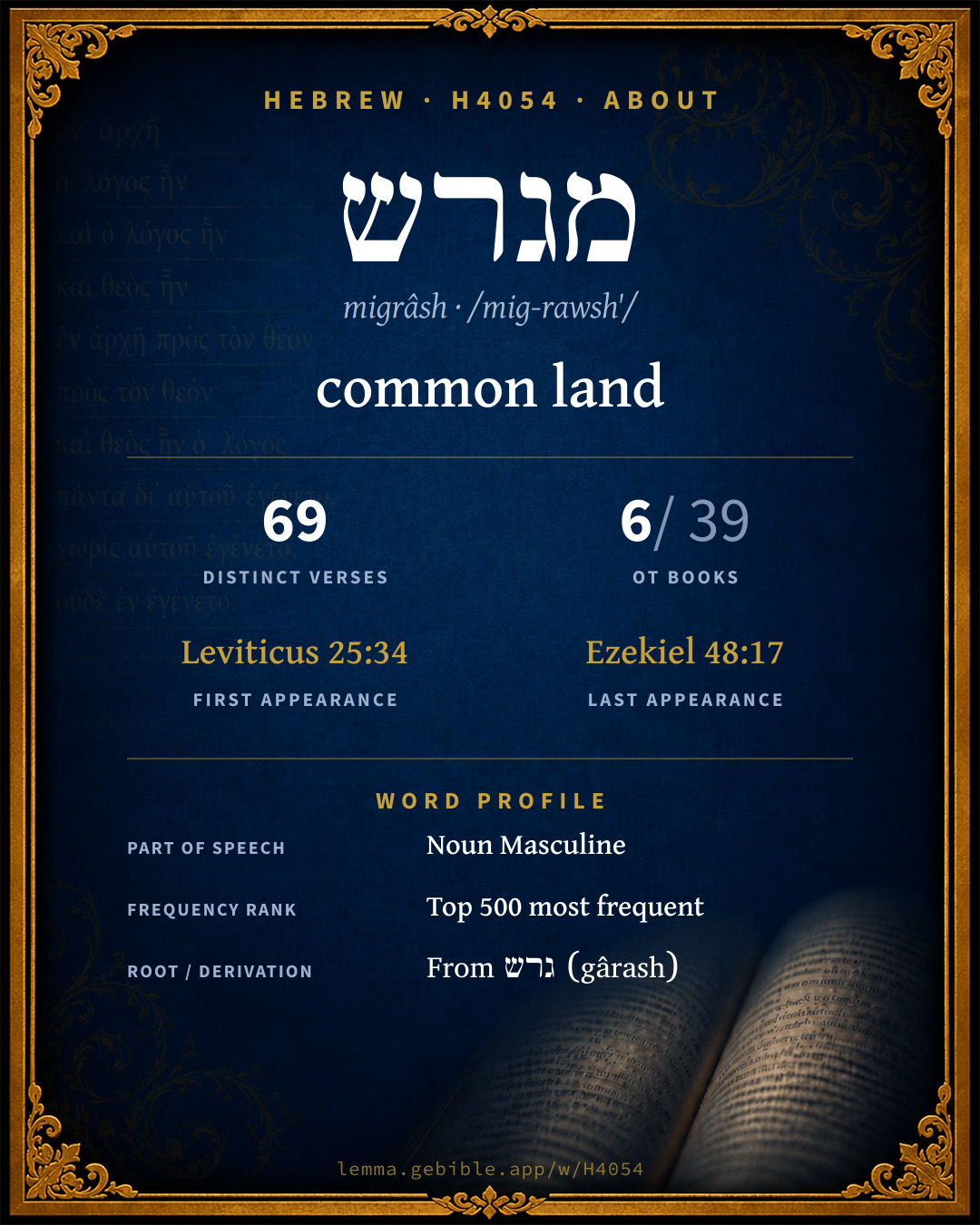
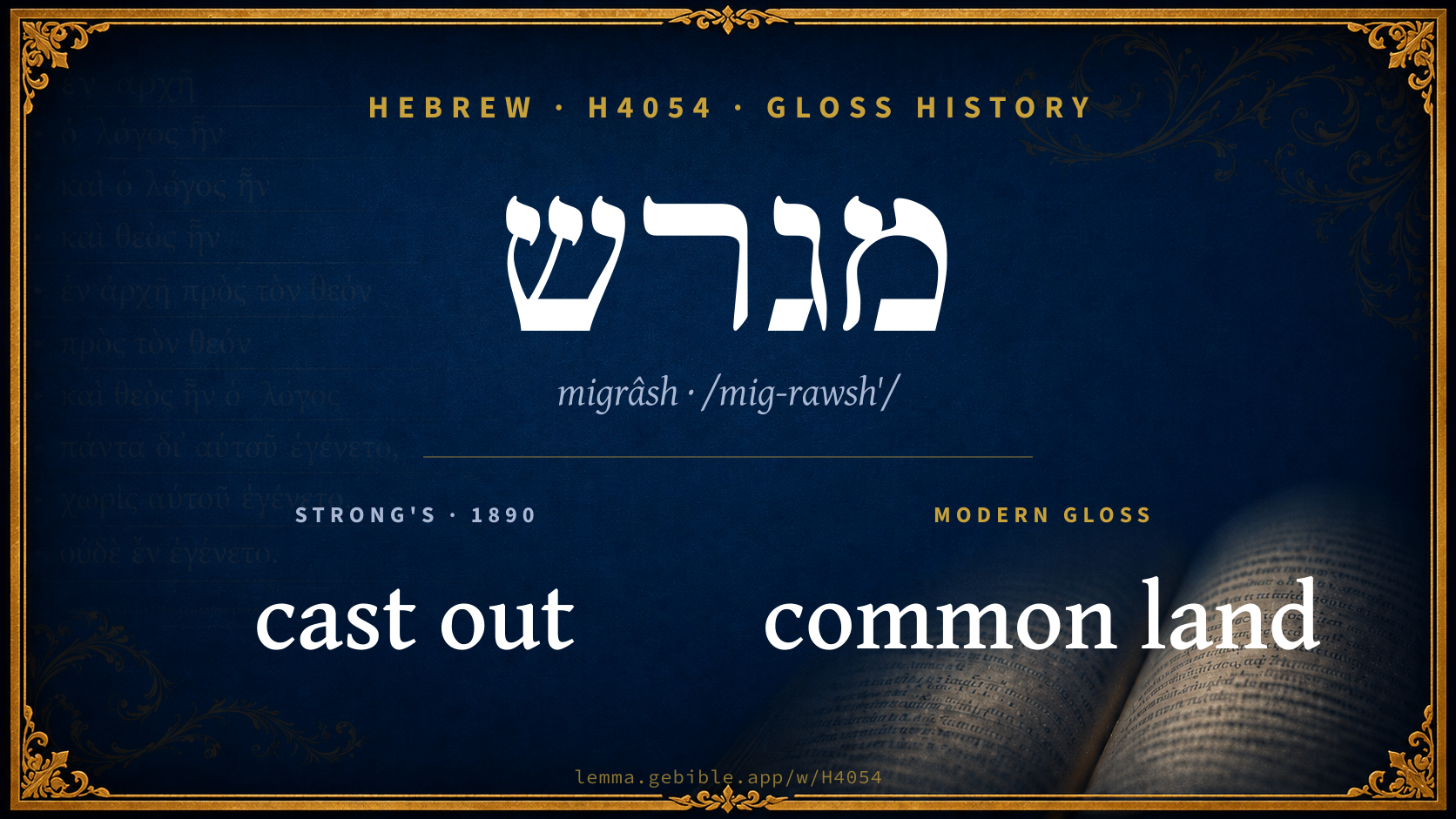
מִגְרָשׁ
common land
Full lexicon entry — Brown-Driver-Briggs (BDB)
From Brown-Driver-Briggs (BDB)
Where this word appears
Grammar key — what these labels mean
Part of speech
- Noun
- A naming word — a person, place, thing, or idea.
Noun type
- Common
- A common noun — a general class of person, place, or thing (“king,” “city,” “water”), not a specific name.
State
- Construct
- A noun bound to a following noun in a possessive / “of” relationship (the construct chain).
- Absolute
- The independent form of a noun, not bound to a following word.
Gender
- Masculine
- Grammatically masculine.
Number
- Plural
- More than one (in Hebrew, generally three or more).
- Singular
- One.
Every verse where H4054 appears in the Book of 1 Chronicles — 23 distinct verses. Click any verse to open its interlinear word-by-word view. Verse text shown in the World English Bible for context — . Each verse’s Hebrew form is shown with its reference; the English is not keyword-highlighted, since the data carries no word-level English alignment. Use “Compare translations” on any verse to read it across multiple English versions. This concordance covers the Hebrew Bible; Septuagint (Greek Old Testament) occurrences are not indexed here.
1 Chronicles
- 1 Chronicles 5:16 מִגְרְשֵׁ֥י n c mp cs They lived in Gilead in Bashan, and in its towns, and in all the suburbs of Sharon, as far as their borders.
- 1 Chronicles 6:55 מִגְרָשֶׁ֖י/הָ n c mp cs + sfx pers 3fs to them they gave Hebron in the land of Judah, and the suburbs of it round about it;
- 1 Chronicles 6:57 מִגְרָשֶׁ֑י/הָ מִגְרָשֶֽׁי/הָ n c mp cs + sfx pers 3fs n c mp cs + sfx pers 3fs To the sons of Aaron they gave the cities of refuge, Hebron; Libnah also with its suburbs, and Jattir, and Eshtemoa with its suburbs,
- 1 Chronicles 6:58 מִגְרָשֶׁ֔י/הָ מִגְרָשֶֽׁי/הָ n c mp cs + sfx pers 3fs n c mp cs + sfx pers 3fs and Hilen with its suburbs, Debir with its suburbs,
- 1 Chronicles 6:59 מִגְרָשֶׁ֔י/הָ מִגְרָשֶֽׁי/הָ n c mp cs + sfx pers 3fs n c mp cs + sfx pers 3fs and Ashan with its suburbs, and Beth-shemesh with its suburbs;
- 1 Chronicles 6:60 מִגְרָשֶׁ֨י/הָ֙ מִגְרָשֶׁ֔י/הָ מִגְרָשֶׁ֑י/הָ n c mp cs + sfx pers 3fs n c mp cs + sfx pers 3fs n c mp cs + sfx pers 3fs and out of the tribe of Benjamin, Geba with its suburbs, and Allemeth with its suburbs, and Anathoth with its suburbs. All their cities throughout their families were thirteen cities.
- 1 Chronicles 6:64 מִגְרְשֵׁי/הֶֽם n c mp cs + sfx pers 3mp The children of Israel gave to the Levites the cities with their suburbs.
- 1 Chronicles 6:67 מִגְרָשֶׁ֖י/הָ מִגְרָשֶֽׁי/הָ n c mp cs + sfx pers 3fs n c mp cs + sfx pers 3fs They gave to them the cities of refuge, Shechem in the hill-country of Ephraim with its suburbs; Gezer also with its suburbs,
- 1 Chronicles 6:68 מִגְרָשֶׁ֔י/הָ מִגְרָשֶֽׁי/הָ n c mp cs + sfx pers 3fs n c mp cs + sfx pers 3fs and Jokmeam with its suburbs, and Beth Horon with its suburbs,
- 1 Chronicles 6:69 מִגְרָשֶׁ֔י/הָ מִגְרָשֶֽׁי/הָ n c mp cs + sfx pers 3fs n c mp cs + sfx pers 3fs and Aijalon with its suburbs, and Gath-rimmon with its suburbs;
- 1 Chronicles 6:70 מִגְרָשֶׁ֔י/הָ מִגְרָשֶׁ֑י/הָ n c mp cs + sfx pers 3fs n c mp cs + sfx pers 3fs and out of the half-tribe of Manasseh, Aner with its suburbs, and Bileam with its suburbs, for the rest of the family of the sons of Kohath.
- 1 Chronicles 6:71 מִגְרָשֶׁ֑י/הָ מִגְרָשֶֽׁי/הָ n c mp cs + sfx pers 3fs n c mp cs + sfx pers 3fs To the sons of Gershom [were given], out of the family of the half-tribe of Manasseh, Golan in Bashan with its suburbs, and Ashtaroth with its suburbs;
- 1 Chronicles 6:72 מִגְרָשֶׁ֑י/הָ מִגְרָשֶֽׁי/הָ n c mp cs + sfx pers 3fs n c mp cs + sfx pers 3fs and out of the tribe of Issachar, Kedesh with its suburbs, Daberath with its suburbs,
- 1 Chronicles 6:73 מִגְרָשֶׁ֔י/הָ מִגְרָשֶֽׁי/הָ n c mp cs + sfx pers 3fs n c mp cs + sfx pers 3fs and Ramoth with its suburbs, and Anem with its suburbs;
- 1 Chronicles 6:74 מִגְרָשֶׁ֑י/הָ מִגְרָשֶֽׁי/הָ n c mp cs + sfx pers 3fs n c mp cs + sfx pers 3fs and out of the tribe of Asher, Mashal with its suburbs, and Abdon with its suburbs,
- 1 Chronicles 6:75 מִגְרָשֶׁ֔י/הָ מִגְרָשֶֽׁי/הָ n c mp cs + sfx pers 3fs n c mp cs + sfx pers 3fs and Hukok with its suburbs, and Rehob with its suburbs;
- 1 Chronicles 6:76 מִגְרָשֶׁ֔י/הָ מִגְרָשֶׁ֑י/הָ מִגְרָשֶֽׁי/הָ n c mp cs + sfx pers 3fs n c mp cs + sfx pers 3fs n c mp cs + sfx pers 3fs and out of the tribe of Naphtali, Kedesh in Galilee with its suburbs, and Hammon with its suburbs, and Kiriathaim with its suburbs.
- 1 Chronicles 6:77 מִגְרָשֶׁ֑י/הָ מִגְרָשֶֽׁי/הָ n c mp cs + sfx pers 3fs n c mp cs + sfx pers 3fs To the rest of [the Levites], the sons of Merari, [were given], out of the tribe of Zebulun, Rimmono with its suburbs, Tabor with its suburbs;
- 1 Chronicles 6:78 מִגְרָשֶׁ֑י/הָ מִגְרָשֶֽׁי/הָ n c mp cs + sfx pers 3fs n c mp cs + sfx pers 3fs and beyond the Jordan at Jericho, on the east side of the Jordan, [were given them], out of the tribe of Reuben, Bezer in the wilderness with its suburbs, and Jahzah with its suburbs,
- 1 Chronicles 6:79 מִגְרָשֶׁ֔י/הָ מִגְרָשֶֽׁי/הָ n c mp cs + sfx pers 3fs n c mp cs + sfx pers 3fs and Kedemoth with its suburbs, and Mephaath with its suburbs;
- 1 Chronicles 6:80 מִגְרָשֶׁ֑י/הָ מִגְרָשֶֽׁי/הָ n c mp cs + sfx pers 3fs n c mp cs + sfx pers 3fs and out of the tribe of Gad, Ramoth in Gilead with its suburbs, and Mahanaim with its suburbs,
- 1 Chronicles 6:81 מִגְרָשֶׁ֔י/הָ מִגְרָשֶֽׁי/הָ n c mp cs + sfx pers 3fs n c mp cs + sfx pers 3fs and Heshbon with its suburbs, and Jazer with its suburbs.
- 1 Chronicles 13:2 מִגְרְשֵׁי/הֶ֑ם n c mp cs + sfx pers 3mp David said to all the assembly of Israel, If it seem good to you, and if it be of Yahweh our God, let us send abroad everywhere to our brothers who are left in all the land of Israel, with whom the priests and Levites are in their cities that have suburbs, that they may gather themselves to us;
About this entry
At a glance — auto-summarized from this page’s data, not written by a person. Every figure links to its source below. This summary describes the numbers; it doesn’t interpret them.
“common land” is the headline sense of the Hebrew noun מגרש (migrâsh). Older and newer Bibles part ways — “suburbs” in the King James Version, “pasturelands” (Berean Standard Bible) in modern versions. See the renderings breakdown. It turns up in 69 verses across 6 books, a moderately common footprint. It concentrates in Joshua, which alone accounts for 48% of its uses. Its earliest occurrence is Leviticus 25:34. See the sense tree, 69-verse concordance, and the renderings breakdown below.
Gloss history
Strong's 1890 vs modern scholarship
About this word
Strong's H4054 catalogs a Hebrew word from the Hebrew Old Testament.
These counts are not copied from any lexicon or concordance. They are computed here, from the morphology-tagged Hebrew Old Testament. What Lemma adds →
- 69
- distinct verses
- The word appears in 69 distinct verses.
- 6 / 39
- OT books
- The word appears in 6 of 39 Old Testament books.
- #382
- by frequency
- Top 500 most frequent Hebrew words (rank 382 of 8,640 Hebrew words by occurrence).
View all 69 occurrences in the concordance →
Most concentrated in
- Joshua 33 verses 48%
- 1 Chronicles 23 verses 33%
- Numbers 5 verses 7%
By section of the Old Testament
By traditional corpus
Conventional, traditional groupings — biblical authorship is debated, so this is a traditional corpus grouping, not an authorship claim. Each share is this word’s portion of its verses in that division of the Hebrew canon. Each figure is a share of the word’s 69 distinct verses.
- Prophets (Nevi'im) 38 verses · 55%
- Writings (Ketuvim) 25 verses · 36%
- Torah (Pentateuch) 6 verses · 9%
How translations render this word
Counts come from each version’s own published word-to-Strong’s tagging or interlinear alignment — an approximate guide to how each version renders this word, not a word-level alignment the data otherwise carries. Because each total is that version’s own tagged count, the per-version totals vary from one another and need not match the appearance or distinct-verse counts above. These counts may also differ from a printed concordance because Lemma counts each distinctly tagged rendering and does not collapse phrase taggings into a single head-word total. This is a fixed set of word-tagged versions (KJV, ASV, BSB, ULT) and does not change with the reading translation you choose elsewhere. Each version’s license is shown beside its name below (and on Sources).
- King James Version: Suburbs 107×
- American Standard Version: Suburbs 104×
- Berean Standard Bible: Pasturelands 38×, Pastureland 4×, Together with their pasturelands 4×
- unfoldingWord Literal Text: Pasturelands 103×, Pastureland 3×, Pastureland of 2×
King James Version Public Domain
Renders H4054 across 111 tagged occurrences — most commonly:
Plus 4 renderings that appear only once — usually multi-word phrases or single function words the recovered tagging swept in, not distinct renderings.
American Standard Version Public Domain
Renders H4054 across 111 tagged occurrences — most commonly:
Plus 7 renderings that appear only once — usually multi-word phrases or single function words the recovered tagging swept in, not distinct renderings.
Berean Standard Bible Public Domain
Renders H4054 across 51 tagged occurrences — most commonly:
Plus 5 renderings that appear only once — usually multi-word phrases or single function words the recovered tagging swept in, not distinct renderings. Not rendered by a distinct English word in 64 further occurrences.
unfoldingWord Literal Text CC BY-SA 4.0
Renders H4054 across 117 tagged occurrences — most commonly:
Plus 7 renderings that appear only once — usually multi-word phrases or single function words the recovered tagging swept in, not distinct renderings.
Senses in BDB
The 1 sense BDB distinguishes for this word, in lexicon order (not ranked by frequency or importance). The full entry — with sub-senses — is in the Lexicon Entry tab.
- common, common land, open land, suburb
Word origin
n.m. Nu 35:2 common, common-land, open land (perhaps orig. pasture-land, as place of [cattle] driving)—abs. מ׳ Ez 45:2 + 2 times + Ez 48:15 (Co מגרשָׁהּ); cstr. מִגְרַשׁ Lv 25:34; 2 Ch 31:19; (on מִגְרָשָׁהּ Ez 36:5 cf. גרשׁ); elsewhere pl., abs. מִגְרשׁוֹת Ez 27:28 (Baer); Co מרעשׁת assumed from רָעַשׁ, cf. 𝔊; cstr. מִגְרְשֵׁי Nu 35:4 + 2 times; sf. מִגְרָשֶׁיהָ Jos 21:13(×2) + 42 times; מִגְרָשֶׁהָ Jos 21:11 + 46 times in Jos 21 (generally –֑ or –֔ but also –֖ v 21); מִגְרְשֵׁיהֶם Nu 35:3 + 4 times; מִגְרְשֵׁיהֶן Nu 35:7 + 8 times—commonland, usually pl., and usually as attached to a city or town, especially as surrounding Levitical cities Nu 35:2, 3, 4, 5, 7 Jos 14:4; 21:2 + 55 times Jos 21 (all P; in Codd. & old Vrss. are two vv Jos 21, betw. v 35, 36, with מ׳ 4 times; om. Mass, Edd., Baer, but cf. Theile, & Di ad loc.); 1 Ch 6:40 + 40 times 1 Ch 6; 13:2; 2 Ch 11:14; so also שְׂדֵה מ׳ Lv 25:34 (P), שְׂדֵי מ׳ 2 Ch 31:19; lands surrounding the holy city Ez 48:15, 17; open land or space about the temple Ez 45:2; only 1 Ch 5:16 כל־מִגְרְשֵׁי שָׁרוֹן of (pasture-)lands in a district, cf. שׁרון.—Ez 27:28 מגרשׁות, if true text, = open country about Tyre (opp. sea, cf. context), but v. Da & cf. supr.
— Brown-Driver-Briggs (Oxford 1906, public domain), digitized via Sefaria, supplemented by the OpenScriptures HebrewLexicon (CC BY 4.0). See Sources.
Derived from גרש (gârash) (H1644) — to drive out.
Jastrow Dictionary
A second Hebrew/Aramaic lexicon for comparison, covering Aramaic and post-biblical (Talmudic, Targumic, Midrashic) usage that the biblical-Hebrew BDB does not. Matched by lemma rather than by Strong’s number, so a lemma may carry more than one Jastrow headword (shown separately below), and the entries cover usage well beyond the Bible.
מִגְרָשׁ
- open space outside of a place. Gen. R. s. 21, end (ref. to Gen. III, 24) למִגְרָשָׁהּ של עדן וכ׳ he drove him out to the open outskirts of the garden of Eden. Macc. 12ᵃ, a. e. אין עושין שדה מ׳ וכ׳ you must not change a cultivated field (outside of a town of refuge into an open space &c. e.g. Genesis 3:24
A Dictionary of the Targumim, the Talmud Babli and Yerushalmi, and the Midrashic Literature (Marcus Jastrow; London, Luzac, 1903) — Public Domain. Digitized via Sefaria. Digitized via Sefaria. Full attribution on Sources.
Forms in the corpus
The 33 distinct written forms H4054 takes in the Hebrew Bible, most frequent first — each parse links to that state’s occurrences in the concordance. Hebrew forms include their vowel points and cantillation, so a single lemma takes many written forms.
Same root — word family
Other BDB entries built from the same root as H4054, grouped by Strong’s listed origin. These share a root / origin per the lexicon — not necessarily a shared meaning. Each links to that word’s own entry.
Derives from
Shares the same root
Proper names from this root
People and places named from this root — a name, not an additional meaning of the word.
Compare all same-root words → Showing 4 of 5 — not the complete family. 1 of the same-root words is a proper name (a person or place). They share a root, not necessarily a meaning.
Septuagint verse parallels
This word appears in 54 verses that also exist in the Greek Old Testament (Septuagint), out of the 69 Hebrew verses it occurs in. You can read those verses in Greek by switching the Old Testament edition to the Septuagint.
Read these verses in the Septuagint
This is a verse-level parallel only — the same verses exist in both the Hebrew and Greek Old Testaments. No word-level Hebrew↔Greek correspondence is claimed: the data carries no such alignment, so no Greek word is shown as this Hebrew word’s translation. Coverage is not total — the Septuagint omits the deuterocanon and renumbers the Psalms, so some Hebrew verses have no direct Greek parallel.