
Numbers 35:2

Hebrew (Westminster Leningrad Codex) Numbers 35:2 appears in the Hebrew Old Testament. The text above is from the Westminster Leningrad Codex. Each word links to its Strong’s number, a concise gloss, and parsing drawn from the Open Scriptures Hebrew Bible morphology. Click any word for its full Brown-Driver-Briggs (BDB) entry.
Download image
Cite this verse

Numbers 35:2 (World English Bible). Public Domain. Lemma interlinear Bible study tool, https://lemma.gebible.app/v/numbers/35/2.

Show BibTeX & RIS
BibTeX
RIS
English Translation
Command the children of Israel that they give to the Levites of the inheritance of their possession cities to dwell in; and suburbs for the cities round about them shall you give to the Levites.
World English Bible · Public Domain
Download a study sheet

One document with this verse’s original text, its word-by-word gloss line, the meaning frame, cross-references with their text, attributed commentary, and full source and license credits — printable, and it pastes into notes with its structure intact.

This verse Autodidact and up

Study sheet (.html) Plain text (.txt)

A passage Seminary Student

Up to 50 verses in one chapter. A passage sheet keeps up to 6 commentary sources and 12 cross-references per verse, in the order this page ranks them, and says so on the sheet whenever that leaves anything out. Ask for a single verse and you get the Autodidact verse sheet above.

Everything on this page stays free to read, with no account — the sheet is a download of what is already on screen, not access to it.

Want to remove ads? Support Godless Engineer
Compare translations 3

The same verse in 3 English versions, stacked beneath the original-language interlinear above. Click any original word for its lexicon entry.

Each is an independent rendering of the whole verse — the interlinear is not word-aligned to these translations.

Highlighted words mark where these versions differ — a whole-verse word diff, not a word-by-word alignment.

  • World English Bible Public Domain
    Command the children of Israel that they give to the Levites of the inheritance of their possession cities to dwell in; and suburbs for the cities round about them shall you give to the Levites.
  • King James Version Public Domain
    Command the children of Israel, that they give unto the Levites of the inheritance of their possession cities to dwell in; and ye shall give also unto the Levites suburbs for the cities round about them.
  • unfoldingWord Literal Text CC BY-SA 4.0
    “Command the sons of Israel, and they shall give to the Levites cities for dwelling from the inheritance of their possession, and you shall give to the Levites pastureland for the cities, all around them.

unfoldingWord Literal Text — © unfoldingWord, licensed CC BY-SA 4.0. Word-aligned USFM3 via Door43 (git.door43.org/unfoldingWord/en_ult).

Versions to compare (up to 4)

3 of 4 selected

Show all 18 translations

Every available English version of this verse, each an independent rendering of the whole verse.

  • World English Bible Public Domain
    Command the children of Israel that they give to the Levites of the inheritance of their possession cities to dwell in; and suburbs for the cities round about them shall you give to the Levites.
  • Berean Standard Bible Public Domain
    “Command the Israelites to give, from the inheritance they will possess, cities for the Levites to live in and pasturelands around the cities.
  • Majority Standard Bible Public Domain
    “Command the Israelites to give, from the inheritance they will possess, cities for the Levites to live in and pasturelands around the cities.
  • King James Version Public Domain
    Command the children of Israel, that they give unto the Levites of the inheritance of their possession cities to dwell in; and ye shall give also unto the Levites suburbs for the cities round about them.
  • American Standard Version (1901) Public Domain
    Command the children of Israel, that they give unto the Levites of the inheritance of their possession cities to dwell in; and suburbs for the cities round about them shall ye give unto the Levites.
  • Revised Version (1885) Public Domain
    Command the children of Israel, that they give unto the Levites of the inheritance of their possession cities to dwell in; and suburbs for the cities round about them shall ye give unto the Levites.
  • Geneva Bible (1599) Public Domain
    Commande ye children of Israel, that they giue vnto the Leuites of the inheritace of their possession, cities to dwell in: yee shall giue also vnto the Leuites the suburbes of the cities round about them.
  • Douay-Rheims (1899) Public Domain
    Command the children of Israel that they give to the Levites out of their possessions,
  • Young's Literal Translation Public Domain
    `Command the sons of Israel, and they have given to the Levites of the inheritance of their possession cities to inhabit; also a suburb for the cities round about them ye do give to the Levites.
  • Literal Standard Version CC BY-SA 4.0
    “Command the sons of Israel, and they have given to the Levites cities to inhabit from the inheritance of their possession; you also give [the] outskirt around them, of the cities, to the Levites.
  • Unlocked Literal Bible CC BY-SA 4.0
    “Command the people of Israel to give some of their own shares of land to the Levites. They must give them cities to live in and pastureland surrounding those cities.
  • unfoldingWord Literal Text CC BY-SA 4.0
    “Command the sons of Israel, and they shall give to the Levites cities for dwelling from the inheritance of their possession, and you shall give to the Levites pastureland for the cities, all around them.
  • Darby Bible Public Domain
    Command the children of Israel, that of the inheritance of their possession they give unto the Levites cities to dwell in; and a suburb for the cities round about them shall ye give unto the Levites.
  • World Messianic Bible Public Domain
    “Command the children of Israel to give to the Levites cities to dwell in out of their inheritance. You shall give pasture lands for the cities around them to the Levites.
  • Webster's Bible Public Domain
    Command the children of Israel, that they give to the Levites of the inheritance of their possession cities to dwell in; and ye shall give also to the Levites suburbs for the cities around them.
  • Free Bible Version CC BY-SA 4.0
    “Order the Israelites to provide from their land allocation towns for the Levites to live in and pastures around the towns.
  • Bible in Basic English Public Domain
    Give orders to the children of Israel to give to the Levites, from the heritage which is theirs, towns for themselves, with land on the outskirts of the towns.
  • JPS Tanakh (1917) Public Domain
    'Command the children of Israel, that they give unto the Levites of the inheritance of their possession cities to dwell in; and open land round about the cities shall ye give unto the Levites.

Literal Standard Version (2020), Covenant Press — licensed CC BY-SA 4.0. Text via the HelloAO Bible API (eBible.org). Unlocked Literal Bible (unfoldingWord) — licensed CC BY-SA 4.0. Text via the HelloAO Bible API (eBible.org). unfoldingWord Literal Text — © unfoldingWord, licensed CC BY-SA 4.0. Word-aligned USFM3 via Door43 (git.door43.org/unfoldingWord/en_ult). Free Bible Version, Dr. Jonathan Gallagher — licensed CC BY-SA 4.0. Text via the HelloAO Bible API (eBible.org).

Word by word

More ways to search: Search by grammar → Find every occurrence → Compare this word →

Practice this passage: Drill this verse → Learn its vocabulary →

אֲחֻזָּתָ֖ם
ʼăchuzzâh
H272
“possession · their”
Noun, Common, Feminine, Singular, Construct + Suffix, Personal, 3rd Person, Masculine, Plural
Part of Speech
Noun
Type
Common
Gender
Feminine
Number
Singular
State
Construct
Full BDB Definition

Origin: from passive participle from H270

TWOT: 64a

possession, property - land - possession by inheritance
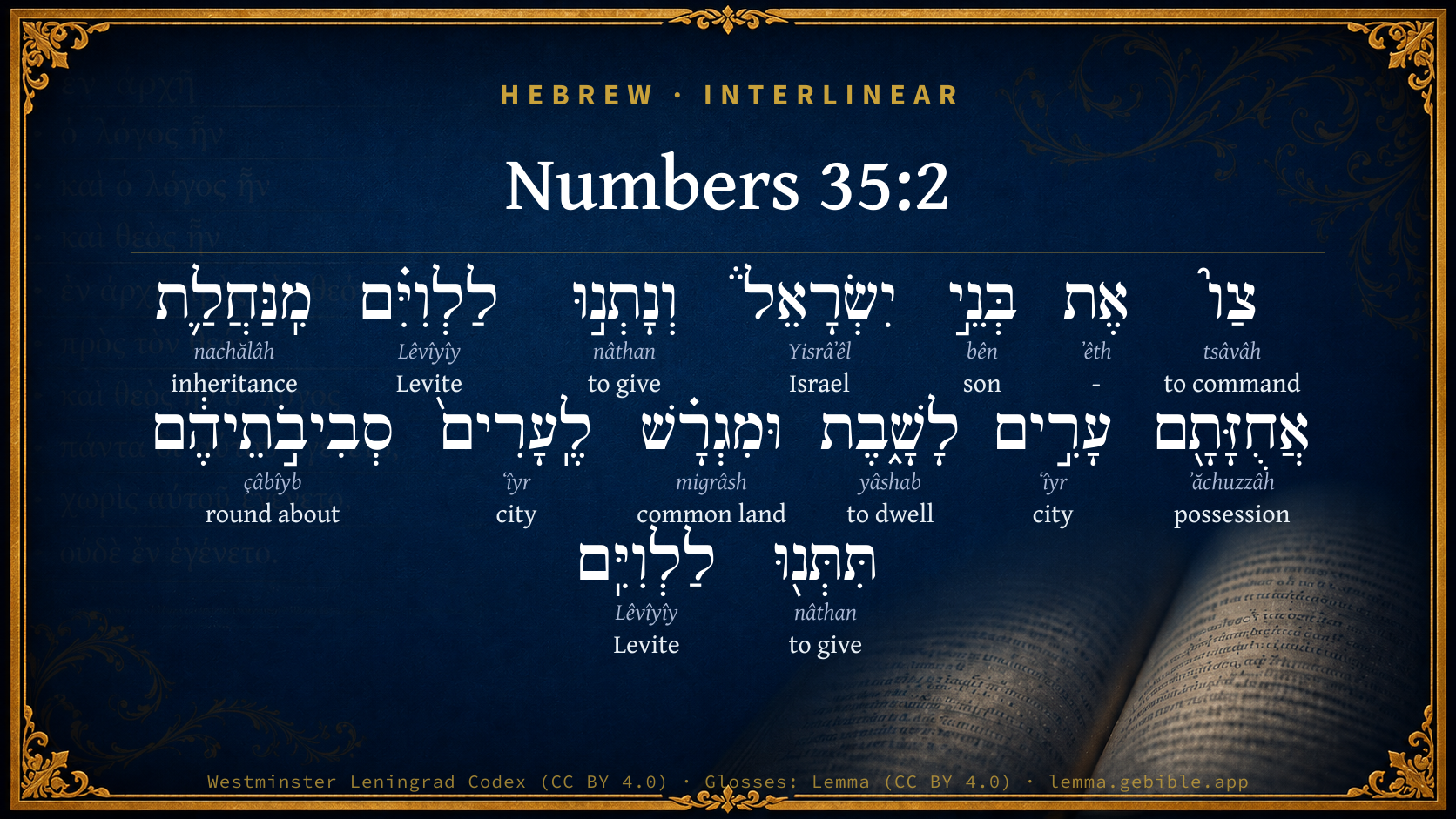
  1. צַו֮ tsâvâh H6680 “command” Verb, Piel, Imperative, 2nd Person, Masculine, Singular
  2. אֶת ʼêth H853 “-” Particle, Direct Object
  3. בְּנֵ֣י bên H1121 “sons of” Noun, Common, Masculine, Plural, Construct
  4. יִשְׂרָאֵל֒ Yisrâʼêl H3478 “Israel” Noun, Proper
  5. וְנָתְנ֣וּ nâthan H5414 “and · to give” Conjunction + Verb, Qal, Sequential Perfect, 3rd Person, Common, Plural
  6. לַלְוִיִּ֗ם Lêvîyîy H3881 “to/for the · Levites” Preposition, Determined + Noun, Gentilic, Masculine, Plural, Absolute
  7. מִֽנַּחֲלַ֛ת nachălâh H5159 “from · inheritance of” Preposition + Noun, Common, Feminine, Singular, Construct
  8. עָרִ֣ים ʻîyr H5892 “cities” Noun, Common, Feminine, Plural, Absolute
  9. לָשָׁ֑בֶת yâshab H3427 “to dwell” Preposition + Verb, Qal, Infinitive Construct
  10. וּמִגְרָ֗שׁ migrâsh H4054 “and · common land” Conjunction + Noun, Common, Masculine, Singular, Absolute
  11. לֶֽעָרִים֙ ʻîyr H5892 “to/for the · cities” Preposition, Determined + Noun, Common, Feminine, Plural, Absolute
  12. סְבִיבֹ֣תֵיהֶ֔ם çâbîyb H5439 “surroundings · their” Noun, Common, Both, Plural, Construct + Suffix, Personal, 3rd Person, Masculine, Plural
  13. תִּתְּנ֖וּ nâthan H5414 “to give” Verb, Qal, Imperfect, 2nd Person, Masculine, Plural
  14. לַלְוִיִּֽם Lêvîyîy H3881 “to/for the · Levites” Preposition, Determined + Noun, Gentilic, Masculine, Plural, Absolute

About this verse

These counts appear in no published source. They are computed here, from the morphology-tagged text and Lemma’s own curated glosses. What Lemma adds →

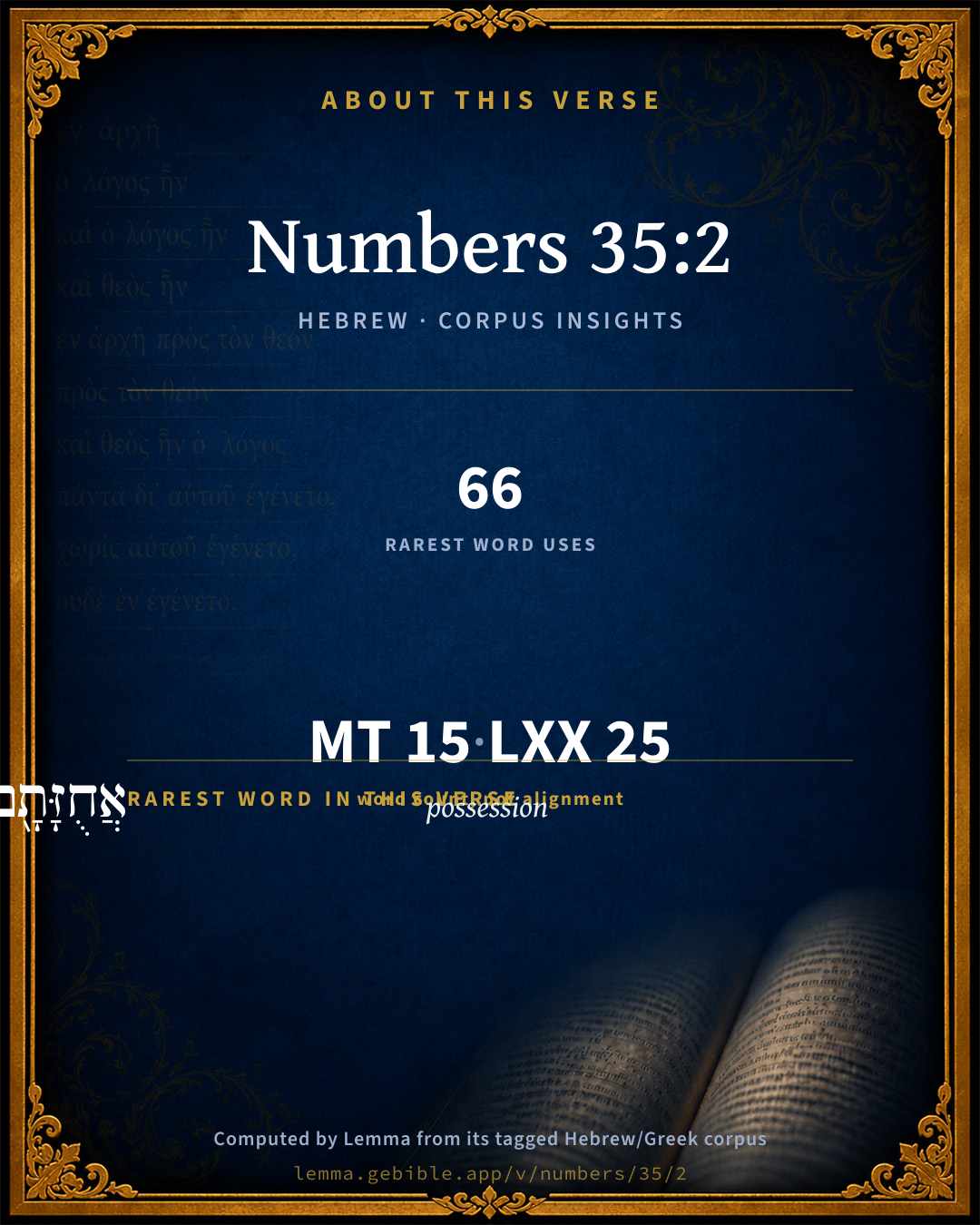
15
words
12
distinct lemmas
Pentateuch
section

Grammatical profile

  • 4 verbs
  • 10 nouns
  • 1 particle

Verb forms

  • צַו֮ Piel · Imperative
  • וְנָתְנ֣וּ Qal · Sequential Perfect
  • לָשָׁ֑בֶת Qal · Infinitive Construct
  • תִּתְּנ֖וּ Qal · Imperfect

Repetition

Words recur within this verse — often emphatic in Hebrew:

  • וְנָתְנ֣וּ to give H5414 ×2
  • לַלְוִיִּ֗ם Levite H3881 ×2
  • עָרִ֣ים city H5892 ×2

Hebrew & Septuagint length

In English translation the verse runs 35 words from the Hebrew and 39 from the Septuagint (LXX English) — closely comparable.

A rough comparison of the two English renderings, which tokenize alike — not a word-level alignment.

Word counts can differ between the Hebrew and the Greek without any difference in meaning — e.g. the Hebrew direct-object marker אֵת has no separate Greek word, and Greek often adds the article ὁ.

In the original languages it is 15 Hebrew tokens and 25 Greek tokens — but the two are counted differently (Hebrew bundles its prefixes and suffixes into one token; the Greek is in lemma form), so that isn’t a like-for-like length.

Cross-references

7

Topical passages linked to Numbers 35:2 in the Treasury of Scripture Knowledge — connected by theme and wording, ordered by reader-vote popularity; previews shown in the World English Bible.

  • Joshua 14:3–4 For Moses had given the inheritance of the two tribes and the half-tribe beyond the Jordan: but to the Levites he gave no inheritance among them.
  • Ezekiel 48:8 By the border of Judah, from the east side to the west side, shall be the offering which you shall offer, twenty-five thousand [reeds] in breadth, and in length as one of the portions, from the east side to the west side: and the sanctuary shall be in the midst of it.
  • Leviticus 25:32–34 "'Nevertheless the cities of the Levites, the houses in the cities of their possession, the Levites may redeem at any time.
  • Joshua 21:2–42 and they spoke to them at Shiloh in the land of Canaan, saying, Yahweh commanded Moses to give us cities to dwell in, with the suburbs of it for our cattle.
  • Ezekiel 45:1–8 Moreover, when you shall divide by lot the land for inheritance, you shall offer an offering to Yahweh, a holy portion of the land; the length shall be the length of twenty-five thousand [reeds], and the breadth shall be ten thousand: it shall be holy in all the border of it round about.
  • Ezekiel 48:22 Moreover from the possession of the Levites, and from the possession of the city, being in the midst of that which is the prince's, between the border of Judah and the border of Benjamin, it shall be for the prince.
  • 1 Corinthians 9:10–14 or does he say it assuredly for our sake? Yes, it was written for our sake, because he who plows ought to plow in hope, and he who threshes in hope should partake of his hope.

Cross-references courtesy of OpenBible.info (CC BY 4.0).

Hebrew and Greek witnesses Masoretic Hebrew ↔ Greek Septuagint

The same verse in the two great witnesses to the Old Testament, shown verse-for-verse.

These are two independent witnesses, not word-aligned to each other, and the Septuagint is shown in lemma (dictionary) form.

Hebrew Numbers 35:2 Masoretic · Westminster Leningrad Codex

צַו֮ אֶת בְּנֵ֣י יִשְׂרָאֵל֒ וְנָתְנ֣וּ לַלְוִיִּ֗ם מִֽנַּחֲלַ֛ת אֲחֻזָּתָ֖ם עָרִ֣ים לָשָׁ֑בֶת וּמִגְרָ֗שׁ לֶֽעָרִים֙ סְבִיבֹ֣תֵיהֶ֔ם תִּתְּנ֖וּ לַלְוִיִּֽם

Command the children of Israel that they give to the Levites of the inheritance of their possession cities to dwell in; and suburbs for the cities round about them shall you give to the Levites.

World English Bible · Public Domain

Greek LXX Numbers 35:2 Septuagint · lemma form

συντάσσω ὁ υἱός ἰσραήλ καί δίδωμι ὁ λευίτης ἀπό ὁ κλῆρος κατάσχεσις αὐτός πόλις καταοἰκέω καί ὁ προάστειον ὁ πόλις κύκλος αὐτός δίδωμι ὁ λευίτης

Give orders to the children of Israel, and they shall give to the Levites cities to dwell in from the lot of their possession, and they shall give to the Levites the suburbs of the cities round about them.

LXX2012 (modern English Septuagint) · Public Domain

Hebrew: Westminster Leningrad Codex (CC BY 4.0). Greek: Septuagint (public domain); English from LXX2012 (modern English Septuagint) (Public Domain). How the Septuagint differs from the Hebrew →

Targum (Aramaic paraphrase)

2

The Targum is the ancient Jewish Aramaic paraphrase of the Hebrew Scriptures — an interpretive translation, not the Hebrew text itself. Onkelos (literal) and Pseudo-Jonathan (expansive) render the Torah, and Jonathan the Prophets. Coverage is partial: where no permissively-licensed English translation exists for a verse, only the Aramaic is shown. This is verse-level text, not a word-by-word alignment to the Hebrew.

  1. Targum Onkelos Torah (Genesis–Deuteronomy)
    פַּקֵד יָת בְּנֵי יִשְׂרָאֵל וְיִתְּנוּן לְלֵוָאֵי מֵאַחֲסָנַת אֲחוּדַתְהּוֹן קִרְוִין לְמִתָּב וְרֶוַח לְּקִרְוַיָא סַחֲרָנֵיהוֹן תִּתְּנוּן לְלֵוָאֵי

    (no public-domain English translation for this verse)

    Targum Onkelos — Aramaic: “Onkelos Genesis” (public domain); “Onkelos Exodus” (public domain); “Onkelos Leviticus” (public domain); “Onkelos Numbers” (public domain); “Onkelos Deuteronomy” (public domain). English: “Sefaria Community Translation” (CC0 1.0 (public-domain dedication)); “J.W. Etheridge. The Targums of Onkelos and Jonathan Ben Uzziel on the Pentateuch. London: Longmans, Green, 1862” (public domain). Text via Sefaria.

  2. Targum Pseudo-Jonathan Torah (Genesis–Deuteronomy)
    פַּקֵיד יַת בְּנֵי יִשְרָאֵל וְיֶחְסוּן לְלֵיוָאֵי מֵאַחְסָנַת אֲחוּדַתְהוֹן קִירְוִין לְמִיתַב וּפַרְוִילִין לְקִירְוַיָא חֲזוּרְנוּתְהוֹן תִּתְּנוּן לְלֵיוָאֵי

    Command the sons of Israel that they give to the Levites from their inheritance cities to dwell in, and suburbs (open spaces) to the cities round about shall you give to the Levites.

    Targum Pseudo-Jonathan — Aramaic: “Targum Jonathan on Genesis” (public domain); “Targum Jonathan on Exodus” (public domain); “Targum Jonathan on Leviticus” (public domain); “Targum Jonathan on Numbers” (public domain); “Targum Jonathan on Deuteronomy” (public domain). English: “The Targum of Jonathan ben Uzziel, trans. J. W. Etheridge, London, 1862” (public domain). Text via Sefaria.

Commentary

Notes on Numbers 35:2 from classic Christian and Jewish commentators (each source and its license shown beneath its notes). The classic Christian expositions comment on the surrounding passage and are grouped to its opening verse, so a note may address several verses; the Jewish commentaries on the Tanakh (Rashi and others) are per-verse, so they appear only where the commentator wrote on this verse.

Lemma curates 59 commentaries, every one of them public domain or Creative Commons licensed, each selected and text-cleaned for this edition rather than reprinted as found. About our sources →

Trapp's Complete Commentary

John Trapp

Num 35:2 Command the children of Israel, that they give unto the Levites of the inheritance of their possession cities to dwell in; and ye shall give [also] unto the Levites suburbs for the cities round about them.

Ver. 2. Suburbs.] These were for pasture, pleasure, and other country commodities, not for tillage; for the Levites were to have no such employment. {Num 18:20; Num 18:24}

John Trapp, A Commentary or Exposition upon All the Books of the Old and New Testament (1647–1656) — public domain. Text from a community e-Sword module.

Joseph Benson's Commentary

Num 35:2. That they give unto the Levites — cities — The reason of this appointment was, that the Levites, being a body of people distinct from the rest of the nation, had no share in the division of the country. It is to be observed that the priests, the sons of Aaron, being also of the tribe of Levi, are here comprehended under the common name of Levites, as well as those inferior ministers of religion generally signified by that term.

Joseph Benson's Commentary on the Old and New Testaments (1811–1818) — public domain. Text from a community e-Sword module.

Geneva Bible (1599)

Geneva Bible translators

Because they had no inheritance assigned them in the land of Canaan.

God would have them scattered through all the land, because the people might be preserved by them in the obedience of God and his Law.

Geneva Bible (1599) marginal notes — public domain. Text via Bolls.life.

Ellicott's Commentary for English Readers

XXXV.

(2) Cities to dwell in.—The object of the dispersion of the Levites throughout the other tribes seems to have been primarily with a view to the instruction of their brethren in the law of the Lord (Deu_33:10). It is probable that the Levites also discharged all those other functions which are now discharged by the learned professions.

And ye shall give also unto the Levites suburbs . . . —The word migrash, “suburb,” denotes, probably, pasture ground into which flocks are driven.

A Bible Commentary for English Readers, edited by Charles John Ellicott (1878–1897) — public domain. Text from a community e-Sword module.

The Cambridge Bible for Schools and Colleges

gen. ed. J. J. S. Perowne

2. suburbs] ‘pasture lands’ (marg.) rightly represents the true force of the word, which denotes lit. a place for driving cattle (cf. Num_35:3). But it came to be used more generally of common land surrounding a town, which all the inhabitants had the right to use. It occurs very frequently in P passages of Josh. and 1 Ch.

The Cambridge Bible for Schools and Colleges (gen. ed. J. J. S. Perowne; Cambridge University Press, 1878–1918) — public domain. Text from a community e-Sword module.

John Gill's Exposition

Command the children of Israel,.... All the tribes of them; it is not a bare instruction that is given them, much less a mere request that is made to them, or something proposed, and left to their option whether they would agree to it or not; but it is strictly enjoined them by the Lord, who had given them freely all they should possess, and who had a right to all they had, and to whom they were in duty and gratitude bound to do his will and pleasure: the order is:

that they give unto the Levites, of the inheritance of their possession, cities to dwell in; which was but reasonable and requisite, that the ministers of God, and the assistants of the priests, and who did the service of the congregation, that they should have, habitations for them and their families, as well as food and raiment was provided for them in another way:

and ye shall give also unto the Levites suburbs for the cities round about them; which were partly for ornament to their cities, and partly for their health, that they might have air, and not be too closely confined within the walls of their cities; and also for convenience, that they have room for their cattle, and places to lay up the increase of their fields, as after suggested. Jarchi says, that a suburb was a space and place parted without the city, round about, for the beauty of it; but they were not allowed to build there an house (i.e. to dwell in), nor to plant a vineyard, nor to sow seed; other ground is after provided for such uses.

John Gill's Exposition of the Whole Bible (1746–1763) — public domain (CC PDM 1.0). Text via the HelloAO Bible API.

Albert Barnes' Notes on the Bible

Suburbs - Rather, “pasture-grounds,” required for their large cattle, for their sheep and goats, and for all their beasts whatever they might be Num 35:3.

Albert Barnes' Notes on the Bible (1834–1885) — public domain. Text from a community e-Sword/MySword module.

The Pulpit Commentary

That they give unto the Levites... cities to dwell in. This legislation forms the natural sequel and complement of the Divine decrees already promulgated concerning the Levites. Separated from the rest of the tribes from the time of the first census, (Num_1:49) excluded from any tribal inheritance, (Num_18:20) but endowed with tithes and offerings for their maintenance, (Num_18:21, &c.); it was also necessary that they should be provided with homes for themselves and their cattle. They might indeed have been left to exist as they could, and where they could, upon the provision made for them in the law. But, on the one hand, that provision was itself precarious, depending as it did upon the piety and good feeling of the people; (which must often have been found wanting: cf. Neh_13:10 Mal_3:8, Mal_3:9) and, on the other, it is evident that the Levites were intended, as far as their family and social life was concerned, to share the ordinary comforts and enjoyments of Israelites. Nothing could have been more foreign to the Mosaic ideal than a ministry celibate, ascetic, and detached from this world"s wealth, such as readily enough sprang up (whether intended or not) under the teaching of the gospel. (cf. Luk_10:4 Luk_12:33 Act_20:34, 35 1Co_7:7, 1Co_7:25, 26 9:18, 27 2Co_6:10 2Ti_2:4) Suburbs. The Hebrew word vrgmi undoubtedly means here a pasture, or a paddock, an enclosed place outside the town into which the cattle were driven by day to feed. It is possible that the A.V may have used the word "suburbs" in that sense. To keep cattle to some extent was not only a universal custom, but was well-nigh a necessity of life in that age.

The Pulpit Commentary (1880–1919), ed. H.D.M. Spence-Jones & Joseph S. Exell — public domain. Text from a community e-Sword module.

Rashi

Rabbi Shlomo Yitzchaki (Rashi)

ומגרש AND OPEN LAND — an area consisting of an open space round about the city outside it, serving to beautify the city. It was not permitted to build houses there nor to plant vineyards nor to sow a plantation (cf. Arakhin 33b).

Rashi on the Tanakh — English translations: “The Judaica Press complete Tanach with Rashi, translated by A. J. Rosenberg” (CC BY 4.0); “Pentateuch with Rashi's commentary by M. Rosenbaum and A.M. Silbermann, 1929-1934” (public domain); “The Metsudah Tanach series, Lakewood, N.J” (CC BY 4.0); and “The Book of Joshua, Metsudah Publications, 1997” (CC BY 4.0). Text via Sefaria.

Ramban (Nachmanides)

Rabbi Moshe ben Nachman (Ramban / Nachmanides)

AND OPEN LAND — “a space [consisting of] open land outside and around the city, in order to make the city pleasant; and they [the Levites] are not permitted to build any building there or to plant a vineyard, or to sow any crop. 4. A THOUSAND CUBITS ROUND ABOUT. But afterwards [in Verse 5] it says [that it should be] two thousand cubits! How can we explain this? He assigned two thousand cubits for them around [the cities], of which the inner [area with a radius of a] thousand [cubits, as mentioned in Verse 4] was to be free [open] space, and the outer [area of a thousand cubits] was to be for fields and vineyards round about.” This is Rashi’s language taken from the words of our Rabbis. thousand served as the open space, and the outermost was for fields and vineyards. Thus the two verses are harmonized. It will be noted though that Rashi did not assign any dimensions for the city proper. This will be one of the major contentions of Ramban, from which will follow important conclusions (see Note 59).The correct interpretation according to the plain meaning of Scripture seems to be that Scripture [in Verse 4] is stating that they should assign as open space a thousand cubits directly round about the city, meaning that [the combined open space of both sides of the city] should be a thousand cubits long, five hundred on each side, and similarly [the open space of both sides together] of the width, should be a thousand cubits, five hundred cubits on each side. After this He stated [in Verse 5] that they should make a square [the dimension of which to be] two thousand cubits by two thousand cubits, and the city should be situated in the center of the square. He thus added to them [the dimensions — in Verse 5] an open space not directly facing the city, equal to the measurement directly in front of the city, so that you find when leaving a thousand cubits as open space round about the city as He assigned at first [in Verse 4], the city, a thousand by a thousand cubits, will be in [the center of] the square. (open space) of five hundred by a thousand extends in each direction directly facing the city, there still remains a space of five hundred by five hundred above and below these migrashim, near the corners of the outer square. These remaining spaces, Ramban will suggest, were to be designated for fields and vineyards. [In a drawing of Ramban’s design of the Levite city, found in my Hebrew commentary, p. 336, there will be noticed a circle encompassing all these four migrashim directly facing the city up to the walls of the outer-square. The circle naturally cuts down somewhat on the space allotted for the fields and vineyards. I based this upon the Gemara in Erubin ibid., as interpreted by the commentators, especially the Ritba, in order to bring Ramban’s words into consonance with the text there. Ramban’s general concept though of the Levite city and its environs as presented here, according to the plain meaning of Scripture, is clear.] Thus the city given to the Levites was in the form of a square.Know that the term pei’ah [in Verse 5] signifies “a whole side” [i.e., the whole length of the distance of any of the four sides of the outer square, and not merely any point along that side]. (for the east ‘side’ two thousand cubits) as any point on that eastern side of the circle, located two thousand cubits away from the city (see Note 57), Ramban applies it to the whole length of that eastern side alongside the city [of which a thousand cubits were directly opposite the city, and five hundred were above and below the city, as explained]. Similarly the expression, a hundred cubits long ‘lapei’ah ha’echath’ means “for the whole ‘one’ side,” and so also similar expressions mentioned there [with reference to the dimensions of the Tabernacle]. This is also true of the term pei’ah at the end of the Book of Ezekiel [with reference to the dimensions of the city of Jerusalem and the Sanctuary of the future]. Moreover, if the intent of the verse was to have been [as Rashi interpreted] that they were to assign two thousand cubits round about the city in each direction, He would have said, “And you shall measure without the city ‘l’pe’ath keidmah (‘to’ the east side — two thousand cubits) etc.;” but instead He says [in Verse 5] And you shall measure without the city ‘eth’ pe’ath keidmah, which means “the measure of that [whole] side” [i.e., the whole distance along the eastern side of the outer square area, and also on each of the other outer sides, as the verse continues]. Such a four-sided plane figure having all its sides equal [and all its angles, right angles] is indeed a pleasingly suitable appearance for cities to have, not that they should measure two thousand cubits around the city in all directions [as explained by Rashi], thus eliminating the corners. A similar case is the expression, It shall be eighteen thousand reeds round about, Verse 35. which means that the city [of Jerusalem] will measure on all of its four sides together eighteen thousand reeds, since he [Ezekiel] assigned there for each of the four sides four thousand and five hundred [reeds]. Now it is correct to say that the thousand cubits which He assigned [in Verse 4] as open space directly round about the city that it is not to be planted, and the thousand cubits He added in the second verse at each of the outer sides [not directly opposite the city] be used for fields and vineyards, as our Rabbis have received by tradition. But the term migrash (open space) in Scriptural language applies to both, but in the one case [in the remote corners, not directly opposite the city] it may be cultivated and sown, whereas in the other case [in the migrash facing directly the city] it may neither be plowed nor sown. That is why Scripture separated them from each other [by giving two commands, in Verse 4 and in Verse 5, and not commanding both of them together]. as consisting of a thousand cubits and Verse 5 which assigns it to be two thousand. Ramban’s answer is that the term migrash applies to both — open space, and land for planting. Thus Verse 4 addresses itself to that migrash which was for open space, while Verse 5 speaks of the overall concept of migrash which includes both the thousand cubits of open space directly opposite the city, and the five hundred cubits above and below the city for planting, which total altogether two thousand cubits.

Ramban (Nachmanides) on the Tanakh — English translation: “Commentary on the Torah by Ramban (Nachmanides). Translated and annotated by Charles B. Chavel. New York, Shilo Pub. House, 1971-1976” (CC BY 4.0). Text via Sefaria.

Lesson kit

Teaching starters — assembled from the data on this page, not authored interpretation. Every prompt links to the verse data it draws on. Edit before teaching.

Numbers, in the Pentateuch, opens this verse with 15 words (12 distinct Hebrew lemmas). Its most distinctive word is ʼăchuzzâh (“possession”). A historical commentator’s framing appears above. Read the whole chapter for the surrounding context.

Discussion questions

  1. What does “possession” (ʼăchuzzâh) contribute to the verse as a whole?
  2. Joshua 14:3–4 shares this passage’s theme. How do the two illuminate each other?
  3. “to give” occurs 2× in this one verse. What is the effect of the repetition?
  4. These translations render this verse differently. What is at stake in choosing one wording over another?
  5. The verb «צַו֮» is Piel Imperative. How does its form color the action?
  6. Reading how Trapp's Complete Commentary and Joseph Benson's Commentary read this verse, where do the two commentators agree and where do they part?

Things to notice

Reading settings

Reading text

Shown beneath each verse's original-language words.

Old Testament
Old Testament edition

Read the OT as the Masoretic Hebrew (MT) or the Greek Septuagint (LXX).

English shown for the Greek Septuagint (in the Hebrew ↔ Greek comparison).

Comparing translations? Open the Compare panel on any verse page to stack up to four side by side.