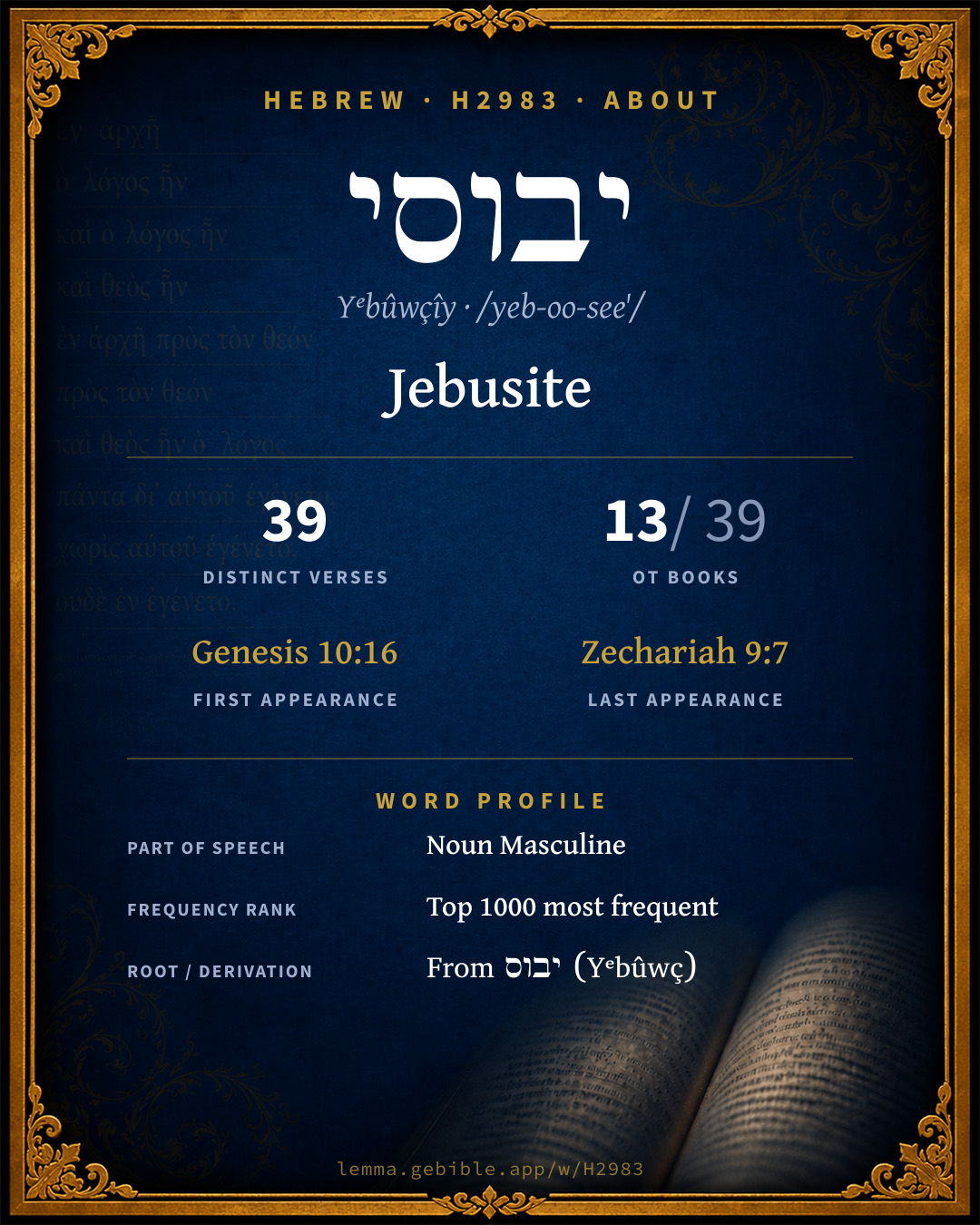
יְבוּסִי
Jebusite
BDB lists 2 entries for ‘Jebusite’ fuller range ↓
Full lexicon entry — Brown-Driver-Briggs (BDB)
From Brown-Driver-Briggs (BDB)
Where this word appears
Grammar key — what these labels mean
Part of speech
- Noun
- A naming word — a person, place, thing, or idea.
Noun type
- Gentilic
- A noun naming a member of a people, tribe, or region of origin (e.g. an Israelite, a Moabite).
- Proper
- A name of a specific person, place, or people (e.g. Abraham, Zion, Israel).
State
- Absolute
- The independent form of a noun, not bound to a following word.
Gender
- Masculine
- Grammatically masculine.
Number
- Singular
- One.
Grammatical forms
- Noun, Gentilic, Masculine, Singular, Absolute 40 times (98%)
- Noun, Proper 1 time (2%)
Parsed forms decoded from the imported morphology (morphhb / Westminster Leningrad Codex — WLC text public domain, morphhb tagging CC BY 4.0), counted across 41 parsed occurrences — not distinct verses.
Every verse where H2983 appears — 39 distinct verses across 13 books. Click any verse to open its interlinear word-by-word view. Verse text shown in the World English Bible for context — . Each verse’s Hebrew form is shown with its reference; the English is not keyword-highlighted, since the data carries no word-level English alignment. Use “Compare translations” on any verse to read it across multiple English versions. This concordance covers the Hebrew Bible; Septuagint (Greek Old Testament) occurrences are not indexed here.
Genesis 2 verses
Exodus 6 verses
- Exodus 3:8 וְ/הַ/יְבוּסִֽי conj + ptcl def.art + n Gentilic ms I have come down to deliver them out of the hand of the Egyptians, and to bring them up out of that land to a good and large land, to a land flowing with milk and honey; to the place of the Canaanite, the Hittite, the Amorite, the Perizzite, the Hivite, and the Jebusite.
- Exodus 3:17 וְ/הַ/יְבוּסִ֑י conj + ptcl def.art + n Gentilic ms and I have said, I will bring you up out of the affliction of Egypt to the land of the Canaanite, the Hittite, the Amorite, the Perizzite, the Hivite, and the Jebusite, to a land flowing with milk and honey."'
- Exodus 13:5 וְ/הַ/יְבוּסִ֗י conj + ptcl def.art + n Gentilic ms It shall be, when Yahweh shall bring you into the land of the Canaanite, and the Hittite, and the Amorite, and the Hivite, and the Jebusite, which he swore to your fathers to give you, a land flowing with milk and honey, that you shall keep this service in this month.
- Exodus 23:23 וְ/הַ/יְבוּסִ֑י conj + ptcl def.art + n Gentilic ms For my angel shall go before you, and bring you in to the Amorite, the Hittite, the Perizzite, the Canaanite, the Hivite, and the Jebusite; and I will cut them off.
- Exodus 33:2 וְ/הַ/יְבוּסִֽי conj + ptcl def.art + n Gentilic ms I will send an angel before you; and I will drive out the Canaanite, the Amorite, and the Hittite, and the Perizzite, the Hivite, and the Jebusite:
- Exodus 34:11 וְ/הַ/יְבוּסִֽי conj + ptcl def.art + n Gentilic ms Observe that which I command you this day. Behold, I drive out before you the Amorite, the Canaanite, the Hittite, the Perizzite, the Hivite, and the Jebusite.
Numbers 1 verse
Deuteronomy 2 verses
- Deuteronomy 7:1 וְ/הַ/יְבוּסִ֔י conj + ptcl def.art + n Gentilic ms When Yahweh your God shall bring you into the land where you go to possess it, and shall cast out many nations before you, the Hittite, and the Girgashite, and the Amorite, and the Canaanite, and the Perizzite, and the Hivite, and the Jebusite, seven nations greater and mightier than you;
- Deuteronomy 20:17 וְ/הַ/יְבוּסִ֑י conj + ptcl def.art + n Gentilic ms but you shall utterly destroy them: the Hittite, and the Amorite, the Canaanite, and the Perizzite, the Hivite, and the Jebusite; as Yahweh your God has commanded you;
Joshua 9 verses
- Joshua 3:10 וְ/הַ/יְבוּסִֽי conj + ptcl def.art + n Gentilic ms Joshua said, Hereby you shall know that the living God is among you, and that he will without fail drive out from before you the Canaanite, and the Hittite, and the Hivite, and the Perizzite, and the Girgashite, and the Amorite, and the Jebusite.
- Joshua 9:1 וְ/הַ/יְבוּסִֽי conj + ptcl def.art + n Gentilic ms It happened, when all the kings who were beyond the Jordan, in the hill-country, and in the lowland, and on all the shore of the great sea in front of Lebanon, the Hittite, and the Amorite, the Canaanite, the Perizzite, the Hivite, and the Jebusite, heard of it;
- Joshua 11:3 וְ/הַ/יְבוּסִ֖י conj + ptcl def.art + n Gentilic ms to the Canaanite on the east and on the west, and the Amorite, and the Hittite, and the Perizzite, and the Jebusite in the hill-country, and the Hivite under Hermon in the land of Mizpah.
- Joshua 12:8 וְ/הַ/יְבוּסִֽי conj + ptcl def.art + n Gentilic ms in the hill-country, and in the lowland, and in the Arabah, and in the slopes, and in the wilderness, and in the South; the Hittite, the Amorite, and the Canaanite, the Perizzite, the Hivite, and the Jebusite:
- Joshua 15:8 הַ/יְבוּסִי֙ ptcl def.art + n Gentilic ms and the border went up by the valley of the son of Hinnom to the side of the Jebusite southward (the same is Jerusalem); and the border went up to the top of the mountain that lies before the valley of Hinnom westward, which is at the uttermost part of the valley of Rephaim northward;
- Joshua 15:63 הַ/יְבוּסִי֙ הַ/יְבוּסִ֜י ptcl def.art + n Gentilic ms ptcl def.art + n Gentilic ms As for the Jebusites, the inhabitants of Jerusalem, the children of Judah couldn't drive them out: but the Jebusites dwell with the children of Judah at Jerusalem to this day.
- Joshua 18:16 הַ/יְבוּסִי֙ ptcl def.art + n Gentilic ms and the border went down to the uttermost part of the mountain that lies before the valley of the son of Hinnom, which is in the valley of Rephaim northward; and it went down to the valley of Hinnom, to the side of the Jebusite southward, and went down to En Rogel;
- Joshua 18:28 וְ/הַ/יְבוּסִ֨י conj + ptcl def.art + n Gentilic ms and Zelah, Eleph, and the Jebusite (the same is Jerusalem), Gibeath, [and] Kiriath; fourteen cities with their villages. This is the inheritance of the children of Benjamin according to their families.
- Joshua 24:11 וְ/הַ/יְבוּסִ֑י conj + ptcl def.art + n Gentilic ms You went over the Jordan, and came to Jericho: and the men of Jericho fought against you, the Amorite, and the Perizzite, and the Canaanite, and the Hittite, and the Girgashite, the Hivite, and the Jebusite; and I delivered them into your hand.
Judges 3 verses
- Judges 1:21 הַ/יְבוּסִי֙ הַ/יְבוּסִ֜י ptcl def.art + n Gentilic ms ptcl def.art + n Gentilic ms The children of Benjamin did not drive out the Jebusites who inhabited Jerusalem; but the Jebusites dwell with the children of Benjamin in Jerusalem to this day.
- Judges 3:5 וְ/הַ/יְבוּסִֽי conj + ptcl def.art + n Gentilic ms The children of Israel lived among the Canaanites, the Hittites, and the Amorites, and the Perizzites, and the Hivites, and the Jebusites:
- Judges 19:11 הַ/יְבוּסִ֥י ptcl def.art + n Gentilic ms When they were by Jebus, the day was far spent; and the servant said to his master, Please come and let us turn aside into this city of the Jebusites, and lodge in it.
2 Samuel 4 verses
- 2 Samuel 5:6 הַ/יְבֻסִ֖י ptcl def.art + n Gentilic ms The king and his men went to Jerusalem against the Jebusites, the inhabitants of the land, who spoke to David, saying, Except you take away the blind and the lame, you shall not come in here; thinking, David can't come in here.
- 2 Samuel 5:8 יְבֻסִי֙ n Gentilic ms David said on that day, Whoever strikes the Jebusites, let him get up to the watercourse, and [strike] the lame and the blind, who are hated of David's soul. Therefore they say, There are the blind and the lame; he can't come into the house.
- 2 Samuel 24:16 הַ/יְבֻסִֽי ptcl def.art + n Gentilic ms When the angel stretched out his hand toward Jerusalem to destroy it, Yahweh repented him of the evil, and said to the angel who destroyed the people, It is enough; now stay your hand. The angel of Yahweh was by the threshing floor of Araunah the Jebusite.
- 2 Samuel 24:18 הַ/יְבֻסִֽי ptcl def.art + n Gentilic ms Gad came that day to David, and said to him, Go up, rear an altar to Yahweh in the threshing floor of Araunah the Jebusite.
1 Kings 1 verse
1 Chronicles 6 verses
- 1 Chronicles 1:14 הַ/יְבוּסִי֙ ptcl def.art + n Gentilic ms and the Jebusite, and the Amorite, and the Girgashite,
- 1 Chronicles 11:4 הַ/יְבוּסִ֔י ptcl def.art + n Gentilic ms David and all Israel went to Jerusalem (the same is Jebus); and the Jebusites, the inhabitants of the land, were there.
- 1 Chronicles 11:6 יְבוּסִי֙ n Gentilic ms David said, Whoever strikes the Jebusites first shall be chief and captain. Joab the son of Zeruiah went up first, and was made chief.
- 1 Chronicles 21:15 הַ/יְבוּסִֽי ptcl def.art + n Gentilic ms God sent an angel to Jerusalem to destroy it: and as he was about to destroy, Yahweh saw, and he repented him of the evil, and said to the destroying angel, It is enough; now stay your hand. The angel of Yahweh was standing by the threshing floor of Ornan the Jebusite.
- 1 Chronicles 21:18 הַ/יְבֻסִֽי ptcl def.art + n Gentilic ms Then the angel of Yahweh commanded Gad to tell David, that David should go up, and raise an altar to Yahweh in the threshing floor of Ornan the Jebusite.
- 1 Chronicles 21:28 הַ/יְבוּסִ֑י ptcl def.art + n Gentilic ms At that time, when David saw that Yahweh had answered him in the threshing floor of Ornan the Jebusite, then he sacrificed there.
2 Chronicles 2 verses
- 2 Chronicles 3:1 הַ/יְבוּסִֽי ptcl def.art + n Gentilic ms Then Solomon began to build the house of Yahweh at Jerusalem on Mount Moriah, where [Yahweh] appeared to David his father, which he made ready in the place that David had appointed, in the threshing floor of Ornan the Jebusite.
- 2 Chronicles 8:7 וְ/הַ/יְבוּסִ֔י conj + ptcl def.art + n Gentilic ms As for all the people who were left of the Hittites, and the Amorites, and the Perizzites, and the Hivites, and the Jebusites, who were not of Israel;
Ezra 1 verse
Nehemiah 1 verse
Zechariah 1 verse
About this entry
At a glance — auto-summarized from this page’s data, not written by a person. Every figure links to its source below. This summary describes the numbers; it doesn’t interpret them.
The Hebrew name יבוסי centers on the idea of “Jebusite.” First canonically at Genesis 10:16, it enters the text early. The Hebrew Bible uses it across 39 verses — moderately common. For the data behind this summary, explore 39-verse concordance and the renderings breakdown below.
Gloss history
Strong's 1890 vs modern scholarship
About this word
Strong's H2983 catalogs a Hebrew word from the Hebrew Old Testament.
These counts are not copied from any lexicon or concordance. They are computed here, from the morphology-tagged Hebrew Old Testament. What Lemma adds →
- 39
- distinct verses
- The word appears in 39 distinct verses.
- 13 / 39
- OT books
- The word appears in 13 of 39 Old Testament books.
- #891
- by frequency
- Top 1000 most frequent Hebrew words (rank 891 of 8,640 Hebrew words by occurrence).
View all 39 occurrences in the concordance →
Most concentrated in
- Joshua 9 verses 23%
- Exodus 6 verses 15%
- 1 Chronicles 6 verses 15%
By section of the Old Testament
By traditional corpus
Conventional, traditional groupings — biblical authorship is debated, so this is a traditional corpus grouping, not an authorship claim. Each share is this word’s portion of its verses in that division of the Hebrew canon. Each figure is a share of the word’s 39 distinct verses.
- Prophets (Nevi'im) 18 verses · 46%
- Torah (Pentateuch) 11 verses · 28%
- Writings (Ketuvim) 10 verses · 26%
How translations render this word
Counts come from each version’s own published word-to-Strong’s tagging or interlinear alignment — an approximate guide to how each version renders this word, not a word-level alignment the data otherwise carries. Because each total is that version’s own tagged count, the per-version totals vary from one another and need not match the appearance or distinct-verse counts above. These counts may also differ from a printed concordance because Lemma counts each distinctly tagged rendering and does not collapse phrase taggings into a single head-word total. This is a fixed set of word-tagged versions (KJV, ASV, BSB, ULT) and does not change with the reading translation you choose elsewhere. Each version’s license is shown beside its name below (and on Sources).
- King James Version: Jebusites 25×, Jebusite 14×, Jebusi 2×
- American Standard Version: Jebusite 28×, Jebusites 12×
- Berean Standard Bible: Jebusites 31×, Jebusite 8×
- unfoldingWord Literal Text: Jebusite 29×, Jebusites 11×
King James Version Public Domain
Renders H2983 across 41 tagged occurrences — most commonly:
American Standard Version Public Domain
Renders H2983 across 41 tagged occurrences — most commonly:
Plus 1 rendering that appears only once — usually multi-word phrases or single function words the recovered tagging swept in, not distinct renderings.
Berean Standard Bible Public Domain
Renders H2983 across 41 tagged occurrences — most commonly:
Plus 2 renderings that appear only once — usually multi-word phrases or single function words the recovered tagging swept in, not distinct renderings.
unfoldingWord Literal Text CC BY-SA 4.0
Renders H2983 across 41 tagged occurrences — most commonly:
Plus 1 rendering that appears only once — usually multi-word phrases or single function words the recovered tagging swept in, not distinct renderings.
Senses in the full BDB
What do BDB’s symbols mean?
BDB uses these scholarly abbreviations:
| Symbol | Meaning |
|---|---|
| 𝔊 | the Septuagint (the ancient Greek translation, LXX) |
| 𝔙 | the Vulgate (the Latin translation) |
| 𝔖 | the Syriac version (the Peshitta) |
| 𝔗 | the Targum (the Aramaic translation) |
| ψ | the Psalms |
| √ | root (the underlying root or stem) |
| ‖ | parallel passage (a synonymous or contrasted parallel) |
| † | the dagger: every passage where the word occurs is cited |
The 2 senses and sub-senses the full Brown-Driver-Briggs lexicon distinguishes for this word, in lexicon order (not ranked by frequency), with BDB’s own verbatim wording and sub-sense lettering. Shown in Hebrew script with BDB’s own scholarly abbreviations. The condensed entry is in the Lexicon Entry tab. See also the Forms in the corpus table below.
- 1. adj.gent. Jebusite, Jebusites, sg. אורנה הַיְבֻסִי 2 S 24:16, 18 cf. 1 Ch 21:15, 18, 28 2 Ch 3:1; as subst. a Jebusite Zc 9:7; usually c. art. הַי׳ coll. the Jebusites, in hist. statement Gn 10:16 (J) = 1 Ch 1:14 Nu 13:29 (E) Jos 9:1; 11:3; 12:8; 24:11 (all D) Ju 3:5 Ne 9:8, all in list of Canaanitish peoples; so also 1 K 9:20 = 2 Ch 8:7, where remnant of these peoples referred to; also Ezr 9:1, which seems to shew that this list had become a standing expression for early inhabitants; cf. further in promises (JED) Gn 15:21 Ex 3:8, 17; 13:5; 23:23; 33:2; 34:11 Dt 7:1; 20:17; Jos 3:10; specif. defined as inhabitants of Jebus-Jerusalem Jos 15:63(×2) (J) Ju 1:21(×2) 2 S 5:6, 8 (on which cf. Dr) 1 Ch 11:6 (called also יוֹשֵׁב הָאָרֶץ 2 S 5:6 & ישְׁבֵי הָאָרֶץ 1 Ch 11:4); v. also עִיר הַיְבוּסִי הַזֹּאת Ju 19:11; whence e.g. 2 Samuel 24:16
- 2. Jerusalem, Hex only P, Jos 15:8 גֵּי בֶן־הִנֹּם אֶל־כֶּתֶף היבוסי מִנֶּגֶב הִיא יְרוּשָׁלָ֑םִ, cf. 18:16; 18:28 וְהַיְבוּסִי הִיא יְרוּשָׁלַםִ.—Cf. כנען. e.g. Joshua 15:8
Senses from the full Brown-Driver-Briggs lexicon (Brown, Driver, Briggs; Oxford 1906 — public domain), digitized via Sefaria, supplemented by the OpenScriptures HebrewLexicon (CC BY 4.0). Full attribution on Sources.
Word origin
v. sub בוס p. 101a supr.
— Brown-Driver-Briggs (Oxford 1906, public domain), digitized via Sefaria, supplemented by the OpenScriptures HebrewLexicon (CC BY 4.0). See Sources.
Derived from יבוס (Yᵉbûwç) (H2982) — Jebus.
Forms in the corpus
The 20 distinct written forms H2983 takes in the Hebrew Bible, most frequent first — each parse links to that state’s occurrences in the concordance. Hebrew forms include their vowel points and cantillation, so a single lemma takes many written forms.
| Form | Parsing | Example | Uses |
|---|---|---|---|
| וְ/הַ/יְבוּסִֽי | Noun, Gentilic, Masculine, Singular, Absolute | Exodus 3:8 | 7 |
| הַ/יְבוּסִי֙ | Noun, Gentilic, Masculine, Singular, Absolute | Genesis 10:16 | 6 |
| וְ/הַ/יְבוּסִ֑י | Noun, Gentilic, Masculine, Singular, Absolute | Deuteronomy 20:17 | 4 |
| הַ/יְבֻסִֽי | Noun, Gentilic, Masculine, Singular, Absolute | 1 Chronicles 21:18 | 3 |
| הַ/יְבוּסִֽי | Noun, Gentilic, Masculine, Singular, Absolute | Genesis 15:21 | 3 |
| וְ/הַ/יְבוּסִ֔י | Noun, Gentilic, Masculine, Singular, Absolute | Deuteronomy 7:1 | 3 |
| הַ/יְבוּסִ֜י | Noun, Gentilic, Masculine, Singular, Absolute | Joshua 15:63 | 2 |
| הַ/יְבֻסִ֖י | Noun, Gentilic, Masculine, Singular, Absolute | 2 Samuel 5:6 | 1 |
| הַ/יְבוּסִ֑י | Noun, Gentilic, Masculine, Singular, Absolute | 1 Chronicles 21:28 | 1 |
| הַ/יְבוּסִ֔י | Noun, Gentilic, Masculine, Singular, Absolute | 1 Chronicles 11:4 | 1 |
| הַ/יְבוּסִ֗י | Noun, Gentilic, Masculine, Singular, Absolute | Ezra 9:1 | 1 |
| הַ/יְבוּסִ֥י | Noun, Gentilic, Masculine, Singular, Absolute | Judges 19:11 | 1 |
| וְ/הַ/יְבוּסִ֖י | Noun, Gentilic, Masculine, Singular, Absolute | Joshua 11:3 | 1 |
| וְ/הַ/יְבוּסִ֗י | Noun, Gentilic, Masculine, Singular, Absolute | Exodus 13:5 | 1 |
| וְ/הַ/יְבוּסִ֤י | Noun, Gentilic, Masculine, Singular, Absolute | Numbers 13:29 | 1 |
| וְ/הַ/יְבוּסִ֥י | Noun, Gentilic, Masculine, Singular, Absolute | Nehemiah 9:8 | 1 |
| וְ/הַ/יְבוּסִ֨י | Noun, Gentilic, Masculine, Singular, Absolute | Joshua 18:28 | 1 |
| יְבֻסִי֙ | Noun, Gentilic, Masculine, Singular, Absolute | 2 Samuel 5:8 | 1 |
| יְבוּסִי֙ | Noun, Gentilic, Masculine, Singular, Absolute | 1 Chronicles 11:6 | 1 |
| כִּ/יבוּסִֽי | Noun, Proper | Zechariah 9:7 | 1 |
Septuagint verse parallels
This word appears in 37 verses that also exist in the Greek Old Testament (Septuagint), out of the 39 Hebrew verses it occurs in. You can read those verses in Greek by switching the Old Testament edition to the Septuagint.
Read these verses in the Septuagint
- Genesis 10:16
- Exodus 3:8
- Numbers 13:29
- Deuteronomy 7:1
- Joshua 3:10
- Judges 1:21
- 2 Samuel 5:6
- 1 Chronicles 1:14
- 2 Chronicles 3:1
- Ezra 9:1
- Zechariah 9:7
This is a verse-level parallel only — the same verses exist in both the Hebrew and Greek Old Testaments. No word-level Hebrew↔Greek correspondence is claimed: the data carries no such alignment, so no Greek word is shown as this Hebrew word’s translation. Coverage is not total — the Septuagint omits the deuterocanon and renumbers the Psalms, so some Hebrew verses have no direct Greek parallel.