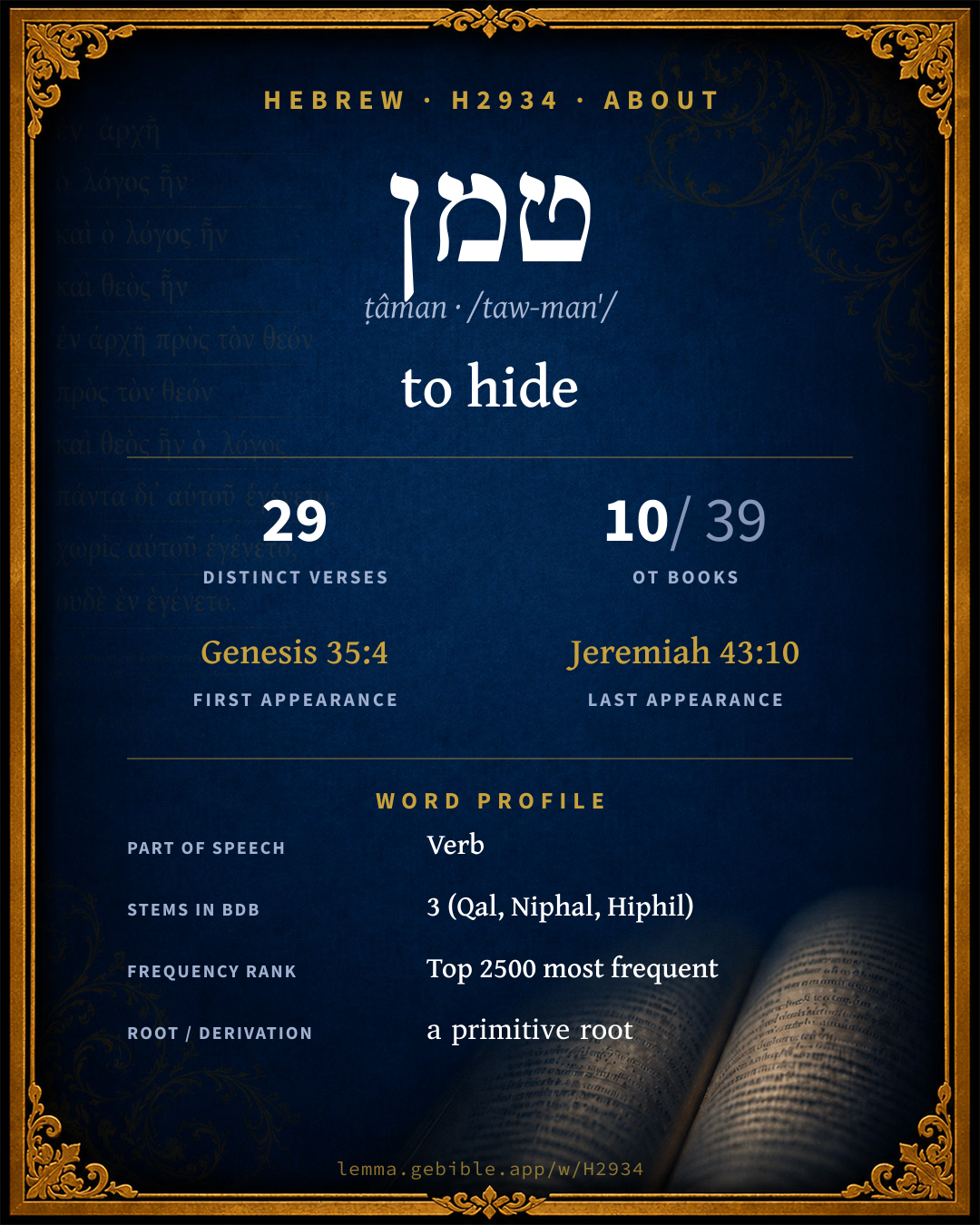
טָמַן
to hide
also: conceal, bury fuller range ↓
Full lexicon entry — Brown-Driver-Briggs (BDB)
From Brown-Driver-Briggs (BDB)
Where this word appears
See every Qal verb in the Hebrew Bible →
Grammar key — what these labels mean
Part of speech
- Verb
- An action or state-of-being word.
Stem
- Qal
- The basic, simple active stem — the plain form of the verb (“he wrote”). Here: ‘hide’
- Hiphil
- The causative active stem (“he caused / brought about”).
- Niphal
- Usually the simple passive or reflexive of the Qal (“he was written”).
Form
- Perfect
- A completed action or state — Hebrew marks aspect (completeness) more than strict tense (“he wrote”).
- Participle Passive
- A verbal adjective expressing action received (“written”).
- Sequential Imperfect
- An imperfect with prefixed waw — the standard past-narrative form (waw-consecutive imperfect).
- Infinitive Construct
- A bound verbal noun, frequently with prepositions (“to write / in writing”).
- Imperative
- A direct command (“write!”).
- Sequential Perfect
- A perfect with prefixed waw continuing a preceding imperfect or command (waw-consecutive perfect).
State
- Absolute
- The independent form of a noun, not bound to a following word.
- Construct
- A noun bound to a following noun in a possessive / “of” relationship (the construct chain).
Person
- 3rd Person
- The one spoken about (“he / she / it / they”).
- 2nd Person
- The one addressed (“you”).
- 1st Person
- The speaker (“I / we”).
Gender
- Common
- Either gender — not distinguished for this form.
- Masculine
- Grammatically masculine.
- Feminine
- Grammatically feminine.
Number
- Plural
- More than one (in Hebrew, generally three or more).
- Singular
- One.
Grammatical forms 15 distinct
- Verb, Qal, Perfect, 3rd Person, Common, Plural 6 times (19%)
- Verb, Qal, Participle Passive, Masculine, Singular, Absolute 4 times (13%)
- Verb, Qal, Perfect, 3rd Person, Masculine, Singular 3 times (10%)
- Verb, Qal, Infinitive Construct 3 times (10%)
- Verb, Hiphil, Sequential Imperfect, 3rd Person, Masculine, Plural 2 times (6%)
- Verb, Qal, Imperative, 2nd Person, Masculine, Singular 2 times (6%)
- Verb, Qal, Sequential Imperfect, 3rd Person, Masculine, Singular 2 times (6%)
- Verb, Qal, Perfect, 1st Person, Common, Singular 2 times (6%)
+7 more forms (7 occurrences)
Parsed forms decoded from the imported morphology (morphhb / Westminster Leningrad Codex — WLC text public domain, morphhb tagging CC BY 4.0), counted across 31 parsed occurrences — not distinct verses.
Every verse where H2934 appears — 29 distinct verses across 10 books. Click any verse to open its interlinear word-by-word view. Verse text shown in the World English Bible for context — . Each verse’s Hebrew form is shown with its reference; the English is not keyword-highlighted, since the data carries no word-level English alignment. Use “Compare translations” on any verse to read it across multiple English versions. This concordance covers the Hebrew Bible; Septuagint (Greek Old Testament) occurrences are not indexed here.
Genesis 1 verse
Exodus 1 verse
Deuteronomy 1 verse
Joshua 3 verses
- Joshua 2:6 וַֽ/תִּטְמְנֵ/ם֙ conj + Qal wimpf 3fs + sfx pers 3mp But she had brought them up to the roof, and hid them with the stalks of flax, which she had laid in order on the roof.
- Joshua 7:21 טְמוּנִ֥ים Qal ptcp.pass mp when I saw among the spoil a goodly Babylonian mantle, and two hundred shekels of silver, and a wedge of gold of fifty shekels weight, then I coveted them, and took them; and, behold, they are hid in the earth in the midst of my tent, and the silver under it.
- Joshua 7:22 טְמוּנָ֛ה Qal ptcp.pass fs So Joshua sent messengers, and they ran to the tent; and, behold, it was hid in his tent, and the silver under it.
2 Kings 1 verse
Job 5 verses
- Job 3:16 טָ֭מוּן Qal ptcp.pass ms Or as a hidden untimely birth I had not been, As infants who never saw light.
- Job 18:10 טָמ֣וּן Qal ptcp.pass ms A noose is hidden for him in the ground, A trap for him in the way.
- Job 20:26 טָמ֪וּן Qal ptcp.pass ms All darkness is laid up for his treasures. An unfanned fire shall devour him. It shall consume that which is left in his tent.
- Job 31:33 לִ/טְמ֖וֹן prep + Qal inf.cs If like Adam I have covered my transgressions, By hiding my iniquity in my heart,
- Job 40:13 טָמְנֵ֣/ם בַּ/טָּמֽוּן Qal impv 2ms + sfx pers 3mp prep det + Qal ptcp.pass ms Hide them in the dust together. Bind their faces in the hidden place.
Psalms 7 verses
- Psalms 9:15 טָ֝מָ֗נוּ Qal pf 3cp The nations have sunk down in the pit that they made; In the net which they hid, their own foot is taken.
- Psalms 31:4 טָ֣מְנוּ Qal pf 3cp Pluck me out of the net that they have laid secretly for me, For you are my stronghold.
- Psalms 35:7 טָֽמְנוּ Qal pf 3cp For without cause they have hidden their net in a pit for me. Without cause they have dug a pit for my soul.
- Psalms 35:8 טָמַ֣ן Qal pf 3ms Let destruction come on him unawares. Let his net that he has hidden catch himself. Let him fall into that destruction.
- Psalms 64:5 לִ/טְמ֣וֹן prep + Qal inf.cs They encourage themselves in evil plans. They talk about laying snares secretly. They say, "Who will see them?"
- Psalms 140:5 טָֽמְנֽוּ Qal pf 3cp The proud have hidden a snare for me, They have spread the cords of a net by the path. They have set traps for me. Selah.
- Psalms 142:3 טָמְנ֖וּ Qal pf 3cp When my spirit was overwhelmed within me, You knew my path. In the way in which I walk, They have hidden a snare for me.
Proverbs 2 verses
Isaiah 1 verse
Jeremiah 7 verses
- Jeremiah 13:4 וְ/טָמְנֵ֥/הוּ conj + Qal impv 2ms + sfx pers 3ms Take the belt that you have bought, which is on your loins, and arise, go to the Euphrates, and hide it there in a cleft of the rock.
- Jeremiah 13:5 וָ/אֶטְמְנֵ֖/הוּ conj + Qal wimpf 1cs + sfx pers 3ms So I went, and hid it by the Euphrates, as Yahweh commanded me.
- Jeremiah 13:6 לְ/טָמְנ/וֹ prep + Qal inf.cs + sfx pers 3ms It happened after many days, that Yahweh said to me, Arise, go to the Euphrates, and take the belt from there, which I commanded you to hide there.
- Jeremiah 13:7 טְמַנְתִּ֣י/ו Qal pf 1cs + sfx pers 3ms Then I went to the Euphrates, and dug, and took the belt from the place where I had hid it; and, behold, the belt was marred, it was profitable for nothing.
- Jeremiah 18:22 טָמְנ֥וּ Qal pf 3cp Let a cry be heard from their houses, when you shall bring a troop suddenly on them; for they have dug a pit to take me, and hid snares for my feet.
- Jeremiah 43:9 וּ/טְמַנְתָּ֤/ם conj + Qal wpf 2ms + sfx pers 3mp Take great stones in your hand, and hide them in mortar in the brick work, which is at the entry of Pharaoh's house in Tahpanhes, in the sight of the men of Judah;
- Jeremiah 43:10 טָמָ֑נְתִּי Qal pf 1cs and tell them, Thus says Yahweh of Hosts, the God of Israel: Behold, I will send and take Nebuchadrezzar the king of Babylon, my servant, and will set his throne on these stones that I have hidden; and he shall spread his royal pavilion over them.
About this entry
At a glance — auto-summarized from this page’s data, not written by a person. Every figure links to its source below. This summary describes the numbers; it doesn’t interpret them.
The Hebrew verb טמן centers on the idea of “to hide.” First canonically at Genesis 35:4, it enters the text early. It turns up in 29 verses across 10 books, a moderately common footprint. Different stems carry different senses — BDB groups them under 3 stems, among them Qal and Niphal. It clusters with מטמון under a shared root. Dig into 29-verse concordance and the renderings breakdown below.
Gloss history
Strong's 1890 vs modern scholarship
About this word
Strong's H2934 catalogs a Hebrew word from the Hebrew Old Testament.
These counts are not copied from any lexicon or concordance. They are computed here, from the morphology-tagged Hebrew Old Testament. What Lemma adds →
- 29
- distinct verses
- The word appears in 29 distinct verses.
- 10 / 39
- OT books
- The word appears in 10 of 39 Old Testament books.
- #1,120
- by frequency
- Top 2500 most frequent Hebrew words (rank 1,120 of 8,640 Hebrew words by occurrence).
View all 29 occurrences in the concordance →
By section of the Old Testament
By traditional corpus
Conventional, traditional groupings — biblical authorship is debated, so this is a traditional corpus grouping, not an authorship claim. Each share is this word’s portion of its verses in that division of the Hebrew canon. Each figure is a share of the word’s 29 distinct verses.
- Writings (Ketuvim) 14 verses · 48%
- Prophets (Nevi'im) 12 verses · 41%
- Torah (Pentateuch) 3 verses · 10%
How translations render this word
Counts come from each version’s own published word-to-Strong’s tagging or interlinear alignment — an approximate guide to how each version renders this word, not a word-level alignment the data otherwise carries. Because each total is that version’s own tagged count, the per-version totals vary from one another and need not match the appearance or distinct-verse counts above. These counts may also differ from a printed concordance because Lemma counts each distinctly tagged rendering and does not collapse phrase taggings into a single head-word total. This is a fixed set of word-tagged versions (KJV, ASV, BSB, ULT) and does not change with the reading translation you choose elsewhere. Each version’s license is shown beside its name below (and on Sources).
- King James Version: Hid 7×, Hide 4×
- American Standard Version: Hid 5×, Hide 3×, Burieth 2×
- Berean Standard Bible: Hidden 3×, Hide 3×, Buries 2×
- unfoldingWord Literal Text: They hid 4×, Hidden 3×, Hide 2×
King James Version Public Domain
Renders H2934 across 32 tagged occurrences — most commonly:
Plus 21 renderings that appear only once — usually multi-word phrases or single function words the recovered tagging swept in, not distinct renderings.
American Standard Version Public Domain
Renders H2934 across 30 tagged occurrences — most commonly:
Plus 20 renderings that appear only once — usually multi-word phrases or single function words the recovered tagging swept in, not distinct renderings.
Berean Standard Bible Public Domain
Renders H2934 across 31 tagged occurrences — most commonly:
Plus 17 renderings that appear only once — usually multi-word phrases or single function words the recovered tagging swept in, not distinct renderings.
unfoldingWord Literal Text CC BY-SA 4.0
Renders H2934 across 33 tagged occurrences — most commonly:
Plus 14 renderings that appear only once — usually multi-word phrases or single function words the recovered tagging swept in, not distinct renderings.
Senses in the full BDB
Hebrew verbs can shift meaning by stem (binyan): Qal is the basic action, Niphal is often passive or reflexive, Piel often intensifies or makes it factitive, and Hiphil is typically causative. The senses below are grouped under the stem BDB assigns to each.
What do BDB’s symbols mean?
BDB uses these scholarly abbreviations:
| Symbol | Meaning |
|---|---|
| 𝔊 | the Septuagint (the ancient Greek translation, LXX) |
| 𝔙 | the Vulgate (the Latin translation) |
| 𝔖 | the Syriac version (the Peshitta) |
| 𝔗 | the Targum (the Aramaic translation) |
| ψ | the Psalms |
| √ | root (the underlying root or stem) |
| ‖ | parallel passage (a synonymous or contrasted parallel) |
| † | the dagger: every passage where the word occurs is cited |
The 6 senses and sub-senses the full Brown-Driver-Briggs lexicon distinguishes for this word, in lexicon order (not ranked by frequency), with BDB’s own verbatim wording and sub-sense lettering. Shown in Hebrew script with BDB’s own scholarly abbreviations. The condensed entry is in the Lexicon Entry tab. See also the Forms in the corpus table below.
Qal
- Pf. טָמַן ψ 35:8 + 2 times etc.; Impf. וַיִּטְמֹן Gn 35:4, etc.; Imv. sf. טָמְנֵהוּ Je 13:4; טָמְנֵם Jb 40:13; Inf. cstr. לִטְמוֹן Jb 31:33 ψ 64:6; Pt. pass. טָמוּן Jb 3:16 + 3 times; טְמוּנָה Jos 7:22; pl. טְמֻנִים Jos 7:21; cstr. טְמוּנֵי Dt 33:19;— e.g. Psalms 35:8
- 1. hide, c. acc. Gn 35:4 (E), Ex 2:12 (E; dead body in sand), Jos 2:6 (JE; spies under flax-stalks), Jos 7:21, 22 (JE; Achan’s theft), Je 13:4, 5, 6, 7 (Jer.’s girdle), 43:9, 10 (stones at Tahpanhes); hide, bury hand in dish (צַלָּ֑חַת) Pr 19:24; 26:15 (of עָצֵל the sluggard); נֵפֶל טָמוּן Jb 3:16 hidden abortion, i.e. a lifeless child at once buried; שְׂפֻנֵי טְמוּנֵי חול Dt 33:19 (poem); of hiding iniquity עון Jb 31:33; hiding the wicked in the dust עפר Jb 40:13. e.g. Genesis 35:4
- 2. often of hiding, concealing, secretly laying a snare רֶשֶׁת ψ 9:16; 35:8, sq. לִי 31:5; שַׁחַת רִשְׁתָּם 35:7; פַּח sq. לִי 140:6; 142:4; sq. לרגלי Je 18:22; חבל Jb 18:10; מוֹקשׁים ψ 64:5. e.g. Psalms 9:16
- 3. טָמוּן that which is darkened = darkness, Jb 40:13 nearly = שְׁאוֹל: פניהם חֲבשׁ בט׳ bind their faces in darkness (i.e. the wicked); hide = reserve Jb 20:26 all darkness is held in reserve for his treasures, i.e. all calamities are stored up for them. e.g. Job 40:13
Niphal
- Imv. הִטָּמֵן בֶּעָפָר מִפְּנֵי פַּחַד י׳ Is 2:10 hide thyself in the dust, from before the terror of י׳. e.g. Isaiah 2:10
Hiphil
- (or Qal? BaZMG 1889, 180) Impf. וַיֵּלְכוּ וַיַּטְמִנוּ 2 K 7:8(×2) and they went and hid (it), i.e. plunder from Aramaic camp. e.g. 2 Kings 7:8
Senses from the full Brown-Driver-Briggs lexicon (Brown, Driver, Briggs; Oxford 1906 — public domain), digitized via Sefaria, supplemented by the OpenScriptures HebrewLexicon (CC BY 4.0). Full attribution on Sources.
Word origin
vb. hide, conceal, especially in earth (NH id.; whence perhaps Aramaic טְמַן keep, preserve; cf. Arabic طَمَرَ bury, hide (loan-word Frä 137); Aramaic ܛܡܰܪ, טְמַר id.);—
— Brown-Driver-Briggs (Oxford 1906, public domain), digitized via Sefaria, supplemented by the OpenScriptures HebrewLexicon (CC BY 4.0). See Sources.
Origin: a primitive root
Jastrow Dictionary
A second Hebrew/Aramaic lexicon for comparison, covering Aramaic and post-biblical (Talmudic, Targumic, Midrashic) usage that the biblical-Hebrew BDB does not. Matched by lemma rather than by Strong’s number, so a lemma may carry more than one Jastrow headword (shown separately below), and the entries cover usage well beyond the Bible.
טָמַן
- cmp. preced.) to hide, store away, preserve, esp. to keep dishes warm for the Sabbath. Sabb. II, 7 טוֹמְנִין את החמין you may put warm dishes in the chafing stove &c. Ib. IV, 1; a. fr.—Makhsh. I, 6 הטומן פירותיו וכ׳ if one hides his fruits in water against thieves.—Koh. R. to X, 8 שהוא ט׳ וכ׳ that he buried it there; a. e.—Part. pass. טָמוּן. B. Kam. 5ᵇ, a. e. נזקי ט׳ באש damage caused to things hidden in a pile to which fire was set. Gen. R. s. 68 היה ט׳ וכ׳ he (Jacob) was hiding (before Esau) in the house of Eber; Meg. 17ᵃ מוּטְמָן (Ms. M. נטמן, v. Rabb. D. S. a. l. note); a. fr.
- to be hidden, to hide one’s self, to be stored up. Ib. שנ׳ בבית עבר, v. supra. Lev. R. s. 3 ויִטָּמְנוּ ד"ת בפיך and the words of the Law shall be stored up in thy mouth. Pesik. R. s. 4 נ׳ במערה sought protection in a cave; a. e.
- 1. to hide, keep. B. Kam. 61ᵇ שדרכם להַטְמִין וכ׳ which it is customary to hide in the stack. B. Mets. 61ᵇ לא יַטְמִין … במלח he must not keep his weights in salt (by which they gain in weight); a. fr.—Part. pass. מוּטְמָן, v. supra.
- 2. to hide one’s self, lie in wait. B. Kam. 79ᵇ ראוהו שה׳ וכ׳ if he has been seen hiding himself in the woods (waiting for a chance to steal).
טְמַן
- Targ. Job XIV, 13 Ms. (ed. טשא). [Targ. Esth. V, 14 נטמון, Buxt., some ed. נטמא, נדמון, read with ed. Lag.: נרמי, נרמון.—Targ. Y. Gen. XXVI, 15; 18, v. טְמַם.]
טמן
- , Y. Dem. II, end, 23ᵃ, read: נוּמִּין, v. לוּמָּא
A Dictionary of the Targumim, the Talmud Babli and Yerushalmi, and the Midrashic Literature (Marcus Jastrow; London, Luzac, 1903) — Public Domain. Digitized via Sefaria. Digitized via Sefaria. Full attribution on Sources.
Forms in the corpus
The 30 distinct written forms H2934 takes in the Hebrew Bible, most frequent first — each parse links to that stem’s occurrences in the concordance. Hebrew forms include their vowel points and cantillation, so a single lemma takes many written forms.
Same root — word family
Other BDB entries built from the same root as H2934, grouped by Strong’s listed origin. These share a root / origin per the lexicon — not necessarily a shared meaning. Each links to that word’s own entry.
Derived from this word
Compare all same-root words → They share a root, not necessarily a meaning.
Septuagint verse parallels
This word appears in 29 verses that also exist in the Greek Old Testament (Septuagint), out of the 29 Hebrew verses it occurs in. You can read those verses in Greek by switching the Old Testament edition to the Septuagint.
Read these verses in the Septuagint
- Genesis 35:4
- Exodus 2:12
- Deuteronomy 33:19
- Joshua 2:6
- 2 Kings 7:8
- Job 3:16
- Psalms 9:15
- Proverbs 19:24
- Isaiah 2:10
- Jeremiah 13:4
This is a verse-level parallel only — the same verses exist in both the Hebrew and Greek Old Testaments. No word-level Hebrew↔Greek correspondence is claimed: the data carries no such alignment, so no Greek word is shown as this Hebrew word’s translation. Coverage is not total — the Septuagint omits the deuterocanon and renumbers the Psalms, so some Hebrew verses have no direct Greek parallel.