
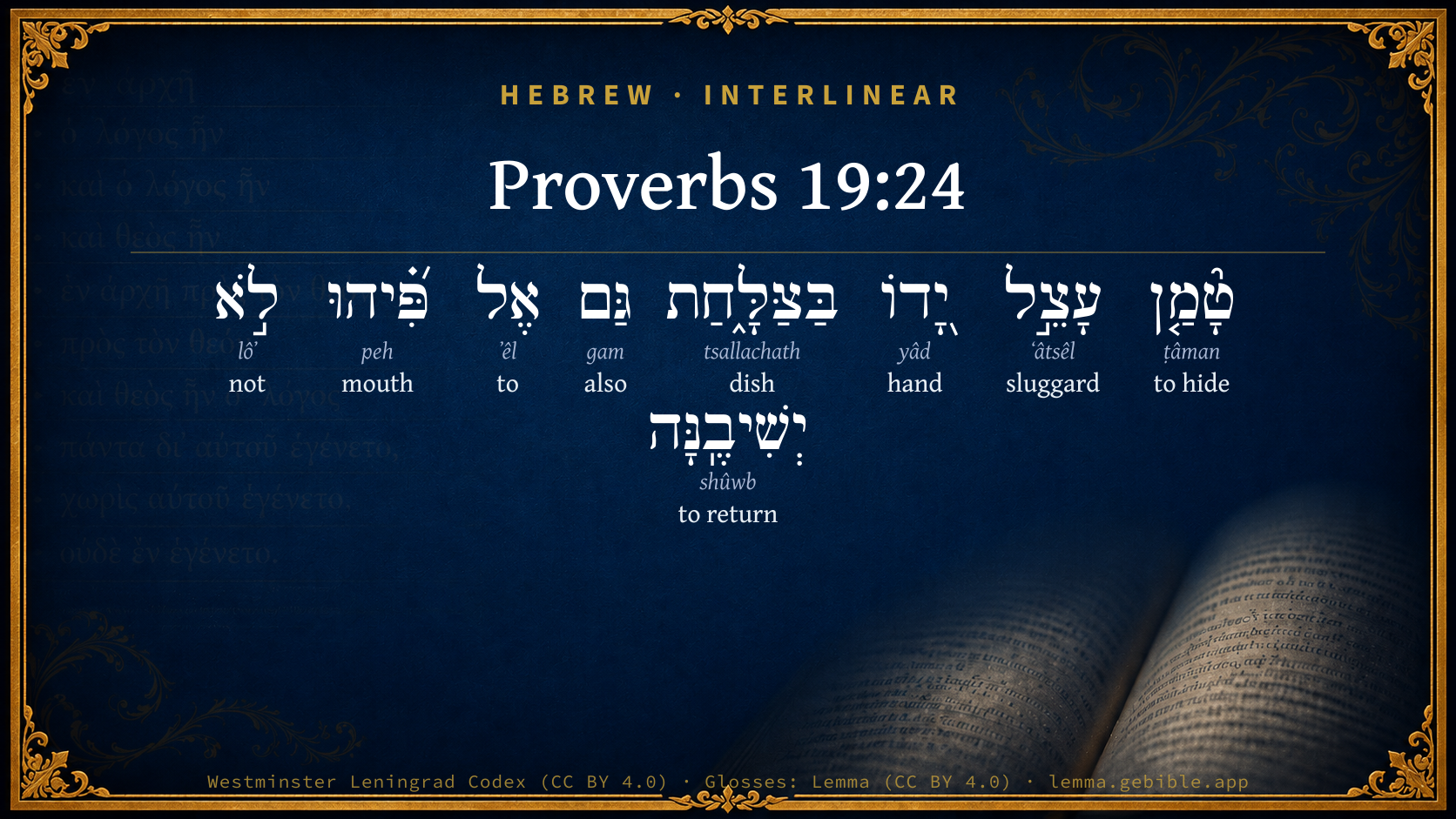
Proverbs 19:24

Hebrew (Westminster Leningrad Codex) Proverbs 19:24 appears in the Hebrew Old Testament. The text above is from the Westminster Leningrad Codex. Each word links to its Strong’s number, a concise gloss, and parsing drawn from the Open Scriptures Hebrew Bible morphology. Click any word for its full Brown-Driver-Briggs (BDB) entry.
Download image
Cite this verse

Proverbs 19:24 (World English Bible). Public Domain. Lemma interlinear Bible study tool, https://lemma.gebible.app/v/proverbs/19/24.

Show BibTeX & RIS
BibTeX
RIS
English Translation
The sluggard buries his hand in the dish; He will not so much as bring it to his mouth again.
World English Bible · Public Domain
Download a study sheet

One document with this verse’s original text, its word-by-word gloss line, the meaning frame, cross-references with their text, attributed commentary, and full source and license credits — printable, and it pastes into notes with its structure intact.

This verse Autodidact and up

Study sheet (.html) Plain text (.txt)

A passage Seminary Student

Up to 50 verses in one chapter. A passage sheet keeps up to 6 commentary sources and 12 cross-references per verse, in the order this page ranks them, and says so on the sheet whenever that leaves anything out. Ask for a single verse and you get the Autodidact verse sheet above.

Everything on this page stays free to read, with no account — the sheet is a download of what is already on screen, not access to it.

Want to remove ads? Support Godless Engineer
Compare translations 3

The same verse in 3 English versions, stacked beneath the original-language interlinear above. Click any original word for its lexicon entry.

Each is an independent rendering of the whole verse — the interlinear is not word-aligned to these translations.

Highlighted words mark where these versions differ — a whole-verse word diff, not a word-by-word alignment.

  • World English Bible Public Domain
    The sluggard buries his hand in the dish; He will not so much as bring it to his mouth again.
  • King James Version Public Domain
    A slothful man hideth his hand in his bosom, and will not so much as bring it to his mouth again.
  • unfoldingWord Literal Text CC BY-SA 4.0
    A lazy one hides his hand in the dish; he will not even return it to his mouth.

unfoldingWord Literal Text — © unfoldingWord, licensed CC BY-SA 4.0. Word-aligned USFM3 via Door43 (git.door43.org/unfoldingWord/en_ult).

Versions to compare (up to 4)

3 of 4 selected

Show all 18 translations

Every available English version of this verse, each an independent rendering of the whole verse.

  • World English Bible Public Domain
    The sluggard buries his hand in the dish; He will not so much as bring it to his mouth again.
  • Berean Standard Bible Public Domain
    The slacker buries his hand in the dish; he will not even bring it back to his mouth.
  • Majority Standard Bible Public Domain
    The slacker buries his hand in the dish; he will not even bring it back to his mouth.
  • King James Version Public Domain
    A slothful man hideth his hand in his bosom, and will not so much as bring it to his mouth again.
  • American Standard Version (1901) Public Domain
    The sluggard burieth his hand in the dish, And will not so much as bring it to his mouth again.
  • Revised Version (1885) Public Domain
    The sluggard burieth his hand in the dish, and will not so much as bring it to his mouth again.
  • Geneva Bible (1599) Public Domain
    The slouthfull hideth his hand in his bosome, and wil not put it to his mouth againe.
  • Douay-Rheims (1899) Public Domain
    The slothful hideth his hand under his armpit, and will not so much as bring it to his mouth.
  • Young's Literal Translation Public Domain
    The slothful hath hidden his hand in a dish, Even unto his mouth he bringeth it not back.
  • Literal Standard Version CC BY-SA 4.0
    The slothful has hidden his hand in a dish, || Even to his mouth he does not bring it back.
  • Unlocked Literal Bible CC BY-SA 4.0
    The sluggard buries his hand in the dish; he will not even bring it back up to his mouth.
  • unfoldingWord Literal Text CC BY-SA 4.0
    A lazy one hides his hand in the dish; he will not even return it to his mouth.
  • Darby Bible Public Domain
    A sluggard burieth his hand in the dish, and will not even bring it to his mouth again.
  • World Messianic Bible Public Domain
    The sluggard buries his hand in the dish; he will not so much as bring it to his mouth again.
  • Webster's Bible Public Domain
    A slothful man hideth his hand in his bosom, and will not so much as bring it to his mouth again.
  • Free Bible Version CC BY-SA 4.0
    Lazy people put their hands in a dish, and won't even lift the food to their mouths.
  • Bible in Basic English Public Domain
    The hater of work puts his hand deep into the basin, and will not even take it to his mouth again.
  • JPS Tanakh (1917) Public Domain
    The sluggard burieth his hand in the dish, and will not so much as bring it back to his mouth.

Literal Standard Version (2020), Covenant Press — licensed CC BY-SA 4.0. Text via the HelloAO Bible API (eBible.org). Unlocked Literal Bible (unfoldingWord) — licensed CC BY-SA 4.0. Text via the HelloAO Bible API (eBible.org). unfoldingWord Literal Text — © unfoldingWord, licensed CC BY-SA 4.0. Word-aligned USFM3 via Door43 (git.door43.org/unfoldingWord/en_ult). Free Bible Version, Dr. Jonathan Gallagher — licensed CC BY-SA 4.0. Text via the HelloAO Bible API (eBible.org).

Word by word

More ways to search: Search by grammar → Find every occurrence → Compare this word →

Practice this passage: Drill this verse → Learn its vocabulary →

About this verse

These counts appear in no published source. They are computed here, from the morphology-tagged text and Lemma’s own curated glosses. What Lemma adds →

9
words
9
distinct lemmas
Wisdom
section

Notable vocabulary

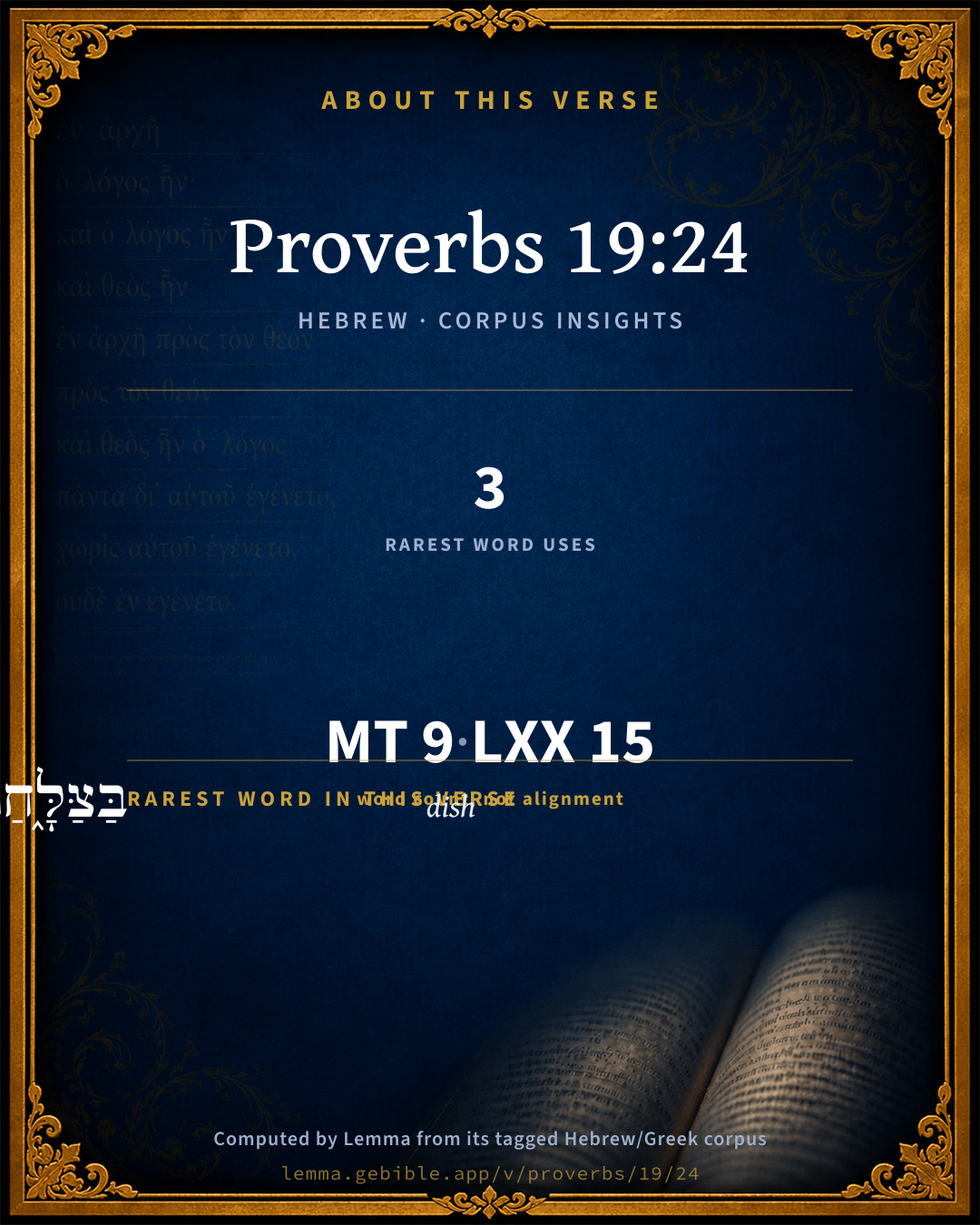
The rarest word here is בַּצַּלָּ֑חַת dish H6747 — appearing just 3 times in the whole Hebrew Bible.

Shared distinctive vocabulary

בַּצַּלָּ֑חַת dish H6747 occurs in 3 verses of the Hebrew Bible. Also found in:

Grammatical profile

  • 2 verbs
  • 3 nouns
  • 1 adjective
  • 1 preposition
  • 2 particles

Verb forms

  • טָ֘מַ֤ן Qal · Perfect
  • יְשִׁיבֶֽנָּה Hiphil · Imperfect

Hebrew & Septuagint length

In English translation the verse runs 20 words from the Hebrew and 18 from the Septuagint (LXX English) — closely comparable.

A rough comparison of the two English renderings, which tokenize alike — not a word-level alignment.

Word counts can differ between the Hebrew and the Greek without any difference in meaning — e.g. the Hebrew direct-object marker אֵת has no separate Greek word, and Greek often adds the article ὁ.

In the original languages it is 9 Hebrew tokens and 15 Greek tokens — but the two are counted differently (Hebrew bundles its prefixes and suffixes into one token; the Greek is in lemma form), so that isn’t a like-for-like length.

Cross-references

9

Topical passages linked to Proverbs 19:24 in the Treasury of Scripture Knowledge — connected by theme and wording, ordered by reader-vote popularity; previews shown in the World English Bible.

  • Proverbs 15:19 The way of the sluggard is like a thorn patch, But the path of the upright is a highway.
  • Proverbs 6:9–10 How long will you sleep, sluggard? When will you arise out of your sleep?
  • Proverbs 26:13–16 The sluggard says, "There is a lion in the road! A fierce lion roams the streets!"
  • Proverbs 24:30–34 I went by the field of the sluggard, By the vineyard of the man void of understanding;
  • Proverbs 12:27 The slothful man doesn't roast his game, But the possessions of diligent men are prized.
  • Proverbs 19:15 Slothfulness casts into a deep sleep. The idle soul shall suffer hunger.
  • Mark 14:20 He answered them, "It is one of the twelve, he who dips with me in the dish.
  • Psalms 74:11 Why do you draw back your hand, even your right hand? Take it out of your pocket and consume them!
  • Matthew 26:23 He answered, "He who dipped his hand with me in the dish, the same will betray me.

Cross-references courtesy of OpenBible.info (CC BY 4.0).

Hebrew and Greek witnesses Masoretic Hebrew ↔ Greek Septuagint

The same verse in the two great witnesses to the Old Testament, shown verse-for-verse.

These are two independent witnesses, not word-aligned to each other, and the Septuagint is shown in lemma (dictionary) form.

Hebrew Proverbs 19:24 Masoretic · Westminster Leningrad Codex

טָ֘מַ֤ן עָצֵ֣ל יָ֭דוֹ בַּצַּלָּ֑חַת גַּם אֶל פִּ֝֗יהוּ לֹ֣א יְשִׁיבֶֽנָּה

The sluggard buries his hand in the dish; He will not so much as bring it to his mouth again.

World English Bible · Public Domain

Greek LXX Proverbs 19:24 Septuagint · lemma form

ὁ ἐνκρύπτω εἰς ὁ κόλπος αὐτός χείρ ἀδίκως οὐδέ ὁ στόμα οὐ μή προςἄγω αὐτός

He that unjustly hides his hands in his bosom, will not even bring them up to his mouth.

LXX2012 (modern English Septuagint) · Public Domain

On this verse, Haydock's Catholic Bible Commentary discusses the Septuagint’s reading. Read the note in Commentary ↓

Hebrew: Westminster Leningrad Codex (CC BY 4.0). Greek: Septuagint (public domain); English from LXX2012 (modern English Septuagint) (Public Domain). How the Septuagint differs from the Hebrew →

Commentary

Notes on Proverbs 19:24 from classic Christian and Jewish commentators (each source and its license shown beneath its notes). The classic Christian expositions comment on the surrounding passage and are grouped to its opening verse, so a note may address several verses; the Jewish commentaries on the Tanakh (Rashi and others) are per-verse, so they appear only where the commentator wrote on this verse.

Lemma curates 59 commentaries, every one of them public domain or Creative Commons licensed, each selected and text-cleaned for this edition rather than reprinted as found. About our sources →

Trapp's Complete Commentary

John Trapp

Pro 19:24 A slothful [man] hideth his hand in [his] bosom, and will not so much as bring it to his mouth again.

Ver. 24. A slothful man hideth his hand in his bosom.] The Latins say, He wraps it in his cloak; Manum habet sub pallio, He puts it in his pocket, say we. Erewhiles we had him fast asleep; and here going about his business, as if he were still asleep; so lazy that any the least labour is grievous to him, he can hardly find in his heart to feed himself, so to uphold the life of his hands, which he should maintain with "the labour of his hands" {2Th 3:10} and with "the sweat of his brow." {Gen 3:19} Very sucklings get not their milk without much tugging and tiring themselves at the dug.

John Trapp, A Commentary or Exposition upon All the Books of the Old and New Testament (1647–1656) — public domain. Text from a community e-Sword module.

The Biblical Illustrator

Joseph S. Exell

Pro_19:24

A slothful man hideth his hand in his bosom.

A protest against laziness

Most critics substitute the word dish for bosom here: A slothful man hideth his hand in his dish. This certainly makes the description of the lazy man more graphic. His repast is provided for him; it is spread before him, but he is too lazy to take it: he drops his hand in the dish. This laziness may be seen in different departments of life.

I. In worldly concerns.

II. In intellectual matters. The dish of knowledge is laid before a lazy man; he has books, leisure, money, everything in fact to enable him to enrich his mind with knowledge, and train his faculties for distinguished work in the realm of science, but he is too lazy. His mind becomes enfeebled and diseased for the want of exercise. It may be seen--

III. In spiritual interests. Gospel provisions are laid before the lazy man. There are the unsearchable riches of Christ; but he is too indolent to make any exertion to participate in the heavenly blessings. (David Thomas, D. D.)

The Biblical Illustrator, edited by Joseph S. Exell (c. 1880s–1900s) — public domain. Text from a community e-Sword module.

Joseph Benson's Commentary

Pro 19:24. A slothful man hideth his hand in his bosom — Either to keep it warm in cold weather, or to give it rest, being unwilling to fatigue it with the labour of any action; and will not bring it to his mouth again — Namely, to feed himself; as if he expected that the meat should drop into his mouth. “It is a most elegant, but hyperbolical, description of a man who hath given himself up to sloth; who refuses to do things as easy as pulling his hand out of his bosom, and as necessary as eating and drinking.”

Joseph Benson's Commentary on the Old and New Testaments (1811–1818) — public domain. Text from a community e-Sword module.

Tyndale Open Study Notes

Tyndale Open Resources

19:24 // 26:15 This proverb is a humorous comment on the foolishness of being lazy (see also 10:4-6, 26; 12:11, 27; 13:4; 15:19; 18:9).

Tyndale Open Study Notes — © Tyndale Open Resources, licensed CC BY-SA 4.0. Text via the HelloAO Bible API.

Matthew Henry's Commentary

A sluggard is here exposed as a fool, for, 1. All his care is to save himself from labour and cold. See his posture: He hides his hand in his bosom, pretends he is lame and cannot work; his hands are cold, and he must warm them in his bosom; and, when they are warm there, he must keep them so. He hugs himself in his own ease and is resolved against labour and hardship. Let those work that love it; for his part he thinks there is no such fine life as sitting still and doing nothing. 2. He will not be at the pains to feed himself, an elegant hyperbole; as we say, A man is so lazy that he would not shake fire off him, so here, He cannot find in his heart to take his hand out of his bosom, no, not to put meat into his own mouth. If the law be so that those that will not labour must not eat, he will rather starve than stir. Thus his sin is his punishment, and therefore is egregious folly.

Matthew Henry's Commentary on the Whole Bible (1708–1710) — public domain (CC PDM 1.0). Text via the HelloAO Bible API.

Jamieson, Fausset & Brown

Robert Jamieson, A. R. Fausset & David Brown

bosom--literally, a wide dish in which the hand was plunged in eating (Mat 26:23). Compare Pro 26:15, the sentiment expressed with equal irony and less exaggeration.

Jamieson, Fausset & Brown — Commentary Critical and Explanatory on the Whole Bible (1871) — public domain (CC PDM 1.0). Text via the HelloAO Bible API.

Adam Clarke's Commentary

Verse 24. A slothful man hideth his hand in his bosom] Is too lazy to feed himself, If he dip his hand once in the dish, he is too lazy to put it in a second time. It is a strange case that a man, through his excessive slothfulness, would rather starve than put himself to the trouble to eat.

Adam Clarke's Commentary on the Bible (1810–1826) — public domain. Text from a community e-Sword/MySword module.

Ellicott's Commentary for English Readers

(24) A slothful man hideth his hand in his bosom.—Better, in the dish that stood in the middle of the table at an Oriental dinner, into which the guests dipped their hands to take out the food for themselves (Mat_26:23).

A Bible Commentary for English Readers, edited by Charles John Ellicott (1878–1897) — public domain. Text from a community e-Sword module.

The Cambridge Bible for Schools and Colleges

gen. ed. J. J. S. Perowne

24. hideth his hand in his bosom] Rather, burieth his hand in the dish (R.V.), after the Oriental fashion of eating. See Pro_26:15, where this clause occurs again. Comp. Mat_26:23. The Heb. word is rendered dish, 2Ki_21:13; and (in a slightly different form) cruse (A.V. and R.V.) in 2Ki_2:20; pan, 2Ch_35:13. “It was probably a flat metal saucer of the form still common in the East,” Smith’s Dict. of Bible, Art. cruse.

The Cambridge Bible for Schools and Colleges (gen. ed. J. J. S. Perowne; Cambridge University Press, 1878–1918) — public domain. Text from a community e-Sword module.

John Gill's Exposition

A slothful man hideth his hand in his bosom,.... In cold weather to keep it warm, and at other times, as unwilling to use it in labour; it is the proper posture and just attitude of a slothful man. The word for "bosom" is sometimes used for a "pot" or "platter" (u); and then the sense is, that he puts his hands under a pot over a fire to warm them; or in one removed at some distance from the fire, as Jarchi; or rather it may signify his putting his hand into a plate of food, and yet so slothful, as it follows,

and will not so much as bring it to his mouth again; so sluggish, that he will rather starve than be at the pains to feed himself; he will not take his hand out of his bosom, to take food out of the dish to feed himself with; and even when his hand is in the dish, he will not take it from thence again, and lift it to his mouth; an hyperbolical expression. Gussetius (w) thinks, it may have respect to such slothful men, who are careless and negligent to their souls; who, though they have the holy Scriptures in their hands, like a vessel full of wholesome food for the soul, yet will not make use of the least mite out of them, that they may receive eternal life.

(u) "in patinam", Tigurine version; "in lebete", Mercerus, Michaelis; "in patinia", Cocceius; "in paropsidem", Schultens. (w) Ebr. Comment. p. 715.

John Gill's Exposition of the Whole Bible (1746–1763) — public domain (CC PDM 1.0). Text via the HelloAO Bible API.

Albert Barnes' Notes on the Bible

Hideth his hand in his bosom - Better, dippeth his hand in the dish (compare 2Ki 21:13). The scene brought before us is that of an Eastern feast. There are no knives, or forks, or spoons. Every guest has to help himself, or be helped by the host. Compare Joh 13:26.

Albert Barnes' Notes on the Bible (1834–1885) — public domain. Text from a community e-Sword/MySword module.

Haydock's Catholic Bible Commentary

CHAPTER XIX.

Arm-pit. Or Hebrew tsallachath, "in the pot," out of which he eats; which shews his negligence. --- Mouth, to eat. This hyperbole indicates that he is too lazy to take the necessary sustenance, chap. xxvi. 15. (Calmet) --- Septuagint, "in his breast unjustly. Neither will he bring them to his mouth." (Haydock) --- He will bestow nothing, and shall reap no benefit from his avarice. (St. Bernard) --- He will not practise what he teaches. (St. Gregory, Mor. xii. 10.)

George Leo Haydock (1774–1849), Haydock's Catholic Family Bible and Commentary, 1859 edition — public domain. Excludes Psalms (Douay-Rheims chapter numbering differs from Protestant) and Deuterocanonical books (Catholic canon only).

Matthew Poole's English Annotations

Hideth his hand in his bosom; either to keep it warm in cold weather; or to give it rest, being loth to oppress it with the labour of any action. It is a sarcastical hyperbole.

Will not so much as bring it to his mouth again, to wit, to feed himself; he expects that the meat should drop into his mouth.

Matthew Poole's English Annotations on the Holy Bible (1683–1685) — public domain. Text from a community e-Sword/MySword module.

Whedon's Commentary on the Bible

Daniel D. Whedon

24. Hideth… in his bosom — Better, in a dish. He does not even return it to his own mouth. A sarcastic hyperbole, like “too lazy to eat.” The allusion is to the Oriental mode of eating. Pro_12:27; Pro_15:19; Pro_26:13; Pro_26:15; Mat_26:23; Joh_13:26. Our version follows the Septuagint and Vulgate. The word occurs in the sense of dish, 2Ki_21:13.

Daniel D. Whedon (gen. ed.), Commentary on the Old and New Testaments (1874–1909) — public domain. Text from a community e-Sword module.

The Pulpit Commentary

A slothful man hideth him hand in his bosom; Revised Version, the sluggard burieth his hand in the disk. The word tsallachath, translated "bosom" here and in the parallel passage, Pro_26:15 (where see note), is rightly rendered "dish". (2Ki_21:13) At an Oriental meal the guests sit round a table, on which is placed a dish containing the food, from which every one helps himself with his fingers, knives, spoons, and forks being never used. (comp. Rth_2:14 Mat_26:23) Sometimes the holt himself helps a guest whom ha wishes to honour. (comp. Joh_13:26) And will not so much as bring it to him mouth again He finds it too great an exertion to feed himself, a hyperbolical way of denoting the gross laziness which recoils from the slightest labour, and will not take the least trouble to win its livelihood. An Arabic proverb says, "He dies of hunger under the date tree." Septuagint, "He who unjustly hideth his hands in his bosom will not even apply them to his mouth;" i.e. he who will not work will never feed himself.

The Pulpit Commentary (1880–1919), ed. H.D.M. Spence-Jones & Joseph S. Exell — public domain. Text from a community e-Sword module.

John Wesley's Explanatory Notes

Bring it - To feed himself; he expects that the meat should drop into his mouth.

John Wesley, Explanatory Notes Upon the Whole Bible (1754–1765) — public domain. Text via the GEBible commentary corpus.

Keil & Delitzsch

C. F. Keil & F. Delitzsch

24 The slothful hath thrust his hand into the dish;

He bringeth it not again to his mouth.

This proverb is repeated in a different form, Pro 26:15. The figure appears, thus understood, an hyperbole, on which account the lxx understand by צלחת the bosom or lap, κόλπον; Aquila and Symmachus understand by it the arm-pit, μασχάλην or μάλην; and the Jewish interpreters gloss it by חיק (Kimchi) or קרע החלוק, the slit (Ita. fenditura) of the shirt. But the domestic figure, Kg2 21:13, places before us a dish which, when it is empty, is wiped and turned upside down;

(Note: While צפּחת, ṣaḥfat, in the sense of dish, is etymologically clear, for צלּחת, neither ṣalaḥ (to be good for), nor salakh (to be deaf, mangy), offers an appropriate verbal meaning. The Arab. zuluh (large dishes) stands under zalah (to taste, of the tasting of good), but is scarcely a derivative from it. Only צלח, which in the meaning of good for, proceeding from the idea of penetrating through, has retained the root-meaning of cleft, furnishes for צלּחת and צלוחית a root-word in some measure useful.)

and that the slothful when he eats appears too slothful to bring his hand, e.g., with the rice or the piece of bread he has taken out of the dish, again to his mouth, is true to nature: we say of such a man that he almost sleeps when he eats. The fut. after the perf. here denotes that which is not done after the former thing, i.e., that which is scarcely and only with difficulty done; לּו ... גּם may have the meaning of "yet not," as at Psa 129:2; but the sense of "not once" = ne ... quidem, lies here nearer Deu 23:3.

Keil & Delitzsch — Biblical Commentary on the Old Testament (1861–1891) — public domain (CC PDM 1.0). Text via the HelloAO Bible API. (Old Testament only.)

Bridges on Proverbs

Charles Bridges

Another forcible figure of the palsy of sloth!†1 It so grows on its victim, that he has no heart to do even necessary things for himself; as if he could not take his hand out of his bosom; and would rather suffer the cravings of hunger, than make the exertion of putting his food into his mouth. A melancholy picture it is of many fair intentions and promises, and apparently good beginnings in religion — all stopped for want of the effort to overcome the least hindrance. Every religious duty is a burden. The struggle necessary for prayer — the only means of receiving our spiritual food — is too hard. The soul, that seemed to have been awakened, sinks into its former lethargy; and the effort to rouse it becomes each time fainter and more hopeless. The hand cannot be stretched out, though it were to lay hold on a crown.

Some, indeed, seem to feel little or no exertion to be necessary; a plain proof, that they have never been really in earnest about this momentous concern. The conflict is not imaginary. "Woe unto those, who," reposing on the lap of indulgence, "are at ease in Zion." (Amo 6:1 .) A religion without sacrifice, without diligence, will never open a way to heaven. It is treasuring up unavailing repentance against the latter days. If the work of the day, much more the work of eternity, calls for all diligence. If the Emperor Titus could mourn, that he ’had lost a day,’ what will be the stinging remorse of having lost a life! To think, that by a right beginning, followed up by "a patient continuance in well-doing" (Rom 2:7 ), we might have effectively "served the will of God in our generation" (Act 13:36 ), so as to have been missed in the world after we had "fallen asleep;" to think that we might have sown seed for eternity, so that our "memory," instead of "rotting," would "have been blessed" (Pro 10:7 ); that all this was wished, contemplated, nay — even resolved; yet not an atom of it accomplished: will not this be a thorn for a dying pillow, perhaps the tormenting worm for eternity?

The mere waste of time is far from being the worst part of the evil. It is fatal alike to our well-being, and our well-doing, to condemn our energies to rust out in inactivity. Thomson’s excuse for reposing in his ’Castle of Indolence’ was, that he had nothing to do. And doubtless the want of an object is sufficient to make an idler of a man of talent. But can this ever be the condition of any one — even the least occupied, or the least influential among us? Are any of us freed from the responsibility of diligence, if not for ourselves, at least in the service of our fellow-creatures. Much less can the Christian plead as an excuse for "standing idle," that "no man hath hired him." (Mat 20:6-7 .) Is not the great object always in sight, always worthy of all the concentration of mind, talent, and energy — "To me to live is Christ"? (Php 1:21 .)

The special time for the resistance of this deadly disease, is when we are most under its power. When the Bible is uninteresting as a common book, then is the time to live in it with patient diligence. When prayer is cold and heartless, instead of giving up, hold on, however feebly, yet with perseverance. When in a state of listless exertion, be employed for God and for his Church. Form habits of early energy. Beware of a dreaming sentimentalism. Cultivate bodily activity. Regard the incursions of sloth as the effects of those poisons, which, while they cause sleep, unless counteracted by constant resistance, must prove fatal. Yet with all these means, never forget the one only principle, that makes them effectual — prayer, unceasing, believing, "looking unto Jesus," who not only gives life, but liveliness. (Heb 12:1-2 . Joh 10:10 .)

Christian! He who hath awakened you from the sleep of death, will keep you awake, till the Lord come. Still even with you much drowsiness remains, trifling away time in a tame, barren profession, such as your Lord will not tolerate. He will make you feel, that life is a solemn reality, that prayer is not a half-hearted work, but a close dealing with the living God, a warm pulse of the hidden life, a continued conflict with mighty enemies.

Are you then struggling in this conflict? Look for repose only in the arms of victory. While the conflict lasts, there is no time for loitering or for slumber. Yet forget not to thank God for every victory, yea, for the continued strength, enabling you to persevere in the fight; for the wise dispensation also, that appoints this holy conflict, as the means of invigorating our faith, our hope, our meetness for the crown, and our joyful expectation of it. If peace with God is our life, "the joy of the LORD is our strength" (Neh 8:10 ), our health, our happiness, yet not to be found in a listless, enervated habit.

Footnotes:

†1 See similar figures Pro 12:27 ; Pro 26:15 . Ecc 4:5 .

Charles Bridges, An Exposition of the Book of Proverbs (1846) — public domain. Text from a community e-Sword module.

Kretzmann's Popular Commentary

Paul E. Kretzmann

v. 24. A slothful man hideth his hand in his bosom, rather, he plunges it into the wide dish which contained the principal food of the family, and will not so much as bring it to his mouth again, too lazy even to eat.

Paul E. Kretzmann, Popular Commentary of the Bible (1921–1924) — public domain. Text from a community e-Sword module.

Rashi

Rabbi Shlomo Yitzchaki (Rashi)

A lazy man hid his hand in a kettle Heb. בצלחת, in a hot kettle, in which, when removed from the fire and emptied, one may warm his hand. Similar to it in Chronicles (II 35:13): “they cooked in pots, in cauldrons, and in kettles (בצלחות),” In the name of Rabbi Isaac HaLevi I heard that בצלחת is derived from the expression of the Aramaic translation of ויבקע “and he split,” which is וצלח. At the time of the cold and the frost, since the cold and the frost crack and split the hands. [Hence, we render: A lazy man hid his hand in winter.] But I heard that is a rend of a cloak called fenditura [in Italian, in German Riss, Spalt, Schlitz], i.e., he hides it in his bosom.

Rashi on the Tanakh — English translations: “The Judaica Press complete Tanach with Rashi, translated by A. J. Rosenberg” (CC BY 4.0); “Pentateuch with Rashi's commentary by M. Rosenbaum and A.M. Silbermann, 1929-1934” (public domain); “The Metsudah Tanach series, Lakewood, N.J” (CC BY 4.0); and “The Book of Joshua, Metsudah Publications, 1997” (CC BY 4.0). Text via Sefaria.

Lesson kit

Teaching starters — assembled from the data on this page, not authored interpretation. Every prompt links to the verse data it draws on. Edit before teaching.

Proverbs, in the Wisdom, opens this verse with 9 words (9 distinct Hebrew lemmas). Its most distinctive word is tsallachath (“dish”). A historical commentator’s framing appears above. Read the whole chapter for the surrounding context.

Discussion questions

  1. The word tsallachath carries the sense “dish.” How does it shape the verse?
  2. How does 2 Kings 21:13, which shares the word «dish», read alongside this verse?
  3. The translations on this page render this verse differently — a whole-verse word diff, not a word-by-word alignment. What might account for the different wordings?
  4. «טָ֘מַ֤ן» is a Qal Perfect verb. How does that grammatical form shape the action described?
  5. Compare how Trapp's Complete Commentary and The Biblical Illustrator read this verse. Where do they agree or differ?

Things to notice

Reading settings

Reading text

Shown beneath each verse's original-language words.

Old Testament
Old Testament edition

Read the OT as the Masoretic Hebrew (MT) or the Greek Septuagint (LXX).

English shown for the Greek Septuagint (in the Hebrew ↔ Greek comparison).

Comparing translations? Open the Compare panel on any verse page to stack up to four side by side.