
Zechariah 1:20

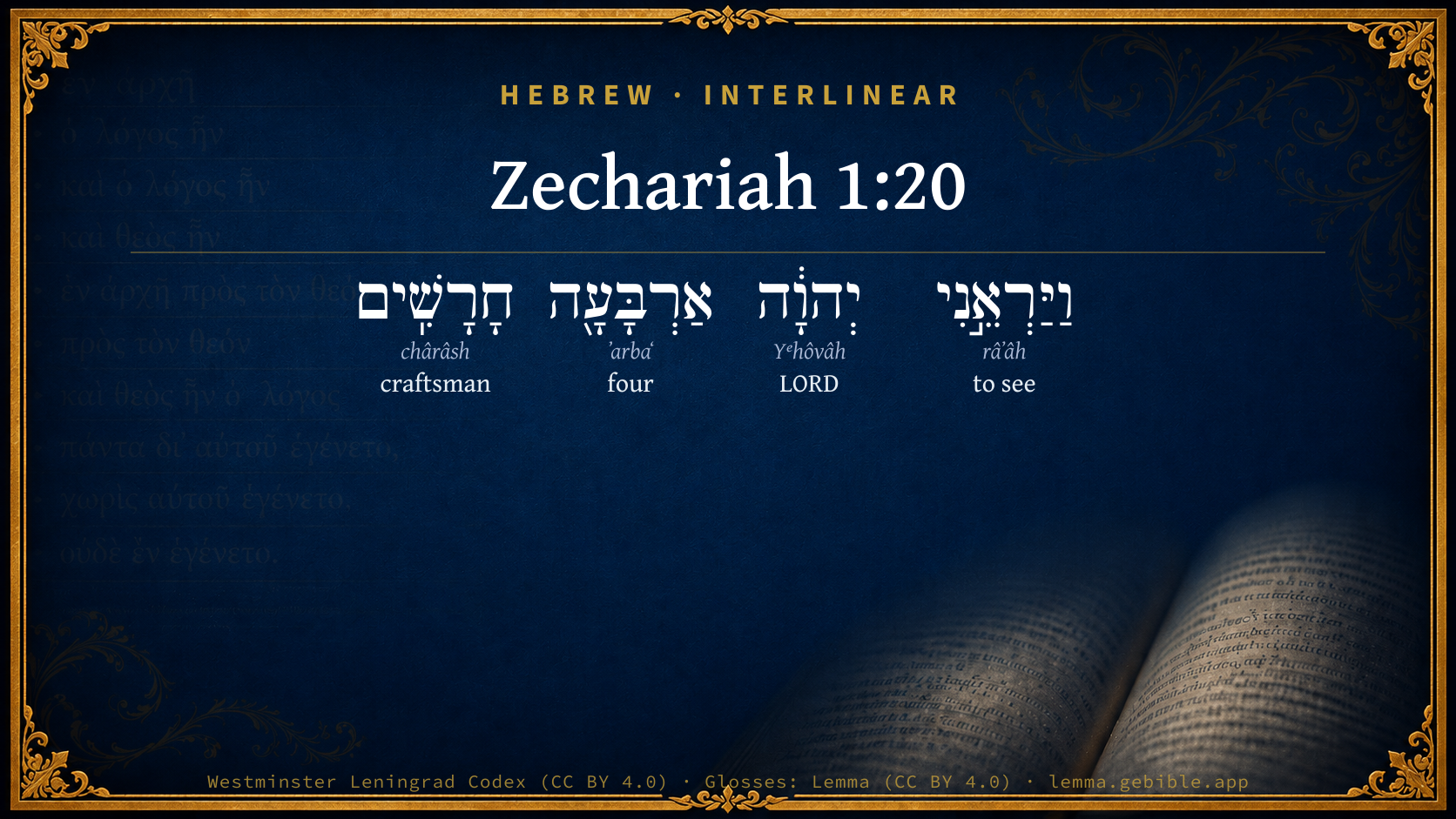
Hebrew (Westminster Leningrad Codex) Zechariah 1:20 appears in the Hebrew Old Testament. The text above is from the Westminster Leningrad Codex. Each word links to its Strong’s number, a concise gloss, and parsing drawn from the Open Scriptures Hebrew Bible morphology. Click any word for its full Brown-Driver-Briggs (BDB) entry.
Download image
Cite this verse

Zechariah 1:20 (World English Bible). Public Domain. Lemma interlinear Bible study tool, https://lemma.gebible.app/v/zechariah/1/20.

Show BibTeX & RIS
BibTeX
RIS
English Translation
Yahweh showed me four craftsmen.
World English Bible · Public Domain
Download a study sheet

One document with this verse’s original text, its word-by-word gloss line, the meaning frame, cross-references with their text, attributed commentary, and full source and license credits — printable, and it pastes into notes with its structure intact.

This verse Autodidact and up

Study sheet (.html) Plain text (.txt)

A passage Seminary Student

Up to 50 verses in one chapter. A passage sheet keeps up to 6 commentary sources and 12 cross-references per verse, in the order this page ranks them, and says so on the sheet whenever that leaves anything out. Ask for a single verse and you get the Autodidact verse sheet above.

Everything on this page stays free to read, with no account — the sheet is a download of what is already on screen, not access to it.

Want to remove ads? Support Godless Engineer
Compare translations 3

The same verse in 3 English versions, stacked beneath the original-language interlinear above. Click any original word for its lexicon entry.

Each is an independent rendering of the whole verse — the interlinear is not word-aligned to these translations.

Highlighted words mark where these versions differ — a whole-verse word diff, not a word-by-word alignment.

  • World English Bible Public Domain
    Yahweh showed me four craftsmen.
  • King James Version Public Domain
    And the LORD shewed me four carpenters.
  • unfoldingWord Literal Text CC BY-SA 4.0
    And Yahweh showed me four craftsmen.

unfoldingWord Literal Text — © unfoldingWord, licensed CC BY-SA 4.0. Word-aligned USFM3 via Door43 (git.door43.org/unfoldingWord/en_ult).

Versions to compare (up to 4)

3 of 4 selected

Show all 16 translations

Every available English version of this verse, each an independent rendering of the whole verse.

  • World English Bible Public Domain
    Yahweh showed me four craftsmen.
  • Berean Standard Bible Public Domain
    Then the LORD showed me four craftsmen.
  • Majority Standard Bible Public Domain
    Then the LORD showed me four craftsmen.
  • King James Version Public Domain
    And the LORD shewed me four carpenters.
  • American Standard Version (1901) Public Domain
    And Jehovah showed me four smiths.
  • Revised Version (1885) Public Domain
    And the LORD shewed me four smiths.
  • Geneva Bible (1599) Public Domain
    And the Lord shewed me foure carpenters.
  • Douay-Rheims (1899) Public Domain
    And the Lord shewed me four smiths.
  • Young's Literal Translation Public Domain
    And Jehovah doth shew me four artizans.
  • Literal Standard Version CC BY-SA 4.0
    And YHWH shows me four artisans.
  • Unlocked Literal Bible CC BY-SA 4.0
    Then Yahweh showed me four craftsmen.
  • unfoldingWord Literal Text CC BY-SA 4.0
    And Yahweh showed me four craftsmen.
  • Darby Bible Public Domain
    And Jehovah shewed me four craftsmen.
  • World Messianic Bible Public Domain
    The LORD showed me four craftsmen.
  • Free Bible Version CC BY-SA 4.0
    Then the Lord showed me four craftsmen.
  • JPS Tanakh (1917) Public Domain
    (2-3) And the LORD showed me four craftsmen.

Literal Standard Version (2020), Covenant Press — licensed CC BY-SA 4.0. Text via the HelloAO Bible API (eBible.org). Unlocked Literal Bible (unfoldingWord) — licensed CC BY-SA 4.0. Text via the HelloAO Bible API (eBible.org). unfoldingWord Literal Text — © unfoldingWord, licensed CC BY-SA 4.0. Word-aligned USFM3 via Door43 (git.door43.org/unfoldingWord/en_ult). Free Bible Version, Dr. Jonathan Gallagher — licensed CC BY-SA 4.0. Text via the HelloAO Bible API (eBible.org).

Word by word

More ways to search: Search by grammar → Find every occurrence → Compare this word →

Practice this passage: Drill this verse → Learn its vocabulary →

About this verse

These counts appear in no published source. They are computed here, from the morphology-tagged text and Lemma’s own curated glosses. What Lemma adds →

4
words
4
distinct lemmas
Prophets
section

Shared distinctive vocabulary

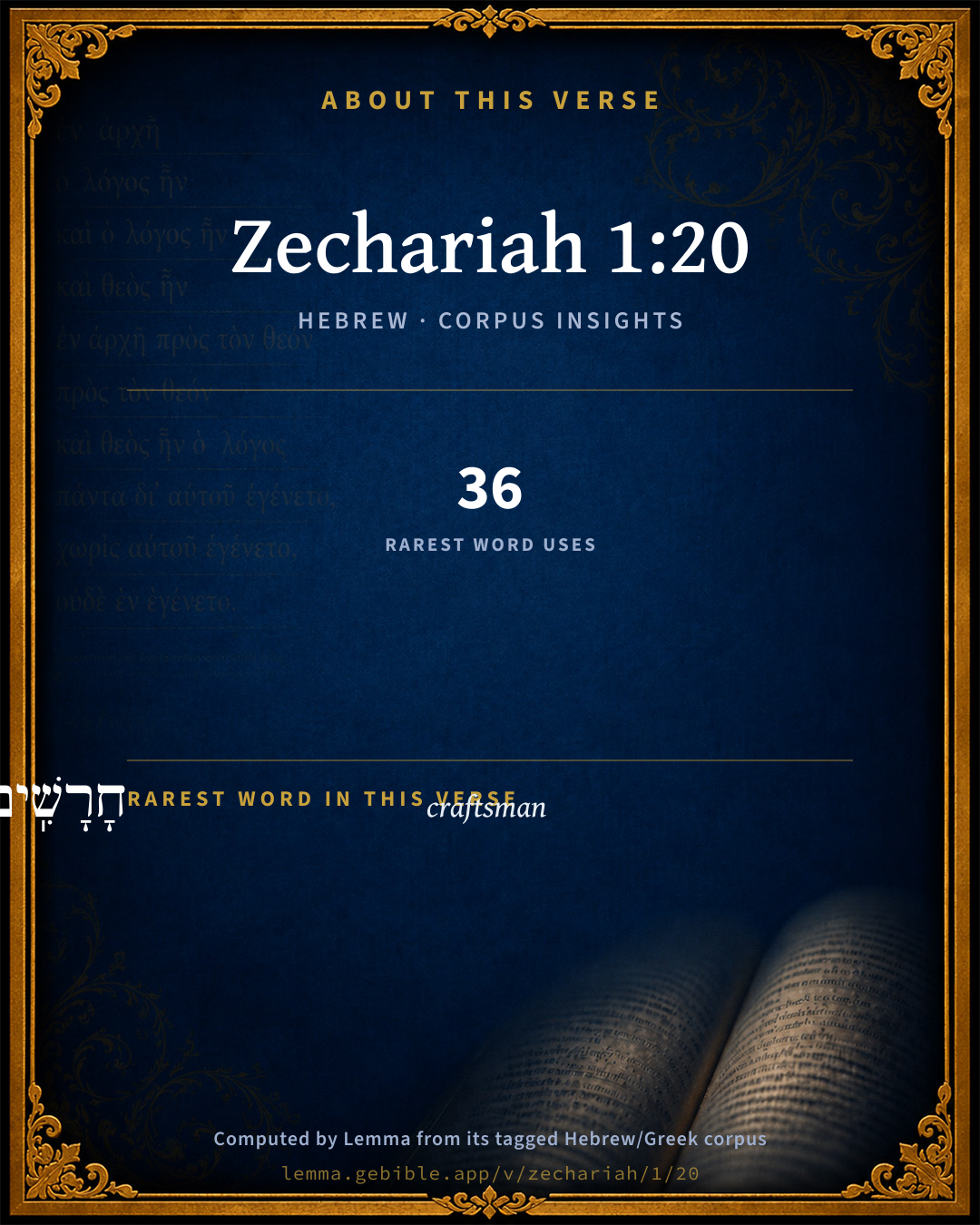
חָרָשִֽׁים craftsman H2796 occurs in 33 verses of the Hebrew Bible. Also found in:

Grammatical profile

  • 1 verb
  • 2 nouns
  • 1 adjective

Verb forms

  • וַיַּרְאֵ֣נִי Hiphil · Sequential Imperfect

Hebrew & Septuagint length

In English translation the verse runs 5 words from the Hebrew and 7 from the Septuagint (LXX English) — closely comparable.

A rough comparison of the two English renderings, which tokenize alike — not a word-level alignment.

Word counts can differ between the Hebrew and the Greek without any difference in meaning — e.g. the Hebrew direct-object marker אֵת has no separate Greek word, and Greek often adds the article ὁ.

Cross-references

12

Topical passages linked to Zechariah 1:20 in the Treasury of Scripture Knowledge — connected by theme and wording, ordered by reader-vote popularity; previews shown in the World English Bible.

  • Zechariah 10:3–5 My anger is kindled against the shepherds, And I will punish the male goats; For Yahweh of Hosts has visited his flock, the house of Judah, And will make them as his horse in the battle that he is proud of.
  • Zechariah 9:12–16 Turn to the stronghold, you prisoners of hope! Even today I declare that I will restore double to you.
  • Zechariah 12:2–6 "Behold, I will make Jerusalem a cup of reeling to all the surrounding peoples, and on Judah also will it be in the siege against Jerusalem.
  • Deuteronomy 33:25 Your bars shall be iron and brass; As your days, so shall your strength be.
  • Judges 11:16 but when they came up from Egypt, and Israel went through the wilderness to the Red Sea, and came to Kadesh;
  • Judges 11:18 Then they went through the wilderness, and went around the land of Edom, and the land of Moab, and came by the east side of the land of Moab, and they encamped on the other side of the Arnon; but they didn't come within the border of Moab, for the Arnon was the border of Moab.
  • 1 Samuel 12:11 Yahweh sent Jerubbaal, and Bedan, and Jephthah, and Samuel, and delivered you out of the hand of your enemies on every side; and you lived in safety.
  • Nehemiah 9:27 Therefore you delivered them into the hand of their adversaries, who distressed them: and in the time of their trouble, when they cried to you, you heard from heaven; and according to your manifold mercies you gave them saviors who saved them out of the hand of their adversaries.
  • Isaiah 54:15–17 Behold, they may gather together, but not by me: whoever shall gather together against you shall fall because of you.
  • Obadiah 1:21 Saviors will go up on Mount Zion to judge the mountains of Esau, and the kingdom will be Yahweh's.
  • Micah 5:5–6 He will be our peace when Assyria invades our land, And when he marches through our fortresses, Then we will raise against him seven shepherds, And eight leaders of men.
  • Micah 5:8–9 The remnant of Jacob will be among the nations, In the midst of many peoples, Like a lion among the animals of the forest, Like a young lion among the flocks of sheep; Who, if he goes through, treads down and tears in pieces, And there is no one to deliver.

Cross-references courtesy of OpenBible.info (CC BY 4.0).

Hebrew and Greek witnesses Masoretic Hebrew ↔ Greek Septuagint

The same verse in the two great witnesses to the Old Testament, shown verse-for-verse.

These are two independent witnesses, not word-aligned to each other, and the Septuagint is shown in lemma (dictionary) form.

Hebrew Zechariah 1:20 Masoretic · Westminster Leningrad Codex

וַיַּרְאֵ֣נִי יְהוָ֔ה אַרְבָּעָ֖ה חָרָשִֽׁים

Yahweh showed me four craftsmen.

World English Bible · Public Domain

Greek LXX Zechariah 1:20 Septuagint · lemma form
And the Lord showed me four artificers.

LXX2012 (modern English Septuagint) · Public Domain

On this verse, The Pulpit Commentary discusses the Septuagint’s reading. Read the note in Commentary ↓

Hebrew: Westminster Leningrad Codex (CC BY 4.0). Greek: Septuagint (public domain); English from LXX2012 (modern English Septuagint) (Public Domain). How the Septuagint differs from the Hebrew →

Commentary

Notes on Zechariah 1:20 from classic Christian and Jewish commentators (each source and its license shown beneath its notes). The classic Christian expositions comment on the surrounding passage and are grouped to its opening verse, so a note may address several verses; the Jewish commentaries on the Tanakh (Rashi and others) are per-verse, so they appear only where the commentator wrote on this verse.

Lemma curates 59 commentaries, every one of them public domain or Creative Commons licensed, each selected and text-cleaned for this edition rather than reprinted as found. About our sources →

Trapp's Complete Commentary

John Trapp

Zec 1:20 And the LORD shewed me four carpenters.

Ver. 20. And the Lord showed me four carpenters] He that before was called an angel is here called Jehovah, this shows him to be Christ, who is God blessed for ever. In respect of his eternal essence he is called the Lord; in respect of his office or mediatorship, an angel.

Four carpenters] Or smiths; so many horns, so many artificers to batter and break them. God wants not ways and means to help his own at a dead lift; he knows how to deliver, saith Peter, 2Pe 2:9, and herein usually he goeth a way by himself. Many times he setteth the enemies together by the ears among themselves; while that I withal escape, saith David, Psa 141:9. Thus by Nebuchadnezzar, as by a club or beetle, he brake the rest of those horrible horns; as at this day the Pope by the Turk, and Spaniard by the French, and that the Church may have her halcyons. No marvel I slept so soundly seeing Antipater was by and watched, said Philip of Macedon. We may better say of Antipater, our gracious Father and guardian, the keeper of his Israel.

John Trapp, A Commentary or Exposition upon All the Books of the Old and New Testament (1647–1656) — public domain. Text from a community e-Sword module.

The Biblical Illustrator

Joseph S. Exell

Zec_1:20

And the Lord shewed me four carpenters

The counterbalancing of agencies

Evil agencies are counterbalanced by good--for there is a Divine providence always at work in this world.

The prophet saw four horns, representing the powers by which Judah had been scattered; but at the same time he saw four carpenters, the instruments raised up by God to accomplish a Divine work.

I. The world is made for the Church. Men read the history of nations without the slightest reference to the Church of the living God. They look at passing events and circumstances without believing that they are the development of a Divine providence at work in the world. It may be thought that the world was made for unfallen man. Was it not rather made to be the scene of mans trial and probation? It is a fact that the world was mapped out with a peculiar reference to the locality and home of the Church. The world was made for Christ, and therefore for the Church. The world was made to be the school for unfallen intelligences. It was made to be the tabernacle of God.

II. The work going on in the world is in accordance with the Divine plan. There is a charm in history, since it not only annihilates the distances of time and space, but transports us to other scenes and periods. If you are a devout student of history you will see a Divine hand prescribing, the limits of conquest and the extent of a nations duration. There is, then, eternal order underlying the worlds disorder, and a Divine will subordinating all human wills. The great chapters of the worlds history have all been written beforehand. We have only seen parts of the plan, some of the first chapters--strange and startling.

III. The work of God in this world is under Divine supervision and angelic inspection. From some brief hints, it would appear as if the government of the worlds provinces had been, in some measure, intrusted to the management of angels in former times.

IV. Evil agencies are counterbalanced by good. In the natural world there are opposite forces, and laws that seem antagonistic, but these agencies are counterbalanced. We have darkness and light--we have night and day. All the forces in this world are adjusted by Divine wisdom, and thus the balance of the universe is preserved. There are opposite powers in the world. There is Satan, and there is Christ. For this purpose was the Son of God manifested, that He might destroy the works of the devil. There is sin; and yet sin is counteracted by grace. There is flesh, and there is spirit. The one seems to be the adversary of the other. Is the law in our members always to bring us into captivity to sin? No. Flesh itself is to be transfigured, to be consecrated and hallowed. There is death in the world. All men die, though Christ has died; all men shall rise, because Christ has risen. Thus evil agencies are counterbalanced by good. If there are powers hostile to the Church and to us, there are powers that are directly opposed to them, and that are at work for us, for said the prophet, The Lord shewed me four carpenters. (H. J. Bevis.)

Four carpenters

I. The truth exhibited in this vision.

1. The champions of the Church are as numerous as its assailants.

2. They are more powerful than its assailants.

3. They are seasonably provided.

II. The ground on which this truth rests. On the love, power, promises, and dispensations of God. (G. Brooks.)

Zechariahs vision

When God makes the prophet, He does not unmake the man. Each sacred writer preserves his individuality. Character and circumstance leave their impress on the inspired productions. Zechariah was moulded by the peculiarities of the age in which he lived. He was raised up to incite the Jews zeal in building the temple. His mind overflowed with it. He could think of nothing else. Hence we cannot marvel that, when he prophesied, he used architectural figures. At one time he sees a man with measuring line, and anon he says, The Lord shewed me four carpenters.

1. Gods works are often unobserved. The Lord shewed me. The seer did not behold them at first. Only when Divine help was afforded did he become aware of them. Are there not thousands who resemble him? As regards nature it is so. Eyes have they, and they see not. What is true of creation is true with double emphasis and touching revelation. The Bible is dull and uninteresting to some. Others delight in it. Why the difference? The last have Divine teaching.

2. Gods works are creative. Carpenters. These are constructive agents. Building, not demolishing, is their proper work. In seeking our own spiritual and moral welfare, we cannot too often remember this important principle--the true method of destroying is by creating. Get good into your heart, and it will cast out evil.

3. Gods works are compensative. Four. Observe the number. It corresponds with the number of Israels foes. There is more of equality in mens conditions than is often supposed. A grand law of compensation is in operation. God hath set one thing over against the other. As regards riches and poverty, adversity and prosperity, there is compensation. Everywhere evil is counterbalanced by good. Our mercies outweigh our miseries. (T. R. Stevenson.)

The four carpenters

The Hebrew word means workman in iron, brass, and stone, as well as wood. They are here the workmen of God. The horn is the instrument of power. The four horns are the symbols of persecutors, of violence and oppression, of the destroyers of the people and State. How were they to be crushed, put to fear, destroyed? That the prophet could never have found out for himself. The Lord showed him four carpenters. They were to fray (frighten) the horns. It would be heart breaking if there were nothing for us but to realise the evils we have brought on ourselves; if we were left only to all that we could see of our troubles. But there is a revelation for us, and an interpretation of the revelation too. The four horns were met by four carpenters. It was a declaration to Zechariah that there existed--ready to act out of the unseen world, whether by energising human means, or not--a system of counterpoises, and counter influences, and means of salvation, with Divine intentions concerning them, all of which were there, though man saw them not. God revealed the workers of the spirit world. Zechariah saw four horns; it was the human apprehending the terrible; and the terrible is not ignored by God; it is emphasised, it is explained. God puts their evil work against His people side by side with the work that He will do in their behalf. There was a matching of four against four. All evil meets its match in every part when God comes forth to work. If there be bad influences against you and yours, God can bring counter influences against them, and He can break the spell of evil already done. Why need you ever despair of restoration, of help, of salvation, be your cause never so low? The Son of God has come that He might destroy the works of the devil. (P. B. Power, M. A.)

.

The Biblical Illustrator, edited by Joseph S. Exell (c. 1880s–1900s) — public domain. Text from a community e-Sword module.

Tyndale Open Study Notes

Tyndale Open Resources

1:20 The word translated blacksmiths could refer to any sort of craftsmen (mason, carpenter, smith). If the horns representing the nations were metal (see 1 Kgs 22:11), then blacksmiths were appropriate to the task of destroying them (see 2 Chr 24:12; Isa 44:12).

Tyndale Open Study Notes — © Tyndale Open Resources, licensed CC BY-SA 4.0. Text via the HelloAO Bible API.

Geneva Bible (1599)

Geneva Bible translators

These Carpenters or Smiths are God’s instruments, which with their mallets and hammers break these hard and strong horns which should overthrow the Church, and declare that none enemy’s horn is so strong, but God hath an hammer to break it in pieces.

Geneva Bible (1599) marginal notes — public domain. Text via Bolls.life.

Jamieson, Fausset & Brown

Robert Jamieson, A. R. Fausset & David Brown

four carpenters--or "artificers." The several instrumentalities employed, or to be employed, in crushing the "Gentile" powers which "scattered" Judah, are hereby referred to. For every one of the four horns there was a cleaving "artificer" to beat it down. For every enemy of God's people, God has provided a counteracting power adequate to destroy it.

Jamieson, Fausset & Brown — Commentary Critical and Explanatory on the Whole Bible (1871) — public domain (CC PDM 1.0). Text via the HelloAO Bible API.

Adam Clarke's Commentary

Verse 20. Four carpenters.] Four other powers, who should defeat the powers intended by the horns. These are the same as the four chariots mentioned Zec 6:1-3; Zec 6:6-7. The first was NABOPOLASSAR, father of Nebuchadnezzar, who overturned the empire of the Assyrians. The second was CYRUS, who destroyed the empire of the Chaldeans. The third was ALEXANDER the Great, who destroyed the empire of the Persians. And the fourth was PTOLEMY, who rendered himself master of Egypt. Some of these had already been cast down; the rest were to follow. Calmet gives this interpretation, and vindicates it at length.

Adam Clarke's Commentary on the Bible (1810–1826) — public domain. Text from a community e-Sword/MySword module.

John Calvin's Commentaries

But we must join the latter part, — that God showed also to the Prophet four smiths, for these two visions are connected together. Whosoever then takes only the first part, acts very absurdly, for the meaning of the prophecy will not be thus evident. If then we would not mutilate what is connected, we must not separate what is added respecting the four smiths. Inasmuch then as the Jews had been on every side oppressed, God shows that he has remedies enough, and even from various quarters. The Prophet had seen four horns; he now sees four smiths, that is, he is made to know that God can immediately find means to check all disorders and tumults; for he can beat as it were on an anvil these horns, and break in pieces those which had previously scattered the Jews. The same view then is to be taken of the number four as in the former instance: for as the Chaldeans had raged against the Jews, so the Lord shows that he had enemies ready at hand, as he had already in part made it evident; for how was it that the Persian and Medes had so suddenly taken possession of Babylon, had they not been workmen whom God had employed to strike down the Babylonian horn? And whence was it that the Syrians, the Egyptians, and other nations had been made prostrate? It was because they were horns. But the Lord broke down the ferocity of so many nations by his many workmen, for he employed these as though they were hired and ready to do his service. We now apprehend the real object of the Prophet.

But though the Prophet intended by this prophecy to encourage and animate to patience his own nation, as the Spirit of God had given him this office; yet there is here set before us by the Lord as in a mirror, the real condition of the Church at this day. Let us not then wonder if the world rage on every side against the Church and if storms and tempests arise from the east as well as from the west: nor is it a new thing that many enemies from various parts unite together; and that God’s Church should thus have to bear many assaults. This is one thing. In the meantime let this be our consolation, — that God has many smiths at hand. Very apposite is the Prophet’s metaphor; for the hardiness of the horns was formidable LO the Jews; but the Prophet intimates that there is hardness in the hammers, capable of breaking in pieces all horns. God then, though we may be struck by our enemies, will find smiths to break them in pieces; and this indeed is what we have found by experience. How comes it, that the small number of those who purely worship God continue to exist, notwithstanding the rage of enemies, and in spite of so many consultations and devices? For what do all monarchies desire more, or with greater avidity, than to extinguish the memory of the gospel? If then we enquire, what is the condition of the whole world at this day, we shall find that there is hardly a city or a people, or a monarch, or even one of the least princes, whose race is not exhibited against the Church. How then comes it, that they do not put forth their strength and demolish the Church, which by one breath might a hundred times fall to the ground? How is this, except that God by his handlers breaks the horns, and that by means of smiths?

John Calvin's Commentaries (1540-1563) — public domain. Text from the Calvin Translation Society English edition (1840s-50s) via the Christian Classics Ethereal Library (ccel.org). Calvin's coverage is partial (roughly two-thirds of the Bible); uncommented books and verses are honest gaps, never fabricated. The 19th-century editor's footnotes and remarks are omitted so the notes are faithfully Calvin's own voice.

Ellicott's Commentary for English Readers

(20) Carpenters.—Better, workmen, for the Hebrew word does not mean “carpenters,” unless followed by the word meaning “wood.

A Bible Commentary for English Readers, edited by Charles John Ellicott (1878–1897) — public domain. Text from a community e-Sword module.

The Cambridge Bible for Schools and Colleges

gen. ed. J. J. S. Perowne

20. the Lord] Jehovah, from whom the whole series of visions proceeded, Zec_1:7.

four carpenters] Rather, artificers, or workmen; (smiths, R. V.). The word is used of working in wood, but also in metals and in stone. Isa_44:12-13; 2Sa_5:11. There is no ground for the idea that these artificers represent angelic ministries. They rather indicate generally the various human agencies, corresponding in number and variety to the enemies of Israel, by the instrumentality of which those enemies should be overthrown. “Comparat gentes, quæ infestæ fuerant Judæis, cornibus: postea comparet fabris alios hostes, quorum manu et opera utitur Deus ad frangendos conatus eorum omnium, qui molesti erunt ecclesiæ.” Calvin.

The Cambridge Bible for Schools and Colleges (gen. ed. J. J. S. Perowne; Cambridge University Press, 1878–1918) — public domain. Text from a community e-Sword module.

John Gill's Exposition

And the Lord showed me four carpenters. To saw and cut in pieces the four horns; or rather "four blacksmiths" (y); these horns were horns of iron; so the word is rendered a "smith" in Sa1 13:19 and indeed it signifies both a worker in wood and a worker in iron; and who are sometimes distinguished by what they work in, whether wood or iron; see Isa 44:12. The Jews say (z) these four carpenters are Messiah ben David, Messiah ben Ephraim, Elijah, and the priest of righteousness; or, as elsewhere (a), Elijah, the King Messiah, Melchizedek, and he that was anointed for war; though Kimchi much better interprets them of the kings, the princes above, who preside over kingdoms, that is, the angels; and so Jerom and Theodoret; who have been sometimes employed in the destruction of the enemies of God's people, or in preventing them doing the mischief they otherwise would; and even the several monarchies themselves have been the means of destroying each other; so the Babylonians were destroyed by the Medes and Persians; the Persians by the Grecians; the Grecians by the Romans; and the Romans by the Goths, Hunns, Vandals, &c. in the western part of the empire; and by the Saracens and Turks in the eastern part of it: and they may be applied to the apostles of Christ, who were chiefly mechanics, mean and illiterate persons, yet workmen in the Gospel, that need not to be ashamed; and who were sent by Christ into the four parts of the world, to spread his Gospel, set up his interest, and pull down the kingdom of Satan: and since the Jews make the Messiah himself one of these carpenters, they have no reason to upbraid or be offended at Jesus our Messiah being a carpenter, and a carpenter's son, as in Mat 13:55 and Kimchi owns that their ancient Rabbins explain this verse of the days of the Messiah.

(y) "fabros ferrarios", Pembellus, Sanctius, Burkius. (z) T. Bab. Succa, fol. 52. 2. (a) Shirhashirim Rabba, fol. 11. 4. Vid. Bemidbar Rabba, sect. 14. fol. 111. 4.

John Gill's Exposition of the Whole Bible (1746–1763) — public domain (CC PDM 1.0). Text via the HelloAO Bible API.

Matthew Poole's English Annotations

The Lord; Jehovah, who before is the Angel, i.e. Christ, he is the eternal One, the great God.

Showed me; both proposed the thing to be seen, and gave eyes to see and discern it.

Four carpenters; known by their garb and tools to be carpenters, or smiths, as the Hebrew bears it.

Matthew Poole's English Annotations on the Holy Bible (1683–1685) — public domain. Text from a community e-Sword/MySword module.

The Pulpit Commentary

Four carpenters; craftsmen; Revised Version, smiths, in which case "the horns" would be made of iron. The word is applied to workers in wood, stone, and metal; therefore an ambiguous rendering seems most suitable here. LXX, tektonav ; Vulgate, fabros. They represent the human agencies employed by God to overthrow the powers hostile to the Church. Their number is the same as that of the "horns," thus showing their adequacy for the work which they have to execute. It is quite unnecessary to attempt to identify the four "craftsmen." Some take them to be Zerubbabel, Joshua, Ezra, and Nehemiah; or Nebuchadnezzar, Cyrus, Cambyses, and Alexander the Great; or the four evangelists; or generally, angels. We shall be safer if we look upon them merely as God"s instruments and servants without further identification.

The Pulpit Commentary (1880–1919), ed. H.D.M. Spence-Jones & Joseph S. Exell — public domain. Text from a community e-Sword module.

Scofield Reference Notes

C. I. Scofield

And the Lord

The word charash, trans. "carpenter," is lit. carver, engraver. Zec 1:21 makes it plain that, whatever the four carvers may be, they are used to "fray," or carve away (Heb. charad) in the sense of diminishing, enfeebling, the great Gentile world-powers. They may stand for Jehovah’s "four sore judgments," the sword, famine, evil beasts, and pestilence Eze 14:21 the four horses of Revelation 6.

The Scofield Reference Bible (1917 edition), notes by C. I. Scofield — public domain. Text from a community e-Sword module.

unfoldingWord translationNotes

Door43 World Missions Community

four craftsmen

"blacksmiths" or "metalworkers"

these people

This refers to the four craftsmen.

These are the horns that scattered Judah

The horns symbolize the powerful nations that had conquered the kingdoms of Israel. The word "Judah" represents the people who lived in Judah. See how you translated a similar phrase in Zechariah 1:19. AT: "These horns represent the nations that scattered the people of Judah" (See: Symbolic Language and Metonymy)

so that no man would lift up his head

The nations oppressing the people of Judah severely is spoken of as if no person in Judah was able to raise his head. AT: "and caused them to suffer greatly" (See: Metaphor)

to cast down the horns of the nations that lifted up a horn against the land of Judah

Yahweh speaks of the nations using their military power to conquer Judah as if the nations had lifted up their horns. He speaks of these four craftsmen destroying the military power of these nations as if the craftsmen threw those horns to the ground. AT: "to destroy the power of the nations who used their military might against the land of Judah" (See: Metaphor)

to cast down the horns of the nations that lifted up a horn

"to cast down the horns that the nations had lifted up"

translationWords

Yahweh

kingdom of Judah

nation

unfoldingWord translationNotes — © Distant Shores Media and the Door43 World Missions Community, licensed CC BY-SA 4.0. Source: git.door43.org/Door43/en_tn.

Lesson kit

Teaching starters — assembled from the data on this page, not authored interpretation. Every prompt links to the verse data it draws on. Edit before teaching.

Zechariah, in the Prophets, opens this verse with 4 words (4 distinct Hebrew lemmas). Its most distinctive word is chârâsh (“craftsman”). A historical commentator’s framing appears above. Read the whole chapter for the surrounding context.

Discussion questions

  1. How does “craftsman” (chârâsh) shape what this verse is saying?
  2. Exodus 28:11 shares the word «craftsman» with this verse. How do the two illuminate each other?
  3. These translations render this verse differently; the difference is in the English rendering, not the original. What questions does that raise?
  4. The verb «וַיַּרְאֵ֣נִי» is Hiphil Sequential Imperfect. How does its form color the action?
  5. Reading how Trapp's Complete Commentary and The Biblical Illustrator read this verse, where do the two commentators agree and where do they part?

Things to notice

Reading settings

Reading text

Shown beneath each verse's original-language words.

Old Testament
Old Testament edition

Read the OT as the Masoretic Hebrew (MT) or the Greek Septuagint (LXX).

English shown for the Greek Septuagint (in the Hebrew ↔ Greek comparison).

Comparing translations? Open the Compare panel on any verse page to stack up to four side by side.