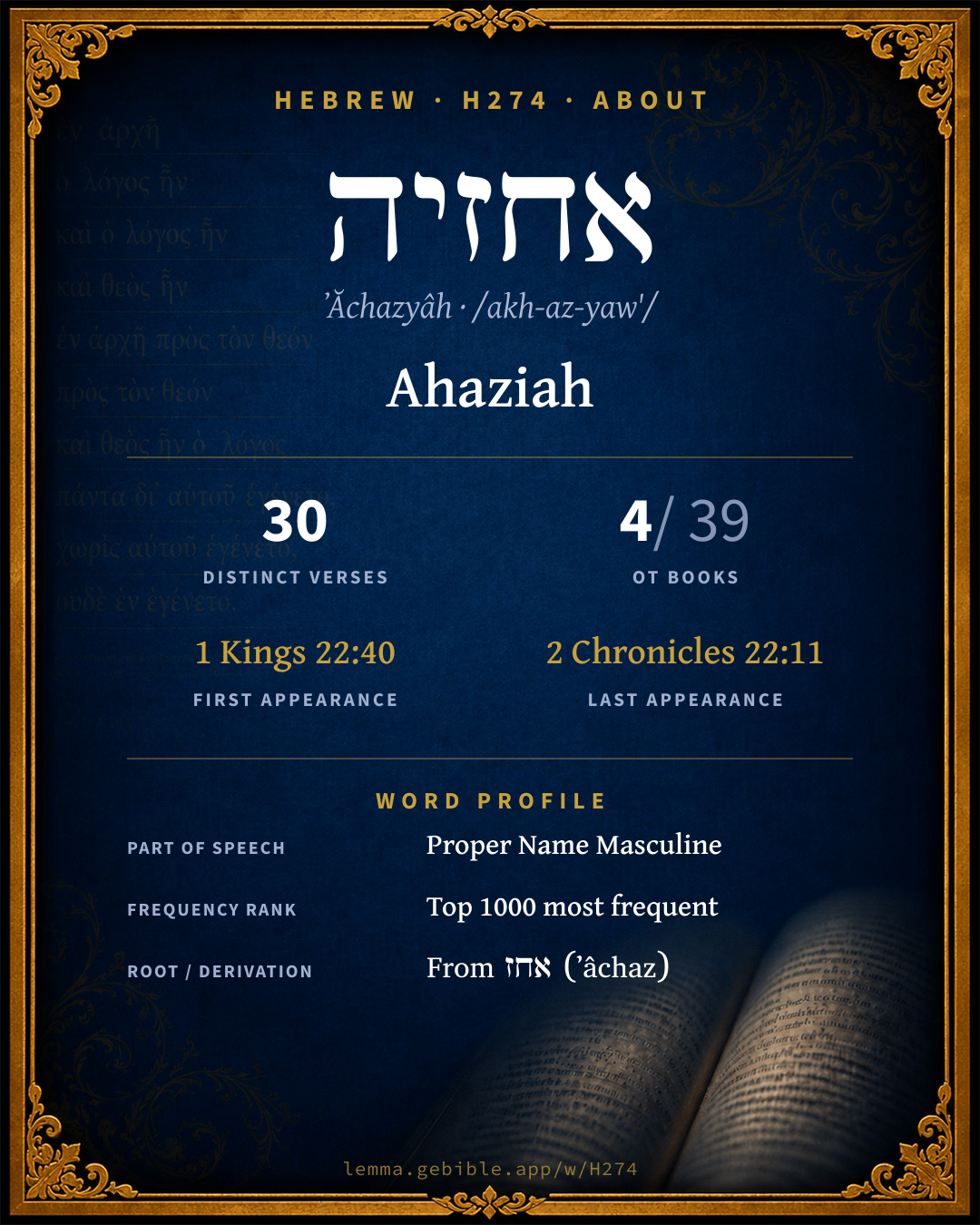
אֲחַזְיָ֫הוּ
Ahaziah
BDB lists 3 entries for ‘Ahaziah’ fuller range ↓
Full lexicon entry — Brown-Driver-Briggs (BDB)
From Brown-Driver-Briggs (BDB)
Where this word appears
Grammar key — what these labels mean
Part of speech
- Noun
- A naming word — a person, place, thing, or idea.
Noun type
- Proper
- A name of a specific person, place, or people (e.g. Abraham, Zion, Israel).
Every verse where H274 appears in the Book of 2 Kings — 17 distinct verses. Click any verse to open its interlinear word-by-word view. Verse text shown in the World English Bible for context — . Each verse’s Hebrew form is shown with its reference; the English is not keyword-highlighted, since the data carries no word-level English alignment. Use “Compare translations” on any verse to read it across multiple English versions. This concordance covers the Hebrew Bible; Septuagint (Greek Old Testament) occurrences are not indexed here.
2 Kings
- 2 Kings 1:2 אֲחַזְיָ֜ה n Proper Ahaziah fell down through the lattice in his upper chamber that was in Samaria, and was sick: and he sent messengers, and said to them, Go, inquire of Baal Zebub, the god of Ekron, whether I shall recover of this sickness.
- 2 Kings 1:18 אֲחַזְיָ֖הוּ n Proper Now the rest of the acts of Ahaziah which he did, aren't they written in the book of the chronicles of the kings of Israel?
- 2 Kings 8:24 אֲחַזְיָ֥הוּ n Proper Joram slept with his fathers, and was buried with his fathers in the city of David; and Ahaziah his son reigned in his place.
- 2 Kings 8:25 אֲחַזְיָ֥הוּ n Proper In the twelfth year of Joram the son of Ahab king of Israel did Ahaziah the son of Jehoram king of Judah begin to reign.
- 2 Kings 8:26 אֲחַזְיָ֣הוּ n Proper Twenty-two years old was Ahaziah when he began to reign; and he reigned one year in Jerusalem. His mother's name was Athaliah the daughter of Omri king of Israel.
- 2 Kings 8:29 וַ/אֲחַזְיָ֨הוּ conj + n Proper King Joram returned to be healed in Jezreel of the wounds which the Syrians had given him at Ramah, when he fought against Hazael king of Syria. Ahaziah the son of Jehoram king of Judah went down to see Joram the son of Ahab in Jezreel, because he was sick.
- 2 Kings 9:16 וַֽ/אֲחַזְיָה֙ conj + n Proper So Jehu rode in a chariot, and went to Jezreel; for Joram lay there. Ahaziah king of Judah was come down to see Joram.
- 2 Kings 9:21 וַ/אֲחַזְיָ֨הוּ conj + n Proper Joram said, Make ready. They made ready his chariot. Joram king of Israel and Ahaziah king of Judah went out, each in his chariot, and they went out to meet Jehu, and found him in the portion of Naboth the Jezreelite.
- 2 Kings 9:23 אֲחַזְיָ֖הוּ אֲחַזְיָֽה n Proper n Proper Joram turned his hands, and fled, and said to Ahaziah, There is treachery, Ahaziah.
- 2 Kings 9:27 וַ/אֲחַזְיָ֤ה conj + n Proper But when Ahaziah the king of Judah saw this, he fled by the way of the garden-house. Jehu followed after him, and said, Smite him also in the chariot: [and they struck him] at the ascent of Gur, which is by Ibleam. He fled to Megiddo, and died there.
- 2 Kings 9:29 אֲחַזְיָ֖ה n Proper In the eleventh year of Joram the son of Ahab began Ahaziah to reign over Judah.
- 2 Kings 10:13 אֲחַזְיָ֣הוּ אֲחַזְיָ֨הוּ֙ n Proper n Proper Jehu met with the brothers of Ahaziah king of Judah, and said, Who are you? They answered, We are the brothers of Ahaziah: and we go down to Greet the children of the king and the children of the queen.
- 2 Kings 11:1 אֲחַזְיָ֔הוּ n Proper Now when Athaliah the mother of Ahaziah saw that her son was dead, she arose and destroyed all the seed royal.
- 2 Kings 11:2 אֲחַזְיָ֜הוּ אֲחַזְיָ֗ה n Proper n Proper But Jehosheba, the daughter of king Joram, sister of Ahaziah, took Joash the son of Ahaziah, and stole him away from among the king's sons who were slain, even him and his nurse, [and put them] in the bedchamber; and they hid him from Athaliah, so that he was not slain;
- 2 Kings 12:18 וַ/אֲחַזְיָ֨הוּ conj + n Proper Jehoash king of Judah took all the holy things that Jehoshaphat and Jehoram and Ahaziah, his fathers, kings of Judah, had dedicated, and his own holy things, and all the gold that was found in the treasures of the house of Yahweh, and of the king's house, and sent it to Hazael king of Syria: and he went away from Jerusalem.
- 2 Kings 13:1 אֲחַזְיָ֖הוּ n Proper In the three and twentieth year of Joash the son of Ahaziah, king of Judah, Jehoahaz the son of Jehu began to reign over Israel in Samaria, [and reigned] seventeen years.
- 2 Kings 14:13 אֲחַזְיָ֗הוּ n Proper Jehoash king of Israel took Amaziah king of Judah, the son of Jehoash the son of Ahaziah, at Beth-shemesh, and came to Jerusalem, and broke down the wall of Jerusalem from the gate of Ephraim to the corner gate, four hundred cubits.
About this entry
At a glance — auto-summarized from this page’s data, not written by a person. Every figure links to its source below. This summary describes the numbers; it doesn’t interpret them.
אחזיה — transliterated ʼĂchazyâh — is a Hebrew name carrying the sense “Ahaziah.” Its uses cluster heavily in 2 Kings (57% of all occurrences). With 30 verses in 4 books, it is a moderately common word in the Hebrew Bible. It first appears in 1 Kings 22:40. See 30-verse concordance and the renderings breakdown below.
Gloss history
Strong's 1890 vs modern scholarship
About this word
Strong's H274 catalogs a Hebrew word from the Hebrew Old Testament.
These counts are not copied from any lexicon or concordance. They are computed here, from the morphology-tagged Hebrew Old Testament. What Lemma adds →
- 30
- distinct verses
- The word appears in 30 distinct verses.
- 4 / 39
- OT books
- The word appears in 4 of 39 Old Testament books.
- #967
- by frequency
- Top 1000 most frequent Hebrew words (rank 967 of 8,640 Hebrew words by occurrence).
View all 30 occurrences in the concordance →
Most concentrated in
- 2 Kings 17 verses 57%
- 2 Chronicles 9 verses 30%
- 1 Kings 3 verses 10%
By section of the Old Testament
By traditional corpus
Conventional, traditional groupings — biblical authorship is debated, so this is a traditional corpus grouping, not an authorship claim. Each share is this word’s portion of its verses in that division of the Hebrew canon. Each figure is a share of the word’s 30 distinct verses.
- Prophets (Nevi'im) 20 verses · 67%
- Writings (Ketuvim) 10 verses · 33%
How translations render this word
Counts come from each version’s own published word-to-Strong’s tagging or interlinear alignment — an approximate guide to how each version renders this word, not a word-level alignment the data otherwise carries. Because each total is that version’s own tagged count, the per-version totals vary from one another and need not match the appearance or distinct-verse counts above. These counts may also differ from a printed concordance because Lemma counts each distinctly tagged rendering and does not collapse phrase taggings into a single head-word total. This is a fixed set of word-tagged versions (KJV, ASV, BSB, ULT) and does not change with the reading translation you choose elsewhere. Each version’s license is shown beside its name below (and on Sources).
- King James Version: Ahaziah 31×, Was ahaziah 2×
- American Standard Version: Ahaziah 28×, Was ahaziah 2×
- Berean Standard Bible: Ahaziah 32×, Ahaziah’s 3×
- unfoldingWord Literal Text: Ahaziah 35×
King James Version Public Domain
Renders H274 across 37 tagged occurrences — most commonly:
Plus 4 renderings that appear only once — usually multi-word phrases or single function words the recovered tagging swept in, not distinct renderings.
American Standard Version Public Domain
Renders H274 across 35 tagged occurrences — most commonly:
Plus 5 renderings that appear only once — usually multi-word phrases or single function words the recovered tagging swept in, not distinct renderings.
Berean Standard Bible Public Domain
Renders H274 across 37 tagged occurrences — most commonly:
Plus 2 renderings that appear only once — usually multi-word phrases or single function words the recovered tagging swept in, not distinct renderings.
unfoldingWord Literal Text CC BY-SA 4.0
Renders H274 across 37 tagged occurrences — most commonly:
Plus 2 renderings that appear only once — usually multi-word phrases or single function words the recovered tagging swept in, not distinct renderings.
Senses in the full BDB
What do BDB’s symbols mean?
BDB uses these scholarly abbreviations:
| Symbol | Meaning |
|---|---|
| 𝔊 | the Septuagint (the ancient Greek translation, LXX) |
| 𝔙 | the Vulgate (the Latin translation) |
| 𝔖 | the Syriac version (the Peshitta) |
| 𝔗 | the Targum (the Aramaic translation) |
| ψ | the Psalms |
| √ | root (the underlying root or stem) |
| ‖ | parallel passage (a synonymous or contrasted parallel) |
| † | the dagger: every passage where the word occurs is cited |
The 3 senses and sub-senses the full Brown-Driver-Briggs lexicon distinguishes for this word, in lexicon order (not ranked by frequency), with BDB’s own verbatim wording and sub-sense lettering. Shown in Hebrew script with BDB’s own scholarly abbreviations. The condensed entry is in the Lexicon Entry tab. See also the Forms in the corpus table below.
- 1. king of Isr., son of Ahab 1 K 22:40, 50, 52 2 K 1:18 2 Ch 20:37 (אֲחַזְיָהוּ); + 2 K 1:2 2 Ch 20:35 (אֲחַזְיָה). e.g. 1 Kings 22:40
- 2. king of Judah, son of Joram 2 K 8:24, 25; 9:21; 10:13; 11:1; 12:19; 13:1; 14:13 1 Ch 3:11 2 Ch 22:1 + 2 K 1 Ch (all אֲחַזְיָהוּ); 2 K 9:16, 23, 27, 29; 11:2 (אֲחַזְיָה). e.g. 2 Kings 8:24
- 3. אַחְזַי a priest Ne 11:13 (for which יַחְזֵרָה 1 Ch 9:12 v. SmListen, Tafel). cf. Arabic احّ viii, + إِخّ = adopt, hence perhaps י׳ hath adopted. e.g. Nehemiah 11:13
Senses from the full Brown-Driver-Briggs lexicon (Brown, Driver, Briggs; Oxford 1906 — public domain), digitized via Sefaria, supplemented by the OpenScriptures HebrewLexicon (CC BY 4.0). Full attribution on Sources.
Word origin
n.pr.m. (Yah(u) hath grasped; 𝔊 Ὀχοζ(ε)ιας 1 K 22:52 etc., cf. LagBN 53)
— Brown-Driver-Briggs (Oxford 1906, public domain), digitized via Sefaria, supplemented by the OpenScriptures HebrewLexicon (CC BY 4.0). See Sources.
Derived from אחז (ʼâchaz) (H270) — to grasp.
Forms in the corpus
The 19 distinct written forms H274 takes in the Hebrew Bible, most frequent first — each parse links to that state’s occurrences in the concordance. Hebrew forms include their vowel points and cantillation, so a single lemma takes many written forms.
| Form | Parsing | Example | Uses |
|---|---|---|---|
| אֲחַזְיָ֥הוּ | Noun, Proper | 1 Chronicles 3:11 | 5 |
| אֲחַזְיָ֔הוּ | Noun, Proper | 2 Chronicles 22:7 | 4 |
| אֲחַזְיָ֣הוּ | Noun, Proper | 1 Kings 22:51 | 4 |
| אֲחַזְיָ֖הוּ | Noun, Proper | 2 Kings 1:18 | 3 |
| אֲחַזְיָ֗הוּ | Noun, Proper | 2 Chronicles 20:37 | 3 |
| וַ/אֲחַזְיָ֨הוּ | Noun, Proper | 2 Kings 8:29 | 3 |
| אֲחַזְיָ֛הוּ | Noun, Proper | 2 Chronicles 22:8 | 2 |
| אֲחַזְיָ֨הוּ | Noun, Proper | 2 Chronicles 22:1 | 2 |
| אֲחַזְיָ֖ה | Noun, Proper | 2 Kings 9:29 | 1 |
| אֲחַזְיָ֗ה | Noun, Proper | 2 Kings 11:2 | 1 |
| אֲחַזְיָ֜ה | Noun, Proper | 2 Kings 1:2 | 1 |
| אֲחַזְיָ֜הוּ | Noun, Proper | 2 Kings 11:2 | 1 |
| אֲחַזְיָ֣ה | Noun, Proper | 2 Chronicles 20:35 | 1 |
| אֲחַזְיָ֤הוּ | Noun, Proper | 1 Kings 22:49 | 1 |
| אֲחַזְיָ֨הוּ֙ | Noun, Proper | 2 Kings 10:13 | 1 |
| אֲחַזְיָֽה | Noun, Proper | 2 Kings 9:23 | 1 |
| וַ/אֲחַזְיָ֤ה | Noun, Proper | 2 Kings 9:27 | 1 |
| וַֽ/אֲחַזְיָה֙ | Noun, Proper | 2 Kings 9:16 | 1 |
| לַ/אֲחַזְיָ֖הוּ | Noun, Proper | 2 Chronicles 22:8 | 1 |
Same root — word family
Other BDB entries built from the same root as H274, grouped by Strong’s listed origin. These share a root / origin per the lexicon — not necessarily a shared meaning. Each links to that word’s own entry.
Derives from
Shares the same root
Proper names from this root
People and places named from this root — a name, not an additional meaning of the word.
Compare all same-root words → Showing 4 of 6 — not the complete family. 3 of the same-root words are proper names (people or places). They share a root, not necessarily a meaning.
Bible dictionary
Public-domain dictionary articles matched to this entry by name (Ahaziah). A biblical name can be shared by more than one person or place, so an article may treat several.
Easton's Bible Dictionary · M. G. Easton, 1897
Held by Jehovah. (1.) The son and successor of Ahab. He followed the counsels of his mother Jezebel, and imitated in wickedness the ways of his father. In his reign the Moabites revolted from under his authority (2 Kings 3:5-7). He united with Jehoshaphat in an attempt to revive maritime trade by the Red Sea, which proved a failure (2 Chr. 20:35-37). His messengers, sent to consult the god of Ekron regarding his recovery from the effects of a fall from the roof-gallery of his palace, were met on the way by Elijah, who sent them back to tell the king that he would never rise from his bed (1 Kings 22:51; 2 Kings 1:18).
(2.) The son of Joram, or Jehoram, and sixth king of Judah. Called Jehoahaz (2 Chr. 21:17; 25:23), and Azariah (2 Chr. 22:6). Guided by his idolatrous mother Athaliah, his reign was disastrous (2 Kings 8:24-29; 9:29). He joined his uncle Jehoram, king of Israel, in an expedition against Hazael, king of Damascus; but was wounded at the pass of Gur when attempting to escape, and had strength only to reach Megiddo, where he died (2 Kings 9:22-28). He reigned only one year.
Smith's Bible Dictionary · William Smith, 1863
(sustained by the Lord).
+ Son of Ahab and Jezebel eighth king of Israel, reigned B.C. 896-895. After the battle of Ramoth in Gilead, in which Ahab perished [Ahab], the vassal king of Moab refused his yearly tribute; comp. (Isaiah 16:1) Before Ahaziah could take measures for enforcing his claim, he was seriously injured by a fall through a lattice in his palace at Samaria. Being an idolater, he sent to inquire of the oracle of Baalzebub in the Philistine city of Ekron whether he should recover his health. But Elijah, who now for the last time exercised the prophetic office, rebuked him for this impiety, and announced to him his approaching death. The only other recorded transaction of his reign, his endeavor to join the king of Judah in trading to Ophir, is related under Jehoshaphat. (1 Kings 22:49-53; 2 Kings 1:1; 2 Chronicles 20:35-37) + Fifth king of Judah, son of Jehoram and Athaliah (daughter of Ahab), and therefore nephew of the preceding Ahaziah, reigned one year, B.C. 884. He is Galled Azariah, (2 Chronicles 22:2) probably by a copyist's error, and Jehoahaz. (2 Chronicles 21:17) He was 22 years old at his accession. (2 Kings 8:26) (his age 42, in (2 Chronicles 22:2) Isa a copyist's error). Ahaziah was an idolater, and he allied himself with his uncle Jehoram king of Israel against Hazael, the new king of Syria. the two kings were, however defeated at Ramoth, where Jehoram was severely wounded. The revolution carried out in Israel by Jehu under the guidance of Elisha broke out while Ahaziah was visiting his uncle at Jezreel. As Jehu approached the town, Jehoram and Ahaziah went out to meet him; the former was shot through the heart by Jehu, and Ahaziah was pursued and mortally wounded. He died when he reached Megiddo.
Hitchcock's Bible Names Dictionary · Roswell D. Hitchcock, 1869
seizure; vision of the Lord
Classic public-domain reference works; full attribution on Sources.
Septuagint verse parallels
This word appears in 29 verses that also exist in the Greek Old Testament (Septuagint), out of the 30 Hebrew verses it occurs in. You can read those verses in Greek by switching the Old Testament edition to the Septuagint.
Read these verses in the Septuagint
This is a verse-level parallel only — the same verses exist in both the Hebrew and Greek Old Testaments. No word-level Hebrew↔Greek correspondence is claimed: the data carries no such alignment, so no Greek word is shown as this Hebrew word’s translation. Coverage is not total — the Septuagint omits the deuterocanon and renumbers the Psalms, so some Hebrew verses have no direct Greek parallel.