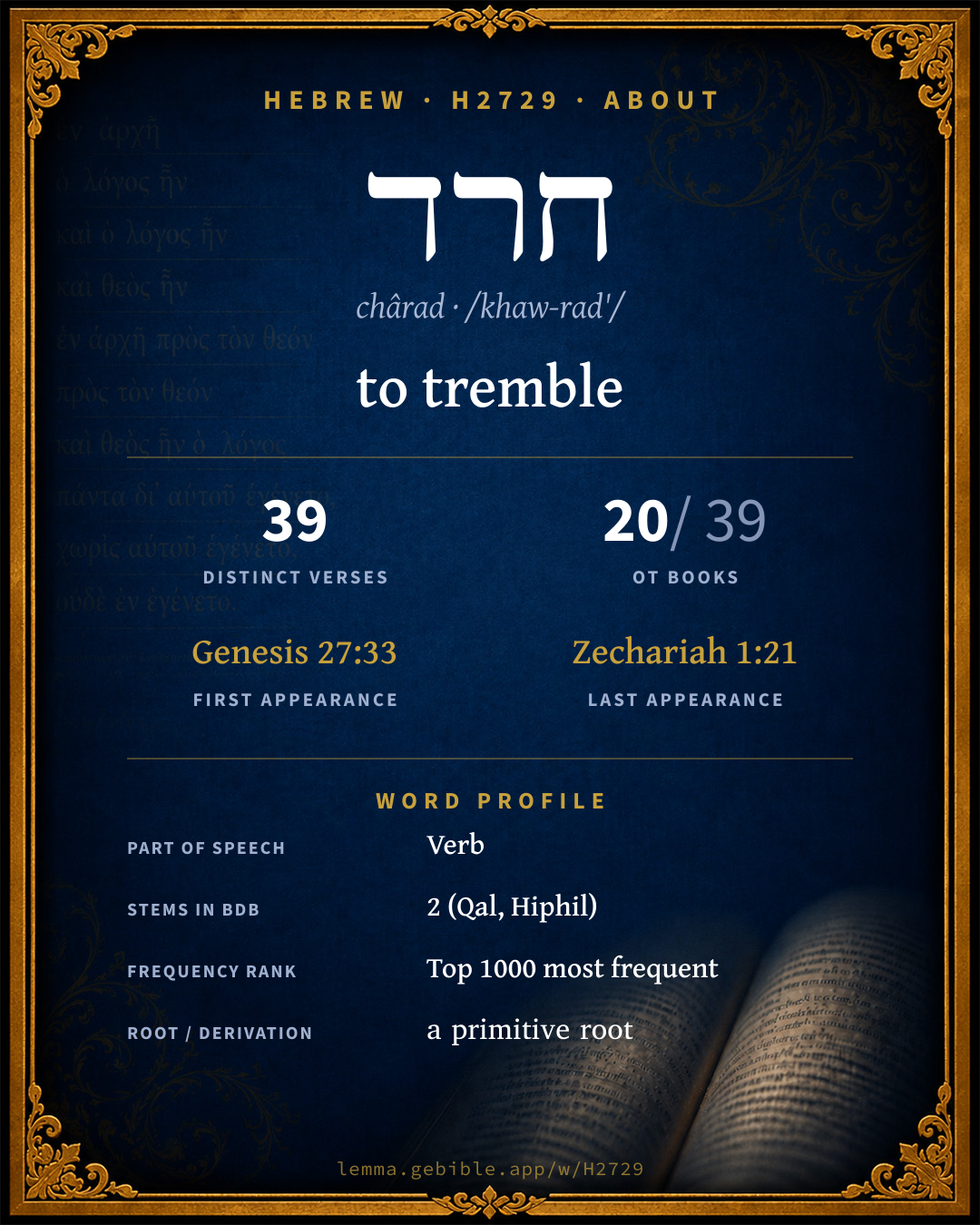
חָרַד
to tremble
also: quake, move about, be afraid, be startled fuller range ↓
Full lexicon entry — Brown-Driver-Briggs (BDB)
From Brown-Driver-Briggs (BDB)
Where this word appears
See every Qal verb in the Hebrew Bible →
Grammar key — what these labels mean
Part of speech
- Verb
- An action or state-of-being word.
Stem
- Hiphil
- The causative active stem (“he caused / brought about”).
- Qal
- The basic, simple active stem — the plain form of the verb (“he wrote”). Here: ‘tremble’
Form
- Participle Active
- A verbal adjective expressing ongoing or characteristic action (“writing / one who writes”).
- Sequential Imperfect
- An imperfect with prefixed waw — the standard past-narrative form (waw-consecutive imperfect).
- Imperfect
- An incomplete, ongoing, or future action (“he will / would write”).
- Sequential Perfect
- A perfect with prefixed waw continuing a preceding imperfect or command (waw-consecutive perfect).
- Infinitive Construct
- A bound verbal noun, frequently with prepositions (“to write / in writing”).
- Perfect
- A completed action or state — Hebrew marks aspect (completeness) more than strict tense (“he wrote”).
- Imperative
- A direct command (“write!”).
State
- Absolute
- The independent form of a noun, not bound to a following word.
Person
- 3rd Person
- The one spoken about (“he / she / it / they”).
- 1st Person
- The speaker (“I / we”).
- 2nd Person
- The one addressed (“you”).
Gender
- Masculine
- Grammatically masculine.
- Common
- Either gender — not distinguished for this form.
- Feminine
- Grammatically feminine.
Number
- Singular
- One.
- Plural
- More than one (in Hebrew, generally three or more).
Grammatical forms 14 distinct
- Verb, Hiphil, Participle Active, Masculine, Singular, Absolute 12 times (31%)
- Verb, Qal, Sequential Imperfect, 3rd Person, Masculine, Singular 6 times (15%)
- Verb, Qal, Imperfect, 3rd Person, Masculine, Plural 5 times (13%)
- Verb, Qal, Sequential Imperfect, 3rd Person, Masculine, Plural 3 times (8%)
- Verb, Qal, Sequential Perfect, 3rd Person, Common, Plural 2 times (5%)
- Verb, Hiphil, Infinitive Construct 2 times (5%)
- Verb, Qal, Perfect, 3rd Person, Common, Plural 2 times (5%)
- Verb, Hiphil, Sequential Perfect, 1st Person, Common, Singular 1 time (3%)
+6 more forms (6 occurrences)
Parsed forms decoded from the imported morphology (morphhb / Westminster Leningrad Codex — WLC text public domain, morphhb tagging CC BY 4.0), counted across 39 parsed occurrences — not distinct verses.
Every verse where H2729 appears — 39 distinct verses across 20 books. Click any verse to open its interlinear word-by-word view. Verse text shown in the World English Bible for context — . Each verse’s Hebrew form is shown with its reference; the English is not keyword-highlighted, since the data carries no word-level English alignment. Use “Compare translations” on any verse to read it across multiple English versions. This concordance covers the Hebrew Bible; Septuagint (Greek Old Testament) occurrences are not indexed here.
Genesis 2 verses
- Genesis 27:33 וַ/יֶּחֱרַ֨ד conj + Qal wimpf 3ms Isaac trembled violently, and said, "Who, then, is he who has taken venison, and brought it me, and I have eaten of all before you came, and have blessed him? Yes, he will be blessed."
- Genesis 42:28 וַ/יֶּֽחֶרְד֞וּ conj + Qal wimpf 3mp He said to his brothers, "My money is restored! Behold, it is even in my sack." Their hearts failed them, and they turned trembling one to another, saying, "What is this that God has done to us?"
Exodus 2 verses
- Exodus 19:16 וַ/יֶּחֱרַ֥ד conj + Qal wimpf 3ms It happened on the third day, when it was morning, that there were thunders and lightnings, and a thick cloud on the mountain, and the sound of an exceedingly loud trumpet; and all the people who were in the camp trembled.
- Exodus 19:18 וַ/יֶּחֱרַ֥ד conj + Qal wimpf 3ms Mount Sinai, the whole of it, smoked, because Yahweh descended on it in fire; and its smoke ascended like the smoke of a furnace, and the whole mountain quaked greatly.
Leviticus 1 verse
Deuteronomy 1 verse
Judges 1 verse
Ruth 1 verse
1 Samuel 5 verses
- 1 Samuel 13:7 חָרְד֥וּ Qal pf 3cp Now some of the Hebrews had gone over the Jordan to the land of Gad and Gilead; but as for Saul, he was yet in Gilgal, and all the people followed him trembling.
- 1 Samuel 14:15 חָרְד֖וּ Qal pf 3cp There was a trembling in the camp, in the field, and among all the people; the garrison, and the spoilers, they also trembled; and the earth quaked: so there was an exceeding great trembling.
- 1 Samuel 16:4 וַ/יֶּחֶרְד֞וּ conj + Qal wimpf 3mp Samuel did that which Yahweh spoke, and came to Bethlehem. The elders of the city came to meet him trembling, and said, Come you peaceably?
- 1 Samuel 21:1 וַ/יֶּחֱרַ֨ד conj + Qal wimpf 3ms Then came David to Nob to Ahimelech the priest: and Ahimelech came to meet David trembling, and said to him, Why are you alone, and no man with you?
- 1 Samuel 28:5 וַ/יֶּחֱרַ֥ד conj + Qal wimpf 3ms When Saul saw the host of the Philistines, he was afraid, and his heart trembled greatly.
2 Samuel 1 verse
1 Kings 1 verse
2 Kings 1 verse
Job 2 verses
Isaiah 5 verses
- Isaiah 10:29 חָֽרְדָה֙ Qal pf 3fs they are gone over the pass; they have taken up their lodging at Geba; Ramah trembles; Gibeah of Saul is fled.
- Isaiah 17:2 מַחֲרִֽיד Hiphil ptcp.act ms The cities of Aroer are forsaken; they shall be for flocks, which shall lie down, and none shall make them afraid.
- Isaiah 19:16 וְ/חָרַ֣ד conj + Qal pf 3ms In that day shall the Egyptians be like women; and they shall tremble and fear because of the shaking of the hand of Yahweh of Hosts, which he shakes over them.
- Isaiah 32:11 חִרְדוּ֙ Qal impv 2mp Tremble, you women who are at ease; be troubled, you careless ones; strip yourselves, and make yourselves naked, and gird [sackcloth] on your loins.
- Isaiah 41:5 יֶחֱרָ֑דוּ Qal impf 3mp The isles have seen, and fear; the ends of the earth tremble; they draw near, and come.
Jeremiah 3 verses
- Jeremiah 7:33 מַחֲרִֽיד Hiphil ptcp.act ms The dead bodies of this people shall be food for the birds of the sky, and for the animals of the earth; and none shall frighten them away.
- Jeremiah 30:10 מַחֲרִֽיד Hiphil ptcp.act ms Therefore don't you be afraid, O Jacob my servant, says Yahweh; neither be dismayed, Israel: for, behold, I will save you from afar, and your seed from the land of their captivity; and Jacob shall return, and shall be quiet and at ease, and none shall make him afraid.
- Jeremiah 46:27 מַחֲרִֽיד Hiphil ptcp.act ms But don't be afraid you, Jacob my servant, neither be dismayed, Israel: for, behold, I will save you from afar, and your seed from the land of their captivity; and Jacob shall return, and shall be quiet and at ease, and none shall make him afraid.
Ezekiel 6 verses
- Ezekiel 26:16 וְ/חָֽרְדוּ֙ conj + Qal wpf 3cp Then all the princes of the sea shall come down from their thrones, and lay aside their robes, and strip off their embroidered garments: they shall clothe themselves with trembling; they shall sit on the ground, and shall tremble every moment, and be astonished at you.
- Ezekiel 26:18 יֶחְרְד֣וּ Qal impf 3mp Now shall the isles tremble in the day of your fall; yes, the isles that are in the sea shall be dismayed at your departure.
- Ezekiel 30:9 לְ/הַחֲרִ֖יד prep + Hiphil inf.cs In that day shall messengers go forth from before me in ships to make the careless Ethiopians afraid; and there shall be anguish on them, as in the day of Egypt; for, behold, it comes.
- Ezekiel 32:10 וְ/חָרְד֤וּ conj + Qal wpf 3cp Yes, I will make many peoples amazed at you, and their kings shall be horribly afraid for you, when I shall brandish my sword before them; and they shall tremble at every moment, every man for his own life, in the day of your fall.
- Ezekiel 34:28 מַחֲרִֽיד Hiphil ptcp.act ms They shall no more be a prey to the nations, neither shall the animals of the earth devour them; but they shall dwell securely, and none shall make them afraid.
- Ezekiel 39:26 מַחֲרִֽיד Hiphil ptcp.act ms They shall bear their shame, and all their trespasses by which they have trespassed against me, when they shall dwell securely in their land, and none shall make them afraid;
Hosea 2 verses
- Hosea 11:10 וְ/יֶחֶרְד֥וּ conj + Qal impf 3mp They will walk after Yahweh, Who will roar like a lion; For he will roar, and the children will come trembling from the west.
- Hosea 11:11 יֶחֶרְד֤וּ Qal impf 3mp They will come trembling like a bird out of Egypt, And like a dove out of the land of Assyria; And I will settle them in their houses," says Yahweh.
Amos 1 verse
Micah 1 verse
Nahum 1 verse
Zephaniah 1 verse
Zechariah 1 verse
About this entry
At a glance — auto-summarized from this page’s data, not written by a person. Every figure links to its source below. This summary describes the numbers; it doesn’t interpret them.
At its core, חרד (chârad) means “to tremble.” It first appears in Genesis 27:33. Spanning 39 verses in 20 books, it ranks among the moderately common words of the Hebrew Bible. The verb spans 2 stems, from Qal to Hiphil. Sharing its root, it stands alongside חרד and חרדי. Each statement above links to its evidence; the full detail follows below.
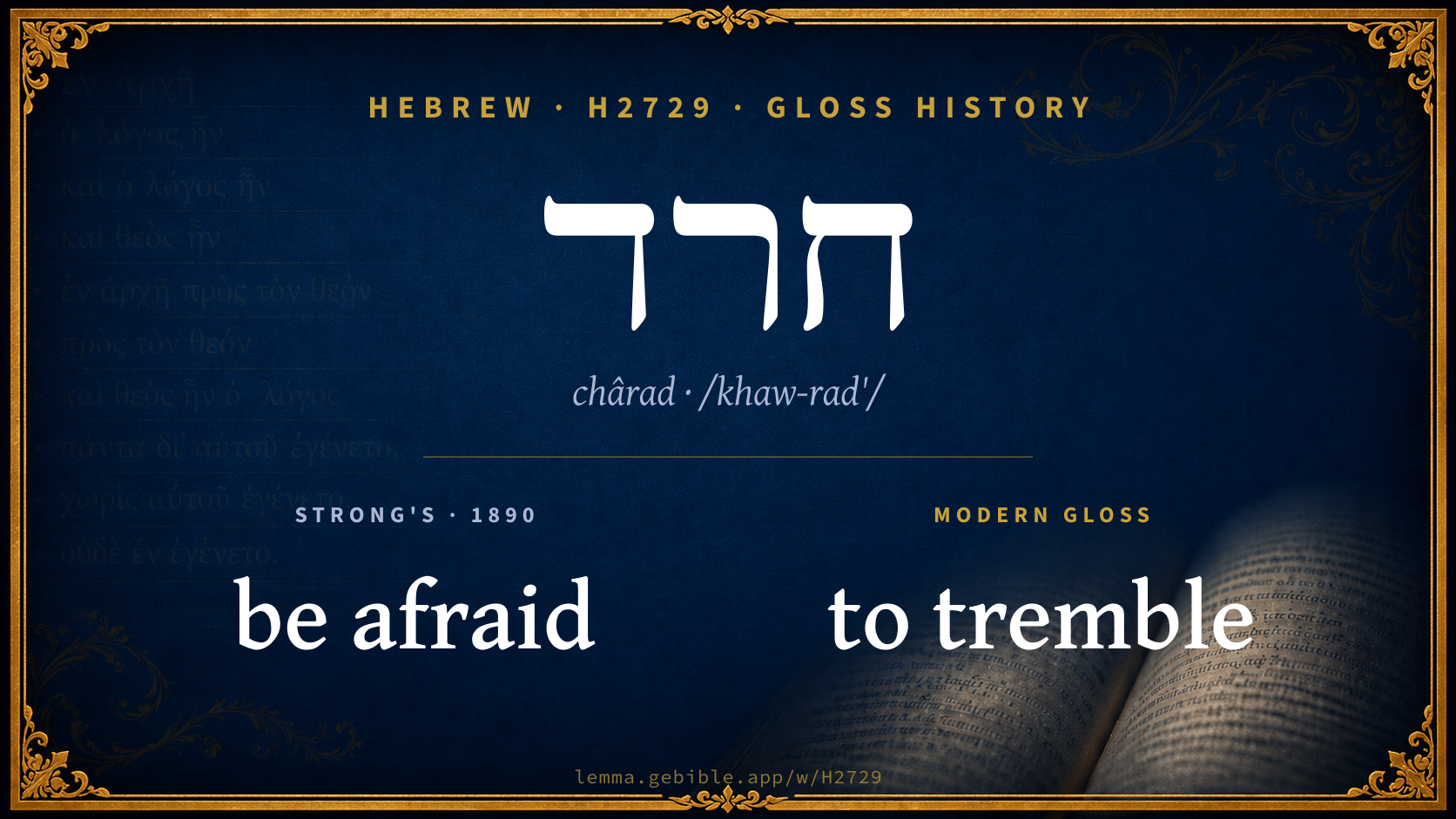
Gloss history
Strong's 1890 vs modern scholarship
About this word
Strong's H2729 catalogs a Hebrew word from the Hebrew Old Testament.
These counts are not copied from any lexicon or concordance. They are computed here, from the morphology-tagged Hebrew Old Testament. What Lemma adds →
- 39
- distinct verses
- The word appears in 39 distinct verses.
- 20 / 39
- OT books
- The word appears in 20 of 39 Old Testament books.
- #922
- by frequency
- Top 1000 most frequent Hebrew words (rank 922 of 8,640 Hebrew words by occurrence).
View all 39 occurrences in the concordance →
By section of the Old Testament
By traditional corpus
Conventional, traditional groupings — biblical authorship is debated, so this is a traditional corpus grouping, not an authorship claim. Each share is this word’s portion of its verses in that division of the Hebrew canon. Each figure is a share of the word’s 39 distinct verses.
- Prophets (Nevi'im) 30 verses · 77%
- Torah (Pentateuch) 6 verses · 15%
- Writings (Ketuvim) 3 verses · 8%
How translations render this word
Counts come from each version’s own published word-to-Strong’s tagging or interlinear alignment — an approximate guide to how each version renders this word, not a word-level alignment the data otherwise carries. Because each total is that version’s own tagged count, the per-version totals vary from one another and need not match the appearance or distinct-verse counts above. These counts may also differ from a printed concordance because Lemma counts each distinctly tagged rendering and does not collapse phrase taggings into a single head-word total. This is a fixed set of word-tagged versions (KJV, ASV, BSB, ULT) and does not change with the reading translation you choose elsewhere. Each version’s license is shown beside its name below (and on Sources).
- King James Version: None shall make them afraid 4×, Trembled 4×, None made them afraid 2×
- American Standard Version: None shall make them afraid 5×, Tremble 3×, Trembled 3×
- Berean Standard Bible: Fear 3×, Tremble 3×, Trembled 3×
- unfoldingWord Literal Text: Trembled 9×, Tremble 7×, And 6×
King James Version Public Domain
Renders H2729 across 39 tagged occurrences — most commonly:
Plus 17 renderings that appear only once — usually multi-word phrases or single function words the recovered tagging swept in, not distinct renderings.
American Standard Version Public Domain
Renders H2729 across 39 tagged occurrences — most commonly:
Plus 20 renderings that appear only once — usually multi-word phrases or single function words the recovered tagging swept in, not distinct renderings.
Berean Standard Bible Public Domain
Renders H2729 across 39 tagged occurrences — most commonly:
Plus 26 renderings that appear only once — usually multi-word phrases or single function words the recovered tagging swept in, not distinct renderings.
unfoldingWord Literal Text CC BY-SA 4.0
Renders H2729 across 57 tagged occurrences — most commonly:
Plus 24 renderings that appear only once — usually multi-word phrases or single function words the recovered tagging swept in, not distinct renderings.
Senses in the full BDB
Hebrew verbs can shift meaning by stem (binyan): Qal is the basic action, Niphal is often passive or reflexive, Piel often intensifies or makes it factitive, and Hiphil is typically causative. The senses below are grouped under the stem BDB assigns to each.
What do BDB’s symbols mean?
BDB uses these scholarly abbreviations:
| Symbol | Meaning |
|---|---|
| 𝔊 | the Septuagint (the ancient Greek translation, LXX) |
| 𝔙 | the Vulgate (the Latin translation) |
| 𝔖 | the Syriac version (the Peshitta) |
| 𝔗 | the Targum (the Aramaic translation) |
| ψ | the Psalms |
| √ | root (the underlying root or stem) |
| ‖ | parallel passage (a synonymous or contrasted parallel) |
| † | the dagger: every passage where the word occurs is cited |
The 6 senses and sub-senses the full Brown-Driver-Briggs lexicon distinguishes for this word, in lexicon order (not ranked by frequency), with BDB’s own verbatim wording and sub-sense lettering. Shown in Hebrew script with BDB’s own scholarly abbreviations. The condensed entry is in the Lexicon Entry tab. See also the Forms in the corpus table below.
Qal
- Pf. וְחָרַד consec. Is 19:16, חָֽרְדָה Is 10:29, חָרַדְתְּ 2 K 4:13, חָרְדוּ 1 S 13:7; 14:15, וְחָֽרְדוּ consec. Ez 26:16; 32:10; Impf. יֶחֱרַד Jb 37:1, וַיֶּחֱרַד Gn 27:33 + 5 times; יֶחְרְדוּ Ho 11:10 Ez 26:18, יֶֽחֶרְדוּ Ho 11:11, יֶחֱרָ֑דוּ Am 3:6 Is 41:6, וַיֶּֽחֶרְדוּ Gn 42:28 + 2 times; Imv. חִרְדוּ Is 32:11;— e.g. Isaiah 19:16
- 1. tremble, quake, of a mountain Ex 19:18—so ℌ, but read הָעָם, 𝔊 v. Di (E); of isles Ez 26:18 (metaph., in fear); so Is 41:5 (קְצוֹת הארץ, ‖ אִיִּים יראו). e.g. Exodus 19:18
- 2. tremble, of persons under supernat. infl. 1 S 14:15 (‖ חֲרָדָה, וַתִּרְגַּז הָאָרָץ); start, start up (out of sleep) Ru 3:8; in mental disturbance Gn 27:33 (J; c. acc. cogn.) tremble, in terror Ex 19:16 (E), Is 32:11 (‖ רגז), be startled (at sound of trumpet) Am 3:6 cf. 1 K 1:49 (+ קום, הלך, ירא); tremble Ez 26:16; 32:10 sq. לְ = at, Jb 37:1 (לִבִּי), be terrified, of Egypt (personif.) Is 19:16 (‖ פָּחַד), Ramah 10:29, of Saul 1 S 28:5 subj. לִבּוֹ, ‖ ירא). e.g. 1 Samuel 14:15
- 3. be anxiously careful חָרַדְתְּ אֵלֵנוּ את־כל הַחֲרָדָה הַזּאֹת 2 K 4:13. e.g. 2 Kings 4:13
- 4. with preps. pregn. = go or come trembling 1 S 13:7 (sq. מֵאחריו 𝔊L We Dr) Gn 42:28 (E; sq. אֶל־) 1 S 16:4 (sq. לִקְרָאתוֹ) so 21:2, Ho 11:10 (מִיָּם) v 11 (מִמִּצְרַיִם). e.g. 1 Samuel 13:7
Hiphil
- Pf. הֶחֱרִיד Ju 8:12, וְהַחֲרַדְתִּ֫י 2 S 17:2; Pt. מַחֲרִיד Lv 26:6 + 11 times; Inf. cstr. הַחֲרִיד Ez 30:9 Zc 2:4;—drive in terror, rout an army, sq. acc. Ju 8:12 Ez 30:9 Zc 2:4 cf. 2 S 17:2; (We proposes החרידו Ho 5:8 ‘setzt Benj. in Schrecken,’ for MT אַחֲרֶיךָ); in Pt. abs., only in וְאֵין מ׳; and none shall terrify, i.e. disturb the peace of those reposing—שׁכב, שׁקט, רבץ, ישׁב, ישׁב לָבֶטַח—in the promised land Lv 26:6, so after captivity Je 30:10 = 46:27, also Ez 34:28; 39:26 Mi 4:4 Zp 3:13; of undisturbed peace of the righteous Jb 11:19; peace of flocks in forsaken cities Is 17:2; undisturbed feeding on carrion by fowl and beast Dt 28:26 Je 7:33, undisturbed prowling of lions Na 2:12 metaph. of Assyrians). e.g. Judges 8:12
Senses from the full Brown-Driver-Briggs lexicon (Brown, Driver, Briggs; Oxford 1906 — public domain), digitized via Sefaria, supplemented by the OpenScriptures HebrewLexicon (CC BY 4.0). Full attribution on Sources.
Word origin
vb. tremble, be terrified (Assyrian ḫarâdu, id., according to DlHA 20, Pr 46; Arabic خَرِدَ be bashful, shamefaced; NH חֲרָדָה a trembling)—
— Brown-Driver-Briggs (Oxford 1906, public domain), digitized via Sefaria, supplemented by the OpenScriptures HebrewLexicon (CC BY 4.0). See Sources.
Origin: a primitive root
Jastrow Dictionary
A second Hebrew/Aramaic lexicon for comparison, covering Aramaic and post-biblical (Talmudic, Targumic, Midrashic) usage that the biblical-Hebrew BDB does not. Matched by lemma rather than by Strong’s number, so a lemma may carry more than one Jastrow headword (shown separately below), and the entries cover usage well beyond the Bible.
חָרֵד
- (b. h.) to be excited, to tremble. Gen. R. s. 67 (ref. to מאד, Gen. XXVII, 33) מחרדה שח׳ וכ׳ more than the trembling which he felt on the altar; (Yalk. ib. 115 שהֶחֱרִיד). Tanḥ. Tol’d 13 שתי חרדות ח׳ וכ׳ twice did Isaac tremble. Gen. R. l. c. חָרֵיד is he frightened?; Yalk. l. c. חָרֵד; a. e. e.g. Genesis 27:33
- 1. same, v. supra.—2)
- to frighten. Gen. R. l. c. חרדה שה׳ יעקב וכ׳ the fright which Jacob caused to Isaac; Tanḥ. l. c.; Ruth R. to III, 8. Ib. חרדה שהֶחֱרִידָה וכ׳ the alarm which Ruth caused &c. Ib. שהן מַחְרִידוֹת וכ׳ they (the fowl) excite the man (who tries to catch them); a. e.
A Dictionary of the Targumim, the Talmud Babli and Yerushalmi, and the Midrashic Literature (Marcus Jastrow; London, Luzac, 1903) — Public Domain. Digitized via Sefaria. Digitized via Sefaria. Full attribution on Sources.
Forms in the corpus
The 24 distinct written forms H2729 takes in the Hebrew Bible, most frequent first — each parse links to that stem’s occurrences in the concordance. Hebrew forms include their vowel points and cantillation, so a single lemma takes many written forms.
Same root — word family
Other BDB entries built from the same root as H2729, grouped by Strong’s listed origin. These share a root / origin per the lexicon — not necessarily a shared meaning. Each links to that word’s own entry.
Derived from this word
Proper names from this root
People and places named from this root — a name, not an additional meaning of the word.
Compare all same-root words → 1 of the same-root words is a proper name (a person or place). They share a root, not necessarily a meaning.
Septuagint verse parallels
This word appears in 37 verses that also exist in the Greek Old Testament (Septuagint), out of the 39 Hebrew verses it occurs in. You can read those verses in Greek by switching the Old Testament edition to the Septuagint.
Read these verses in the Septuagint
- Genesis 27:33
- Exodus 19:16
- Leviticus 26:6
- Deuteronomy 28:26
- Judges 8:12
- Ruth 3:8
- 1 Samuel 13:7
- 2 Samuel 17:2
- 1 Kings 1:49
- 2 Kings 4:13
- Job 11:19
- Isaiah 10:29
This is a verse-level parallel only — the same verses exist in both the Hebrew and Greek Old Testaments. No word-level Hebrew↔Greek correspondence is claimed: the data carries no such alignment, so no Greek word is shown as this Hebrew word’s translation. Coverage is not total — the Septuagint omits the deuterocanon and renumbers the Psalms, so some Hebrew verses have no direct Greek parallel.